A place where economics, financial markets, and real estate intersect.
Showing posts with label janet yellen. Show all posts

Monday, January 29, 2018

Morning Report: Fed and Jobs report highlights of the week

Vital Statistics:

Last Change
S&P Futures  2867.8 -6.8
Eurostoxx Index 400.4 -0.2
Oil (WTI) 54.7 -0.4
US dollar index 83.4 0.3
10 Year Govt Bond Yield 2.71%
Current Coupon Fannie Mae TBA 103.591
Current Coupon Ginnie Mae TBA 103.688
30 Year Fixed Rate Mortgage 4.19
Stocks are lower this morning on no real news. Bonds and MBS are down.

This should be a big week for the bond market, with the FOMC meeting in the middle of the week and the jobs report on Friday. No move is expected at the FOMC meeting, but people will focus on the language of the statement. Since this is Janet Yellen's last meeting most of the attention will probably be on her and not the statement.

Aside from the Fed meeting this week, Treasury will announce 10 and 30 year bond issues, and the expectation is that it will be the first increase since 2009. With Treasury selling more paper, while the Fed cuts its purchases, it could be a rough week for bonds. 

Personal Incomes and Personal Spending rose 0.4% in December. The PCE price index was up .1% MOM / 1.7% YOY and the core PCE price index was up .2% MOM and 1.5% YOY. This puts the core PCE index at an increase of 1.5% for the year, and marks the 6th year in a row inflation has undershot the Fed's target. The savings rate is the lowest since 2005.

Freddie Mac's total loan portfolio increased 9% on an annualized basis in December. Their DQ rate slipped from 1.08% to .97%. 

Home prices rose annually for the 67th consecutive month to $283,000 according to the Black Knight Financial Services Home Price Index. The MOM gain was .27%. As of November, home prices were up 6.5% for the year. 

Monday, October 16, 2017

Morning Report: Janet Yellen is constructive on the economy

Vital Statistics:

Last Change
S&P Futures  2554.8 2.0
Eurostoxx Index 391.7 0.3
Oil (WTI) 52.3 0.8
US dollar index 86.4 0.1
10 Year Govt Bond Yield 2.29%
Current Coupon Fannie Mae TBA 102.875
Current Coupon Ginnie Mae TBA 103.938
30 Year Fixed Rate Mortgage 3.86

Stocks are higher this morning on no real news. Bonds and MBS are down small. 

Janet Yellen discussed the strong economy on Sunday, and again hinted that we will see another rate hike in December. The hurricanes will probably depress growth slightly, but the economy should rebound by year's end. The consumer is still pretty strong, according to Friday's retail sales report. Persistently slow inflation has been a surprise, however.

Manufacturing was strong in the NY area according to the Empire State Manufacturing Survey. The index came in at 30, which is the highest reading in 3 years. An increase in shipments and hiring drove the increase, which is one data point that shows the increase in sentiment indicators is actually translating into more business. 

Boston Fed President Eric Rosengren thinks we might see 3-4 rate hikes in 2018. This assumes that employment continues to rise and inflation begins to pick up. Friday's consumer price index report was weak, however with core inflation rising 0.1% MOM and 1.7% YOY, below the Fed's 2% inflation target. 

This week is the 30 year anniversary of the Crash of 87, and given the run up in the market, people are looking for another one. A lot will depend on earnings season, which is just starting. Given that the market is now dominated by high frequency traders that basically turn off their machines once volatility spikes you could see selling into a vacuum. Cheap commissions and sub-penny bid/ask spreads have pretty much eliminated the market-makers and the NYSE specialist from the game.

Average home sizes are falling in the US after rising for pretty much 3 decades. The average square footage decreased to 2420 square feet from the record of 2520 set in 2015. The Baby Boomer McMansion trend has run its course and builders are beginning to focus on starter homes in order to attract the Millennials. 


Wednesday, September 27, 2017

Morning Report: Tax reform to be unveiled today

Vital Statistics:

Last Change
S&P Futures  2500.8 5.3
Eurostoxx Index 385.4 1.4
Oil (WTI) 51.9 0.0
US dollar index 86.5 0.4
10 Year Govt Bond Yield 2.29%
Current Coupon Fannie Mae TBA 103.24
Current Coupon Ginnie Mae TBA 104.21
30 Year Fixed Rate Mortgage 3.87

Stocks are up this morning as Washington pivots to tax reform. Bonds and MBS are down. 

Janet Yellen spoke yesterday and said that it would be "imprudent" to wait until inflation hits 2% to start hiking rates. Those comments were taken as support for a December hike and the Fed Funds futures took up the odds of a rate hike in December to 81%.  

Bonds were also under pressure due to the possibility of some sort of tax deal. Here is a preview of the tax plan. Trump plans on releasing the details today. Apparently the big pieces involve cutting the corporate tax rate falls to 20%, while the top individual income tax bracket falls to 35%. There is an option for Congress to institute a higher bracket. Deductions will be limited while the standard deduction increases. The most contentious deduction will be the state and local tax deduction, which will hit taxpayers in high tax states like NY and CT the most. CT is already reeling from an exodus of high income earners and businesses, and this will only exacerbate that. This won't be good for real estate prices there. While this is largely going to hit blue states, there are enough Republican House members in blue states to deep-six it unless Trump can get some Democrats on board. No word on eliminating or lowering the cap on the mortgage interest deduction. 

Pending Home Sales fell by 2.6% in August, according to NAR. 

Mortgage applications fell half a percent last week as purchases rose 3% and refis fell 4%. The hurricanes did depress activity in Florida and Texas, however increasing rates and a lack of home inventory were the biggest drivers. 

Durable goods orders rose 1.7% in August, which beat consensus estimates. Ex-aircraft, they were up 0.2%. Capital Goods orders rose 0.9%, which is an indication that business expects to see further activity and is increasing their capacity. The bump in capital goods orders is being driven by the rebound in oil prices and drilling activity in the energy sector. Capacity Utilization rates are still low compared to historical standards.


The bond market has been in a tight range for this entire year. In fact, the 62 basis point range has been the tightest in over 50 years. Historically, that range has been closer to 175 basis points. The article is somewhat misleading, as the range is going to fall naturally when rates fall from 10% to 2%. Using volatility measured in sigma is better. That said, it isn't just the US bond market: volatility in general is down. The VIX (the volatility measure for the stock market) has been in the single digits. Historically that has been a warning sign (When VIX is high, time to buy. When VIX is low, time to go). 

Tuesday, September 26, 2017

Morning Report: Janet Yellen speaks at 11:50 today

Vital Statistics:

Last Change
S&P Futures  2495.8 -1.3
Eurostoxx Index 384.1 0.2
Oil (WTI) 51.9 -0.4
US dollar index 86.1 0.3
10 Year Govt Bond Yield 2.22%
Current Coupon Fannie Mae TBA 103.24
Current Coupon Ginnie Mae TBA 104.21
30 Year Fixed Rate Mortgage 3.85

Stocks are lower this morning as we await a Janet Yellen speech at lunchtime. Bonds and MBS are flat. 

Janet Yellen will address inflation, uncertainty, and monetary policy at the National Association of Business Economics today. Charles Evans, Lael Brainard, and Loretta Mester also speak this morning. There probably won't be any market-moving comments, but just be aware. 

Charles Evans said he won't support further rate hikes until we see clearer signs of inflation. This puts him in the camp of Neel Kashkari, who also doesn't see the need to tap on the brakes. The dot plot from the last meeting showed 11 out of 16 members forecasting a rate hike in December. The Fed Funds futures are pricing in a 3/4% chance of a rate hike. This is the highest we have seen in this contract. Note the futures are predicting nothing happens in the November meeting. 

Case-Shiller is out this morning, and home prices are up 5.9% YOY. The Pacific Northwest continues to outperform, with Seattle up 13.5% and Portland up 7.6%. Separately, home prices rose 0.5% MOM and are up 6.2% YOY, according to the Black Knight Financial Services Home Price Index. We are starting to see the areas around DC cool down, while New York (especially upstate) is beginning to pick up. 

New Home Sales fell to 560k in August, according to the Census Bureau. This is a drop of 3.4% MOM and 1.2% YOY. Tight inventory remains the biggest problem. The median sales price of a new home was $300,200, and inventory was about 284k or 6.1 month's worth. The Street was looking for 583k. 

Consumer confidence slipped in September, according to the Conference Board. The index came in at 119.8, a touch below expectations. Expectations concerning employment and income contributed to the strong showing. 

Monday, August 28, 2017

Morning Report: New 30 year mortgage proposal

Vital Statistics:

Last Change
S&P Futures  2445.8 3.3
Eurostoxx Index 373.4 -0.7
Oil (WTI) 47.5 -0.4
US dollar index 85.6 -0.1
10 Year Govt Bond Yield 2.17%
Current Coupon Fannie Mae TBA 103.33
Current Coupon Ginnie Mae TBA 104.21
30 Year Fixed Rate Mortgage 3.84

Stocks are up this morning after Harvey pounded Houston. Bonds and MBS are up.

About 10% of US gasoline refining capacity is offline due to Harvey. We could see higher gasoline and heating oil prices as a result. 

We have a big week of economic data with GDP, personal spending and incomes, PCE inflation, and the jobs report. The December Fed Funds Futures are pricing in a 61% chance of no change in the Fed Funds rate at the December meeting. 

Janet Yellen and Mario Draghi defended the post-crisis regulatory framework and suggested only "modest" changes to it. Janet Yellen's term expires early next year, and many are wondering who Trump will nominate to replace her (or whether she will be re-nominated). Gary Cohn is the name most mentioned as a replacement. With regards to Dodd-Frank, most of the regulatory changes will probably concern the regulatory burden for smaller community banks and finding a way to give them some relief. A change in the structure of the CFPB would also be a possibility. 

Speaking of the CFPB, there is talk that Director Cordray will be resigning soon in order to run for Governor of Ohio. 

The Fed lays out a proposal for a new type of 30 year fixed rate mortgage - the COFI (cost of funds index) mortgage. It is a 30 year fixed rate mortgage, however it has restrictions on refinancing and equity extraction. Essentially, it is an ARM from the banks' standpoint, and a 30 year fixed from the borrower's standpoint. The payment never changes, however the amount of the payment that goes to principal and interest varies with interest rates. When rates fall, the interest component of the fixed mortgage payment falls as well, and that extra payment is applied to the principal, which creates a reservoir of home equity. When rates rise, the interest component increases, and the home equity component falls. If the reservoir is empty (i.e. no home equity to draw upon), the bank covers it. Essentially the idea would be to replace something that is difficult to hedge (prepayment risk) with something easy to hedge (basically option-like interest rate risk). The added equity build will also limit risk to the government, which still guarantees the credit risk.  Interesting idea, however the industry will probably not like it, as it reduces refinancing opportunities. I suspect these bonds will also be difficult to securitize as well. 

Friday, August 25, 2017

Morning Report: Markets prepare for Janet Yellen

Vital Statistics:

Last Change
S&P Futures  2447.5 6.8
Eurostoxx Index 375.7 1.2
Oil (WTI) 47.7 0.3
US dollar index 86.1 -0.1
10 Year Govt Bond Yield 2.20%
Current Coupon Fannie Mae TBA 103.09
Current Coupon Ginnie Mae TBA 103.97
30 Year Fixed Rate Mortgage 3.89

Stocks are up this morning as we await Janet Yellen and Mario Draghi speeches in Jackson Hole. Bonds and MBS are flat. 

Janet Yellen will be speaking at 10:00 am EST at Jackson Hole. The markets aren't expecting much in the way of new policy guidance, however given the general illiquidity of the markets, and the fact that it is a Friday during summer, anything that spooks the herd could have outsized effects. 

Durable goods orders slipped 6.8% in July largely due to a drop in aircraft orders. Ex-transportation they were up 0.5% MOM and 5.6% YOY. Capital Goods orders rose 0.4% and are up 3.5% YOY. Capital Goods orders are a good proxy for business capital expenditures, and indicates manufacturing confidence in the future. 

Credit scoring is something we take for granted, however there is competition to the standard Fair Issac model (FICO). VantageScore (created by Fair Issac competitors Transunion, Equifax and Experian) is attempting to become an alternate scoring methodology for Fannie / Fred and FHFA loans. FHFA is worried that allowing new credit scoring methods would create a race to the bottom, where the agencies end up using the one that shines the most favorable light on borrowers. Some feel the FICO methodology, which doesn't distinguish between types of debt, is outdated. Vantagescore uses things like utility and rent payment history, which is useful for people who don't borrow much in the first place and don't have a FICO score. 

The post-election sell-off in bonds is unwinding, and mortgage rates have hit the lows of 2017, matching levels seen just after the election, according to Freddie Mac. The 30 year fixed rate mortgage averaged 3.86% for the week ending August 24, which is the lowest level since November 10, 2016. 

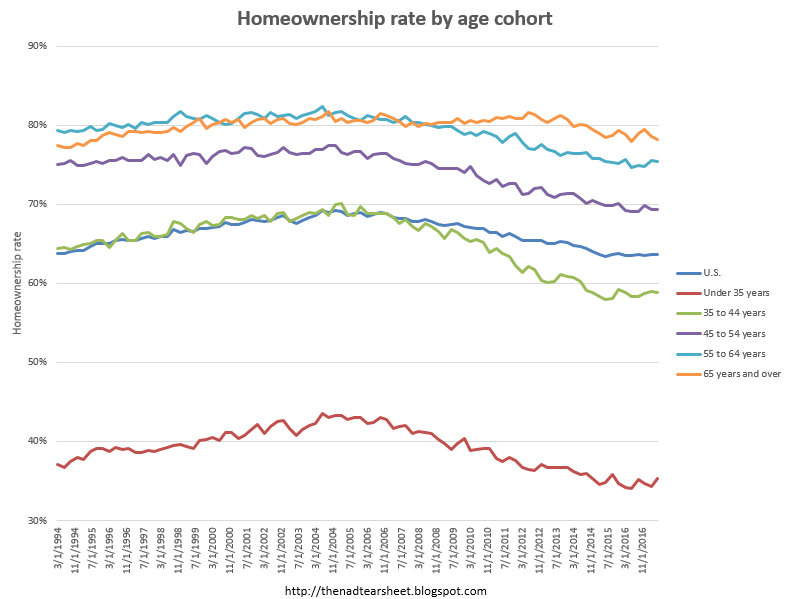
The homeownership rate may have bottomed, and perhaps we are seeing a turnaround for the younger buyers. Below is a chart of the homeownership rate by age cohort, going back to 1994. The youngest age brackets definitely have the most volatility, and they are the most affected by the dearth of starter homes for sale. 


Thursday, August 24, 2017

Morning Report: Existing Home Sales fall

Vital Statistics:

Last Change
S&P Futures  2447.0 5.5
Eurostoxx Index 375.8 1.8
Oil (WTI) 47.7 0.3
US dollar index 86.1 0.1
10 Year Govt Bond Yield 2.19%
Current Coupon Fannie Mae TBA 103.09
Current Coupon Ginnie Mae TBA 103.97
30 Year Fixed Rate Mortgage 3.89

Stocks are higher this morning on no real news. Bonds and MBS are flat.

Today starts the Fed conference in Jackson Hole. No major speeches are planned for today, however Janet Yellen speaks tomorrow. There is the possibility of some volatility around then. The big question will be whether Yellen is nominated for another term or will she be replaced when her term expires next year. National Economic Council Chairman Gary Cohn is the name most mentioned as a replacement. Donald Trump criticized the Fed's low interest rate policy while on the campaign trail, but it will be interesting to see if he nominates a hawk. Most politicians prefer doves when push comes to shove. 

Initial Jobless Claims fell to 234k last week. The labor market remains strong as companies hang on to their workers. 

Existing home sales fell 1.3% in July, according to NAR. This is up 2.1% YOY, but is the lowest number of 2017. Lawrence Yun, NAR chief economist, says the second half of the year got off on a somewhat sour note as existing sales in July inched backward. “Buyer interest in most of the country has held up strongly this summer and homes are selling fast, but the negative effect of not enough inventory to choose from and its pressure on overall affordability put the brakes on what should’ve been a higher sales pace,” he said. “Contract activity has mostly trended downward since February and ultimately put a large dent on closings last month.” The median house price was $258,300 which is up 6.2% YOY. Unsold inventory is down to 4.2 month's worth, from 4.8 months a year ago. 

What are the most active real estate markets right now? Colorado Springs, Chicago, and Reno. Least active? San Francisco, where the average house price is now over a million. Much of the Northeast is cold as well. What makes a market active? Access to both good jobs and affordable homes. 

Big money managers are swapping corporate debt for mortgage backed securities, particularly subprime MBS from before the crisis. Corporate debt simply got too expensive, and MBS got too cheap. The supply of subprime MBS has been shrinking however as loans get paid off, and non-agency MBS outstanding are about 25% of what they used to be. For fixed income managers, MBS have outperformed most everything this year. The appetite for MBS paper is encouraging, as it would open up the origination business to more outside-the-box product and allow credit to be extended to borrowers who have been more or less shut out of the market post-crisis. 

A reduction in the mortgage interest deduction is on the table as part of tax reform. The talk is that the cap would drop from $1 million to $600k or so. Toll Brothers CEO Doug Yearley said reducing the MID would be bad policy and would discourage homeownership. Of course Toll is in the McMansion business, so he is talking his book a little. Bob Shiller thinks the effect would be de minimus as it would only affect something like 4% of taxpayers. 


Wednesday, July 12, 2017

Morning Report: Janet Yellen's dovish comments spark a rally

Vital Statistics:

Last Change
S&P Futures  2435.3 11.0
Eurostoxx Index 382.2 3.0
Oil (WTI) 45.7 0.7
US dollar index 88.1 -0.1
10 Year Govt Bond Yield 2.31%
Current Coupon Fannie Mae TBA 103.31
Current Coupon Ginnie Mae TBA 104.375
30 Year Fixed Rate Mortgage 4.03

Stocks and bonds are sporting their rally caps on Janet Yellen's prepared testimony in front of Congress. 

The big event of the day will be Janet Yellen's semiannual testimony in front of the House Financial Services Committee. Expect the focus to be on the tightness of the labor market and why we have yet to see any real wage inflation. Both sides will also try and get her to agree with their viewpoints on banking regulation. Here are her prepared remarks. 

The statement that jumped out to me was this: "That expectation is based on our view that the federal funds rate remains somewhat below its neutral level--that is, the level of the federal funds rate that is neither expansionary nor contractionary and keeps the economy operating on an even keel. Because the neutral rate is currently quite low by historical standards, the federal funds rate would not have to rise all that much further to get to a neutral policy stance." That is a dovish statement, and bonds took off, especially the long end of the yield curve. This sentiment was echoed by Lael Brainard as well.

The Fed Funds futures reacted to the remarks by assigning a 91% probability of no move in September and assigning a 53% chance of no move in Decsember. These are about 9-10 basis points higher than they were last week.

Minneapolis Fed President Neel Kashkari is skeptical that the economy is close to overheating, and he believes that wage growth will happen once labor is scarce. The fact that wages aren't really increasing leads him to believe there is still plenty of slack in the labor market, despite some shortages in certain skills.

Donald Trump Jr. met with a Russian lawyer last year who supposedly had dirt on Hillary Clinton. Turns out the info mainly concerned the Ziffs and was tangentially related to the Clinton Foundation. Interpretation of the gravity of this is predictably falling along partisan lines. PIMCO is warning that this could affect markets since it makes bipartisan consensus less likely in DC, but that ship has sailed. Note stocks went out on their highs yesterday, which indicates the stock market assigns zero import to the latest "bombshell."

Mortgage Applications fell 7.4% last week as purchases fell 3% and refis fell 13%. The index does include an adjustment for the 4th of July holiday, however many people took off on the Monday prior. Interest rates did rise on the back of a European bond sell-off, which hurt production. 

RBS reached a settlement with the FHFA for $5.5 billion related to toxic MBS securities from the go-go days. 

Tuesday, February 28, 2017

Morning Report: Futures now anticipate a 50% chance of a March hike

Vital Statistics:

Last Change
S&P Futures  2365.8 -2.5
Eurostoxx Index 369.7 0.2
Oil (WTI) 53.7 -0.4
US dollar index 90.9
10 Year Govt Bond Yield 2.36%
Current Coupon Fannie Mae TBA 102.59
Current Coupon Ginnie Mae TBA 104.063
30 Year Fixed Rate Mortgage 4.09

Stocks are flattish on no real news. Bonds and MBS are down small. 

There were no changes to the headline estimate for fourth quarter GDP in the second revision. It came in at 1.9%, while the price index was revised down to 1.9% from 2.2%. 


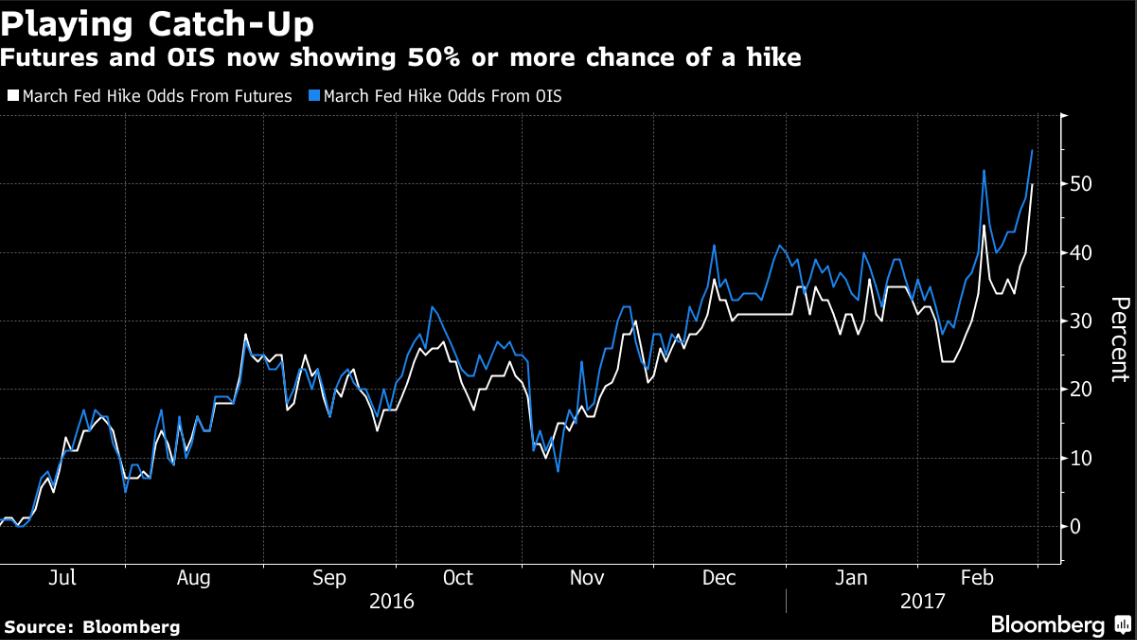
Despite the subdued growth and inflation, the Fed Funds futures are bumping up their probability of a March hike to about 50% now. There is the perception that Yellen's Fed is worried most about surprising the markets, so in some ways, this becomes a self-fulfilling prophecy. The more the Fed Funds futures price in a hike, the more likely the Fed is to vote for one. 


Home prices rose 5.8% in December, according to the Case-Shiller Home Price index. This is the fastest pace of acceleration in the past 2.5 years. Interestingly, we are starting to see correlations between the top tier and bottom tiers break down as the luxury market slows while the demand for starter homes increases. Much of that is inventory-driven, where starter homes are snapped up within a month of listing, while McMansions languish. Certainly in the Western MSAs, Chinese demand is a big factor, and that has been slowed by capital controls.

Housing demand increased 6.5% in January, according to Redfin. “Soaring stock markets, still low mortgage rates and a steady economy bolstered homebuyers at the start of 2017,” said Redfin chief economist Nela Richardson. “Homebuyers were not just window shopping, they were serious about making offers and getting to the closing table. However, this uptick in homebuyer enthusiasm won’t guarantee strong sales in the coming months. With pending home sales down across the country in January despite strong demand, the lack of supply is a formidable foe for buyers this year.”

The trade deficit widened to $69.2 billion in January from $64.4 billion in December. Exports fell 0.2% while imports rose 2.3%. The US dollar is playing a big part here, but I suspect this number will begin to take on more importance going forward, especially with respect to threats of protectionism, which will flow through to growth and ultimately interest rates. 

In other economic news, business activity strengthened in February, according to the Chicago PMI Index. Consumer confidence rose in February and stands at a 15 year high, according to the Conference Board. Finally, the Richmond Fed Manufacturing Index improved. 

Donald Trump will address Congress tonight, and lay out his vision for his administration going forward. Expect to see a call for increased defense spending, while cuts in discretionary spending to offset it, along with stepped up growth assumptions. Administration officials are signaling that the speech will be a Reaganesque "Morning in America" speech of optimism and economic growth. Those looking for details on his plans should probably not expect much in the way of clarity. The speech will probably not be market-moving unless it goes really badly, in which case you should expect a flight to safety, with lower stock prices and lower interest rates. Here are the sectors to watch: financials, retailers, healthcare.

Freddie Mac has put out its Outlook for the housing market and origination. They forecast a 27% drop in originations as the refi business goes away, with the 30 year fixed rate mortgage to average 4.4%. Their baseline prediction anticipates some fiscal stimulus out of DC, which should send inflationary expectations somewhat higher, but not cause a major increase. The second most likely scenario would be heavier fiscal stimulus, which would cause higher inflation, with higher interest rates, higher home price inflation, and lower origination numbers. The least likely scenario is a retrenchment of inflation (basically the Japan scenario).


Wednesday, February 15, 2017

Morning Report: Janet Yellen spooks the bond market

Vital Statistics:

Last Change
S&P Futures  2334.8 -2.3
Eurostoxx Index 371.3 1.1
Oil (WTI) 53.1 -0.1
US dollar index 91.4 0.1
10 Year Govt Bond Yield 2.50%
Current Coupon Fannie Mae TBA 102.1
Current Coupon Ginnie Mae TBA 103.2
30 Year Fixed Rate Mortgage 4.11

Markets are flat this morning as Janet Yellen continues to speak. Bonds and MBS are down.

Mortgage Applications fell 3.7% last week as purchases fell 5% and refis fell 3%. The average conforming rate fell 3 basis points, which makes this a surprise, but it could just be the vagaries of the slow season, which is pretty much over.

The consumer price index rose more than expected, increasing 0.6% month-over month and 2.5% year-over-year. The core rate, which excludes food and energy rose 0.3% MOM and is up 2.3% YOY. Both numbers are above the Fed's 2% inflation target, which is why bonds are selling off further this morning. Higher motor vehicle prices drove the increase, which is the highest reading in 4 years. Note that yesterday's PPI number (which typically leads CPI) showed very little inflation. While the Fed focuses on the Personal Consumption Expenditure index as its preferred method of measuring inflation, wage inflation is what matters. Until you see wage inflation, commodity push inflation will generally be self-correcting.

Retail sales came in better than expected, rising 0.4% month-over-month. Excluding autos and gas, they rose 0.7%.

In manufacturing data, the Empire State Manufacturing Survey increased to 18.7. Industrial production fell 0.3% however, while manufacturing production rose 0.2%. Capacity Utilization fell to 75.3%. Low capacity utilization rates are generally non-inflationary. Business inventories rose 0.4%, and the inventory to sales ratio fell from 1.38 to 1.35. A high inventory to sales ratio is generally bearish for the economy as it portends a slowdown in manufacturing while business works off excess inventory. The ratio is still elevated, but below last year's levels.

The post-election bump in builder confidence was given back last month as higher rates discouraged traffic. The index dropped from 68 to 65, which is still a strong reading.

Janet Yellen testified in front of Congress yesterday, beginning her two-day Humphrey-Hawkins testimony. Here are her prepared remarks. Bonds sold off during the testimony, apparently because of this statement: "As I noted on previous occasions, waiting too long to remove accommodation would be unwise, potentially requiring the FOMC to eventually raise rates rapidly, which could risk disrupting financial markets and pushing the economy into recession." Seems to be a pretty benign (and obvious) statement, but there you go. The 10 year added 5 bps in yield but recovered some of those losses later in the day. There was also mention of ending the program of re-investing maturing MBS proceeds back into the market, but that is probably something we won't see until next year. The effect of that on the MBS market is going to be a function of current rates and the average coupon of the portfolio.


Tuesday, February 14, 2017

Morning Report: Janet Yellen heads to the Hill

Vital Statistics:

Last Change
S&P Futures  2327.0 0.8
Eurostoxx Index 369.9 -0.2
Oil (WTI) 53.2 0.3
US dollar index 91.0 -0.2
10 Year Govt Bond Yield 2.43%
Current Coupon Fannie Mae TBA 102.1
Current Coupon Ginnie Mae TBA 103.2
30 Year Fixed Rate Mortgage 4.06

Stocks are flat this morning after the producer price index comes in a little hotter than expected. Bonds and MBS are flat.

As expected, Steve Mnuchin was confirmed by the Senate to be the new Treasury Secretary. 

The Producer Price Index (which measures inflation at the wholesale level) came in at 0.6% in January, higher than the 0.3% consensus estimate. On a year-over-year basis, it is up 1.6%. The core rate, which strips out the volatile energy and food components, was up 0.2% and is up 1.6% YOY. Inflation remains under control, and won't really accelerate until we see wage growth. 

Despite the early missteps of the Trump administration, small business remains optimistic about the future, according to the NFIB. Small business added on average .15 workers in January, the highest reading in two years, and historically a very high number. 53% reported trying to hire workers and 47% were unable to find qualified candidates. 


Janet Yellen begins her two-day Humphrey-Hawkins testimony to Congress. There probably won't be much in the way of market-moving headlines, as I suspect the focus will be on deregulation and changes to Dodd-Frank. Any references to monetary policy should pretty much echo the Feb 1 FOMC statement. 

PIMCO is warning investors to be prepared if the Fed makes a mistake by tightening too fast. Historically central banks have moved a little too quickly trying to bring back rates from the zero bound (or close to it). In fact, the Bank of Japan has tried twice since their 1989 crash to get off the zero bound and has had to reverse course each time. The markets are currently forecasting a 30% chance of a Fed hike at their March meeting. The risk isn't so much that the current board of governors will move to fast - it is that Trump nominates hawks. That said, no politician likes a hawkish central bank except on the campaign trail, so that fear could be overblown. 

Richmond Federal Reserve Bank President Jeffrey Lacker (nonvoting) said the markets are underestimating the pace of Fed rate hikes this year. ""Rates need to rise more briskly than markets now seem to expect. The elevated uncertainty now surrounding fiscal policy, particularly the potential for substantial fiscal stimulus, suggests that our next increase should come sooner rather than later in order to reduce the risks associated with having to raise rates more rapidly later on." The way things are looking in DC, it seems pretty unlikely we are going to see any sort of cooperation on anything, least of all a tax cut. 

It bears repeating that interest rate cycles are long. Coming out of the Great Depression, long term Treasury rates stayed below 3% from 1934 to 1956. Below is a chart going back almost 100 years. Long term rates are pretty much around the levels we saw in the 1940s. Note the uptick in interest rates around 1932. That was the Fed tightening that pushed the economy over the edge during the Great Depression. The Fed didn't make the same mistake this time around, which is probably the biggest reason why the Great Recession didn't become the Great Depression II. Ironically, it took Ben Bernanke to officially admit that the Fed screwed up in the 30s. 


Completed foreclosures fell 40% year-over-year in December to 21,000. The foreclosure inventory is down 30%. The seriously delinquent rate is 2,6%, which is the lowest since June 2007. Foreclosures remain concentrated in the judicial states of NY and NJ. The rest of the country has pretty much worked through their foreclosure inventory. 


Real estate agents are optimistic for 2017, according to NAR. Changes in the FHA rules for condos is helping. 

Regulators put the kibosh on a strategy by JP Morgan and Redwood to help ease the path for private label securitizations. The idea was for JP Morgan to create a junior structure which contained the riskiest mortgages, sell off that piece to Redwood, and to retain the senior tranches. The hope was that this would reduce the amount of capital JPM would be required to keep against the mortgages. The OCC rejected the deal. 

Monday, February 13, 2017

Morning Report: Janet Yellen goes to Capitol Hill this week

Vital Statistics:

Last Change
S&P Futures  2318.0 5.3
Eurostoxx Index 369.8 2.4
Oil (WTI) 53.4 -0.4
US dollar index 91.1 0.2
10 Year Govt Bond Yield 2.44%
Current Coupon Fannie Mae TBA 102.1
Current Coupon Ginnie Mae TBA 103.2
30 Year Fixed Rate Mortgage 4.06

Stocks are higher this morning on no real news. Bonds and MBS are down. 

No economic data this morning, but we will get some inflation data this week with the consumer price index and the producer price index. Janet Yellen also delivers her 2 day Humphrey-Hawkins testimony on the Hill on Tuesday and Wednesday. My hunch is that monetary policy will take a backseat to banking regulation as the main subject of questioning. Note that top Fed banking regulator Daniel Tarullo has announced his resignation. Tarullo was viewed as a tough regulator (and was disliked by the industry for opacity and for changing the rules in the middle of the game. GE executive and former deputy to Hank Paulson David Nason is the front-runner to replace Tarullo. 

Donald Trump will get to fill 3 Federal Reserve Board governorships (maybe 4 as Lael Brainard is rumored to be resigning as well). It is unlikely that he will go with nominees in the mold of Janet Yellen and will choose business leaders instead of academics to fill those seats. While Trump criticized the Fed on the campaign trail as keeping rates too low for too long, there isn't a politician on the planet that likes a hawkish Fed. In fact, if Trump is successful in making big fiscal changes to the fiscal situation in DC, then he may prefer to have a more dovish Fed to keep rates low. 

Foreign investors are dumping Treasuries, although this has been going on for almost a year, so it is hard to characterize it as Trump-related. Foreign selling has been absorbed by US domestic money managers, which has lowered the impact. Ultimately, the Fed is probably driving it: While the Fed sees the light at the end of the tunnel for QE and extraordinary stimulus, the ECB and the Bank of Japan are still in the middle of it. While the US has some of the highest yields in the world, it is at the biggest risk of a big bond market sell-off. The cost to foreign investors in hedging the US currency is also extremely high. For example, a Japanese money manager isn't getting 2.44% when they buy a Treasury. It turns out to be around 90 basis points when you add in hedging costs. 


The Washington Post has a good run-down on potential changes to Dodd-Frank. Overall, the reforms center on the Volcker Rule, the CFPB, and small banks. The paper obtained a memo from Jeb Hensarling which discussed some of the reforms. The biggest component is the financial CHOICE act, which allows banks an exemption from some of the Dodd-Frank restrictions (think prop trading) if they raise more capital. The CFPB would continue to be run by a single director who could be fired at will by the President. It will also have some restrictions on rule-making and enforcement, making it look more like the Federal Trade Commission. The CHOICE act probably has enough votes to clear the House, but getting it through the Senate will be a challenge. 

Professional economists are still scratching their heads over the lack of wage growth in the economy. If we are truly at full employment, the laws of supply and demand say that wages should be increasing. This is the biggest driver for the Fed, so getting it right is important. If the Fed tightens in expectation of wage inflation that was never going to arrive in the first place, they could choke off the recovery. The Bank of Japan made the same mistake twice since 2000. My sense is that the term "full employment"is a misnomer. Yes, we are at full employment according to the Bureau of Labor Statistics, but that is because we no longer count the unemployed once they hit 6 months without a job. They are still unemployed, however and that shadow inventory of workers colors the mindset of both workers and employers. 

There is some concern about Ben Carson as the leader of HUD, and what he intends to do with respect to affordable housing. Carson doesn't have a large body of work discussing housing policy, however he has made some contradictory statements, referring once to efforts by HUD to change local zoning laws as "social engineering" yet mentioning local regulatory impediments to housing affordability in his testimony to Congress. What these regulatory impediments are is anyone's guess. They could be zoning restrictions, environmental restrictions, or even things like open space requirements. Obama's HUD was very aggressive in suing localities to change their zoning laws, and we will have to see if that continues. Overall, the Federal government doesn't have a lot of influence over local zoning rules. and has gotten nowhere in ultra-blue Westchester County NY, even with the the carrot of Federal housing money and the stick of lawsuits. 

Thursday, January 19, 2017

Morning Report: Housing starts rise

Vital Statistics:

Last Change
S&P Futures  2265.3 -1.3
Eurostoxx Index 362.4 -0.7
Oil (WTI) 51.6 0.5
US dollar index 91.9 0.0
10 Year Govt Bond Yield 2.45%
Current Coupon Fannie Mae TBA 103
Current Coupon Ginnie Mae TBA 104
30 Year Fixed Rate Mortgage 4.13

Stocks are lower this morning after the ECB decision to stand pat. Bonds and MBS are lower after Janet Yellen's bullish comments on the economy and some decent data this morning.

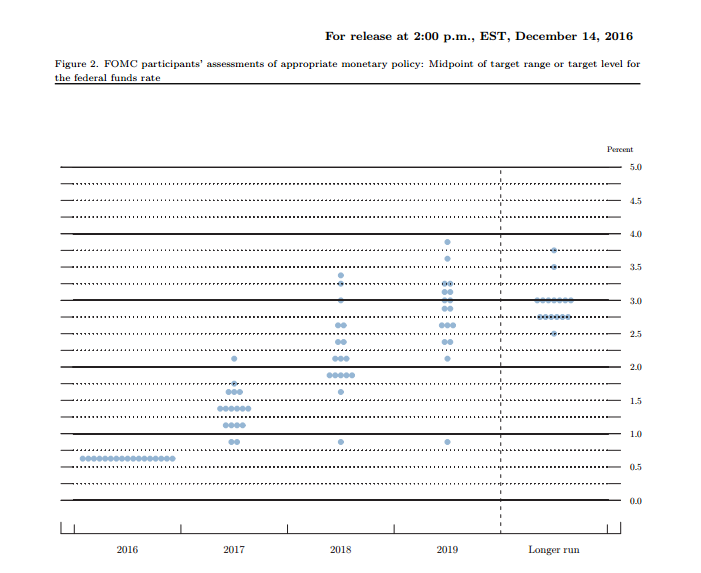
Janet Yellen spoke yesterday, saying the economy was close to the Fed's target, which warrants gradual rate hikes. Here are her prepared remarks. "That said, as of last month, I and most of my colleagues--the other members of the Fed Board in Washington and the presidents of the 12 regional Federal Reserve Banks--were expecting to increase our federal funds rate target a few times a year until, by the end of 2019, it is close to our estimate of its longer-run neutral rate of 3 percent." That should have been a relative uncontroversial statement, given that roughly corresponds with the December dot plot. However, bonds sold off anyway.


Housing starts rose to 1.23 million in December from 1.1 million in November. Building Permits were flat at 1.21 million. Starts beat expectations while permits missed. Multifam drove the increase in starts, while single fam fell slightly. 


Initial Jobless Claims fell to 234k last week nearly matching a low set in November. You would have to go back to the early 1970s (during the Vietnam war draft) to see claims this low. That is even more impressive when you factor in population growth. Employers are hanging onto their employees. 

The Philadelphia Fed survey jumped last month as conditions improved for manufacturing. New orders and employment drove the increase. 

Treasury Secretary nominee Steve Mnuchin travels to Capitol Hill today for his confirmation hearing. The questions will largely center on his role in the IndyMac turnaround, as well as his recommendations for the GSEs. He will also be asked about his comments regarding possible tax reform and whether the rich will receive an "absolute tax cut." 

The nonbank share of FHA lending is worrying some in Washington. As banks have retreated from FHA lending, nonbank lenders like Quicken and Freedom have taken up the slack. GNMA is conducting a push to lure banks back into the business. 

The Fed's Beige Book survey was a non-event. Most districts described their employment markets as "tight" and expansion as "modest."

One bond investor thinks the bond bull market is still going to last a while longer. Why? The velocity of money has hit a floor since the Great Recession and hasn't picked up. The velocity of money measures how many times a dollar has been "turned over" in different transactions. It peaked at 2.2x in 1997 and is currently sitting around 1.4x. This has been driven by the Great American Deleveraging which began with the bursting of the real estate bubble - income growth has been nonexistent, and the marginal dollar has been saved, not spent. The lower velocity is keeping a lid on inflation. 


Bridgewater CEO Ray Dalio sees a mild bear market in bonds as economic growth picks up. He views the nascent populism being exhibited worldwide as a threat to multinational corporations and emerging economies. How politicians direct and engage that populism is going to be critical. Note that the Fed is addressing some of this by launching a new think tank: The Opportunity and Inclusive Growth Institute, which will be run by Minneapolis Fed head Neel Kashkari. Of course there isn't much the Fed can do to address income inequality, however quantitative easing has largely benefited those that own assets, who are primarily rich. 

Here is a good article on determining how much house you can afford. 

Friday, August 26, 2016

Morning Report: Janet Yellen speaks at 10:00 am

Vital Statistics:

Last Change
S&P Futures  2173.0 0.0
Eurostoxx Index 342.0 0.0
Oil (WTI) 47.4 0.1
US dollar index 85.6 0.1
10 Year Govt Bond Yield 1.56%
Current Coupon Fannie Mae TBA 103.3
Current Coupon Ginnie Mae TBA 104.2
30 Year Fixed Rate Mortgage 3.5

Markets are in a holding pattern ahead of Janet Yellen's speech in Jackson Hole today. Bonds and MBS are flat

Janet Yellen will give a speech today at 10:00 am, discussing the tools in the Fed's monetary policy toolkit. Speeches at Jackson Hole are generally not market-moving, however the markets have been adjusting ahead of this one. Expect to hear Yellen push for fiscal policy to improve the economy. 

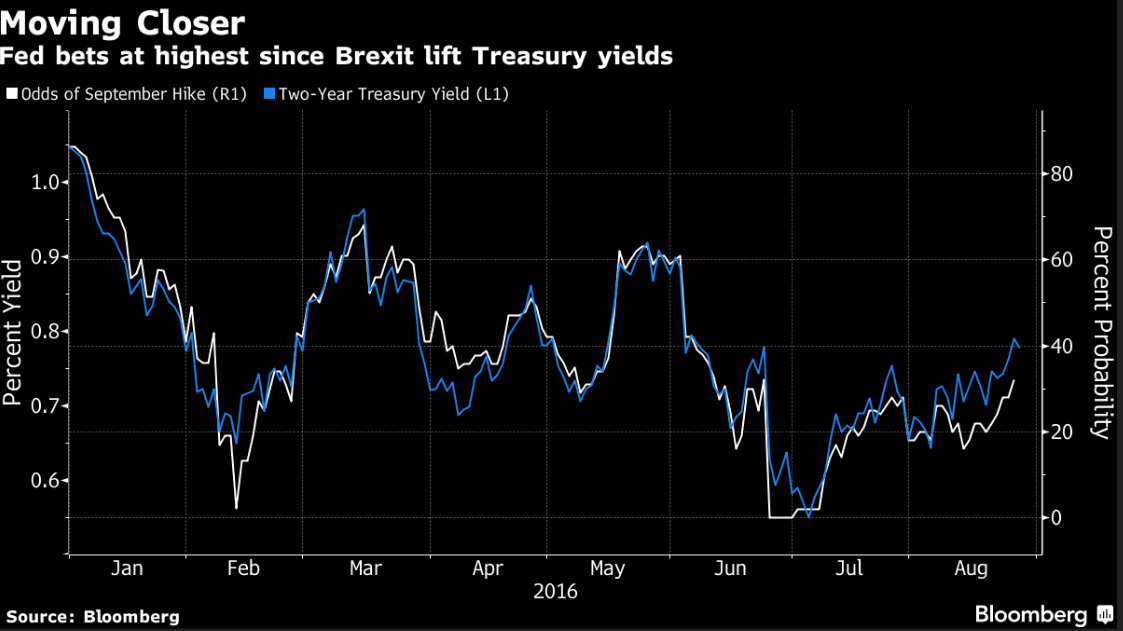
The markets are now assigning a 33% chance of a rate hike in September. Somewhat hawkish Fed-speak out of different Fed heads largely accounts for the increase. The Fed Funds futures markets are also assigning a 58% chance of a hike through December.


GDP came in at 1.1% in the second quarter, which was a downward revision from the first estimate of 1.2%. The price index was up 2.3% on a year-over-year basis, which was a little hotter than expected. 

Corporate profits fell 2.2% in the second quarter. Tough to reconcile a near-record stock market with falling profits. Something has to give. 


For all the talk in Washington about the need for more infrastructure spending, states are beginning to take advantage of low interest rates to issue bonds to raise money for infrastructure spending. When municipalities can borrow money for 30 years at 2.23%, it is kind of a no-brainer. Both Donald Trump and Hillary Clinton are talking about increasing infrastructure spending, so it looks like we will probably have something out of DC next year as well. 

Tuesday, June 21, 2016

Morning Report: Janet Yellen gets more dovish

Vital Statistics:

LastChangePercent
S&P Futures 2087.13.50.17%
Eurostoxx Index2852.433.11.17%
Oil (WTI)47.211.02.16%
LIBOR0.6560.0020.24%
US Dollar Index (DXY)94.4-0.169-0.18%
10 Year Govt Bond Yield1.68%-0.01%
Current Coupon Ginnie Mae TBA105.9
Current Coupon Fannie Mae TBA105
BankRate 30 Year Fixed Rate Mortgage3.53

Markets are up this morning as the market frets about Brexit and Janet Yellen speaks. Bonds and MBS are up small.

The latest polls for Brexit are mixed, and the bottom line is that it is too close to call. If the UK leaves the EU, the most likely effect will be a flight to safety, which would mean global flows to US Treasuries, lowering rates. Some of the forecasts I am seeing would be a sub 1.4% on the 10 year if the UK leaves, or a return to the old 1.7% - 1.9% range if they stay. FWIW, spread betting is common in the UK, and the markets there are much deeper than the political betting sites in the US. Right now, the spread betting markets are assigning a 25% probability of Brexit. 

Janet Yellen adjusted her language to be slightly more dovish ahead of her testimony today in front of the Senate Banking Committee. She is exhibiting a little more uncertainty over whether the economy is ready to return to moderate growth. Not sure what changed in the last week or so, but there you go. 

Homebuilder Lennar beat estimate this morning as the housing market continues to improve and wage growth begins to appear. Interestingly, they are pulling back a little from the market, it appears: "As this year's spring selling season improved over last year, our second quarter new orders increased 10% to 7,962 homes year-over-year, while our home deliveries and home sales revenue also increased to 6,724 homes and $2.4 billion, respectively.  As the recovery has continued to mature, we have remained focused on our strategy of moderating our growth rate in community count and home sales, as well as on our soft-pivot land strategy, targeting land acquisitions with a shorter average life." For some reason, the builders don't seem to trust this recovery in housing. 

Perhaps Lennar's reticence comes from the attitudes of consumers. A recent survey shows housing affordability remains a big problem. That said, perceptions of real estate as a good long-term investment are improving. They should, since rental inflation is generally outpacing house price appreciation and the buy-rent decision is skewed heavily towards buying. That said, consumers are becoming more pessimistic that the housing crisis is over. 

Good breakdown on how big of a boost homebuilding is for the economy. Unfortunately, the only discussion of housing in DC revolves around how hard we should be slugging the banks.