A place where economics, financial markets, and real estate intersect.
Showing posts with label homeownership rate. Show all posts

Monday, July 30, 2018

Morning Report: Uptick in the homeownership rate

Vital Statistics:

Last Change
S&P futures 2817.75 0
Eurostoxx index 391.62 -0.46
Oil (WTI) 69.98 1.29
10 Year Government Bond Yield 2.98%
30 Year fixed rate mortgage 4.58%

Stocks are flat this morning on no real news. Bonds and MBS are down. 

Global bonds are under pressure this morning on fears that the Bank of Japan may make some changes to its monetary policy. While these sorts of things don't impact the US directly, global sovereign bonds tend to trade as a group and US yields will be influenced by them.

We have a lot of important numbers this week, with personal incomes / personal spending on Tuesday and the jobs report on Friday. We also have the FOMC meeting on Tuesday and Wednesday. No changes in policy are expected, however the language of the statement will be in focus as always. 

Earnings season continues, with announcements from Freddie Mac, Annaly, Pennymac, and MFA.

FHFA Director Mel Watt was accused of sexual harassment. His term expires at the end of the year, but he will probably be shown the door regardless. 

The homeownership rate increased to 64.4% from 64.3% in the second quarter, according to the Census Bureau. This is a 4 year high. Interesting, the geographic dispersion is quite large, ranging from 59.7% in the West to 68.3% in the Midwest. Affordability matters, but that is a big divergence. We also saw a marked increase in younger homeowners, with the under-35 age cohort increasing from 35.3% to 36.5%. Rental vacancy rates fell from 7% to 6.8% while homeowner vacancy rates were flat at 1.5%. The overall homeownership rate is below the long term average, however the increase that started in 1994 and ended with the top of the housing bubble was probably artificial. 


Pending home sales rose 0.9% in June, according to NAR. While this is a nice uptick from May, contract signings are still down 2.5% on a YOY basis. It looks like we are seeing an uptick in inventory in some of the MSAs with the biggest inventory issues: Seattle, San Jose, and Portland. With the lion's share of 2018 in the books already, NAR is projecting a decline in existing home sales for 2018 of 1% and an increase in the median home price of 5%. 

Thursday, April 26, 2018

Morning Report: Initial Jobless Claims lowest since 1969

Vital Statistics:

Last Change
S&P futures 2652.75 8.25
Eurostoxx index 382.29 2.12
Oil (WTI) 68.61 0.56
10 Year Government Bond Yield 3.00%
30 Year fixed rate mortgage 4.62%

Stocks are higher this morning on strong earnings from Facebook. Bonds and MBS are up.

The ECB maintained its current policy and made some cautious comments, which is pushing up bonds in Europe. US Treasuries are following along on the relative value trade. 

The 10 year has made a pretty sizeable move over the past month or so, and mortgage rates typically lag. So don't be surprised if mortgage rates continue to tick up, even if the 10 year finds a home at the 3% level. 

The homeownership rate was flat in the first quarter at 64.2%. It is up from 63.6% a year ago however. It bottomed in the second quarter of 2016 at 62.9%. 

Durable Goods Orders increased 2.6% in March, following a strong February. Ex-transportation, they were flat however and core capital goods, which is a proxy for business capital investment, fell slightly. February's already strong numbers were revised up slightly. 

Retail inventories fell 0.5% while wholesale inventories increased by the same amount. 

Initial Jobless Claims fell to 209,000 last week, which is the lowest number since 1969. When you adjust for population growth, the number becomes even more dramatic:


Deutsche Bank is scaling back its US operations to focus on becoming a more Euro-centric bank. It is hard to believe, but almost 20 years ago, the bank decided to make a big foray into the US market by buying Banker's Trust and Alex Brown. 

Moody's is worrying about the next area of opportunity in the mortgage market: cash-out refinances. As many CLTVs are approaching 75%, homeowners may choose to do a cash-out to either consolidate higher rate debt, or perhaps do home improvements. The other opportunity remains refinancing FHA loans that have accumulated enough equity to qualify for a conforming loan without MI. Finally, those who still have ARMs might find the relative attractiveness of a 30 year fixed to be a compelling switch. In an environment of rising home prices and rising interest rates, these will be the only game in town. 

Homebuilders are facing rising input costs - sticks and bricks, if you will. Framing lumber prices are up 16% this year, and plywood is up 33%. Inventory is so tight that builders are able to pass these costs onto homebuyers. A tight labor market remains an issue for the industry as well. All of this points to higher home prices going forward. 

For those wondering if we are indeed at the end of the credit cycle, here is WeWork's bond offering, which came in at $700 million with bonds paying 7.875%. Borrowing money at 7.875% for 5% cap rate office space? Set that aside for the moment. They introduced a new financial concept, called "community-adjusted EBITDA," which not only strips out interest, depreciation and amortization, and taxes, but also ignores general and administrative, marketing, and design / development costs. That has to be the first time I have ever heard this term before, and it should just be renamed EBBS - or earnings before bad stuff. 

Friday, August 25, 2017

Morning Report: Markets prepare for Janet Yellen

Vital Statistics:

Last Change
S&P Futures  2447.5 6.8
Eurostoxx Index 375.7 1.2
Oil (WTI) 47.7 0.3
US dollar index 86.1 -0.1
10 Year Govt Bond Yield 2.20%
Current Coupon Fannie Mae TBA 103.09
Current Coupon Ginnie Mae TBA 103.97
30 Year Fixed Rate Mortgage 3.89

Stocks are up this morning as we await Janet Yellen and Mario Draghi speeches in Jackson Hole. Bonds and MBS are flat. 

Janet Yellen will be speaking at 10:00 am EST at Jackson Hole. The markets aren't expecting much in the way of new policy guidance, however given the general illiquidity of the markets, and the fact that it is a Friday during summer, anything that spooks the herd could have outsized effects. 

Durable goods orders slipped 6.8% in July largely due to a drop in aircraft orders. Ex-transportation they were up 0.5% MOM and 5.6% YOY. Capital Goods orders rose 0.4% and are up 3.5% YOY. Capital Goods orders are a good proxy for business capital expenditures, and indicates manufacturing confidence in the future. 

Credit scoring is something we take for granted, however there is competition to the standard Fair Issac model (FICO). VantageScore (created by Fair Issac competitors Transunion, Equifax and Experian) is attempting to become an alternate scoring methodology for Fannie / Fred and FHFA loans. FHFA is worried that allowing new credit scoring methods would create a race to the bottom, where the agencies end up using the one that shines the most favorable light on borrowers. Some feel the FICO methodology, which doesn't distinguish between types of debt, is outdated. Vantagescore uses things like utility and rent payment history, which is useful for people who don't borrow much in the first place and don't have a FICO score. 

The post-election sell-off in bonds is unwinding, and mortgage rates have hit the lows of 2017, matching levels seen just after the election, according to Freddie Mac. The 30 year fixed rate mortgage averaged 3.86% for the week ending August 24, which is the lowest level since November 10, 2016. 

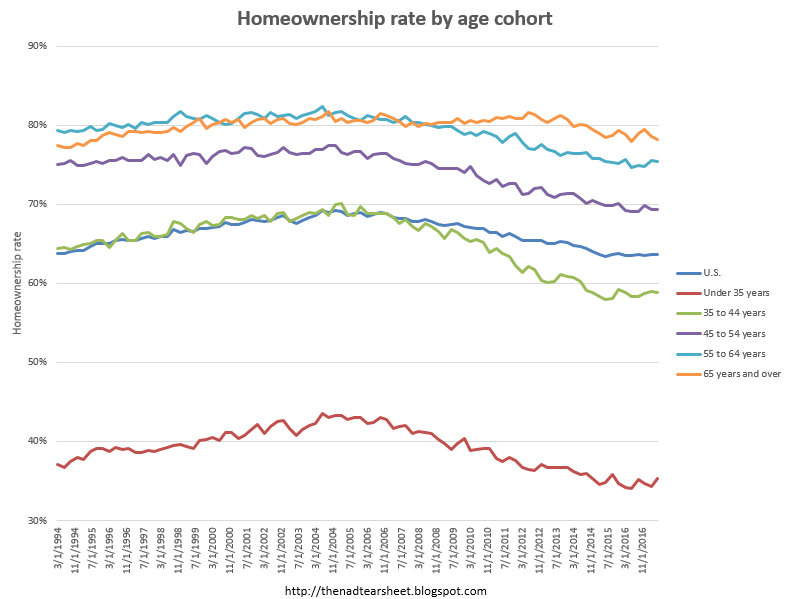
The homeownership rate may have bottomed, and perhaps we are seeing a turnaround for the younger buyers. Below is a chart of the homeownership rate by age cohort, going back to 1994. The youngest age brackets definitely have the most volatility, and they are the most affected by the dearth of starter homes for sale. 


Friday, April 28, 2017

Morning Report: Q1 GDP weakest in 3 years

Vital Statistics:

Last Change
S&P Futures  2387.0 1.0
Eurostoxx Index 386.8 -1.0
Oil (WTI) 49.5 0.6
US dollar index 89.7
10 Year Govt Bond Yield 2.32%
Current Coupon Fannie Mae TBA 102.63
Current Coupon Ginnie Mae TBA 103.68
30 Year Fixed Rate Mortgage 3.98

Stocks are flattish after first quarter GDP misses expectations. Bonds and MBS are down.

First quarter GDP came in at 0.7%, which was lower than the 1.1% consensus forecast. A decline in spending on motor vehicles was a drag on Q1, which has been weak the past several years for some reason. The personal consumption expenditure (the inflation measure most preferred by the Fed rose 2.4%, which is higher than their target rate. This was the highest reading in several years, which means the Fed might be forced to move even though growth is weak. The savings rate jumped from 5.5% to 5.7%, which means consumers are still using increases in income to pay down debt. Inventory depletion and a drop in government spending, along with weak consumption were the main drivers. Note that this is just the advance estimate, and will be revised twice in the next month. 


Employment costs rose 2.8% annualized in the first quarter, according the BLS. Wages and salaries rose 2.5% while benefit costs increased 2.2%. We have been seeing a gradual tick up in this index, however wages are still well off their pre-crisis historical trend. 


Trump's tax plan was short on specifics, but it certainly looks like wealthier residents in high tax states will feel it the most. Killing the state and local tax deduction has been fraught with risk, but given that it will largely affect the blue states it might have a chance. Eliminating the mortgage interest deduction will be a poison pill, IMO. Will tax reform hit the residential real estate market? Probably not, as tight inventories are the dominant factor driving pricing right now. 

The homeownership rate ticked down slightly in the first quarter to 63.6% from 63.7% in the fourth quarter. It looks like it is on the rebound, however the first time homebuyer really needs incomes to rise in order to catch an asset that is increasing 7% a year. More starter home construction would help too, but multi-fam seems to be the interest of builders. Vacancy rates are largely flat MOM and YOY. 


The Chicago Purchasing Manager Index rose last month, while consumer sentiment slipped. 

Housing Wire's home price forecast for the rest of the year. Overall, looking at 3.5% growth, with a range of anywhere from 1% to 10%. 

Thursday, February 2, 2017

Morning Report: 2016 had the lowest homeownership rates since 1965

Vital Statistics:

Last Change
S&P Futures  2267.5 -7.0
Eurostoxx Index 362.7 -0.5
Oil (WTI) 54.0 0.2
US dollar index 90.2 -0.4
10 Year Govt Bond Yield 2.44%
Current Coupon Fannie Mae TBA 102.1
Current Coupon Ginnie Mae TBA 103.2
30 Year Fixed Rate Mortgage 4.16

Stocks are lower this morning on overseas weakness. Bonds and MBS are up.

The Fed maintained interest rates at current levels and made no changes to its reinvestment policy. The statement itself was relatively dovish, which caused a small rally in bonds in the afternoon. The money quote: "In light of the current shortfall of inflation from 2 percent, the Committee will carefully monitor actual and expected progress toward its inflation goal. The Committee expects that economic conditions will evolve in a manner that will warrant only gradual increases in the federal funds rate; the federal funds rate is likely to remain, for some time, below levels that are expected to prevail in the longer run." There was no mention of Washington, and a slight reference to improving sentiment. 

Productivity remains a problem as it increased at an anemic 1.3% pace in the fourth quarter. Output increased 2.2% and hours worked increased 0.2%. Unit labor costs increased 1.7% as wages and compensation increased 3% and productivity increased 1.3%. Part of the problem is that business capital expenditures have been in maintenance mode since the financial crisis. Morgan Stanley believes that sentiment is changing, and that means more capital expenditures going forward. Higher productivity means higher non-inflationary wage growth, which translates into higher standards of living. Note the recent divergence between capital expenditure plans and actual spending. 


Announced job cuts increased to 45,934 in January, according to outplacement firm Challenger, Gray and Christmas. The holiday season was atrocious for many bricks and mortar retailers, and some are shuttering stores and declaring bankruptcy. Macy's accounted for almost a quarter of the layoffs. The energy patch is finally on the mend and hiring again. 

Initial Jobless Claims fell to 246,000 last week.

The homeownership rate ticked up to 63.7% in the fourth quarter after hitting a 52 year low in the second quarter. Overall, the homeownership rate for 2016 was the lowest since records began in 1965. 


NAR took a look at the aspiring homeowner in its latest survey. Affordability was the #1 reason for people not owning a home, followed by flexibility concerns. That said, 88% of non-owners eventually do want to own a home. There still seems to be a disconnect between what people think they need (as far as a downpayment) versus what is actually required. FHA loans remain the best way to get these people their first home. 

Wednesday, October 12, 2016

Morning Report: The Fed shrinks its balance sheet using this one weird trick...

Vital Statistics:

Last Change
S&P Futures  2130.8 -4.0
Eurostoxx Index 339.6 -0.6
Oil (WTI) 50.8 0.0
US dollar index 88.4 0.1
10 Year Govt Bond Yield 1.79%
Current Coupon Fannie Mae TBA 103.3
Current Coupon Ginnie Mae TBA 104.2
30 Year Fixed Rate Mortgage 3.54

Stocks are down again after getting roughed up yesterday. Bonds and MBS are down as well. 

Mortgage applications fell 6% last week as purchases fell 3% and refis fell 8%. 

Job openings decreased by 400k to 5.4 million in August, according to the BLS. The quits rate (which is probably the best indicator for strength in the labor market) was steady at 2.1%. I wonder if we are seeing employers begin to hire the long-term unemployed, which would account for the drop in openings and the flat quits rate. The labor force participation rate is beginning to pick itself off the floor, as we saw in the latest jobs data. 

We will get the FOMC minutes from the September meeting at 2:00 pm EST today. Be aware of possible market movement around then, especially if the minutes turn out to be a bit more dovish than expected. On Sunday, Fed Vice Chairman Stanley Fischer said that September's decision to wait on hiking rates was a "close call." The minutes will hopefully shed further light on that statement. 

The biggest problem with QE is what to do with all of these assets that now sit on the Fed's balance sheet. The Fed can't sell the Treasuries it bought without withdrawing liquidity from the system. That would be contractionary, and the economy (or at least the financial system) might be too fragile to handle it. That would be the case even if the Fed just lets it run off by not re-investing maturing proceeds. There is now a school of thought that the Fed's balance sheet should simply remain the size it is now, and we shouldn't return to pre-bubble levels. The thinking is that governments should simply consolidate the Fed's assets onto its own balance sheet. (called "permanent monetization") Given that central banks are ultimately owned by the government, its Treasuries would effectively "cancel out" the debt issued by the government. This is why looking at the debt to GDP ratio is somewhat misleading: about a quarter of our debt is owned by the central bank. It is like taking out a loan and leaving the money in your savings account. In nominal terms, your debt is up, but your net worth is unchanged. One thing is for sure: none of this is in the econ textbooks. We are all making it up as we go along. 

A Federal Appeals court ruled yesterday that the CFPB's structure is unconstitutional. The director of the CFPB is appointed for a 5 year term, and can only be fired for cause by the President. The court found that this structure puts too much power in the hands of one person, and is more or less unaccountable. Rob Chrisman takes a look at what is going on

A study from the Urban Institute forecasts that the homeownership rate will continue to decline. The question ultimately rests on whether the Millennials are going to follow a different path than previous generations, or are they simply late bloomers who will eventually marry, have kids, and want a place in the suburbs. Note that the homeownership rate started going vertical in 1994, with the Clinton Administration's policies to encourage homeownership, as a tool for social engineering. Post-crisis, the rates has returned to its previously undisturbed rate. 


Thursday, August 11, 2016

Morning Report: Bond trading is now like trading commodities

Vital Statistics:

Last Change
S&P Futures  2177.0 58.0
Eurostoxx Index 345.0 4.0
Oil (WTI) 41.6 -0.2
US dollar index 86.0 -0.2
10 Year Govt Bond Yield 1.51%
Current Coupon Fannie Mae TBA 103.8
Current Coupon Ginnie Mae TBA 105.2
30 Year Fixed Rate Mortgage 3.52

Markets are flattish this morning on no real news. Bonds and MBS are flat as well.

Slow news day (again)

Initial Jobless claims dipped ever so slightly to 266k last week. 

Import prices rose 0.1% month-over-month, but are down 3.7% on an annual basis. Inflation remains in a deep freeze. 

Housing has historically been the vehicle people use to build wealth. For most people, it is their biggest assets. Home prices have been rising since bottoming in 2012, but aspiring homeowners have been shut out as the homeownership rate hits levels not seen since the 1970s. For young Millennials with student loan debt and difficult job prospects, home price increases have made the dream of homeownership further out of reach. Meanwhile, rental inflation (driven by the same scarcity issues that are driving home price appreciation) mean that rent accounts for a bigger and bigger percentage of disposable income. 


The homeownership rate fell to 62.9% in the second quarter, which is a 51 year low. You can see the big jump in homeownership that started in the mid 90s has been reversed. That jump in homeownership was a function of Bill Clinton's social engineering via the housing market and the development of a securitization market. Tight credit post-financial crisis remains an issue as well, as the US taxpayer bears the credit risk for 90% of all origination. If a loan doesn't fit into the government / conforming box, it likely isn't getting done. 

That said, this does represent pent-up demand that will be unleashed at some point, and with housing starts still well below historical averages, could provide a massive boost to the economy once it turns around. Don't forget the Millennial generation is bigger than the baby boomers. Amidst the gloom however, is evidence that the Millennials are finally buying

Interesting observation, and spot-on: Negative interest rates have made bond investing similar to commodity investing. As Warren Buffett would say that with commodities you are simply betting on what someone else might pay for them at some future moment. Commodities cost money to hold (because storage isn't free) and now bonds with negative yields exhibit the same characteristics. The only way to make money in bonds has been to find a greater fool to sell to. If this causes volatility to spike (which in theory it should), then that will have major effects on mortgage rates and pipeline hedging.

Friday, April 29, 2016

Morning Report: The homeownership rate falls again

Vital Statistics:

Last Change Percent
S&P Futures  2066.5 -5.9 -0.28%
Eurostoxx Index 3055.8 -69.6 -2.23%
Oil (WTI) 46.51 0.5 1.04%
LIBOR 0.638 0.004 0.63%
US Dollar Index (DXY) 93.18 -0.583 -0.62%
10 Year Govt Bond Yield 1.86% 0.03%
Current Coupon Ginnie Mae TBA 105.4
Current Coupon Fannie Mae TBA 104.7
BankRate 30 Year Fixed Rate Mortgage 3.65

Markets are lower after yesterday's bloodbath. Bonds and MBS are down.

Personal incomes rose 0.4% in March, while spending rose 0.1%. The savings rate rose to 5.4%, this highest since late 2012. The Great American De-Leveraging continues..

The PCE Core Index (which is the inflation measure preferred by the Fed) rose 0.1% in march and is up 1.6% YOY. This is still below the Fed's 2% target rate. We simply aren't going to see much in the way of inflation until we see wage growth. 

Speaking of wage growth, the employment cost index rose 0.6% in the first quarter as wages and salaries increased by 0.7% and benefits increased by 0.5%. On an unadjusted YOY basis, compensation increased 1.9% as salaries increased 2% and benefits increased 1.7%. 

Consumer sentiment fell in April, according to the University of Michigan Consumer Sentiment Survey. 

The homeownership rate fell to 63.5% in the first quarter, which is back below the levels of the mid 80s through the mid 90s. The gains in homeownership that started with the Clinton Administration's social engineering via the housing market in 1995 have been given back. 


As the Millennial generation ages, that number should increase, and does represent pent-up demand for housing. Affordability remains a big issue, along with high DTI ratios due to student debt. The homeownership rate for Gen Xers was 59%

Worried about the increase in the price of oil? Don't be. It is due to a massive short squeeze. For every barrel of oil being bought by a long speculator, there are 9 shorts exiting their position. 

Wednesday, October 21, 2015

Morning Report: Homeownership rate down to almost 50 year lows.

Vital Statistics:

Last Change Percent
S&P Futures  2031.2 10.6 0.52%
Eurostoxx Index 3278.1 22.4 0.69%
Oil (WTI) 45.39 -0.9 -1.94%
LIBOR 0.317 -0.001 -0.16%
US Dollar Index (DXY) 94.91 -0.004 0.00%
10 Year Govt Bond Yield 2.04% -0.02%
Current Coupon Ginnie Mae TBA 104.8
Current Coupon Fannie Mae TBA 104.5
BankRate 30 Year Fixed Rate Mortgage 3.79

Stocks are higher this morning as a couple big mergers are announced. Bonds and MBS are up.

Mortgage Applications rose 11.8% last week, as purchases rose 16.4% and refis rose 8.8%. 

Education opportunity: It is better for Millennials to buy than to rent. The catch: Millennials like the urban environment and in the hot markets like San Francisco and New York, they are priced out of the market. Not all urban areas are bad however: Here are the affordable places:


UBS is closing down its Manged High Yield Plus Fund. Is that a harbinger of bad things to come? The closing of a BNP Paribas fund in 2007 is credited with starting the financial crisis, though I remember the first tell being the inability of banks to sell the debt associated with the Alliance / Boots merger. High yield has been struggling lately as over-extended energy exploration companies are getting hammered by low oil prices. While we don't have a residential real estate bubble anymore, it could still cause some ripples in the bond markets. 

Freddie Mac is looking to expand its offering of low downpayment loans. The government is worried about people being shut out of the mortgage market, particularly low income borrowers and those with difficult to document income. Fannie Mae is looking to make income documentation easier.  Note that the homeownership rate in the US has fallen to 63.4%, about where it was before the US began the Great Experiment In Expanding Home Ownership, which began with Bill Clinton's HUD around 1994. The last time the homeownership rate was this low? 1967. This represents a lot of pent-up demand for purchase business and is an opportunity.


Wednesday, July 29, 2015

Morning Report - Homeownership falls to 4 decade low

Vital Statistics:

Last Change Percent
S&P Futures  2087.8 0.6 0.03%
Eurostoxx Index 3552.5 -1.6 -0.05%
Oil (WTI) 47.73 -0.3 -0.52%
LIBOR 0.294 0.001 0.17%
US Dollar Index (DXY) 96.71 -0.062 -0.06%
10 Year Govt Bond Yield 2.27% 0.02%
Current Coupon Ginnie Mae TBA 104.1 0.0
Current Coupon Fannie Mae TBA 103.4 -0.1
BankRate 30 Year Fixed Rate Mortgage 3.98

Markets are flattish as we await the FOMC decision. Bonds and MBS are down small. 

Mortgage Applications rose 0.8% last week as purchases fell 0.1% and refis rose 1.6%. 

Pending Home Sales fell 1.8% in June versus May, but are up 11.1% year over year. 

Pretty much no one is forecasting a rate hike at today's meeting, given there is no press conference. There is a chance of rate volatility around 2:00 pm, but I would expect the statement to say pretty much what the various Fed speakers have been saying for a while - the economy is improving, the labor market is losing some of its slack, inflation remains contained, and the Fed will remain data-dependent. 

Homebuilder D.R. Horton reported yesterday, beating estimates. Orders increased 25%, closings increased 37%. Texas remains strong despite the drop in oil prices. 

The homeownership rate fell to the lowest level since 1967. Basically all of the gains that began with the Great Bill Clinton / George W Bush experiment in using housing as a tool for social engineering have been given back. Note that household formation is finally back on the upswing, so we have a lot of pent-up demand.


Wednesday, June 24, 2015

Morning Report - A generation of renters?

Vital Statistics:

Last Change Percent
S&P Futures  2111.6 -4.8 -0.23%
Eurostoxx Index 3595.1 -30.9 -0.85%
Oil (WTI) 60.99 0.0 -0.03%
LIBOR 0.282 0.001 0.34%
US Dollar Index (DXY) 95.24 -0.189 -0.20%
10 Year Govt Bond Yield 2.39% -0.02%
Current Coupon Ginnie Mae TBA 100.7 0.1
Current Coupon Fannie Mae TBA 99.28 0.1
BankRate 30 Year Fixed Rate Mortgage 4.18

Markets are lower after Greek Prime Minister Tsipras expressed shock that his proposals still do not go far enough to get a deal. Bonds and MBS are up.

Mortgage Applications rose 1.6% last week as purchases rose 1.2% and refis rose 1.8%. 

The third revision to first quarter GDP came in at -0.2%. This is an upward revision from the previous -0.7% estimate. A combination of harsh weather, a West Coast port strike, and a slowdown in the oil patch depressed growth. Lower gas prices still are not translating into higher spending at the malls, however. Consumers continue to save / repay debt.

Greece was handed new terms for a bailout. The proposals Tspiras provided do not go far enough, and he took to Twitter to harangue the IMF and the EU. Brave new world: negotiating and posturing via Twitter. “There is still a lot of work to do,” Dutch Finance Minister Jeroen Dijsselbloem, who chairs meetings of his euro-area counterparts, told reporters in Brussels. “We are not there yet.”

Homeownership levels have fallen back to the levels of the early 90s. Millennials are renting in droves. Is this the new face of homownership, or simply the pendulum overcorrecting on the other side? While house prices are back in bubblicious territory (primarily due to a lack of inventory), rates are so low that mortgage payments are still comparable to rents. 

Speaking of lack of inventory, homebuilding giant Lennar reported earnings this morning, beating the Street. Revenues increased 30% as deliveries increased 21% and ASPs increased to $348,000. New orders increased 18% in units as well. The stock is up about 5% pre-open. Could housing be the new engine for the economy? Hopefully, as manufacturing seems to be going through a soft patch. 

Washington is alleging discrimination in REO, saying that homes in low-income neighborhoods are not being properly maintained. The problem in many of these place, especially in the rust belt, is that the opportunities are so sparse that people are moving out, and no one is moving in. When you have a net outflow of people and an endless supply of vacant houses, these properties become basically worthless. And what bank wants to throw good money after bad maintaining a house that probably will never sell in the first place?

Tuesday, April 28, 2015

Morning Report - The homeownership rate continues to fall

Vital Statistics:

Last Change Percent
S&P Futures  2101.6 -3.1 -0.15%
Eurostoxx Index 3728.1 -43.3 -1.15%
Oil (WTI) 57.05 0.1 0.11%
LIBOR 0.279 0.002 0.72%
US Dollar Index (DXY) 96.47 -0.297 -0.31%
10 Year Govt Bond Yield 1.95% 0.03%
Current Coupon Ginnie Mae TBA 103.1 -0.2
Current Coupon Fannie Mae TBA 102.2 -0.3
BankRate 30 Year Fixed Rate Mortgage 3.77

Markets are flattish this morning as the FOMC begins their meeting. Bonds and MBS are down. 

Consumer Confidence slipped in April, to 95.2 from 101.3. Consumers’ appraisal of current-day conditions continued to soften. Those saying business conditions are “good” edged down from 26.7 percent to 26.5 percent. However, those claiming business conditions are “bad” also decreased from 19.4 percent to 18.2 percent. Consumers were less favorable in their assessment of the job market. Those stating jobs are “plentiful” declined from 21.0 percent to 19.1 percent, while those claiming jobs are “hard to get” rose from 25.5 percent to 26.4 percent. The current reading is just about the historical average.


The FOMC meeting begins today. This is should be the last meeting where rate hikes are off the table. Given the weak first quarter, and subsequent economic weakness, the consensus has shifted markedly from a June hike to a September hike. As an aside, we will get the advance estimate for Q1 GDP tomorrow, and the consensus is that the economy grew at 1%. Granted, some of that is weather-driven, but there is no question the economy has slowed dramatically from the Q214-Q315 pace of 4.6%-5.0%. The jobs report next week will be huge. 

Home Prices increased .93% month-over-month and 5.03% year over year, according to Case-Shiller. Overall, prices are about 10% below their 2006 peaks, however some hot markets like Denver and San Francisco have surpassed that peak already. Price inflation is being driven by a lack of supply, not wage growth, which means that prices will probably flatline once new home construction kicks into gear or until wages start increasing. We will get a good read on wages this Thursday, with personal income and personal spending. 

The homeownership rate fell to 63.7% in Q115, from 64% in the fourth quarter of 2015. Pretty much all of the increase that started with the Clinton Administration's homeownership initiatives in the mid 90s have been given back. 


Wednesday, May 1, 2013

Morning Report - New FHFA Chairman

Vital Statistics:
Last Change Percent
S&P Futures  1591.2 -1.0 -0.06%
Eurostoxx Index 2712.0 0.0 0.00%
Oil (WTI) 91.87 -1.6 -1.70%
LIBOR 0.273 0.000 0.00%
US Dollar Index (DXY) 81.38 -0.367 -0.45%
10 Year Govt Bond Yield 1.65% -0.02%  
Current Coupon Ginnie Mae TBA 106.5 0.0
Current Coupon Fannie Mae TBA 104.7 0.1
RPX Composite Real Estate Index 192.5 0.4
BankRate 30 Year Fixed Rate Mortgage 3.43

Markets are slightly weaker ahead of the FOMC announcement later today. MBA mortgage applications increased 1.8% last week. The Markit Flash Manufacturing Purchasing Managers Index came in at 52.1, indicating that business conditions for manufacturers are more or less in line with historical trends. Bonds and MBS are up.

The ADP employment change (which is a forecast for Friday's jobs report) came in lower than expected at 119,000. March was revised downward as well. Lately the ADP employment change has not been all that great or a predictor of the official jobs report, but we'll see.

The FOMC's rate decision is expected to be released at 2:00 pm EST. Nobody expects any change in interest rates - the big question will be regarding asset purchases or QE. Late last year, there appeared to be a consensus that QE would end sometime this year. Subsequent comments from Federal Reserve governors however seemed to contradict that view. Now, we have some that have mentioned the possibility of additional measures. If anything that probably points to a "steady as she goes" type of statement, but we'll see.

Looks like Ed DeMarco is out at FHFA and Mel Watt is in. This probably means principal mods for conforming mortgages are on the way. Interestingly, Watt represented the Charlotte district, the same district as Bank of America. Principal mods are not a slam dunk however - the biggest MBS holders are pension funds and they are struggling to meet their obligations in this low interest rate environment. Watt's confirmation will not be a slam dunk by any means.

The homeownership rate declined to 65% in Q1, the lowest level since 1995. This speaks to the absolute dearth of household formation numbers in the last 5 years. While the number has dropped significantly from its peak in 2005, it is still more or less at historical averages.

Chart:  Homeownership rate