A place where economics, financial markets, and real estate intersect.
Showing posts with label FICO. Show all posts

Friday, January 19, 2018

Morning Report: Shutdown day.

Vital Statistics:

Last Change
S&P Futures  2799.3 3.0
Eurostoxx Index 400.2 1.4
Oil (WTI) 63.0 -0.9
US dollar index 84.4 0.0
10 Year Govt Bond Yield 2.62%
Current Coupon Fannie Mae TBA 102.375
Current Coupon Ginnie Mae TBA 103.25
30 Year Fixed Rate Mortgage 4.03

Stocks are higher this morning as we head into the deadline to keep the government open. Bonds and MBS are flattish.

Consumer sentiment slipped in early January, according to the University of Michigan Consumer Sentiment survey. The reading fell to 94.4 from 97 in December. 

The House passed a 1 month continuing resolution yesterday and all eyes turn to the Senate, where Democrats are demanding action on immigration in exchange for a vote to keep the lights on. If they can't come to a deal, the government will shut down at midnight. This will be a little different than it was during the Obama years: Obama wanted the public to feel the pain of the government shutting down, so he made it as visible as possible. Trump is going to do the exact opposite. National Parks will still be open, although the rangers will be off duty. Tax transcripts were held up the last time the government shut down, so hopefully everyone planned accordingly. 

So far, the markets are treating the drama in DC as a sideshow. The US dollar, bond yields, and stock prices don't care. The 10 year is trading right at technical support right now, so if it breaks through that level, technical analysts are thinking the next level is 3%. 

Are credit scores preventing people from getting mortgages? Some are arguing that the old FICO scores are outdated and the GSEs should open up credit scores for competition. There is always the fear that competing credit scores will create a race to the bottom, where the most lax score wins, but that is probably overblown. Most originators won't touch the lowest permissible scores to begin with, so changing the number will probably only result in them changing their overlays to maintain the same credit profile as before. 

They say all real estate is local, and from what we have seen prices are rising rapidly. Are there pockets of weakness still? In fact there are, in the super-rich bedroom community of Greenwich, CT. Last quarter, prices fell at high end by almost 14%, the most since 2008 when Lehman Brothers collapsed. Sellers are tired of waiting years to get the price they want, and are finally getting realistic about the new market conditions. One estate, which was originally listed at $65 million ended up going for $21 million. The bottom line for Greenwich is that the financial industry, which really supported the area, has changed and probably isn't coming back to pre-bubble levels. This also explains Connecticut's budget issues as well - the rich communities in Fairfield County largely supported the state. 

Labor shortages are starting to push up wages, especially for skilled workers. Yesterday's initial jobless claims number was the lowest in 45 years. The markets and the Fed are forecasting 3 rate hikes this year. The risk is probably that this estimate is too low. The markets have been bumping up their March forecast. which currently stands at a 73% chance of a 25 basis point rate hike, up from 61% a month ago. 

The CFPB made its budget request for the first quarter, and the number is.... $0.00. The agency has $177 million in the bank (so to speak) and has a budget of $145 million, so they aren't asking for any more money

The Senate is working on a housing reform plan that would wind down Fannie and Fred and replace them with up a large number of private guarantors with a catastrophic government backstop. The Senate differs from FHFA here - FHFA wants a small number of guarantors to operate under a regulated utility model to prevent a race to the bottom, while the Senate envisions no limit. One other big change - the elimination of affordable housing goals, which will be replaced with incentives. This will almost certainly anger liberals, who were able to kill housing reform in 2014 over that exact issue. 

Want to be master of the universe? Try the Monetary Policy Game

Friday, August 25, 2017

Morning Report: Markets prepare for Janet Yellen

Vital Statistics:

Last Change
S&P Futures  2447.5 6.8
Eurostoxx Index 375.7 1.2
Oil (WTI) 47.7 0.3
US dollar index 86.1 -0.1
10 Year Govt Bond Yield 2.20%
Current Coupon Fannie Mae TBA 103.09
Current Coupon Ginnie Mae TBA 103.97
30 Year Fixed Rate Mortgage 3.89

Stocks are up this morning as we await Janet Yellen and Mario Draghi speeches in Jackson Hole. Bonds and MBS are flat. 

Janet Yellen will be speaking at 10:00 am EST at Jackson Hole. The markets aren't expecting much in the way of new policy guidance, however given the general illiquidity of the markets, and the fact that it is a Friday during summer, anything that spooks the herd could have outsized effects. 

Durable goods orders slipped 6.8% in July largely due to a drop in aircraft orders. Ex-transportation they were up 0.5% MOM and 5.6% YOY. Capital Goods orders rose 0.4% and are up 3.5% YOY. Capital Goods orders are a good proxy for business capital expenditures, and indicates manufacturing confidence in the future. 

Credit scoring is something we take for granted, however there is competition to the standard Fair Issac model (FICO). VantageScore (created by Fair Issac competitors Transunion, Equifax and Experian) is attempting to become an alternate scoring methodology for Fannie / Fred and FHFA loans. FHFA is worried that allowing new credit scoring methods would create a race to the bottom, where the agencies end up using the one that shines the most favorable light on borrowers. Some feel the FICO methodology, which doesn't distinguish between types of debt, is outdated. Vantagescore uses things like utility and rent payment history, which is useful for people who don't borrow much in the first place and don't have a FICO score. 

The post-election sell-off in bonds is unwinding, and mortgage rates have hit the lows of 2017, matching levels seen just after the election, according to Freddie Mac. The 30 year fixed rate mortgage averaged 3.86% for the week ending August 24, which is the lowest level since November 10, 2016. 

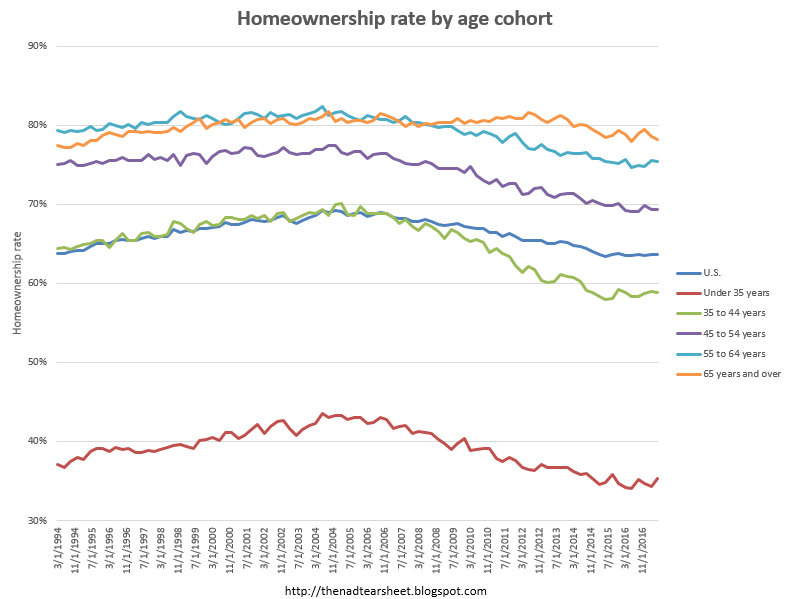
The homeownership rate may have bottomed, and perhaps we are seeing a turnaround for the younger buyers. Below is a chart of the homeownership rate by age cohort, going back to 1994. The youngest age brackets definitely have the most volatility, and they are the most affected by the dearth of starter homes for sale. 


Monday, March 6, 2017

Morning Report: Higher rates affecting high FICO refis more than low FICO refis.

Vital Statistics:

Last Change
S&P Futures  2373.8 -7.5
Eurostoxx Index 373.6 -1.6
Oil (WTI) 53.2 -0.1
US dollar index 91.5
10 Year Govt Bond Yield 2.48%
Current Coupon Fannie Mae TBA 101.86
Current Coupon Ginnie Mae TBA 103.19
30 Year Fixed Rate Mortgage 4.19

Stocks are lower this morning on overseas weakness. Bonds and MBS are flat.

Fed Funds futures are now fully pricing in a 25 basis point hike at next week's FOMC meeting. Now that we are in the quiet period, the only market-moving data should be late this week when we get productivity and the jobs report. 

Consumer spending has almost fully recovered from the Great Recession, with the February number coming in at $101, the strongest February since 2008

Factory orders increased 1.2% in January. Consensus was for a 1.1% increase. 

Over the weekend, the war between Democrats and Trump intensified, with Democrats calling for Attorney General Jeff Sessions to resign and Trump accusing the Obama administration of tapping the phones of Trump Tower. So far, markets are basically ignoring all of this as a sideshow. IMO, markets are sanguine about this simply because the deepening partisanship makes gridlock even more likely, and therefore a lot of the uncertainty is taken off the table. When and if that ever changes, the canary in the coal mine should be the dollar. 

Prepay speeds dropped by 30% in January, according to the Black Knight Financial Services Mortgage Monitor. Delinquencies declined by 4% versus December and are down 17% YOY. That said, foreclosure starts increased largely due to seasonal effects. Note the decline in prepayments was not uniform across the credit spectrum: 720+ FICO prepays declined by 32%, while sub 620 FICO prepays fell by 10%. Even with rates up here, it still makes sense for some borrowers to do cash-out refis in order to consolidate higher interest rate debt like credit cards. 

What should you do if you are upside down on your home? Zillow has you covered