A place where economics, financial markets, and real estate intersect.
Showing posts with label fomc. Show all posts

Friday, August 3, 2018

Morning Report: Decent jobs report

Vital Statistics:

Last Change
S&P futures 2829.25 1.5
Eurostoxx index 386.66 -3.19
Oil (WTI) 37.32 -0.34
10 Year Government Bond Yield 2.97%
30 Year fixed rate mortgage 4.57%

Stocks are higher this morning on fears of an escalation in the trade war. Bonds and MBS are up small as markets continue to digest moves from the Bank of England and the Fed.

The Fed maintained current policy and didn't reveal anything new in the statement. Bonds yawned at the decision. Trade was not mentioned in the statement. The Fed Fund futures are now sitting at a 94% chance of a Sep hike and a 70% chance of a Sep and Dec hike. 

The jobs report was decent - payrolls disappointed but the revisions in May and June more than made up for it. Jobs report data dump:

  • Payrolls up 157,000 (Street was looking for 190,000)
  • Prior two month revision + 57,000
  • Labor force participation rate 62.9%
  • Unemployment rate 3.9%
  • Average hourly earnings up .3% MOM / 2.7% YOY (in line with expectations)
The employment population ratio ticked up to 60.4%. While this number has been steadily rising, the labor force participation ratio remains stuck just below the 70% level. 


Initial Jobless Claims were flat last week at 218,000, while announced job cuts fell to 27,122. 

Wells will pay a $2 billion penalty for misrepresentations on loans made during the bubble years. This is after they paid a $1 billion penalty for auto loan issues. 

The Atlanta's Fed's GDP tracker is now looking for 5% growth in Q3. This model tends to give volatile results early in the quarter, but that is a pretty amazing number. Seems like every business in the US is firing on all cylinders except for mortgage banking.

The Trump Administration is looking into the idea of indexing capital gains to inflation. This idea has been around for decades, and it is based on the idea that asset prices will rise over time, some of which is due to simple inflation. If prices overall rise 5%, and your house value increases 5% as well, are you really better off? You probably aren't, and yet you are paying taxes as if you are. It gets brutal in places like California, where if you move, the equity you built just gets rolled into buying an even more expensive home than the one you left. The tax bill makes that a difficult trade. The Admin is looking to see if they can make the change directly in the tax code, bypassing Congress. So far, it seems like the idea has little traction in Congress. Democrats will be uniformly opposed and Republicans don't seem all that anxious to get whacked in the press for something that nobody seems to be asking for in the first place.

Speaking of politics, we are in opposite world, where the Koch brothers are cozying up with Democrats and Richard Trumka of the AFL-CIO is supporting Trump's trade war. What does this mean? It means some investors are moving to cash ahead of midterm elections. 

Thursday, June 14, 2018

Morning Report: Fed hikes rates 25 basis points

Vital Statistics:

Last Change
S&P futures 2786 8
Eurostoxx index 389.9 1.7
Oil (WTI) 67.03 0.39
10 Year Government Bond Yield 2.94%
30 Year fixed rate mortgage 4.61%

Stocks are higher after the FOMC raised interest rates a quarter of a point. Bonds and MBS are up.

As expected, the Fed raised the Fed funds rate by 25 basis points to a range of 1.75% - 2%. The economy is clicking on all cylinders, with unemployment down, consumer spending up and business investment increasing. They took up their estimates for 2018 GDP growth to 2.8% from 2.7%, took up core PCE inflation to 2% from 1.9% and took down their unemployment rate forecast to 3.6% from 3.8%. The dot plot was increased slightly and the Fed funds futures shifted to a 60/40 probability of 2 more hikes this year. 


Bonds initially sold off on the announcement, touching 3% at one point, but have since rallied back. The ECB also announced that it will stop buying bonds in September, depending on the data. Bunds are rallying on that statement and the 10 year could be rallying on the relative value trade. The Fed noted that longer-term inflation expectations have not changed, and they didn't change their outlook for inflation from 2019 onward. One other thing of note: the Fed is going to start having press conferences after every meeting in order to disabuse people of the idea that the Fed can only hike in December, March, June and September. 

In other economic news, initial jobless claims fell to 218,000 last week, while retail came in way higher than expected, rising 0.8% for the headline number and 0.5% for the control group, which excludes gasoline, autos and building materials. Restaurants and apparel were the big gainers, increasing 1.3% and 1.5%. Consumer discretionary spending is back, as the FOMC statement indicated.  Finally, import and export prices were higher than expected, with increasing energy prices pushing up imports and higher ag prices increasing exports.

Outgoing Republican Congressman Darrell Issa is supposedly one of the finalists who will be appointed as the head of the CFPB. The Administration has said that it will abide by its June 22 deadline to appoint a permanent head of the CFPB. Acting Chairman Mick Mulvaney is not involved in the selection process. Mark McWatters, a former banking regulator is another top choice, and probably makes more sense than Issa.  

The May real estate market was the strongest on record, according to Redfin. Prices rose 6.3% and the average home was on market 34 days. In Denver, the time on market was under a week. Over a quarter of the homes sold in May went over their listing price. San Jose saw a price increase of 27% YOY to a median home price of over $1.2 million. 

Note that rents rose by 3.6%, which is tilting the rent-vs-buy decision a little. Interestingly, Sam Zell, a famous real estate financier, thinks the multifam market is topping and should become less attractive going forward. 

Affordable home advocates are touting a statistic that shows a minimum wage worker cannot afford a 2 bedroom apartment anywhere in the country. That is an awfully high bar - heck entry level investment bankers can't afford a 2 bedroom apartment either. That is why young adults usually have roommates. I get there is a shortage of affordable housing, but that is a completely disingenuous statistic. Sam Zell is probably correct, however there could in fact be a glut of luxury apartments and a shortage of affordable ones. 

Wednesday, June 13, 2018

Morning Report: Mortgage credit availability eases

Vital Statistics:

Last Change
S&P futures 2792 4
Eurostoxx index 388.99 1.46
Oil (WTI) 65.94 -0.41
10 Year Government Bond Yield 2.96%
30 Year fixed rate mortgage 4.62%

Stocks are higher as we await the FOMC decision. Bonds and MBS are flat.

The FOMC decision is set to come out at 2:00 pm EST. Investors are going to probably focus most closely on the dot plot to get a sense of whether we get 1 or 2 more hikes this year. Generally speaking, the dot plots have been a bit more hawkish than the Fed Funds futures market.

Inflation appears to be picking up at the wholesale level (kind of echoes what we were seeing yesterday in the NFIB Small Business Optimism report). The Producer Price Index rose 0.5% MOM / 3.1% YOY, which was higher than expectations. Much of the pressure came from higher energy prices. Trade (which is a function of the dollar) was the other catalyst. Ex-food and energy, prices rose 0.1% MOM / 2.6% YOY. The Fed does pay attention to this number, however the PCE index is their preferred measure of inflation, and it is sitting close to their target.

Mortgage applications fell 2% last week. Both purchases and refis fell by the same amount.

Mortgage Credit Availability rose in May by 1.5% as a dwindling refi market is encouraging originators to widen the credit box. While the index has been steadily rising since 2011 when it was benchmarked it is nothing like the bubble, where credit was orders of magnitude tighter.


The business press warns that liquidity is going to dry up during the next crisis. While Dodd-Frank claims to allow market making (and not proprietary trading), there is no doubt that banks are going to be completely uninterested in sticking their necks out during the next sell-off. Even worse will be ETF investors who think an exchange traded fund gives them a liquidity risk "free lunch". (It isn't like I am investing in junk bonds - I am investing in an ETF that invests in junk bonds - its different!) When the underlying assets of that ETF go no-bid, so will the ETF.

Ever wonder why servicing values in states like NY, NJ, and CT are so low? The foreclosure process can stretch out for years. In this case, the occupants made their last payment in June 2010.

Speaking of the Northeast, all real estate is local as they say. While the West Coast sees sales close in weeks, luxury properties languish for years in the Northeast. The tony NYC suburb of New Canaan, CT has banned "for sale" signs, because there are too many of them (although the excuse is that people shop on line). There is definitely a bifurcation line in the NYC suburbs - below $750k you can move the property, above that good luck. And $1.5 million or more, forget about it.

From the NAHB: rental inflation is moderating. Meanwhile, home equity hits a new high.

Monday, June 11, 2018

Morning Report: Big week ahead

Vital Statistics:

Last Change
S&P futures 2782 -0.5
Eurostoxx index 386.55 1.43
Oil (WTI) 65.12 -0.61
10 Year Government Bond Yield 2.96%
30 Year fixed rate mortgage 4.59%

Stocks are flattish this morning ahead of a busy week. Bonds and MBS are down small. 

This is a big week with the FOMC meeting on Tuesday and Wednesday, the ECB, and also a slew of economic data, particularly inflation data. The FOMC meeting will dominate, and we will also get a fresh new set of projections. The Street will focus on the inflation projections, especially as we continue to get anecdotal evidence of wage inflation. 

The G7 met over the weekend, and it largely consisted of Donald Trump playing Al Czervik to the Bushwood global elite. There is talk about us doing permanent damage to our allies, but these events are largely messaging affairs and nothing much concrete ever comes out of them. There were a bunch of threats and counter-threats over trade barriers, and the message from the Administration was that the US has historically accepted the short end of the stick on these trade deals in the name of free trade in general, but those days are over. Will anything actually come from this? Probably not, which is why the markets don't care. 

Trump left the G7 meeting early to head to the Singapore Summit to meet with Kim Jong Un. 

CFPB Director Mick Mulvaney said on Friday that he fired the 3 advisory boards because they were simply too big. He said that many participants were uncomfortable being candid at these meetings, and that "There is actually some good information that can pass when you sort of turn the cameras off." Mulvaney has also been frustrated by leaks coming out of the agency, and he hopes this will help. Mulvaney also intends for the CFPB to go out "in the field" and have more town hall discussion meetings. 

The interest rate on excess reserves is a real "inside baseball" statistic that could hold some clues on how the Fed intends to proceed going forward. The Fed is worried that conditions are tightening in the money markets and there are less excess reserves (excess reserves in another name for "dry powder" in the banking system). If there is less dry powder (or lending capacity) in the system then borrowers will have to accept higher rates in order to access these funds. The Fed funds rate is already close to the high end of the target range, which is worrying the some on the FOMC. The Fed started unwinding its QE balance sheet, letting about $100 billion of its $4.5 trillion sheet run off. We are already seeing a swoon in emerging markets. Bottom line: tightening financial conditions could cause the Fed to take a breather sooner than anticipated. 


Rising interest rates and home prices are not deterring potential home purchasers, as the Fannie Mae Home Purchase Sentiment Index hit a new high in May. “The HPSI edged up to another survey high in May, bolstered in part by a fresh record high in the net share of consumers who say it’s a good time to sell a home. However, the perception of high home prices that underlies this optimism cuts both ways, boosting not only the good-time-to-sell sentiment but also the view that it’s a bad time to buy, and presenting a potential dilemma for repeat buyers,” said Doug Duncan, senior vice president and chief economist at Fannie Mae.


Monday, May 14, 2018

Morning Report: The push-pull of monetary policy

Vital Statistics:

Last Change
S&P futures 2732 3.75
Eurostoxx index 391.38 -1
Oil (WTI) 70.81 0.11
10 Year Government Bond Yield 2.98%
30 Year fixed rate mortgage 4.55%

Stocks are higher this morning as trade tensions with China eased somewhat over the weekend. Bonds and MBS are down small.

The Trump Administration is pushing Congress to get a long-term funding deal done by the August recess. 

There won't be much in the way of market-moving data this week - housing starts and retail sales will be the only possibilities. We will have Fed-speak every day however. 

As the yield curve flattens, it is attracting more and more attention. Chris Whalen argues that Fed manipulation of the curve is the driving force behind the flattening. By paying interest on excess reserves, the Fed has pushed up short term rates far further than demand for credit would imply - in fact he argues that if the Fed stopped paying interest on excess reserves, the Fed Funds rate would get cut in half. On the other side of the coin, fears of taking losses on its QE portfolio has caused the Fed to hold down long-term rates. Finally, he argues that the reason for the growth in nonbank lending has been due to unwritten guidance from the government to the big banks: don't go lower than 680 on FICO scores. There is a conflict between macroprudential regulation and monetary policy, which is inhibiting credit growth despite the FOMC's attempts to stimulate it. Whalen argues that credit growth is not high enough to really stimulate a recovery and that is due to hard caps the regulators have imposed on commercial and industrial lending, construction finance, and multifamily lending. I wonder if credit is behind the lack of housing construction despite such high demand. 

As rates rise, we are seeing more and more money flow into passively-managed bond funds. One of the interesting dynamics of passively managed indices is the self-reinforcing mechanism of the investing itself. For example, look at the FAANG stocks (Facebook, Amazon, Apple, Netflix, and Google). Their weight in the S&P 500 is based on their market caps. So, as these companies outperform the S&P 500, their weighting in the index increases, which causes passive investors to buy more in order to maintain their weighting. It becomes a self-fulfilling prophecy. Here is where it gets strange in bond-land. Companies with the most debt end up dominating the index. So in theory, as a company gets more risky (by issuing more debt), passive investors demand more of their debt. So unlike passive equity investment, which builds on strength, passive bond investing builds on weakness. This means that there should be much more room for index outperformance with actively managed bond funds than with passively managed bond funds. 

Interesting chart from David Stockman:

If the ratio of net worth to income is going to revert to the mean, that means either asset prices are going to crash, or incomes are going to rise. I think the latter is what will occur. 

Wednesday, May 2, 2018

Morning Report: Awaiting the FOMC

Vital Statistics:

Last Change
S&P futures 2652 0.25
Eurostoxx index 387.17 2.14
Oil (WTI) 67.45 0.19
10 Year Government Bond Yield 2.99%
30 Year fixed rate mortgage 4.55%

Stocks are flat as we await the FOMC decision. Bonds and MBS are down small. 

Mortgage Applications fell 2.5% last week as purchases fell 2% and refis fell 4%. 

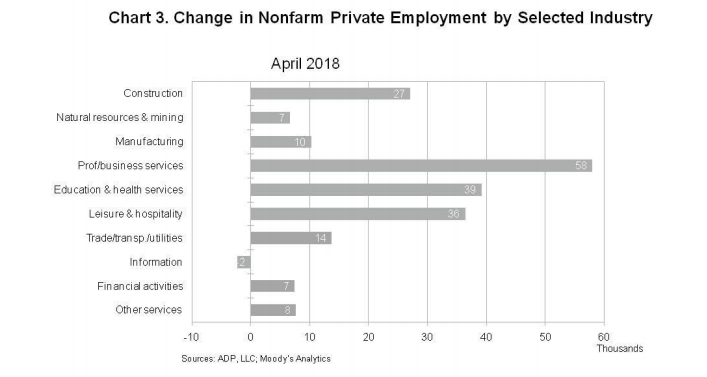
The economy added 204,000 jobs last month according to the ADP Employment Report. This was higher than expectations and is above the Street estimate for Friday's jobs report. Medium sized firms (50-500 employees) added the most jobs, and Professional and Business Services sector had the most growth. Construction added a lot of jobs as well. 


The FOMC announcement is scheduled for 2:00 pm EST today. No changes in rates are expected, but investors will be looking to see if the Fed changes its language about inflation running below target. The latest PCE index came in at 2%, which is the Fed's target. The second-order question will be to see whether the Fed changes their 2% rate from a symmetric target to a ceiling. The most likely outcome will be a "steady as she goes" statement and any changes will be communicated at the June meeting with a fresh set of economic forecasts. Today's announcement should be a nonevent. 

The Fed Funds futures are predicting a 6% chance of a hike at the May meeting and a 94% chance of a 25 basis point hike at the June meeting. 

The labor shortage is so acute in the Rust Belt that some towns are paying people to move there. Most of these small towns have a major demographic problem - younger workers moved to the cities in response to the Great Recession, leaving only the older workers who are now retiring. The fear is that labor shortages will prompt employers to leave, which will create a downward spiral.

Consumer advocates worry that Mick Mulvaney is not going to blow up the CFPB, but will neuter it with a thousand cuts. That said, the rhetoric from the left is a bit overblown. Mick Mulvaney said: “When I took over, we had roughly 26 lawsuits ongoing,” he told the House Appropriations Committee on April 18. “I dismissed one, because the other 25 I thought were pretty good lawsuits.”

Thursday, April 12, 2018

Morning Report: Minutes offer clues why the Fed keeps missing on inflation

Vital Statistics:

Last Change
S&P futures 2355.5 14.5
Eurostoxx index 377.42 1.23
Oil (WTI) 66.58 -0.24
10 Year Government Bond Yield 2.80%
30 Year fixed rate mortgage 4.39%

Stocks are rising this morning on no real news. Bonds and MBS are down. 

While investors are still worried about conflict in Syria, things seem to be settling down somewhat as Russia seemed to cool their rhetoric and Trump backed off from suggesting an attack was imminent. Call it WWE diplomacy: lots of trash-talking outside the ring, which often leads nowhere. 

The last of the 3 inflation indicators this week came in lower than expected. Import prices were flat month-over-month and rose 3.6% YOY. Import prices are driven by the currency and commodity prices, so the Fed tends to de-emphasize them.  

Initial Jobless Claims fell to 233,000 last week. The labor market continues to shrug off the volatility in the markets. 

The FOMC minutes didn't really reveal much we don't already know, however one statement stuck out. On the labor market, they mentioned that the labor force participation rate was stronger than they had expected. That is interesting because the conventional wisdom in the markets and Washington is that the labor force participation rate is too low. The implications of that view - that the labor force participation rate should be lower - means that their inflation forecasts going forward might be too high. They are forecasting the unemployment rate to fall lower, which would in theory trigger more wage inflation (companies fighting for fewer workers), and push the Fed to hike rates faster in response. If they are getting the forecasts wrong for the labor force participation rate, it means that (a) they have more room to let the economy run, and (b) the longer-term growth rate of the economy is higher. This is good news. Perhaps it is a realization that fewer people are retiring at 65, and many of those longer-term unemployed are returning to the labor force. The labor force participation rate acts as sort of a speed limit for the economy. As it rises, the speed limit rises as well. 

With regard to trade, this is what they had to say: "Participants did not see the steel and aluminum tariffs, by themselves, as likely to have a significant effect on the national economic outlook, but a strong majority of participants viewed the prospect of retaliatory trade actions by other countries, as well as other issues and uncertainties associated with trade policies, as downside risks for the U.S. economy." In other words, the trade war has to really escalate for it to register economically. 

Mick Mulvaney laid out his vision for the CFPB in his semiannual testimony to Congress yesterday. His prepared remarks are here. As he alluded to earlier, things are changing: "The Bureau is going about its work in several new ways. First, to execute the new mission, the Bureau will continue to seek the counsel of others and make decisions only after weighing relevant available evidence and a full range of perspectives. Second, the Bureau will protect the legal rights of all, equally. And third, we will do what is right with confidence, acting with humility and moderation." On enforcement, he said: In another change, the Bureau practice of “regulation by enforcement” has ceased. The Bureau will continue to enforce the law. That is our job, and we take it seriously. However, people will know what the rules are before the Bureau accuses them of breaking those rules. Finally, he stated that the CFPB will review the Home Mortgage Disclosure Act and recommend changes.

CoreLogic notes that we have yet to see any effects of the new tax regime on home price appreciation. It is still early, however. That said, we do have a lot of inventory at the higher price points - probably most of it was driven by building decisions over the past several years - however tax reform is certainly not helping, at least in the high price / high tax MSAs. 

Thursday, March 22, 2018

Morning Report: The Fed hikes rates

Vital Statistics:

Last Change
S&P futures 2699 -19
Eurostoxx index 371.42 -3.54
Oil (WTI) 63.42 1.36
10 Year Government Bond Yield 2.84%
30 Year fixed rate mortgage 4.46%

Stocks are lower this morning after the Fed hiked rates and the Bank of England decided to stand pat. Bonds and MBS are up. 

In a unanimous decision, the FOMC hiked the Fed Funds rate 25 basis points yesterday and released its new dot plot and projections. The projection materials showed a meaningful hike in projected GDP: from 2.5% to 2.7% in 2018 and from 2.1% to 2.4% in 2019. They also took down their estimate for unemployment: from 3.9% to 3.8% in 2018 and from 3.9% to 3.6% in 2019. They also cut their long term estimate of the unemployment rate from 4.6% to 4.5%. The dot plot bumped up their projections for the Fed funds rate across the board, by about a quarter in 2018 and 2019 and by 3/8 in 2020. The Fed funds futures didn't move much. The May futures are predicting no change, the June futures are predicting a 78% chance of another 25 basis point hike, and the Dec futures are predicting a 42% chance of another 25 basis point hike.

Note the dot plot comparison and how the interest rate forecasts inched up: Bill Gross isn't buying the forecast. He thinks a Fed Funds rate above 2% when inflation is only 2% will be too destabilizing in such a highly leveraged world. Of course Bill is probably talking his book a bit too.


Home prices rose 0.8% MOM and 7.3% YOY according to the FHFA House Price Index. The Middle Atlantic and Midwest lagged while the West Coast and Mountain states led. 

Initial Jobless Claims ticked up 3k last week to 229,000. 

The Index of Leading Economic Indicators came in much stronger than expected in February. January was revised upward as well. 

The Trump administration plans to announce $50 billion in tariffs against the Chinese for intellectual property violations. The US accuses China of using foreign investment restrictions to force US companies to share technology.

Fannie and Fred are stepping up their purchases of affordable housing loans under their "duty to serve" mandate. Between them, they will buy roughly 8,400 more loans for manufactured, rural, and affordable housing. The problem with these areas (especially rural areas) is that the low loan balances make the loans themselves less profitable. On the other hand, low balance loans generally have higher servicing values, all things being equal. The GSEs are targeting Appalacia, the lower Mississippi Delta, and Native American areas. 

Loan gestation times fell to 42 days in February, according to the latest Ellie Mae Origination Insights Report. This is a big drop on a year-over-year basis as well, which strips out some of the seasonality issues. Credit scores also fell a touch. 

Wednesday, March 21, 2018

Morning Report: Existing Home Sales increase

Vital Statistics:

Last Change
S&P futures 2719 -3.75
Eurostoxx index 374.05 -1.52
Oil (WTI) 63.42 1.36
10 Year Government Bond Yield 2.90%
30 Year fixed rate mortgage 4.46%

Stocks are lower as we await the FOMC decision. Bonds and MBS are down. 

The FOMC decision is scheduled to be released at 2:00 pm EST. This will be Jerome Powell's first rate hike and press conference, so the markets will be hanging on his every word. Here are some of the things the Street will be focusing on. The biggest will be the dot plot for the rest of the year. Do the tax cuts and planned infrastructure spend push the Fed to bump up their consensus of 3 hikes this year to 4%? If so, that is bearish for bonds (higher rates). Another will be the long term neutral Fed Funds rate, which currently stands at 2.8%. Do they move it up to 3%? That sort of revision would be taken as hawkish as well and would push rates higher. Finally, the long-term unemployment rate is currently set at 4.6%, which implies the current rate of 4.1% is too low. If they move down the longer-term unemployment rate, that could be interpreted as dovish. 

While most mortgage market participants are rightly focused on the 10 year bond yield, there is another rate that is gathering attention - LIBOR. LIBOR has been rising steadily over the past 18 months, and and 3-month LIBOR is at levels not seen since 2008. LIBOR and the 1 year T-bill rate are the reference index in many adjustable rate loans. What does this mean for the mortgage industry? Funding costs are rising, while volumes are falling. Not a good mix for profitability. Also note that this is yet another reason for borrowers with ARMs to consider a refi into a 30 or 15 year fixed rate mortgage. Long-term rates have been much more stable than LIBOR, and therefore the relative attractiveness is increasing. 


Note that increasing short-term rates are having a spill-over effect onto other asset classes. Long-term bonds have had no competition from money market instruments for a decade. That is changing. 

Mortgage Applications fell 1% last week as purchases rose 1% and refis fell 5%. 

Existing home sales rose 3% in February to a seasonally adjusted pace of 5.54 million. This is up 1.1% YOY. The median home price rose 5.9% to $241k. Total housing inventory stood at 1.59 million, which is 8% lower than a year ago.  The first-time homebuyer accounted for 29% of sales, which is down from 31% a year ago, and well below the historical average of 40%. Days on market fell to 37. The average contract rate for a 30 year mortgage increased 3 basis points to 4.33%. Distressed sales fell to 4%. Overall, it is the same story - tight inventory and rising prices.  

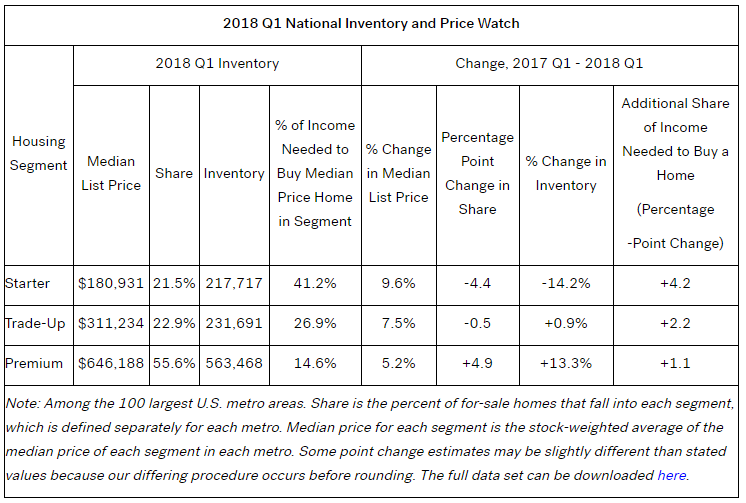
For the first time homebuyer, this is bad news, as most of the inventory is at the high end, not the low end. Starter homes in the Bay Area are over $800k, and engineers in Silicon Valley are struggling to pay the rent. Starter homes account for 22% of the inventory, while luxury accounts for almost 60%. 


Meanwhile, construction job openings are the approaching post-recession highs. Lack of labor remains the biggest issue for construction companies. 

Congress seems close to a deal to keep the government open after funding expires on Friday.  Fiscal conservatives will be unhappy, as the trade seems to be higher military spending for higher non-military spending. For originators, the biggest issue with a government shutdown is the inability to get 4506-T reports out of the IRS. 

Tuesday, March 20, 2018

Morning Report: FOMC meeting begins today

Vital Statistics:

Last Change
S&P futures 2725.25 3
Eurostoxx index 375.23 1.54
Oil (WTI) 62.97 0.91
10 Year Government Bond Yield 2.88%
30 Year fixed rate mortgage 4.43%

Stocks are higher this morning after yesterday's bloodbath in tech. Bonds and MBS are down small. 

Current funding for the government is set to expire on Friday, and Congress is still working on a plan to keep the lights on. Sticking points include funding for the military, the border wall, and the NY-NJ Hudson River Tunnel. Votes are looking likely for Thursday and Friday, so there isn't a lot of margin for error. Making matters worse is a major snowstorm which is set to hit the East Coast tomorrow. Washington is set to get 4-8 inches which could shut down government for the day. New York is set to get a foot. 

We could see some movements in interest rates over the next couple of days with the FOMC decision tomorrow and the Bank of England decision on Thursday. A 25 basis point hike is more or less assured, but the markets will be focused on the projection materials, particularly the dot plot. This will be Jerome Powell's first rate hike, so every word in the statement and everything he says in the press conference will be parsed even more closely that usual. 

The government is mulling a change in the bankruptcy laws that would allow more students to reduce or eliminate student loan debt in bankruptcy. High levels of student loan debt are one reason why the first time homebuyer has been missing in action in this housing recovery. As of now, tax debt and student loan debt are more or less permanent - bankruptcy doesn't eliminate them. Student loan servicers are required by Department of Education regulations to oppose bankruptcies, even if they know there is little chance of recovery. The servicers realize this is often throwing good money after bad. 

Freddie Mac crunched the numbers on how rising interest rates affect the housing market and the mortgage industry. Since 1990, increases in interest rates have dropped home sales by 5%, cut housing starts by 11% and cut mortgage origination by 30%. Of course the rate hikes since 1990 were in the context of a secular bull market in bonds that started around 1981 and ended around 2016 or so. In other words, these rate hikes were short-lived. This time around, that probably isn't happening. That said, starts are so depressed relative to demand to begin with that we probably won't see an 11% drop. Unless inflation picks up massively, the Fed will continue to go slow and will be loath to knock the economy back into a recession. 

As I mentioned yesterday, I have left iServe and am seeking a new opportunity. I will be contacting many of you over the next few days / weeks. 

Monday, March 12, 2018

Morning Report: Demand for Treasuries is falling

Vital Statistics:

Last Change
S&P Futures  2794.5 6.0
Eurostoxx Index 379.2 0.9
Oil (WTI) 61.5 -0.6
US dollar index 83.8 0.0
10 Year Govt Bond Yield 2.89%
Current Coupon Fannie Mae TBA 102.25
Current Coupon Ginnie Mae TBA 102.5
30 Year Fixed Rate Mortgage 4.4

Stocks are higher on no real news. Bonds and MBS are flat

This week will have some important economic data with housing starts on Friday and inflation data on Wednesday and Thursday. No Fed-speak as we are in the quiet period ahead of next week's FOMC meeting. 

As part of Dodd-Frank reform, Congress is looking at broadening the credit box for a qualified mortgage. Rural buyers, who typically use a smaller community bank, tend to have the biggest issues in getting a mortgage. Banks with $10 billion or less in assets could still get QM protection provided they meet some of the requirements and also hold the loan on their balance sheet. This change has bipartisan support - most everyone agrees that Dodd-Frank was too onerous for smaller banks. 

Investors are beginning to have less of an appetite at Treasury auctions. Treasury auctions are generally non-newsworthy events that happen every Monday. While there is no real risk of a failed auction, we are starting to see less demand for Treasuries, which is to be expected in a rising interest rate environment. That said, you might start to see interest rates move on auction results. Bid / Cover ratios are not yet part of the business press vernacular, but we could be heading there. Something to keep in mind if rates suddenly move on a Monday afternoon. 

Demand for Treasuries will drop if we see an honest-to-goodness trade war. Politicians make a big deal out of trade deficits, which sound worse than they really are. I run a massive trade deficit with my local deli: I buy lunch from them every day, and they never so much as buy a cup of coffee from me. China has chosen to accept Treasuries instead of our goods and services. If we buy less from them as the result of a trade war, they will buy less Treasuries, which would imply higher interest rates at the margin. 

That said, China (and to a less extent Canada) have real estate bubbles on their hands, and residential real estate bubble generally lead to banking crises. What happens when you have banking crises? Demand for risk-free assets rise. In China especially, we should see the trade deficit balloon if that happens, as they will try and export their way out of the recession, and their own workers will have less disposable income to buy US goods and services. A burst China bubble could recreate the economy of the 1990s, where the US gets a free lunch with non-inflationary low interest rates. In the 90s, Japan and China were "exporting deflation" to the US, which is part of the reason why the 90s felt so good. Of course instead of price inflation, we got asset bubbles instead which caused their own headaches. This time around, we won't have the same problem. People know that stocks and real estate aren't special assets that can only increase in price. 

Wednesday, January 31, 2018

Morning Report: Wages and salaries accelerating

Vital Statistics:

Last Change
S&P Futures  2835.5 11.0
Eurostoxx Index 396.6 0.4
Oil (WTI) 64.2 -0.3
US dollar index 83.0 0.0
10 Year Govt Bond Yield 2.71%
Current Coupon Fannie Mae TBA 103.591
Current Coupon Ginnie Mae TBA 103.688
30 Year Fixed Rate Mortgage 4.19

Stocks are higher this morning after global markets recovered overnight. Bonds and MBS are flat.

We should get the FOMC decision today around 2:00 pm EST. Be careful locking around then. The consensus seems to be that this will be a no change / hawkish tone type of statement. 

This will be Janet Yellen's last FOMC meeting. Jerome Powell seems to be cut more or less from the same cloth as Yellen, so the Fed's go-slow approach to hiking interest rates will probably continue. 

Treasury increased the size of its debt issues for the first time since 2009 this morning on the back of increased deficit spending and lower purchases from the Fed. They are offering $66 billion of 3, 10, and 30 year notes this time around, an increase from $62 billion in November. Less purchasing by the Fed plus increased issuance = higher interest rates, at least at the margin.  

Mortgage Applications fell 2.6% last week as both purchases and refis fell by the same amount. The average 30 year conforming rate increased 6 basis points to 4.41%

The ADP jobs number came in at 235,000 last month, which was higher than expectations. The Street is looking for 175,000 jobs in this Friday's jobs report. 

Compensation is accelerating, according to the Bureau of Labor Statistics. The Employment Cost Index rose 0.6% in the fourth quarter, and is up 2.6% YOY. Private Industry compensation rose faster than government, with wages and salaries up 2.8% YOY. A year ago, that annual increase was 2.3%. The industry with the biggest increase? Truck drivers. 

The "typical" mortgage payment rose 12% last year, according to CoreLogic. This measure takes the median home price and calculates the principal and interest payment using the prevailing Freddie Mac mortgage rate and assumes a 20% down payment. They are looking for this payment to increase another 13% next year as home prices and interest rates continue to rise. 

Pending home sales rose 0.5% in December, according to NAR. Home sales are being depressed by tight inventory despite strong growth in wages and jobs. 

Monday, January 29, 2018

Morning Report: Fed and Jobs report highlights of the week

Vital Statistics:

Last Change
S&P Futures  2867.8 -6.8
Eurostoxx Index 400.4 -0.2
Oil (WTI) 54.7 -0.4
US dollar index 83.4 0.3
10 Year Govt Bond Yield 2.71%
Current Coupon Fannie Mae TBA 103.591
Current Coupon Ginnie Mae TBA 103.688
30 Year Fixed Rate Mortgage 4.19
Stocks are lower this morning on no real news. Bonds and MBS are down.

This should be a big week for the bond market, with the FOMC meeting in the middle of the week and the jobs report on Friday. No move is expected at the FOMC meeting, but people will focus on the language of the statement. Since this is Janet Yellen's last meeting most of the attention will probably be on her and not the statement.

Aside from the Fed meeting this week, Treasury will announce 10 and 30 year bond issues, and the expectation is that it will be the first increase since 2009. With Treasury selling more paper, while the Fed cuts its purchases, it could be a rough week for bonds. 

Personal Incomes and Personal Spending rose 0.4% in December. The PCE price index was up .1% MOM / 1.7% YOY and the core PCE price index was up .2% MOM and 1.5% YOY. This puts the core PCE index at an increase of 1.5% for the year, and marks the 6th year in a row inflation has undershot the Fed's target. The savings rate is the lowest since 2005.

Freddie Mac's total loan portfolio increased 9% on an annualized basis in December. Their DQ rate slipped from 1.08% to .97%. 

Home prices rose annually for the 67th consecutive month to $283,000 according to the Black Knight Financial Services Home Price Index. The MOM gain was .27%. As of November, home prices were up 6.5% for the year. 

Thursday, December 14, 2017

Morning Report: The Fed bumps up its forecast for 2018 GDP

Vital Statistics:

Last Change
S&P Futures  2671.0 2.0
Eurostoxx Index 389.3 -1.4
Oil (WTI) 56.3 -0.4
US dollar index 86.9 0.1
10 Year Govt Bond Yield 2.37%
Current Coupon Fannie Mae TBA 102.531
Current Coupon Ginnie Mae TBA 103.591
30 Year Fixed Rate Mortgage 3.88

Stocks are higher after a relatively dovish FOMC statement. Bonds and MBS are down small after rallying hard after the announcement yesterday. 

As expected, the Fed raised rates a quarter of a percent yesterday and released their economic forecasts. This was Janet Yellen's last hurrah. The vote was 7-2 with two dissenters: Evans and Kashkari, who both wanted to maintain the current Fed Funds rate. Bonds rallied on the FOMC decision, largely due to the dot plot, which showed virtually no change from September, despite a big upward revision in the Fed's 2018 GDP forecast, which went from 2.1% to 2.5%. Their forecast for unemployment was revised downward from 4.1% to 3.9%, while their forecast for core inflation remained unchanged at 1.9%. It was a Goldilocks report for the markets. You can see the dot plot comparison below, with the central tendency right around 2%.


Note that the Fed Funds futures are currently predicting 1-2 hikes next year through November (we don't have December 2018 Fed Funds futures yet). So, the market is somewhat more dovish than the FOMC is, but they are pretty close. Note that one of the big trades on the Street right now is a bet that the Fed will blink and only raise rates 1-2 times next year. The other big trade that is happening right now: yield curve flattening trades, where traders bet that the difference in yield between the 2 year and the 10 year will decrease. 


Initial Jobless Claims fell to 225k last week. This is just off the post-crisis low of 223k, and you would have to go back to the early 1970s to find similar readings. The job market is pretty strong, provided you are employed. The long-term jobless still are with us, although it remains to be seen how many will (or even want to) re-enter the workforce. That untapped reservoir is probably one big reason why wage inflation continues to be muted. 

Retail Sales came in way stronger than expected, pointing to a strong holiday shopping season. The headline number was up 0.8%, as was the control group, which was a big jump from October, and above the highest point in the consensus range. The S&P SPDR Retailer ETF (XRT) is up about .63% in an otherwise flattish market early. 

The ECB maintained interest rates at current levels and cut their QE buying in half. Central bank demand for sovereign debt is being cut back globally. FWIW, we aren't really seeing that much of an impact in yields (Probably as people pile into curve flatteners, as described above). The German Bund is down with Treasuries. 

The NAR points out that the median age of renters is rising - it rose to 40 from 38 a year before. Given that the relative attractiveness of buying compared to renting is about as big as it ever has been, what gives? It is mainly empty-nest Boomers who are choosing to go with rentals, which means no more home maintenance. 

Bill Gross warns that the Fed really has to stop hiking rates once the Fed Funds rate gets around 2 - 2.25% or else it runs the risk of hurting the housing market. "A lot [of mortgages] are variable, floating-rate mortgages. And to the extent that the Fed has already raised interest rates by 75 to 100 basis points and is expect to raise by another 50 to 100 that affects the average monthly payments." He is correct on the ARM part of it, and with the Fed raising short term rates, while long-term rates stay in place, it is the time to refinance out of an ARM and into a 30 year fixed rate mortgage. While he does draw upon 2005 - 2006 as a comparison, we were in a bubble then. It really isn't similar to today, where inventory is so tight we probably won't see any price decreases. If anything, we are seeing bidding wars. 

Wednesday, December 13, 2017

Morning Report: Awaiting the Fed

Vital Statistics:

Last Change
S&P Futures  2667.8 0.0
Eurostoxx Index 391.3 -0.4
Oil (WTI) 57.7 0.5
US dollar index 87.3 0.0
10 Year Govt Bond Yield 2.42%
Current Coupon Fannie Mae TBA 102.531
Current Coupon Ginnie Mae TBA 103.591
30 Year Fixed Rate Mortgage 3.88

Stocks are flat as we await the FOMC decision today at 2:00 pm. Bonds and MBS are up on a weaker-than-expected CPI number.

The FOMC decision is set to be released around 2:00 pm EST. The Fed is almost certainly going to hike by 25 basis points, but the economic forecasts and the fed funds forecasts (the dot plot) will be the focus. The language of the statement will come into play as well, but the dot plot will be the first thing traders will look at. Loan officers, be careful locking around then. 

Mortgage applications fell 2.3% last week as purchases fell 1% and refis fell 3%. The 10 year bond yield inched up and mortgage rates hit their highest levels since March. 

Prices at the consumer level rose 0.4% in November and are up 2.2% YOY. Ex-food and energy, they rose 0.1% MOM and 1.7% YOY. The Fed prefers to focus on the personal consumption expenditure index, not CPI. Energy prices rose smartly in November, and accounted for about 3/4 of the increase in the index. The core rate was a touch below expectations. 

The House and Senate continue to work on reconciling their tax bills. It looks like the final compromise will result in a corporate tax rate of 21%, a mortgage interest cap of $750k, lowering the top rate to 37%, and setting the pass-through rate at 23%. Congress hopes to vote on a bill early next week, before Democrat Doug Jones, who won in Alabama last night, takes his seat. 

If the mortgage interest deduction cap falls to $750,000 it probably shouldn't make that big of a difference for home prices, and certainly not at the lower price points. Remember, the median house price in the US is about 1/3 of that number. But the bedroom communities of some of the bigger cities could see a softening, especially at the top end. 

The lack of affordable housing is a critical problem in this country, and many advocates are worried about tax reform. Affordable housing is largely driven by tax benefits, and those benefits are a function of tax rates. Lower tax rates, and the value of the tax benefits fall. A second issue is that commodity prices are rising, which increases construction costs. Lumber is up almost 15% from the beginning of the year, and OSB products are up 30%. 

Homeowners' equity increased by 1.3 trillion over the past year ending in September, as the value of the housing assets rose to $24.2 trillion and outstanding mortgage debt rose to $10 trillion. Homeowner's equity as a percentage of home value is pretty much back to pre-crisis levels. It has been mainly driven by home price appreciation, not decreasing mortgage debt, however. 


Thursday, November 2, 2017

Morning Report: Tax and Fed Head day

Vital Statistics:

Last Change
S&P Futures  2573.8 -1.0
Eurostoxx Index 395.3 -1.4
Oil (WTI) 54.3 0.0
US dollar index 87.7 0.0
10 Year Govt Bond Yield 2.37%
Current Coupon Fannie Mae TBA 102.875
Current Coupon Ginnie Mae TBA 103.938
30 Year Fixed Rate Mortgage 3.95

Stocks are flat after the Fed maintained rates and the Bank of England hiked them. Bonds and MBS are flat as well. 

As expected, the Fed maintained the current level of the Fed Funds rate and said its plan of tapering QE remained on track. Since there was no press conference or updated projections, there really wasn't much for the bond market to work with. The part that caught my eye was that the Fed saw risks to the economy as evenly balanced. Given the growth and the low unemployment rate the risks to the economy are probably to the high side. What is more likely? An uptick in inflation to 2 - 3% or a recession? 

Separately, the Atlanta Fed bumped up their estimate for Q4 GDP to 4.5%. That would work out to 3.1% growth for 2017. That said, hurricane effects didn't drag down Q3 all that much so we may not see that big of a rebound in Q4. This estimate is going to hinge on the holiday shopping season. 

Job cuts fell to 29,831 in October, the lowest in 20 years, according to outplacement firm Challenger, Gray, and Christmas. The health care sector had the biggest number of cuts. Separately, initial jobless claims fell to 229,000 last week. 

Perhaps an explanation of why we are starting to see wage growth: productivity rose to 3% in the third quarter. Lousy start / stop productivity growth has bedeviled the economy since 2008. Increases in productivity drive increases in real (non-inflationary) wages. Unit labor costs rose 0.5%. 

Donald Trump is expected to nominate Jerome Powell to run the Fed today. There are many that are disappointed that Yellen didn't get a second term, however Trump wants someone with private sector experience to run the Fed, after a string of academics. We probably won't see much difference between Powell and Yellen in terms of monetary policy (any differences would be so minor no one will notice) but there will be differences in regulatory approach. Janet Yellen was very much in the Obama mold of aggressive regulation. Powell is expected to be more balanced in his approach to the banks. 

The GOP is slated to release their tax reform bill today. There have been trial balloons galore floated, so nobody really knows what it will entail. The most likely change is a drop in the corporate tax rate (which may or may not be phased in and / or temporary), an increase in the standard deduction, and limitations on deductions for those that itemize. Some sacred cows are going to take a hit in this bill, and with zero expected Democratic votes, it will have a narrow path to approval. Here is what the latest handicapping has..

Donald Trump signed the Congressional Review Act override to the CFPB's arbitration rule. Eliminating the mandatory arbitration rule was always more about benefiting lawyers than consumers, and even the CFPB's own research showed that consumers get better compensation from arbitration than they do from class action suits (ever get an unexpected check in the mail for $1.37 after a class action suit you never heard of? The rest went to the legal fees). Small and medium sized financial firms will be the biggest beneficiaries of this rule.