A place where economics, financial markets, and real estate intersect.
Showing posts with label existing home sales. Show all posts

Wednesday, August 22, 2018

Morning Report: Existing home sales fall again

Vital Statistics:

Last Change
S&P futures 2856 -5.75
Eurostoxx index 383.91 -0.25
Oil (WTI) 67.32 0.89
10 Year Government Bond Yield 2.82%
30 Year fixed rate mortgage 4.58%

Stocks are modestly lower this morning after Paul Manafort was found guilty and Michael Cohen copped a plea. Bonds and MBS are flat.

Paul Manafort was found guilty of fraud and tax charges and there was a mistrial on the other charges. Nothing was found on the Russian front. Ex Trump lawyer Michael Cohen pled guilty to FEC violations, which relates to the Stormy Daniels case. Whether this ends up getting legs remains to be seen. FWIW, the markets are saying it is no big deal. 

We will get the FOMC minutes today at 2:00 pm. Given the lack of liquidity in the markets, we could see some market movement in what should otherwise be a non-event. 

Mortgage applications rose for the first time in 6 weeks as purchases rose 3% and refis rose 6%. Overall they rose 4.2%. Mortgage rates were unchanged, so that is a surprising jump in refi activity. Given that the index is sitting at lows not seen since the turn of the century, it doesn't take much of a bump in activity to move the index. 

Existing home sales fell again for the fourth month in a row. They fell 0.7% on a MOM basis and are down 1.5% on a YOY basis. This is the fifth straight month of YOY declines. It looks like much of the decline was attributable to weakness in the Northeast. The median house price rose 4.5% to 269,600.  Current estimates of median income are around 61,500, so that puts the median house to median income ratio around 4.4x. While other measures of housing affordability remain decent, this one is flashing red for valuations overall. The MP / MI ratio ignores interest rates, which are the biggest determinant of affordability, but over time house prices correlate with incomes, and it wouldn't be a surprise to see home prices begin to take a breather. 


Fed Chairman Jerome Powell assured Senator Tim Scott that the Fed remains independent despite the jawboning from Trump. Powell said in a radio interview: “We do our work in a strictly nonpolitical way, based on detailed analysis, which we put on the record transparently, and we don’t ... take political considerations into account,” Powell told the radio show. “I would add though that no one in the administration has said anything to me that really gives me concern on this front.” Separately, Dallas Fed Chairman Robert Kaplan said that the Fed only needs to hike 3 or 4 more times to get to neutral. 

Monday, July 23, 2018

Morning Report: Existing home sales and signs of financial stress in Europe

Vital Statistics:

Last Change
S&P futures 2798.25 -2
Eurostoxx index 384.88 -0.74
Oil (WTI) 68.98 0.72
10 Year Government Bond Yield 2.89%
30 Year fixed rate mortgage 4.51%

Stocks are flattish this morning as earnings continue to come in. Bond and MBS are down.

This should generally be a quiet week with regards to market-moving data, although we will get the first estimate of Q2 GDP on Friday. Aside from that, we do get some real estate data with existing home sales today and the FHFA House Price Index tomorrow. 

Existing home sales fell 0.6% in June, according to NAR. They are down 2.2% on a YOY basis. Blame low inventory. Lawrence Yun, NAR chief economist, says closings inched backwards in June and fell on an annual basis for the fourth straight month. “There continues to be a mismatch since the spring between the growing level of homebuyer demand in most of the country in relation to the actual pace of home sales, which are declining,” he said. “The root cause is without a doubt the severe housing shortage that is not releasing its grip on the nation’s housing market. What is for sale in most areas is going under contract very fast and in many cases, has multiple offers. This dynamic is keeping home price growth elevated, pricing out would-be buyers and ultimately slowing sales.”

Other stats from the report:
  • median home price 276,900 (up 5.2%)
  • Inventory 1.95 MM homes (4.3 month's worth)
  • Days on market 26 days (down from 28 last year)
  • First time buyers 31% of sales
  • All-cash transactions 22% (up from 18% last year)
  • Sales rose in the Northeast and Midwest, fell in the South and West
Manufacturing activity picked up in June, according to the Chicago Fed National Activity Index. May's abrupt downturn appears to have been a spurious data point, and not an indication of a change in trend. Employment and production-related indicators drove the increase in the index. So far, we aren't seeing trade issues reflected in the production indices, however there is the possibility that manufacturers are stockpiling inventory and accelerating some production ahead of sanctions which is masking the effect. That said, we would expect to see a drop in the employment indicators, which isn't happening.

Liquidity in the bond market is starting to dry up, at least if you measure by bid/ask spreads. Dodd-Frank rules were intended to curb proprietary trading but not market-making. Markets continued to function after the law was implemented, which gave some comfort to regulators that they were on the right track. Now that QE is ending, some of the market structure problems are getting exposed. Banks are less involved in market making and we are seeing bid / ask spreads increase in many markets. This is so far largely a European problem, however an anecdote from one fund who had trouble unwinding an Italian bond position is worrisome. They had a position in Italian sovereign debt and had trouble getting bids larger than $10 million, which is a miniscule trade - especially for G7 sovereign debt. So far it hasn't had a huge effect in the US, but this is something to watch, especially the next time we get a credit crunch. Investors may find entire swaths of the bond market go no-bid, which will include the ETFs linked to these bonds. Tight bid-ask spreads and regulations might be good news for investors and taxpayers in normal times, but they aren't free. 

Despite the issues in the Euro bond markets, stress in the financial system did decrease slightly last month, according to the St. Louis Fed. Historically we are at very low levels, however the Fed is still employing extraordinary measures to support the market, so the past isn't really all that comparable. 


Interesting concept for real estate investors: Now there are a couple of online platforms that allow people to bid on single-family rental properties on line. Not sure what the fee is to transact, but the company also helps connect the investor with a mortgage lender and a property manager. 

CFPB nominee Kathy Kraninger took a lot of heat from Democrats on Friday regarding her role in the Trump Administration's border family separation policies. Not sure how much OMB (her current role) has in DOJ and DHS policy making but Democrats spent a lot of time on the issue. There is a lot of concern that she doesn't have the financial regulatory background to run the agency, however her nomination does allow the Administration to reset the clock on Mulvaney's tenure and he gets to stay if she doesn't get confirmed by the Senate. Either way, the CFPB is getting reined in.

Thursday, June 21, 2018

Morning Report: Almost a third of MSAs are overvalued

Vital Statistics:

Last Change
S&P futures 2771 -0.75
Eurostoxx index 383.16 -1.13
Oil (WTI) 65.91 0.84
10 Year Government Bond Yield 2.93%
30 Year fixed rate mortgage 4.57%

Stocks are flattish this morning on no real news. Bonds and MBS are up small. 

Initial Jobless Claims fell by 3,000 to 218,000, while the Index of Leading Economic Indicators increased by 0.2%, below expectations. This index is predicting that growth will moderate in the coming months. Note that Goldman has taken its Q2 GDP estimate up to 4%, which is a torrid pace.  

Mortgage Applications rose 5.1% last week as purchases rose 4% and refis rose 6%. Mortgage rates were more or less unchanged for the week. 

Existing Home Sales fell 0.4% last month to a seasonally adjusted annual rate of 5.43 million. Existing Home Sales are down 3% on a YOY basis, making this the third consecutive month with a YOY decline. The median house price hit a record, rising 4.9% to $264,800. While restricted supply has been an ongoing issue, the market is beginning to feel the pinch of rising rates and prices. The first time homebuyer accounted for 31%, which is a decrease and well below the historical norm of 40%. At current run rates, we have about 4.1 month's worth of inventory. Some realtors noted that potential sellers are pulling their homes off the market for fear they won't find a replacement. We need a dramatic increase in home construction to fix the issue and so far we are seeing modest increases. 

Speaking of home price increases, the FHFA reported that prices rose 0.1% MOM in April and are up 6.4% YOY. Since the FHFA index ignores jumbo and non-QM, this is prime first-time homebuyer territory. Home price appreciation is beginning to converge as the laggards like the Mid-Atlantic (which covers NY and NJ) are picking up steam. The dispersion a year ago was huge. 


CoreLogic estimates that a third of all MSAs are now overvalued. The last time we hit this level was early 2003, just before the bubble hit its stride. It is natural to ask if we are in another bubble, and IMO the answer is "no." The term "bubble" gets thrown around so much that it has lost its meaning. The necessary conditions for a bubble (magical thinking on the part of buyers and the financial sector) just aren't there. China has a bubble. Norway has a bubble. The US does not. 

The US coastal and Rocky Mountain areas have the most overvalued residential real estate, but aside from that it is still cheap / fairly valued elsewhere. Either the overvalued MSAs will start building more homes, or the employers in those MSAs will begin to move more operations to cheaper areas. You can see that already with Amazon.com de-emphasizing Seattle. Some MSAs become to cheap to ignore (the Rust Belt, for instance) and others become so expensive that companies cannot attract entry-level talent anymore. For a hotshot MIT data scientist, working at Google or Facebook sounds very cool, but if you can't afford an apartment are you really going to be willing to work there? 


Foreclosure starts fell in May to 44.900, which is a 17 year low. The foreclosure rate of 0.59% is the lowest in 15 years. At the current rate of decline, the foreclosure inventory is set to hit pre-recession levels later this year. The Northeast still has a foreclosure backlog to deal with, but the rest of the country has moved on. 

HUD is asking for public input into its disparate impact rules, which were dealt a blow at SCOTUS. Disparate impact is a highly controversial legal theory that says a company is guilty of discimination even if they didn't intend to discriminate - if the numbers don't match the population the lender is guilty, no questions asked. That theory was dealt a blow with a 2015 ruling that said the plaintiff must be able to point to specific policies of the lender that explain the disparate impact. HUD is now looking to tweak the language to conform to this ruling. 

Incoming CFPB nominee Kathy Kraninger is getting some static from Democrats due to her position at DHS. They are asking questions about her role in the zero tolerance policy and child separations. Elizabeth Warren is putting a hold on her nomination until she answers these questions. That may not be a disappointment to the Administration however. The gameplan may be to slow-walk a new CFPB nominee in order to keep current Acting CFPB Chairman Mick Mulvaney at the helm of the agency. 

Thursday, May 24, 2018

Morning Report: 10 year trades below 3% on slightly dovish FOMC minutes

Vital Statistic:

Last Change
S&P futures 2726 -4
Eurostoxx index 392.54 -0.07
Oil (WTI) 71 -0.84
10 Year Government Bond Yield 2.98%
30 Year fixed rate mortgage 4.61%

Stocks are lower after Trump threatened more tariffs on autos. Bonds and MBS are up on the dovish FOMC minutes.

Initial Jobless Claims ticked up to 234,000 last week.

Existing home sales fell 2.5% in April, according to NAR. Sales fell to an annualized pace of 5.46 million, down from 5.6 million in March, which was also the Street estimate. Lawrence Yun, NAR chief economist, says this spring’s staggeringly low inventory levels caused existing sales to slump in April. “The root cause of the underperforming sales activity in much of the country so far this year continues to be the utter lack of available listings on the market to meet the strong demand for buying a home,” he said. “Realtors® say the healthy economy and job market are keeping buyers in the market for now even as they face rising mortgage rates. However, inventory shortages are even worse than in recent years, and home prices keep climbing above what many home shoppers are able to afford.”

Other tidbits from the report: the median home price increased 5.3% to $257,900, inventory of 1.8 million homes represents a 4 month supply, days on market fell to 26 days, and the first time homebuyer was 33% of all transactions.

US house prices rose 1.7% in the first quarter, according to the FHFA House Price Index. On a YOY basis, they were up almost 7%. The West Coast continued to lead the pack with high single-digit growth rates, and the Middle Atlantic showed an acceleration of growth. Over the past 5 years, the Middle Atlantic (NY, NJ, PA) has been the slowest appreciating region, growing just over half the rate of the West Coast.


The FOMC minutes were a bit more dovish than expected - the Fed Funds futures are now handicapping a 37% chance of 4 hikes this year, down from the mid 40% yesterday. The FOMC is worried about a trade war with China depressing economic activity. On inflation, they emphasized the symmetry of the inflation goal. "Most participants viewed the recent firming in inflation as providing some reassurance that inflation was on a trajectory to achieve the Committee’s symmetric 2 percent objective on a sustained basis." Overall, nothing was all that new, just a re-affirmation of symmetry, meaning that the 2% target is not a ceiling.

Dallas Fed Head Robert Kaplan thinks the Fed has about 4 more hikes to go before it is at a "neutral" stance. He also discussed his views of inflation above 2%: "I want to run around 2, and if we got a little bit above it and I thought it would be short-term and not long-term, I could tolerate it"

As anyone who attended the Secondary Conference could tell you, mortgage banking is going through a rough stretch right now. Digitalization of mortgage banking has compressed margins and volumes are down. Even people that want to move are finding a dearth of inventory. What could be the catalyst to turn things around? Buy-side firms ringing the register on the REO-to-rental trade. That would bring back enough purchase activity to allow some of the smaller firms to retrench and get their costs under control. Wishing for falling rates is probably a long shot, although if the 10 year finds a level here, we could see rates come in a little, but probably not enough to bring back refis.

Refi activity is going to be concentrated in two areas: cash out to refinance credit card debt, etc, and FHA refis into conforming once the homeowner has enough equity to get under the 80% LTV threshold and avoid having to pay PMI.

While the mortgage business is going through a rough patch, quarterly profits for banks are spiking (tax reform has some effects here). The banking sector largely sat out the M&A boom that has been common throughout other industries. The US market is still about the least concentrated banking market on the planet. Is it time for some M&A? 

Monday, April 23, 2018

Morning Report: 10 year pushing towards 3%

Vital Statistics:

Last Change
S&P futures 2675 3.9
Eurostoxx index 381.41 0
Oil (WTI) 67.33 -1.07
10 Year Government Bond Yield 2.97%
30 Year fixed rate mortgage 4.51%

Stocks are higher this morning on no real news. Bonds and MBS are down. 

US Treasury Secretary Steve Mnuchin signaled that the US is ready to discuss a truce in the trade war with China. He characterized his mood as "cautiously optimistic" and said he won't make a commitment on timing. Beijing welcomed the announcement. Separately, Mnuchin also discussed easing sanctions on Rusal which sent aluminum prices back down. 

Existing home sales rose on a month-over-month basis in March, but are down on an annual basis according to NAR. Lawrence Yun, NAR chief economist, says closings in March eked forward despite challenging market conditions in most of the country. "Robust gains last month in the Northeast and Midwest – a reversal from the weather-impacted declines seen in February – helped overall sales activity rise to its strongest pace since last November at 5.72 million," said Yun. "The unwelcoming news is that while the healthy economy is generating sustained interest in buying a home this spring, sales are lagging year ago levels because supply is woefully low and home prices keep climbing above what some would-be buyers can afford."

The median home price was $250,400, up 5.8% YOY. Inventory is down over 7% YOY to 1.67 million units, which represents a 3.6 month supply at current sales levels. A historically balanced market would be 6.5 month's worth. Properties stayed on market for an average of 30 days, which is down almost a week YOY. The first time homebuyer accounted for 30% of sales, and all-cash sales were 20% of transactions.

Commodity price inflation has pushed the 10 year yield to 3%. Many technical analysts consider that to be confirmation that the 3 decade bull run in bonds is over. The one caveat is that the sell-off is being driven by rising commodity prices which tends to be temporary, especially if it doesn't translate into wage growth. You can see the pop in yields post-election below. Hard to believe we were sub 1.8% in late October 2016.


This week will have some important data to the bond market, with GDP and the employment cost index on Friday. We will also get a slew of housing data with existing home sales, new home sales, and Case-Shiller. 

The Street estimate for Q1 GDP is 2%. Generally speaking, the estimates from the banks are lower than the estimates from the regional Federal Reserve banks. 

Economic activity moderated in March, according to the Chicago Fed National Activity Index. Production and employment indicators fell. February's reading was unusually strong, however. The CFNAI is a meta-index of 85 different economic indices, and can be volatile. It isn't a market-mover. 

A paper suggests that the ratings agencies largely got it right with the bubble-era RMBS. The AAA tranches (even subprime) were largely money good, and the study pours cold water on the popular narrative that inflated ratings on RMBS caused the financial crisis. 

The big banks are rushing to launch websites and apps for mortgages as volume contracts. Bank of America, Wells Fargo, and JP Morgan have either launched or plan to launch mortgage banking tech products in response to Rocket Mortgage from Quicken. The company claims that 98% of its customers in the first quarter (some $20 billion in origination) accessed Rocket at some point in the application process. That is an astounding number, though I wonder if that includes push notifications that the borrower didn't necessarily respond to or interact with. 

Speaking of tech, HUD is looking into allegations of housing discrimination by Facebook. Facebook uses big data to allow advertisers to slice and dice the demographics any way they want to target their specific market. What if advertisers decide to target some demographics and not others? That is considered non-problematic for things like consumer products, but housing could be a different story. 

Wednesday, March 21, 2018

Morning Report: Existing Home Sales increase

Vital Statistics:

Last Change
S&P futures 2719 -3.75
Eurostoxx index 374.05 -1.52
Oil (WTI) 63.42 1.36
10 Year Government Bond Yield 2.90%
30 Year fixed rate mortgage 4.46%

Stocks are lower as we await the FOMC decision. Bonds and MBS are down. 

The FOMC decision is scheduled to be released at 2:00 pm EST. This will be Jerome Powell's first rate hike and press conference, so the markets will be hanging on his every word. Here are some of the things the Street will be focusing on. The biggest will be the dot plot for the rest of the year. Do the tax cuts and planned infrastructure spend push the Fed to bump up their consensus of 3 hikes this year to 4%? If so, that is bearish for bonds (higher rates). Another will be the long term neutral Fed Funds rate, which currently stands at 2.8%. Do they move it up to 3%? That sort of revision would be taken as hawkish as well and would push rates higher. Finally, the long-term unemployment rate is currently set at 4.6%, which implies the current rate of 4.1% is too low. If they move down the longer-term unemployment rate, that could be interpreted as dovish. 

While most mortgage market participants are rightly focused on the 10 year bond yield, there is another rate that is gathering attention - LIBOR. LIBOR has been rising steadily over the past 18 months, and and 3-month LIBOR is at levels not seen since 2008. LIBOR and the 1 year T-bill rate are the reference index in many adjustable rate loans. What does this mean for the mortgage industry? Funding costs are rising, while volumes are falling. Not a good mix for profitability. Also note that this is yet another reason for borrowers with ARMs to consider a refi into a 30 or 15 year fixed rate mortgage. Long-term rates have been much more stable than LIBOR, and therefore the relative attractiveness is increasing. 


Note that increasing short-term rates are having a spill-over effect onto other asset classes. Long-term bonds have had no competition from money market instruments for a decade. That is changing. 

Mortgage Applications fell 1% last week as purchases rose 1% and refis fell 5%. 

Existing home sales rose 3% in February to a seasonally adjusted pace of 5.54 million. This is up 1.1% YOY. The median home price rose 5.9% to $241k. Total housing inventory stood at 1.59 million, which is 8% lower than a year ago.  The first-time homebuyer accounted for 29% of sales, which is down from 31% a year ago, and well below the historical average of 40%. Days on market fell to 37. The average contract rate for a 30 year mortgage increased 3 basis points to 4.33%. Distressed sales fell to 4%. Overall, it is the same story - tight inventory and rising prices.  

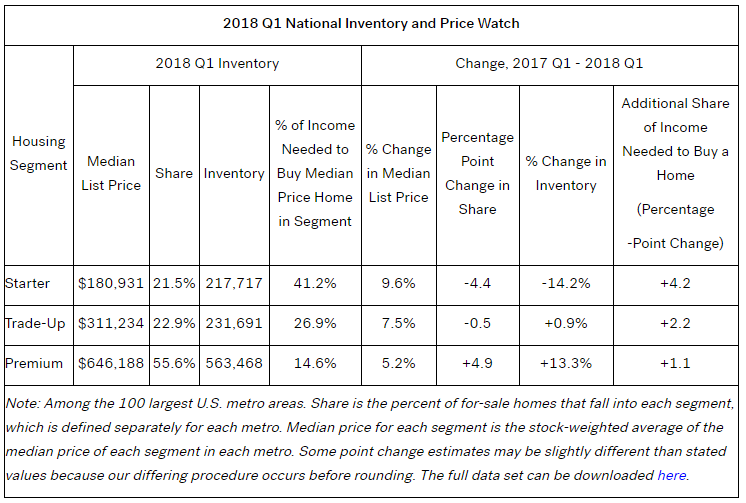
For the first time homebuyer, this is bad news, as most of the inventory is at the high end, not the low end. Starter homes in the Bay Area are over $800k, and engineers in Silicon Valley are struggling to pay the rent. Starter homes account for 22% of the inventory, while luxury accounts for almost 60%. 


Meanwhile, construction job openings are the approaching post-recession highs. Lack of labor remains the biggest issue for construction companies. 

Congress seems close to a deal to keep the government open after funding expires on Friday.  Fiscal conservatives will be unhappy, as the trade seems to be higher military spending for higher non-military spending. For originators, the biggest issue with a government shutdown is the inability to get 4506-T reports out of the IRS. 

Wednesday, February 21, 2018

Morning Report: Existing home sales fall

Vital Statistics:

Last Change
S&P Futures  2715.3 1.3
Eurostoxx Index 379.1 -1.4
Oil (WTI) 61.8 0.1
US dollar index 83.8 0.2
10 Year Govt Bond Yield 2.88%
Current Coupon Fannie Mae TBA 103.591
Current Coupon Ginnie Mae TBA 103.688
30 Year Fixed Rate Mortgage 4.4

Stocks are flattish this morning on no real news. Bonds are lower after a tough auction yesterday. 

Mortgage Applications fell 6.6% last week as purchases fell 6% and refis fell 7%. Higher mortgage rates are beginning to bite. 

Existing Home Sales fell 3.2% in January, according to the National Association of Realtors. Lawrence Yun, NAR's Chief Economist said: “The utter lack of sufficient housing supply and its influence on higher home prices muted overall sales activity in much of the U.S. last month. While the good news is that Realtors® in most areas are saying buyer traffic is even stronger than the beginning of last year, sales failed to follow course and far lagged last January’s pace. It’s very clear that too many markets right now are becoming less affordable and desperately need more new listings to calm the speedy price growth.” The median home price rose 5.8% to $240,500. Inventory rose, however it still remains extremely tight at 3.4 month's worth of supply. The rise in prices and scant inventory may be scaring away the first time homebuyer which dropped to 29% of sales. Historically, that number has been closer to 40%.

The FOMC minutes from the January meeting are scheduled to be released at 2:00 pm EST today. Investors noted a slight change in the January FOMC statement, where the need for "gradual adjustments" in interest rates was changed to "further gradual adjustments" in interest rates. They hope to get more clarity on what message the Fed intends to send with that change of language, however we probably will have to wait until the March meeting when the Fed releases their new dot plot of expected interest rate movements. As of now, the consensus seems to be a total of 3 hikes this year, at least according to the Fed Funds futures. New York Fed Chairman William Dudley said in an interview that the statement was meant to reflect further strength in the economy. 

Homeowners will be able to deduct mortgage insurance premiums on their 2017 returns thanks to a last-minute change in the budget. Borrowers must have adjusted gross income below $100k and the insurance must apply to their principal residence. No word on whether this will continue, and it will probably be a moot point anyway as taxpayers with AGIs under 100k will probably be better off taking the standard deduction most of the time. The tax liability on principal forgiveness also was extended for another year. This would apply to homeowners who get principal forgiven in loan modifications, short sales, and foreclosures. The tax code treats forgiven debt as ordinary income, and the people who go through mods or foreclosures are usually in such financial trouble to begin with that the last thing they need is an additional tax bill. 

The Supreme Court yesterday declined to hear a lawsuit brought by Fannie Mae shareholders which challenges the government's sweep of all of Fannie's profits into the Treasury. This isn't the end of the road for the investors however - they have one more claim pending in the U.S Court of Federal Claims in DC. Fannie Mae stock is down about 5% pre-open. 

Merger mania in the mortgage banking space continues. Mr. Cooper has been bought by WMIH in a cash and stock transaction worth $3.8 billion in cash, stock and assumed debt. Mr. Cooper and WMIH are the new monikers for old stalwarts Nationstar (or IndyMac) and Washington Mutual. Separately, Flagstar has bought the mortgage warehousing operations of Santander Bank. 

Wednesday, December 20, 2017

Morning Report: Is the Trump Reflation Trade returning?

Vital Statistics:

Last Change
S&P Futures  2693.3 -0.3
Eurostoxx Index 390.5 -0.5
Oil (WTI) 57.5 0.3
US dollar index 86.8 0.0
10 Year Govt Bond Yield 2.49%
Current Coupon Fannie Mae TBA 102.531
Current Coupon Ginnie Mae TBA 103.375
30 Year Fixed Rate Mortgage 3.88

Stocks are higher this morning as tax reform looks set to pass. Bonds and MBS are down. 

The Senate passed tax reform, and it looks like we'll need a second vote in the House because of the name. Stocks like it, and bonds are selling off. That said, bonds are selling off worldwide, so it isn't just the US. 

Hot on the heels of tax reform comes funding the government, as normal funding runs out on Friday.  Mitch McConnell has vowed there will be no government shutdown, and he is probably correct, as the continuing resolution will be larded up with all sorts of unrelated measures to garner the necessary votes. The big threat is if Democrats demand some sort of immigration deal or if conservatives balk at stabilizing Obamacare or re-authorizing CHIP. Politicians talk about "Christmas Tree" bills, where everyone gets an ornament (or a priority satisfied). Given the silence in the media and the absence of leaks, it appears that is exactly what is going on. Just in time for the season, I guess.  

The 10 year broke through support yesterday, which caused a sell-off driven by stop-loss selling on the part of technical traders.  Don't forget, one of the biggest trades on the Street right now is the yield curve flattening trade, where investors are long the 10 year and short the 2 year (or some variation of that). Yesterday, people got carried out on that trade as the losses on the 10 year side of the trade were not offset by gains on the 2 year. My point on this is that the movement in the 10 year over the past couple of days has a lot of noise in it, caused by temporary technical trading. It might just be a blip. 


Does the passage of tax reform bring the Trump Reflation Trade back into play? The Trump Reflation Trade refers to the rally in stocks and the sell-off in bonds that we saw a year ago based on policy expectations in Washington. The markets were expecting a tax cut and an infrastructure spending plan which would goose the economy and drive investors out of safe assets like Treasuries into riskier assets like stocks and corporate bonds. That trade petered out, at least on the bond side of the ledger as getting anything passed in Washington looked almost impossible. We had a nice rally in bonds in Spring and have been stuck in a narrow range since. With tax reform now done, and talks of infrastructure spending next year, we could see a repeat, where bonds test the early 2017 levels around 2.6%. That said, I would be extremely surprised to see a deal on infrastructure, as 2018 will be all about midterm elections and posturing ahead of them. 

The tax bill made some changes that are positive for housing and the mortgage industry. The biggest one for many smaller independent originators concerns mortgage servicing rights and the recognition of income for tax purposes. The original bill would have required originators to pay the tax up front for the MSR portion of the gain on sale. Since MSRs are not cash, it would have hurt the cash flows of many smaller originators and perhaps driven them out of servicing. The tax treatment for MSRs remains unchanged. Second, affordable housing advocates were worried about two provisions that would have possibly discouraged affordable housing construction - the removal of the Low Income Housing Tax Credit and Private Activity Bonds. Those provisions remain unchanged. 

Mortgage Applications fell 4.9% last week as purchases fell 6% and refis fell 3% despite a drop in rates. 

Existing Home Sales rose 5.6% to a seasonally adjusted annualized value of 5.81 million, which is the highest since 2006. The median home price rose 5.8% to $248,000. There are 1.67 million homes for sale, which represents about 3.4 month's worth. The first time homebuyer was 29% of sales, and we saw cash-only sales (think investors) increase to 22%. The new tax bill will make it somewhat more attractive to be a landlord, so we could see some effect here, especially at the lower price points. 

Tuesday, November 21, 2017

Morning Report: Existing Home Sales fall again

Vital Statistics:

Last Change
S&P Futures  2590.3 8.3
Eurostoxx Index 388.5 2.1
Oil (WTI) 56.2 -0.3
US dollar index 87.4 -0.1
10 Year Govt Bond Yield 2.36%
Current Coupon Fannie Mae TBA 102.651
Current Coupon Ginnie Mae TBA 103.494
30 Year Fixed Rate Mortgage 3.9

Stocks are higher this morning on overseas strength. Bonds and MBS are flat.

Existing Home Sales rose 0.7% in September, according to NAR. This was the second slowest this year, behind August. Overall, sales were down 1.5% YOY. Tight inventory and the hurricanes affected sales. The median home price increased 4.2% YOY to 245k. Inventory was 4.2 month's worth. First time homebuyers fell to 29% of sales, driven by a dearth of inventory at the lower price points. The NAR also puts in a plug for maintaining the mortgage interest deduction and the state / local tax deductions, as eliminating them will make homeownership more expensive. “There's no way around the fact that any proposal that marginalizes the mortgage interest deduction and eliminates state and local tax deductions essentially disincentives homeownership and is a potential tax hike on millions of middle-class homeowners,” said Brown. “Reforming the tax code is a worthy goal, but it should not lead to the middle class, who primarily build wealth through owning a home, footing the bill. Instead, Congress should be looking at ways to ensure more creditworthy prospective buyers are able to achieve homeownership and enjoy its personal and wealth-building benefits.”

Economic activity picked up in October, according the Chicago Fed National Activity Index. Production-related indicators drove the increase. Employment-related indicators were positive, but less so than September. The economy definitely seems to be accelerating. 

What is driving global growth? China and India for the most part, but it looks like Japan is waking from its long slumber at last. Japanese growth has been missing since the early 90s and is transitioning from being a drag on global growth to a driver of it. Don't forget, Japan is the third biggest economy in the world and has been largely moribund since the early 90s. Want to see what a real bear market in stocks looks like? Take a look at the long term chart of the Nikkei 225: The Nikkei is hitting 20 year highs, and is still 43% below its 1989 peak. 


The Japanese resurgence will probably mean higher interest rates, at least at the margin, as well as higher commodity prices. Much of this will depend on what happens in China, which has a massive real estate bubble and will probably have to go through a secular recession like the US did in the 30s and Japan did for the last 2 decades. 

Janet Yellen said she will resign her position on the Federal Reserve Board once Jerome Powell is sworn in. “As I prepare to leave the Board, I am gratified that the financial system is much stronger than a decade ago, better able to withstand future bouts of instability and continue supporting the economic aspirations of American families and businesses,” Yellen said in her resignation letter. Her term officially expires in 2024, but it is rare for an ex-chairman to stay on. Donald Trump will have four open positions to fill, leaving him with the ability to make his mark on the Fed.


Friday, October 20, 2017

Morning Report: Existing Home sales still muted

Vital Statistics:

Last Change
S&P Futures  2565.8 5.3
Eurostoxx Index 390.2 1.1
Oil (WTI) 51.0 -0.3
US dollar index 86.7 0.2
10 Year Govt Bond Yield 2.35%
Current Coupon Fannie Mae TBA 102.875
Current Coupon Ginnie Mae TBA 103.938
30 Year Fixed Rate Mortgage 3.9

Stocks are higher after the Senate passed a budget resolution which allows tax reform to go forward. Bonds and MBS are down. 

Existing Home Sales increased 0.7% in September, according to the National Association of Realtors. This is down 1.5% YOY. September's number was only slightly higher than August, which was the lowest reading in a year. The median home price rose 4.2% to 245,100. Inventory is still a big problem, down YOY at 4.2 month's worth from 4.5 a year ago. The first time homebuyer was 29% of sales, which was a drop. There is a complete dearth of listings at the low end of the market. 

The Senate passed a budget resolution last night on party lines (with Rand Paul voting against) which allows tax reform to go forward on a simple majority. There are still a couple of differences between what the House and Senate are willing to accept. The House wants to see revenue-neutral tax reform, while the Senate is willing to accept an increase in the deficit. The House version includes spending cuts to offset the tax cuts, while the Senate version envisions additional revenue from allowing more oil production in Alaska. They hope to have a deal by the end of the year. 

General Electric missed earnings badly this morning, however this appears to be a bit of a kitchen sink release for the new CEO. Regardless, the stock is down 6% this morning. GE historically has been a bellwether for the entire stock market, but today the FAANGs run the show. 

The next Fed nominee is reportedly a horse race between Jerome Powell and John Taylor. Trump is expected to make his announcement in the next couple of weeks. Insiders say that Powell is the favorite of the two. Both nominees are more hawkish than Janet Yellen, which means rates will go up faster and higher, at least at the margin. In all honesty, the practical differences between Yellen and these nominees is not all that large. It probably won't make any difference to the economy. 

The increasing digitization of real estate transactions has increased the risk of fraud. Scammers are issuing emailed instructions to change wire transfer destinations on closing day. The best step buyers can take is simply to be aware of the potential for fraud and to verify everything, especially changes in wiring instructions. 

The latest CoreLogic Market Pulse takes a look at the effects of the hurricanes on local real estate markets. They estimate that 70% of the flood damage in the Houston area is uninsured. This will be a nightmare for loan servicers. Separately, Black Knight Financial Services is seeing about a 9% jump in past-due mortgages due to the hurricanes. In fact, September had the first year-on-year increase in delinquencies since 2010. 

Wednesday, September 20, 2017

Morning Report: Awaiting the Fed

Vital Statistics:

Last Change
S&P Futures  2504.5 0.0
Eurostoxx Index 381.8 -0.4
Oil (WTI) 50.0 0.5
US dollar index 85.1 -0.2
10 Year Govt Bond Yield 2.24%
Current Coupon Fannie Mae TBA 103.24
Current Coupon Ginnie Mae TBA 104.21
30 Year Fixed Rate Mortgage 3.85

Stocks are flat as we await the FOMC decision. Bonds and MBS are down small. 

The FOMC decision is due out at 2:00 pm EST and Janet Yellen will hold a press conference at 2:30 PM. While no changes in interest rates are expected, there could be some market movement, especially if we see surprising changes to the economic forecast or the dot plot.  At the June meeting, the FOMC was predicting GDP growth of 2.2% for 2017, unemployment of 4.3% and PCE inflation of 1.6%. GDP growth averaged a touch over 2% for the first half, so the Fed is clearly anticipating a stronger second half. The markets are also looking for some guidance on tapering MBS and Treasury purchases. Given how much rates have risen over the past couple of weeks, we could be due for a bit of a "buy the rumor, sell the fact" rally post event. 


Mortgage Applications decreased 9.7% last week due to an increase in rates and the effects of Hurricanes Harvey and Irma. Purchases decreased 11% and refis fell 9%. Treasury rates increased 11 basis points. The hurricanes were a big driver of the drop: ex-Florida and Texas, applications increased 13%, however there are all sorts of seasonal adjustments, along with the effect the Labor Day comparison that come into play as well. 

Existing Home Sales came in at 5.35 million in August, a drop of 1.7% from the July reading of 5.44 million. SFR sales fell while condos rose. Hurricane Harvey probably had some effect on August sales, however the overriding concern is lack of inventory which fell to 1.88 million homes, which represents a 4.2 month supply at current rates. The median home price rose to 253,500, an increase of 5.6% YOY. The first time homebuyer accounted for only 31% of sales, the lowest in a year. Historically, that number has been closer to 40%. 

Hurricane Maria is expected to hit bankrupt Puerto Rico and then move up the East Coast. Most of the spaghetti tracks predict it won't hit the US East Coast, but it is still very early.

Looking to buy your first house? Trulia advises you to start looking now, as starter home inventory peaks and prices bottom in the seasonally slow period. They find that inventory for starter homes actually rises 7% in fall months and prices are 3% - 4% lower compared to the spring and summer seasons. Separately, tight inventory remains an issue. On a year-over-year basis, starter home inventory is down 20% this quarter, while move up is down 12% and luxury is down 2%. Overall, inventory is down 9% YOY nationally. 

In response to Hurricanes Irma and Harvey, HUD, Fannie, and Freddie have provided some disaster relief for borrowers in areas affected by the storms. There will be a 90 day moratorium on foreclosures, as well as increases in SBA loans and 203k loans to help people rebuild homes destroyed in the storm. 

Credit card delinquencies are on the rise as consumer borrowing is outpacing income growth (again). Note subprime auto DQs are on the rise too. Mortgage delinquencies are still falling, which is good news.

Thursday, August 24, 2017

Morning Report: Existing Home Sales fall

Vital Statistics:

Last Change
S&P Futures  2447.0 5.5
Eurostoxx Index 375.8 1.8
Oil (WTI) 47.7 0.3
US dollar index 86.1 0.1
10 Year Govt Bond Yield 2.19%
Current Coupon Fannie Mae TBA 103.09
Current Coupon Ginnie Mae TBA 103.97
30 Year Fixed Rate Mortgage 3.89

Stocks are higher this morning on no real news. Bonds and MBS are flat.

Today starts the Fed conference in Jackson Hole. No major speeches are planned for today, however Janet Yellen speaks tomorrow. There is the possibility of some volatility around then. The big question will be whether Yellen is nominated for another term or will she be replaced when her term expires next year. National Economic Council Chairman Gary Cohn is the name most mentioned as a replacement. Donald Trump criticized the Fed's low interest rate policy while on the campaign trail, but it will be interesting to see if he nominates a hawk. Most politicians prefer doves when push comes to shove. 

Initial Jobless Claims fell to 234k last week. The labor market remains strong as companies hang on to their workers. 

Existing home sales fell 1.3% in July, according to NAR. This is up 2.1% YOY, but is the lowest number of 2017. Lawrence Yun, NAR chief economist, says the second half of the year got off on a somewhat sour note as existing sales in July inched backward. “Buyer interest in most of the country has held up strongly this summer and homes are selling fast, but the negative effect of not enough inventory to choose from and its pressure on overall affordability put the brakes on what should’ve been a higher sales pace,” he said. “Contract activity has mostly trended downward since February and ultimately put a large dent on closings last month.” The median house price was $258,300 which is up 6.2% YOY. Unsold inventory is down to 4.2 month's worth, from 4.8 months a year ago. 

What are the most active real estate markets right now? Colorado Springs, Chicago, and Reno. Least active? San Francisco, where the average house price is now over a million. Much of the Northeast is cold as well. What makes a market active? Access to both good jobs and affordable homes. 

Big money managers are swapping corporate debt for mortgage backed securities, particularly subprime MBS from before the crisis. Corporate debt simply got too expensive, and MBS got too cheap. The supply of subprime MBS has been shrinking however as loans get paid off, and non-agency MBS outstanding are about 25% of what they used to be. For fixed income managers, MBS have outperformed most everything this year. The appetite for MBS paper is encouraging, as it would open up the origination business to more outside-the-box product and allow credit to be extended to borrowers who have been more or less shut out of the market post-crisis. 

A reduction in the mortgage interest deduction is on the table as part of tax reform. The talk is that the cap would drop from $1 million to $600k or so. Toll Brothers CEO Doug Yearley said reducing the MID would be bad policy and would discourage homeownership. Of course Toll is in the McMansion business, so he is talking his book a little. Bob Shiller thinks the effect would be de minimus as it would only affect something like 4% of taxpayers. 


Monday, July 24, 2017

Morning Report: Existing Home Sales fall

Vital Statistics:

Last Change
S&P Futures  2468.0 -1.3
Eurostoxx Index 378.9 -1.3
Oil (WTI) 46.1 0.3
US dollar index 86.4 -0.1
10 Year Govt Bond Yield 2.24%
Current Coupon Fannie Mae TBA 103.31
Current Coupon Ginnie Mae TBA 104.375
30 Year Fixed Rate Mortgage 3.96

Stocks are lower this morning as earnings continue to come in. Bonds and MBS are flat.

The big event this week will be the FOMC meeting on Tuesday and Wednesday. No change in rates is expected, however the language in the statement always has the potential to move markets, so just be aware. We will have some important data, especially in housing, as well as GDP this Friday. No data this morning, however. 

Affordable housing advocates will be spending the week marching and discussing the need for more affordable housing, as well as advocating for no cuts the HUD's budget. The biggest proposed cut to HUD involves the Community Development Block Grant program, which famously funds Meals on Wheels, but is in reality just funds pet projects in various districts, especially in the counties surrounding DC.

The Fed will probably discuss tapering this week, which concerns letting its portfolio of bonds bought during quantitative easing to mature. The European Central Bank is also contemplating doing something similar. While there is concern that tapering will push up longer-term interest rates, these are probably overblown. Certainly QE did not affect mortgage backed spreads much at all, and tapering will be a fraction of what full-blown QE was. 


Existing Home Sales dropped 1.8% in June as tight inventory is driving up prices and affecting affordability. The median home price increased 6.5% to $263,800. This puts the median house price to median income ratio at about 4.4x, which is elevated. That ratio peaked at 4.8x during the bubble, and fell to 3.3x during the bust years. Historically that number has been in the 3.2x-3.6x range, although you have to correct for interest rates, which does affect affordability. You can see the index of home prices versus incomes diverging again.


Total housing inventory fell to 1.96 million units, which represents a 4.3 month supply. A balanced market is usually around 6 month's worth. Affordability concerns also hurt the first time homebuyer, who fell to 32% of sales, down from a 33% the prior month. All cash sales were down to 18% from 22% the year prior. The REO to rental trade might be driving that as professional investors stop buying. In fact, pros should be looking at selling - prices are elevated. 

Wednesday, June 21, 2017

Morning Report: Existing home sales rise

Vital Statistics:

Last Change
S&P Futures  2436.5 -1.0
Eurostoxx Index 387.7 -1.5
Oil (WTI) 43.3 -0.9
US dollar index 88.9 -0.1
10 Year Govt Bond Yield 2.17%
Current Coupon Fannie Mae TBA 103.31
Current Coupon Ginnie Mae TBA 104.375
30 Year Fixed Rate Mortgage 3.92

Stocks are lower this morning on no real news. Bonds and MBS are flat.

Mortgage applications rose 0.6% last week as purchases fell 1% and refis rose 2%. The average 30 year fixed rate mortgage was flat at 4.13%. The share of refis rose to 46.6% from 45.4%. 

Existing home sales rose 1.1% MOM and 2.7% YOY, according to NAR. Lawrence Yun, NAR chief economist, says sales activity expanded in May as more buyers overcame the increasingly challenging market conditions prevalent in many areas. "The job market in most of the country is healthy and the recent downward trend in mortgage rates continues to keep buyer interest at a robust level," he said. "Those able to close on a home last month are probably feeling both happy and relieved. Listings in the affordable price range are scarce, homes are coming off the market at an extremely fast pace and the prevalence of multiple offers in some markets are pushing prices higher."
Chicago FRB President Charles Evans said the Fed can wait until December to hike rates, and that it could begin to start shrinking its balance sheet earlier than that. Note the Fed Funds futures are predicting the Fed will stand pat at the July and September FOMC meetings. The median house price was up 5.8% to $252,800. Unsold inventory is at 4.2 months' worth and days on market fell to 27 days. The first time homebuyer accounted for 33% of sales, down a percentage point from April but up 3 from a year ago. 

On this day, 10 years ago the financial crisis began as creditors began to auction off collateral at two Bear Stearns hedge funds. 

Is the high price of housing in the Bay Area bringing back the 19th century concept of the company town? Google has been buying apartments for temporary housing for its employees. Interesting issue, where builders won't take the risk on building new housing, but companies need the housing for their employees. 

The government is looking to tackle GSE reform again, Johnson - Crapo from 2014 was simply too complicated, and affordable housing types were against it as well. Sen Mike Warner said: "We have consensus on the importance of the 30-year loan, we have consensus that there needs to be more capital on the front end so in the event of a catastrophic event where the government guarantee kicks in, you'll have private capital at risk. We're also thinking of using Ginnie Mae as the wrap. And we're trying to maintain an active TBA market so there is liquidity and the ability of borrowers to lock in their mortgage rates." Warner went on to say that GSE reform could happen before financial reform as there is more bipartisan consensus on that.