A place where economics, financial markets, and real estate intersect.
Showing posts with label corelogic home price index. Show all posts

Tuesday, July 3, 2018

Morning Report: Strong manufacturing numbers, still a coin-toss for 2 hikes this year

Vital Statistics:

Last Change
S&P futures 2737 10
Eurostoxx index 380.51 3.77
Oil (WTI) 75 1.06
10 Year Government Bond Yield 2.87%
30 Year fixed rate mortgage 4.52%

Stocks are up this morning as emerging markets rally overnight. Bonds and MBS are flat.\

Today should be quiet as markets close early ahead of the 4th of July holiday. 

Manufacturing continued to plow ahead in June, according to the ISM PMI Index. The responses from the survey participants show that the trade war is having some impact. One food and beverage company mentioned that they were shifting some production to Canada in order to escape Chinese retaliatory tariffs on US products. Inflationary pressures are present in higher commodity prices, and we are seeing secondary pressure from transportation (higher oil prices and driver shortages are pushing up prices here). Pretty much every commodity is seeing price increases, and there are material shortages in aluminum, steel, and electronic components. Overall, this is a strong manufacturing reading, which is usually associated with 5.2% GDP growth. Of course, manufacturing isn't the driver of the economy it used to be, but it is still a strong reading. 

The Fed is going to pay close attention to this report, particularly the part about labor shortages. From their standpoint, inflationary pressures from commodity price inflation are generally considered transitory and therefore temporary. An old saw in the commodity markets is that the cure for high prices is high prices. The potential dampening effect from trade battles will also concern them. IMO, until you start seeing wage inflation pick up in a meaningful way the Fed will consider this a push. Note we will get some insight into this on Thursday when the minutes from the June meeting are released. 

The Fed funds futures are still handicapping a 76% chance of a 25 bp hike in September and a 45% chance of one in December as well. 


Construction spending rose 0.4% in May, and is up 4.5% on an annualized basis. Residential construction was up 0.8% MOM and 6.6% YOY, as an increase in private resi construction was offset by a drop in public housing spending. Manufacturing construction took a step back, which will be something to watch (could just be noise, but could be trade-related). Meanwhile retail (specifically mall-related construction) is in the doldrums as vacancy rates soar.

Home price appreciation accelerated in May, according to the CoreLogic Home Price index. Prices rose 1.1% MOM and are up 7.1% YOY. The housing shortage is well-documented, and the problem is most acute at the entry-level. Higher rates and low inventory is also preventing some people from moving. CoreLogic estimates that 50% of the mortgage market has a rate of 3.75% or lower. According to CoreLogic's model which compares home price appreciation to income appreciation, we are seeing large pockets of overvaluation, particularly in Florida, the West Coast, the sand states, and parts of the Eastern Seaboard. The Midwest remains cheap.

Trump is reportedly mulling whether to pick a new Chief of Staff. One of the potential candidates is current CFPB Chairman Mick Mulvaney. Mulvaney is currently doing double duty as OMB and CFPB head, so a change for him would be unlikely, but the possibility is still there. Here are the implications of a change and who might replace him. 

Labor shortages continue to be an issue in the Midwest. Companies are now less squeamish about hiring ex-cons. In Elkhart, (where the labor market is so tight it sports a 2% unemployment rate and even the KFC is offering sign-on bonuses), companies are hiring convicted felons (except sex offenders) and are waiving drug tests. It is a back-to-the future scenario, where the labor market is suddenly transported back to 1955. 

Thursday, June 21, 2018

Morning Report: Almost a third of MSAs are overvalued

Vital Statistics:

Last Change
S&P futures 2771 -0.75
Eurostoxx index 383.16 -1.13
Oil (WTI) 65.91 0.84
10 Year Government Bond Yield 2.93%
30 Year fixed rate mortgage 4.57%

Stocks are flattish this morning on no real news. Bonds and MBS are up small. 

Initial Jobless Claims fell by 3,000 to 218,000, while the Index of Leading Economic Indicators increased by 0.2%, below expectations. This index is predicting that growth will moderate in the coming months. Note that Goldman has taken its Q2 GDP estimate up to 4%, which is a torrid pace.  

Mortgage Applications rose 5.1% last week as purchases rose 4% and refis rose 6%. Mortgage rates were more or less unchanged for the week. 

Existing Home Sales fell 0.4% last month to a seasonally adjusted annual rate of 5.43 million. Existing Home Sales are down 3% on a YOY basis, making this the third consecutive month with a YOY decline. The median house price hit a record, rising 4.9% to $264,800. While restricted supply has been an ongoing issue, the market is beginning to feel the pinch of rising rates and prices. The first time homebuyer accounted for 31%, which is a decrease and well below the historical norm of 40%. At current run rates, we have about 4.1 month's worth of inventory. Some realtors noted that potential sellers are pulling their homes off the market for fear they won't find a replacement. We need a dramatic increase in home construction to fix the issue and so far we are seeing modest increases. 

Speaking of home price increases, the FHFA reported that prices rose 0.1% MOM in April and are up 6.4% YOY. Since the FHFA index ignores jumbo and non-QM, this is prime first-time homebuyer territory. Home price appreciation is beginning to converge as the laggards like the Mid-Atlantic (which covers NY and NJ) are picking up steam. The dispersion a year ago was huge. 


CoreLogic estimates that a third of all MSAs are now overvalued. The last time we hit this level was early 2003, just before the bubble hit its stride. It is natural to ask if we are in another bubble, and IMO the answer is "no." The term "bubble" gets thrown around so much that it has lost its meaning. The necessary conditions for a bubble (magical thinking on the part of buyers and the financial sector) just aren't there. China has a bubble. Norway has a bubble. The US does not. 

The US coastal and Rocky Mountain areas have the most overvalued residential real estate, but aside from that it is still cheap / fairly valued elsewhere. Either the overvalued MSAs will start building more homes, or the employers in those MSAs will begin to move more operations to cheaper areas. You can see that already with Amazon.com de-emphasizing Seattle. Some MSAs become to cheap to ignore (the Rust Belt, for instance) and others become so expensive that companies cannot attract entry-level talent anymore. For a hotshot MIT data scientist, working at Google or Facebook sounds very cool, but if you can't afford an apartment are you really going to be willing to work there? 


Foreclosure starts fell in May to 44.900, which is a 17 year low. The foreclosure rate of 0.59% is the lowest in 15 years. At the current rate of decline, the foreclosure inventory is set to hit pre-recession levels later this year. The Northeast still has a foreclosure backlog to deal with, but the rest of the country has moved on. 

HUD is asking for public input into its disparate impact rules, which were dealt a blow at SCOTUS. Disparate impact is a highly controversial legal theory that says a company is guilty of discimination even if they didn't intend to discriminate - if the numbers don't match the population the lender is guilty, no questions asked. That theory was dealt a blow with a 2015 ruling that said the plaintiff must be able to point to specific policies of the lender that explain the disparate impact. HUD is now looking to tweak the language to conform to this ruling. 

Incoming CFPB nominee Kathy Kraninger is getting some static from Democrats due to her position at DHS. They are asking questions about her role in the zero tolerance policy and child separations. Elizabeth Warren is putting a hold on her nomination until she answers these questions. That may not be a disappointment to the Administration however. The gameplan may be to slow-walk a new CFPB nominee in order to keep current Acting CFPB Chairman Mick Mulvaney at the helm of the agency. 

Tuesday, April 3, 2018

Morning Report: Half of MSAs are overvalued

Vital Statistics:

Last Change
S&P futures 2589 14
Eurostoxx index 368.88 -2
Oil (WTI) 63.15 0.14
10 Year Government Bond Yield 2.76%
30 Year fixed rate mortgage 4.41%

Stocks are rebounding after yesterday's bloodbath. Bonds and MBS are down small. 

No economic data today. Neel Kashkari speaks at 9:30 this morning.

The replacement for LIBOR begins trading today, when the New York Fed begins listing its new Secured Overnight Financing Rate. The NY Fed will also publish a couple other rates: the Broad General Collateral Rate and the Tri-party General Collateral Rate. Details can be found here. The appeal of SOFR will be that it is based on arms-length transactions and not quotes from banks that may or may not be real. 

Prepayment speeds collapsed in early 2018 as rates rose, according to Black Knight Financial Services. Prepayment speeds are generally a proxy for refi activity, which has dried up as more of the refi opportunities are out-of-the-money. From this point onward, refi activity will be driven by home price appreciation more than interest rates. As home prices rise, the opportunity will be cash-outs, FHA with MI to conventional without MI, and ARMS into 30 year fixed. As the yield curve flattens, the relative decrease in the monthly initial ARM payment decreases.


Home equity topped $5.4 trillion last quarter and beat the record set in 2005. 75% of that is in mortgages that are out-of-the-money, or below the current 30 year fixed rate mortgage. 

Home Prices rose 1% in February and are up 6.7% YOY, according to CoreLogic. They are forecast to be flat in March and up 4.7% YOY. Much of the torrid growth has been in the West / Mountain states, especially WA, NV, ID, and UT. Affordability has fallen and home price appreciation is expected to slow going forward. About half the MSAs are now overvalued, as home price appreciation and mortgage rates have outstripped income growth. 


Tuesday, November 7, 2017

Morning Report: Home ownership rate ticks up

Vital Statistics:

Last Change
S&P Futures  2588.5 -0.3
Eurostoxx Index 396.3 -0.3
Oil (WTI) 57.3 -0.1
US dollar index 87.9 0.0
10 Year Govt Bond Yield 2.32%
Current Coupon Fannie Mae TBA 102.875
Current Coupon Ginnie Mae TBA 103.938
30 Year Fixed Rate Mortgage 3.95

Stocks are flat on no real news. Bonds and MBS are flat as well. 

Small business optimism slipped in September, according to the NFIB. The big driver was a drop in sales expectations, which may have been influenced by the hurricanes in Texas and Florida. The drop was not just concentrated in the affected areas, so it is hard to attribute the drop to simply that. Small business shed an average of .17 workers during the month, and again this was not simply a hurricane effect. Small business optimism is high by historical standards, however and the Atlanta Fed is forecasting a 4.5% jump in GDP growth the fourth quarter of 2017. 

Job openings were 6.1 million at the end of September. The quits rate edged up to 2.2%. The quits rate has historically been a leading indicator for wage growth, and a data point the Fed invariably references during their FOMC deliberations. 

Tax reform continues to work its way through the committee process. Partisan tensions are already beginning to show. One thing to note: the Senate bill maintains the mortgage interest deduction at $1 million versus the House's plan to cap it at $500,000. Corporations are digesting a surprise provision that levies an excise tax on payments made to overseas affiliates. Here is the state of play. 

Home prices rose 7% YOY, according to CoreLogic. They are up 0.9% MOM. Rental price inflation was about 3%, less than half the increase in the index, which reflects tight inventory conditions. They estimate that about a third of the major metropolitan areas are overvalued. Rental price inflation is lagging as the homeownership rate increases. It hit 63.9% in the third quarter, according to the Census Bureau.


The Bank of England plotted the real risk free rate of interest going back to 1311. It puts into perspective how depressed the current global economy is, when you consider the real rate has been around 4% historically. The blue shaded areas are real rate depressions, and the one starting in the early 1980s has been the second-longest and is most similar to the long depressions of the late 19th century. These periods have been historically associated with low productivity growth, populism, and protectionism. Note that the bounceback from these periods has been sharp: typically you have seen an increase of 315 basis points in the two years after the cycle ends. The late 19th century phase was associated with the birth of Marxism. Is it a coincidence that Millennials are embracing socialism and communism? 


JP Morgan estimates there will be 4 rate hikes in 2018. A tightening labor market will drive the increases, however we are seeing commodity price inflation as well, which will eventually flow through to overall inflation. Food and energy prices are increasing, and for the builders, lumber prices are at multi-year highs. 

Tuesday, September 5, 2017

Morning Report: More dovish talk out of the Fed

Vital Statistics:

Last Change
S&P Futures  2468.5 -5.8
Eurostoxx Index 374.4 0.2
Oil (WTI) 48.1 0.8
US dollar index 85.4 -0.2
10 Year Govt Bond Yield 2.13%
Current Coupon Fannie Mae TBA 103.33
Current Coupon Ginnie Mae TBA 104.21
30 Year Fixed Rate Mortgage 3.86

Stocks are lower this morning on no real news. Bonds and MBS are up. 

There isn't a much in the way of market-moving economic data this week, but we will have a bit of Fed-speak. Despite the weak-ish jobs report on Friday, the Fed Funds futures are handicapping a bigger chance of a hike in December. We are now at at 43% chance of a rate hike versus 38% last week. 

Historically, September has been a bad month for stocks. Here are some of the things that could upset the apple cart. Geopolitical risk is probably the biggest, followed by a government shutdown. The Fed is out of the picture. Note that the dividend yield on the S&P 500 is higher than Treasuries. 

Factory orders fell 3.3% in July, more or less in line with expectations. The drop was expected due to a big order from Boeing in June. 

Fed governor Lael Brainard said the Fed should slow rate hikes if inflation remains below 2%, where it has been for the past 5 years. Brainard is one of the doves on the FOMC, and the one who probably most resembles Janet Yellen's thinking.

Home prices rose 0.9% MOM and are up 6.7% YOY, according to the CoreLogic Home Price Index. Home prices rose the most in the Pacific Northwest and the mountain states. About a third of the MSAs CoreLogic covers are overvalued. 28% were considered undervalued. 


The Trump Administration is backing off threats to shut down the government over funding the border wall. Given the continuing rebuilding efforts in Houston and the potential for Hurricane Irma to hit Florida, a government shutdown over the debt ceiling isn't going to happen. Trump also said he will rescind the Obama Administration's executive order on immigration in 6 months, which gives Congress time to handle this legislatively. Funding for the wall in exchange for some protection for the Dreamers is probably the deal that will get done. 

Speaking of hurricanes, CoreLogic estimates that about 70% of the flood damage in Houston was uninsured. 


Wednesday, May 3, 2017

Morning Report: Fed Day

Vital Statistics:

Last Change
S&P Futures  2382.3 -3.5
Eurostoxx Index 389.0 -0.4
Oil (WTI) 47.8 0.2
US dollar index 89.8
10 Year Govt Bond Yield 2.29%
Current Coupon Fannie Mae TBA 102.84
Current Coupon Ginnie Mae TBA 103.92
30 Year Fixed Rate Mortgage 4.04

Markets are quiet ahead of the Fed decision this afternoon. Bonds and MBS are flat.

Back from the MBA Secondary Conference. Q1 was dismal for pretty much everyone, but people are thinking interest rates are heading lower not higher. 

The FOMC decision will be out at 2:00 pm EST. Nobody expects the Fed to make any policy changes, but the wording in the statement could move markets. Just be prepared for some volatility around that time and be careful with locks. 

The ADP jobs report came in at 177k, a little bit better than the 170k forecast. The Street is looking for 185k jobs in this Friday's employment situation report. 

Mortgage Applications fell 0.1% last week as purchases rose 4% and refis fell 5%. 

Personal incomes rose 0.2% last month and consumer spending was flat. The core PCE index (the inflation measure preferred by the Fed) came in at 1.8%, below the Fed's 2% target rate.

The ISM manufacturing Index slipped to 54.8 from 56, while the ISM non-manufacturing index improved to 57.5 from 55.8.

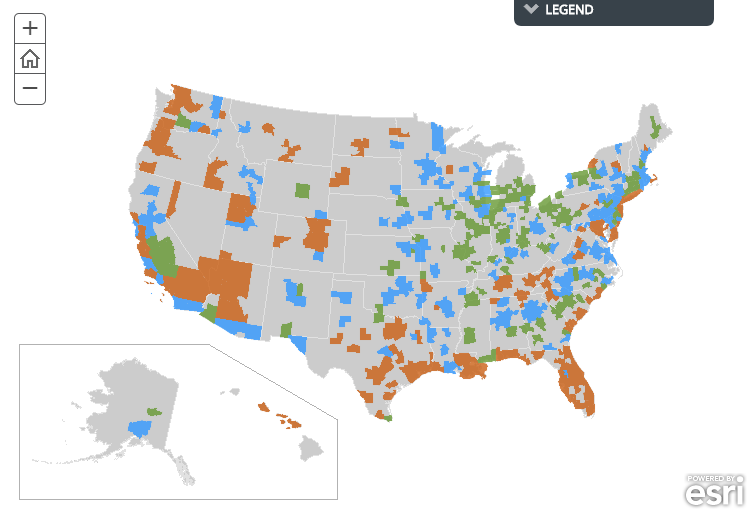
Home prices rose 1.6% MOM and are up 7.1% YOY according to the CoreLogic Home Price Index. The index is within 2.8% of its April 2006 peak. The FHFA House Price Index has already recouped its losses from the bubble years. They forecast a 5% increase this year and see the index recouping the bubble losses in late summer. Here is a map of the overvalued (red) and the undervalued (green) MSAs. 


Given that the house price indices are approaching or have already surpassed their past peaks, you would figure that most houses in the US would be at those levels as well. Unfortunately, they are not. In fact, Trulia estimates that only 1/3 of houses have recouped the losses from the bubble. There is a huge dispersion as well - only 3% of homes in Fresno or Las Vegas or the NYC suburbs have surpassed their prior peak levels, while 94% of homes in Denver or San Francisco have. The problem with these home price indices is that they use a repeat sales methodology, which tends to over-emphasize hot markets. Real estate prices in states exposed to the tech sector and the energy sector are performing the best. Surprisingly, flyover America is doing better than Coastal America. On the link, you can do a county-by-county analysis to see where you stack up. 


Housing continues to punch below its weight in terms of contribution to GDP. Residential construction has historically been around 2% of GDP, and based on the first quarter estimate it was closer to 1.3%. We have incredibly tight demand for homes, so why aren't we seeing building? It depends on who you ask. If you ask a builder in a hot market, the problem is lack of skilled labor. In other areas, regulation and credit are the culprits. The housing market continues to be a conundrum for policy makers and analysts.


Tuesday, February 7, 2017

Morning Report: Confidence up, affordability down

Vital Statistics:

Last Change
S&P Futures  2291.5 5.0
Eurostoxx Index 363.3 1.7
Oil (WTI) 52.7 -0.4
US dollar index 90.9 0.6
10 Year Govt Bond Yield 2.43%
Current Coupon Fannie Mae TBA 102.1
Current Coupon Ginnie Mae TBA 103.2
30 Year Fixed Rate Mortgage 4.13

Stocks are up this morning on no real news. Bonds and MBS are down small. 

Job openings were largely unchanged MOM at 5.5 million, according to the BLS's JOLTS report. On a year-over-year basis, they were up 4.2%. Hires ticked up slightly, while separations fell. The quits rate ticked down to 2.0% from 2.1% in November and 2.2% last year. This will give some comfort to bond investors as well as the Fed, as an increase in the quits rate usually leads an increase in wage growth. 

Home prices rose 0.8% MOM and are up 7.2% YOY according to CoreLogic. They foresee a deceleration of home price appreciation in 2017, with a 4.7% increase. The action was in the Pacific Northwest and Mountain states, with Washington, Idaho, Oregon, Colorado, and Utah leading the charge. Here is a map of the overvalued (red) and undervalued (green) MSAs:


Rising home prices and mortgage rates have hit affordability, which is the lowest in 7 years, when you use the metric of mortgage payment on the median house to median income ratio. Much of the hit took place towards the end of last year as as rates spiked post-election. Tight inventory is driving the price increases, not incomes, which means current prices are vulnerable if wages don't increase. Eventually builders will start more construction, but as of now they are still holding back. 

Economic confidence improved last week according to the Gallup Economic Confidence Index. January was the highest month since 2008. More people are feeling engaged at work, but future expectations drove the index. Despite all the sturm and drang out of Washington, Americans are shrugging it off. Other indices like the VIX, as well as gold prices (despite what the article below says) are confirming this. Separately, Fannie Mae's Home Purchase Sentiment Index improved two points last month. Most notable in that survey: the net share of people reporting significantly higher household income growth in the past 12 month increased by 5 percentage points. Also, bankruptcy filings are the lowest since 2006. 


On the other hand, Washington insiders and journalists (especially) are not feeling that way. Donald Trump has upset the traditional way things are done, and that has a lot of pros spooked. That said, I think creating a confidence index based on the use of the word "uncertainty" in business articles speaks more towards the predilections of journalists than it does to the markets as a whole. 


Fixing Dodd-Frank will take some time, along with repealing and replacing Obamacare. Democrats are vowing to go to the mattresses on both, although I think Obamacare will be where the war is going to be fought. As I have said before, I suspect there is enough bipartisan agreement to do something on Dodd-Frank, at least with regards to small bank regulation. Reforming the CFPB is expected to cleave down partisan lines, although the Courts may be forcing Congress's hand there. Much of the change is going to be done non-legislatively, in how the agencies interpret and enforce the law. Democratic Party priorities like disclosing the pay difference between CEOs and the rank and file are simply going to go by the wayside. 

Rob Chrisman mentioned iServe in this morning's blog, talking about our own John McDade's VA tour, where he visits our branches and talks about what a great product the VA loan is. 

Wednesday, May 6, 2015

Morning Report - Productivity falls

Vital Statistics:


LastChangePercent
S&P Futures 2088.04.30.16%
Eurostoxx Index3598.1-34.8-0.96%
Oil (WTI)60.631.72.88%
LIBOR0.280.0010.36%
US Dollar Index (DXY)95.37-0.112-0.12%
10 Year Govt Bond Yield2.19%0.00%
Current Coupon Ginnie Mae TBA102.30.1
Current Coupon Fannie Mae TBA101.1-0.1
BankRate 30 Year Fixed Rate Mortgage3.89

Stocks are higher this morning after yesterday's bloodbath. Bonds and MBS are flat

The ADP Employment Change index is forecasting a weak employment report this Friday. They report shows 169,000 jobs were created in April, which was lower than the 200,000 estimate. The Street is forecasting an increase of 230,000 for Friday. This is the weakest report in over a year, and you can see the marked slowdown beginning this year. If the early weakness was just weather-related, then you should see some sort of rebound. You aren't.


Some more disappointing data this morning - productivity fell 1.9% in the first quarter after falling 2.1% in the fourth quarter. Output fell .2% while compensation increased 6.2%. Unit Labor Costs rose 5%. Lower productivity has been driven by a combination of a stronger labor market and weak GDP growth, so it isn't necessarily a bad thing, at least in the short term. It means that we could still see improvement in the labor market despite weak economic growth. 

Mortgage Applications fell 4.6% last week as purchases rose .8% and refis fell 8.3%. Bonds got slammed last week, so that isn't a surprise. The 30 year fixed rate mortgage rate rose to 3.93% from 3.85%. Refis as a percentage of loans fell to 52.5%. 

Foreclosures fell to 2.22%, according to the MBA. Delinquencies fell to 5.54%. 

As the rhetoric between Greek Prime Minister Alexis Tsipras and the EU gets more and more heated, the ECB is wrestling with how much of a haircut to demand on Greek collateral. The machinations between the Greeks and the EU are driving Euro yields, which are driving US yields. “The fundamentals have not changed, but bond markets have,” said Christoph Rieger, the Frankfurt-based head of fixed income strategy at Commerzbank AG. “The European bond markets are broken, hampered by low yields, high regulation and central bank intervention. Markets will have to get used to these erratic swings.” The European situation is why so many bond strategists got it so wrong in the US over the past year and explains why bonds are selling off in the US despite some weaker economic data.

Home Prices rose 5.9% annually, according to CoreLogic. A combination of tight inventory, low mortgage rates, and improving confidence is the culprit. Of course we need wage growth to make this actually sustainable, and it looks like we could be seeing the start of wage growth, at least according to the Employment Cost Index.