A place where economics, financial markets, and real estate intersect.
Showing posts with label ADP. Show all posts

Wednesday, September 30, 2015

Morning Report: ADP forecasting 200,000 jobs in September

Vital Statistics:

Last Change Percent
S&P Futures  1894.9 20.4 1.09%
Eurostoxx Index 3105.2 75.3 2.48%
Oil (WTI) 45.02 -0.2 -0.46%
LIBOR 0.327 0.001 0.15%
US Dollar Index (DXY) 96.19 0.330 0.34%
10 Year Govt Bond Yield 2.08% 0.03%
Current Coupon Ginnie Mae TBA 104.5 -0.1
Current Coupon Fannie Mae TBA 104.2 -0.1
BankRate 30 Year Fixed Rate Mortgage 3.85

Stocks are up this morning on no real news. Feels like end of month / quarter window dressing. Bonds and MBS are down small

The economy added 200,000 jobs in September, according to ADP. This is bang in line with the Street estimate for payrolls on Friday. Note that the initial reports of late summer payrolls seem to consistently miss on the downside and are usually revised upward in subsequent months. 

Mortgage Applications fell 6.7% last week as purchases fell 5.6% and refis fell 7.5%. 

The ISM Milwaukee index fell to 39.44 from 47.7 last month. The Chicago Purchasing Manager Index fell to 48.7 from 54.4. The strong dollar is taking its toll on manufacturers. 

All cash sales dropped to 31% in June, according to Corelogic. The historical, pre-bubble average is close to 25%. This speaks to the lack of first time homebuyers. It also speaks to an increase in gettable loans as that number reverts to the mean, even if home sales remain flat.

One of the big questions facing the Fed concerns falling unemployment and a falling labor force participation rate. Intuitively, you would think that as unemployment falls, people who are not currently in the labor force but want to be would find jobs, which would push up the participation rate. If the labor force participation rate remains low, that means the potential growth of the economy remains low, which means a slow, plodding recovery that won't feel like any sort of economic boom. It also means inflation should, at least in theory, come back as companies bid up the wages of the fewer workers that are left. So far we aren't seeing that. Millennials should be picking up the slack of retiring boomers but so far it hasn't happened. And if Millennials don't do it, then you need to pick up immigration

Elizabeth Warren is mad that the government is selling distressed mortgages to hedge funds and private equity firms and wants them sold to non-profit firms. She is of the opinion that hedge funds and private equity firms pursue foreclosure too quickly and said “The heart of it is these loan sales need to come with strings attached with basic outcomes for homeowners.” She is either posing for the cameras or completely uninformed: They do come with strings attached. You usually cannot foreclose for at least a year and must hold the loans for a period of several years. 

Heading into campaign season, Americans' trust in the media is at an all time low

Wednesday, May 6, 2015

Morning Report - Productivity falls

Vital Statistics:


LastChangePercent
S&P Futures 2088.04.30.16%
Eurostoxx Index3598.1-34.8-0.96%
Oil (WTI)60.631.72.88%
LIBOR0.280.0010.36%
US Dollar Index (DXY)95.37-0.112-0.12%
10 Year Govt Bond Yield2.19%0.00%
Current Coupon Ginnie Mae TBA102.30.1
Current Coupon Fannie Mae TBA101.1-0.1
BankRate 30 Year Fixed Rate Mortgage3.89

Stocks are higher this morning after yesterday's bloodbath. Bonds and MBS are flat

The ADP Employment Change index is forecasting a weak employment report this Friday. They report shows 169,000 jobs were created in April, which was lower than the 200,000 estimate. The Street is forecasting an increase of 230,000 for Friday. This is the weakest report in over a year, and you can see the marked slowdown beginning this year. If the early weakness was just weather-related, then you should see some sort of rebound. You aren't.


Some more disappointing data this morning - productivity fell 1.9% in the first quarter after falling 2.1% in the fourth quarter. Output fell .2% while compensation increased 6.2%. Unit Labor Costs rose 5%. Lower productivity has been driven by a combination of a stronger labor market and weak GDP growth, so it isn't necessarily a bad thing, at least in the short term. It means that we could still see improvement in the labor market despite weak economic growth. 

Mortgage Applications fell 4.6% last week as purchases rose .8% and refis fell 8.3%. Bonds got slammed last week, so that isn't a surprise. The 30 year fixed rate mortgage rate rose to 3.93% from 3.85%. Refis as a percentage of loans fell to 52.5%. 

Foreclosures fell to 2.22%, according to the MBA. Delinquencies fell to 5.54%. 

As the rhetoric between Greek Prime Minister Alexis Tsipras and the EU gets more and more heated, the ECB is wrestling with how much of a haircut to demand on Greek collateral. The machinations between the Greeks and the EU are driving Euro yields, which are driving US yields. “The fundamentals have not changed, but bond markets have,” said Christoph Rieger, the Frankfurt-based head of fixed income strategy at Commerzbank AG. “The European bond markets are broken, hampered by low yields, high regulation and central bank intervention. Markets will have to get used to these erratic swings.” The European situation is why so many bond strategists got it so wrong in the US over the past year and explains why bonds are selling off in the US despite some weaker economic data.

Home Prices rose 5.9% annually, according to CoreLogic. A combination of tight inventory, low mortgage rates, and improving confidence is the culprit. Of course we need wage growth to make this actually sustainable, and it looks like we could be seeing the start of wage growth, at least according to the Employment Cost Index. 

Wednesday, December 5, 2012

Morning Report - ADP and NEWCO spelled backwards

Vital Statistics:

Last Change Percent
S&P Futures  1408.4 2.9 0.21%
Eurostoxx Index 2598.9 8.1 0.31%
Oil (WTI) 88.63 0.1 0.15%
LIBOR 0.311 0.000 0.00%
US Dollar Index (DXY) 79.79 0.142 0.18%
10 Year Govt Bond Yield 1.60% -0.01%
RPX Composite Real Estate Index 191.2 0.3

Markets are higher this morning after China eased investment restrictions on banks and announced measures to promote urban development. Chinese GDP has slowed from close to 9% to 7.5% over the last 9 months. While 7.5% GDP growth sounds impressive, it is back in late '08-early '09 levels. Productivity rose 2.9% in Q3, while unit labor costs fell 1.9%.  Bonds and MBS are flattish.

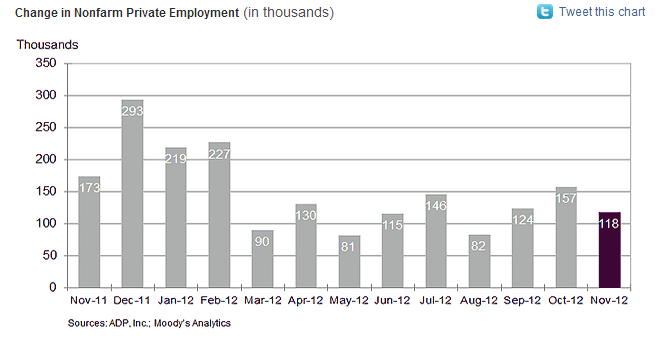
ADP reported a 118k increase in US nonfarm private sector employment for the month of November. This report was obviously driven by Hurricane Sandy. The biggest gains were in construction and utilities, while manufacturing fell. A blip upward in construction and temp workers for storm clean-up and a drop in manufacturing as plants with no power laid off employees.   October was revised downward.  Mark Zandi estimates that the hurricane depressed employment by 86k.

Edit:  Immediately after hitting "post"  Citi announces it will cut 11,000 jobs.

Chart:  ADP change in non-farm payrolls:


Obama has drawn a line in the sand:  No increase in top rates for incomes over 250k, no deal. He expressed openness to cutting top rates next year in the context of broad tax reform.

Servicers beware:  Not only do you have to fear the CFPB, the state regulators are getting involved.  New York State is refusing to approve Ocwen's purchase of Homeward and the servicing unit of ResCap unless the company agrees to bring in a monitor from NY State which would oversee operations for two years and recommend changes in business practices.  In all of my years of analyzing mergers and the regulatory process, I have never seen anything like this.  Ocwen goes on to point out that they have "not received from any regulator at the federal or state level or any level any findings or evidence we have wrongfully foreclosed on any borrower."  This is unprecedented.

The Fed is expected to announce a new round of Treasury buying after Operation Twist ends at the end of the year. US GDP is expected to slow as uncertainty over the fiscal cliff has weighed on capital expenditures and hiring.  ML / BOA is forecasting 1% GDP growth in Q4 and Q1.