A place where economics, financial markets, and real estate intersect.
Showing posts with label Ocwen. Show all posts

Friday, April 21, 2017

Morning Report: Existing Home Sales highest in 10 years

Vital Statistics:

Last Change
S&P Futures  2355.0 3.0
Eurostoxx Index 378.8 0.7
Oil (WTI) 50.6 -0.1
US dollar index 89.8
10 Year Govt Bond Yield 2.23%
Current Coupon Fannie Mae TBA 102.97
Current Coupon Ginnie Mae TBA 104
30 Year Fixed Rate Mortgage 3.98
Stocks are up this morning on no real news. Bonds and MBS are flat. 

Existing Home Sales rose to their fastest pace in 10 years, according to the NAR. Existing Home Sales increased at a 5.79 million annual rate, which was the fastest since January 2007. Lawrence Yun, Chief Economist of NAR said: The early returns so far this spring buying season look very promising as a rising number of households dipped their toes into the market and were successfully able to close on a home last month," he said. "Although finding available properties to buy continues to be a strenuous task for many buyers, there was enough of a monthly increase in listings in March for sales to muster a strong gain. Sales will go up as long as inventory does." The median existing home sale price was $236,400, up 6.8% from a year ago. Inventory increased, however it remains at about 3.8 months' worth. Days on market dropped to 34, a huge decrease from a year ago, when it was in the mid-high 40s. Inventory remains the biggest problem as homebuilders have yet to pump out the required supply to meet demand. 

More Millennials (ages 18-34) live with their parents than with a spouse. Of course we have seen a general trend of waiting until later in life to get married and have kids, so this is somewhat just the extension of a trend. How many of these young adults would like to move out of their parent's home but find rents / house prices too expensive? 

The next big issue for the bond market (and markets in general) is the debt ceiling debate. The government will run out of money by the end of the month, although it can play some accounting games to keep the lights on until a new CR is passed. If not, we could see a partial government shutdown on April 29. It appears that Trump will need some Democrats to pass a CR, and they are demanding that funds be appropriated to shore up the Obamacare exchanges. Trump wants more money for a wall, immigration enforcement and defense spending, which the Democrats oppose. So far, the markets view this as so much theater, but we will see how far the brinkmanship goes. 

Delinquencies have hit an 11 year low, according to Black Knight Financial Services. Total non-current inventory (30 days down +) is at 2.3 million. Prepay speeds increased however, as rates fell. Foreclosure starts ticked up slightly MOM, but are down 18% YOY. 

Why the exurbs are the new high growth area, and what that means for urban living (and politics). Technology is lowering the cost of transportation (basically lowering the cost of distance), and more manufacturing does not need to be near the big cities, and it looks like the exurbs will take up the slack. This has enormous implications for politics, as Democrats dominate the cities and Republicans dominate the suburbs. 

More problems for Backwards Newco. North Carolina is prohibiting them from acquiring new servicing until it fixes defects in how it handles escrow accounts. Separately, the CFPB is going after them as well. The stock was down over 50% yesterday on about 20x normal volume. 

Legendary macro trader Paul Tudor Jones is sending a warning about the stock market. You are seeing more and more strategists fretting about valuations as the Trump reflation trade deflates. If the stock market takes a swoon, that will not be lost on the Fed. Yet another reason why we may have seen the highs for mortgage rates and the 10 year already. 

That said, Treasury Secretary Steve Mnuchin says the Administration is "pretty close" to bringing major tax reform. It will probably be an end-of-year event, as the previous August deadline is not going to happen. The Administration has a narrow window to get things done, as politicians will turn to the 2018 midterms soon after the new year. 

Monday, February 29, 2016

Morning Report: Lousy numbers out of Walter and Ocwen.

Vital Statistics:

Last Change Percent
S&P Futures  1941.7 -1.0 -0.05%
Eurostoxx Index 2920.2 -8.9 -0.30%
Oil (WTI) 32.89 0.1 0.34%
LIBOR 0.635 -0.001 -0.08%
US Dollar Index (DXY) 98.3 0.153 0.16%
10 Year Govt Bond Yield 1.75% -0.01%
Current Coupon Ginnie Mae TBA 105.3
Current Coupon Fannie Mae TBA 104.7
BankRate 30 Year Fixed Rate Mortgage 3.69

Markets are higher this morning after the Chinese cut reserve requirements in an effort to stimulate their economy. Bonds and MBS are flattish.

The ISM Milwaukee Index improved to 55.2 from 50.4, while the Chicago Purchasing Manager index fell to 47.6 from 55.6.

Pending Home Sales fell 2.5% in January, according to NAR. A dearth of inventory continues to weigh on the market. 

The corporate bond market is having difficulty digesting new issuance. Over the past 12 months, there have been 75 "no go" days, where the primary market was essentially shut. This is higher than the bad old days of 2008-2009. High Yield is even worse, with issuance down 75% year-over-year. 

When the stock and bond markets disagree, go with what bonds day. Unsurprisingly, asset managers continue to rotate out of stocks and into bonds

Warren says don't worry, be happy. Also the annotated version of the annual letter.

What are the characteristics of houses that sell quickly? Spanish architecture and 1,500-2,000 square feet.

Originator and servicer Walter Investment reported lower than expected earnings this morning and the stock is down about 10%. for 2015, originations were up 36% and the servicing portfolio increased by 4%. In the fourth quarter, origination volume was up 8% YOY. 

Walter wasn't the only company to miss this morning: Ocwen also is down about 11% after missing its quarter. Delinquencies rose to 13.7% from 13.1%. 

Thursday, November 5, 2015

Morning Report: Tough go of it for mortgage originators, servicers, and REITs.

Vital Statistics:

Last Change Percent
S&P Futures  2099.1 4.4 0.21%
Eurostoxx Index 3465.3 26.2 0.76%
Oil (WTI) 45.89 -0.4 -0.93%
LIBOR 0.334 -0.001 -0.15%
US Dollar Index (DXY) 97.97 0.023 0.02%
10 Year Govt Bond Yield 2.23% 0.00%
Current Coupon Ginnie Mae TBA 104.4
Current Coupon Fannie Mae TBA 103.7
BankRate 30 Year Fixed Rate Mortgage 3.74

Markets are higher this morning on no real news. Bonds and MBS are flat.

Initial Jobless Claims ticked up to 276k from 260k last week. Still strong numbers - the lowest since the Nixon Administration, which is even more impressive given the growth in the population over that time period. 

Challenger, Gray and Christmas announced job cuts fell 1.3% in October after rising 93.2% the month before. We are continuing to see layoffs in the energy patch. 

Nonfarm productivity rose 1.6% in the third quarter and unit labor costs rose 1.4%. Productivity tends to be somewhat volatile. Productivity growth is necessary if we are going to see real wage growth. 

The Bloomberg Consumer Comfort Index fell to 41.1 last week.  

Mortgage originator Stonegate reported lower-than expected earnings yesterday. Originations in Q3 were up 1% on a quarter-over-quarter basis and down 2% on a year-over-year basis. The stocks of the originators / servicers have gotten absolutely hammered this year, with Nationstar down 2/3 over the past year, Stonegate down 60%, and Ocwen down 72%. 

Not only has it been rough for the mortgage originators and servicers, mortgage investors have had a rough go of it as well. Pretty much all of the agency mortgage REITs got roughed up last quarter and reported decreases in book value. The volatility in the financial markets over the third quarter pushed out MBS spreads. All of the REITs are switching out of interest-rate sensitive MBS (things like 30 year fixed rate securities, or what originators are typically selling) into more commercial and credit sensitive instruments. It is a bet that the economy is recovering. At the margin, the fact that these entities are pulling back in the MBS market means that mortgage rates are a little higher than they otherwise would be. 

Citi's Head of North American Economics thinks Janet Yellen and the Fed are making a big mistake, letting the markets influence their decision-making. Economists are starting to discuss the possibility that the Fed is really subject to a triple mandate these days - not only are they supposed to keep inflation expectations in check and to minimize unemployment, they also have an unspoken mandate to keep the financial markets stable. The genesis of this really started with the Crash of 1987 when Alan Greenspan said the Fed stood buy to provide liquidity in the aftermath. The Fed rode to the rescue again after the Asian Tiger Crisis, the Long-Term Capital Management crisis, and even took prophylactic measures to prevent Y2K from becoming a crisis. Eventually this all became known as the "Greenspan put" and we have seen the endgame, which is the serial inflating of asset bubbles. 

Friday, July 31, 2015

Morning Report: Employment Cost inflation lowest since 1982

Vital Statistics:

Last Change Percent
S&P Futures  2106.2 2.5 0.12%
Eurostoxx Index 3580.9 -2.9 -0.08%
Oil (WTI) 47.92 -0.6 -1.24%
LIBOR 0.297 0.000 0.00%
US Dollar Index (DXY) 96.63 -0.928 -0.95%
10 Year Govt Bond Yield 2.20% -0.06%
Current Coupon Ginnie Mae TBA 104.1 0.2
Current Coupon Fannie Mae TBA 103.4 0.1
BankRate 30 Year Fixed Rate Mortgage 3.93

Stocks are flattish after the Employment Cost Index comes in lower than expected. Bonds and MBS are flat

The Employment Cost Index rose 0.2% in the second quarter, the lowest increase since BLS started keeping track, which began in 1982. On a 12-month basis, employment costs are up 2%. This number includes salaries and benefits, so we still have wage inflation barely keeping up with inflation in general. Given the low ECI and falling commodity prices in general, the Fed has an excuse not to move in September. Bonds rallied hard on the announcement. 

Note that in 1982, the US was in the worst recession since the Great Depression. This was the recession caused by Paul Volcker's tightening to conquer 1970s inflation. It also corresponded to the first wave of globalization, where US industry had to deal with international competition for the first time since WWII. Given that we are 5 years into an expansion, that number sticks out like a sore thumb. 

The ECI is just another demonstration of the strange state of affairs in the US labor market. People who have jobs are keeping them, as demonstrated by the multi-decade lows in initial jobless claims and the low unemployment rate. Job openings are at the highest since BLS started keeping track in 2001. The labor force participation rate is the lowest since the late 1970s and wage inflation is the lowest since 1982. Definitely a perplexing environment for the Fed to navigate. 

Lost in the GDP data from yesterday, GDP growth was revised downward from 2.3% to 2% for the years 2011-2014. Apparently the government overestimated what government spending was during those years. Kind of funny, actually.

The Chicago Purchasing Manager's index rose to 54.7 in July from 49.4. 

Consumer Confidence slipped slightly in July, according to the University of Michigan Consumer Sentiment Survey. The current conditions index rose while the expectations index fell. The number of people who say their household financial situation is worse than a year ago ticked up to 29%. Interesting to say the least, given that these consumer confidence indices often are influence by gasoline prices and those have been falling as oil has been taken to the woodshed. 

Speaking of oil prices, both Exxon-Mobil and Chevron reported weaker than expected numbers this morning, and both stocks are getting whacked. Surprisingly, D.R. Horton (who has a lot of TX exposure) has not seen any evidence of this hitting homebuyer demand. 

Chart: West Texas Intermediate:


Ocwen missed earnings estimates and the stock is down about 16% on the open. The UPB of its servicing portfolio fell 26% to $322 billion. They unveiled a new plan to cut costs as their assets fall. 

The House Financial Services Committee passed a "hold harmless" period for TRID, which basically says the CFPB won't be able to enforce TRID and impose penalties until Feb 1 2016, provided the issuer is making a good-faith effort to comply with the regulation. There is a competing bill in the Senate which would have a shorter period, ending on Jan 1. The CFPB has already delayed the implementation once. 


Tuesday, April 21, 2015

Morning Report - the wages of ZIRP...

Vital Statistics:

Last Change Percent
S&P Futures  2100.9 9.9 0.47%
Eurostoxx Index 3728.5 10.5 0.28%
Oil (WTI) 56.3 -0.1 -0.14%
LIBOR 0.276 0.001 0.24%
US Dollar Index (DXY) 98.09 0.152 0.16%
10 Year Govt Bond Yield 1.88% -0.01%  
Current Coupon Ginnie Mae TBA 103.4 0.0
Current Coupon Fannie Mae TBA 102.6 0.1
BankRate 30 Year Fixed Rate Mortgage 3.73

Stocks are higher this morning as earnings come in better than expected. Bonds and MBS are up.

Housing advocates are urging the government to investigate and intervene in communications between MBS holders and servicers. They claim that MBS investors (read Wall Street Sharpies) are urging servicers to forego modifications and to pursue "unnecessary foreclosures." Surprisingly, they hold up Ocwen as pillar of servicing virtue. Of course Ocwen is fighting for its life and will do anything it possibly can to make the government happy. 

New simpler mortgage disclosure forms are coming August 1, and they could slow closings as professionals learn to navigate the new system. 

M&A activity is picking up, with an interesting situation in the pharma sector. Mylan, who last week launched a hostile bid for Perrigo, now faces an unsolicited bid from Teva. A combination of low interest rates and high stock prices make growth by acquisition an attractive strategy. Teva's biggest drug faces generic competition so they need to replace that revenue. Mylan / Teva is going to face antitrust scrutiny. This situation looks like a fun one for the arbs. 

While ZIRP is helping to drive M&A activity, the unintended consequence is that insurers and pension funds are getting hammered as they cannot earn enough on their assets to cover their estimated liabilities. There are two ways out of the box: either assume it away with rosy estimates of asset return and liability inflation, or take a lot more risk. This is part of the reason why the Fed wants to get rates up to a more normal level. I suspect they fear we are going to have to bail out the state pension funds and / or insurance companies.

High end real estate has replaced gold as the go-to asset for storing wealth. Real Estate and contemporary art are the new store of value of choice for foreign investors. Gold, which used to have that role, cannot get out of its own way. Why? Blame the financial crisis, where gold sold off just like every other asset in a situation tailor-made for it. If gold was unable to rally in that sort of crisis, what good is it? Note that high end real estate in places like London, New York, and Vancouver are owned largely by Chinese investors, and China has its own issues, as even state-owned companies are now defaulting on their debt. As their real estate bubble bursts, it will be interesting to see if they liquidate overseas property. Generally in a crisis, you sell what you can, not necessarily what you want to. 

Wednesday, December 5, 2012

Morning Report - ADP and NEWCO spelled backwards

Vital Statistics:

Last Change Percent
S&P Futures  1408.4 2.9 0.21%
Eurostoxx Index 2598.9 8.1 0.31%
Oil (WTI) 88.63 0.1 0.15%
LIBOR 0.311 0.000 0.00%
US Dollar Index (DXY) 79.79 0.142 0.18%
10 Year Govt Bond Yield 1.60% -0.01%
RPX Composite Real Estate Index 191.2 0.3

Markets are higher this morning after China eased investment restrictions on banks and announced measures to promote urban development. Chinese GDP has slowed from close to 9% to 7.5% over the last 9 months. While 7.5% GDP growth sounds impressive, it is back in late '08-early '09 levels. Productivity rose 2.9% in Q3, while unit labor costs fell 1.9%.  Bonds and MBS are flattish.

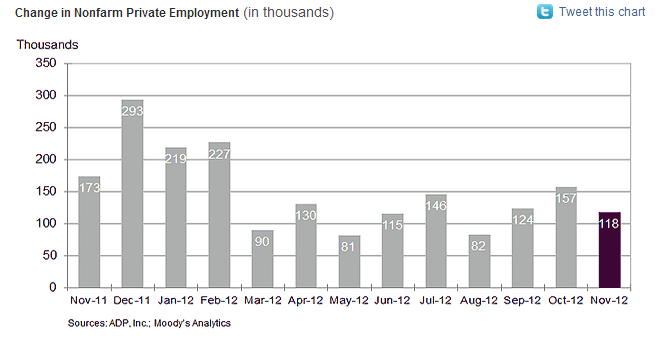
ADP reported a 118k increase in US nonfarm private sector employment for the month of November. This report was obviously driven by Hurricane Sandy. The biggest gains were in construction and utilities, while manufacturing fell. A blip upward in construction and temp workers for storm clean-up and a drop in manufacturing as plants with no power laid off employees.   October was revised downward.  Mark Zandi estimates that the hurricane depressed employment by 86k.

Edit:  Immediately after hitting "post"  Citi announces it will cut 11,000 jobs.

Chart:  ADP change in non-farm payrolls:


Obama has drawn a line in the sand:  No increase in top rates for incomes over 250k, no deal. He expressed openness to cutting top rates next year in the context of broad tax reform.

Servicers beware:  Not only do you have to fear the CFPB, the state regulators are getting involved.  New York State is refusing to approve Ocwen's purchase of Homeward and the servicing unit of ResCap unless the company agrees to bring in a monitor from NY State which would oversee operations for two years and recommend changes in business practices.  In all of my years of analyzing mergers and the regulatory process, I have never seen anything like this.  Ocwen goes on to point out that they have "not received from any regulator at the federal or state level or any level any findings or evidence we have wrongfully foreclosed on any borrower."  This is unprecedented.

The Fed is expected to announce a new round of Treasury buying after Operation Twist ends at the end of the year. US GDP is expected to slow as uncertainty over the fiscal cliff has weighed on capital expenditures and hiring.  ML / BOA is forecasting 1% GDP growth in Q4 and Q1.