A place where economics, financial markets, and real estate intersect.
Showing posts with label Fiscal Cliff. Show all posts

Thursday, January 3, 2013

Morning Report - Money for Nothing

Vital Statistics:

Last Change Percent
S&P Futures  1455.0 -2.1 -0.14%
Eurostoxx Index 2690.8 -20.4 -0.75%
Oil (WTI) 92.82 -0.3 -0.32%
LIBOR 0.305 0.000 0.00%
US Dollar Index (DXY) 80.16 0.317 0.40%
10 Year Govt Bond Yield 1.84% 0.01%  
RPX Composite Real Estate Index 192 0.2  

Stock markets are giving back a little after yesterday's relief rally on the fiscal cliff deal.  Mortgage Applications fell 10.4% last week.  2013 forecasts are starting to trickle in from strategists - suffice it to say 1H13 looks rough, with the economy basically at stall speed.

There is quite a bit of economic data this morning.  ADP forecast that 215k private sector jobs were created in December.  Challenger and Gray reported that announced job cuts fell in December to 32,556. Initial Jobless Claims came in at 215k. The NY ISM came in at 54.3, indicating the outlook is barely positive.  Later this afternoon, we will get the minutes from the Dec FOMC meeting.

Corelogic reported that shadow inventory - properties that are seriously delinquent, in foreclosure, or are REO that are not listed for sale - fell 12% in October to 2.3 million units, representing 7 month's supply.  Almost half of the properties are delinquent and not foreclosed.  The real question is how much this inventory will depress prices.  Given that many of these units are in judicial states, the supply will be dripped out slowly. Also, if a home has been vacant for several years, it develops problems that make the repairs more than the property is worth.  So, while it is in inventory, it is probably worth very little and isn't competing with the homes that most normal homebuyers are focused on.

So now that we have the fiscal cliff uncertainty out of the way, the markets should continue to rally, right?  We, according to business leaders, no.  And since the deal does not reduce debt, we are in danger of a downgrade, according to Moody's. The debt ceiling also was a taste of what is to come, with 3 gating items in the near future - the debt ceiling, the continuing resolution, and the sequestration.  Obama has already laid a marker down saying that it can't be "all spending cuts."  Given that Republicans have already made the tax hike concession, they are likely to take a tough negotiating stance on these items. So it could get ugly.

How did Obama get Boehner on board for tax increases?  A simple warning.  Stop opposing higher taxes for top earners or I will dedicate my second term to blaming Republicans for the global recession. And, blame is one of Obama's many talents.

Latest investment outlook from Bill Gross - Money for Nothin' Writing Checks for Free.  The basic idea is that right now, the government is financing its deficit more or less for free.  Why?  Because the Fed is buying the treasuries (or at least 80%) through QE, and by statute, it gives its profit or losses back to the government.  So the government is basically (in a roundabout way) paying interest to itself. Bill goes on to point out that this has been done before, and it has always ended badly. In the long run, inflation will rear its ugly head.  Of course Paul Krugman would echo Keynes and say "in the long run, we are all dead."  Bill also makes the good Austrian point - that Krugman has no answer for - that the unintended consequences of QE include mal-investments that will sow the seeds for the next bust.  You can view this debate here.


Wednesday, January 2, 2013

Morning Report - Happy New Year

Vital Statistics:

Last Change Percent
S&P Futures  1445.5 25.4 1.79%
Eurostoxx Index 2705.2 69.3 2.63%
Oil (WTI) 93.3 1.5 1.61%
LIBOR 0.305 -0.001 -0.33%
US Dollar Index (DXY) 79.45 -0.282 -0.35%
10 Year Govt Bond Yield 1.84% 0.09%  
RPX Composite Real Estate Index 191.8 -0.5  

Markets are higher this morning after the government reached a compromise on the fiscal cliff.  It turned out the bond market (which was refusing to rally in spite of the setbacks along the way) was correct in its forecast.  When stocks and bonds are telling you different things, listen to the bond market -  it is usually right.  The 10-year is at the top of its recent 1.55 - 1.85 trading range.  MBS are down.

The House passed the Senate compromise on the fiscal cliff late last night, taking income tax hikes for most people off the table (although taxes are going up for everyone with a job).  Here are the main effects:


  • Tax rates will increase to the Clinton level rates for incomes over 450k
  • Limits on itemized deductions kick in at incomes > 300k
  • Capital Gains and Dividends rise to 20% for incomes over that threshold
  • Estate tax set at 40%, with a $5 million threshold that will be indexed to inflation
  • The sequester will be delayed for 2 months
  • the AMT will be permanently patched and indexed for inflation.
  • Extended unemployment benefits continue
The debt ceiling was not addressed in this deal.  The end deal is more or less a tax hike with no spending cuts. It looks like they extended the tax relief for principal mods / short sales as well.  So, unless you make over $300k, you are fine, right?  Nope.  77% of all households will see their taxes increase because the payroll tax holiday expired.

On to the debt ceiling, where Obama has already said he won't accept spending cuts without further tax increases. That will be a contentious debate, since Republicans already walked the plank with their base and voted for tax hikes without Democrats giving up a thing.  Given that Republicans have voted for tax hikes already, the "Republicans are unreasonable" arguments will lose some of their sting.  They will be emboldened to push for more spending cuts, which the White House will refuse. While the WH had the benefit of circumstance in the fiscal cliff negotiations, where the default outcome was a big tax hike, now Republicans have the benefit of circumstance where the default outcome is where spending gets cut (as the sequester was merely delayed, not eliminated).  Punch line, things will get ugly again in Washington, so look to fade this rally.

Bob Schiller is not convinced we are off to the races in the housing recovery.  Basically, he believes housing has hit "fair value" and isn't going anywhere for a while. He may be correct, and that house price inflation will go back to its old relationship with incomes.

Friday, December 28, 2012

Morning Report - On the Waterfront Edition

Vital Statistics:

Last Change Percent
S&P Futures  1401.8 -8.9 -0.63%
Eurostoxx Index 2633.2 -26.8 -1.01%
Oil (WTI) 91.01 0.1 0.15%
LIBOR 0.308 -0.003 -0.96%
US Dollar Index (DXY) 79.81 0.188 0.24%
10 Year Govt Bond Yield 1.70% -0.03%  
RPX Composite Real Estate Index 192.3 0.0  

Stock index futures are lower on pessimism about a budget deal. Obama will meet with Congressional leaders today to see if they can hammer out a deal. The House will meet on Sunday night. The same story remains - stocks are worried about going over the cliff, while the bond market seems skeptical.  For a laugh, check out Rick Santelli's rant about the way the markets are handicapping it.

One other possible headwind for the economy in Q1 - a longshoreman's strike that would close cargo ports on the Eastern Seaboard and the Gulf Coast. This would not only limit raw material supplies to US factories, it would also push many logistics workers, truck drivers, etc on to the unemployment rolls. Some economists estimate that a strike could cost the US economy $1 billion a day. Will Obama risk alienating his labor base to intervene?  Fun fact:  the average compensation for a longshoreman in $124k.

Yesterday's consumer confidence numbers took a step downward, and seem to back up reports that this year's holiday sales were weak.The outlook for business conditions and labor markets fell.

Chart:  Conference Board Consumer Confidence:


In spite of the pessimism over the fiscal cliff, luxury homes priced over $1 million are making a comeback. Sales have risen by 9% for the first 9 months of 2012.  Strong foreign demand has been driving up prices in Manhattan and the Hamptons. In terms of foreclosures over $1 million, the NYC suburbs hold 4 out of the top 10 zip codes, with New Canaan taking the lead.  This is still the wreckage from the bust, where lots of $1 million a year guys lost their jobs in 2007 and haven't worked since.


Thursday, December 27, 2012

Morning Report - The Mod Squad

Vital Statistics:

Last Change Percent
S&P Futures  1416.2 2.7 0.19%
Eurostoxx Index 2665.1 16.6 0.62%
Oil (WTI) 91.18 0.2 0.22%
LIBOR 0.311 0.001 0.32%
US Dollar Index (DXY) 79.44 -0.182 -0.23%
10 Year Govt Bond Yield 1.77% 0.01%
RPX Composite Real Estate Index 192.3 0.5

Markets are quiet again as desks are understaffed both in Europe and the US. Initial Jobless Claims fell to 350k, back to the bottom end of our 350k - 390k range. Bonds and MBS are down small and continue to dismiss the possibility of a cliff-induced recession.

President Obama heads back to Washington to try and craft a deal to avert the fiscal cliff. The WH seems to have backed off its proposal to increase taxes at 400k and has moved back to 250k. It is looking more and more like we will go over the cliff on Jan 1 and then pass some sort of tax cut package soon thereafter.  Treasury informed Congress that we will hit the debt limit on Monday, but they can play some games to keep the government funded through Feb.

Of course, once we climb the fiscal cliff, we will go right into the battle of the debt ceiling. Moody's has already fired a shot across the bow, saying that they expect the government to raise the limit, but they may downgrade the U.S.'s credit rating unless we get a decrease in the debt / GDP ratio.

Yesterday's WSJ report on possible new initiatives to mitigate the effects of the housing bust have already been met with skepticism. The first plan involved allowing deeply underwater non-agency loans to refi into Fan and Fred loans.  James Pethokousis of the American Enterprise Institute points out that allowing the GSEs to refi underwater non-agency mortgages is a non-starter with virtually all Republicans and many Democrats as it shifts risk from the private sector to the public sector.  Plus, you have to get the originators on board, and they won't make 125%+ LTV loans without some sort of safe harbor against buyback risk.

A second plan would further expand HAMP, by changing the definition of "in danger of imminent default" to include anyone who is has a LTV over 125%, even if they are current on their mortgage. Such a move would not require Congressional approval. The American Securitization Forum is against the idea, given that these loans are worth their weight in gold.  They are current, have above-market coupons, and have virtually no chance of being prepaid for years. If enacted, investors would take an income hit (although Treasury would pay them the coupon difference for 5 years), and would see a capital loss as well. My sense is that ASF's argument will be met with very little sympathy in the Administration, although state and federal pension funds will be quietly making the same argument as well. Still another hurdle would be servicers, who would have to buy off on the idea that modding a current loan is somehow good for the investor.

Wednesday, December 26, 2012

Morning Report - Case-Schiller

Vital Statistics:
Last Change Percent
S&P Futures  1422.7 2.9 0.20%
Eurostoxx Index 2648.5 -2.6 -0.10%
Oil (WTI) 89.09 0.5 0.54%
LIBOR 0.31 0.000 0.00%
US Dollar Index (DXY) 79.66 -0.015 -0.02%
10 Year Govt Bond Yield 1.78% 0.00%  
RPX Composite Real Estate Index 191.8 0.1  

Markets are quiet this morning, as most of Europe is shut for Boxing Day. Bonds and MBS are flat.

Not much is happening on the fiscal cliff front, although Obama plans to cut his vacation short and return to Washington to try and hammer out a deal. Chances of any sort of grand bargain are virtually nil; all that could be accomplished at this point is some sort of fig leaf. In spite of the political and economic uncertainty, and the early indications of a weak Christmas, the bond market still refuses to price in the possibility of a recession.

The S&P / Case-Schiller index of home values came in at  145.93 for the month of October, up 4.3% year-over-year and up 66 basis points month-over-month. The hardest-hit MSAs continued to show the biggest gains, with prices up 22% in Phoenix and 10% in Detroit. The Northeast MSAs (Boston and NY) are showing the smallest increases.

Chart:  S&P / Case-Schiller:


The Obama administration is considering expanding its mortgage-refinancing program to include underwater borrowers with non government loans.  Such a move would require legislation to change Fannie and Fred's charters and would also involve a bump in the guarantee fee to price in the additional risk. It will also require the blessing of FHFA, which has indicated general support for the program.  Finally, it will require some sort of immunity from buy-back risk in order to get originators on board.

A new study confirms what many have thought about high-frequency trading:  It is highly profitable and adds no value to the system as a whole. Aggressive, liquidity-taking high frequency trading (in other words, front-running) does the best. The profitability of HFT seems to be persistent - new entrants are less likely to be profitable and are more likely to exit. Speed matters above all, and that is why James Simons is so consistently profitable.

Monday, December 24, 2012

Morning Report - Merry Christmas.


Vital Statistics:

LastChangePercent
S&P Futures 1421.8-4.1-0.3%
Eurostoxx Index2648.3-3.0-0.15%
Oil (WTI)88.38-0.28-0.31%
LIBOR0.310.0000.00%
US Dollar Index (DXY)79.460.1560.15%
10 Year Govt Bond Yield1.77%+0.04%
RPX Composite Real Estate Index191.8-0.1


Markets are quiet this morning as most shops have skeleton crews on the desk.  Stock and Bond markets will be open until 1:00 pm.  There is no economic data this morning. Bonds are down while MBS are flat.

The fact that bonds have not rallied in the face of the machinations of the fiscal cliff has me scratching my head. Mohammed El Arian of PIMCO believes a recession is now more likely. If we enter a recession, we could be looking at a 1.25% 10-year.  We broke 1.4% in late July. Yet here we sit at 1.77%.  Liquidity is typically low this time of year, so you can't read too much into it, but unless we get a deal on the cliff soon, we could be looking at a big rally in Treasuries come January.

With the collapse of Boehner's Plan B, all attention turns to the Senate which hopes to devise some sort of band aid to prevent the worst of the fiscal cliff. In particular, Mitch McConnell has been more of an observer than a participant as negotiations have centered on the WH and House. Apparently Joe Biden has better luck dealing with the Minority Leader than Obama, and has earned the reputation as the "McConnell Whisperer." Democrats are urging Boehner to re-enter negotiations with a bipartisan bill. Ironically, by rejecting Boehner's Plan B, Tea Party Republicans in the House have lost their seat at the table.

Lender Processing Services is out with their first look at November delinquency numbers. Delinquencies are up sequentially, while foreclosures are down.

The Fed is disappointed that mortgage rates are not responding to the Fed's MBS purchase program. At least the story mentions the reason - increases in guarantee fees. Most stories about this (The Washington Post is absolutely terrible on this) don't mention the fee increase. Even the WSJ does it, by mentioning "higher fees charged by Fan and Fred" in a generic fashion, as is they are inconsequential.  People don't understand how much G-fees matter. There is the perception in Washington that lenders are simply pocketing the difference when in reality their costs have increased. The media has glommed onto the idea that the financial industry is inherently crooked and there is no disabusing them of that.

Merry Christmas to all.

Friday, December 21, 2012

Morning Report - Over the cliff we go

Vital Statistics:

Last Change Percent
S&P Futures  1418.4 -22.2 -1.54%
Eurostoxx Index 2645.3 -13.0 -0.49%
Oil (WTI) 89.04 -1.1 -1.21%
LIBOR 0.31 0.000 0.00%
US Dollar Index (DXY) 79.38 0.116 0.15%
10 Year Govt Bond Yield 1.75% -0.04%  
RPX Composite Real Estate Index 191.8 -0.1  

Stock index futures are getting crushed this morning after House Speaker John Boehner postponed a vote for Plan B, which would have raised taxes on millionaires, after he couldn't get enough Republican votes.  He has scheduled a press conference for 10:00 am. This is probably the final nail in the coffin for a deal before the end of the year.  It also could mean Speaker Cantor.

So, what are the options now on the fiscal cliff?  John Boehner could continue to work with the President on a deal that can garner bipartisan support in the House.  Second, the House could pass the Senate bill, with Republicans voting "present." Finally (and probably the most likely outcome) is that we go over the cliff and immediately pass tax cuts in the new year. It goes without saying that all of this is dependent on the world not ending today.

On the economic data front, Personal Income and Spending came in better than expected.  Durable Goods were higher than expected and the Chicago Fed National Activity Index rebounded. Of course none of that matters right now. Bonds are up a point, while MBS are up 1/4. In view of what is happening in Washington, I wouldn't want to be short bonds right now.

Thursday, December 20, 2012

Morning Report: Merger mania on Wall Street

Vital Statistics:
Last Change Percent
S&P Futures  1430.2 -2.9 -0.20%
Eurostoxx Index 2654.9 0.2 0.01%
Oil (WTI) 89.7 -0.3 -0.31%
LIBOR 0.31 0.000 0.00%
US Dollar Index (DXY) 79.12 -0.145 -0.18%
10 Year Govt Bond Yield 1.78% -0.03%
RPX Composite Real Estate Index 191.8 -0.1

Markets are slightly lower after a slew of economic data this morning.  3Q GDP was revised upward to 3.1%.  Initial Jobless Claims came in at 361k. Consumption rose 1.6%.  The November Index of Leading Economic Indicators fell .2%.  Bonds and MBS are flat.

The FHFA House Price Index rose a half of a percent in October.  Sep was revised downward.  Prices are up 5.6% YOY and the index is 15.7% below its peak in April 2007.  We are more or less back to Summer of 2004 levels.


The Intercontinental Exchange (ICE) has agreed to buy NYSE Euronext for $8.2 billion.  It shows just how much the importance of trading equities has fallen.  Who would have thought a 12 year old scrappy upstart from Atlanta would end up buying the New York Stock Exchange, Paris Bourse, and the Amsterdam Exchange?  The floor of the New York Stock Exchange is more or less just a museum these days.  Separately, Knight Capital Group, the Nasdaq market-maker which lost $460 million on a computer glitch earlier this year, agreed to a deal with Getco, the Chicago-based leader in high frequency trading.

On the fiscal cliff front, the House plans to vote on a measure that increases taxes on millionaires.  Obama has already threatened to veto it. The current bid / ask spread is 400 - 1000, meaning that Obama wants the threshold for higher taxes to start at 400k, while Boehner wants it to start at 1 million. Bloomberg has a good backgrounder on the relationship between Obama and Boehner.

KB Home announced their 4th quarter and full year earnings this morning.  Deliveries were up 6% and average selling prices increased 10% sequentially and 23% year-over-year. Backlog is up 35% and that potential revenue would be the highest since Q407. Larger homes were the driver, which accounts for the jump in ASPs.

Tuesday, December 18, 2012

Morning Report - Reaching across the fiscal abyss

Vital Statistics:

Last Change Percent
S&P Futures  1431.2 4.2 0.29%
Eurostoxx Index 2637.4 9.4 0.36%
Oil (WTI) 87.76 0.6 0.64%
LIBOR 0.309 0.000 0.00%
US Dollar Index (DXY) 79.49 -0.077 -0.10%
10 Year Govt Bond Yield 1.78% 0.01%
RPX Composite Real Estate Index 191.7 0.1

Markets are higher this morning on optimism for a deal on the fiscal cliff. The President made some tax concessions to move closer to Speaker Boehner's position. The current account deficit increased more than expected to 107.5B.  Bonds continue to sell off, although it looks like the 10-year yield is bumping up against resistance. Certainly the announcement of QE4EVA was a case of "buy the rumor, sell the fact."  FWIW, that is my gut feeling about stocks and the fiscal cliff as well.

Both sides are coming closer on a deal to avoid the fiscal cliff.  Obama has lowered his revenue target to $1.2 trillion from $1.4 trillion and moved up the threshold for higher taxes to $400k from $250k.  $1.22 trillion will be cut in spending, from a variety of areas. The second biggest component of "savings" would be interest saved on debt that isn't going to be issued. Only in DC, would that count. It would also raise the debt ceiling enough to cover two years and the 2014 midterms.  On capital gains, the top tax rate would be 20%. Raising the medicare eligibility age from 65 to 67 seems to be off the table.  The sequester will be replaced by another sequester.  Extended unemployment benefits would continue.  One other surprising tidbit - the President wants to replace the expiring payroll tax cut with other stimulus measures such as infrastructure spending.  Which means everyone's taxes are going up, not just the rich.

The FHA plans to sell 40,000 non-performing loans over the next year to help improve its finances, which would make them the biggest seller of distressed paper, according to Louis Amaya of National Asset Direct.  One interesting wrinkle is that it is a back-door way to achieve principal mods.  Acting FHFA Chairman Ed DeMarco has steadfastly refused to allow FHA to reduce principal when modifying delinquent loans.  However, if they sell the loans, the investor is free to make whatever modification makes sense.  Under a U.S. Treasury program, investors can be reimbursed as much as 63 cents on the dollar for principal forgiveness.  Steve Schwartzman of Blackstone said they are "loading the boat." with delinquent loans, both for rentals and a macro bet on a housing recovery.

At 10:00 am, we will get the National Association of Homebulder's Housing Market Index.  This is a sentiment indicator of the homebuilders, which has been skyrocketing since housing bottomed earlier this year. According to Trulia, the Millenials are planning to ditch the rentals to buy a house in the next two years. As I have stated in other posts, household formation numbers have been highly depressed during the last 5 years, not because of demographics, but because of the economy. That represents a lot of pent-up demand that will be unleashed as the economy recovers.

Chris Whalen of Carrington discusses how the lending environment has changed and how the "regulatory arbitrage" favors the smaller independent lenders.  The downside is that mortgages will remain tough to get courtesy of the CFPB, especially in judicial states with high value properties.

Fun useless link of the day - put your own house in a snow globe.  h/t Rob Chrisman.

Monday, December 17, 2012

Morning Report

Vital Statistics:

Last Change Percent
S&P Futures  1414.9 5.7 0.40%
Eurostoxx Index 2622.9 -7.6 -0.29%
Oil (WTI) 86.67 -0.1 -0.07%
LIBOR 0.309 0.001 0.32%
US Dollar Index (DXY) 79.58 -0.001 0.00%
10 Year Govt Bond Yield 1.72% 0.02%
RPX Composite Real Estate Index 191.6 0.4

Markets are higher this morning after Japan elected Shinzo Abe, who has advocated further fiscal and monetary stimulus.  The Empire Manufacturing Survey showed manufacturing in NY state contracted more than expected. Bonds are down and MBS are down small.

The negotiations on the fiscal cliff continue. The President has tied any discussions on entitlement cuts to increasing taxes on the rich and an increase in the debt ceiling.  Boehner has proposed a millionaire's surtax and an increase in the debt ceiling. Of course, Boehner can strike a deal with the President, but that doesn't mean he can deliver the votes in the House.

Barry Ritholz has MBIA's presentation on Countrywide's fraud.

Samuelson discusses the Fed's targeting of both unemployment and inflation and lays out some of the unintended consequences.


Thursday, December 13, 2012

Morning Report - QE4EVA

Vital Statistics:

Last Change Percent
S&P Futures  1427.7 0.5 0.04%
Eurostoxx Index 2625.6 -4.8 -0.18%
Oil (WTI) 86.29 -0.5 -0.55%
LIBOR 0.308 -0.002 -0.48%
US Dollar Index (DXY) 79.87 0.058 0.07%
10 Year Govt Bond Yield 1.71% 0.01%  
RPX Composite Real Estate Index 191.3 0.5  

Markets are flat after a mixed bag of economic data.  Retail sales increased .3% in November vs an expectation of .5%.  Initial Jobless claims fell to 343k and were well below the 369k expectation. The Producer Price Index showed inflation running lower than anticipated. The Bloomberg Consumer Comfort Index fell.  Bonds are down a few ticks and MBS are flat.

As expected, the Fed announced a Treasury buying program in its FOMC statement. $45 billion per month, until unemployment drops below 6.5% and inflation stays below 2.5%.  Bernake was careful not to characterize the 6.5% unemployment rate as NAIRU - or the non- accelerating inflation rate of unemployment. They took down their GDP projections from September, with their 2013 GDP forecast falling to a range of 2.3 - 3.0 from a range of 2.5 - 3.0.  They also took down unemployment as well, to a range of 7.3% to 7.7% from a range of 7.6% - 7.9%.  Inflation forecasts were lowered as well. Here is a video of the press conference.  Bonds reacted negatively to the announcement.  Biggest takeaway - the Fed has the pedal to the metal and they are writing the book as they go along.

Looks like no progress so far on the fiscal cliff. A recent poll shows overwhelming support for increasing taxes on the rich.  Business execs have been lobbying for a deal. Liberals are fighting spending cuts. Bernake mentioned in his press conference that the Fed does not have the ability to offset the negative effects to the economy if we go over.

A delay in BofA's jumbo deal shows just how hard it is to bring private capital back into the mortgage market. Private Label Securitizations were $3.5 billion this year, versus $1 trillion in 2006. Blame Dodd-Frank's proposed "skin in the game" rules, which combined with accounting and other requirements would require banks to hold capital against all of the underlying loans.

Transunion is forecasting mortgage delinquency rates to fall to 5.06% at the end of 2013 from 5.32% today. RealtyTrac reported foreclosure starts are at a 71 month low.

From the Department of Irony:  it turns out that the government's exit from GM hinges on the success of its newly-unveiled full size Silverado pickup.  I could have sworn I heard many in Washington claim that the reason GM hit the wall was because they were making these huge vehicles that "nobody wants."

Monday, December 10, 2012

Morning Report - Does uncertainty drive the economy or vice versa?

Vital Statistics:

Last Change Percent
S&P Futures  1414.5 -1.5 -0.11%
Eurostoxx Index 2578.6 -22.8 -0.88%
Oil (WTI) 86.63 0.7 0.81%
LIBOR 0.311 0.001 0.32%
US Dollar Index (DXY) 80.35 -0.062 -0.08%
10 Year Govt Bond Yield 1.61% -0.01%
RPX Composite Real Estate Index 190.5 -0.4

Louis and I did a podcast on the fiscal cliff and the economy.  You can listen to it here.

Markets are mixed this morning as optimism on the fiscal cliff is overshadowed by European events.  Mario Monti is resigning, creating an opening for Silvio Berlusconi to return.  Italian bond yields are up 31 basis points to 4.83%.  Japan is officially in a recession again (its third in the last four years) as 3Q GDP shrank at a 3.5% annualized rate. Bonds and MBS are up small.

Generally, we have a data-light week coming up, with inflation numbers dominating.  The FOMC rate decision is Dec 12.

The details of a deal on the cliff are taking shape.  On the revenue side, either a "split the difference" between the current top rate and 39.6%, or a redefinition of what is considered "rich," to 375k - 500k. Entitlement cuts will be part of the package.  Ezra Klein reported Friday that the deal will probably be an increase in the top rate to 37% and an increase of the Medicare eligibility age to 67. Both sides seem to be inching closer together, and we'll see if Boehner can pull his caucus together when they meet on Wed.

Ever since the financial crisis began, "uncertainty" has become the buzzword thrown out to explain why the economy continues to limp along. Two professors from Chicago and Stanford tested the hypothesis that uncertainty is driving the economy by regressing economic variables against the number of times the word "uncertainty" was mentioned in the press.  They found a statistical relationship between the two, and estimate that the upturn in uncertainty caused a 16% drop in private investment and 2.3 million jobs. Of course there is a big risk of confusing correlation and causation.  Does uncertainty cause a bad economy, or does a bad economy increase the risk that government will do something (either good or bad) in an attempt to fix the economy?

New lawsuits continue to be filed against the banks for the sins of the subprime crisis. Some in the banking industry fear the cost could reach $300 billion. Investors are now suing the trust banks for failing to police issuers.  This is a new front, as the trust banks merely hold the securities and collect / disburse payments for a nominal fee.  Servicers, are you next?

Saturday, December 8, 2012

Wednesday, December 5, 2012

Morning Report - ADP and NEWCO spelled backwards

Vital Statistics:

Last Change Percent
S&P Futures  1408.4 2.9 0.21%
Eurostoxx Index 2598.9 8.1 0.31%
Oil (WTI) 88.63 0.1 0.15%
LIBOR 0.311 0.000 0.00%
US Dollar Index (DXY) 79.79 0.142 0.18%
10 Year Govt Bond Yield 1.60% -0.01%
RPX Composite Real Estate Index 191.2 0.3

Markets are higher this morning after China eased investment restrictions on banks and announced measures to promote urban development. Chinese GDP has slowed from close to 9% to 7.5% over the last 9 months. While 7.5% GDP growth sounds impressive, it is back in late '08-early '09 levels. Productivity rose 2.9% in Q3, while unit labor costs fell 1.9%.  Bonds and MBS are flattish.

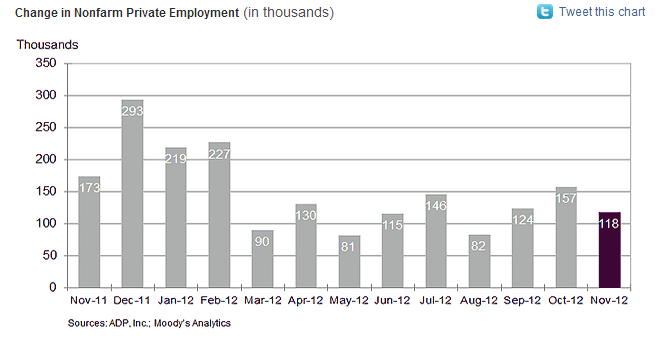
ADP reported a 118k increase in US nonfarm private sector employment for the month of November. This report was obviously driven by Hurricane Sandy. The biggest gains were in construction and utilities, while manufacturing fell. A blip upward in construction and temp workers for storm clean-up and a drop in manufacturing as plants with no power laid off employees.   October was revised downward.  Mark Zandi estimates that the hurricane depressed employment by 86k.

Edit:  Immediately after hitting "post"  Citi announces it will cut 11,000 jobs.

Chart:  ADP change in non-farm payrolls:


Obama has drawn a line in the sand:  No increase in top rates for incomes over 250k, no deal. He expressed openness to cutting top rates next year in the context of broad tax reform.

Servicers beware:  Not only do you have to fear the CFPB, the state regulators are getting involved.  New York State is refusing to approve Ocwen's purchase of Homeward and the servicing unit of ResCap unless the company agrees to bring in a monitor from NY State which would oversee operations for two years and recommend changes in business practices.  In all of my years of analyzing mergers and the regulatory process, I have never seen anything like this.  Ocwen goes on to point out that they have "not received from any regulator at the federal or state level or any level any findings or evidence we have wrongfully foreclosed on any borrower."  This is unprecedented.

The Fed is expected to announce a new round of Treasury buying after Operation Twist ends at the end of the year. US GDP is expected to slow as uncertainty over the fiscal cliff has weighed on capital expenditures and hiring.  ML / BOA is forecasting 1% GDP growth in Q4 and Q1.

Tuesday, December 4, 2012

Morning Report - Earnings from Toll Brothers

Vital Statistics:

Last Change Percent
S&P Futures  1408.8 1.7 0.12%
Eurostoxx Index 2600.1 17.7 0.69%
Oil (WTI) 88.11 -1.0 -1.10%
LIBOR 0.311 0.000 0.00%
US Dollar Index (DXY) 79.69 -0.188 -0.24%
10 Year Govt Bond Yield 1.63% 0.01%
RPX Composite Real Estate Index 190.9 -0.1

Markets are flattish after John Boehner released the Republican counter-offer to Obama's proposal. Needless to say, the two sides are far apart. We have the ISM New York later this morning and no other economic data.  Bonds are up slightly and MBS are down small.

John Boehner laid out the GOP proposal for the fiscal cliff last night: $800B in new revenues over the next decade, and $600B in cuts to entitlements.  The new revenues would come from limiting deductions on incomes over $250k, and would maintain current marginal tax rates.  Of the spending cuts, they propose to increase the Medicare eligibility age to 67 and to make changes to the CPI calculation that affects cost-of-living increases to Social Security.  Given that marginal tax rates will stay the same on the rich, this plan is obviously a non-starter with Democrats.

Toll Brothers released its 4Q earnings this morning and this release demonstrates how much different the landscape is today from a year ago.  Revenues were up 48%, signed contracts were up 75%, and backlog was up 70%.  Prices were up 3% YOY.  Toll is in the McMansion business, so these numbers are more representative of the high end.  Bob Toll made a point re homebuilding that I have been making - that household formation has been artificially depressed due to the economy, and that has created pent-up demand for new construction.  He cites a Harvard study that estimates that based on historical trends, 1.8 to 2.8 million households should have been formed since 2007 than were actually created.  He goes on to say that experts estimate the the housing industry has to product 1.4 to 1.7 million homes per year to keep up with demographic demand.  Don't forget, 1.5 million has been the average number since the 1950s.  Our recent production has been around half that.  Since 2007.  TOL is up about 3% pre-open.

The upcoming increase in G-fees has created a flurry of activity as borrowers and lenders try and get loans done ahead of the increase.  November issuance of government-backed MBS increased 45% last month.  The G-fee increase takes effect on Dec 1, so expect issuance to fall off in the coming months.

Monday, December 3, 2012

Morning Report "Gs" and "Js" edition.

Vital Statistics:

Last Change Percent
S&P Futures  1420.8 6.4 0.45%
Eurostoxx Index 2603.5 28.2 1.10%
Oil (WTI) 89.54 0.6 0.71%
LIBOR 0.311 0.000 0.00%
US Dollar Index (DXY) 79.87 -0.288 -0.36%
10 Year Govt Bond Yield 1.64% 0.03%
RPX Composite Real Estate Index 191.1 0.0

Markets are higher this morning after a better than expected PMI report out of China and Europeans took steps to solve their crisis there.  We will get the November ISM report and Construction Spending at 10:00 am. Bonds are down a point, while MBS are down a few ticks.

Talks on the fiscal cliff seem to be at a stalemate.  Both sides are digging in their heels and making their respective cases on the Sunday morning talk shows. Given that we have seen this movie before in the debt ceiling and the last time we approached the cliff, the markets are taking a sanguine view.  Two economists sum up the left / right views pretty well this morning:  Sameulson vs Krugman.

Has the G-fee become the new Social Security Trust Fund - in other words, the piggybank government uses to fund items unrelated to housing?  It would appear so.  They were used in the debt ceiling deal a couple of years ago, and are now being used to pay for visas for highly skilled immigrants. Never mind that the G-fee is   more or less an insurance policy payment used to compensate the GSEs for credit risk. Maybe the "G" in G-fee should be changed from "guarantee" to "general"

The Fed is contemplating another round of asset purchases as Operation Twist ends this year. While Minneapolis President Kocherlakota believes "monetary policy if anything is too tight," Philly Fed President Charles Plosser warns that additional stimulus may not have the capability to affect employment rates and risks the possibility that the "US turns into a Japanese experience where we have extremely weak modest growth over a long period of time."  It is refreshing to hear someone invoke the "J" word - Japan - which should be the elephant in the room, both in Washington and at the Fed.

Check out our latest article in the Scotsman Guide:  Where are we going, Where have we been?

Friday, November 30, 2012

Morning Report - Shadow Inventory and the Fiscal Cliff

Vital Statistics:

Last Change Percent
S&P Futures  1416.0 0.3 0.02%
Eurostoxx Index 2588.6 6.9 0.27%
Oil (WTI) 87.84 -0.2 -0.26%
LIBOR 0.311 0.000 0.00%
US Dollar Index (DXY) 80.26 0.055 0.07%
10 Year Govt Bond Yield 1.60% -0.01%
RPX Composite Real Estate Index 191 -0.2

Markets are flattish on a morning with no major news. For the time being, the stock market will react to every new development in the talks. The S&P dropped 7 points yesterday after Boehner came out and cited no progress on the talks.  Expect a bumpy ride in the stock market until we reach some sort of resolution.  In economic news, Personal income was flat in October and Personal Spending was down .2%.  Both numbers  were lower than forecast, and were probably affected by Hurricane Sandy.

Obama's opening demand on the fiscal cliff is basically:  new spending, and $1.6 trillion in new taxes.  McConnell apparently laughed in Geithner's face when he presented it. So basically here is the bid / ask:  Higher tax rates and lower deductions on the rich, and increased spending vs the Romney Tax Plan. In other words, zero at par.

Business Week has a piece on the shadow inventory.  They make a point I have been making that the shadow inventory is getting picked over. They fear that once this glut of houses in disrepair hit the market, they will depress pricing.  My point is that they are already on the market, basically going for almost nothing. Just for fun, I looked at some place on Zillow.  There are over 2,200 homes in Detroit for $15,000 or lower.  177 in Toledo, OH. 118 in Stockton, 31 in Harrisburg.  How are you going to depress these markets further?  How many will ever sell?  The only thing left is to write them down to zero (which probably has already happened) and move on.


Wednesday, November 28, 2012

Morning Report - Government subsidies and the housing bubble

Vital Statistics:

Last Change Percent
S&P Futures  1392.3 -5.1 -0.36%
Eurostoxx Index 2526.2 -17.3 -0.68%
Oil (WTI) 86.22 -1.0 -1.10%
LIBOR 0.311 -0.001 -0.32%
US Dollar Index (DXY) 80.53 0.125 0.16%
10 Year Govt Bond Yield 1.61% -0.02%
RPX Composite Real Estate Index 191.3 0.5

Markets are lower this morning on no real news.  Expect stocks and bonds to be choppy as they react to every new clue about the fiscal cliff.  Harry Reid said he was "disappointed" in how the talks were going yesterday. This one will probably go down to the wire. Bonds and MBS are up.

Bob Schiller told CNBC that the possibility of the US curbing mortgage interest deductions could prompt a sea change from buying houses to renting. He is cautious on house prices:  "Persistently high unemployment and low growth in wages are reasons to be skeptical of this recovery. People that haven't recovered their economic situation yet and we have threats from abroad.  I still think it's a risky market."

To Schiller's point about people not yet recovering from their economic situation, the NY Fed has a report out on the pace of consumer de-leveraging. Aggregate consumer debt fell by .7% YOY to 11.31 trillion, which is down 11% from the peak in Q308. Still, the excesses of the housing bubble have yet to be worked off.  That said, debt service payments are at multi-decade lows, due to lower interest rates.  If you are wondering why the Fed is keeping interest rates so low for so long, this is why.  Inflation is a debtor's best friend, and that is why the Fed is so sanguine about inflation.

Chart:  Debt balance and composition:


For what it is worth, I do not share Schiller's caution.  I am bullish on residential real estate and think it will be the best performing asset in the US next year.

The Washington Post picked up on the Brown-Forman special dividend.  Expect companies with excess cash to distribute it to shareholders before taxes go up next year.

Investor's Business Daily has a good write-up on how HUD and the GSEs helped inflate the housing bubble through affordable housing goals.  They include a very interesting chart showing homeownership rates and different policy actions:  Given that the interpretation of what went wrong has fallen completely along partisan lines, this piece of the puzzle has yet to be officially examined. And explains why Franklin Raines (who ran Fannie Mae in the early 00s and instituted the American Dream Commitment) has escaped prosecution despite presiding over an accounting fraud that rivaled Enron.