A place where economics, financial markets, and real estate intersect.
Showing posts with label Toll Brothers. Show all posts

Tuesday, August 21, 2018

Morning Report: Housing inventory is still falling, albeit at a slower rate

Vital Statistics:

Last Change
S&P futures 2862 4
Eurostoxx index 384.93 1.7
Oil (WTI) 67.47 1.04
10 Year Government Bond Yield 2.83%
30 Year fixed rate mortgage 4.58%

Stocks are higher this morning as earnings season winds down. Bonds and MBS are down. 

Same store sales rose 4.7% last week, which is indicative of a strong back-to-school shopping season. BTS is a good predictor of the holiday shopping season, which would support strong GDP growth for the rest of the year. Consumption is about 70% of US GDP. Current projections are looking at north of 3% growth for the year.

The Fed Funds futures are now handicapping a 96% chance of a Sep hike and a 63% chance of a Sep and Dec hike. Meanwhile, the yield curve continues to flatten. 

Trump made some comments about Fed Chairman Jerome Powell at a fundraiser, saying that he expected him to be a "cheap money guy" and didn't expect him to raise interest rates. He also tweeted that he is "getting no help" from the Fed. While publicly discussing monetary policy is not a normal thing for the President to do, wishing rates were lower is. The only politicians who want higher rates are the ones not in power. He also called the Europeans and the Chinese currency manipulators. Under any other President this would be big, but the dollar and the bond market largely ignored it. It  shows that markets are largely dismissing "Donald being Donald" communiques from the WH.  

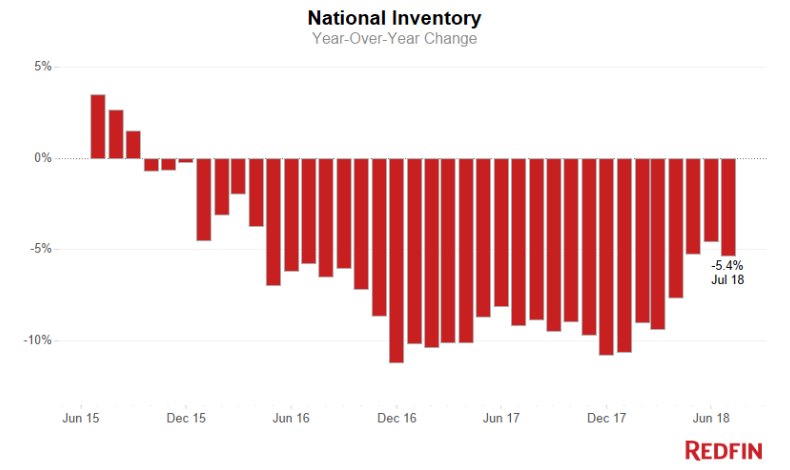
The YOY declines in inventory that have bedeviled the industry are beginning to moderate, at least according to Redfin. Inventory was down 5.8% in July, which is lower than the double-digit decreases we had been seeing. The median sales price rose 5.3%. Homes went under contract in 35 days, which is 3 days faster than a year ago. Activity is slowing in some of the hotter markets however, especially Washington DC. The inventory issue won't be fixed until we get housing starts back to some semblance of normalcy, which means a few years of 2MM units before returning to historical averages of around 1.5MM. 

Toll Brothers reported strong numbers this morning, which has sent the stock up 11%. Revenues were up 27% and deliveries were up 18%. Backlog rose 22% in dollars and 13% in units. They also bought back about $137 million worth of stock, which accounts for about 70% of earnings. Robert I. Toll, executive chairman, stated: “We believe there is room for continued growth in the new home market in the coming years. Household formations have been increasing and in many regions the aging housing stock may not satisfy the lifestyles of today’s buyers. Yet new home production has not kept pace with the growth in population and households. On the single-family side, housing starts, other than during the anemic years of this recovery, are at their lowest level since 1970. In addition, existing home values have increased, providing potential move-up and empty nester customers with more equity that they can put toward a new home purchase. We believe these two groups, along with the growing number of millennials starting to buy homes, are all sources of potential new demand in the coming years.”  

I find it interesting that he talks about the low level of housing starts, while at the same time spending 70% of Toll's net income on buybacks. Certainly the actions don't seem to match the words. 

Tuesday, May 22, 2018

Morning Report: Consumer debt to hit $4 trillion this year

Vital Statistics:

Last Change
S&P futures 2737 4.75
Eurostoxx index 396.69 0.82
Oil (WTI) 72.55 0.31
10 Year Government Bond Yield 3.07%
30 Year fixed rate mortgage 4.66%

Stocks are higher this morning as the trade rhetoric with China cools. Bonds and MBS are up.

China said overnight it would cut its tariff duties on automobiles from 25% to 15%. 

Things are looking grim for the origination business, according to people at the MBA Secondary Conference in NYC. A combination of declining volumes and skinnier margins are pushing the smaller originators out of the market. Hard to see what changes things, although an increase in homebuilding would help. 

McMansion builder Toll Brothers missed quarterly earnings estimates on higher costs, driven by building materials, land and labor. Gross margins contracted 150 basis points, while revenues increased 17%. The stock is down 7% this morning. 

Economic activity accelerated slightly in April, according to the Chicago Fed National Activity Index. Production-related indices accounted for the majority of the index gain, followed by employment indices. The CFNAI is a meta-index of 85 different economic indicators. 

Oil continues its strong run on the back of OPEC cuts and supply disruptions out of Venezuela and Iran. Oil is the highest it has been in almost 4 years. The ability to turn on incremental supply quickly and cheaply will help keep a lid on prices, although higher gas prices for the summer driving season are going to dampen sentiment. 

JP Morgan might get bigger in FHA loans, according to statements made at the MBS Secondary Conference. Regulatory risk caused the bank to publicly state it was pulling back from that market. Regulatory reform is helping, but the bank says that further fixes will be needed. Chase does do FHA lending, but it is tiny. 

The level of consumer debt in the economy has a lot of people talking. Consumer debt is probably going to hit $4 trillion by the end of 2018. Certainly the chart of consumer debt looks worrisome:


Increased student loan debt is a big driver of the increase. That said, does that mean consumers are in over their heads? Can they service that debt? Well, if you look at this chart, it doesn't appear to be a problem:


In other words, consumer debt is high, but the amount people are actually paying to service that debt is very low. Higher interest rates will move that debt service ratio up, but it is hard to make an argument that consumers are over-extended, at least by looking at that chart. 

Freddie Mac is launching its Borrower of the Future Campaign to take a look at how the industry will have to address the younger homebuyer. “The increase in self-employed and the rise of the sharing economy and digitally-driven lifestyles are having a tremendous impact and leading to shifts in behavioral, economic and societal factors,” said Chris Boyle, Chief Client Officer at Freddie Mac. “Collectively, the industry must now take into account these dynamics as we think about how to effectively help the next generation find the home of their dreams. We’re excited to serve in this important role to help the industry better understand the Borrower of the Future, and then drive the conversation on how to apply these insights to make the mortgage process more efficient and affordable.”

Neel Kashkari discusses how the Fed has beaten the Phillips Curve. The Phillips Curve dates back to the 1950s, and plots a relationship between unemployment and inflation. Kashkari cites the 2009 interventions, which should have caused deflation, but didn't. We have unemployment below 4% and still no signs of real inflation. 

Tuesday, February 27, 2018

Morning Report: Jerome Powell Addresses Congress

Vital Statistics:

Last Change
S&P Futures  2782.0 -2.5
Eurostoxx Index 381.8 -1.3
Oil (WTI) 63.6 -0.3
US dollar index 83.7 0.2
10 Year Govt Bond Yield 2.88%
Current Coupon Fannie Mae TBA 102.313
Current Coupon Ginnie Mae TBA 102.531
30 Year Fixed Rate Mortgage 4.4

Stocks are down small on no real news. Bonds and MBS are down as well.

Durable Goods Orders fell 3.7% in January MOM, but rose 6.8% YOY. Ex-transportation, they fell 0.3% MOM and rose 6.9% YOY. Core Capital Goods (a proxy for business capital expenditures and expansion) fell 0.2% MOM and is up 6.3% YOY. 

In other economic news, the trade deficit widened to 74 billion, while retail inventories rose 0.8%. Wholesale Inventories rose 0.7%.

Home prices rose 6.3% YOY in December to close out 2017 up 6.3% overall. House price inflation will be subject to a bit of a push-pull effect: Strong demand and limited supply will provide support for home prices, while increasing interest rates will reduce affordability and should have a dampening effect on home price inflation. That said, by historical standards, these mortgage rates are still extremely low, and affordability is still extremely high, at least on a long-term basis when you use monthly payment as a percentage of income. 

The FHFA House Price Index rose 0.3% and it is up 6.5% for the year. 

Fed Chairman Jerome Powell testifies in front of Congress this morning at 10:00 am. Here are his prepared remarks. Nothing in the remarks jumps out at me as anything all that new, although Powell argues that the stability of the labor force participation rate over the past few years is a sign of strength, not weakness. Yes, baby boomers are retiring but their kids are entering the workforce so it should balance out. Below is a chart of the labor force participation rate going back to WWII. Note the steady rise beginning in the 1960s. That is the baby boom entering the workforce, and the secular change of more women entering the workforce. About half of those gains have been given back in the Great Recession. I think he is saying that the labor force participation rate should be trending even lower due to demographic factors, and that the stability of the past few years is evidence that the labor market is strong. Perhaps. 


The Fed has always had a simple model of unemployment and inflation called the Phillips Curve. It basically says that unemployment will start driving inflation if it gets low enough. Historically economists have thought that unemployment levels in the low 4s would trigger it. So far we have seen some wage inflation in some skilled areas, but nothing widespread. Most of the inflation we have been seeing has been commodity push inflation driven by food and energy prices. These things often reverse, as higher prices invite new supply. Or in other words, the cure for high prices is high prices. 

You are beginning to see a new theory in academia - that the slow growth in wages is not due to a supply / demand issue, but is evidence of an antitrust problem, or at least a market failure. Hard to see how heavyweights like Wal Mart and McDonalds are colluding for low wage labor, but that;s what they believe, and they think the cure is a higher minimum wage, more unions, and exerting more oversight over the bigger employers. Occam's Razor says that labor-replacing technology is probably the driver, but that's no fun. 

Toll Brothers reported better-than expected earnings this morning, showing that there is still plenty of strength in the luxury sector of the market. Orders rose 19% in units, and ASPs rose 6.8% to $826k.  Margins are falling however, as increasing input and labor costs push against price hikes. 

Surprising stat: 35% of homebuyers bid on a home before seeing it in person. The young buyer is more likely to do this: almost half of Millennial buyers bid before seeing. 

Tuesday, December 5, 2017

Morning Report: Toll Brothers misses

Vital Statistics:

Last Change
S&P Futures  2642.0 3.8
Eurostoxx Index 386.6 -0.9
Oil (WTI) 57.3 -0.2
US dollar index 86.7 0.1
10 Year Govt Bond Yield 2.39%
Current Coupon Fannie Mae TBA 102.625
Current Coupon Ginnie Mae TBA 103.625
30 Year Fixed Rate Mortgage 3.88

Stocks are higher this morning on no real news. Bonds and MBS are flat.

Toll Brothers announced earnings this morning that missed analyst expectations. The sector has been on a tear this year, so weak earnings are expected to be punished by the markets. Revenues increased 9% and earnings increased 68%. The company used a lot of its cash to repurchase stock and bonds, which isn't a great sign for future growth. Generally when companies are seeing great opportunities, they re-invest in the business. When they don't, they buy back stock. The street didn't like the guidance, and the stock is down about 6% pre-market. 

Toll is in the luxury end of the housing market, covering McMansions in urban areas out West and luxury apartments in the East. The change in the mortgage interest deduction is probably going to impact demand. Note that the builders that focus on entry-level building are doing much better. For the past 10 years, the luxury end of the market was the only part that was working. Now the market is shifting to the first time homebuyer. 

Speaking of the luxury end of the market, the New York Times frets about the effect tax reform will have on New York City. It turns out that 40,000 residents in New York City account for half the city's revenue. If they leave, it will have a huge impact on the city's finances. The people most affected will be those making over $200,000, and in a high cost area like New York City and the suburbs, that is not rich by any stretch of the imagination. 

Factory orders fell 0.1% in October, ending a generally good month for manufacturing. Capital Goods orders were strong however, and that points to a stronger Q4 and 2018. Capital Goods orders are generally associated with business expansion, capacity increases, and modernization. 

The services economy decelerated in November from a record in October, according to the ISM Non-Manufacturing Survey. 

Tax reform heads to committee to resolve the differences between the House and Senate versions. Here are the biggest sticking points. The committee starts work on Monday, with an eye to have a final vote in Mid-December. 

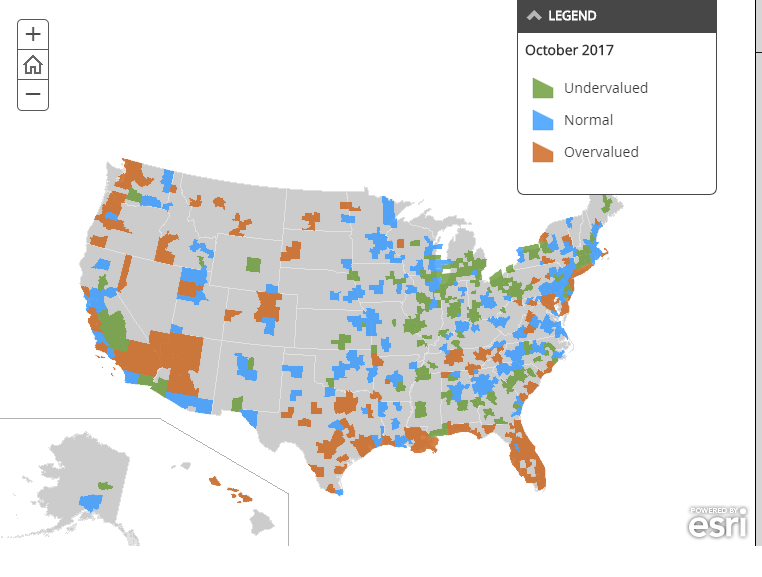
Home prices rose 0.9% MOM and are up 7% YOY, according to CoreLogic. The fastest growth continues to be in the West and Mountain states. Much of the Midwest remains undervalued while we are seeing overvaluation in places like Florida, Texas, and the West Coast. Note that fears about climate change are not evident in Florida real estate


First time homebuyers are still relatively uninformed about mortgages. According to a recent survey, 20% of Americans think it is impossible to get a mortgage with less than 5% down, despite the fact that FHA goes down to 3%, VA allows nothing, and the GSEs have 3% down products. Most people get their information on the Internet, and surprisingly almost nobody gets their mortgage information from the CFPB. 

How did HAMP and HARP help struggling homeowners? It turns out, not much. In fact, borrowers who had a principal reduction had pretty much the same default rates as borrowers without a principal reduction. These reductions were big: 32% or about $112,000 on average. These results pour cold water on the strategic default theory, which says that borrowers will choose to toss the keys to the bank once the home value is less than their outstanding mortgage. FWIW, I think the defaults in 2006 were strategic defaults, as the economy had yet to roll over and professionals were playing the greater fool game. Note that modifying a mortgage payment to a percentage of income didn't really help either. The punch line is that many defaults were caused by a short term blip in a borrower's financial situation - often an unexpected expense like a medical bill - and servicers should work on creating a solution to help the borrower over that hump and then re-evaluate. 

Tuesday, August 22, 2017

Morning Report: Are we hitting price exhaustion at the high end of the market?

Vital Statistics:

Last Change
S&P Futures  2432.3 4.3
Eurostoxx Index 374.4 1.6
Oil (WTI) 47.4 0.0
US dollar index 86.2 0.3
10 Year Govt Bond Yield 2.21%
Current Coupon Fannie Mae TBA 103.09
Current Coupon Ginnie Mae TBA 103.97
30 Year Fixed Rate Mortgage 3.89

Stocks are higher this morning on no real news. Bonds and MBS are lower. 

House prices rose 1.6% in the second quarter and are up 6.6% YOY, according to the FHFA House Price Index. The fastest growth was out West, with Washington up 12.4%. The weakest areas were in the Northeast and Mid-Atlantic, particularly CT. 

Morgan Stanley is warning that stocks and corporate bonds could be vulnerable once the Fed begins to let its portfolio of Treasuries and MBS run off. A committee of investors and banks hypothesized that corporate credit spreads could widen as much as 135 basis points. Will that have the same effect on mortgage backed securities spreads? Quantitative easing itself didn't move in spreads all that much, so I cannot imagine something that will amount to a tiny fraction of that having much impact either. The Fed's balance sheet is now about $4.5 trillion. Pre-crisis it was under $1 trillion. Many market observers think the Fed may never be able to get its balance sheet back down to where it was pre-crisis. 


Tensions with North Korea and fears of a debt ceiling standoff have pushed down the market's assessment of future Fed Funds hikes. The December Fed Funds futures are now predicting a 62% chance of no hike versus a coin toss about a week ago. 

The government plans to try and get some sort of tax reform done this year, however it will be difficult. We are much more likely to see some sort of "tax reform light" which probably won't have a massive impact on the economy in the near term. The first order of business is to fund the government and to get an increase in the debt ceiling. Meanwhile, Bridgewater CEO Ray Dalio is taking off risk due to political polarization and buying gold. 

The DOJ ended the Obama Administration's Operation Choke Point, which was sold as an attempt to prevent banks from funding fraudulent actors, but in reality was just an attempt to prevent banks from doing business with payday lenders, which the Administration opposed on ideological grounds. The idea was to hopefully drive payday lenders out of business by making them unable to find banks to service them. 

Luxury homebuilder Toll Brothers reported earnings this morning, and the stock is down a touch pre-market. Average selling prices fell due to a change in product mix. ASPs for signed contracts were flat and contracts were up 25%. Could we be seeing exhaustion, pricing-wise- at the high end of the market? Perhaps, but Robert Toll, Chairman of the Board said: “We believe our industry has room to run. Single-family housing starts, at 811,000, are still well below the 50-year industry average of 1.02 million units. The home ownership rate is on the rise but also still below historic norms. Interest rates remain low, unemployment is low, and more and more buyers are entering the upscale market. Based on these trends, we believe Toll Brothers is well positioned for future growth.”

Despite the lousy housing starts numbers, homebuilder stocks have been on a tear, rising 31% this year. Part of this was due to corporate tax reform - since homebuilders generally have little to no international exposure, a drop in the statutory rate would boost their earnings the most, compared to someone like Apple who has international entities all over the world. Builders have been struggling with their own issues however, especially a shortage of skilled labor. Many of the skilled laborers who worked in homebuilding during the boom either retired or went to work in different industries. Second, construction materials (aka sticks and bricks) are rising as well, and any sort of trade war with Canada will affect framing lumber prices. One thing to remember about homebuilding is that it is a very cyclical business, and during booms, multiples compress. The average homebuilder P/E is about 11 right now, and during the go-go years, it got down to 8.5. In other words, you could be right on earnings increasing, but wrong on the stock price as it goes nowhere while earnings grow. The other side of that argument is that there is so much pent-up demand for housing right now that a slowdown is simply not on the horizon. 

A new lending firm claims it can cut the closing process down to 8 days, and the borrower never has to speak to a loan officer. The industry average is 43 days. 

Wednesday, February 22, 2017

Morning Report: Existing Home Sales strongest in 10 years

Vital Statistics:

Last Change
S&P Futures  2357.5 -2.5
Eurostoxx Index 373.2 -0.3
Oil (WTI) 54.0 0.6
US dollar index 91.3 .
10 Year Govt Bond Yield 2.40%
Current Coupon Fannie Mae TBA 102.045
Current Coupon Ginnie Mae TBA 103.17
30 Year Fixed Rate Mortgage 4.14

Stocks are higher this morning on no real news. Bonds and MBS are up small. 

Mortgage applications fell 2% last week as purchases fell 3% and refis fell 1%. The rate on a 30 year fixed rate mortgage rose 4 basis points to 4.36%, according to the MBA. 

The year got off to a strong start with existing home sales increasing at an annualized rate of 5.69 million in January, according to NAR. This is up 3.8% from a year ago, and is the strongest reading since Feb 2007. The median home price rose 7% to $228,900. Inventory is down 7% YOY and stands at 3.6 months' worth. Days on market dropped to 50 from 64 a year ago. The first time homebuyer accounted for 33% of sales, which is inching up. Competition is strongest for homes in the low to medium price range. Fannie's deal with Blackstone on single family rentals will probably only make the lower price points even tighter. Still, a good start for the year. If we get some regulatory relief for the smaller banks, we should see more construction for the "mom and pop" builders. 

Toll Brothers reported better than expected numbers this morning, with deliveries flat in dollars but up 12% in units, contracts up 14% in dollars and 22% in units, and backlog was up 19% in dollars and 21% in units. Average selling prices fell to 773,700 from 873,500, but that was due to an acquisition, and a geographic shift to the North and East. The company raised guidance as well for 2017. The stock is up about 6% pre-open. 

We have the potential for some volatility in rates this afternoon with a Fed speech at 1:00 and the FOMC minutes at 2:00 pm. Below is a chart of the current handicapping in the Fed Funds futures market. Looks like about a 30% chance of a March hike, about a 55% chance of a hike by May and a 75% chance of a hike by June. The dot plot from December is forecasting between 2 and 3 25 basis point hikes.


Donald Trump reversed Obama's immigration enforcement policy, which will make it easier to deport people who commit crimes. Obama's policy only deported those that were guilty of violent crimes. Trump will now include those guilty of fraud as well. The policy for "Dreamers" - those who came illegally as children - is unchanged. There are some worries that this will affect the housing market by reducing demand and making the market for construction workers even tighter. It could also tighten credit, as Dreamers are eligible for Fannie, Freddie, and FHA loans. The fear is that any sort of mass-deportation will trigger early defaults, leaving the lender on the hook for a buyback. From the look of it, the change in immigration policy is relatively minor - more for show than an actual substantive change in policy - and there are no mass deportations on the horizon. 

Any sort of increase in deportations will probably make a tight labor market even tighter, which would be inflationary. That is the fear about this afternoon's FOMC minutes. The FOMC statement from Feb 1 removed references to lower energy prices and a strong dollar, which work against inflation. Investors will also be looking to see if there was discussion around shrinking the Fed's balance sheet. This could conceivably affect mortgage pricing, as the biggest buyer of MBS pulls away. That said, spreads didn't do much when the Fed was aggressively buying, so the end of reinvestment probably won't make that big of a difference either. 

Fannie Mae shareholders got slammed yesterday after an appeals court rejected their bid to sue the US government over the "net sweep" dividend change. Fannie Mae stock was down 35% yesterday, while Freddie Mac was down 38%. Fannie stock has been on a wild ride since the election, rising from $1.65 to $4.50 before falling back to $2.71 yesterday. FNMA stock has always been a litigation lottery ticket, and the only reason it exists in the first place is because the government didn't want to have to consolidate Fannie and Freddie debt on its balance sheet so it had to leave 20% outstanding. Fannie Mae's market cap is $15.72 billion, and last year they earned $12.3 billion, which makes their P/E ratio about 1.3x. The Obama administration was adamant that FNMA shareholders should receive nothing – in their view conservatorship is tantamount to bankruptcy and in bankruptcies the common stock gets wiped out.

Tuesday, December 6, 2016

Morning Report: Productivity rises

Vital Statistics:

Last Change
S&P Futures  2207.5 3.0
Eurostoxx Index 343.2 2.0
Oil (WTI) 50.7 -1.1
US dollar index 91.0 0.0
10 Year Govt Bond Yield 2.39%
Current Coupon Fannie Mae TBA 103
Current Coupon Ginnie Mae TBA 104
30 Year Fixed Rate Mortgage 4.11

Stocks are lower this morning on no real news. Bonds and MBS are up. 

Non-farm productivity improved to 3.1% in the third quarter, breaking out of a long slump. Unit labor costs increased 0.7%. Note that productivity and costs have been kind of oscillating around the zero point for the past several years. This is why wage growth has been going nowhere. New policies in terms of regulatory relief and tax reform could help improve productivity according to St. Louis Fed Head James Bullard. 


Donald Trump has been discussing a potential 35% tariff on good imported from companies that offshore jobs. Not sure if this is even going to be legal, let alone legislatively possible. Tariffs are generally good for no one, except perhaps union workers. The last time we had a cocktail of tariffs and Fed tightening (1930), the economic result was nothing to write home about. While Reagan did impose tariffs against Japan, the results were mixed at best

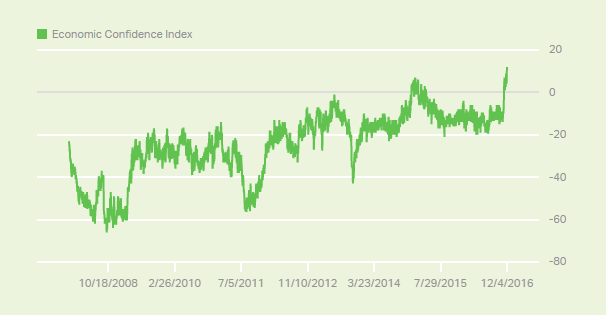
Economic confidence improved markedly in November, according to Gallup and is now at post-crisis highs. It will be interesting to see whether this translates into higher holiday spending. Separately, it could bode well for the Spring selling season, which is just around the corner (basically starts around Super Bowl Sunday).


Luxury homebuilder Toll Brothers announced better than expected numbers this morning. Deliveries were up 29% in dollars and 22% in units, however we are seeing a moderation in inflation. Average selling prices rose 5.5% to $834k, which is well below the double-digit ASP inflation we have been seeing, especially at the high end. They discussed the Millennials and how they are targeting them: “With the millennial generation now entering their thirties and forming families, we are starting to benefit from the desire for home ownership from the affluent leading edge of this huge demographic wave. In FY 2016, approximately 22% of our settlements included one primary buyer thirty-five years of age or under. (emphasis mine). We are currently courting these customers with our core suburban homes, urban condos and rental apartment properties. We are also introducing a new product line, T|Select by Toll Brothers, which incorporates the elegance and style of a higher-end Toll Brothers home but with fewer structural options, a quicker delivery time and a slightly lower price."

Home prices rose 1.1% MOM and are up 6.7% YOY, according to CoreLogic. The coasts remain largely overvalued, while the interior is mainly undervalued. 


While rising rates are creating worries in the mortgage banking sector of the economy, banks have been on a tear since the election, outperforming the S&P 500 by 11 percentage points. This means the Street is forecasting a big increase in credit and profitability which should offset some of the doom and gloom amongst mortgage bankers. The "tell" will be the return of the private label securitization market, and the follow-on return of the first time homebuyer. Shops that focus on purchase activity should be optimistic about the future. 


Wednesday, August 24, 2016

Morning Report: New Home sales rise, existing home sales fall

Vital Statistics:

Last Change
S&P Futures  2186.0 1.0
Eurostoxx Index 345.6 2.0
Oil (WTI) 46.8 -1.7
US dollar index 85.8 0.1
10 Year Govt Bond Yield 1.55%
Current Coupon Fannie Mae TBA 103.3
Current Coupon Ginnie Mae TBA 104.2
30 Year Fixed Rate Mortgage 3.5

Stocks are flattish this morning on no real news. Bonds and MBS are flat as well.

Bonds have been in a tight trading range over the past couple of weeks. On Friday, Janet Yellen will speak in Jackson Hole.

Existing home sales dropped 3% YOY in July as tight inventory remains an issue. The median home price increased 5.3% YOY to 244k. Unsold inventory is at 4.7 months, an uptick from June. The first time homebuyer accounted for 32% of sales compared to 28% last year. Appraisal-related issues are increasing as demand is overwhelming the already reduced supply of appraisers. 

New home sales increased over 12% in July to a 654,000 annual rate. The median home price fell 5.1% month-over-month to $294,600. The median home price is down about half a percent YOY. Softness in the luxury space might be driving this as well as a move to focus more on starter homes. Supply is still tight at about 4.3 month's worth so you can't say it is a glut. Regardless of what is going on in pricing, the number is an encouraging sign for the economy. 


You aren't seeing softness in pricing at Toll Brothers. Their ASPs rose 16% in the third quarter YOY. Toll has been emphasizing luxury urban condo construction, which may explain part of the huge increase. Revenues increased 24% and net income rose 54%. Yet what are they doing with their capital? Buying back stock, to the tune of $97 million worth in the third quarter. If business is that good, why?

Mortgage Applications fell 2.1% last week as purchases fell .3% and refis fell 3%. 

The FHFA House Price Index rose 0.2% MOM and is up 5.6% YOY. Home prices rose in every state except for Vermont. The Pacific Northwest and mountain states had the highest price appreciation, while the Northeast and Mid Atlantic continue to bring up the rear. In fact, the worst MSA was the Stamford-Bridgeport MSA which saw prices decline 3%. The FHFA index only looks at houses with a conforming mortgage, so it excludes jumbos and cash sales. 


McMansions are not holding their resale value the way they used to. This may help explain the drop in the median sales price for new homes. The premiums are lower for new houses.

There is an old saying that if you spend some time on a website and can't figure out what the product is, you are the product. This is especially true with Facebook. Ever wonder how facebook classifies you politically? You can find out here. This determines the political ads you see. 

Tuesday, May 24, 2016

Morning Report: New home sales spike

Vital Statistics:

LastChangePercent
S&P Futures 2070.622.00.54%
Eurostoxx Index2953.7-25.3-0.85%
Oil (WTI)44.740.10.18%
LIBOR0.630.0000.00%
US Dollar Index (DXY)93.98-0.313-0.33%
10 Year Govt Bond Yield1.87%0.00%
Current Coupon Ginnie Mae TBA105.7
Current Coupon Fannie Mae TBA104.9
BankRate 30 Year Fixed Rate Mortgage3.75

Markets are higher this morning on no real news. Bonds and MBS are down.

New Home Sales came in much stronger than expected, at an annual rate of 619,000. This is the highest level since early 2008. While it is premature to bust out the champagne quite yet (prior to the bubble, the last time sales were this low was the early 90s), it is an encouraging sign. The Spring Selling season got off to a somewhat slow start, but seems to be picking up momentum. Note this number has an unusually wide margin for error this month, so expect a revision. 


Speaking of new home sales, we got second quarter numbers out of Toll Brothers this morning. Earnings beat on the top and bottom lines, with revenues increasing 31% in dollars and 9% in units. Interestingly, average selling prices of signed contracts were flat. Contracts only rose 3%, and the problems were in California, with not enough inventory for sale. They continue to build out their urban apartment segment and plan to expand it to smaller cities and suburbs. 

The Richmond Fed manufacturing index fell in May to -1 from 14. 

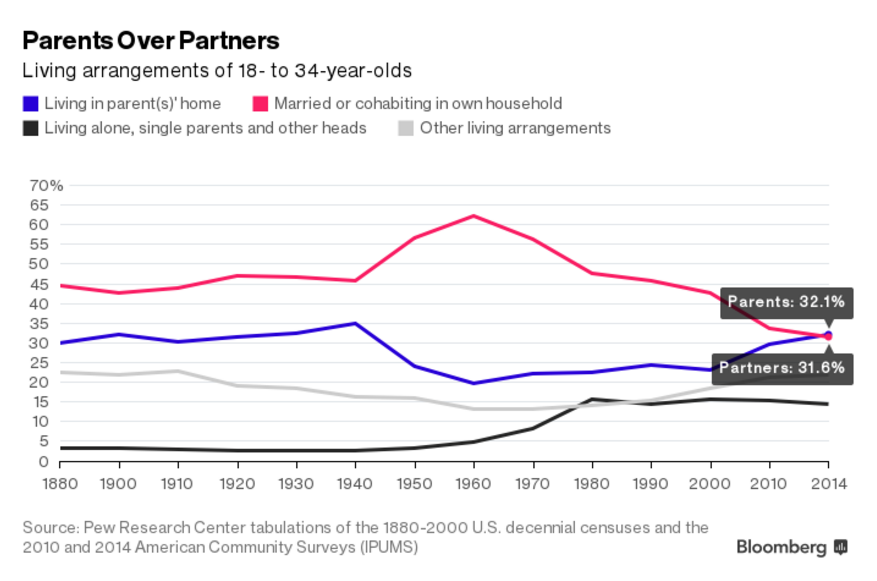
More millennials are living with their parents than they are with a partner or significant other, for the first time in the modern era. This is probably a reflection of a lot of things - from the weak economy to people getting married later in life. However, it does represent pent-up demand for housing. 


Foreclosure starts fell to 58,700 in April, the lowest level since 2006. Delinquencies increased slightly, but are still down 10% YOY. The active foreclosure inventory fell below 600,000 for the first time since 2007. The Northeast still has some wood to chop in terms of liquidating foreclosures. 

Wednesday, February 24, 2016

Morning Report: New Home Sales fall

Vital Statistics:

LastChangePercent
S&P Futures 1896.0-20.6-1.04%
Eurostoxx Index2867.6-27.6-0.95%
Oil (WTI)30.09-0.7-2.21%
LIBOR0.6190.0010.19%
US Dollar Index (DXY)96.93-0.019-0.02%
10 Year Govt Bond Yield1.67%-0.03%
Current Coupon Ginnie Mae TBA105.3
Current Coupon Fannie Mae TBA104.8
BankRate 30 Year Fixed Rate Mortgage3.68

Markets are getting pounded on the new worry du jour: Brexit. Bonds and MBS are rallying..

Brexit is the threat of the UK leaving the EU. It has implications mainly in the foreign exchange markets, but if the markets need something to worry about, well there you go. 

Mortgage Applications fell 4.3% last week as purchases rose 2.2% and refis fell 7.7%. The spike in rates last week killed the refis. 

New Home Sales continue to disappoint. Sales fell in January to 494k from 544k in December. For whatever reason, homebuilders continue to hold back production and rely in price hikes to move the top line. 

Regardless, people are still optimistic about the housing sector going forward. Toll Brothers mentioned that a dearth of skilled labor is an issue. Interestingly, average selling prices on signed contracts are falling for them in some areas of the country (the Mid-Atlantic and the South) and are flat in the West. Their urban luxury apartment sector was where all the ASP growth was. Perhaps the builders have pushed price hikes about as far as they can and now buyers are beginning to balk. 

Tuesday, February 23, 2016

Morning Report: Home Prices continue to rise

Vital Statistics:

LastChangePercent
S&P Futures 1910.0-6.6-0.34%
Eurostoxx Index2867.6-27.6-0.95%
Oil (WTI)30.09-0.7-2.21%
LIBOR0.6190.0010.19%
US Dollar Index (DXY)96.93-0.019-0.02%
10 Year Govt Bond Yield1.77%0.03%
Current Coupon Ginnie Mae TBA105.3
Current Coupon Fannie Mae TBA104.8
BankRate 30 Year Fixed Rate Mortgage3.68

Stocks are lower this morning on fears of another yuan devaluation. Bonds and MBS are down.

Home Prices continued to rally in December, according to the Case-Shiller Home Price Index. They were up 0.8% on a month-over-month basis and up 5.7% on a year-over-year basis. Prices remain about 11.5% below their July 2006 peak. Note the FHFA House Price index which we will get on Thursday is already at new highs.


Existing Home Sales were up 0.4% at 5.47 million units in January, according to the National Association of Realtors. On a year-over-year basis, they are up 11%, the biggest gain in 3 years. The median home price rose 8.2% year-over-year to $213,800 as supply constraints continue to drive up prices. Housing inventory is 1.82 million units, which represents a 4 month supply. A balanced market is more like 6 - 6.5 month's worth. Ultimately, the big price increases are unhealthy because incomes have yet to really exhibit growth (although that may be changing). The median house price to median income ratio is roughly 3.8x, using the median income data from Sentier. 3.3 - 3.7x which is about normal. 

Speaking of home supply, McMansion builder Toll Brothers reported earnings this morning. Revenues were driven again by an 11.7% increase in average selling prices and not by unit growth. Gross margins fell, which speaks to increasing costs. So far this February, deposits and contracts are flat with last year. The decline in stocks probably has a lot to do with it as the luxury buyer is going to be more sensitive to asset prices than the first time homebuyer. 

Interesting to see this dynamic with the builders - a reluctance to build more units despite higher prices. Interestingly, CalAtlantic (the new name for Standard Pacific and Ryland after their merger) is bringing back the buydown loan. 

In other economic news, consumer confidence slipped in in February, and the Richmond Fed Manufacturing Index both fell. 

Blackrock is warning clients that the Fed is not likely to sit out the rest of 2016, the way the Fed Funds futures markets are predicting. Efficient market theorists might scoff at that notion, however the interest rate markets are so manipulated by central banks at the moment it makes sense to look at market signals with a jaundiced eye. What does that mean to mortgage types? Make hay now, because no one knows how long these low rates are going to stick around. 

Speaking of credit markets, the new subprime - auto loans - are beginning to exhibit signs of trouble. Auto loans are being priced like mortgages, however a mortgage is secured by a generally appreciating asset, while an auto loan is secured by a depreciating asset. This is the result of financial repression, which is the act of pushing interest rates to the floor. Investors who have to earn a return (like pension funds and insurance companies) are forced to move further and further out on the risk curve to earn their required return. The actuarial tables really couldn't care less that interest rates are zero. 

Donald Trump looks to be cruising to a third consecutive victory in Nevada. The big question for the D is whether he is a plurality winner or a majority winner. Once the establishment coalesces around one candidate will he continue to lead? One other interesting tidbit: Democratic turnout for the primaries is pretty depressed. Republican turnout is huge. Kind of pokes a hole in the media's attempt to create a Bernie Sanders movement, doesn't it?


Monday, November 9, 2015

Morning Report: Bill Gross says 100% chance of a move in December

Vital Statistics:

Last Change Percent
S&P Futures  2089.4 -4.3 -0.21%
Eurostoxx Index 3459.5 -8.8 -0.25%
Oil (WTI) 44.28 0.0 -0.02%
LIBOR 0.341 -0.003 -0.73%
US Dollar Index (DXY) 99.14 -0.033 -0.03%
10 Year Govt Bond Yield 2.35% 0.03%
Current Coupon Ginnie Mae TBA 104.1
Current Coupon Fannie Mae TBA 103.2
BankRate 30 Year Fixed Rate Mortgage 3.82

Stocks are down this morning as investors digest the jobs report. Bonds and MBS are down.

The Labor Market Conditions Index improved to 1.6 in October from an upward-revised 1.3 in September.

The week after the jobs report is usually pretty data-light, and this week is no exception. Aside from the JOLTS job openings on Thursday and retail sales on Friday, there simply isn't much market-moving data. 

Luxury builder Toll Brothers announced preliminary numbers for the 4th quarter and full year. Revenues came in at $1.44 billion, a touch higher than the Street estimates. This was up 6% in dollars and 1% in units. Average selling prices rose 5.8% to $790,000. Signed contracts rose 29% in dollars and 12% in units. Backlog is up 29% in dollars and 10% in units. We will hear from D.R. Horton tomorrow. Although we are in the dull season for the builders, it looks like they are thinking of ramping up production. In the jobs report, construction jobs increased from 33k in September to 78k in October. 

The OECD took down its forecast for global growth in 2016 from 3.6% to 3.3%. A deterioration in the Brazilian and Russian economies drove the downgrade. Japan's forecast from from 1.2% to 1%. The Eurozone was taken down from 1.1% to 1%. The US economy is forecast to grow 2.6%. 

In light of those forecasts, should the Fed hold off on raising rates until things are more clear? Many would argue that ZIRP is an emergency measure and we are no longer in an emergency. Bank of America lays out the argument that the economy can withstand an increase in rates.

Tuesday, August 25, 2015

Morning Report: Green on the Screen as PBOC cuts rates

Vital Statistics:

Last Change Percent
S&P Futures  1932.7 61.5 3.29%
Eurostoxx Index 3211.9 138.5 4.51%
Oil (WTI) 39.55 1.3 3.43%
LIBOR 0.329 0.000 0.00%
US Dollar Index (DXY) 94.14 0.812 0.87%
10 Year Govt Bond Yield 2.08% 0.08%
Current Coupon Ginnie Mae TBA 104.5 0.2
Current Coupon Fannie Mae TBA 104.9 0.7
BankRate 30 Year Fixed Rate Mortgage 3.89

Markets are higher this morning after the People's Bank of China cut interest rates and required reserves. Bonds and MBS are down.

The Chinese Government is going back to the big levers to try and support asset prices - using rate cuts and reserve requirement cuts. They are also using pension fund money to buy stocks and have prohibited insiders and large investors from selling. John Hilsenrath from the Wall Street Journal described China this way: China is like a CDO. You don't know what's inside, how well it performs or where the leverage is until it's under stress. I think that is a very apt description. 

The FHFA House Price Index rose 0.2% in June, lower than expectations. The S&P Case-Shiller index of real estate prices fell 0.12% in June but is up 5% year-over-year. 

New Home sales rose to an annualized pace of 507k in July, slightly lower than expectations. Surprisingly, consumer confidence rose in a big way to 101.5 from 91.

McMansion builder Toll Brothers reported numbers this morning which missed analyst estimates. Revenues and deliveries both declined. Average selling prices actually declined - first time we have seen that out of the builders. That said, signed contracts were up 30% in dollars and 12% in units as ASPs rise to $834k from $717k last year at this time. The stock is up half a buck pre-open, but then again pretty much everything is green this morning. 

During the big sell-off in the markets, Treasuries only moved grudgingly higher. I had been reading that the Middle East (which is getting crushed by low oil prices) was selling the 10 year in a big way. Interestingly, TBAs and mortgage rates have been fading the move in the bond markets. People have been moving back their timing estimates for the first rate hike and bonds are not reacting much to it. 

For those that are market history buffs, here is a cool chart showing the economy from the American Revolution through WWII.

Wednesday, May 27, 2015

Morning Report: The Bernank is sanguine on China

Vital Statistics:

Last Change Percent
S&P Futures  2106.9 2.0 0.10%
Eurostoxx Index 3638.4 19.1 0.53%
Oil (WTI) 57.54 -0.5 -0.84%
LIBOR 0.285 0.003 0.89%
US Dollar Index (DXY) 97.68 0.377 0.39%
10 Year Govt Bond Yield 2.15% 0.01%  
Current Coupon Ginnie Mae TBA 102 -0.1
Current Coupon Fannie Mae TBA 101 -0.1
BankRate 30 Year Fixed Rate Mortgage 3.92

Markets are flattish as Greek talks plod along in a directionless fashion. Bonds and MBS are flat.

Mortgage Applications fell for the fifth week in a row, according to the MBA. Rates rose last week so that isn't a surprise. Purchases were up 1.2% while refis fell 3.9%. 

Luxury homebuilder Toll Brothers reported this morning with EPS of 37 cents a share better than the Street estimate of 35 cents, however it looks like the beat was due to a lower-than-expected tax rate. Revenues were light as deliveries declined 1% in dollars and 2% in units. Net signed contracts rose 25% in dollars and average selling prices for net signed contracts increased 13% to $826,000. California demand is "very strong" as well as Texas and NYC. The rental business continues to grow. Overall, the high end of the market continues to perform very well. 

Was Elmer Fudd correct about adjustable rate mortgages? Seemed ill advised at the time, right ahead of a rate hike - seriously, with perfect clairvoyance he told people to take out ARMs before rates went up. Well, it required a bursting of the real estate bubble to make it work out. That said, if people move often, ARMs may in fact make sense. 

The Bernank doesn't think China will have a hard landing. Given their real estate bubble, and the fact that their stock market has doubled over the past year, I find that wildly optimistic. It seems like countries that experience decades of fast growth tend to have hard landings (the US in the Great Depression, Japan now). Bull markets are a natural breeding ground for dumb debt-financed investments. Maybe the government wonks that run China's economy can manage it through heavy-handed intervention in the markets, but it hasn't been done before. 

The Feds are on the trail of massive corruption at FIFA. You mean to tell me there might be some jiggery-pokery going on in soccer?

Venezuela has found a solution to its toilet paper shortage. Make the Bolivar note worth less than toilet paper