| Last | Change | |||
| S&P futures | 2737 | 4.75 | ||
| Eurostoxx index | 396.69 | 0.82 | ||
| Oil (WTI) | 72.55 | 0.31 | ||
| 10 Year Government Bond Yield | 3.07% | |||
| 30 Year fixed rate mortgage | 4.66% | |||
Stocks are higher this morning as the trade rhetoric with China cools. Bonds and MBS are up.
China said overnight it would cut its tariff duties on automobiles from 25% to 15%.
Things are looking grim for the origination business, according to people at the MBA Secondary Conference in NYC. A combination of declining volumes and skinnier margins are pushing the smaller originators out of the market. Hard to see what changes things, although an increase in homebuilding would help.
McMansion builder Toll Brothers missed quarterly earnings estimates on higher costs, driven by building materials, land and labor. Gross margins contracted 150 basis points, while revenues increased 17%. The stock is down 7% this morning.
Economic activity accelerated slightly in April, according to the Chicago Fed National Activity Index. Production-related indices accounted for the majority of the index gain, followed by employment indices. The CFNAI is a meta-index of 85 different economic indicators.
Oil continues its strong run on the back of OPEC cuts and supply disruptions out of Venezuela and Iran. Oil is the highest it has been in almost 4 years. The ability to turn on incremental supply quickly and cheaply will help keep a lid on prices, although higher gas prices for the summer driving season are going to dampen sentiment.
JP Morgan might get bigger in FHA loans, according to statements made at the MBS Secondary Conference. Regulatory risk caused the bank to publicly state it was pulling back from that market. Regulatory reform is helping, but the bank says that further fixes will be needed. Chase does do FHA lending, but it is tiny.
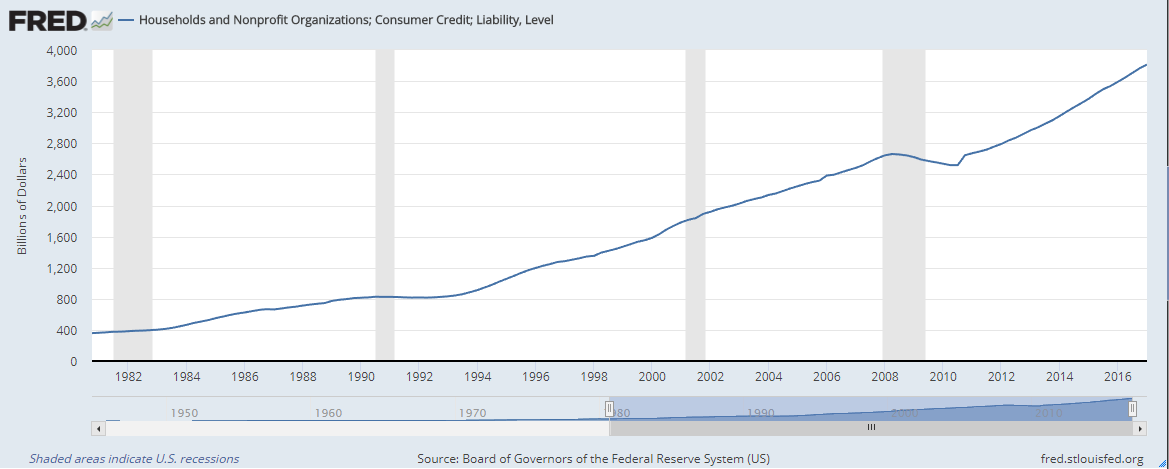
The level of consumer debt in the economy has a lot of people talking. Consumer debt is probably going to hit $4 trillion by the end of 2018. Certainly the chart of consumer debt looks worrisome:

Increased student loan debt is a big driver of the increase. That said, does that mean consumers are in over their heads? Can they service that debt? Well, if you look at this chart, it doesn't appear to be a problem:

In other words, consumer debt is high, but the amount people are actually paying to service that debt is very low. Higher interest rates will move that debt service ratio up, but it is hard to make an argument that consumers are over-extended, at least by looking at that chart.
Freddie Mac is launching its Borrower of the Future Campaign to take a look at how the industry will have to address the younger homebuyer. “The increase in self-employed and the rise of the sharing economy and digitally-driven lifestyles are having a tremendous impact and leading to shifts in behavioral, economic and societal factors,” said Chris Boyle, Chief Client Officer at Freddie Mac. “Collectively, the industry must now take into account these dynamics as we think about how to effectively help the next generation find the home of their dreams. We’re excited to serve in this important role to help the industry better understand the Borrower of the Future, and then drive the conversation on how to apply these insights to make the mortgage process more efficient and affordable.”
Neel Kashkari discusses how the Fed has beaten the Phillips Curve. The Phillips Curve dates back to the 1950s, and plots a relationship between unemployment and inflation. Kashkari cites the 2009 interventions, which should have caused deflation, but didn't. We have unemployment below 4% and still no signs of real inflation.