A place where economics, financial markets, and real estate intersect.
Showing posts with label productivity. Show all posts

Wednesday, August 15, 2018

Morning Report: Mortgage delinquencies continue to fall

Vital Statistics:

Last Change
S&P futures 2824 -16.5
Eurostoxx index 380.78 -4.14
Oil (WTI) 66.49 -0.55
10 Year Government Bond Yield 2.86%
30 Year fixed rate mortgage 4.58%

Stocks are lower this morning on overseas weakness. Bonds and MBS are up.

Kind of a mixed bag with economic data this morning. 

Retail Sales came in well above expectations in July, with the headline number rising 0.5%. The control group, which excludes autos, gas, and building materials was up the same amount. While July's numbers were strong, June's estimate was revised downward, so expect to see a downward revision on Q2 GDP from the first estimate of 4.1%.

Mortgage Applications fell 2% last week as purchases fell 3% and refis were flat. The typical mortgage rate fell 3 basis points, which helped push refis up to 37.6% of all mortgages. 

Productivity increased 2.9% as output increased 4.8% and hours worked increased 1.9%. Compensation costs increased 2%, so with the productivity gain, unit labor costs fell 0.9%. This will certainly make the Fed happy, as higher productivity leads to higher non-inflationary wage growth and higher standards of living. This is the preliminary estimate for the second quarter and will be subject to revision. 

Industrial production only managed a 0.1% gain in July, and manufacturing production was up 0.3%. June numbers were revised sharply higher, so that offset the weakness. Capacity Utilization was flat at 78.1%. 

Homebuilder confidence slipped last month to the lowest in a year as labor shortages and higher material prices dampen sentiment. “The good news is that builders continue to report strong demand for new housing, fueled by steady job and income growth along with rising household formations,” said NAHB Chairman Randy Noel, a homebuilder from LaPlace, La. “However, they are increasingly focused on growing affordability concerns, stemming from rising construction costs, shortages of skilled labor and a dearth of buildable lots.”

Despite the strong economic news, we are starting to see a bit of a risk-off trade in the structured credit market. Bank of America has gone negative on structured products and agency MBS. This means that mortgage spreads are widening which will either lead to higher mortgage rates or lower profit margins (probably a bit of both). That said, B of A is calling for a flattening of the yield curve, which will offset the wider spreads at least somewhat. 

The strong economy is lowering delinquencies, according to CoreLogic. The 30 day + DQ rate fell from 4.5% to 4.2% in May. Seriously delinquent rates are lower overall, except for the hurricane hit states of Florida and Texas. The California wildfires have the potential to goose up DQ rates in the coming months. 


Thursday, May 3, 2018

Morning Report: The Fed maintains rates as expected

Vital Statistics:

Last Change
S&P futures 2622 -5.75
Eurostoxx index 385.94 -1.5
Oil (WTI) 67.7 -0.21
10 Year Government Bond Yield 2.94%
30 Year fixed rate mortgage 4.58%

Stocks are lower after the Fed maintained interest rates. Bonds and MBS are up. 

As expected, the Fed maintained its current Fed Funds target yesterday. The money quote: Inflation on a 12-month basis is expected to run near the Committee's symmetric 2 percent objective over the medium term. Risks to the economic outlook appear roughly balanced. The "symmetric" characterization of their inflation target (as opposed to treating the 2% target as a ceiling) gave markets some comfort that the Fed is going to continue its slow upward march in the Fed Funds rate as long as inflation remains around these levels. Bonds initially fell on the news and then rallied. 

The Fed Funds futures are pricing in a 100% chance of a tightening at the June meeting, and the December futures are pricing in one more tightening this year, with a smaller chance of 2. 

Job cuts fell in April after an unusually strong March, according to outplacement firm Challenger, Gray and Christmas. Retail has accounted for the largest share of job cuts this year, followed by health care. For the year, companies have announced around 175,000 job cuts, while announcing 210,000 job plans. C&G uses press releases to count job cuts and hirings, so it necessarily relate to the payroll numbers being put out tomorrow by BLS. 

Productivity rose 0.7% while unit labor costs rose 2.7% in the first quarter, according to BLS. Weak productivity growth has been an issue for a while and is one of the reasons why wage growth has seemed muted. Increases in standards of living are driven by increases in productivity. The increase in unit labor costs may be related to many of the minimum wage hikes we saw at the beginning of the year. Theoretically, the lower the productivity, the less room the Fed has to maneuver. 


Initial Jobless Claims rose slightly to 211,000 which is still close to 50 year lows. 

The service sector continues to expand, albeit at a slower pace than March according to the ISM Non-Manufacturing Index. The respondents echoed the same trade fears as the manufacturers did. Some snippets:
  • “Economy is humming along. [Activity in] both residential and commercial construction [is] apparent. Agriculture sector seems to be moderating at these commodity price levels. The international trade situation appears to be shifting on a minute-by-minute basis, which has folks nervous.” (Finance & Insurance)
  • "National shortage of Class-A drivers and the increased demand for logistics is resulting in an increase in the cost of goods." (Accommodation & Food Services)
  • Construction activity continues to remain strong in the region, resulting in capacity issues and shortages of labor, materials and subcontractors.” (Public Administration)
Bill Gross thinks the upward move in interest rates is pretty much done, and he doesn't see much more of a move from here. “Supply from the Treasury is a factor in addition to what the Fed might do in terms of a mild, bearish tone for U.S. Treasury bonds,” Gross told Bloomberg TV. “I would expect the 10-year to basically meander around 2.80 to perhaps 3.10 or 3.15 for the balance of the year. It’s a hibernating bear market, which means the bear is awake but not really growling.”Of course Bill is talking his book a little, but he is probably right, with the caveat that inflation remains around the 2% level.

Beware of cult stocks once they lose favor with the Street. Tesla's conference call was supposedly a disaster last night, and Elon Musk decided to take questions from You Tube people instead of analysts who were interested in things like cash burn. Comparisons are being drawn to Enron's conference call in the early 00s when Jeff Skilling blew up at analysts which caused people to take a more critical look at the company. Don't forget TSLA bonds have been getting slammed, and that is toxic for a stock with negative cash flow trading over 4x revenues. 

Fannie Mae results are out. The company made $4.3 billion in the first quarter. 

Big fixed income money managers have not had much of an appetite for MBS as QE pushed down returns. That may be changing, as BlackRock and BNP Paribas are allocating more funds to the sector. One big advantage of MBS is liquidity. What does this mean for mortgage originators? Lower rates, at least at the margin. 

Wednesday, December 6, 2017

Morning Report: Productivity increases in the third quarter

Vital Statistics:

Last Change
S&P Futures  2625.0 -3.3
Eurostoxx Index 384.5 -2.3
Oil (WTI) 56.9 -0.8
US dollar index 86.8 0.0
10 Year Govt Bond Yield 2.32%
Current Coupon Fannie Mae TBA 102.625
Current Coupon Ginnie Mae TBA 103.625
30 Year Fixed Rate Mortgage 3.88

There is a slight risk-off feel to the market today as stocks are lower and bonds rally.

Mortgage Applications rose 5% last week as purchases rose 2% and refis rose 9%. The average 30 year fixed rate mortgage dropped a basis point to 4.19%.

The economy added 190,000 jobs last month according to the ADP Employment Survey. The Street is looking for 204,000 jobs in this Friday's payroll report. This ADP number is more or less close to the average for the past year. Moody's Chief Economist Mark Zandi is warning that the job market could overheat next year, as he sees the unemployment rate going below 4%. Will that cause the Fed to start hiking rates more aggressively? Perhaps, but until we start seeing broad-based wage inflation and begin to see it flow through to prices the Fed will probably be content to gradually normalize policy and not push the economy into a recession.


Productivity rose 3% in the third quarter, according to BLS, as output increased 4.1% and hours worked increased 1.1%. Generally speaking productivity increases drive wage increases, although that relationship has broken down somewhat over the past 15 years or so. Unit labor costs declined 0.2% as the increase in productivity offset the 2.7% increase in wages. At a recent CEO roundtable, labor costs have taken over regulation as the top concern of Corporate America. Tax reform will probably encourage more capital investment to make workers more productive, and that should translate into wage inflation, although not necessarily into a larger number of workers.

As tax reform gets resolved, the next issue will be funding the government. It won't take many conservatives to balk at funding the government to make Democrats necessary to keep the lights on. Democrats want some sort of immigration deal to go along with voting for a continuing resolution, which will be a non-starter for many Republicans. Don't forget the last time we had a government shutdown, you couldn't get 4506-Ts from the IRS, loan officers, plan accordingly.

Ray Dalio of Bridgewater warns that tax reform will cause an exodus from high tax states like California, New York, New Jersey, and Connecticut. Many big names in the hedge fund business have already relocated to Florida, where there are no state income taxes. Connecticut will be especially vulnerable, as it gets most of its revenue from one county. Meanwhile, NAR and Trulia warn that tax reform will hit property values in these high tax states, and will exacerbate the inventory shortage as it will discourage sellers. As I have said before, it may affect the higher end of the market in these areas, but the sub $750,000 sector should be fine. If anything, it might encourage those that are thinking of buying a million dollar home to lower their price point, which would increase demand in that sector. As a general rule, the multi-million sector in the Northeast has been moribund to begin with, and the multi-million sector in the West has been driven by foreign money and stock market appreciation.

Affordable Housing Advocates are also staunchly opposed to the new tax bill. Many for simple ideological reasons, however tax reform will affect the value of the tax write-offs that act as the incentive to build affordable housing. It will make affordable housing construction less attractive (and may turn it into a money-losing enterprise). Some groups claim that the home price appreciation has been so fast (especially in California) that it is creating a homelessness problem. A lack of affordable housing has been an issue for a long time, and tax reform certainly won't make it less of one.

The hurricanes accounted for 10% of the country's mortgage delinquencies. This is going to be a huge headache for lenders with servicing portfolios in Texas and Florida.

The emergence of fraud and swindles usually signals the top of bubbles. Liar loans and CDO squareds were the bell ringing at the top of the US residential real estate market. It looks like we are getting to see some of this in China as well, which has a residential real estate market of epic proportions. When China's residential real estate bubble finally bursts, it will be a massive battle of wills between Mr. Market and Mr. Big Government. When Japan's bubble burst, the government used all sorts of ham-handed methods to prevent a crash, and I wouldn't be surprised to see China try some of the same things. Once China's bubble bursts, they will export deflation to the world, which will keep inflation in check in the US, however it will also sap global growth. Luckily Japan seems to be picking up at long last (almost 30 years).

Monday, June 5, 2017

Morning Report: Productivity flat

Vital Statistics:

Last Change
S&P Futures  2435.8 -2.0
Eurostoxx Index 391.8 -0.7
Oil (WTI) 47.1 -0.5
US dollar index 88.3
10 Year Govt Bond Yield 2.18%
Current Coupon Fannie Mae TBA 102.6
Current Coupon Ginnie Mae TBA 103.81
30 Year Fixed Rate Mortgage 3.9

Stocks are lower this morning after we saw terror attacks in London. Bonds and MBS are down as well.

Four nations over the weekend cut diplomatic ties with Qatar, one of the Middle East's biggest financial centers. The issue is over political interference, terrorism, and ties with Iran. Oil is selling off on the news. 

The week after the jobs report is generally data-light and that is the case this week as well. We are entering the blackout period for the Fed ahead of the FOMC meeting, which means no Fed-speak either. Should be a relatively calm week. 

Nonfarm productivity was flat in the first quarter as unit labor costs rose 2.2%. Productivity is the biggest driver of wage increases (because it is generally non-inflationary) and the lack of productivity has been a big reason why wages have been going nowhere for the past 10 years. 

Factory orders fell 0.2% last month, despite strength from aircraft orders. The ISM services index came in at a strong 56.9, just missing Street expectations. 

The Fed Funds futures are now pricing in a 96% chance of a rate hike next week. The implied probability of rate hikes continues to increase as the yield curve flattens. This means the long end of the curve (which is the biggest influence on mortgage rates) is sanguine about the economy and the risk of inflation. 

How regulation is impacting the supply of starter homes by increasing the cost to build them. In the DC area, about $75 of the price of a new home is driven by government mandates. Meanwhile, D.R. Horton is in a bidding war for Austin Texas based Forestar. 

Thursday, May 4, 2017

Morning Report: Fed still constructive on the economy

Vital Statistics:

Last Change
S&P Futures  2389.5 6.3
Eurostoxx Index 391.1 1.7
Oil (WTI) 46.9 -0.9
US dollar index 90.1
10 Year Govt Bond Yield 2.34%
Current Coupon Fannie Mae TBA 102.84
Current Coupon Ginnie Mae TBA 103.92
30 Year Fixed Rate Mortgage 4.04

Stocks are higher as the GOP votes on the Obamacare replacement. Bonds and MBS are down. 

The Fed made no changes to policy yesterday. Bonds sold off a few ticks on the announcement, which was constructive on the economy. Specifically, they noted that job gains remained solid, despite a slowdown in economic growth. Consumption remains an issue, but much of that is due to an increase in the savings rate post-crisis. 

Job cuts decreased in April, according to outplacement firm Challenger, Gray and Christmas. Just over 36,000 job cuts were announced in April, which is down 15% from March and 43% from April last year. Retailers announced the most cuts, with autos and healthcare coming in second and third. 

Initial Jobless Claims fell to 238k last week, which is still at the lowest levels since the early 1970s. 

Productivity fell 0.6% in the first quarter while unit labor costs rose 3%. This reading certainly makes sense in light of the weak Q1 GDP print. The conundrum of the past decade has been the drop in productivity growth, which drives wage growth and increases in standards of living. While there is a definite measurement issue (for example the plethora of free information available on the internet would certainly seem to boost productivity, however because it is free, it doesn't show up in the calculations). Last year's productivity growth was 1.4%, which was well below the historical average of 2.2%. Theoretically, low productivity would lower the growth ceiling on the economy which would make inflation emerge quicker and force the Fed to act more aggressively, however inflation is nowhere to be found and while there are labor shortages we aren't seeing any real wage inflation yet. 

Donald Trump has mentioned breaking up the big banks and a return to some sort of Glass-Steagall regime. That said, it doesn't appear to be a priority, and the administration barely discusses it. Any discussion of breaking up the big banks would probably be limited to Bank of America, JP Morgan, and Citi. Any sort of break-up of these 3 would probably have limited impact on the mortgage market, as non-banks now dominate the space and Wells Fargo really doesn't have the investment banking footprint the big 3 have. 

The continuing resolution was passed by the House which should take the risk of a government shut down off the table until later next year.


Wednesday, March 8, 2017

Morning Report: Rates rise on strong ADP report

Vital Statistics:

Last Change
S&P Futures  2368.3 1.8
Eurostoxx Index 372.8 0.6
Oil (WTI) 52.5 -0.6
US dollar index 92.0
10 Year Govt Bond Yield 2.57%
Current Coupon Fannie Mae TBA 101.438
Current Coupon Ginnie Mae TBA 102.784
30 Year Fixed Rate Mortgage 4.19

Stocks are higher after a strong ADP jobs report. Bonds and MBS are down. 

The private sector added 298,000 jobs in February, according to the ADP jobs report. This reading was the highest in 3 years and beat the consensus number by 115,000 jobs. January was revised upward as well. Construction employment increased by 60,000, which bodes well for home construction, although a mild winter probably affected that number.  Friday's payroll number is forecast to be 195,000. The report sent the 10 year and the 2 year bond yield up 3 basis points. 


Mortgage applications rose 3.3% last week as purchases rose 2% and refis rose 5%. Refis as a percent of total production increase marginally after hitting a 9 year low last week at 45.4%. The average mortgage rate increased by 6  basis points last week. 

Productivity increased at a 1.3% annual pace in the fourth quarter as output rose 2.4% and hours worked increases 1%. Unit Labor costs increased 1.7%. Productivity was marginally below expectations, while unit labor costs were above. Productivity (or lack thereof) has been a consistent issue over the past 10 years. Productivity ultimately is what drives increases in standards of living. 

Given the strong economic data, the Fed has been jawboning the markets, sending Fed Funds forecasts higher. The move over the past 3 weeks in the Fed Funds futures contracts was the result of a number of speeches designed to wake up the markets. "We didn't clearly see how the balance of risks was shifting, so they have to slap our faces, and say, 'Look, you are missing the point'," said Tim Duy, an economics professor at the University of Oregon. You can see the huge change in sentiment in the chart below, which calculates the implied probability of a March hike:


Despite the chance of 2-3 hikes this year, the Fed isn't really moving to a contractionary monetary policy regime. On a scale of 1 to 10, we are going from 9 to maybe 8.5. We aren't even remotely near a normal level in the Fed Funds rate, which is still negative by about 100 basis points (the effective FF rate is trading at 67 basis points and the inflation rate is around 1.7% or so, so the real rate is about -1%). 

Janet Yellen's Fed is almost the mirror image of Alan Greenspan's Fed in that Yellen communicates to the markets what the Fed is thinking, while Greenspan stayed as opaque as possible. Note that the last 3 times the Fed went into a tightening cycle, they blew up the mortgage backed securities markets (1994) the stock market bubble (1999) and the residential real estate bubble (2006). You could argue that we currently have a bubble in global sovereign debt in that bond prices are assuming that inflation has been vanquished and is never, ever, ever coming back. 

Republicans released their repeal and replace of Obamacare, and for the most part it is pretty similar to Obamacare. There are some small changes, but it more or less keeps the same structure. Direct subsidies are being replaced by refundable tax credits, while the Medicaid expansion gets block granted to the states. The Cadillac Tax gets pushed out to 2025, and pricing becomes more of a function of age than income. Conservative Republicans are against it, as well as pretty much every Democrat. 

When dealing with corporations, there is a public Trump (the tweeter) and the private Trump. Since taking office, he has hit pharma companies on drug prices, automakers on outsourcing, and even retailers. Behind closed doors he is more accommodating. This explains why business confidence has been increasing despite these public statements. 

Despite the strong data, the Atlanta Fed revised its forecast for Q1 GDP to an increase of only 1.3%. 

Tuesday, December 6, 2016

Morning Report: Productivity rises

Vital Statistics:

Last Change
S&P Futures  2207.5 3.0
Eurostoxx Index 343.2 2.0
Oil (WTI) 50.7 -1.1
US dollar index 91.0 0.0
10 Year Govt Bond Yield 2.39%
Current Coupon Fannie Mae TBA 103
Current Coupon Ginnie Mae TBA 104
30 Year Fixed Rate Mortgage 4.11

Stocks are lower this morning on no real news. Bonds and MBS are up. 

Non-farm productivity improved to 3.1% in the third quarter, breaking out of a long slump. Unit labor costs increased 0.7%. Note that productivity and costs have been kind of oscillating around the zero point for the past several years. This is why wage growth has been going nowhere. New policies in terms of regulatory relief and tax reform could help improve productivity according to St. Louis Fed Head James Bullard. 


Donald Trump has been discussing a potential 35% tariff on good imported from companies that offshore jobs. Not sure if this is even going to be legal, let alone legislatively possible. Tariffs are generally good for no one, except perhaps union workers. The last time we had a cocktail of tariffs and Fed tightening (1930), the economic result was nothing to write home about. While Reagan did impose tariffs against Japan, the results were mixed at best. 

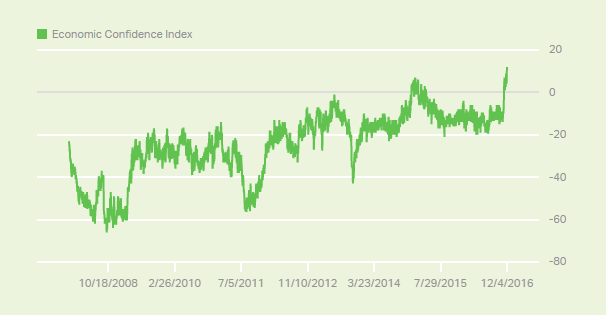
Economic confidence improved markedly in November, according to Gallup and is now at post-crisis highs. It will be interesting to see whether this translates into higher holiday spending. Separately, it could bode well for the Spring selling season, which is just around the corner (basically starts around Super Bowl Sunday).


Luxury homebuilder Toll Brothers announced better than expected numbers this morning. Deliveries were up 29% in dollars and 22% in units, however we are seeing a moderation in inflation. Average selling prices rose 5.5% to $834k, which is well below the double-digit ASP inflation we have been seeing, especially at the high end. They discussed the Millennials and how they are targeting them: “With the millennial generation now entering their thirties and forming families, we are starting to benefit from the desire for home ownership from the affluent leading edge of this huge demographic wave. In FY 2016, approximately 22% of our settlements included one primary buyer thirty-five years of age or under. (emphasis mine). We are currently courting these customers with our core suburban homes, urban condos and rental apartment properties. We are also introducing a new product line, T|Select by Toll Brothers, which incorporates the elegance and style of a higher-end Toll Brothers home but with fewer structural options, a quicker delivery time and a slightly lower price."

Home prices rose 1.1% MOM and are up 6.7% YOY, according to CoreLogic. The coasts remain largely overvalued, while the interior is mainly undervalued. 


While rising rates are creating worries in the mortgage banking sector of the economy, banks have been on a tear since the election, outperforming the S&P 500 by 11 percentage points. This means the Street is forecasting a big increase in credit and profitability which should offset some of the doom and gloom amongst mortgage bankers. The "tell" will be the return of the private label securitization market, and the follow-on return of the first time homebuyer. Shops that focus on purchase activity should be optimistic about the future. 


Tuesday, August 9, 2016

Morning Report: Productivity drops again

Vital Statistics:

Last Change
S&P Futures  2177.0 1.0
Eurostoxx Index 342.8 1.0
Oil (WTI) 42.9 -0.2
US dollar index 86.9 -0.2
10 Year Govt Bond Yield 1.58%
Current Coupon Fannie Mae TBA 103.3
Current Coupon Ginnie Mae TBA 104.2
30 Year Fixed Rate Mortgage 3.5

Markets are flattish this morning on no real news. Bonds and MBS are flat

Small Business Optimism ticked up last month according to the NFIB. Sentiment remains well below its historical average. The interesting thing is that the inability to find quality workers rose to the #3 problem facing small business after taxes and government regulation. While small business is interested in hiring, they still have very little appetite for capital expenditures. Inflation at the small business level remains nowhere to be found, as small business cut prices on average last month. 

The lack of capital investment ties into another economic number this morning: productivity (or lack thereof). Nonfarm productivity fell .5% in the second quarter, making it the third negative quarter in a row. The Street was looking for a positive .5% reading so the number was a big miss. Productivity is also negative on a year-over-year basis.


Unit Labor costs rose 2% which was a little higher than expected. Comp costs were up 1.5% and productivity losses added another 50 bps. 

Productivity growth is what increases standards of living, which is why a lack of it makes people feel like the recovery is so weak. Part of the explanation is found in the NFIB report - no capital expenditures. Productivity is tough to measure these days, with so much free technology. You know GoToMeeting increases productivity, yet it won't show up in the output numbers because no one pays for it. Same thing with Skype, LinkedIn, etc. While academia suspects there is a problem with the way we measure productivity, no one has found a good way to correct for it.

Completed foreclosures came in at 38,000 in June, a 4% increase from May and a 5% drop year over year. The national foreclosures inventory stands at 375k homes, which is down 26% from a year ago. The number of mortgages seriously delinquent fell 21% YOY to 2.8%, or about 1.1 million homes. The big judicial states like New York and New Jersey lead the pack in foreclosure inventory. 

FHFA says that Fannie Mae and Freddie Mac could require as much as $126 billion in the next housing crisis. Separately, Fannie's home purchase sentiment index hit a new high, albeit it is a relatively new index. 

Wells is saying that the expiration of HARP at the end of the year. Does this mean a dramatic drop in prepay speeds? Not necessarily, in that HARP will probably be replaced with a high LTV refi program. 

Tuesday, June 7, 2016

Morning Report: Janet Yellen acknowledges the bad jobs report

Vital Statistics:


LastChangePercent
S&P Futures 2112.02.9-.03%
Eurostoxx Index3031.4-32.1-1.05%
Oil (WTI)50.10.390.72%
LIBOR0.673-0.001-0.15%
US Dollar Index (DXY)95.38-0.510-0.53%
10 Year Govt Bond Yield1.71%-0.01%
Current Coupon Ginnie Mae TBA105.6
Current Coupon Fannie Mae TBA104.7
BankRate 30 Year Fixed Rate Mortgage3.74


Stocks are higher this morning on no real news. Bonds and MBS are up.

Janet Yellen spoke yesterday and voiced optimism on the economy overall, while characterizing Friday's jobs report as "weak" and "concerning." The Fed has said they remain data-dependent, and the latest data suggests that they will not raise rates next week. That said, the Fed has a growing credibility issue as they have set up the markets for rate hikes several times over the past couple of years only to get cold feet at the last minute. 

The final revision for nonfarm productivity for the first quarter came in unchanged at -0.6%. Unit Labor costs were revised upward to 4.5%.  Output ended up increasing 0.9% while compensation was revised upward in a big way to 4.2%. Productivity has been oscillating close to 0% for the past 8 years or so, and that is a big reason why wages have been going nowhere. While there is some debate going on in academic circles over whether we are measuring productivity correctly these days, it remains an issue that explains stagnant wage growth. And that stagnation cannot be fixed by raising the minimum wage or playing with the Fed Funds rate. 


Coming on the back of Friday's putrid jobs report, the Labor Market Conditions Index turned down in May. This is a meta-index of leading and lagging employment indicators. While it probably won't factor into the Fed's decision next week, it is worth watching.

Home prices increased 6.2% in April, according to CoreLogic. They are forecasting a 5.3% increase for next year as builders increase production and rates start to rise. 

Hillary secured enough delegates to win the Democratic Party nomination last night. Bernie Sanders will begin to come under immense pressure to withdraw from the race while Hillary pivots towards Trump.

Wednesday, May 4, 2016

Morning Report: Productivity falls again

Vital Statistics:


LastChangePercent
S&P Futures 2051.5-9.9-0.48%
Eurostoxx Index3055.8-69.6-2.23%
Oil (WTI)44.22-0.5-1.04%
LIBOR0.6380.0040.63%
US Dollar Index (DXY)93.18-0.583-0.62%
10 Year Govt Bond Yield1.79%-0.01%
Current Coupon Ginnie Mae TBA105.4
Current Coupon Fannie Mae TBA104.7
BankRate 30 Year Fixed Rate Mortgage3.63

Markets are down this morning after some disappointing economic data. Bonds and MBS are flat.

We got some lousy employment / labor data this morning, starting with the ADP jobs report, which shows the economy added 156k jobs last month. The Street was looking for 195k, so this is a big miss. Friday's jobs number is expected to come in around 200k.

Nonfarm productivity fell 1% last quarter, while unit labor costs increased 4.4%. On an annualized basis, productivity has been negative 3 out of the last 4 years. The back-to-back drop is the lowest since 1993. Firms are hiring workers, but uncertainty over the economy is holding back capital expenditures. Unit labor costs increased 4.1% last quarter. This in part might explain why profits this quarter have been weak so far.

Mortgage Applications fell 3.4% last week as purchases fell 0.1% and refis fell 5.5%. 

In other economic news, the service economy continued to expand, with the ISM Non-Manufacturing index improving to 55.7. Durable Goods orders rose 0.8%, but fell 0.2% if you strip out transportation. Factory orders rose 1.1%, while capital goods orders ex defense and aircraft (a proxy for business capital expenditures) rose 0.5%. So a mixed bag overall.

Ted Cruz dropped out of the presidential race last night, paving the way for Donald Trump to be the nominee, unless the party decides to rally around John Kasich at a contested convention. If Gary Johnson were a stock, he would be a screaming buy at the moment. 

We have seen an uptick in the labor force participation rate over the past few months from lows not seen since the 1970s. What is going on? While the hope is that a hot labor market will draw the long-term unemployed back into the labor force, what is really going on is that fewer people are leaving. You can see this borne out in the initial jobless claims data, which is the lowest going back to 1973. People who have jobs are keeping them. For the Fed, this creates a bit of a conundrum. They want more people to re-enter the workforce, but if business has to compete for the current labor pool by increasing wages, the Fed will have to put the brakes on the economy sooner than they would like. 

Thursday, March 3, 2016

Morning Report: lots of economic data this morning

Vital Statistics:

Last Change Percent
S&P Futures  1980.6 -3.0 -0.15%
Eurostoxx Index 3008.4 -13.7 -0.45%
Oil (WTI) 34.41 -0.3 -0.72%
LIBOR 0.632 -0.002 -0.24%
US Dollar Index (DXY) 97.98 -0.232 -0.24%
10 Year Govt Bond Yield 1.85% 0.01%
Current Coupon Ginnie Mae TBA 105.4
Current Coupon Fannie Mae TBA 104.5
BankRate 30 Year Fixed Rate Mortgage 3.68

Stocks are slightly lower as a slew of economic data comes in this morning. Bonds and MBS are flattish. 

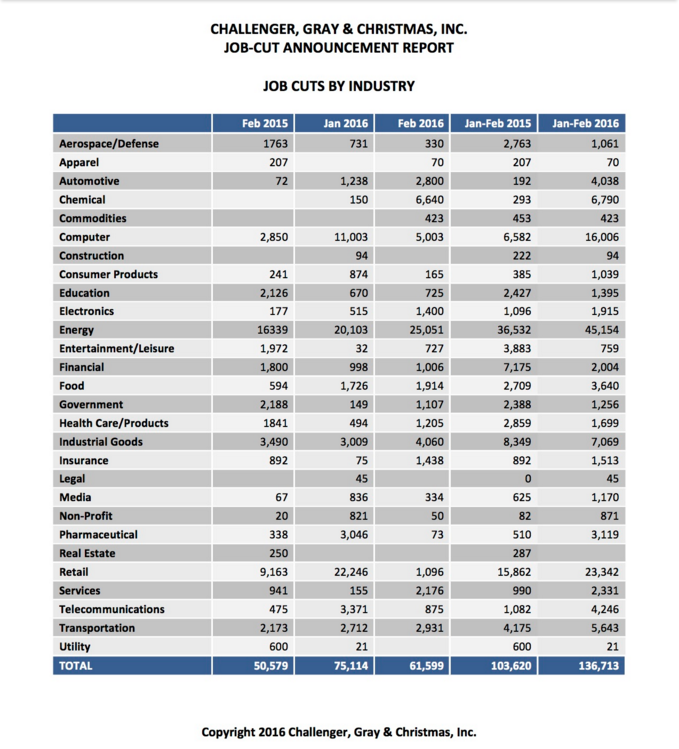
Outplacement firm Challenger, Gray and Christmas reported that announced job cuts rose 21.8% in February to 61.6k. The energy sector accounted for 25k of the losses, followed by chemicals, computer, and industrial goods. The West and the Midwest bore the brunt of the cuts. Remember these are announced job cuts and often never actually happen. Overall, the employment picture is looking decent, however we'll get a better look tomorrow. 

Here is a table of the industries hit. Note that aside from energy, job cuts are pretty low. Note that these are not net numbers either - they don't take into account any sort of hiring. 


Initial Jobless Claims rose to 278k last week. Anything below 300k is a good number.

The ISM Non-manufacturing composite fell slightly to 53.4 in February from 53.5 in January. Business continues to be decent in the services sector. 

Factory Orders fell 1.6% in January, while durable goods orders rose 4.7%. Capital Goods Orders rose 3.4%. 

Why is wage growth so difficult to find? Productivity growth has been weak since peaking around 1999 - 2000. This was the tail end of the big boost from the Internet and the decade-long transformation of the PC into a tool on everyone's desk. Last quarter it came in at -2.2%. Productivity has been negative for 3 out of the past 4 years, and that is not a recipe for wage inflation. 

Unit Labor costs rose 3.3% in the fourth quarter, which drove the drop in productivity as output only increased 1%. 

The Markit US Services PMI fell slightly in February to 49.7 while the composite PMI was flat at 50. 

The Bloomberg Consumer Comfort Index fell to 43.6 from 44.2 last week. Falling perceptions of the economy drove the decline. 

2012 Presidential Nominee Mitt Romney is going to try and push back the Trumpmentum with a speech tonight. 

Nothing too earth-shattering in the Fed's Beige Book which was released yesterday. Overall, manufacturing is flattish compared to last month, however labor markets improved overall, and "wage growth varied considerably, from flat to strong, across all districts." 

Thursday, February 4, 2016

Morning Report: Dismal economic numbers this morning

Vital Statistics:

Last Change Percent
S&P Futures  1896.6 -11.9 -0.62%
Eurostoxx Index 2882.8 -13.8 -0.48%
Oil (WTI) 32.15 -0.1 -0.40%
LIBOR 0.619 0.001 0.10%
US Dollar Index (DXY) 96.44 -0.850 -0.87%
10 Year Govt Bond Yield 1.87% -0.02%
Current Coupon Ginnie Mae TBA 105.3
Current Coupon Fannie Mae TBA 104.7
BankRate 30 Year Fixed Rate Mortgage 3.69

Stocks are lower this morning after we got some disappointing economic data. Bonds and MBS are up small.

Dismal economic numbers all around this morning

Productivity fell 3% in the fourth quarter and unit labor costs rose 4.5%. This is a recipe for falling profits in 2016. Given the tepid GDP growth being forecast for next year (sub 2%), companies will focus most on cost-cutting. Given the excess capacity in the manufacturing economy, companies have been reluctant to spend on capital expenditures, which has depressed productivity. Definitely not a recipe for releasing the animal spirits, although if builders start to address the tight supply, it will provide a good boost for the economy. 

Factory orders fell 2.9% in December, which was below the Street estimate. November's numbers were revised downward as well. 

Durable Goods orders fell 5% in December as well. Capital Goods orders (a proxy for capital expenditures by business) fell by 5%. This directly relates to the lousy productivity numbers above. 

Announced job cuts increased 41.6%, to over 75,000 according to outplacement firm Challenger and Gray. Most of the cuts are coming in retail and energy.  

Initial Jobless Claims rose 285k last week. 

The Bloomberg Consumer Comfort Index fell from 44.6 to 44.2 last week. 

Don't underestimate the Fed, which is the message from major strategists. Goldman Sachs Chief Economist Jan Hatzius is calling for a 3% 10 year by the end of the year. 

On the other hand, mortgage REIT American Capital Agency is calling for the Fed to abandon its "tightening bias" by the end of 2016. They see a hard landing in China, continued weakness in emerging markets, and undervalued Treasuries versus other benchmark sovereigns. 

In a testament to the change occurring in the financial markets, lenders like Quicken and SoFi will be advertising during the Super Bowl this year. 

Both Republicans and Democrats agree the economy is lousy, and both sides are going back to their boilerplate explanations. Democrats blame Wall Street and the rich, while Republicans blame government. The funny thing is that the "Wall Street" they rail against hasn't existed for almost 10 years.

Wednesday, September 2, 2015

Morning Report - productivity and quantitative tightening

Vital Statistics:

S&P Futures  1937.3 21.4 1.12%
Eurostoxx Index 3208.2 19.5 0.61%
Oil (WTI) 45.27 -0.1 -0.31%
LIBOR 0.329 0.005 1.42%
US Dollar Index (DXY) 95.83 0.381 0.40%
10 Year Govt Bond Yield 2.18% 0.03%
Current Coupon Ginnie Mae TBA 104.1 -0.1
Current Coupon Fannie Mae TBA 103.7 -0.1
BankRate 30 Year Fixed Rate Mortgage 3.85

Stocks are higher this morning after Chinese markets rallied to almost unchanged after an early swoon. Bonds and MBS are down.

Mortgage Applications rose 11.3% last week as purchases rose 4.1% and refis rose 16.8%. The 30 year fixed rate mortgage was steady at 4.08%. While the bond market has been pretty volatile, TBAs have been much more steady, tending to fade the moves of the bond market. This means you might see a big drop in the 10 year yield, hope to lock at a great rate, only to find that rates are lower, but not as much as the big move in Treasuries would suggest. 

The ADP jobs report showed payrolls increasing by 190,000 jobs, which is less than forecast. July was revised lower as well. The Street is forecasting an increase of 218,000 in the official report on Friday.

After a couple big quarters, unit labor costs fell in the second quarter by 1.4%. This number tends to be volatile, as does productivity. The Fed pays close attention to these numbers. 

The ISM New York Index fell pretty dramatically in August, from 68.8 to 51.1. The 68.8 reading was unusually good, while the 51.1 reading was unusually bad. 

Factory orders rose 0.4% in July, lower than the 0.9% forecast. Ex-transportation, factory orders fell 0.6%. 

Productivity rebounded in the second quarter to an annualized rate of 3.3%. Overall, productivity growth has been in a downtrend for the past dozen years or so. This is one reason why wage inflation has been so hard to come by - productivity growth has been declining. Take a look at the chart below. You can see productivity flatlining around 2% in the 1980s, then a big acceleration in the 1990s as the personal computer goes from a glorified typewriter to an indispensible tool on everyone's desk. That continues into the early 00s as the internet helps business become more productive. Finally, you see the decline as the PC and Internet phenomenons become played out. While the mainstream media mocked Jeb Bush for talking up the importance of productivity, he was right. 


Is "quantitative tightening" the new buzzword? Not yet, but as central banks worldwide begin to let go of some of their reserves, it may become more common. For the past two decades, central banks (especially China) have been accumulating reserves as they manage their trade balances and their currencies. The net effect has been a bid under Treasuries and a release of money into the system. As China slows, this is reversing as they sell Treasuries to support their currency. When they sell Treasuries, they put pressure on US interest rates and the withdrawal of liquidity acts like a tightening. Punch line: this is the second-order effect of the global slowdown - you might see upward pressure on interest rates, a rising dollar, and a withdrawal of liquidity. This would compound the effect of any Fed tightening. Which means a bumpier road ahead as the Fed pursues normalization. This might explain why the Fed has chosen to not sell (and even to keep re-investing) its portfolio of Treasuries and MBS that it bought during QE.

As world markets recover from last week's bloodbath, the probability of as Sep rate hike is increasing.


Tuesday, August 11, 2015

Morning Report: worrisome trend in the inventory / sales data

Vital Statistics:

Last Change Percent
S&P Futures  2081.0 -18.8 -0.90%
Eurostoxx Index 3619.3 -55.6 -1.51%
Oil (WTI) 43.62 -1.3 -2.98%
LIBOR 0.312 0.000 0.06%
US Dollar Index (DXY) 96.98 -0.181 -0.19%
10 Year Govt Bond Yield 2.16% -0.07%
Current Coupon Ginnie Mae TBA 104.2 -0.2
Current Coupon Fannie Mae TBA 103.6 0.1
BankRate 30 Year Fixed Rate Mortgage 3.91

Markets are lower this morning after China devalued the yuan overnight. Bonds and MBS are up.

Wholesale inventories rose 0.9% in June, while wholesale sales rose only 0.1%. The ratio of inventories to sales rose to 1.3. This is a worrisome signal. A rising inventory to sales ratio is a harbinger of a cyclical recession. While there is a possibility that the West Coast Port strike from earlier this year is messing with the data, the trend is unmistakable. 


Productivity rose less than expected in the second quarter, and unit labor costs were higher than expected, which was disappointing. The first quarter numbers were revised better (productivity up and unit labor costs down), however Q1 productivity was still flat and unit labor costs were higher than inflation. These two numbers can be volatile, so it makes sense to look at a moving average. The 12 month moving average for productivity is about 0.25%. The 12 month MA for unit labor costs is about 2.1%. Anyway, flat productivity and 2% wage inflation is not symptomatic of a great labor market, despite what the numbers say.

Small business optimism rose in July, according to the NFIB. Expectations for the economy accounted for about half the rise. Employment was flat. Increasing labor costs (not only wages, but regulatory burden) are depressing the bottom line as profits fall. In fact, most are reporting that the increase in labor costs is due to mandated benefits, not wage increases. This again speaks to the bifurcated market: the big S&P 500 companies are doing well, but much of that is due to (a) rock bottom interest rates and (b) overseas exposure. Those circumstances don't really apply to the local dry cleaner. Which is why liberals can claim: "These hugely profitable companies refuse to pay a "fair" wage" and conservatives can claim "Regulation is strangling small business and those costs are manifested in stagnant wages." Liberals are focusing their ire at the big multinationals and conservatives focus their ire at government. There is a bit of truth in both viewpoints. 

Speaking of regulations, the American Enterprise Institute crunched the numbers and it turns out that Seattle lost about 1,300 jobs from Jan - June. Of course it is still early days, but it looks like the laws of supply and demand are still applicable in the labor market, regardless of what politicians think. 


Completed foreclosures fell to 43k in June, according to CoreLogic. This is up 4.8% from May but down 14.8% from a year ago. The foreclosure inventory remains the highest in the Northeast, where the judicial states are still working through their backlog.


Google is now going to be known as Alphabet. They are re-organizing into a holding company structure.  The Street seems to like it.