A place where economics, financial markets, and real estate intersect.
Showing posts with label Challenger and Gray. Show all posts

Thursday, October 5, 2017

Morning Report: Handicapping the next Fed Chair

Vital Statistics:

Last Change
S&P Futures  2538.5 2.3
Eurostoxx Index 390.1 -0.3
Oil (WTI) 50.1 0.1
US dollar index 86.7 0.0
10 Year Govt Bond Yield 2.32%
Current Coupon Fannie Mae TBA 103.05
Current Coupon Ginnie Mae TBA 103.98
30 Year Fixed Rate Mortgage 3.88

Stocks are higher this morning on no real news. Bonds and MBS are flat.

I was at the IMN conference earlier this week, which was very informative. Haven't heard this much about convexity in a long, long time. 

We have a lot of Fed-speak today, with 4 speakers. Powell, Williams, and Harker speak this morning and Esther George speaks after the close. Bonds should be quiet as we await the jobs report tomorrow. 

Announced job cuts continue to be low, according to outplacement firm Challenger, Gray and Christmas. Job cuts fell 4.4% in September to 32,346. This number is down 26% from last year. The most movement (in terms of cuts and hiring) remains the retail sector. For the quarter, companies announced job cuts of just over 94,000. Sub-100k quarters are rare: the last one was Q4 last year and then you would have to go back to 2000 to find another. Remember, this stat includes announced job cuts (it counts all the press releases companies do) so these job cuts won't necessarily materialize. 

While online shopping has led to job cuts in bricks-and-mortar stores, those losses are being offset by new jobs in e-commerce. Of course the jobs are very different and require different skill sets, but it kind of looks like a wash


Initial Jobless Claims fell to 260k last week as hurricane-related effects continue to mess with the numbers. Note the ADP Survey (which foreshadows the BLS numbers tomorrow) was weak at 135,000 however hurricane-related effects are probably included in that number as well. 

Janet Yellen's term expires early next year. Here are the most likely candidates to run the Fed going forward. Trump could re-nominate Janet Yellen, however she is a liberal and supports stronger banking regulation. Gary Cohn is another possibility, as Trump prefers business people over academics. Jerome Powell is another possibility, and he would be somewhat more hawkish than Yellen. He is supposedly the choice of Treasury Secretary Steve Mnuchin. Kevin Warsh is more hawksh than either Yellen or Powell and supports financial deregulation. Warsh would probably get some opposition from the left. Finally, John Taylor would be the most hawkish. While politicians might rail against too easy money out of the Fed while on the campaign trail, most prefer dovish types once they are in office. Nobody wants a Fed-induced recession on their watch. The last one we had was 81-82, when Paul Volcker tightened to break the back of 1970s inflation. President Ronald Reagan supported his move, which caused the worst recession (at the time) since the Great Depression. 

Online betting site Predict It shows the market's assessment. Kevin Warsh is in the lead at a 40% chance, while Jerome Powell is at 31% and Yellen is at 10%. Gary Cohn is at 9%. 

Philly Fed President Patrick Harker says that the US economy will continue to grow at a subdued 2% rate until we get some sort of pro-growth tax reform out of Washington. He still supports hiking rates in December. The Fed Funds futures have more or less doubled their probability of a rate hike over the past month from around 40% to over 80%. 

Donald Trump roiled distressed hedge funds yesterday when he suggested that Puerto Rico might need some debt relief to recover. The Commonwealth's general obligation bonds fell into the low 30s. At least Trump was nice enough to wait until everyone marked their books for Q3. 


Thursday, April 6, 2017

Morning Report: FOMC minutes

Vital Statistics:

Last Change
S&P Futures  2348.0 1.5
Eurostoxx Index 379.8 -0.3
Oil (WTI) 51.4 0.2
US dollar index 90.5
10 Year Govt Bond Yield 2.35%
Current Coupon Fannie Mae TBA 102.53
Current Coupon Ginnie Mae TBA 103.813
30 Year Fixed Rate Mortgage 4.07

Stocks are lower this morning after the FOMC worried about stock prices. Bonds and MBS are down small. 

Job cuts rose 17% in March, according to outplacement firm Challenger, Gray and Christmas. Telecom and retail were the two main sectors to trim staff. Note that this report only measures announced job cuts (in press releases), not actual job cuts. We are still seeing losses in the energy patch, however it is much slower than the past two years when we lost over 200k jobs. 

On the other side of the coin, hiring announcements continue to hit records, with the Home Despot announcing 80,000 seasonal hires in March. 

Initial Jobless Claims fell to 234k last week, while the Gallup Good Jobs index improved. The drop in initial jobless claims was the most in 2 years. 

The FOMC minutes showed the Fed is beginning to discount the possibility of a big Trump fiscal expansion. The failure of health care reform means that the available resources for a big infrastructure spend or tax cuts is much less. The Fed also discussed what to do with their $4.5 trillion balance sheet, and how to go about shrinking it. The terms "gradual" and "phase out" were used, which means they probably aren't going to stop reinvesting maturing principal all at once and will perhaps take a couple of meetings to see how it goes. The Fed's fear is that the additional contractionary effects of reducing the balance sheet along with rate hikes will be too much and push the economy into a recession. 

The staff also noted that stock values are above historical norms, which is undoubtedly another reason for them to go slowly. The worst-kept secret in financial markets is that the Fed targets asset prices and uses them to guide policy. 

Goldman Chief Economist Jan Hatzius says that reducing the Fed's balance sheet is probably a good step to clear the decks for whoever will be the new Fed President ahead of the end of Janet Yellen's term in early 2018. 

The left has set up a new website to keep track of HUD and what they are doing. They want to ensure that affordable housing targets don't fall by the wayside as HUD works on housing reform. Given the tight housing inventory these days, affordable housing is a huge need. 

Donald Trump economic adviser Gary Cohn supports some sort of return to the Glass-Steagall days, where consumer banking is separated from the underwriting and trading functions of investment banks. Some Senators and policy types were surprised to hear a Wall Street type advising that. The conversation regarding deposits will be further complicated by the emerging fintech sector which wants access to those deposits as well. 

The Senate is expected to exercise the nuclear option today and eliminate the filibuster for Supreme Court nominees. Neil Gorsuch will probably be confirmed on Friday. 

Thursday, March 9, 2017

Morning Report: Home equity rises

Vital Statistics:

Last Change
S&P Futures  2363.0 -1.0
Eurostoxx Index 372.1 -0.5
Oil (WTI) 49.6 -0.7
US dollar index 92.0
10 Year Govt Bond Yield 2.58%
Current Coupon Fannie Mae TBA 101.438
Current Coupon Ginnie Mae TBA 102.784
30 Year Fixed Rate Mortgage 4.19

Stocks are lower this morning as oil continues to fall. Bonds and MBS are down small. 

Initial Jobless Claims ticked up to 243k last week. The 4 week moving average is 237k. Consumer Comfort improved. 

There were 37,000 announced job cuts in February, according to outplacement firm Challenger, Gray and Christmas. This is a decline of 19% from January and a decrease of 40% from February last year. The job cuts are dominated by the retail sector as department stores had a lousy holiday season. In fact, the job cuts in retail are almost 6x the next biggest sector (energy). Of course some of this is seasonal, but there continue to be problems with the shopping mall sector or retail. The financial sector also reported about 3,300 job cuts as higher interest rates hurt some in the mortgage space and automation / falling fees reduce headcount in banking and asset management. On the other side of the coin, companies announced they were hiring over 162k - and 100k of them were by Amazon.com. It seems strange to think that for every job lost in bricks and mortar retail, 3 were created for online shopping, but there you go. 

Import prices rose 0.2% in February and are up 4.6% YOY, however when you strip out petroleum, they fell 0.1% and are up 0.5% YOY. While the Fed is concerned about potential inflation, we have yet to see any hard evidence of it yet. 

Rising home prices helped reduce negative equity by over $2 billion in the fourth quarter, according to CoreLogic. About 3.2 million homes (or 6.2%) have negative equity. A total of 7.7 million have under 20% equity. These loans become refi candidates as home price rise. Cashout refis driven by increasing home prices will undoubtedly become a larger component of the refi universe as rates continue to rise. 

Under Donald Trump's proposed budget HUD will get about 14% less than last year. It looks like most of the cuts will fall on community devlopment block grants and public housing maintenance. It doesn't appear (at least initially) that the mortgage side of things is affected at all. 


Thursday, May 5, 2016

Morning Report: Regulation increases the cost to originate by 18%

Vital Statistics:


LastChangePercent
S&P Futures 2053.52.90.08%
Eurostoxx Index3055.8-69.6-2.23%
Oil (WTI)44.22-0.5-1.04%
LIBOR0.6380.0040.63%
US Dollar Index (DXY)93.18-0.583-0.62%
10 Year Govt Bond Yield1.78%-0.01%
Current Coupon Ginnie Mae TBA105.4
Current Coupon Fannie Mae TBA104.7
BankRate 30 Year Fixed Rate Mortgage3.63


Markets are flattish this morning on no real news. Bonds and MBS are flat as well

Announced job cuts increased 5.8% in April, according to outplacement firm Challenger, Gray and Christmas. Layoffs are at a 7 year high, driven primarily by pain in the energy sector, but also in retail and computers (Intel accounted for 17k of them). Remember, these are announced job cuts - they often either don't end up materializing or are accomplished by attrition. 

We still aren't seeing evidence of mass layoffs in the initial jobless claims numbers, which are hovering around 40 year lows. Last week, they increased to 274k.

We are starting to see a slowdown in the labor market. The ADP number was a disappointment. The Street is forecasting a 200k print tomorrow.

Consumer comfort fell last week. Increasing gasoline prices aren't helping.

Soaring compliance costs are going to drive M&A activity in the mortgage banking sector.  The average cost to originate a loan has increased by 18% over the past two years to just over $7,000 from just under $6,000 in 2013, according to the MBA. As banks retreat from the sector, non-banks are growing, especially firms like Quicken and Freedom. This is obviously attracting more regulatory scrutiny.

Mortgage credit availability decreased in April, according to the MBA. Lynn Fisher, MBA's Vice President of Research and Economics commented, "Mortgage credit became less available in April as a result of two opposing trends, resulting in a net decrease to the index. Investors continued to roll out Fannie Mae and Freddie Mac's low down payment loan programs, which had a loosening effect on credit availability. However, this was more than offset by tightening among high balance and jumbo loan programs."

The CFPB is proposing a rule to limit mandatory arbitration clauses in financial contracts, which would make it easier for class-action lawsuits. These are in place for 99% of payday lenders, which the CFPB wants to put out of business. 

Thursday, March 3, 2016

Morning Report: lots of economic data this morning

Vital Statistics:

Last Change Percent
S&P Futures  1980.6 -3.0 -0.15%
Eurostoxx Index 3008.4 -13.7 -0.45%
Oil (WTI) 34.41 -0.3 -0.72%
LIBOR 0.632 -0.002 -0.24%
US Dollar Index (DXY) 97.98 -0.232 -0.24%
10 Year Govt Bond Yield 1.85% 0.01%
Current Coupon Ginnie Mae TBA 105.4
Current Coupon Fannie Mae TBA 104.5
BankRate 30 Year Fixed Rate Mortgage 3.68

Stocks are slightly lower as a slew of economic data comes in this morning. Bonds and MBS are flattish. 

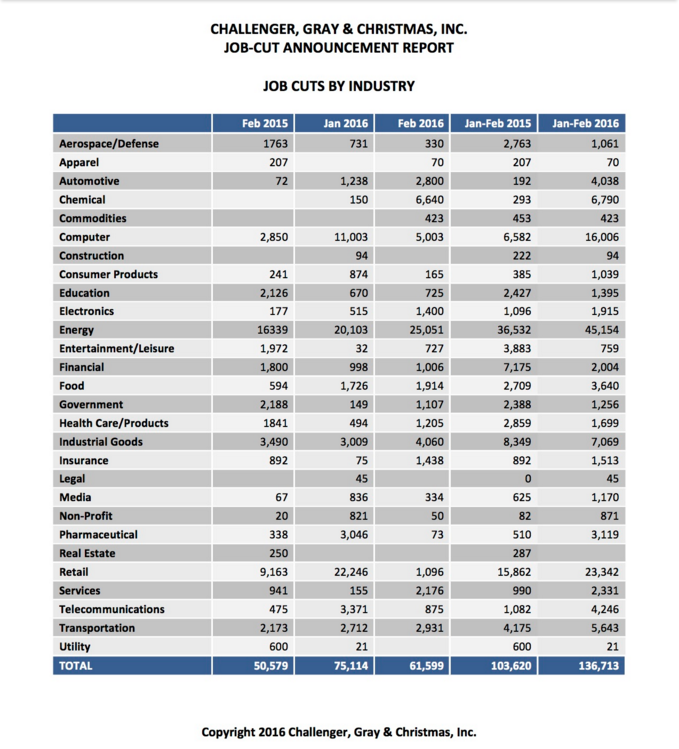
Outplacement firm Challenger, Gray and Christmas reported that announced job cuts rose 21.8% in February to 61.6k. The energy sector accounted for 25k of the losses, followed by chemicals, computer, and industrial goods. The West and the Midwest bore the brunt of the cuts. Remember these are announced job cuts and often never actually happen. Overall, the employment picture is looking decent, however we'll get a better look tomorrow. 

Here is a table of the industries hit. Note that aside from energy, job cuts are pretty low. Note that these are not net numbers either - they don't take into account any sort of hiring. 


Initial Jobless Claims rose to 278k last week. Anything below 300k is a good number.

The ISM Non-manufacturing composite fell slightly to 53.4 in February from 53.5 in January. Business continues to be decent in the services sector. 

Factory Orders fell 1.6% in January, while durable goods orders rose 4.7%. Capital Goods Orders rose 3.4%. 

Why is wage growth so difficult to find? Productivity growth has been weak since peaking around 1999 - 2000. This was the tail end of the big boost from the Internet and the decade-long transformation of the PC into a tool on everyone's desk. Last quarter it came in at -2.2%. Productivity has been negative for 3 out of the past 4 years, and that is not a recipe for wage inflation. 

Unit Labor costs rose 3.3% in the fourth quarter, which drove the drop in productivity as output only increased 1%. 

The Markit US Services PMI fell slightly in February to 49.7 while the composite PMI was flat at 50. 

The Bloomberg Consumer Comfort Index fell to 43.6 from 44.2 last week. Falling perceptions of the economy drove the decline. 

2012 Presidential Nominee Mitt Romney is going to try and push back the Trumpmentum with a speech tonight. 

Nothing too earth-shattering in the Fed's Beige Book which was released yesterday. Overall, manufacturing is flattish compared to last month, however labor markets improved overall, and "wage growth varied considerably, from flat to strong, across all districts." 

Thursday, October 1, 2015

Morning Report - Slew of economic data this morning

Vital Statistics:

Last Change Percent
S&P Futures  1912.8 4.1 0.21%
Eurostoxx Index 3097.1 -3.5 -0.11%
Oil (WTI) 46.64 1.6 3.44%
LIBOR 0.326 -0.001 -0.34%
US Dollar Index (DXY) 96.25 -0.102 -0.11%
10 Year Govt Bond Yield 2.03% -0.01%
Current Coupon Ginnie Mae TBA 104.7 0.0
Current Coupon Fannie Mae TBA 104.5 0.0
BankRate 30 Year Fixed Rate Mortgage 3.84

Stocks are higher after yesterday's rally. Given that yesterday was the end of a pretty lousy month (and quarter) it looked like people gunned the market a little to make their quarterly returns look a little better. Bond yields continue to grind lower.

The next two days are going to have a lot of economic data. 

The ISM Manufacturing Index fell to 50.2 in September from 51.1 in August. 7 industries reported expansion, while 11 reported contraction. The slowdown in China and the strong US dollar are weighing on business confidence. A 50.2 reading would correspond to about a 2.2% GDP growth rate. 

Construction spending rose 0.7% in August, which was better than the 0.5% Street estimate. Residential construction is up 1.3% for the month and 16% for the year. 

Initial Jobless Claims rose to 277k last week. We continue to bounce around the lows with this number. That said....

Jobless Claims may be increasing in the future, as Challenger and Gray announced job cuts increased 93%. This indicator combs the newswires for companies making announcements for job cuts. Something like 58,000 job cut announcements were made in September, with the 30,000 cuts at HP accounting for most of it. 

The Bloomberg Consumer Comfort index rose to 43 from 41.9 last week. 

Auto sales numbers are looking strong. Fiat Chrysler jeep sales are up 40%. Amazing what cheap gasoline can do. 


Thursday, May 7, 2015

Morning Report - Bill Gross sells Bund vol, not Bunds.

Vital Statistics:

Last Change Percent
S&P Futures  2070.3 -3.9 -0.19%
Eurostoxx Index 3550.0 -8.0 -0.22%
Oil (WTI) 60.8 -0.1 -0.21%
LIBOR 0.276 -0.004 -1.38%
US Dollar Index (DXY) 94.44 0.348 0.37%
10 Year Govt Bond Yield 2.23% -0.01%
Current Coupon Ginnie Mae TBA 101.8 -0.2
Current Coupon Fannie Mae TBA 100.7 0.1
BankRate 30 Year Fixed Rate Mortgage 3.91

Stocks are down small as we get a few mixed signals on the job market. Bonds and MBS are holding in there despite another big sell-off in the German Bund, which now yields almost 65 basis points - this is an increase of 57 basis points in about two weeks. Welcome to the new QE normal, where sovereign debt trades with the volatility of tech stocks. 

Note that the volatility in the Bund has hurt Bill Gross, who considers it "the short of a lifetime." Unfortunately, it looks like Bill sold options against the Bund, betting it would trade in a narrow range, and is now taking some gas on his position given the furious sell-off Euro sovereign debt. Welcome to the wonderful world of negative convexity, which is the bane of mortgage bankers globally. 

The volatility in bonds has hurt the mortgage REITs, the latest of which is Annaly Capital, which missed yesterday. American Capital Agency struggled with the volatility as well. Interestingly, American Capital Agency was responsible for some of the outperformance in FHA / VA pricing at the end of the quarter. Ordinarily, they don't buy Ginnie Mae TBAs as Fannies offer higher returns, but they viewed the Ginnie Mae sell off due to the change in MI was overdone, and took a position the other way. Mortgage REITs are generally most active in the secondary market for MBS, however they do dabble in TBAs and can affect loan pricing at the margin. 

We have some mixed employment data this morning, with Challenger and Gray announced job cuts increasing 53% to 61,582 in April, which is the highest number in 3 years. About a third of these cuts are in the oil patch, as Schlumberger, Baker Hughes, and Halliburton all announced layoffs. The other big category is retail, where you are seeing layoffs as well. Ordinarily, you would expect lower energy prices to translate into higher spending at the mall, but it isn't working out that way this time around. Blame broke Millennials who can't find jobs, Gen-Xers who drew the candy cane card as they were hitting their peak earning years, and Baby Boomers who had to retire a little earlier than they had planned. 


On the plus side, initial jobless claims hit 265,000 last week, which is still flirting with 15 year lows. One thing to keep in mind between the initial jobless claims report and Challenger: Challenger looks at announced job cuts. Often, those cuts end up not happening because the business turns around first. 

The Bloomberg Consumer Comfort Index fell to 43.7 last week as consumers still fret about the state of the economy. An index reading of 50 is considered "normalcy."

Janet Yellen ventured into Alan Greenspan territory yesterday when she remarked stock prices are still "quite high." It didn't have the effect on markets that Alan Greenspan's "irrational exuberance" comments did, as stocks largely ignored the warning. Memo to central bankers: You don't have a bubble in stocks. You have a bubble in sovereign debt. 


Thursday, December 6, 2012

Morning Report - Challenger and Gray Job Cuts

Vital Statistics:

Last Change Percent
S&P Futures  1407.0 -1.3 -0.09%
Eurostoxx Index 2598.5 6.4 0.25%
Oil (WTI) 87.52 -0.4 -0.41%
LIBOR 0.311 0.000 0.00%
US Dollar Index (DXY) 79.76 -0.015 -0.02%
10 Year Govt Bond Yield 1.58% -0.01%
RPX Composite Real Estate Index 191 -0.2

Markets are flattish this morning as Washington continues to grind to some sort of agreement on the fiscal cliff.  Initial Jobless Claims fell to 370k. The ECB kept rates at .75% and cut their 2013 GDP forecast to a range of -.9% to .3%.  S&P lowered Greece's bond rating to "selective default."  Bonds are up 1/4 while MBS are flat.

FHFA Acting Chairman Ed DeMarco will be speaking at SIFMA at 1:00 pm. HUD Secretary Shaun Donovan will head to the Hill today to talk about the sorry state of the FHA.

More Republicans are showing openness to increasing rates on the rich in exchange for entitlement spending cuts. So far, the President has shown little interest in cutting any spending aside from defense.  One possibility under discussion involves splitting the difference between 35% and 39.6% on the top rate. That would allow both parties to claim victory.

Challenger and Gray reported job cuts increased 34% in November to 57,000.  This was the second-highest month of the year.  About a third of the announcements come from the Hostess bankruptcy.  Of course December already has 11,000 cuts in the bag as well, courtesy of Citi.  Wall Street has shed 300,000 jobs in the last two years, and more are on the way if revenues don't start increasing.

The NY Department of Financial Services has ordered Ocwen to hire a monitor to ensure compliance with its agreement with the state. The state found instances where Ocwen did not provide a single point of contact to borrowers and did not send a 90-day notice before instituting foreclosure proceedings.

Is the overseas cheap labor arbitrage coming to an end?  Apple announced that it will bring some production back to the US from China. It is a nominal amount - $100 million - and it might just be a symbolic move after the Foxconn PR disaster. The compay has $121B of cash on its balance sheet.

Citi is now advising clients against putting money with Stevie Cohen. SAC spin-off Diamondback is shutting down.