A place where economics, financial markets, and real estate intersect.
Showing posts with label American Capital Agency. Show all posts

Wednesday, April 19, 2017

Morning Report: A tell in the mortgage REITs

Vital Statistics:

Last Change
S&P Futures  2346.0 8.8
Eurostoxx Index 377.5 1.1
Oil (WTI) 52.4 0.0
US dollar index 89.7
10 Year Govt Bond Yield 2.20%
Current Coupon Fannie Mae TBA 103.15
Current Coupon Ginnie Mae TBA 104.3
30 Year Fixed Rate Mortgage 3.97

Stocks are rebounding this morning after yesterday's big sell-off. Bonds and MBS are down small. 

Mortgage applications fell 1.8% during a holiday-shortened week. Purchases were down 3% while refis rose .2%. Note that the 10 year yield fell 15 basis points last week, so we should continue to see follow through in refis. 

The 10 year bond yield slipped below 2.2% yesterday, hitting the lowest point since the immediate post-election rate rise. The Trump reflation trade is unwinding as the market reckons that nothing is going to get done in Washington, which is probably a safe bet at this point. 


While the rest of the world frets about what will happen when the Fed starts shrinking its balance sheet (can we call it quantitative tightening?), there is one sector that is surprisingly sanguine: the mortgage REITs. American Capital Agency and Annaly Capital are both up some 18% since rates peaked in December. Yes, some of that is simply the natural correlation between MREITs and bond prices, however this also comes as the Fed discusses unwinding its balance sheet. If REIT investors were worried that decreased demand for mortgage backed securities would affect the value of their portfolios, you would expect to see it in their stock prices. So far, they are shrugging it off. For originators, this means that mortgage spreads to Treasuries should be safe as well, which is good news. Meanwhile, the homebuilders continue to move higher, despite the disappointing housing starts we have been seeing. Building permits are still depressed as well, so there isn't any indication the tight inventory situation is going to change. 

CFPB Chairman Richard Cordray is supposedly pondering a run for the Governor of Ohio. If so, his days at the CFPB could be numbered. 

The digital mortgage is only going to become more and more common. Here is how lenders should approach it. Punch line: the programmers need to focus on the consumer experience as much as the back end functionality. 

Since housing prices bottomed, condo price appreciation has outstripped single family residence appreciation. Historically that has not been the case, as there is generally more demand for SFR. My guess is that condo prices are more volatile than SFR prices, and that they declined more in the sell-off and are now increasing faster in the rebound. There probably isn't any secular change going on, although many are quick to point out that the Millennials (so far at least) prefer living in urban areas

Wednesday, October 28, 2015

Morning Report: Homeownership rate rebounds in Q3

Vital Statistics:

Last Change Percent
S&P Futures  2063.0 2.6 0.13%
Eurostoxx Index 3397.8 16.8 0.50%
Oil (WTI) 43.59 0.4 0.90%
LIBOR 0.323 0.000 0.08%
US Dollar Index (DXY) 96.6 -0.307 -0.32%
10 Year Govt Bond Yield 2.03% -0.01%
Current Coupon Ginnie Mae TBA 105
Current Coupon Fannie Mae TBA 104.6
BankRate 30 Year Fixed Rate Mortgage 3.78

Markets are slightly higher as we await the FOMC decision. Bonds and MBS are flat.

Mortgage Applications fell 3.5% last week as purchases fell 3.1% and refis fell 3.8%. 

The FOMC decision is set to be released around 2:00 pm EST. I don't expect major volatility around that time, but you never know. Just be aware. 

The FOMC meeting is expected to be a non-event, with no move in rates and perhaps some hawkish language. One thing to watch for will be how the Fed handles its QE portfolio. For the moment, they are re-investing maturing proceeds from their portfolio back into the market. Some Fed-watchers are thinking the Fed may announce plans to let at least some of their Treasury portfolio run off. For the moment, they don't intend to let their MBS portfolios run off.

The homeownership rate rebounded off the 50 year low set in the second quarter. It rose from 63.4% to 63.7%. Household formations have been decelerating all year, however they increased by a 1.3 million pace in September. So far it looks like these people are renters and not homeowners, as rental vacancies remain low and rental inflation continues. We have yet to see a downturn in Millennials living at home with their parents.  

Mortgage REIT American Capital Agency got roughed up last quarter with volatility in world markets. This is notable given that interest rates actually fell during the quarter. Mortgage Backed Securities spreads (the risk premium that investors demand to hold this asset over Treasuries) widened considerably during the quarter. That poor performance in MBS almost necessarily will translate into poor performance of TBAs, which help set mortgage rates. So, if you noticed mortgage rates didn't fall as far as you would have expected during the quarter, that is why. 


Tuesday, August 4, 2015

Morning Report - Puerto Rico defaults, housing inventory remains tight

Vital Statistics:

Last Change Percent
S&P Futures  2091.0 0.1 0.00%
Eurostoxx Index 3608.9 -26.5 -0.73%
Oil (WTI) 45.93 0.8 1.68%
LIBOR 0.309 0.009 2.83%
US Dollar Index (DXY) 97.34 -0.152 -0.16%
10 Year Govt Bond Yield 2.17% 0.03%
Current Coupon Ginnie Mae TBA 104.5 0.0
Current Coupon Fannie Mae TBA 103.9 0.0
BankRate 30 Year Fixed Rate Mortgage 3.85

Stocks are higher this morning on no real news. Bonds and MBS are down small.

The ISM New York Survey increased from 63.1 to 68.8 last month.

Factory orders rose 1.8% in June. May was revised downward to -1.1%.

The IBD / TIPP Economic Optimism Index fell to 46.9 from 48.1.

Puerto Rico officially defaulted on its debt yesterday. The Obama Administration has said that there will be no Federal bailout of the U.S. commonwealth. Want to know where the bodies are buried? Here is a list of the muni funds that hold PR debt. Recovery rates could be as low as 35 cents on the dollar, according to Moody's.

July auto sales were brisk, as SUVs and luxury vehicles sold well. Pretty much everyone reported an increase of sales from 2.4% to 10.5%. 

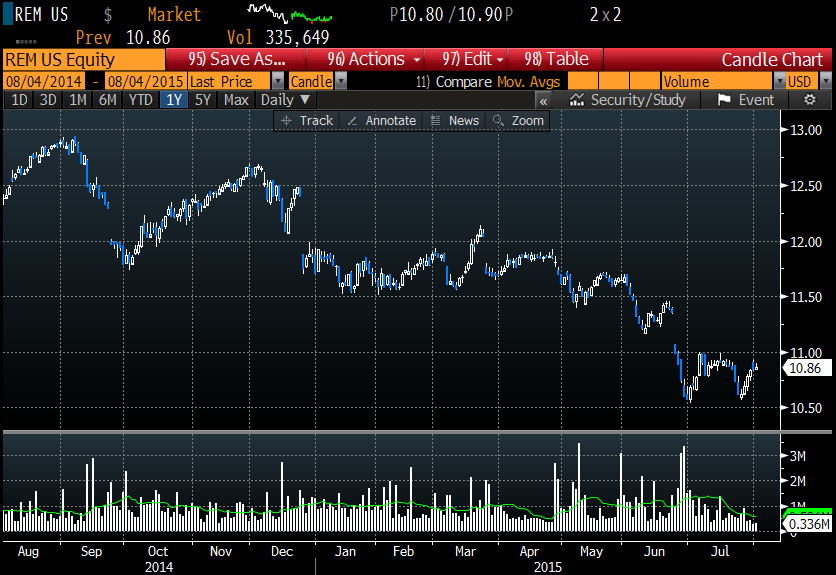
The second quarter was rough for the mortgage REITs. American Capital Agency reported a 6% drop in book value last week (a staggering number), and MFA Financial missed as well. Mortgage REITs are big investors in mortgage backed securities, which are sold by your friendly secondary folks. They have been de-leveraging ahead of the Fed's normalization process, which means that they have less appetite for new paper. This means that mortgage rates will be slightly higher, at the margin. Interestingly, the mortgage REIT sector seems to have found an angle for cheap financing by joining their local Federal Home Loan Bank. You can see how the sector has gotten smacked around by looking at the chart of the iShares Mortgage Real Estate ETF.


Home prices continue to rise on tight inventory, according to CoreLogic. Home prices rose 6.5% in June and are now 7.4% below their April 2006 peak. Tight inventory remains an issue - nationwide, the average supply of homes for sale was 4.8 months. 6.5 months is considered a balanced market. In highly desirable areas, like San Jose and Denver, the supply was 1.6 months. Colorado led the country with almost 10% home price appreciation, while the People's Republic of Taxachussetts brought up the rear by falling 5%. The Northeast still has a clogged foreclosure pipeline to deal with.

Thursday, May 7, 2015

Morning Report - Bill Gross sells Bund vol, not Bunds.

Vital Statistics:

Last Change Percent
S&P Futures  2070.3 -3.9 -0.19%
Eurostoxx Index 3550.0 -8.0 -0.22%
Oil (WTI) 60.8 -0.1 -0.21%
LIBOR 0.276 -0.004 -1.38%
US Dollar Index (DXY) 94.44 0.348 0.37%
10 Year Govt Bond Yield 2.23% -0.01%
Current Coupon Ginnie Mae TBA 101.8 -0.2
Current Coupon Fannie Mae TBA 100.7 0.1
BankRate 30 Year Fixed Rate Mortgage 3.91

Stocks are down small as we get a few mixed signals on the job market. Bonds and MBS are holding in there despite another big sell-off in the German Bund, which now yields almost 65 basis points - this is an increase of 57 basis points in about two weeks. Welcome to the new QE normal, where sovereign debt trades with the volatility of tech stocks. 

Note that the volatility in the Bund has hurt Bill Gross, who considers it "the short of a lifetime." Unfortunately, it looks like Bill sold options against the Bund, betting it would trade in a narrow range, and is now taking some gas on his position given the furious sell-off Euro sovereign debt. Welcome to the wonderful world of negative convexity, which is the bane of mortgage bankers globally. 

The volatility in bonds has hurt the mortgage REITs, the latest of which is Annaly Capital, which missed yesterday. American Capital Agency struggled with the volatility as well. Interestingly, American Capital Agency was responsible for some of the outperformance in FHA / VA pricing at the end of the quarter. Ordinarily, they don't buy Ginnie Mae TBAs as Fannies offer higher returns, but they viewed the Ginnie Mae sell off due to the change in MI was overdone, and took a position the other way. Mortgage REITs are generally most active in the secondary market for MBS, however they do dabble in TBAs and can affect loan pricing at the margin. 

We have some mixed employment data this morning, with Challenger and Gray announced job cuts increasing 53% to 61,582 in April, which is the highest number in 3 years. About a third of these cuts are in the oil patch, as Schlumberger, Baker Hughes, and Halliburton all announced layoffs. The other big category is retail, where you are seeing layoffs as well. Ordinarily, you would expect lower energy prices to translate into higher spending at the mall, but it isn't working out that way this time around. Blame broke Millennials who can't find jobs, Gen-Xers who drew the candy cane card as they were hitting their peak earning years, and Baby Boomers who had to retire a little earlier than they had planned. 


On the plus side, initial jobless claims hit 265,000 last week, which is still flirting with 15 year lows. One thing to keep in mind between the initial jobless claims report and Challenger: Challenger looks at announced job cuts. Often, those cuts end up not happening because the business turns around first. 

The Bloomberg Consumer Comfort Index fell to 43.7 last week as consumers still fret about the state of the economy. An index reading of 50 is considered "normalcy."

Janet Yellen ventured into Alan Greenspan territory yesterday when she remarked stock prices are still "quite high." It didn't have the effect on markets that Alan Greenspan's "irrational exuberance" comments did, as stocks largely ignored the warning. Memo to central bankers: You don't have a bubble in stocks. You have a bubble in sovereign debt.