A place where economics, financial markets, and real estate intersect.
Showing posts with label home prices. Show all posts

Wednesday, May 31, 2017

Morning Report: Nominal versus real home prices

Vital Statistics:

Last Change
S&P Futures  2416.3 5.5
Eurostoxx Index 392.1 1.6
Oil (WTI) 48.6 -1.1
US dollar index 88.6
10 Year Govt Bond Yield 2.21%
Current Coupon Fannie Mae TBA 102.6
Current Coupon Ginnie Mae TBA 103.81
30 Year Fixed Rate Mortgage 3.98

Stocks are higher this morning on good overseas economic data. Bonds and MBS are up small. 

Mortgage applications fell by 3.4% last week as purchases fell 1% and refis fell 6%. Mortgage rates barely moved last week. We continue this up/down, up/down pattern. 

Pending Home Sales fell 1.3% in April, according to the NAR. Rising prices plus falling affordability are translating into lower sales for the second straight month. Sales are below a year ago. While building (or lack thereof) continues to be a problem, professional investors who are still paying the REO-to-rental trade are not selling. 

JP Morgan and Bank of America warned this morning that Q2 numbers will be lower than a year ago. A flattening yield curve, along with a lack of volatility is hurting results. The S&P Financials SPDR (XLF) is down about 1.5% this am. 

Economic confidence continues to give back its post-election gains, but is still better than it was pre-election. For the past week, 33% of respondents rated the economy as "excellent" or "good", while 22% rated the economy as "poor."

You hear people sometimes worry about another bubble because home prices have reached their prior peaks. Set aside the argument that bubbles are exceedingly rare psychological phenomenons that only come around every few generations for an asset class. Are home prices really back at bubble levels? If you look at the home price indices like Case-Shiller or FHFA, the answer is yes. However, those indices use nominal (i.e. non-inflation adjusted) prices. And while inflation has been low over the past 10-15 years, it hasn't been zero either. On an inflation-adjusted basis, home prices are still about 14% below peak levels. Compare the two charts below, one with nominal prices and the other with inflation-adjusted prices:

Nominal:


Inflation-adjusted:


You can see that home prices are still elevated compared to historical averages, but they aren't back at bubble levels. Housing has definitely increased in price on an inflation-adjusted basis since the mid-70s, however improvements in financing (interest rates, different products etc) have increased people's buying power and that may account for some of the increase. 


Tuesday, May 30, 2017

Morning Report: Credit scores back to pre-crisis levels

Vital Statistics:

Last Change
S&P Futures  2409.0 -4.8
Eurostoxx Index 390.1 -1.2
Oil (WTI) 49.5 -0.4
US dollar index 88.8
10 Year Govt Bond Yield 2.24%
Current Coupon Fannie Mae TBA 102.6
Current Coupon Ginnie Mae TBA 103.81
30 Year Fixed Rate Mortgage 3.98

Markets are down on overseas weakness. Bonds and MBS are up small. 

Personal Incomes rose 0.4% last month, while personal spending rose the same amount. The PCE inflation index rose 0.2%. All three were in line with expectations, and point to a recovery in the second quarter. The Fed Funds futures are pricing in an 84% chance of a rate hike at the June FOMC meeting, which is only 2 weeks away. 

The Fed will also likely begin to lay out its plan to let its balance sheet shrink at the next meeting as well. It looks like they will allow a small portion of their portfolio to run off and they will keep increasing that number every quarter. Note that this could be put on hold if we get into a protracted debt ceiling fight this fall. 

Home prices are up 5.8% YOY, according to the Black Knight Financial home price index. The index hit $272k, as strength on the West Coast was offset by weakness in the Deep South. The Case-Shiller HPI came up with the similar numbers as well. Meanwhile, housing demand remains strong, according to Redfin, as inventory remains tight and new listings draw in buyers from the sidelines. Despite these market dynamics, home building remains stuck at recessionary levels. It does open up the possibility of more cash-out refis though. 

US credit scores hit a 12 year high this Spring as consumers continue to improve their financial situations by saving more and borrowing less. Interesting tidbit: More than 6 million families will have personal bankruptcies fall off of their credit reports over the next 5 years. Chapter 7 and 13 personal bankruptcy filings hit 1.5 million in 2010. That will be an additional source of mortgage demand in addition to Millennial first time homebuyers. 

Consumer confidence slipped in May, however it remains elevated. Investor confidence rose. 

Neel Kashkari discusses bubbles and the Fed. I found this part fascinating: "When I went to Treasury in July 2006, then-Treasury Secretary Henry Paulson declared to his staff that the U.S. economy was due for some form of crisis. He didn’t know where it would come from but, because markets had been stable for some time, history suggested something would happen. So he tasked his staff (including me) to work with the Federal Reserve and Securities and Exchange Commission to look for signs of trouble. We looked at a variety of scenarios, from an individual large bank running into trouble to a hedge fund blowing up. Sadly (and embarrassingly), we never considered a nationwide housing downturn. We missed it, and we were looking. It seems obvious now. This was clearly a “false negative.”" As the real estate bubble was peaking, the Fed looked for a catalyst for a crisis, and didn't see the housing bubble. I know hindsight is 20/20, but that is an astounding admission...

Wednesday, September 28, 2016

Morning Report: The hot real estate markets are cooling off

Vital Statistics:

Last Change
S&P Futures  2153.5 1.0
Eurostoxx Index 343.1 3.0
Oil (WTI) 45.2 0.5
US dollar index 86.3 -0.2
10 Year Govt Bond Yield 1.56%
Current Coupon Fannie Mae TBA 103.3
Current Coupon Ginnie Mae TBA 104.2
30 Year Fixed Rate Mortgage 3.47

Stocks are flat this morning on no real news. Bonds and MBS are flat as well.

We have a lot of Fed-Speak today, with Neel Kashkari, Janet Yellen, and James Bullard speaking this morning. Charles Evans, Loretta Mester, and Esther George speak this afternoon. There is the possibility that some of them could say something market-moving so be careful with your locks. 

Mortgage Applications fell 0.7% last week as purchases rose 1% and refis fell 2%. 

Durable Goods orders were flat month-over-month and down 1.3% YOY. Ex-transportation, they fell on a MOM and YOY basis. Capital Goods orders (a proxy for business capital investment) is also down for the year, although it was up on a MOM basis. July's numbers were revised downward, so this report is nothing to write home about. 

Despite the gloom in the corporate sector, consumer confidence rose and is at post-crisis highs. This is probably being driven by the stronger labor market. We aren't seeing these numbers flow through to actual sales at the retailers though. The Back-To-School shopping season was a disappointment. 

The hottest real estate markets are beginning to cool off, as high prices and low inventory are putting off buyers. Many of these markets have long surpassed their bubble peaks and are hitting new highs. Given that incomes have not recovered, these price levels may be unsupportable, especially as the Fed hikes interest rates and mortgages become more expensive. 

The latest CoreLogic Market Pulse looks at some of the overvalued markets based on price to income ratios and price to rent ratios. Unsurprisingly, there are pockets of overvaluation in CA, NY, FL, and TX, while the Midwest remains undervalued. The chart is below:


The article also goes on to say that we aren't in a housing bubble. This is true, as bubbles are largely psychological phenomenons where investors and lenders consider an asset "special" and believe it can only go up in price. The last residential real estate bubble (aside from the mid 00s) was in the 1920s. Residential real estate bubbles are rare and I doubt any of us will see another on in the US in our lives. That said, we have residential real estate bubbles in lots of countries overseas (especially China, Norway, and Canada), which will be a damper on global growth when they burst. 

During the debates, Donald Trump went after the Fed, calling them "political" for not raising interest rates. Politicians have always jawboned the Fed, but this has to be the first time I have heard a politician complain that the Fed is keeping rates too low. Usually, politicians are calling for the Fed to not raise rates because they are worried about a recession. At least one economist thinks Janet Yellen would resign if Trump wins.

Tuesday, August 4, 2015

Morning Report - Puerto Rico defaults, housing inventory remains tight

Vital Statistics:

Last Change Percent
S&P Futures  2091.0 0.1 0.00%
Eurostoxx Index 3608.9 -26.5 -0.73%
Oil (WTI) 45.93 0.8 1.68%
LIBOR 0.309 0.009 2.83%
US Dollar Index (DXY) 97.34 -0.152 -0.16%
10 Year Govt Bond Yield 2.17% 0.03%
Current Coupon Ginnie Mae TBA 104.5 0.0
Current Coupon Fannie Mae TBA 103.9 0.0
BankRate 30 Year Fixed Rate Mortgage 3.85

Stocks are higher this morning on no real news. Bonds and MBS are down small.

The ISM New York Survey increased from 63.1 to 68.8 last month.

Factory orders rose 1.8% in June. May was revised downward to -1.1%.

The IBD / TIPP Economic Optimism Index fell to 46.9 from 48.1.

Puerto Rico officially defaulted on its debt yesterday. The Obama Administration has said that there will be no Federal bailout of the U.S. commonwealth. Want to know where the bodies are buried? Here is a list of the muni funds that hold PR debt. Recovery rates could be as low as 35 cents on the dollar, according to Moody's.

July auto sales were brisk, as SUVs and luxury vehicles sold well. Pretty much everyone reported an increase of sales from 2.4% to 10.5%. 

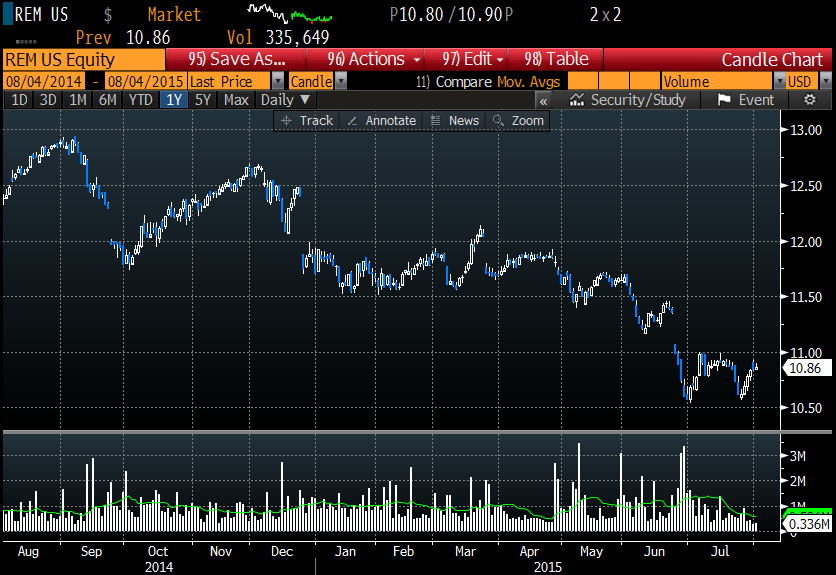
The second quarter was rough for the mortgage REITs. American Capital Agency reported a 6% drop in book value last week (a staggering number), and MFA Financial missed as well. Mortgage REITs are big investors in mortgage backed securities, which are sold by your friendly secondary folks. They have been de-leveraging ahead of the Fed's normalization process, which means that they have less appetite for new paper. This means that mortgage rates will be slightly higher, at the margin. Interestingly, the mortgage REIT sector seems to have found an angle for cheap financing by joining their local Federal Home Loan Bank. You can see how the sector has gotten smacked around by looking at the chart of the iShares Mortgage Real Estate ETF.


Home prices continue to rise on tight inventory, according to CoreLogic. Home prices rose 6.5% in June and are now 7.4% below their April 2006 peak. Tight inventory remains an issue - nationwide, the average supply of homes for sale was 4.8 months. 6.5 months is considered a balanced market. In highly desirable areas, like San Jose and Denver, the supply was 1.6 months. Colorado led the country with almost 10% home price appreciation, while the People's Republic of Taxachussetts brought up the rear by falling 5%. The Northeast still has a clogged foreclosure pipeline to deal with.