A place where economics, financial markets, and real estate intersect.
Showing posts with label durable goods. Show all posts

Thursday, April 26, 2018

Morning Report: Initial Jobless Claims lowest since 1969

Vital Statistics:

Last Change
S&P futures 2652.75 8.25
Eurostoxx index 382.29 2.12
Oil (WTI) 68.61 0.56
10 Year Government Bond Yield 3.00%
30 Year fixed rate mortgage 4.62%

Stocks are higher this morning on strong earnings from Facebook. Bonds and MBS are up.

The ECB maintained its current policy and made some cautious comments, which is pushing up bonds in Europe. US Treasuries are following along on the relative value trade. 

The 10 year has made a pretty sizeable move over the past month or so, and mortgage rates typically lag. So don't be surprised if mortgage rates continue to tick up, even if the 10 year finds a home at the 3% level. 

The homeownership rate was flat in the first quarter at 64.2%. It is up from 63.6% a year ago however. It bottomed in the second quarter of 2016 at 62.9%. 

Durable Goods Orders increased 2.6% in March, following a strong February. Ex-transportation, they were flat however and core capital goods, which is a proxy for business capital investment, fell slightly. February's already strong numbers were revised up slightly. 

Retail inventories fell 0.5% while wholesale inventories increased by the same amount. 

Initial Jobless Claims fell to 209,000 last week, which is the lowest number since 1969. When you adjust for population growth, the number becomes even more dramatic:


Deutsche Bank is scaling back its US operations to focus on becoming a more Euro-centric bank. It is hard to believe, but almost 20 years ago, the bank decided to make a big foray into the US market by buying Banker's Trust and Alex Brown. 

Moody's is worrying about the next area of opportunity in the mortgage market: cash-out refinances. As many CLTVs are approaching 75%, homeowners may choose to do a cash-out to either consolidate higher rate debt, or perhaps do home improvements. The other opportunity remains refinancing FHA loans that have accumulated enough equity to qualify for a conforming loan without MI. Finally, those who still have ARMs might find the relative attractiveness of a 30 year fixed to be a compelling switch. In an environment of rising home prices and rising interest rates, these will be the only game in town. 

Homebuilders are facing rising input costs - sticks and bricks, if you will. Framing lumber prices are up 16% this year, and plywood is up 33%. Inventory is so tight that builders are able to pass these costs onto homebuyers. A tight labor market remains an issue for the industry as well. All of this points to higher home prices going forward. 

For those wondering if we are indeed at the end of the credit cycle, here is WeWork's bond offering, which came in at $700 million with bonds paying 7.875%. Borrowing money at 7.875% for 5% cap rate office space? Set that aside for the moment. They introduced a new financial concept, called "community-adjusted EBITDA," which not only strips out interest, depreciation and amortization, and taxes, but also ignores general and administrative, marketing, and design / development costs. That has to be the first time I have ever heard this term before, and it should just be renamed EBBS - or earnings before bad stuff. 

Friday, March 23, 2018

Morning Report: Durable Goods increase smartly

Vital Statistics:

Last Change
S&P futures 2648.75 5
Eurostoxx index 365.94 -3.21
Oil (WTI) 64.54 0.24
10 Year Government Bond Yield 2.84%
30 Year fixed rate mortgage 4.46%

Stocks are higher this morning after yesterday's bloodbath. Bonds and MBS are down small. 

Troubles with Facebook and the potential for a trade war with China caused a 3% decline in the stock market yesterday. This pushed the 10 year bond yield down towards 2.8%. 

New Home Sales came in at 618k, more or less flat on a MOM and YOY basis. 

Durable Goods orders came in much stronger than expected, increasing 3.1% MOM and almost 9% YOY. Ex-transportation, they rose 1.9% MOM and 8.1% YOY. Core Capital Goods orders (a proxy for business investment / capital expenditures) rose 1.8% MOM and 8% YOY. We might see some strategists bump up their Q1 GDP numbers on that reading. 

KB Home reported first quarter earnings that missed on the top line; however the stock was up regardless after hours. Operating Margins improved, driven by an increase in gross margins. Bottom line numbers are not really comparable given the big adjustment to deferred tax assets as a result of the corporate tax cut. It is interesting to see an increase in gross margins, which have been falling pretty much across the industry. Perhaps it is a sign that home price growth is again outstripping cost growth (particularly labor and commodities). 

The Senate passed a $1.3 trillion spending bill that will keep the government open. Donald Trump is mulling a veto over wall funding, but that is probably just noise. 

Historically, house prices and the homeownership rate have correlated rather closely, but that broke down after house prices bottomed in 2012. What is going on? The first question to ask is whether the increase in homeownership that started in the mid-90s was due to increasing home prices or something else. We know that the Clinton Administration began to pull on some policy levers (and jawbone the GSEs) to increase lending to underserved markets and areas. 

The wealth that was being created in the stock market rally probably helped as well. Easy credit during the bubble also pulled some people into the housing market as well. Once the bubble popped, many people lost their homes and became renters. Finally, tight supply in the aftermath of the bubble is preventing many from buying, and professional investors who are buying starter homes to rent them out are exacerbating the problem. 


Prepayments hit a 4 year low, according to Black Knight Financial Service's First Look on February mortgage performance data. Foreclosure starts fell 25% MOM after spiking in January. Hurricane-related delinquencies fell. 

Realtor.com says that this Spring Selling Season is set to become one of the most competitive ever, with lots of buyers who were unable to find anything last year competing with new homebuyers. How are homebuyers reacting to the environment? Increasing down payments, increasing earnest money, and bidding through the asking price. 

Friday, January 26, 2018

Morning Report: First estimate of Q4 GDP disappoints

Vital Statistics:

Last Change
S&P Futures  2850.8 9.5
Eurostoxx Index 400.8 2.2
Oil (WTI) 66.5 0.0
US dollar index 83.1 -0.3
10 Year Govt Bond Yield 2.63%
Current Coupon Fannie Mae TBA 103.591
Current Coupon Ginnie Mae TBA 103.688
30 Year Fixed Rate Mortgage 4.17

Stocks are higher this morning as Trump speaks in Davos. Bonds and MBS are up small. 

The first estimate for 4th quarter GDP came in at 2.6%, a touch below the 2.9% Street estimate. THis was a drop from the 3.2% growth rate in the third quarter. A larger-than-expected trade deficit, along with some inventory adjustments accounted for the miss. It will be revised twice more in the next month or so. The GDP price deflator (a measure of inflation) was 2.4% and consumer spending was a robust 3.8%. 

Housing increased 6.8% and accounted for about .84% percentage points of the growth. Housing construction will be the engine that will pull the economy going forward. We have tremendous demand for new housing and tight labor markets. Getting back to normalcy (1.5 million units a year) in housing starts will make a big difference. If we get to what is typically observed coming out of a recession (2 MM +) we will be looking the best economy since the 90s.  

The Fed Funds futures didn't really react much to the reading, and are currently handicapping a 71% chance of a 25 basis point hike at the March meeting. Next week's meeting is expected to maintain the current Fed Funds rate. 

Durable Goods orders increased 2.9% last month, which was better than expectations. Ex-transportation they rose 0.6%. Capital Goods orders fell 0.3%. On a YOY basis, all numbers were up smartly: Durable goods up 8.2%, DGXT up 7%, Cap goods up 8.1%. More evidence of a strong economy. 

Donald Trump spoke at Davos. He stressed that America is open for business and that he is willing to negotiate multilateral trade agreements (think TPP). He mentioned tax reform and that America is open for business. 

A non-profit in New Mexico has come up with a concept to help get homeowners in their first home without much of a downpayment and without MI. They issue 2 mortgages, one for 80% of the loan, which is sold on the secondary market without MI, and then a second loan for 18%, which they hold. Supposedly the performance metrics for these loans are better than the control group. 

Wednesday, September 27, 2017

Morning Report: Tax reform to be unveiled today

Vital Statistics:

Last Change
S&P Futures  2500.8 5.3
Eurostoxx Index 385.4 1.4
Oil (WTI) 51.9 0.0
US dollar index 86.5 0.4
10 Year Govt Bond Yield 2.29%
Current Coupon Fannie Mae TBA 103.24
Current Coupon Ginnie Mae TBA 104.21
30 Year Fixed Rate Mortgage 3.87

Stocks are up this morning as Washington pivots to tax reform. Bonds and MBS are down. 

Janet Yellen spoke yesterday and said that it would be "imprudent" to wait until inflation hits 2% to start hiking rates. Those comments were taken as support for a December hike and the Fed Funds futures took up the odds of a rate hike in December to 81%.  

Bonds were also under pressure due to the possibility of some sort of tax deal. Here is a preview of the tax plan. Trump plans on releasing the details today. Apparently the big pieces involve cutting the corporate tax rate falls to 20%, while the top individual income tax bracket falls to 35%. There is an option for Congress to institute a higher bracket. Deductions will be limited while the standard deduction increases. The most contentious deduction will be the state and local tax deduction, which will hit taxpayers in high tax states like NY and CT the most. CT is already reeling from an exodus of high income earners and businesses, and this will only exacerbate that. This won't be good for real estate prices there. While this is largely going to hit blue states, there are enough Republican House members in blue states to deep-six it unless Trump can get some Democrats on board. No word on eliminating or lowering the cap on the mortgage interest deduction. 

Pending Home Sales fell by 2.6% in August, according to NAR

Mortgage applications fell half a percent last week as purchases rose 3% and refis fell 4%. The hurricanes did depress activity in Florida and Texas, however increasing rates and a lack of home inventory were the biggest drivers. 

Durable goods orders rose 1.7% in August, which beat consensus estimates. Ex-aircraft, they were up 0.2%. Capital Goods orders rose 0.9%, which is an indication that business expects to see further activity and is increasing their capacity. The bump in capital goods orders is being driven by the rebound in oil prices and drilling activity in the energy sector. Capacity Utilization rates are still low compared to historical standards.


The bond market has been in a tight range for this entire year. In fact, the 62 basis point range has been the tightest in over 50 years. Historically, that range has been closer to 175 basis points. The article is somewhat misleading, as the range is going to fall naturally when rates fall from 10% to 2%. Using volatility measured in sigma is better. That said, it isn't just the US bond market: volatility in general is down. The VIX (the volatility measure for the stock market) has been in the single digits. Historically that has been a warning sign (When VIX is high, time to buy. When VIX is low, time to go). 

Thursday, July 27, 2017

Morning Report: Fed makes no changes to policy

Vital Statistics:

Last Change
S&P Futures  2478.0 5.0
Eurostoxx Index 382.8 0.0
Oil (WTI) 48.4 -0.3
US dollar index 86.3 0.1
10 Year Govt Bond Yield 2.30%
Current Coupon Fannie Mae TBA 102.93
Current Coupon Ginnie Mae TBA 103.81
30 Year Fixed Rate Mortgage 3.95

Stocks are higher after the Fed maintained existing policy yesterday. Bonds and MBS are flat.

As expected, the Fed kept the Fed Funds rate the same. The statement was almost identical to the June statement. The September Fed Funds futures went to a 100% probability of no hike, and the December futures went to a 51% chance of no hike. The Fed said balance sheet reduction will begin "relatively soon." The consensus seems to be that "relatively soon" means September. The Fed Funds futures are hinting that as well, by going to a 0% probability of a rate hike, which means they are betting September will the meeting where tapering is announced. One complicating factor will be the debt ceiling hike, which will be happening around that time. If we get a stand-off, we might see the Fed punt until the December meeting. 

June Durable Goods orders were up big on aircraft. The headline number was an increase of 6.5% MOM and 16% YOY. Ex-transportation, they were up 0.2% MOM and 6.8% YOY. Core capital goods orders (a proxy for business capital expenditures) fell 0.1% and are up 5.6% YOY.

Initial Jobless Claims ticked up to 244k, while the Chicago Fed National Activity Index rebounded to .13. 

The UK banking regulator has decided to kill LIBOR by phasing it out by 2021. 

Freddie Mac changed its guidelines on Home Possible Loans. No gift money until 3% down. 


Monday, June 26, 2017

Morning Report: Inflation adjusted home prices over the years

Vital Statistics:

Last Change
S&P Futures  2442.5 7.5
Eurostoxx Index 390.7 3.1
Oil (WTI) 43.1 0.1
US dollar index 88.7 0.1
10 Year Govt Bond Yield 2.15%
Current Coupon Fannie Mae TBA 103.31
Current Coupon Ginnie Mae TBA 104.375
30 Year Fixed Rate Mortgage 3.91

Stocks are higher this morning on good economic news overseas. Bonds and MBS are flat. 

Not a lot of important data this week, although we will have a lot of Fed-speak tomorrow. Personal Income and Personal Spending on Friday will be the biggest event. 

Durable Goods orders fell 1.1% last month, as aircraft orders (which are notoriously volatile) fell again. Ex transportation, they were up .1% MOM and 5.5% YOY. Capital Goods orders (which is a proxy for capital expenditures) fell .1% MOM and is up 5% YOY. 

Economic Growth slowed in May, according to the Chicago Fed National Activity Index. This looks like a bit of a reversal from a strong April reading. Production indicators drove the decrease, while employment and housing contributed. 

The recent rally in the markets could provide another justification for rate hikes, according to NY Fed President William Dudley. "When financial conditions ease, as has been the case recently, this can provide additional impetus for the decision to continue to remove monetary policy accommodation."
Note the language "remove monetary policy accommodation." To the Fed, they are still stimulating the economy, and they are dialing back that accommodation, not tightening in the classic sense. 

On an inflation-adjusted basis, home prices have been outstripping inflation for decades. In the 1940s, the median house price (inflation adjusted to 2000 dollars) was $30,600. The median home price in 2000 was almost 200k, inflation adjusted. If you look at non-inflation adjusted numbers, the median home price in 2000 was $2938, and the median income was $956, making the median house price to median income ratio 3.07x. Generally speaking, that ratio is in the 3.1x - 3.6x range historically. It did peak at 4.8x in 2005, and we are back to elevated levels again. 

Speaking of inflation, while things like healthcare, college tuition have outstripped inflation, technology has driven it lower. Check out this Radio Shack Flyer from 1991. Everything on that page cost over $3,200 and all that functionality can now be found on your smartphone. (Yes, even the CB can be monitored via browser). Here is what your phone may be able to do in 10 years


Delinquent GSE mortgages are at the lowest level since 2008. DQ GSE loans were 1%, while DQ FHA loans were 4%. DQs overall were 2.8%. 

Friday, May 26, 2017

Morning Report: GDP revised upward

Vital Statistics:

Last Change
S&P Futures  2410.5 -3.0
Eurostoxx Index 380.9 -1.3
Oil (WTI) 48.8 -0.2
US dollar index 88.8
10 Year Govt Bond Yield 2.24%
Current Coupon Fannie Mae TBA 102.6
Current Coupon Ginnie Mae TBA 103.81
30 Year Fixed Rate Mortgage 4

Stocks are lower this morning on no real news. Bonds and MBS are flat.

Today looks to be a relatively slow day ahead of the 3 day weekend. Markets should become illiquid in the afternoon as most of the Street will be on the LIE by noon. 

First quarter GDP was revised upward from 0.7% to 1.2% in the second revision. Consumption was revised upward from 0.3% to 0.6% and PCE inflation was revised downward from 2.3% to 2.2%. The upward revision to GDP was higher than expected. The current tracking estimate for Q2 is around 3%. 

Durable Goods orders fell in April by 0.7%. The core index, which excludes volatile transportation components fell 0.4%. Capital Goods expenditures were flat. 

Corporate profits rose 12% YOY in the first quarter. For all of the handwringing over stock market valuations, the underlying profitability of Corporate America remains strong. 

After this morning's data, the implied probability of a June hike increased 4% to 87%.

Larry Summers is sticking with his "secular stagnation" thesis. He views secular stagnation as the defining economic issue of our times, and believes that governments aren't doing enough fiscally to break out of it. He does raise a good point about the early 2000s: We had a huge trade deficit, tax cuts, super-easy credit, mid single digit unemployment, and a housing bubble. Yet all the economy could manage was adequate growth. With all of that stimulus, the economy should have been roaring like the late 90s. What is causing secular stagnation is anyone's guess, but his Rx is infrastructure spending and fiscal stimulus. 


Friday, March 24, 2017

Morning Report: Investor optimism at a 16 year high

Vital Statistics:

Last Change
S&P Futures  2344.5 4.5
Eurostoxx Index 376.0 -1.3
Oil (WTI) 47.5 -0.7
US dollar index 90.0
10 Year Govt Bond Yield 2.41%
Current Coupon Fannie Mae TBA 102.06
Current Coupon Ginnie Mae TBA 103.32
30 Year Fixed Rate Mortgage 4.17

Stocks are higher this morning after durable goods orders came in strong. Bonds and MBS are flat

We have a lot of Fed-speak today with 5 speakers, mainly in the morning. 

Durable Goods orders rose 1.7% last month versus a 1.5% expectation. Aircraft orders drove the increase. Ex-transportation they rose 0.4%. The only disappointing part was capital goods orders, which fell 0.1% versus expectations of a 0.1% gain. Capital Goods orders is a proxy for business capital investment, and this number shows that while business may be more optimistic for the future, they aren't putting their money where their mouth is quite yet. 

Donald Trump challenged the GOP to either pass health care reform today or to forget it. Health care reform is being fought by both Democrats (who oppose any cuts whatsoever) and the GOP Freedom caucus (who oppose the program on general principles). Here are some of the proposed amendments and negotiation points. Health care reform is a critical piece of his planned infrastructure spending plan, so if that goes, then it will be much smaller than advertised and tax reform will probably have to be revenue-neutral. Note that revenue-neutral tax reform could still do a lot for the economy just by getting rid of the distortions caused by the tax code. At the margin, the failure to pass health care reform should make the Fed slightly less hawkish. 

Regardless of the state of health care reform, Treasury Secretary Steve Mnuchin says tax reform will get done by the August recess

Investor optimism is at a 16 year high, according to Wells Fargo. Interestingly, this is not based on taxes, as more people expect their taxes to increase (39%) than decrease (29%). Investors are also sanguine about the Fed's proposed interest rate hikes, with equal percentages thinking they will be good, bad, or have no effect. 60% say now is a good time to invest, which is the highest number since 2011, when Wells started tracking that number. Note that extremely high investor sentiment can be a contrary indicator, however betting on that is usually a losing trade. 

Suburbs and exurbs are again out-growing cities and their near suburbs, according to new Census data. This trend was upended during the post-bubble years as young Millennials stayed in the city. 

Wednesday, September 28, 2016

Morning Report: The hot real estate markets are cooling off

Vital Statistics:

Last Change
S&P Futures  2153.5 1.0
Eurostoxx Index 343.1 3.0
Oil (WTI) 45.2 0.5
US dollar index 86.3 -0.2
10 Year Govt Bond Yield 1.56%
Current Coupon Fannie Mae TBA 103.3
Current Coupon Ginnie Mae TBA 104.2
30 Year Fixed Rate Mortgage 3.47

Stocks are flat this morning on no real news. Bonds and MBS are flat as well.

We have a lot of Fed-Speak today, with Neel Kashkari, Janet Yellen, and James Bullard speaking this morning. Charles Evans, Loretta Mester, and Esther George speak this afternoon. There is the possibility that some of them could say something market-moving so be careful with your locks. 

Mortgage Applications fell 0.7% last week as purchases rose 1% and refis fell 2%. 

Durable Goods orders were flat month-over-month and down 1.3% YOY. Ex-transportation, they fell on a MOM and YOY basis. Capital Goods orders (a proxy for business capital investment) is also down for the year, although it was up on a MOM basis. July's numbers were revised downward, so this report is nothing to write home about. 

Despite the gloom in the corporate sector, consumer confidence rose and is at post-crisis highs. This is probably being driven by the stronger labor market. We aren't seeing these numbers flow through to actual sales at the retailers though. The Back-To-School shopping season was a disappointment. 

The hottest real estate markets are beginning to cool off, as high prices and low inventory are putting off buyers. Many of these markets have long surpassed their bubble peaks and are hitting new highs. Given that incomes have not recovered, these price levels may be unsupportable, especially as the Fed hikes interest rates and mortgages become more expensive. 

The latest CoreLogic Market Pulse looks at some of the overvalued markets based on price to income ratios and price to rent ratios. Unsurprisingly, there are pockets of overvaluation in CA, NY, FL, and TX, while the Midwest remains undervalued. The chart is below:


The article also goes on to say that we aren't in a housing bubble. This is true, as bubbles are largely psychological phenomenons where investors and lenders consider an asset "special" and believe it can only go up in price. The last residential real estate bubble (aside from the mid 00s) was in the 1920s. Residential real estate bubbles are rare and I doubt any of us will see another on in the US in our lives. That said, we have residential real estate bubbles in lots of countries overseas (especially China, Norway, and Canada), which will be a damper on global growth when they burst. 

During the debates, Donald Trump went after the Fed, calling them "political" for not raising interest rates. Politicians have always jawboned the Fed, but this has to be the first time I have heard a politician complain that the Fed is keeping rates too low. Usually, politicians are calling for the Fed to not raise rates because they are worried about a recession. At least one economist thinks Janet Yellen would resign if Trump wins.

Thursday, March 3, 2016

Morning Report: lots of economic data this morning

Vital Statistics:

Last Change Percent
S&P Futures  1980.6 -3.0 -0.15%
Eurostoxx Index 3008.4 -13.7 -0.45%
Oil (WTI) 34.41 -0.3 -0.72%
LIBOR 0.632 -0.002 -0.24%
US Dollar Index (DXY) 97.98 -0.232 -0.24%
10 Year Govt Bond Yield 1.85% 0.01%
Current Coupon Ginnie Mae TBA 105.4
Current Coupon Fannie Mae TBA 104.5
BankRate 30 Year Fixed Rate Mortgage 3.68

Stocks are slightly lower as a slew of economic data comes in this morning. Bonds and MBS are flattish. 

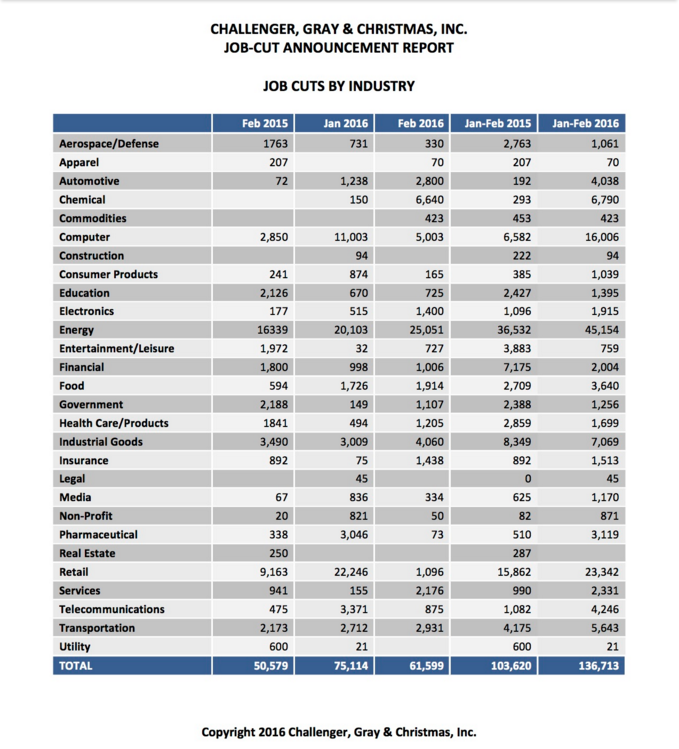
Outplacement firm Challenger, Gray and Christmas reported that announced job cuts rose 21.8% in February to 61.6k. The energy sector accounted for 25k of the losses, followed by chemicals, computer, and industrial goods. The West and the Midwest bore the brunt of the cuts. Remember these are announced job cuts and often never actually happen. Overall, the employment picture is looking decent, however we'll get a better look tomorrow. 

Here is a table of the industries hit. Note that aside from energy, job cuts are pretty low. Note that these are not net numbers either - they don't take into account any sort of hiring. 


Initial Jobless Claims rose to 278k last week. Anything below 300k is a good number.

The ISM Non-manufacturing composite fell slightly to 53.4 in February from 53.5 in January. Business continues to be decent in the services sector. 

Factory Orders fell 1.6% in January, while durable goods orders rose 4.7%. Capital Goods Orders rose 3.4%. 

Why is wage growth so difficult to find? Productivity growth has been weak since peaking around 1999 - 2000. This was the tail end of the big boost from the Internet and the decade-long transformation of the PC into a tool on everyone's desk. Last quarter it came in at -2.2%. Productivity has been negative for 3 out of the past 4 years, and that is not a recipe for wage inflation. 

Unit Labor costs rose 3.3% in the fourth quarter, which drove the drop in productivity as output only increased 1%. 

The Markit US Services PMI fell slightly in February to 49.7 while the composite PMI was flat at 50. 

The Bloomberg Consumer Comfort Index fell to 43.6 from 44.2 last week. Falling perceptions of the economy drove the decline. 

2012 Presidential Nominee Mitt Romney is going to try and push back the Trumpmentum with a speech tonight. 

Nothing too earth-shattering in the Fed's Beige Book which was released yesterday. Overall, manufacturing is flattish compared to last month, however labor markets improved overall, and "wage growth varied considerably, from flat to strong, across all districts." 

Thursday, January 28, 2016

Morning Report: The FOMC acknowledges global risks to the economy

Vital Statistics:

LastChangePercent
S&P Futures 1885.02.00.15%
Eurostoxx Index3024.680.72.74%
Oil (WTI)30.460.10.12%
LIBOR0.621-0.003-0.48%
US Dollar Index (DXY)99.340.2790.28%
10 Year Govt Bond Yield1.99%0.02%
Current Coupon Ginnie Mae TBA104.7
Current Coupon Fannie Mae TBA104
BankRate 30 Year Fixed Rate Mortgage3.71

Markets are flattish after the Fed maintained interest rate levels. Bonds and MBS are flat.

The statement out of the FOMC was relatively dovish, and the key sentence was: "The Committee is closely monitoring global economic and financial developments and is assessing their implications for the labor market and inflation, and for the balance of risks to the outlook." Stocks initially rallied on the statement and then sold off into the close. Bonds rallied. 

Initial Jobless Claims fell from 294k to 278k last week. 

Durable Goods orders fell by 5.1%, much more than the Street expectation of -0.7%. Capital Goods orders ex defense / air, a proxy for business capital expenditures, fell 4.3%. 

Pending Home Sales rose 0.1% in December and are up 3.1% YOY.

The Kansas City Fed index was unchanged at -9. 

Homebuilder PulteGroup reported better than expected earnings this morning. Orders were up 13%, and backlog increased 26%. ASPs increased 6% to $353k. CEO Richard Dugas had this to say about the state of the housing market: "While heightened global economic concerns have created greater market volatility, the positive trends in jobs, demographics and household formations, along with low interest rates and limited housing inventory, support expectations that housing demand continues to move higher at a measured pace for a number of years." They are seeing weakness in Texas, although Dallas seems to be immune to the drop in energy prices, at least for now. 

The CBO estimates that wage growth will outstrip home price appreciation in 2016. They are predicting 3.3% wage inflation and 2.4% home price appreciation. Given the tight inventory levels, I think that home price appreciation estimate is low. Wage inflation has recently crept up from 2% to 2.5%, but I don't see the catalyst for further wage inflation given the huge reservoir of people who left the labor force for statistical purposes but would gladly take a job if they found one. 

Thursday, September 24, 2015

Morning Report: New Home Sales come in strong

Vital Statistics:

Last Change Percent
S&P Futures  1913.5 -15.1 -0.78%
Eurostoxx Index 3027.5 -52.5 -1.71%
Oil (WTI) 44.22 -0.3 -0.58%
LIBOR 0.327 0.001 0.15%
US Dollar Index (DXY) 95.74 -0.327 -0.34%
10 Year Govt Bond Yield 2.09% -0.06%
Current Coupon Ginnie Mae TBA 104.2 -0.2
Current Coupon Fannie Mae TBA 104.2 0.2
BankRate 30 Year Fixed Rate Mortgage 3.78

Markets are lower this morning after Caterpillar warned and announced it will cut 5,000 jobs. Bonds and MBS are up.

New Home Sales rose to an annualized 552k in August, which easily beat expectations. While new home sales have more than doubled from their early 2011 lows, we are still well below what could be considered "normalcy."


Durable Goods orders fell 2% in August, coming in better than estimates. Capital Goods Orders (a proxy for business capital expenditures) fell 0.2% versus expectations of 0.5%. 

The Chicago Fed National Activity Index slipped in August from 0.51 to -.41. This index has had one positive reading all year. 

Initial Jobless Claims came in at 267k. The Bloomberg Consumer Comfort Index fell to 41.9.

Builder KB Home reported better than expected earnings this morning but disappointed on orders. Orders were up 19% to 2,167 units. Backlog increased 36%. Average selling prices rose 9% to $357.2k from $327k. The stock is down about half a buck on the open. 

Holiday retail sales are expected to increase 3.5% - 4% this year, a deceleration from last year's 5% pace. Given all the somewhat weak data, Q3 and Q4 GDP are looking a little soggy. Yet another excuse for the Fed to stand pat. 

Wednesday, August 26, 2015

Morning Report: Consensus shifting rapidly on a rate hike

Vital Statistics:

Last Change Percent
S&P Futures  1918.4 45.6 2.43%
Eurostoxx Index 3213.3 -4.8 -0.15%
Oil (WTI) 39.37 0.1 0.15%
LIBOR 0.332 0.003 0.76%
US Dollar Index (DXY) 94.91 0.378 0.40%
10 Year Govt Bond Yield 2.16% 0.09%
Current Coupon Ginnie Mae TBA 104.3 -0.2
Current Coupon Fannie Mae TBA 104 -0.8
BankRate 30 Year Fixed Rate Mortgage 3.86

Green on the screen again this morning as stocks try to rebound. Yesterday, stocks traded up early only to give it all back late in the day and close with big losses. Bonds and MBS are falling again. 

Durable Goods orders were strong at 2%, and June's number was revised upward. Capital Goods Orders Non-defense, ex-air (a proxy for business capital investment) rose 2.2% versus a 0.3% expectation, while June was revised upward from 0.9% to 1.4%. These were the highest readings in a year

Mortgage Applications rose 0.2% last week as purchases rose 1,7% and refis fell 1%. Surprising that refis fell given the 17 basis point drop in the 10 year, but it looked like TBAs (which set mortgage rates) largely ignored the move in the bond market.

Not sure what caused yesterday's late day sell-off, but the S&P 500 made a 60 point swoon in the last hour of trading to close down 26 points. 


The other interesting thing about this sell-off has been the fact that bonds have not reacted much to the sell-off. The flight to safety trade has been almost non-existent in Treasuries. Odd, since the sell-off has taken down the probability of a rate hike in September. In fact, many strategists are moving out their estimate for the first hike to 2016. 

Larry Summers was arguing over the weekend that financial conditions are acting like a tightening, and therefore the Fed doesn't really need to raise rates right now. Hotlanta Fed President Dennis Lockhart said that conditions in the financial markets have complicated the Fed's decision. By any measure, inflation is nowhere to be found. Given the fear of replicating the 1937 mistake, the Fed is probably going to err on the side of caution. Aside from the psychological discomfort of having rates at 0%, what reason is there to raise rates? 

The carnage in the stock markets in Asia have created some bargains. HTC (the cellphone maker) is trading at a discount to cash. Market cap of $39.7B, no debt, $47.2 billion of cash. Like buying dollar bills for 84 cents. In crisis, opportunity.

Friday, April 24, 2015

Morning Report - NASDAQ 5000

Vital Statistics:

Last Change Percent
S&P Futures  2110.3 3.4 0.16%
Eurostoxx Index 3703.7 5.9 0.16%
Oil (WTI) 57.68 -0.1 -0.10%
LIBOR 0.278 0.000 0.09%
US Dollar Index (DXY) 97.04 -0.242 -0.25%
10 Year Govt Bond Yield 1.93% -0.03%
Current Coupon Ginnie Mae TBA 103.2 0.1
Current Coupon Fannie Mae TBA 102.3 0.1
BankRate 30 Year Fixed Rate Mortgage 3.79

Markets are higher this morning on good earnings out of US companies. Bonds and MBS are up small.

Durable Goods rose 4% in March, however if you strip away transportation, they fell .2%. February was revised downward. Capital Goods orders (a proxy for business capital expenditures) fell .5% and February was revised down to -2.2%. We have seen a slew of disappointing data this quarter - Merrill Lynch is now forecasting Q1 GDP growth of 1.5%.

Comcast has officially pulled the plug on its merger with Time Warner Cable. Washington hated this deal from Day 1, and it became apparent this week that neither the FCC nor the DOJ was going to wave this through. 

Yesterday was a monumental day (of sorts) for stocks. The Nasdaq finally eclipsed its high from March 2000. Back then the mentality was to buy quality stocks, don't worry about the price, just hold out for the long term. For a trip down memory lane, remember the "four horsemen" of tech - the supposedly bulletproof stocks according to Jim Cramer were INTC, DELL, MSFT, and CSCO. Where are they now? Intel is down 57% from the peak, Dell was taken private in 2013 at $13.75, a 77% discount to its 2000 peak, If you were in Mr. Softee, you would be up 10% over 15 years, and almost all of your return would have beeen via the 2.7% dividend. Finally, you would have been much better off in the "other Cisco" - food service company Sysco (SYY) - than you would have been in CSCO, which is down 60% from its peak. No, Virginia, you cannot simply "buy good companies" whatever the price, and expect to make money over the long term.

That era's madness was perfectly encapsulated in the stock split beeper - a pager that would go off when a company announced a stock split. Cause nothing creates value like a stock split. 

In many ways, the four horsemen of tech were similar to the Nifty Fifty of the 1970s - one decision stocks like Avon and Polaroid. They worked until they didn't. In the physical sciences, knowledge is cumulative. In the financial markets, it is cyclical. 

In other words, don't worry about a bubble in the NASDAQ. People realize that stocks are just an asset that can go up or down - there is nothing special about them. Without that mentality of investors, you aren't going to have a bubble. Bonds on the other hand...

The NAHB is forecasting 2015 will be "slow and steady" for housing and 2016 will be the breakout year. The pent up demand of the first time homebuyer will be the catalyst, but we have been waiting for a long time for that. 


Wednesday, March 25, 2015

Morning Report - Rents are driving Millennials to buying.

Vital Statistics:

Last Change Percent
S&P Futures  2085.8 0.9 0.04%
Eurostoxx Index 3700.0 -31.4 -0.84%
Oil (WTI) 47.8 0.3 0.61%
LIBOR 0.267 0.000 0.00%
US Dollar Index (DXY) 96.67 -0.523 -0.54%
10 Year Govt Bond Yield 1.86% -0.01%
Current Coupon Ginnie Mae TBA 103.1 0.0
Current Coupon Fannie Mae TBA 102.5 0.0
BankRate 30 Year Fixed Rate Mortgage 3.82

Markets are flat this morning on no major news. Bonds and MBS are flat as well.

Mortgage Applications rose 9.5% last week as purchases rose 4.9% and refis rose 12.3%. Refis were 60.5% of all applications last week. 

Durable Goods orders fell 1.4% in February. Cap Goods Orders Non-Defense / Ex-air (a proxy for business capital investment) fell 1.4%, while January was revised downward from .6% to -.1%. Corporate America is not increasing capacity at all, and is not pursuing expansion opportunities.

What do companies with cash burning a hole in their pockets do when there are no great expansion opportunities out there? Buy each other. In a bit of a complicated deal, Heinz is buying Kraft. As oil stays down here, I expect to see some deals in the energy patch. The last time oil was this low (aside from the financial crisis days) we saw some huge deals:  Exxon buying Mobil, Conoco buying Philips, and BP buying Amoco. 

Rents are rising so fast that they are forcing Millennials to buy houses. In fact, Millennials are now a bigger homebuying cohort than Generation X. Student loan debt remains the biggest hurdle, however. As the economy recovers, a lot of pent-up demand is going to be unleashed. We have gone from a glut of housing to an extreme shortage, which means the builders are going to have to bump up production. The economy is already reasonably strong with only 1.1 million housing starts. If we get back to normalcy (1.5 million), that will provide a big boost. Plus construction employs a lot of people.