A place where economics, financial markets, and real estate intersect.
Showing posts with label LIBOR. Show all posts

Monday, March 26, 2018

Morning Report: SOFR gets introduced next week

Vital Statistics:

Last Change
S&P futures 2636.75 38.75
Eurostoxx index 368.03 2.21
Oil (WTI) 65.81 -0.07
10 Year Government Bond Yield 2.85%
30 Year fixed rate mortgage 4.46%

Stocks are higher this morning on optimism that a trade war with China can be averted. Bonds and MBS are down.

We will have a short week, with the bond market closed on Friday. On Thursday, we will have an early close. There will be a lot of Fed-speak this week, although not much in the way of market-moving reports.

Economic growth picked up in February according to the Chicago Fed National Activity Index. Production and employment-related indicators drove the increase.

San Francisco Fed Chairman John Williams is the front-runner to replace William Dudley at the New York Fed. Policy-wise he is considered a centrist, although not necessarily a markets guy. He is a long-term macro sort of guy - he doesn't keep a Bloomberg terminal on his desk - which makes him somewhat of an odd pick to run the NY Fed which is all about markets.

Speaking of the NY Fed, it is set to launch its replacement for LIBOR next week - the SOFR (or secured overnight funding rate). Regulators are looking for a replacement for LIBOR after it was found that banks were manipulating it in order to help their own proprietary positions. LIBOR is a reference rate for many adjustable rate mortgages, as well as lines of credit so its replacement will affect the mortgage industry. The big difference between the two is that LIBOR is set based on the forecast of bankers, while SOFR will be based on actual transactions in the money markets. This makes it much less susceptible to manipulation.

Bond market observers will be watching as the Fed auctions off almost $300 billion in paper this week, with the biggest 2 year auction since 2014. Amid weakening demand for US Treasuries, the results could buffet rates a bit. Note China has threatened to stop buying US Treasuries in response to tariffs.

Mortgage banking profits fell in the fourth quarter to $237 a loan from $929 in the third quarter. This was the lowest reading since Q1 when it hit $224. Higher costs and decreasing volumes drove the decrease. Margins also fell as banks cut margins in a more competitive environment. 56% of the firms in the study reported positive pre-tax profit in the quarter, down from 77% in the prior quarter.

California is mulling a new idea to increase the supply of homes on the market, by giving a tax break to people 55 and older who downsize and move to a new county. Many homeowners are reluctant to move because they will get hit with higher property taxes on the new property.

Wednesday, March 21, 2018

Morning Report: Existing Home Sales increase

Vital Statistics:

Last Change
S&P futures 2719 -3.75
Eurostoxx index 374.05 -1.52
Oil (WTI) 63.42 1.36
10 Year Government Bond Yield 2.90%
30 Year fixed rate mortgage 4.46%

Stocks are lower as we await the FOMC decision. Bonds and MBS are down. 

The FOMC decision is scheduled to be released at 2:00 pm EST. This will be Jerome Powell's first rate hike and press conference, so the markets will be hanging on his every word. Here are some of the things the Street will be focusing on. The biggest will be the dot plot for the rest of the year. Do the tax cuts and planned infrastructure spend push the Fed to bump up their consensus of 3 hikes this year to 4%? If so, that is bearish for bonds (higher rates). Another will be the long term neutral Fed Funds rate, which currently stands at 2.8%. Do they move it up to 3%? That sort of revision would be taken as hawkish as well and would push rates higher. Finally, the long-term unemployment rate is currently set at 4.6%, which implies the current rate of 4.1% is too low. If they move down the longer-term unemployment rate, that could be interpreted as dovish. 

While most mortgage market participants are rightly focused on the 10 year bond yield, there is another rate that is gathering attention - LIBOR. LIBOR has been rising steadily over the past 18 months, and and 3-month LIBOR is at levels not seen since 2008. LIBOR and the 1 year T-bill rate are the reference index in many adjustable rate loans. What does this mean for the mortgage industry? Funding costs are rising, while volumes are falling. Not a good mix for profitability. Also note that this is yet another reason for borrowers with ARMs to consider a refi into a 30 or 15 year fixed rate mortgage. Long-term rates have been much more stable than LIBOR, and therefore the relative attractiveness is increasing. 


Note that increasing short-term rates are having a spill-over effect onto other asset classes. Long-term bonds have had no competition from money market instruments for a decade. That is changing. 

Mortgage Applications fell 1% last week as purchases rose 1% and refis fell 5%. 

Existing home sales rose 3% in February to a seasonally adjusted pace of 5.54 million. This is up 1.1% YOY. The median home price rose 5.9% to $241k. Total housing inventory stood at 1.59 million, which is 8% lower than a year ago.  The first-time homebuyer accounted for 29% of sales, which is down from 31% a year ago, and well below the historical average of 40%. Days on market fell to 37. The average contract rate for a 30 year mortgage increased 3 basis points to 4.33%. Distressed sales fell to 4%. Overall, it is the same story - tight inventory and rising prices.  

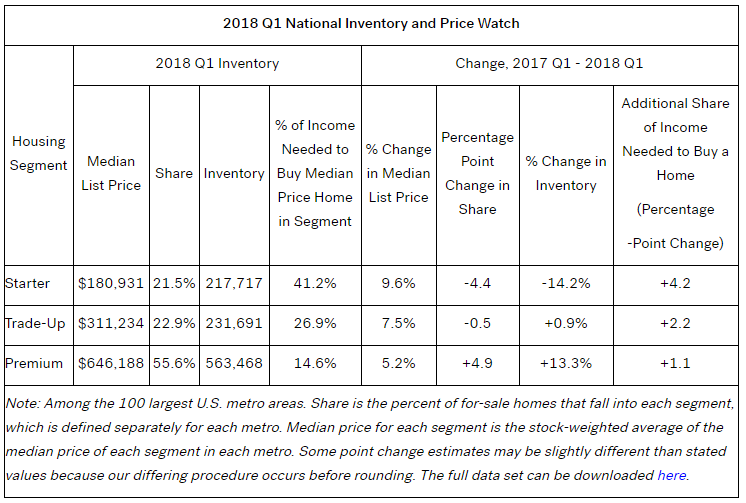
For the first time homebuyer, this is bad news, as most of the inventory is at the high end, not the low end. Starter homes in the Bay Area are over $800k, and engineers in Silicon Valley are struggling to pay the rent. Starter homes account for 22% of the inventory, while luxury accounts for almost 60%. 


Meanwhile, construction job openings are the approaching post-recession highs. Lack of labor remains the biggest issue for construction companies. 

Congress seems close to a deal to keep the government open after funding expires on Friday.  Fiscal conservatives will be unhappy, as the trade seems to be higher military spending for higher non-military spending. For originators, the biggest issue with a government shutdown is the inability to get 4506-T reports out of the IRS. 

Friday, July 28, 2017

Morning Report: More on housing afforability

Vital Statistics:

Last Change
S&P Futures  2465.3 -7.0
Eurostoxx Index 378.7 -3.6
Oil (WTI) 49.1 0.0
US dollar index 86.2 -0.3
10 Year Govt Bond Yield 2.30%
Current Coupon Fannie Mae TBA 102.93
Current Coupon Ginnie Mae TBA 103.81
30 Year Fixed Rate Mortgage 3.95

Stocks are lower this morning on overseas weakness. Bonds and MBS are flat. 

The advance estimate for second quarter GDP came in at 2.6%, in line with expectations. This is an increase from the first quarter estimate of 1.2%. Personal consumption increased 2.8%, while the price index increased 1% while the savings rate inched down. This should give the Fed the room to maintain interest rates at this level if they choose to do so.

The employment cost index rose 0.5% in the second quarter and is up 2.2% YOY. Wages and salaries increased 0.5% and benefit costs increased 0.6%. 

Consumer sentiment edged up in July, according to the University of Michigan survey. 

I had some questions yesterday regarding LIBOR and what happens to ARMs once it is gone in 2021? The short answer is that nobody knows for sure. The US will probably migrate to some other repo rate to set short term rates. Perhaps once LIBOR goes away, there will be a LIBOR reference rate which is pegged to whatever short term rate is being used and will move at a constant spread to that rate. 

I was discussing housing affordability a couple days ago and talked about mortgage payments as a function of income over time. I showed that the post bubble days hit 40 year lows (at least) and that we are still well below historical levels. The issue with that analysis is that it ignores the tax effects of the mortgage interest deduction, which really mattered in the late 70s / early 80s when tax rates and interest rates were much higher. Up until the mid 80s, the marginal tax rate for the median income was between 22% and 24%. It has been 15% ever since. Also, when interest rates were much higher, the vast majority of your payments for the first few years went to interest, not principal - in fact when mortgage rates were 17%, 99% of your first year's payment went to interest. Today, that number is much lower, and even ticked below 70% in 2012. Check out the chart below:


That chart also speaks to how much quicker one can build equity simply by paying their mortgage on time. Back in the 70s / 80s, you were probably lucky to have enough home price appreciation and principal paid to cover your closing costs if you moved after a few years. Today, you have both strong home price appreciation and a higher principal payment percentage. This helps emphasize how real estate is a great way to build wealth. 

Here is the chart comparing the gross percentage of income that a mortgage payment consumed over time and also the tax effected percentage: As you can see, it is pretty linear, and we are still in a great position now compared to 30 years ago. 


Thursday, July 27, 2017

Morning Report: Fed makes no changes to policy

Vital Statistics:

Last Change
S&P Futures  2478.0 5.0
Eurostoxx Index 382.8 0.0
Oil (WTI) 48.4 -0.3
US dollar index 86.3 0.1
10 Year Govt Bond Yield 2.30%
Current Coupon Fannie Mae TBA 102.93
Current Coupon Ginnie Mae TBA 103.81
30 Year Fixed Rate Mortgage 3.95

Stocks are higher after the Fed maintained existing policy yesterday. Bonds and MBS are flat.

As expected, the Fed kept the Fed Funds rate the same. The statement was almost identical to the June statement. The September Fed Funds futures went to a 100% probability of no hike, and the December futures went to a 51% chance of no hike. The Fed said balance sheet reduction will begin "relatively soon." The consensus seems to be that "relatively soon" means September. The Fed Funds futures are hinting that as well, by going to a 0% probability of a rate hike, which means they are betting September will the meeting where tapering is announced. One complicating factor will be the debt ceiling hike, which will be happening around that time. If we get a stand-off, we might see the Fed punt until the December meeting. 

June Durable Goods orders were up big on aircraft. The headline number was an increase of 6.5% MOM and 16% YOY. Ex-transportation, they were up 0.2% MOM and 6.8% YOY. Core capital goods orders (a proxy for business capital expenditures) fell 0.1% and are up 5.6% YOY.

Initial Jobless Claims ticked up to 244k, while the Chicago Fed National Activity Index rebounded to .13. 

The UK banking regulator has decided to kill LIBOR by phasing it out by 2021. 

Freddie Mac changed its guidelines on Home Possible Loans. No gift money until 3% down. 


Friday, June 23, 2017

Morning Report: New Home Sales exceed expectations

Vital Statistics:

Last Change
S&P Futures  2433.0 1.3
Eurostoxx Index 387.2 -1.3
Oil (WTI) 42.9 0.1
US dollar index 88.7 -0.1
10 Year Govt Bond Yield 2.15%
Current Coupon Fannie Mae TBA 103.31
Current Coupon Ginnie Mae TBA 104.375
30 Year Fixed Rate Mortgage 3.92

Stocks are flattish after the Fed gave a clean bill of health to the banks it stress-tested. Bonds and MBS are up small. 

One year ago today, the UK voted to leave the EU, which ignited a big rally in the bond market and pushed the 10 year down to a 1.37% yield. 

New Home Sales ticked up in May to a seasonally adjusted pace of 610k. This was up 2.9% MOM and 8.9% YOY.  The median new home sales price was $345,800 and the average price was $406,400. There are 268,000 new homes for sale at the moment. The 610k print was pretty much the average for the US from 1965-1995. New home sales peaked at over 1.3 million during the bubble years, but we are still a long way from normalcy, given population growth and obsolescence. 


34 systemically important banks passed their stress tests yesterday. The banks are getting better at passing these exams, and the sense is that the Trump Administration will nominate someone to the Fed who will dial back these exams a bit. Next week, the Fed will release its comprehensive capital review, which will determine whether the big banks can increase their dividends or buy back stock. 

Here is a good way to determine how tight a local housing market is: compare the ratio of new jobs to new building permits. In the Bay Area, that ratio is 6.4x: over the past 5 years, that MSA has added 373,000 new jobs, but has issued permits for only 58,000 new units. Lack of land, along with regulatory issues are holding back building there. In less constrained MSAs (both land and regulation) like Houston, the ratio is 1.3x. For the whole US, the country added just about 2.2 million jobs in 2016 and building permits totaled about 1.2 million, or a ratio of 1.8x. 

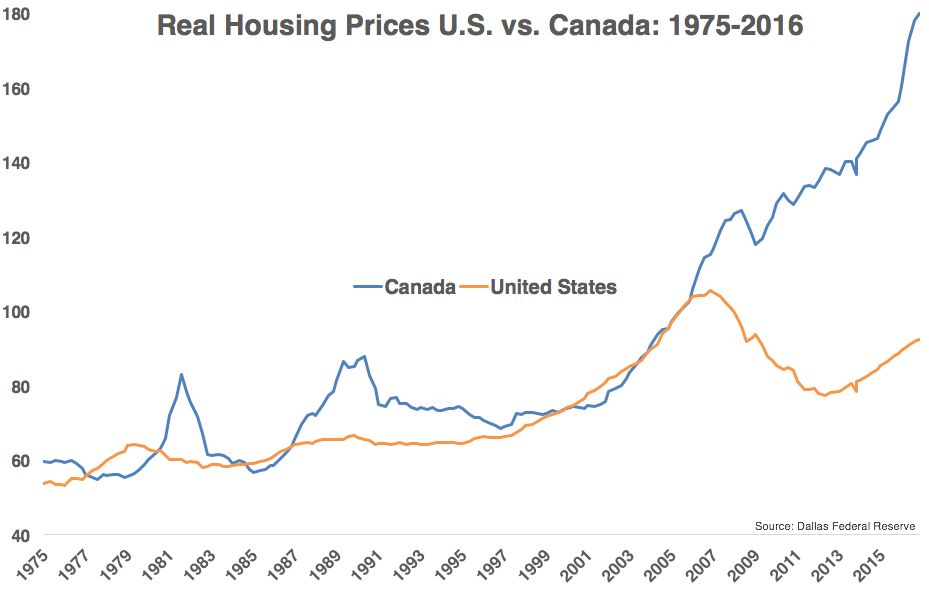
The Canadian housing bubble continues to defy gravity, but the signs are there that its days are probably numbered. Warren Buffet took a 38% stake in troubled Canadian lender Home Capital and agreed to provide a $2 billion line. You can see from the chart below how far the Canadian bubble has exceeded the US one: Note that these are inflation-adjusted indices which is why US prices appear to have not recouped the losses from the bubble years. They have on a nominal basis, but not an inflation-adjusted basis. 


The current median house price in Canada is about 520k and the median income is about 76k, putting the median house price to median income ratio at 6.8x. The US ratio peaked at 4.8x, which gives you some idea of how far prices have gone up North. Once the bubble bursts, it is bound to have some knock-on effects in the US, especially at the high end of the market which is probably more linked to China's bubble than people care to admit. 

The US Government has recommended that the new benchmark short term rate become the Treasury repo rate instead of LIBOR, which is subject to manipulation (as we saw in the UK). Not sure how this will affect current adjustable rate mortgages, but new ones will probably lose LIBOR and will use constant maturity treasuries or some alternative index. 

Wednesday, July 27, 2016

Morning Report: FOMC decision today at 2:00 pm EST

Vital Statistics:

Last Change
S&P Futures  2168.3 5.0
Eurostoxx Index 343.8 2.5
Oil (WTI) 42.8 -0.2
US dollar index 88.0 0.2
10 Year Govt Bond Yield 1.56%
Current Coupon Fannie Mae TBA 103.3
Current Coupon Ginnie Mae TBA 104.2
30 Year Fixed Rate Mortgage 3.53

Markets are calm ahead of the FOMC decision this afternoon. Bonds and MBS are up small.

The FOMC decision is set to come out around 2:00 pm EST today. Beware of locking around that time. Since there is no press conference scheduled, the odds of a rate hike are extremely low. Investors will parse the language of the statement closely. Note the next time Janet Yellen speaks will be in late August at Jackson Hole, so markets will have all sorts of time to fret without any sort of real input from the Fed. 

Mortgage applications fell 11% last week as purchases fell 3% and refis fell 15%. Rates rose 2 basis points last week, but they increased 17 basis points the week before. 

Durable Goods orders fell 4% MOM and are down 6.4% YOY. Ex transportation they were down .5% MOM and 3.6% YOY. Capital Goods orders fell as well. For all the talk about an acceleration in the economy, these numbers are a warning sign. 

Pending Home sales rose 0.2% last month. Tight inventory remains a problem, and the increase was mainly due to the Northeast which doesn't have the inventory problem we see on the West Coast. Lawrence Yun, NAR's chief economist had this to say: "With only the Northeast region having an adequate supply of homes for sale, the reoccurring dilemma of strained supply causing a run-up in home prices continues to play out in several markets, leading to the last two months reflecting a slight, early summer cooldown after a very active spring," he said. "Unfortunately for prospective buyers trying to take advantage of exceptionally low mortgage rates, housing inventory at the end of last month was down almost 6 percent from a year ago,1 and home prices are showing little evidence of slowing to a healthier pace that more closely mirrors wage and income growth."

Lost in all the focus on falling / negative bond yields is the rise in LIBOR. LIBOR is a short-term rate that is the basis for lots and lots of financial products, from everything to auto loans to ARM mortgages. New money market regulations have been pushing up LIBOR. The explanation is really inside-baseball sort of stuff, but just be aware as this does affect ARM pricing.


Just one more note on ARMS - in this interest rate environment, where long term rates are steady / falling and short term rates are rising - ARMs are unattractive for borrowers. If there are any borrowers out there who still have ARMs now is the time to refi to a 30 year fixed rate mortgage. 

Fannie Mae has announced changes to its 3% down HomeReady program.

Changes that go into effect immediately include:
  • Income limits have been raised to 100 percent of area median income (AMI) in all areas except for low income market tracts which have no limit. The company says this will expand access to affordable credit and also make it easier for lenders to determine eligibility for the loans.
  • The occupant borrower will now be allowed to own other residential properties.
  • Homeownership education courses that fulfill the HomeReady mortgage requirement have been expanded to include one-on-one pre-purchase advising from HUD-approved providers. Fannie Mae will offer lenders a $500 credit to encourage borrowers to take advantage of this option. Homebuyer education will continue to be available through Framework, Fannie Mae's education partner.
The requirement for homeownership education has been removed for limited cash-out refinances and borrowers for loans secured by two- to four-unit properties will no longer be required to take landlord education although homeownership education will remain a requirement.
  • The Seller Guide announcing the above changes also noted that Fannie Mae expects to make additional enhancements later this year, including:
  • Allowing a maximum loan-to-value up to 97 percent on limited cash-out refinance transactions in Desktop Underwriter (DU) if the existing mortgage is owned or securitized by Fannie Mae.
  • Expanding current HomeReady eligibility for buydowns and adjustable-rate loans to include three- to four-unit properties.
Adding additional incentives for the one-on-one homeownership counseling implemented with the current changes.

The strange, strange world of jumbo lending in the Bay Area. Lenders are now taking into account stock and stock option compensation for determining whether a borrower can afford a mortgage. In a place where the median house price is $1.13 million, lenders have to get creative in finding ways to get working stiffs into a home. I guess if real estate prices and the stock market continue to hit new highs, everything is okay until the music stops. 

Speaking of crazy lending, car loans are the new subprime, with 8 year car loans at mortgage rates. As investors reach for yield, they inevitably take more risk. That said, fears of this causing a 2008 style calamity are overblown. Residential real estate bubbles are a fundamentally different animal than this sort of thing.