A place where economics, financial markets, and real estate intersect.
Showing posts with label the Fed. Show all posts

Friday, July 20, 2018

Morning Report: Donald Trump, the Fed and housing affordability

Vital Statistics:

Last Change
S&P futures 2801 -3.75
Eurostoxx index 385.19 -1
Oil (WTI) 69.83 0.37
10 Year Government Bond Yield 2.85%
30 Year fixed rate mortgage 4.50%

Stocks are lower after the Trump Administration threatened more tariffs on Chinese goods. Bonds and MBS are down. 

Donald Trump jawboned the Fed a little yesterday, saying he was "not thrilled" with interest rate hikes.  “I am not happy about it. But at the same time I’m letting them (the Fed) do what they feel is best.” For all the histrionics in the business press, this was pretty mild stuff. As a general rule, presidents respect the independence of the Federal Reserve and don't criticize policy all that much. Obama never criticized the Fed's monetary policy but of course he never had to deal with a tightening, so there wasn't much to complain about. Alan Greenspan was considered "The Maestro" by the business press, so both Clinton and GWB gave him a wide berth. That said, Richard Nixon criticized the Fed, and Jimmy Carter installed a political hack (G William Miller - who was a complete disaster) to run the bank, so it isn't like political meddling is unheard of. FWIW, the correlation between rising bond yields and criticism of the Fed is about 1, so expect more as we move from a secular bull market in bonds to a secular bear market. 

Trump has doubled down by tweeting about the Fed and the dollar this morning: "China, the European Union and others have been manipulating their currencies and interest rates lower, while the U.S. is raising rates while the dollars gets stronger and stronger with each passing day - taking away our big competitive edge. As usual, not a level playing field....The United States should not be penalized because we are doing so well. Tightening now hurts all that we have done. The U.S. should be allowed to recapture what was lost due to illegal currency manipulation and BAD Trade Deals. Debt coming due & we are raising rates - Really? Farmers have been on a downward trend for 15 years. The price of soybeans has fallen 50% since 5 years before the Election. A big reason is bad (terrible) Trade Deals with other countries. They put on massive Tariffs and Barriers. Canada charges 275% on Dairy. Farmers will WIN!"

These comments are smacking the dollar this morning, which is pushing up the 10 year yield. The comments have made no changed to the Fed funds futures, which are still predicting an 85% of a 25 basis point hike in September and a 58% chance of another hike in December. 

Note Russia is dumping Treasuries. Most of its position has been liquidated. This was in response to sanctions imposed earlier this year. 

Housing affordability has been falling as rates and prices rise. The most affordable places in the US are the Northeast and the Midwest. The Midwest is the most affordable despite having the highest regional mortgage rates. There is a surprising amount of variation between mortgage rates in different parts of the country - a range of 25 basis points. The Northeast has high prices (but low rates) and the Midwest has low prices (but high rates). Affordability is back to 2009 levels. 


At least one commentator thinks housing has peaked for this cycle. As a general rule, housing construction is an early cycle phenomenon - in other words it generally leads the economy out of a recession. Since this expansion is very long in the tooth, it would follow that housing might have peaked. The problem with that theory is that housing didn't show up in the early recovery - it kept falling well after the recession ended. FWIW, between the shortage we currently have and the fact that building margins are still healthy indicates housing has room to run. 

Thursday, April 19, 2018

Morning Report: Don't fret the flattening yield curve

Vital Statistics:

Last Change
S&P futures 2701.75 -8
Eurostoxx index 381.94 0.11
Oil (WTI) 69.26 0.79
10 Year Government Bond Yield 2.90%
30 Year fixed rate mortgage 4.44%

Stocks are lower as commodities surge. Bonds and MBS are down.

The US imposed sanctions on Russia's Rusal, which has sent aluminum prices up 30% and nickel to 3 year highs. This has the potential to spill through to finished products and bump up inflation. As a general rule, commodity push inflation generally isn't persistent. An old saw in the commodity markets: the cure for high prices is... high prices. 

Initial Jobless Claims ticked up to 232,000 last week, still well below historical numbers. 

Investors are starting to worry about the inverted yield curve. An inverted yield curve (where short term rates are higher than long term rates) has historically signaled a recession. The spread between the 10 year and the 2 year is around 41 basis points, which is a 10 year low. Is that what the yield curve is telling us now? I would answer this way: the yield curve is so manipulated by central banks at the moment, that the information it is putting out should be taken with a boulder of salt. We are in uncharted territory, where long term rates are no longer set purely by market forces. 

Also, take a look at the chart below, where I plotted the last 4 tightening cycles. In the last 2 cycles, the yield curve inverted, by a lot. In late 2000, the yield curve inverted by 100 basis points - that would be like the Fed taking the FF rate up to 4% while the 10 year hovers around here - at 3%. I would note that the mid 90s tightening cycle didn't cause a recession, and the late 90s and mid 00s tightening cycles didn't result in recessions immediately - it took years before the economy entered into a recession. 

The question is whether the Fed caused these recessions. It is possible, and the Fed was probably the catalyst to burst the late 90s stock market bubble and the mid 00s real estate bubbles. But these were going to burst anyway. It doesn't really matter what the catalyst is. This time around, we don't really have a similar bubble - we may have pockets of overvaluation, but we don't have bubbles that the typical American is invested heavily in. Not like stock or houses. I think the Fed is happy to gradually get off the zero bound and once we are at 3% on the Fed funds rate will be content to stop. I could see the 10 year going absolutely nowhere during that time. 


My take is this: take the shape of the yield curve as a very weak and distorted economic signal - the labor data will tell you what is really going on, and the labor data is signalling expansion, not recession. 

Don't forget that bond rates are set in a global market, and relative value trading between sovereign bonds will play a role. The US 2 year is at a multi-decade premium to the German 2 year, and in theory, that should mean that investors sell Bunds to buy Treasuries. The reason why that isn't happening? The US dollar, which isn't buying the Administration's rhetoric. 

Facebook wants to get into the semiconductor business. Really. First Zillow wants to get into the house flipping business and now this. I don't understand why companies with great business models want to dilute them. Both companies have a competitive moat with a largely recession-proof business model. The semiconductor business is one of the most cutthroat, lousy businesses this side of refineries and airlines. Take a look at QCOM today. 

The NAHB remodeling index dipped in March, driven by bad weather in the Northeast and the Midwest. With home affordability slipping due to higher interest rates and home prices, remodeling remains a good substitute for moving up. 

Friday, February 23, 2018

Morning Report: The Street is short Treasuries

Vital Statistics:

Last Change
S&P Futures  2722.3 10.8
Eurostoxx Index 380.9 0.5
Oil (WTI) 62.7 0.0
US dollar index 83.6 0.1
10 Year Govt Bond Yield 2.89%
Current Coupon Fannie Mae TBA 103.591
Current Coupon Ginnie Mae TBA 103.688
30 Year Fixed Rate Mortgage 4.4

Stocks are higher this morning on no real news. Bonds and MBS are up small. 

No economic data today, but we do have a lot of Fed-Speak. 

Speculative short positions in US Treasuries are at a record. This means in plain language, that a lot of speculators are making the same bet: that interest rates are going higher. In practice, crowded trades like this often will behave in a perverse manner, especially when you get data points that don't support the prevailing view.  Right now, the Street thinks inflation is rising and they are negative on Treasuries. Any data point that supports that view will probably have a muted effect, while any data point that doesn't support that view will probably have an outsized reaction. To give an example: Say next week's GDP number comes in higher than expected - maybe 3%, with an increase of the GDP deflator (inflation) at 2.8%. Bonds might sell off from something like 2.9% to 2.92%. However, if GDP comes in light (say 2%), and the GDP deflator comes in at 2% as well, we could see bonds rally from 2.9% to 2.85%. These sorts of movements are generally short-lived (lasting a morning or a day), but they do provide opportunities to lock at good prices if you are nimble. Big picture, rates are going higher, however since there are so many speculative bets against Treasuries at the moment, it will provide some opportunities to lock in at good rates if you are quick. 


Lenders are loosening requirements to get a mortgage, particularly for first time homebuyers. We are seeing a modest drop in overall credit scores, and a slight increase in LTV and DTI ratios. This indicates a move towards low down payment loans. As rates increase, the credit box will almost invariably increase as lenders fight for fewer and fewer loans. Some lenders are also changing the way they treat student loan debt, even excluding it altogether if a parent is making the payments. 

Who is the biggest mortgage lender out there? If you said Wells Fargo, you would be correct for all of 2017. However the biggest lender in the 4th quarter was Quicken

HUD is providing foreclosure relief for victims of the 2017 hurricanes in Texas and Florida. Homeowners affected by these disasters (and some others) may be able to get a loan that covers their mortgage payments for a year, payable upon sale of the property or a refinance. 

How much do you have to make to be in the top 1% these days? Just shy of half a million. To be in the top 10%? Just under 150k. 

This weekend is Buffetapalooza, or the annual shareholders meeting for Berkshire Hathaway in Omaha. It has been called a Woodstock of Capitalism, where shareholders dance with the Froot of the Loom guys, eat See's candy and have dinner at Warren's favorite steakhouse. The climax will be his letter to shareholders, which is usually chock full of folksy advice for investors, along with observations on the economy and the state of affairs politically. Warren is the second-biggest corporate holder of short term Treasuries and is probably itching for a deal. That said, I think the last big deal he did was several years ago when he bought Precision Castparts. 

There is a rumor going around that the Fed will begin holding press conferences after all FOMC meetings, not just the Mar, Jun, Sep and Dec meetings. That could be a setup to begin making interest rate changes at these meetings as well. As of now, the markets expect them not to. Don't forget, press releases after a FOMC meeting is relatively new. Historically the Fed wanted to be opaque, as they believe that their policy is more effective if it is a surprise to the markets. Greenspan was known for changing interest rates between meetings. 

Thursday, July 27, 2017

Morning Report: Fed makes no changes to policy

Vital Statistics:

Last Change
S&P Futures  2478.0 5.0
Eurostoxx Index 382.8 0.0
Oil (WTI) 48.4 -0.3
US dollar index 86.3 0.1
10 Year Govt Bond Yield 2.30%
Current Coupon Fannie Mae TBA 102.93
Current Coupon Ginnie Mae TBA 103.81
30 Year Fixed Rate Mortgage 3.95

Stocks are higher after the Fed maintained existing policy yesterday. Bonds and MBS are flat.

As expected, the Fed kept the Fed Funds rate the same. The statement was almost identical to the June statement. The September Fed Funds futures went to a 100% probability of no hike, and the December futures went to a 51% chance of no hike. The Fed said balance sheet reduction will begin "relatively soon." The consensus seems to be that "relatively soon" means September. The Fed Funds futures are hinting that as well, by going to a 0% probability of a rate hike, which means they are betting September will the meeting where tapering is announced. One complicating factor will be the debt ceiling hike, which will be happening around that time. If we get a stand-off, we might see the Fed punt until the December meeting. 

June Durable Goods orders were up big on aircraft. The headline number was an increase of 6.5% MOM and 16% YOY. Ex-transportation, they were up 0.2% MOM and 6.8% YOY. Core capital goods orders (a proxy for business capital expenditures) fell 0.1% and are up 5.6% YOY.

Initial Jobless Claims ticked up to 244k, while the Chicago Fed National Activity Index rebounded to .13. 

The UK banking regulator has decided to kill LIBOR by phasing it out by 2021. 

Freddie Mac changed its guidelines on Home Possible Loans. No gift money until 3% down. 


Monday, March 27, 2017

Morning Report: The Trump reflation bubble deflates

Vital Statistics:

LastChange
S&P Futures 2324.5-19.5
Eurostoxx Index374.0-1.3
Oil (WTI)47.62-0.35
US dollar index89.4
10 Year Govt Bond Yield2.35%
Current Coupon Fannie Mae TBA102.06
Current Coupon Ginnie Mae TBA103.32
30 Year Fixed Rate Mortgage4.17

Stocks are lower after the Trump reflation trade is being unwound. Bonds and MBS are up.

Not much in the way of data this week - probably the biggest number is the final revision to Q4 GDP on Thursday. We will have a lot of Fed-speak however. 

The Republican House couldn't agree on a replacement for Obamacare and pulled the vote. This puts Trump's planned infrastructure spend and tax cuts in jeopardy as reduced spending on healthcare was the pay-for. That said, tax reform will probably be easier as there is bipartisan agreement that the current corporate tax structure isn't really working for anyone. Tougher will be individual tax reform, where Republicans want to lower rates in exchange for reduced deductions. The mortgage interest deduction will stay, but the deduction for state and local taxes may not. 

Even though the markets are re-adjusting their forecasts for fiscal stimulus, central bankers still seem committed to getting off the zero bound. Amidst all the furor in the US over the last month, Europeans have completely re-assessed what they think the ECB is going to do, taking the implied probability of a rate hike by the end of the year from a long shot to a coin toss.


In the aftermath of the Obamacare vote, the next thing to watch for is whether the regional Fed banks and strategists start taking down their estimates for 2017 GDP. Remember, the Fed's forecast of 2-3 hikes this year was predicated on fiscal stimulus, which now looks less likely. 

Treasuries remain under some selling pressure as Japanese fund managers sell. Note that speculative short positions in Treasuries were pretty high going into this defeat on healthcare, so interest rates may be pushed lower as hedge funds unwind the trade. Not sure how long that lasts, but this is good news for homebuyers entering the Spring selling season. 

Home prices are just shy of their 2006 peak, according to the Black Knight Financial Services Home Price Index. In December, they rose 0.1% MOM and 5.7% YOY. The report has a good state-by-state analysis too. 


Friday, October 21, 2016

Morning Report: More rent versus buy

Vital Statistics:

Last Change
S&P Futures  2124.7 -12.0
Eurostoxx Index 343.3 -1.0
Oil (WTI) 50.3 -1.3
US dollar index 88.6 0.0
10 Year Govt Bond Yield 1.74%
Current Coupon Fannie Mae TBA 103.3
Current Coupon Ginnie Mae TBA 104.2
30 Year Fixed Rate Mortgage 3.57

Stocks are lower this morning on no real news. Bonds and MBS are up.

No economic data today, however we do have some Fed-speak.

Following on yesterday's rent-versus-buy article from Trulia, I crunched some numbers to demonstrate the relative value proposition currently. Using census data for median asking rent and median house prices, I plotted the median asking rent against the mortgage payment for a FHA loan with 3.5% down, including mortgage insurance, property taxes, homeowner's insurance, and the tax benefit of deducting interest and property taxes for a borrower making the median income. Historically, buying has resulted in a payment higher than the median rent payment. This makes sense: your mortgage payment will be more or less fixed, while rent will increase with inflation. 

The chart below plots the two numbers in absolute dollars. You can see the two lines converging which means the rent-versus-buy decision is about as far skewed towards buying than it ever has been.


In the second chart, I plotted the difference between the "median" mortgage payment and median asking rent. The range recently has been anywhere from -10% to 100%. 


The other thing to keep in mind with the rent vs buy decision is that the world's central banks are on a mission to create inflation. They will eventually succeed, and over time the asking rent is going to increase, while the mortgage payment will be largely fixed, with the exception of property taxes and perhaps homeowner's insurance. On the other side of the coin, home price appreciation will probably maintain at least a mid-single digit rate of appreciation, which is higher than the mortgage interest rate, especially when you take into account the tax benefits. 

The takeaway is that the Fed is giving the homeowner a gift in low rates, and that won't last forever. 

Monday, August 22, 2016

Morning Report: Fannie says no hikes this year

Vital Statistics:

Last Change
S&P Futures  2179.0 -3.0
Eurostoxx Index 340.7 -0.1
Oil (WTI) 47.8 -1.0
US dollar index 85.7 0.2
10 Year Govt Bond Yield 1.56%
Current Coupon Fannie Mae TBA 103.3
Current Coupon Ginnie Mae TBA 104.2
30 Year Fixed Rate Mortgage 3.5

Stocks are slightly lower this morning after Stanley Fischer said the US economy was close to hitting all of the Fed's targets. Bonds and MBS are down small.

Not a lot of market-moving data this week, aside form the second revision to GDP on Friday. Note central bankers will be out in Jackson Hole this week, so there is the possibility of comments moving the markets. Otherwise, it looks to be a dull week in late August. 

The Chicago Fed National Activity Index came in better than expected at .27, but the 3 month moving average is negative, indicating the economy is growing slightly below trend. 

Fannie Mae is forecasting the Fed will maintain rates throughout 2016, and they believe the economy will strengthen. “Second quarter growth was a disappointment, but consumer spending appears solid heading into Q3, and we expect inventory investment to balance out after a surprising drawdown in Q2,” said Fannie Mae Chief Economist Doug Duncan. “Credit expansion, combined with improving labor market conditions and strengthening household balance sheets, should continue to support consumers, who will likely be the primary driver of growth again in the second half of the year. The positive July jobs report may encourage some Federal Open Market Committee members to argue for a Fed rate hike at the September meeting. However, we remain convinced that the Fed will hold the target rate steady this year given global uncertainties and anemic output growth. Although much of the financial volatility from Brexit has subsided, long-term Treasury yields continue to face downward pressure and we expect them to remain low for some time.”

More from Fannie on the housing market: “Housing market fundamentals remain a mixed bag. During the second quarter of 2016, both new and existing home sales rose to expansion highs, while single-family starts pulled back, remaining historically low for an expansion,” said Duncan. “Tight housing inventory from a lack of new construction continues to create affordability challenges, particularly at the lower end of the market. Robust rental demand during the second quarter of the year has created the lowest rental vacancy rate in decades. In addition, the homeownership rate dropped to below 63 percent in the second quarter, but we are seeing some tentative signs of older Millennials moving toward homeownership. We expect homebuyers will benefit from improving job and wage growth, more favorable lending standards, and continued low mortgage rates through the rest of the year, with the 30-year fixed-rate mortgage rate projected to average 3.4 percent during the fourth quarter.”

Talk about bad timing: Donald Trump got into the mortgage business in 2006. He did make an interesting point about bubbles and the madness of crowds. “Are you the type of person who takes advantage of positive situations when they present themselves, riding them out as long as they last? Or do you heed every message of doom and gloom, avoiding risks that could be some remarkable opportunities?” If you sold stocks in 1996 when Alan Greenspan discussed "irrational exuberance" in the stock market, you missed out on the lion's share of the growth. Also, the most money is made right at the end of the move when it goes parabolic. 

Following on Donald Trump, many recognize we have a bubble in sovereign debt. Black Rock believes that supply-demand imbalances will keep the bubble inflated for the near term. Meanwhile, Paul Singer suggests that bonds come with a warning label: "Hold such instruments at your own risk; danger of serious injury or death to your capital!"

Note that the European Central Bank and the Bank of Japan are now buying private placements from corporate issuers.  I guess the big question is "what happens when these bond issues go bad?" The European Central Bank is supporting 3.3 trillion euros of assets on 100 billion euros of capital, or about a 32:1 leverage ratio. The Fed is even worse, supporting $4.5 trillion in assets on just $40 billion worth of capital for a 112:1 leverage ratio. It won't take much of a move in asset prices to wipe out the equity of either entity. 


Thursday, August 18, 2016

Morning Report: FOMC minutes not as hawkish as feared

Vital Statistics:

Last Change
S&P Futures  2177.5 -2.0
Eurostoxx Index 342.0 1.5
Oil (WTI) 47.0 0.2
US dollar index 85.5 -0.1
10 Year Govt Bond Yield 1.55%
Current Coupon Fannie Mae TBA 103.3
Current Coupon Ginnie Mae TBA 104.2
30 Year Fixed Rate Mortgage 3.5

Stocks are flattish after the FOMC minutes came in less hawkish than feared. Bonds and MBS are up.

Initial Jobless Claims came in at 262k last week. 

The Philly Fed Business Outlook Survey came in slightly positive, about in line with expectations. 

The FOMC minutes were not quite as hawkish as markets feared. The Fed noted that the two biggest fears at the June meeting (Brexit, which had just happened, and the terrible May jobs report) turned out to be non-events. That said, there is still some debate at the Fed over how much more work they have to do on the employment side of their dual mandate. Some at the Fed point to the unemployment rate and infer their job is largely done, while others point to the low labor force participation rate and say they have more work to do. The lack of language about the risks of the economy being more tilted toward the upside than the downside has been taken as a signal that the Fed isn't planning to move in September. Bonds rallied somewhat on the minutes, with the 10 year falling to 1.54% and the Fed Funds futures reducing the implied probability of a 2016 hike to a coin toss. 

The minutes did discuss housing a bit as well. In terms of housing construction, they noted that housing activity growth had slowed in recent months, which is a fair observation however housing starts have been in a 1.1 million to 1.2 million range for about a year. Not much improvement going on there at all, just steady state. Much of the growth is going to multi-fam construction, not single, however. 

In terms of credit, the Fed noted that mortgage credit became somewhat more easy between the June and July meetings. Apparently, a number of large banks said they had eased standards somewhat for GSE loans. Purchase and refi activity picked up as well. 

Speaking of GSE loans, everyone in DC realizes that the current state of affairs (with the GSEs as wards of the state) is unsustainable, however no one really knows what to do with them. The US taxpayer bears the credit risk of 90% of all new origination. Republicans would like the government less involved with the mortgage market, while Democrats would like to see them officially nationalized and made a government owned corporation. The point is moot, however in that there is nothing in the private sector capable of replacing them. 

Note that Fan and Fred used to be 100% owned by the government (Fannie Mae was a New Deal phenomenon), and LBJ made them a nominally private institution. The reason? Fannie Mae's debt was becoming a problem for the national balance sheet and was making it difficult to finance the Vietnam war. LBJ wanted Fannie Mae's debt off the official books of the US Government, so he spun off a piece to private investor. So, yes Virginia, the first user of off-balance sheet financing was Uncle Sam. 

Former Minneapolis Fed Head Narayana Kochlerakota compares the US recovery to that of Europe and Japan. People trumpeting the great performance of the US versus their peers (largely a partisan affair) are ignoring the fact that the US population has been increasing much faster than Europe, so comparing simple GDP growth isn't really all that meaningful. If you look at employment, the US looks worse. This has big implications for monetary policy. Perhaps QE hasn't been quite the elixir it has been held up to be. In Japan, banks are running out of JGBs to sell the Central Bank. To me, the glaring observation is that the 10 year bond yield where it was pre taper tantrum (Spring of 2013). It implies they could have achieved the same result doing nothing! As Art Cashin said, the Fed is beginning to resemble Casey Stengal's 1962 Mets


That said, it looks like fiscal policy might be ready to run with the ball. Hillary Clinton and Donald Trump both want to spend more money. Assuming Hillary wins and the GOP keeps the House, we will have to see if she can cut a deal with Republicans to allow for more spending. 

Monday, June 27, 2016

Morning Report: Implications of Brexit

Vital Statistics:


Last Change Percent
S&P Futures  2004.6 -14.0 -0.69%
Eurostoxx Index 2714.3 -61.8 -2.22%
Oil (WTI) 46.84 -0.8 -1.68%
LIBOR 0.624 -0.017 -2.58%
US Dollar Index (DXY) 96.58 1.131 1.18%
10 Year Govt Bond Yield 1.47% -0.09%
Current Coupon Ginnie Mae TBA 105.9
Current Coupon Fannie Mae TBA 105.3
BankRate 30 Year Fixed Rate Mortgage 3.56

Stocks are lower this morning as markets adjust to Brexit. Bonds and MBS are up.

Here is the summary of the financial market reaction to Brexit: Stocks down, Treasuries up, US dollar up, Gold up, but other commodities down. Fed Funds futures pricing in no more interest rate hikes this year. In many ways, markets were discounting #Bremain in the week or so heading up to the vote, so in many cases, they merely gave back those moves. Friday was volatile, with 3-sigma moves seen in 23 currencies, 30 sovereign bonds, and and 28 stock market indices. 

What does Brexit mean to the European financial markets?  The banks got crushed on Friday, and part of that is due to widening sovereign spreads. Brexit caused a yield divergence between the German Bund and the PIIGS (Portugal, Italy, Ireland, Greece, and Spain) bonds. Greek spreads widened out 89 basis points to 8.65%. German bond yields fell 14 basis points to -5 basis points. While yields on the PIIGS are still low, they could become an issue going forward.

The biggest risk to the US is any sort of financial contagion. The tell will be the performance of the European and UK banks. Note Italy is considering injecting 50 billion euros into its banking system. The PIIGS are behaving this morning, but that will be something to watch.

Brexit has put the Fed in a box. The slowing economy in China plus the issues with Brexit have pretty much put them on the sidelines for now. In fact, the Fed Funds futures are beginning to price in the possibility of a rate cut. The bottom line is that rates will be lower for longer. FWIW, Bill Gross thinks the upside is limited in US bonds. While Brexit will probably dampen global growth slightly, it shouldn't be a catalyst to push the US into a recession. The biggest beneficiaries will be tourists who want to visit the UK this summer. The biggest losers will be US manufacturers who compete with UK manufacturers and become less competitive due to the sell-off in the pound. In other words, the economic fall-out to the US will probably be pretty limited. Perhaps US stocks were looking for a reason to sell off, but the effect of Brexit on US corporate earnings should be pretty small.

In terms of the mortgage markets, the TBA market (which sets mortgage rates) really didn't have much of a move on Friday. Ginnie II 3.5s were up about 1/4 of a point, which is more or less normal volatility. Fannie TBAs were up 3/8 of a point, which again is more or less normal volatility. Historically, TBAs have lagged movements in the bond markets, and days like Friday absolutely annihilate people who hedge MBS interest rate risk. So, while their portfolio goes up in value, their interest rate hedges lose a lot more than their book gains, so it ends up pressuring TBA pricing, which in turn prevents mortgage rates from moving as low as you think they should go. If the 10 year stays right here, expect mortgage rates to catch up only gradually over a week or even two. Note that the Bankrate US 30 year fixed rate mortgage had been lagging the moves downward in rates already, even before the big move on Friday. It dropped 11 basis points on Friday.

Construction wages are rising faster than the rest of the industry, however they are really just playing catch-up. It will make new houses marginally more expensive, however falling mortgage rates will cushion the blow. 

Thursday, June 16, 2016

Morning Report: The Fed acknowledges reality in the bond market

Vital Statistics:

Last Change Percent
S&P Futures  2052.1 -11.3 -0.55%
Eurostoxx Index 2805.2 -25.1 -0.89%
Oil (WTI) 47.11 -0.9 -1.87%
LIBOR 0.655 0.002 0.35%
US Dollar Index (DXY) 95.03 0.419 0.44%
10 Year Govt Bond Yield 1.57% 0.00%
Current Coupon Ginnie Mae TBA 106
Current Coupon Fannie Mae TBA 105.1
BankRate 30 Year Fixed Rate Mortgage 3.65

Markets are lower this morning on overseas weakness. Bonds and MBS are flat

The Fed left interest rates unchanged yesterday, and the biggest data point was the dot graph which showed 6 members expect no change in interest rates this year. That sent the 10 year yield down 4 basis points and the 2 year down 5. The actual language of the statement wasn't dramatically different from April. They released new economic forecasts, taking down their estimate for 2016 and 2017 GDP to 2%, and increasing their estimate of 2016 inflation from 1.2% to 1.4%. In the press conference afterward, Janet Yellen acknowledged the upcoming vote in the UK (Brexit) was also a factor. The big admission was that rates will remain lower for longer. 


The Fed Funds futures market is now discounting a single-digit chance of a rate hike in July, and the futures are predicting less than a 50% chance of a move throughout the rest of the year. 

Bond yields are falling worldwide, with the German Bund trading at -2.3 basis points, the Swiss 10 year at -51 basis points, and the Japanese government bond yield at -20 basis points. Like it or not, the US 10 year probably won't be able to escape the low rate vortex in the rest of the world, as investors swap out negative-yielding assets and buy Treasuries. Not saying we are going to go negative, but I find it hard to see where the selling pressure is going to come from. Are we going to be positioned for another refi boom? Don't rule it out. 

The other potential beneficiary of low rates worldwide should be mortgage backed securities, especially GN securities which are guaranteed by the government. I would have to imagine overseas investors will find these appetizing at some point. GN and FN TBAs have lagged the movement in Treasuries so far this month. This should translate into better conforming and government pricing going forward, even if bonds take a breather. 

The other beneficiary of negative interest rates? Gold, which has been on a tear lately. The knock on gold has always been that it has no yield. No yield is better than negative yields, and gold has upside, while there probably isn't much upside in a government bond with a negative yield. A rule of thumb for gold has always been that an ounce of gold should buy a high quality men's suit


Initial Jobless Claims rose to 277k last week from 264k the week before. While it looks like payroll growth is slowing, we aren't yet seeing evidence of layoffs. As a rule of thumb, a sub-300k initial jobless print is a sign of strength in the labor market. 

The consumer price index rose 0.2% in May, and is up 1% YOY. Ex-food and energy, it is up 2.2%. Note the Fed doesn't use the CPI, it uses the PCE. 

Real average weekly earnings rose 1.1%. 

Purchase loans are the majority of new originations despite the rally in bonds, according to Ellie Mae's Origination Insight Report. Purchases accounted for 62% of all loans. Days to close increased a day to 45 days and average FICO increased a point to 724. 

Friday, May 20, 2016

Morning Report: The Fed has a credibility problem

Vital Statistics:

LastChangePercent
S&P Futures 2045.36.30.31%
Eurostoxx Index2939.6-16.9-0.57%
Oil (WTI)46.99-1.2-2.49%
LIBOR0.625-0.001-0.16%
US Dollar Index (DXY)95.440.3600.38%
10 Year Govt Bond Yield1.86%0.02%
Current Coupon Ginnie Mae TBA105.4
Current Coupon Fannie Mae TBA104.4
BankRate 30 Year Fixed Rate Mortgage3.65

Stocks are up this morning as commodities rally. Bonds and MBS are slightly lower

Existing Home Sales rose to an annualized pace of 5.45 million in April, according to the NAR. The median home price rose to $232,500, an increase of 6.3% YOY. Total inventory is 2.14 million homes, which represents a 4.7 month supply at the current pace. 

One of the Fed's problems right now is credibility. As the minutes from Wednesday showed, the markets have been relatively complacent about the possibility of a Fed move. Part of that is certainly the Fed's own doing, as they have tried to prep the markets for a rate hike several times over the past year or so, only to decide that the economy isn't strong enough to withstand a rate hike. Here is the problem:


This is what the Fed's forecast for 2015 GDP growth at all of the FOMC meetings starting in September 2013. As you can see, the Fed has been consistently high in its forecast for GDP growth. So, they begin to prep the markets for a rate hike based on their forecast that GDP will improve to a 3%+ rate of growth, and then back off when we start getting real numbers. I suspect the reason is because the Fed's models are based on the garden-variety business cycle, where inventory build drives the process. We are in the aftermath of an asset bubble, and the problem here isn't excess inventory - it is excess debt. And aside from the 1930s and Japan's current experience, we don't have a lot of experience with it. 

Everyone knows auto loans are the new subprime, as low interest rates have pushed investors into riskier and riskier paper. Eight year car loans with rates around the current mortgage rate are common now. The other new issue: negative equity

Separately, the CFPB is going after auto title loans as well as payday lenders. Is the government basically setting the stage such that the unbanked have nowhere to go to get credit? Many would like to see the post office become a bank. 

Thursday, April 28, 2016

Morning Report: The FOMC statemetn soothes markets

Vital Statistics:

Last Change Percent
S&P Futures  2078.2 -12.5 -0.60%
Eurostoxx Index 3079.3 -51.2 -1.63%
Oil (WTI) 45.48 0.1 0.33%
LIBOR 0.634 0.001 0.08%
US Dollar Index (DXY) 93.9 -0.487 -0.52%
10 Year Govt Bond Yield 1.86% 0.01%
Current Coupon Ginnie Mae TBA 105.3
Current Coupon Fannie Mae TBA 104.6
BankRate 30 Year Fixed Rate Mortgage 3.68

Stocks are lower this morning after the Bank of Japan declined to add further stimulus measures to the economy. Bonds and MBS are down.

First quarter GDP came in at 0.5%, lower than expected. Consumption and the core price index both rose. This is the advance estimate, so it will be revised twice over the next two months. Positive contributors to GDP included personal consumption, residential fixed investment, and state / local government spending. Negative contributors include inventory, non-residential fixed investment, and federal government spending. This is the lowest quarterly print in 2 years, although weakness in the oil patch does explain a good chunk of it. 

The Fed maintained interest rates yesterday, and made few changes to the language of the FOMC statement. The most substantive change was that they removed the language regarding weakness in global financial markets. They noted the US economy slowed recently however the labor market continues to improve. Housing and capital expenditures continue to remain soft.  After a few headfakes immediately after the release, the bond market finally decided that the statement was good news and rallied a couple basis points. Stocks took the "glass half full" view and rallied as well. Here is Mohammed El-Arian's take on the statement

Initial Jobless Claims rose to 247k last week. The Bloomberg Consumer Comfort index rose to 43.4 from 42.9 last week as well. 

Realtor.com lays out the hottest real estate markets this month. The West Coast and the Rust Belt lead the pack. Has the Rust Belt finally become too cheap to ignore?

Wednesday, March 2, 2016

Morning Report: Global yields continue to fall

Vital Statistics:

Last Change Percent
S&P Futures  1971.8 -6.1 -0.31%
Eurostoxx Index 3002.6 6.2 0.21%
Oil (WTI) 33.81 -0.6 -1.72%
LIBOR 0.633 -0.002 -0.31%
US Dollar Index (DXY) 98.48 0.129 0.13%
10 Year Govt Bond Yield 1.86% 0.04%
Current Coupon Ginnie Mae TBA 105.3
Current Coupon Fannie Mae TBA 104.5
BankRate 30 Year Fixed Rate Mortgage 3.81

Stocks are lower this morning after yesterday's strong rally. Bonds and MBS are down.

Mortgage Applications fell 4.8% last week as purchases fell 0.6% and refis fell 7.2%. 

The ADP Employment change came in stronger than expected at 214k jobs. The Street is forecasting an increase of 195k payrolls for Friday's jobs report. All of the activity was in the services sector, as the manufacturing sector lost about 9,000 jobs and the financial sector added only 8,000. 

Chart: ADP jobs 


The ISM New York Index fell slightly to 53.6

Donald Trump and Hillary Clinton were the big winners on Super Tuesday. You can probably stick a fork in Sanders at this point. For the GOP, the question is whether Donald Trump is a plurality winner or a majority winner. The establishment is hoping that once they coalesce around a single candidate, the numbers will swing to that candidate. If they go the brokered convention route, Trump will almost certainly run as an independent, which guarantees a Clinton landslide. 

Yesterday was a bloodbath in Treasuries, with the 10 year yield increasing about 9 basis points to 1.82%. The 2 year yield increased 7 basis points. If we see strong wage growth on Friday's jobs report, we could see further weakness in Treasuries. 

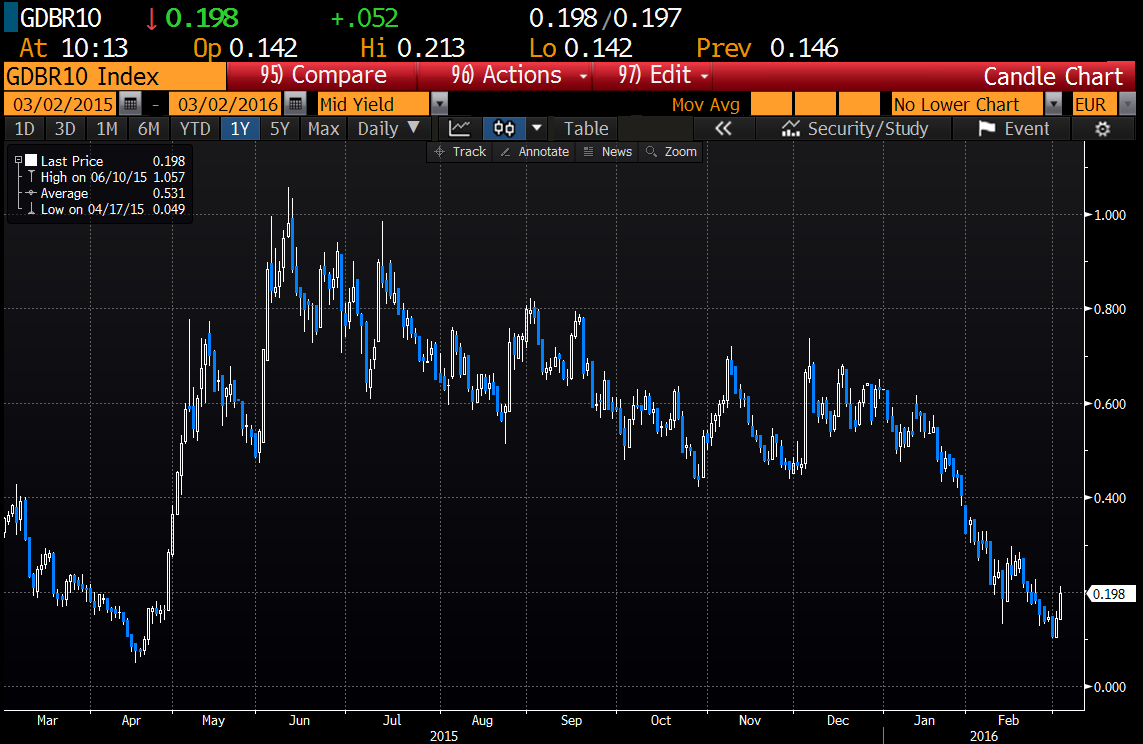
To put the current 1.85% 10 year yield in perspective: when the Fed hiked rates last December, the yield was 2.3%. That said, the fact that interest rates are falling globally will prevent Treasuries from falling too much. Note the German 10 year Bund is close to the sub 10 basis point lows of last spring, and currently yields 18 basis points. The Japanese Government 10 year bond yield is negative 5 basis points. Global investors look at Treasuries yielding more than Italian, Spanish, and Irish bonds and see relative attractiveness, especially since the US is about the only country not trying to devalue its currency. That should help keep a lid on rates. 

Chart: German Bund Yield


The collapse in global bond yields is sending a signal that the Fed isn't going to ignore - that deflation remains a threat. Janet Yellen has pledged to let the labor market "run hot" for a while and that means letting wage growth run. The big question is what happens to the labor force participation rate. If these workers come back, that will prevent too much wage inflation and will be ultimately better for the economy in the longer term. If they don't, then look for wage inflation to begin and the Fed to move earlier. 

Tuesday, October 6, 2015

Morning Report: TRID to delay closings

Vital Statistics:

Last Change Percent
S&P Futures  1973.7 -1.0 -0.05%
Eurostoxx Index 3212.5 22.1 0.69%
Oil (WTI) 46.68 0.4 0.91%
LIBOR 0.327 0.003 0.96%
US Dollar Index (DXY) 95.9 -0.207 -0.22%
10 Year Govt Bond Yield 2.07% 0.01%
Current Coupon Ginnie Mae TBA 104.8 -0.1
Current Coupon Fannie Mae TBA 104.4 0.0
BankRate 30 Year Fixed Rate Mortgage 3.84

Stocks are unchanged this morning as there is very little in the way of economic data / earnings to move markets. Bonds and MBS are down small.

The trade deficit widened to 48 billion in August as the strong dollar cuts exports and increases imports.

The IMF cut is global growth estimate to 3.1% from 3.3%. Blame weak commodity prices.

Economic Optimism improved markedly according to Investors Business Daily and TIPP Online. Many of these consumer confidence indices are merely inverse gasoline price indices. Falling gasoline prices makes people happy. 

Home prices rose almost 7% in August on a year-over-year basis, according to CoreLogic. They are forecasting home price appreciation around 4.3% over the next year. 

Bill Gross sees another 10% downside in stocks and is recommending sitting in cash for a while. His point is that corporate profits are flatlining as commodity prices hurt earnings in the energy patch and the strong dollar hurts manufacturers. Expect more layoffs in the energy sector. Bill Gross called the Chinese sell-off earlier this year as well as the German Bund sell off. 


TRID is expected to delay closings as people get adjusted to the new rules.  CFPB Chairman Richard Cordray says the agency will give lenders who are making good-faith efforts to comply with the new rules a break: "Nobody believes that market participants are going to be trying to abuse consumers here; they're trying to change their systems. So we'll be diagnostic and corrective, not punitive, and there will be time for them to work to get it right and not be perfect on the first day," said Cordray. We'll see if that actually happens. 

What to the French do well? Food, lifestyle, and labor strife. Propose job cuts and you are likely to get the shirt ripped off your back by an angry mob.

Monday, October 5, 2015

Morning Report: The markets and the Fed are on different pages

Vital Statistics:

Last Change Percent
S&P Futures  1957.3 14.2 0.73%
Eurostoxx Index 3192.0 103.8 3.36%
Oil (WTI) 46.1 0.6 1.23%
LIBOR 0.327 0.003 0.96%
US Dollar Index (DXY) 95.93 0.097 0.10%
10 Year Govt Bond Yield 2.01% 0.02%
Current Coupon Ginnie Mae TBA 104.9 -0.1
Current Coupon Fannie Mae TBA 104.5 0.0
BankRate 30 Year Fixed Rate Mortgage 3.88

Markets are higher this morning on overseas strength. Bonds and MBS are down.

The Labor Market Conditions Index fell from a downward-revised 1.2 to zero. This has been the average since 2000. 

The Markit US Composite PMI came in at 55, while the services PMI came in at 55.1. The ISM Non-Manufacturing Composite fell from 59 to 56.9. 

Aftermath of the weak jobs report on Friday: Fed fund futures assign a 10% probability of an Oct hike, 30% probability of a December hike and 50% probability of a March hike. The markets are increasingly out of sync with what the Fed members are actually saying in the press. Note we get the FOMC minutes this Thursday. That will be the highlight of the week. 

The Bernank weighs in on raising rates. His Rx: don't. Separately, DoubleLine's Jeffrey Gundlach thinks we have further downside in risk assets like junk bonds, US equities and emerging markets stocks and bonds. His point: people are holding and hoping these assets rebound. That isn't the psychology of a bottoming process. That happens when people throw in the towel and sell. 

It is looking like the Trans-Pacific Partnership free trade deal is pretty much done. It still has to get through Congress, although he did get fast-track approval. I suspect it won't move the needle that much for the US economically. It is mainly about intellectual property protection for US firms. 

Sometimes bad ideas get implemented, fail, become forgotten, and then come back, like Freddy Kreuger. One such idea is the financial transactions tax, also known as the Robin Hood tax. It is back in vogue in Europe, and Bernie Sander wants a 50 basis point tax on all stock trades, a 11 basis points on bonds and 5 on derivatives will be able to fund a slew of new government benefits. Don't believe it. While leftist politicians love to promote ideas like this as new, they aren't. They have been tried and discarded. Sweden implemented on in the 1980s, only to see most stock trading in Swedish stocks flee to London. The UK in fact did implement one for stock trades, and all it did was drive institutional investors to use swaps to sidestep it and retail investors to go to betting parlors like City Index. They will sell it as raising a lot of revenue - it won't simply because it will kill high frequency trading, and volume will dry up. They will sell it as reducing volatility - some (not all, but some) of HFT is actually market-making which is stabilizing. We don't really have market-makers or specialists on the floor of the New York Stock Exchange like we used to. You could make the argument that it will increase, not decrease volatility. Anyway, #FeelTheBern is big on this idea - he should take a look at how it has (not) worked in the past.