A place where economics, financial markets, and real estate intersect.
Showing posts with label JGB. Show all posts

Wednesday, August 29, 2018

Morning Report: Q2 GDP revised upward

Vital Statistics:


LastChange
S&P futures2899-1
Eurostoxx index385.810.35
Oil (WTI)69.080.55
10 year government bond yield2.88%
30 year fixed rate mortgage4.55%

Stocks are flat this morning after GDP came in better than expected. Bonds and MBS are down small. 

Mortgage Applications fell 1.7% last week as purchases fell 1% and refis fell 3%. This is despite a drop in rates. 

Second quarter GDP was revised upward to 4.2% from 4.1%, which was higher than the street estimate of 4.0%. The main revisions were to consumption (downward) and fixed residential investment (upward). Inventories were a drag on GDP, which means that we should see a bump to Q3's numbers. The GDP price index was also revised up a touch, from 1.8% to 1.9%. All of this provides a good environment for the Fed to ease back from the zero bound. 


Mortgage bankers made $580 per loan in the second quarter, an increase from $118 in the first quarter. Banks cut costs aggressively (dropping production costs per loan by about $1,000) however declining volumes offset that, and this turned out to be the weakest quarter since the MBA began keeping records in 2008. That $580 represents a profit of 21 basis points per loan, which was a drop form 24 bps a year ago. Fee income dropped to 341 bps from 370 in the first quarter. Refis continue to decline, with purchases accounting for 81% of all volume. 

Here is something wild. Last night, there were no trades in the JGB market (the world's second largest bond market). This is the 7th time this has happened this year. The Bank of Japan basically controls the market, and trading has dried up. We live in interesting times, at least if you are a central banker. 

Pending Home sales fell 0.7% in July, according to NAR. Lawrence Yun, NAR chief economist, says the housing market’s summer slowdown continued in July. “Contract signings inched backward once again last month, as declines in the South and West weighed down on overall activity,” he said. “It’s evident in recent months that many of the most overheated real estate markets – especially those out West – are starting to see a slight decline in home sales and slower price growth.” Blame tight supply, which has driven up prices to unaffordable levels. 

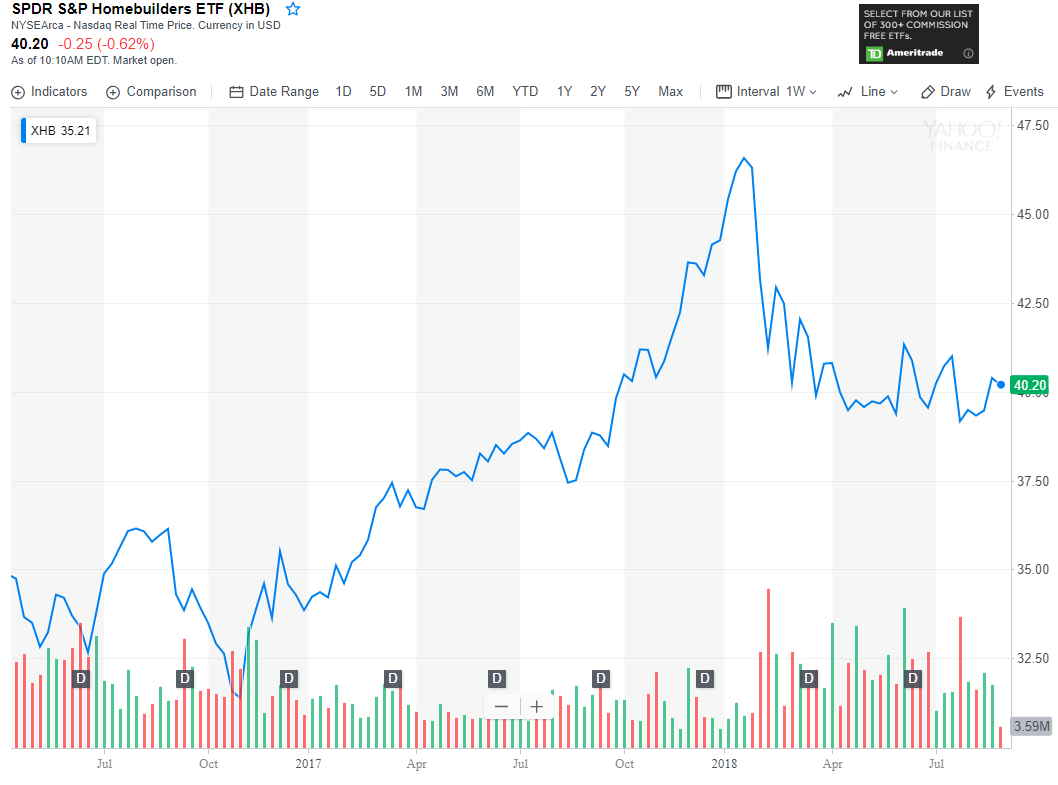
The housing slowdown has not been lost on the stocks of the homebuilders, who despite strong earnings (and an incredibly strong stock market) are down 14% YTD. At some point, the sector will be unable to rely on increasing ASPs and will have to pump up volume to show growth. Despite the clear need for new housing, especially at the starter level, builders seem content to meter their growth and plow excess cash into buybacks. 

Wednesday, March 2, 2016

Morning Report: Global yields continue to fall

Vital Statistics:

Last Change Percent
S&P Futures  1971.8 -6.1 -0.31%
Eurostoxx Index 3002.6 6.2 0.21%
Oil (WTI) 33.81 -0.6 -1.72%
LIBOR 0.633 -0.002 -0.31%
US Dollar Index (DXY) 98.48 0.129 0.13%
10 Year Govt Bond Yield 1.86% 0.04%
Current Coupon Ginnie Mae TBA 105.3
Current Coupon Fannie Mae TBA 104.5
BankRate 30 Year Fixed Rate Mortgage 3.81

Stocks are lower this morning after yesterday's strong rally. Bonds and MBS are down.

Mortgage Applications fell 4.8% last week as purchases fell 0.6% and refis fell 7.2%. 

The ADP Employment change came in stronger than expected at 214k jobs. The Street is forecasting an increase of 195k payrolls for Friday's jobs report. All of the activity was in the services sector, as the manufacturing sector lost about 9,000 jobs and the financial sector added only 8,000. 

Chart: ADP jobs 


The ISM New York Index fell slightly to 53.6

Donald Trump and Hillary Clinton were the big winners on Super Tuesday. You can probably stick a fork in Sanders at this point. For the GOP, the question is whether Donald Trump is a plurality winner or a majority winner. The establishment is hoping that once they coalesce around a single candidate, the numbers will swing to that candidate. If they go the brokered convention route, Trump will almost certainly run as an independent, which guarantees a Clinton landslide. 

Yesterday was a bloodbath in Treasuries, with the 10 year yield increasing about 9 basis points to 1.82%. The 2 year yield increased 7 basis points. If we see strong wage growth on Friday's jobs report, we could see further weakness in Treasuries. 

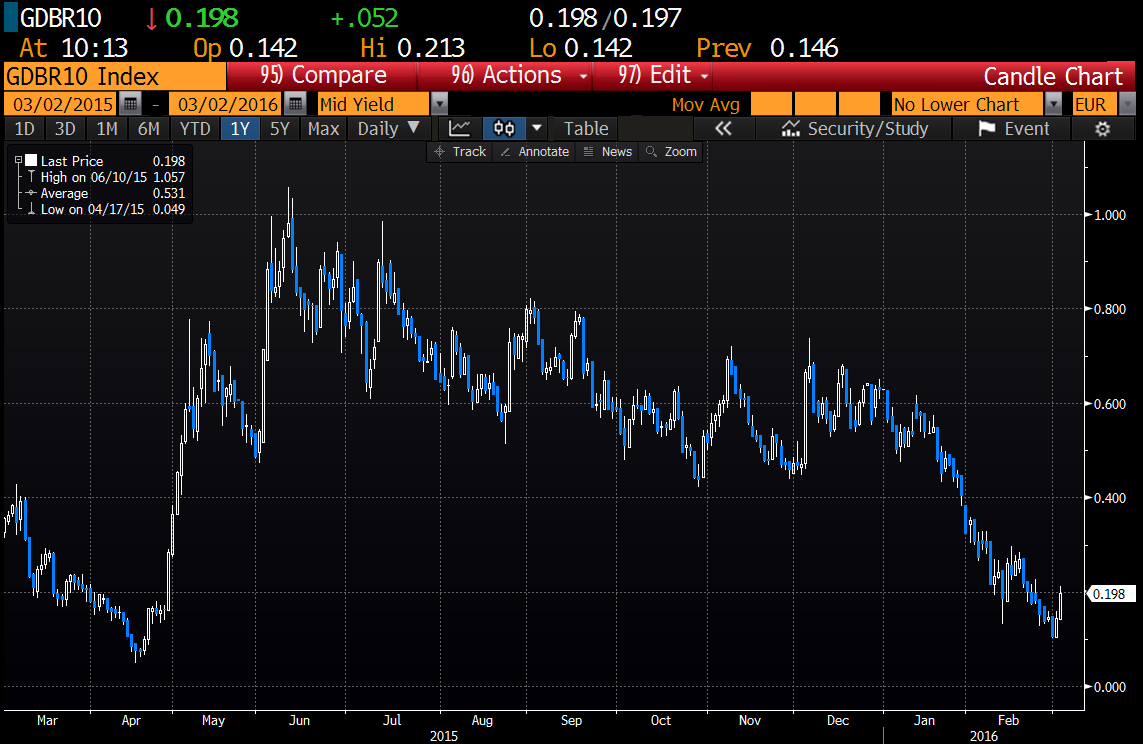
To put the current 1.85% 10 year yield in perspective: when the Fed hiked rates last December, the yield was 2.3%. That said, the fact that interest rates are falling globally will prevent Treasuries from falling too much. Note the German 10 year Bund is close to the sub 10 basis point lows of last spring, and currently yields 18 basis points. The Japanese Government 10 year bond yield is negative 5 basis points. Global investors look at Treasuries yielding more than Italian, Spanish, and Irish bonds and see relative attractiveness, especially since the US is about the only country not trying to devalue its currency. That should help keep a lid on rates. 

Chart: German Bund Yield


The collapse in global bond yields is sending a signal that the Fed isn't going to ignore - that deflation remains a threat. Janet Yellen has pledged to let the labor market "run hot" for a while and that means letting wage growth run. The big question is what happens to the labor force participation rate. If these workers come back, that will prevent too much wage inflation and will be ultimately better for the economy in the longer term. If they don't, then look for wage inflation to begin and the Fed to move earlier.