A place where economics, financial markets, and real estate intersect.
Showing posts with label MBA. Show all posts

Wednesday, August 29, 2018

Morning Report: Q2 GDP revised upward

Vital Statistics:


LastChange
S&P futures2899-1
Eurostoxx index385.810.35
Oil (WTI)69.080.55
10 year government bond yield2.88%
30 year fixed rate mortgage4.55%

Stocks are flat this morning after GDP came in better than expected. Bonds and MBS are down small. 

Mortgage Applications fell 1.7% last week as purchases fell 1% and refis fell 3%. This is despite a drop in rates. 

Second quarter GDP was revised upward to 4.2% from 4.1%, which was higher than the street estimate of 4.0%. The main revisions were to consumption (downward) and fixed residential investment (upward). Inventories were a drag on GDP, which means that we should see a bump to Q3's numbers. The GDP price index was also revised up a touch, from 1.8% to 1.9%. All of this provides a good environment for the Fed to ease back from the zero bound. 


Mortgage bankers made $580 per loan in the second quarter, an increase from $118 in the first quarter. Banks cut costs aggressively (dropping production costs per loan by about $1,000) however declining volumes offset that, and this turned out to be the weakest quarter since the MBA began keeping records in 2008. That $580 represents a profit of 21 basis points per loan, which was a drop form 24 bps a year ago. Fee income dropped to 341 bps from 370 in the first quarter. Refis continue to decline, with purchases accounting for 81% of all volume. 

Here is something wild. Last night, there were no trades in the JGB market (the world's second largest bond market). This is the 7th time this has happened this year. The Bank of Japan basically controls the market, and trading has dried up. We live in interesting times, at least if you are a central banker. 

Pending Home sales fell 0.7% in July, according to NAR. Lawrence Yun, NAR chief economist, says the housing market’s summer slowdown continued in July. “Contract signings inched backward once again last month, as declines in the South and West weighed down on overall activity,” he said. “It’s evident in recent months that many of the most overheated real estate markets – especially those out West – are starting to see a slight decline in home sales and slower price growth.” Blame tight supply, which has driven up prices to unaffordable levels. 

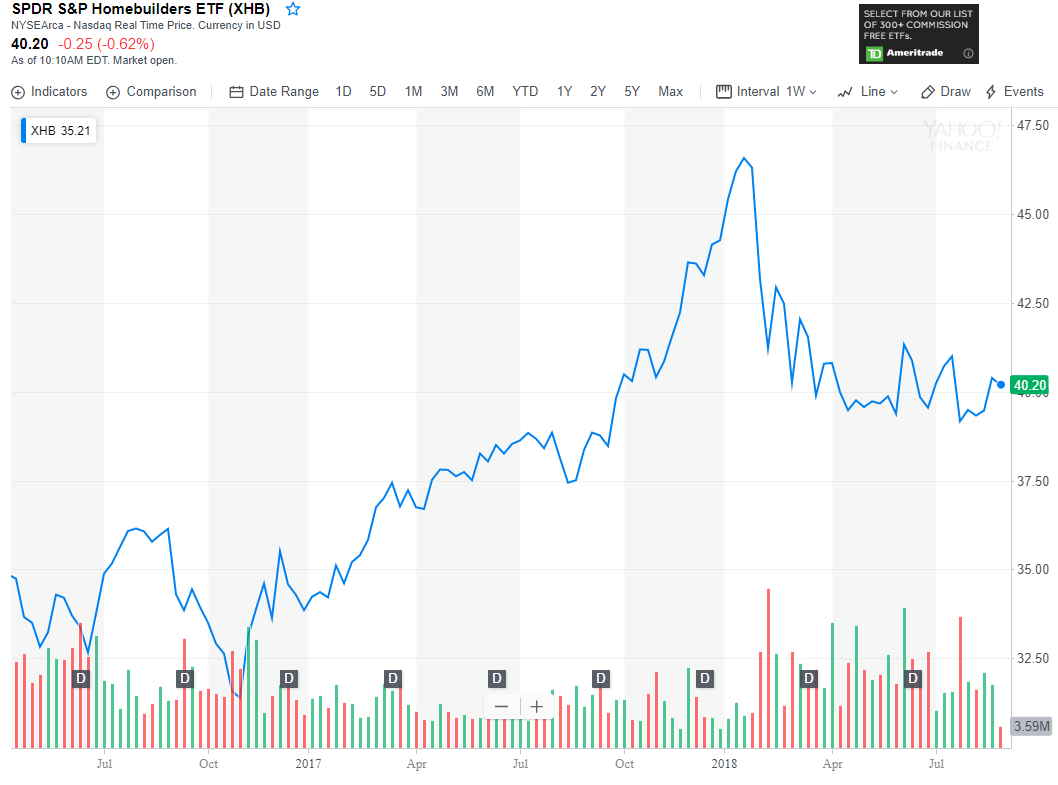
The housing slowdown has not been lost on the stocks of the homebuilders, who despite strong earnings (and an incredibly strong stock market) are down 14% YTD. At some point, the sector will be unable to rely on increasing ASPs and will have to pump up volume to show growth. Despite the clear need for new housing, especially at the starter level, builders seem content to meter their growth and plow excess cash into buybacks. 

Thursday, July 19, 2018

Morning Report: Leading Indicators show strong growth ahead

Vital Statistics:

Last Change
S&P futures 2808 -8.25
Eurostoxx index 386.86 -18
Oil (WTI) 68.23 -0.53
10 Year Government Bond Yield 2.87%
30 Year fixed rate mortgage 4.51%

Stocks are lower as earnings continue to come in. Bonds and MBS are down.

Initial Jobless Claims fell to 207,000 last week, which is the lowest level since 1969. Despite the tightness of the labor market, wage growth is tough to come by.

I have discussed at length the disconnect between the Northeast and the rest of the country when it comes to the real estate market. It turns out that not only does the real estate market lag, so does mortgage banking. Last year was a rough year for mortgage banking, and the typical profit per loan was about 31 basis points. That varied by region, with the Midwest in the lead at 39 basis points while the Northeast lagged at 8. 


The Fed's Beige Book characterized the economy as strong, and said that labor shortages are beginning to impede growth. Engineers, skilled construction workers, truck drivers, and IT professionals are in short supply. So far increasing input prices are not translating into higher inflation - corporate margins are taking the hit. Residential housing continues to improve ever so slowly, and commercial real estate is flat. Overall, the picture points to a strong economy, with room to run. The lack of pricing pressures gives the Fed the leeway to go slow as they get off the zero bound. 

The Conference Board echoed this assessment, with the Index of Leading Economic Indicators increasing 0.5% in June. The LEI is still rising faster than the CEI (basically the future indicators are showing that growth should accelerate) which means we have no sign of a slowdown.


Kathy Kraninger, the Administration's nominee to run the CFPB, will appear before the Senate Banking Committee today. Little is known about her views on financial regulation. Congressional aides have said that she will have enough support to pass the Committee on a party-line vote. In her prepared remarks, she said she will continue Mick Mulvaney's work of balancing the need for consumer protection with the need to treat the financial sector fairly. Suffice it to say, having come from OBM, she doesn't really fit the type of bureaucrat who would normally be tapped to run the CFPB, and that may be the point. If her nomination bogs down, Mick Mulvaney can continue to run the agency.

Interesting stat: 70% of the Millennials who own a home have buyer's remorse. Many used their retirement savings to fund the down payment, which is generally a bad move. Many first time home buyers completely underestimate closing costs as well. Others underestimated the costs of upkeep, which is around $16,000 a year. I suspect many of these lessons are learned by every generation who buys their first home. 

The CoreLogic Mortgage Fraud Risk Index rose 12% in the second quarter compared to a year ago. An increase in borrowers taking on loans for multiple properties (i.e more professional investors) appeared to drive the increase. 

Thursday, June 7, 2018

Morning Report: Changes afoot at the CFPB

Vital Statistics:

Last Change
S&P futures 2774 1.75
Eurostoxx index 386.72 -0.16
Oil (WTI) 65.25 0.52
10 Year Government Bond Yield 2.98%
30 Year fixed rate mortgage 4.58%

Stocks are higher this morning as trade tensions with China ease. Bonds and MBS are lower.

Initial Jobless Claims fell to 222k last week. We are still bouncing around lows that we haven't seen since the Vietnam War. 

Changes are afoot at the CFPB. First, Mick Mulvaney dismissed all 25 members of the Consumer Advisory Board in order to cut costs and increase the diversity of voices. The Community Bank Advisory Board and the Credit Union Advisory Board were also terminated. Apparently, these committees were traveling to DC on taxpayer expense. Many of these people are simply professional political activists in the business of raising money for liberal candidates, and were often given funds from settlements - in other words, it was a bit of a political money-laundering operation. So, there is no reason for an agency under a Republican Administration to fund the Democratic political machine. Also, the Obama / Cordray CFPB was one-sided - they listened only to consumer advocates and had zero interest in input from the industry. For better or worse, you make better policy when you have input from the people who will be affected by your rules and regulations. 

Separately, the CFPB is prepared to dismiss its case against PHH. The PHH case is a tricky one, where the CFPB unilaterally increased a judge's $6 million penalty to $106 million. PHH won a big victory last January when an appeals court threw out the judgement. There structure of the Agency was also brought into question during this case, which helps explain why the CFPB is anxious to make this case go away. 

Independent mortgage bankers lost money on average in the first quarter, according to the MBA. Net production losses were $118 per loan (or about 8 basis points). The last time we saw something similar was the first quarter in 2014. The first quarter is always a seasonally weak period.  Declining volumes, increasing costs, and thinner margins are driving the losses. Net secondary marketing income was more or less flat, and purchases accounted for 71% of the volume. Pull-through rates fell to 70% from 74% in the fourth quarter. Production expenses and personnel expenses increased quite a bit, to almost $9,000 a loan. That number has been closer to $6,200 since 2008. Productivity also fell to 1.9 loans per employee from 2 loans in the fourth quarter. 

Chinese money has been pushing up real estate prices in many cities, from Vancouver to Seattle, to Sydney. Local governments are finding more and more of their citizens are being priced out of the market and are trying to do something about it. In Vancouver, prices were appreciating at an annual rate of 30% before the government imposed a foreign investments tax. The money then left and moved to Toronto. Ultimately probably nothing will change until the Chinese real estate bubble bursts, and no one has any idea when that will happen. One thing is for sure, however. When the bubble does burst, these cities will get hit first. In a financial crisis, you sell what you can, not what you want to. 


Apparently the market cap of the FAANG stocks (Facebook, Amazon, Apple, Netflix, and Google) is now higher than the GDP of Germany. Most crowded trade since the Nifty 50 in the 1970s. 

Thursday, October 26, 2017

Morning Report: Pending Home Sales flat

Vital Statistics:

Last Change
S&P Futures  2561.8 3.3
Eurostoxx Index 389.7 2.5
Oil (WTI) 52.2 0.0
US dollar index 87.4 0.2
10 Year Govt Bond Yield 2.43%
Current Coupon Fannie Mae TBA 102.875
Current Coupon Ginnie Mae TBA 103.938
30 Year Fixed Rate Mortgage 3.93

Stocks are up this morning after yesterday's sell-off. Bonds and MBS are up on the ECB's decision to start tapering QE.

Initial Jobless Claims rose 10k to hit 233k last week. We are still at historically low levels.

Pending home sales were flat in September, according to NAR. The hurricanes in Florida and Texas did depress the number somewhat, but the same old story of low inventory is the real culprit. The Pending Home Sale Index is the lowest since early 2015. 

The House will vote on a budget for next year, which will set the stage for tax reform scheduled to be announced on November 1. As expected, the state and local tax deduction is the biggest bone of contention, with Northeast Republicans dead set against ending it. They are hoping to use the budget vote as leverage to keep the deduction in the tax plan, but they may end up having to wait to see what comes out of the Committee. 

Rising rents are becoming a burden for one in five renters, as the number of people looking to rent exceeds the supply of rentals out there. For people earning under 30,000, 28% were unable to make a full rental payment in the last 3 months. Affordable housing advocates will undoubtedly seize upon this number in order to push HUD to do more. 

The MBA is forecasting about a 5% drop in origination volume from 2017 to 2018 based on higher interest rates depressing refinancing opportunities. Refis will probably be driven by two effects going forward: home price appreciation and the flattening yield curve. As home prices appreciate, those that have FHA loans with MI may now have enough equity in their homes to refinance into a conventional loan with no MI, thus saving a lot of money. Second, 30 year fixed rate mortgages will become more attractive relative to ARMS as the yield curve flattens. These two effects will create refinance opportunities in a rising interest rate environment. That said, purchase activity will be driving things going forward.

The financial services industry had a small victory yesterday as the Senate overturned a rule from the CFPB allowing class-action suits for banks. The argument in favor of class action lawsuits say it is necessary to prevent bad behavior from the banks, while those against class action suits say that wronged customers make more in arbitration, since they save on legal fees. While the big banks are probably able to absorb the massive penalties from a class-action suit, the smaller ones probably cannot. This is a highly divisive issue, pitting two giant funding sources for both parties: the trial lawyer bar for Democrats, and the financial services industry for Republicans. The vote was 50-50 and Mike Pence had to cast the tiebreaking vote.

The BLS released its projection of the job market for the next 10 years. Suffice it to say, the trends we have been seeing over the past decades (decreased emphasis on manufacturing, increased emphasis on services, higher education requirements) will continue. Heath care employment is the growth area, while many manufacturing jobs are becoming obsolete. 

Thursday, August 3, 2017

Morning Report: MBA GSE reform plan shouldn't affect mortgage pricing much

Vital Statistics:

Last Change
S&P Futures  2472.5 -1.0
Eurostoxx Index 379.5 -0.2
Oil (WTI) 49.8 0.2
US dollar index 86.0 0.0
10 Year Govt Bond Yield 2.24%
Current Coupon Fannie Mae TBA 102.93
Current Coupon Ginnie Mae TBA 103.81
30 Year Fixed Rate Mortgage 3.94

Global stocks are lower after the Bank of England cut its growth forecast. Bonds and MBS are up. 

Initial Jobless Claims fell by 5,000 to 240,000 last week. Employers are holding on to their employees. Separately, Challenger and Gray reported that there were 28,307 announced job cuts in July, which is the lowest level since November last year. 80,000 hiring announcements were also made in July, which is the highest July reading on record. 

The ISM non-manufacturing index slipped in June, which appears largely driven by seasonal factors. 

Goldman Sachs alum Gary Cohn is reportedly the front-runner to replace Janet Yellen at the Fed when her term expires. He would be the first non-economist to run the Fed since the disastrous tenure of G. William Miller during the Carter Administration. 

Fannie Mae reported net income of $3.2 billion in the second quarter. It paid a $2.8 billion dividend to Treasury in June. Fannie is returning to its roots as well: "Fannie Mae has transitioned from a portfolio-focused business to a guaranty-focused business. Income from the company’s guaranty business accounted for more than 75 percent of the company’s net interest income in the first half of 2017. Fannie Mae expects net interest income from the company’s guaranty business to account for an increasing portion of net interest income as its retained mortgage portfolio continues to shrink." Fannie Mae drew $116B from Treasury during the crisis, and has paid $163B in dividends back. Those dividend payments have been used to shore up Obamacare. 

The MBA concludes that its plan for housing going forward will have little impact on consumer borrowing costs. Some of the proposals will lower costs, while others will increase costs. The biggest change would cement the explicit guarantee for GSE MBS by the government. This will push down rates and also increase demand, assuming that bank regulatory capital requirements will treat the new GSE MBS the same as GNMA MBS. In other words, banks can treat GNMA MBS as Treasuries and require no capital against them. FNMA MBS have a 20% hit. On the other side of the coin, there will be additional fees earmarked for affordable housing and possibly increased guaranty fees to protect the taxpayer. There will have to be a debate over how big the credit box will be, and affordable housing types will argue it should be bigger while taxpayer advocates will want it smaller. Overall, MBA thinks it will be a wash when it comes to mortgage pricing. 

Luxury home price appreciation outpaced the rest of the market for the first time since 2014, according to Redfin. Much of this was driven by homes being taken off the market. The average luxury home price was 1.79 million, which means we really are talking about the rarified top end of the market. The number of luxury homes on the market fell 9.4% YOY. 1.7% sold above list. The rest of the market averaged $336k and 26% traded above list. 

The debt ceiling is looming, and Mitch McConnell and Paul Ryan are advocating for a hike without spending cuts, which is sure to anger many in the GOP. 

10 years ago, the Jim Cramer rant that unofficially heralded the start of the financial crisis. 

Monday, April 17, 2017

Morning Report: Regulatory relief proposals

Vital Statistics:

Last Change
S&P Futures  2329.3 -1.8
Eurostoxx Index 380.6 -1.3
Oil (WTI) 52.8 -0.3
US dollar index 89.9
10 Year Govt Bond Yield 2.22%
Current Coupon Fannie Mae TBA 102.78
Current Coupon Ginnie Mae TBA 104
30 Year Fixed Rate Mortgage 3.98

Stock futures are largely flat this morning as many overseas investors are on holiday. Bonds and MBS are flat as well. 

Bond yields have broken decisively to the downside over the past week as international tensions escalate. North Korea's failed missile launch, combined with developments in Syria have sent bonds and gold higher. The 10 year yield is at the lowest level since mid-November. 

While international tensions have certainly played a part in the bond rally, weak retail sales and inflation data have as well. The Fed Funds futures are now factoring a less-than-50% probability of a June rate hike, down from a 2/3 probability only a week ago. 

Business conditions softened in New York State last month after the Empire State Manufacturing Survey fell after two unusually strong months. We are starting to see bottlenecks in the supply chain. Employment rose.

Homebuilder sentiment slipped slightly in April, however sentiment remains strong. 

Jamie Dimon of JP Morgan took aim at regulations in his annual letter to stockholders. He was especially critical of the FHA's use of the False Claims Act to hammer lenders who commit unintentional clerical errors but had no intention of committing fraud. This has caused FHA lending (which is the only game in town for subprime borrowers) to become restricted, especially at the big banks. He also called for new uniform standards for mortgage servicing. The cost of servicing delinquent loans has skyrocketed, and this has caused lenders to further restrict credit. JPM estimates that $1 trillion in additional lending could have increased GDP by half a percentage point. 

Rep David Kustoff penned an editorial at CNBC calling for a reform of Dodd-Frank, especially in how it affects smaller community banks. The regulatory burden that was imposed on the system is more easily borne by the JP Morgans and the Wells Fargos of the world than it is by the smaller banks who are the lenders to small business. There is a general bipartisan consensus in DC that something needs to be done to give the smaller lenders some relief, however the political environment is so entrenched and partisan that it is hard to imagine much getting done legislatively. 

The MBA sent its proposals to the Senate. The first one includes a request for more clarity from the CFPB, while the second includes a suggestion to widen the QM safe harbor to all loans that satisfy the QM rule and to increase the ceiling for small loan status under QM to $200k from just over $100k now. The remainder of the suggestions largely concern capital requirements for banks and servicing.

Median house prices rose 7.5% to $273,000 according to RedFin. Sales growth was also up a strong 8.9%. Inventories were down 13%, however. The typical home went under contract within 49 days, which is pretty fast for a March. The average sale to list price was 93.7%, which was a decrease. Perhaps the bidding wars in the hottest markets are cooling off a bit. Note this statement by a real estate agent: 

“As a seller’s agent, the first thing I do when I receive an offer is ask who the lender is. The best offers come from buyers who are pre-approved by a local lender with a strong reputation for speed and reliability. If I’ve worked with the lender before and know they can fund the loan and close on time, I am sure to highlight that for my client.” — Tiffany Aquino, Redfin Agent in Woodbridge, VA

The Fed is assembling its plan to shrink its portfolio of Treasuries and mortgage backed securities, and may actually begin the process this year. The Fed currently owns just under $2 trillion in mortgage backed securities, and we could see that number cut in half over the next decade, according to a paper released in January. The big question for MBS holders is whether they will stop reinvesting maturing proceeds all at once or whether they will phase that in. Given that QE didn't materially affect MBS spreads when it was implemented, it is hard to imaging tapering re-investments will make much of a difference either. 

Wednesday, December 14, 2016

Morning Report: FOMC day: what to watch

Vital Statistics:

Last Change
S&P Futures  2264.8 -3.0
Eurostoxx Index 345.1 -1.4
Oil (WTI) 52.2 -0.8
US dollar index 91.3 -0.1
10 Year Govt Bond Yield 2.44%
Current Coupon Fannie Mae TBA 103
Current Coupon Ginnie Mae TBA 104
30 Year Fixed Rate Mortgage 4.13

Markets are flat this morning as we await the FOMC decision at 2:00 pm EST. Bonds and MBS are up. 

What to look for in the Fed statement: The biggest thing to watch will be the dot plot, which shows the forecasts that various members have for the Federal Funds rate. This is different than the 10 year, which determines mortgage rates. Market participants will compare the September 2016 dot plot with the December 2016 one and look for a shift in the general trend, either up or steepening. 

Generally speaking the dot plots have been heading downward over the past several years as the Fed has been consistently high in its estimate for GDP growth. If the new dot plot is more aggressive (say it predicts 3 hikes for 2017, when before it was 2 hikes, then you could see a bond sell-off, which would send rates higher. 

Janet Yellen will have a press conference at 2:30, and will probably do her best to dodge questions about Trump and his influence on the economy. 


Retail Sales for November disappointed this morning, with the headline number up 0.1% and the core number (ex autos and gas) up 0.2%. November retail sales can be noisy, as more and more shoppers procrastinate. Still, this goes along with the weak Redbook same store sales number yesterday.

Inflation at the wholesale level is on the upswing, according to the Producer Price index. The PPI rose 0.4% MOM and is up 1.3% YOY. The core index is up 0.2% MOM and 1.8% YOY. Inflation remains below the Fed's target which gives them the room to go slowly with rate hikes. 

Mortgage Applications fell 4% last week as purchases fell 3% and refis fell 4%. 

First time homebuyers face a shortage of real estate going into 2017, according to Redfin. For starter homes, the problem is acute. Over the past year, prices have risen 7.5% as inventory fell 12%. This increased the percent of income needed to buy a median home in that segment to 38.5%, an increase of about 2 percentage points. They are hopeful that the bottom is in with respect to tight inventory, however some of that will depend on regulatory policies of the new administration. On the plus side, credit will probably ease a bit as the financial system gets more clarity on regulation. On the negative side, immigration limits will exacerbate the construction labor shortage we currently are experiencing.

Wednesday, August 10, 2016

Morning Report: Job openings flat

Vital Statistics:

Last Change
S&P Futures  2180.0 3.0
Eurostoxx Index 344.3 4.0
Oil (WTI) 42.6 -0.2
US dollar index 86.0 -0.2
10 Year Govt Bond Yield 1.51%
Current Coupon Fannie Mae TBA 103.8
Current Coupon Ginnie Mae TBA 105.2
30 Year Fixed Rate Mortgage 3.52

Markets are up this morning on no real news. Bonds and MBS are rallying

Bond markets worldwide are rallying after the Bank of England tried to buy Gilts as part of its QE program and had a tough time finding sellers. 

Mortgage applications rose 7% last week as purchases rose 3% and refis rose 10%. 

Job openings were unchanged in June, at 5.6 million. The quits rate at 2% was more or less unchanged. This number is the tell for a strengthening labor market. 

The bond market has given back the losses from the strong payrolls report last Friday. The Fed Funds futures markets are pricing in a 45% chance of another rate hike this year. Meanwhile, global bond yields continue to fall, with the German Bund at -9 basis points. 

Affordable starter homes are becoming scarce in many parts of the country. We are seeing bidding wars in the hotter markets. Low housing starts are playing a factor here, and government regulation is a big driver of that. Mandates that increase the cost of construction make starter homes too expensive for an entry-level income. 

Technology is helping drive down realtor commissions, according to Redfin. Of course Redfin is talking its own book, however many sellers are foregoing the use of an agent, especially at the higher price points, which makes sense. 

Wednesday, May 23, 2012

Morning Report

Vital Statistics

Last Change Percent
S&P Futures  1305.2 -9.6 -0.73%
Eurostoxx Index 2148.5 -44.3 -2.02%
Oil (WTI) 91.15 -0.7 -0.76%
LIBOR 0.467 0.000 0.00%
US Dollar Index (DXY) 81.71 0.218 0.27%
10 Year Govt Bond Yield 1.74% -0.03%
RPX Composite Real Estate Index 176.2 0.6


Markets are lower this morning on GREXIT (Greek exit) fears and a lousy earnings report from Dell. Euro sovereign yields are generally lower, with the exception of Greece which is 22 basis points higher and approaching 30%. Remember, this is the post-reorg debt that is trading here. Their debt was trading around 35% before Greece did their restructuring about 10 weeks ago. The stress in Europe is pushing down bond yields here and MBS are up as well.

While the migration to tablets is hurting Dell, they also noted corporations are delaying spending.  Is it because IT spending is slowing in general, or is it that corporations have learned not to beta-test Microsoft operating systems (in this case Windows 8)?

The Congressional Budget Office weighs in on Taxmageddon. Punch line: The budget deficit will drop by $560 billion, and real GDP growth will be .5%, with a contraction of 1.3% in 1H and an expansion of 2.3% in 2H. Remember the government operates on a Sep fiscal, so they are predicting recession in the Sep 12 - Mar 13 time period. If we cancel the tax increases and spending cuts, CBO estimates that real GDP growth would be about 4.4% in real (not nominal) terms in CY13. That is an aggressive (with a capital "A") forecast.

DealBook has an interesting article on the possible unintended consequences of breaking up the big banks.

In other news, the NAR has declared the housing recovery to be underway. The MBA reported that mortgage applications increased 3.8% last week. New home sales in April were 343k, an increase of 3.3% MOM. The FHFA House Price index showed an increase of .55% QOQ and .5% YOY.  This is the first increase since early 2007.  Remember the FHFA index only looks at conforming loans, which is more of the "core" housing market.  It has proven to be a much less volatile index than Case-Schiller or RPX.

Chart:  FHFA House Price Index: