A place where economics, financial markets, and real estate intersect.
Showing posts with label Mick Mulvaney. Show all posts

Thursday, June 7, 2018

Morning Report: Changes afoot at the CFPB

Vital Statistics:

Last Change
S&P futures 2774 1.75
Eurostoxx index 386.72 -0.16
Oil (WTI) 65.25 0.52
10 Year Government Bond Yield 2.98%
30 Year fixed rate mortgage 4.58%

Stocks are higher this morning as trade tensions with China ease. Bonds and MBS are lower.

Initial Jobless Claims fell to 222k last week. We are still bouncing around lows that we haven't seen since the Vietnam War. 

Changes are afoot at the CFPB. First, Mick Mulvaney dismissed all 25 members of the Consumer Advisory Board in order to cut costs and increase the diversity of voices. The Community Bank Advisory Board and the Credit Union Advisory Board were also terminated. Apparently, these committees were traveling to DC on taxpayer expense. Many of these people are simply professional political activists in the business of raising money for liberal candidates, and were often given funds from settlements - in other words, it was a bit of a political money-laundering operation. So, there is no reason for an agency under a Republican Administration to fund the Democratic political machine. Also, the Obama / Cordray CFPB was one-sided - they listened only to consumer advocates and had zero interest in input from the industry. For better or worse, you make better policy when you have input from the people who will be affected by your rules and regulations. 

Separately, the CFPB is prepared to dismiss its case against PHH. The PHH case is a tricky one, where the CFPB unilaterally increased a judge's $6 million penalty to $106 million. PHH won a big victory last January when an appeals court threw out the judgement. There structure of the Agency was also brought into question during this case, which helps explain why the CFPB is anxious to make this case go away. 

Independent mortgage bankers lost money on average in the first quarter, according to the MBA. Net production losses were $118 per loan (or about 8 basis points). The last time we saw something similar was the first quarter in 2014. The first quarter is always a seasonally weak period.  Declining volumes, increasing costs, and thinner margins are driving the losses. Net secondary marketing income was more or less flat, and purchases accounted for 71% of the volume. Pull-through rates fell to 70% from 74% in the fourth quarter. Production expenses and personnel expenses increased quite a bit, to almost $9,000 a loan. That number has been closer to $6,200 since 2008. Productivity also fell to 1.9 loans per employee from 2 loans in the fourth quarter. 

Chinese money has been pushing up real estate prices in many cities, from Vancouver to Seattle, to Sydney. Local governments are finding more and more of their citizens are being priced out of the market and are trying to do something about it. In Vancouver, prices were appreciating at an annual rate of 30% before the government imposed a foreign investments tax. The money then left and moved to Toronto. Ultimately probably nothing will change until the Chinese real estate bubble bursts, and no one has any idea when that will happen. One thing is for sure, however. When the bubble does burst, these cities will get hit first. In a financial crisis, you sell what you can, not what you want to. 


Apparently the market cap of the FAANG stocks (Facebook, Amazon, Apple, Netflix, and Google) is now higher than the GDP of Germany. Most crowded trade since the Nifty 50 in the 1970s. 

Wednesday, May 2, 2018

Morning Report: Awaiting the FOMC

Vital Statistics:

Last Change
S&P futures 2652 0.25
Eurostoxx index 387.17 2.14
Oil (WTI) 67.45 0.19
10 Year Government Bond Yield 2.99%
30 Year fixed rate mortgage 4.55%

Stocks are flat as we await the FOMC decision. Bonds and MBS are down small. 

Mortgage Applications fell 2.5% last week as purchases fell 2% and refis fell 4%. 

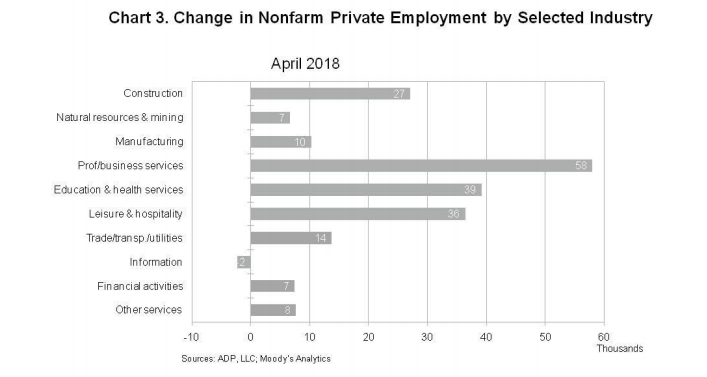
The economy added 204,000 jobs last month according to the ADP Employment Report. This was higher than expectations and is above the Street estimate for Friday's jobs report. Medium sized firms (50-500 employees) added the most jobs, and Professional and Business Services sector had the most growth. Construction added a lot of jobs as well. 


The FOMC announcement is scheduled for 2:00 pm EST today. No changes in rates are expected, but investors will be looking to see if the Fed changes its language about inflation running below target. The latest PCE index came in at 2%, which is the Fed's target. The second-order question will be to see whether the Fed changes their 2% rate from a symmetric target to a ceiling. The most likely outcome will be a "steady as she goes" statement and any changes will be communicated at the June meeting with a fresh set of economic forecasts. Today's announcement should be a nonevent. 

The Fed Funds futures are predicting a 6% chance of a hike at the May meeting and a 94% chance of a 25 basis point hike at the June meeting. 

The labor shortage is so acute in the Rust Belt that some towns are paying people to move there. Most of these small towns have a major demographic problem - younger workers moved to the cities in response to the Great Recession, leaving only the older workers who are now retiring. The fear is that labor shortages will prompt employers to leave, which will create a downward spiral.

Consumer advocates worry that Mick Mulvaney is not going to blow up the CFPB, but will neuter it with a thousand cuts. That said, the rhetoric from the left is a bit overblown. Mick Mulvaney said: “When I took over, we had roughly 26 lawsuits ongoing,” he told the House Appropriations Committee on April 18. “I dismissed one, because the other 25 I thought were pretty good lawsuits.”

Wednesday, April 25, 2018

Morning Report: Markets sell off as 10 year breaches 3% level

Vital Statistics:

Last Change
S&P futures 2626.5 -9
Eurostoxx index 379.58 -3.53
Oil (WTI) 67.53 -0.22
10 Year Government Bond Yield 3.02%
30 Year fixed rate mortgage 4.59%

Stocks are lower this morning after yesterday's interest rate-driven sell-off. Bonds and MBS are down.

The 10 year breached the 3% mark yesterday, which served as a catalyst for a substantial stock market sell-off. Of course 3% is just a round number, but it is the highest rate since 2014. Some pros are looking for a global slowdown in the economy, which could make some corporate borrowers vulnerable. We certainly appear to be in the late stages of a credit cycle. Junk-rated bond issuance has been on a tear over the past few years, reaching $3 trillion as yield-starved investors have had to reach into the lower credits to make their return bogeys. That said, corporate bond spreads are still at historical lows, (investment grade spreads are still half of what they were as recently as early 2016. Let's also not forget that much of the bond issuance over the past 8 years went to refinance old debt at higher interest rates - in other words it was a net positive for these companies. 

We are now going to see just how much of the huge rally in financial assets over the last decade was due to the inordinate amount of stimulus coming out of the Fed. As stocks now have to compete with Treasuries, some changes in asset allocations are to be expected and the riskier assets are going to bear the brunt of the selling. Keep things in perspective, however. Interest rate cycles are measured in generations. 


One of the benefits of QE has been to goose asset prices (which was kind of the whole point). Increasing people's net worth would increase spending and therefore increase GDP. It probably worked, however that hasn't been costless. One of the problems with increasing real estate prices is that it shuts people out from places where there is opportunity (California in particular). If you already own property in CA and have been experiencing torrid home price appreciation, you can move since your increased home equity can be used to purchase another expensive property. But if you live in the Midwest were home price appreciation has been less, you might not be able to take that job in San Francisco since you can't afford to live there. That said, negative equity was probably a bigger problem and home price appreciation did mitigate that issue. 

Mortgage Applications fell 0.2% last week as purchases were flat and refis were down 0.3%. Conforming rates increased 6 basis points, while government rates increased 1. ARMs decreased to 6% of total applications. A flattening yield curve makes ARMs less and less attractive relative to 30 year fixed mortgages.  

Acting CFPB Director Mick Mulvaney has made some changes at the Bureau. First, he is ending the pursuit of auto lenders, which Dodd-Frank prohibited. The Cordray CFPB did an end-around by going after the big banks behind some of the auto financing, and that will end. Second, Mulvaney will no longer make public the complaint database against financial services companies, saying that “I don’t see anything in here that I have to run a Yelp for financial services sponsored by the federal government.” Finally, he plans to change the name from the CFPB to the BCFP. All of this is in keeping with Mulvaney's commitment to follow the law and go no further. 


Friday, April 13, 2018

Morning Report: Wells reports flat YOY growth in origination

Vital Statistics:

Last Change
S&P futures 2676 12.5
Eurostoxx index 380.54 1.72
Oil (WTI) 66.97 -0.24
10 Year Government Bond Yield 2.83%
30 Year fixed rate mortgage 4.42%

Stocks are higher after it looks like cooler heads are prevailing in a trade war with China. Bonds and MBS are down. 

Donald Trump told his aides to explore re-joining the Trans-Pacific Partnership trade deal after withdrawing early in his administration. Does this mean "re-negotiate?" Unclear, but that would encounter heavy resistance. Still, it is better than throwing around tariff threats. Markets are breathing a sigh of relief. 

Job openings were little changed at 6.1 million in February. They are up almost 8% YOY however. The quits rate was stuck at 2.2%. The quits rate is a metric the Fed invariably mentions in their analysis of the job market and wage inflation. A higher quits rate usually presages wage inflation. Construction and manufacturing had big increases in openings. 

Consumer sentiment slipped in the preliminary April reading. Market volatility could be driving it, however higher gas prices could be playing a role as well. 

Acting CFPB Head Mick Mulvaney appeared before the Senate Banking Committee yesterday, and noted that Dodd-Frank only requires him to appear, not answer questions. Jeb Hensarling made a crack about the Chairman could sit and play Candy Crush in front of Congress if he wanted to. Mulvaney did answer questions, however he was making a point about how little accountability the agency has, and perhaps a point from his memo earlier - that the CFPB would follow the law, but go no further. The big question for the CFPB is the status of the PHH case. If that goes to SCOTUS, the only one that has standing to defend the agency is the Administration. 

Wells Fargo reported earnings, and it looks like they have been affected less by higher rates than other independent bankers. Mortgage origination was down 19% QOQ, which is simply seasonality at work, but they were only down 2% YOY. As you would expect, the purchase business is a higher percentage, and it looks like they were able to maintain flat YOY growth by getting more aggressive in the correspondent channel. The price of that was a sizeable drop in margins - 31 basis points. 

JP Morgan saw a more typical drop, with originations down 19% YOY. The servicing portfolio fell as well. Citi reported better earnings on equity trading. 

Californians may get to vote for a divorce from each other - to separate the state into 3 separate ones. One will contain the coast between LA and SF, another will be Northern CA, and the other will be Southern CA. As of now, LA and SF basically control the whole state, and there is a big conflict between the coastal environmental types and the farmers who supply something like half of the US's agricultural output. Still, given that Democrats control the state and the ag belt will probably vote R, this probably isn't happening. 


Thursday, April 12, 2018

Morning Report: Minutes offer clues why the Fed keeps missing on inflation

Vital Statistics:

Last Change
S&P futures 2355.5 14.5
Eurostoxx index 377.42 1.23
Oil (WTI) 66.58 -0.24
10 Year Government Bond Yield 2.80%
30 Year fixed rate mortgage 4.39%

Stocks are rising this morning on no real news. Bonds and MBS are down. 

While investors are still worried about conflict in Syria, things seem to be settling down somewhat as Russia seemed to cool their rhetoric and Trump backed off from suggesting an attack was imminent. Call it WWE diplomacy: lots of trash-talking outside the ring, which often leads nowhere. 

The last of the 3 inflation indicators this week came in lower than expected. Import prices were flat month-over-month and rose 3.6% YOY. Import prices are driven by the currency and commodity prices, so the Fed tends to de-emphasize them.  

Initial Jobless Claims fell to 233,000 last week. The labor market continues to shrug off the volatility in the markets. 

The FOMC minutes didn't really reveal much we don't already know, however one statement stuck out. On the labor market, they mentioned that the labor force participation rate was stronger than they had expected. That is interesting because the conventional wisdom in the markets and Washington is that the labor force participation rate is too low. The implications of that view - that the labor force participation rate should be lower - means that their inflation forecasts going forward might be too high. They are forecasting the unemployment rate to fall lower, which would in theory trigger more wage inflation (companies fighting for fewer workers), and push the Fed to hike rates faster in response. If they are getting the forecasts wrong for the labor force participation rate, it means that (a) they have more room to let the economy run, and (b) the longer-term growth rate of the economy is higher. This is good news. Perhaps it is a realization that fewer people are retiring at 65, and many of those longer-term unemployed are returning to the labor force. The labor force participation rate acts as sort of a speed limit for the economy. As it rises, the speed limit rises as well. 

With regard to trade, this is what they had to say: "Participants did not see the steel and aluminum tariffs, by themselves, as likely to have a significant effect on the national economic outlook, but a strong majority of participants viewed the prospect of retaliatory trade actions by other countries, as well as other issues and uncertainties associated with trade policies, as downside risks for the U.S. economy." In other words, the trade war has to really escalate for it to register economically. 

Mick Mulvaney laid out his vision for the CFPB in his semiannual testimony to Congress yesterday. His prepared remarks are here. As he alluded to earlier, things are changing: "The Bureau is going about its work in several new ways. First, to execute the new mission, the Bureau will continue to seek the counsel of others and make decisions only after weighing relevant available evidence and a full range of perspectives. Second, the Bureau will protect the legal rights of all, equally. And third, we will do what is right with confidence, acting with humility and moderation." On enforcement, he said: In another change, the Bureau practice of “regulation by enforcement” has ceased. The Bureau will continue to enforce the law. That is our job, and we take it seriously. However, people will know what the rules are before the Bureau accuses them of breaking those rules. Finally, he stated that the CFPB will review the Home Mortgage Disclosure Act and recommend changes.

CoreLogic notes that we have yet to see any effects of the new tax regime on home price appreciation. It is still early, however. That said, we do have a lot of inventory at the higher price points - probably most of it was driven by building decisions over the past several years - however tax reform is certainly not helping, at least in the high price / high tax MSAs. 

Thursday, January 25, 2018

Morning Report: New Sheriff in Town at the CFPB

Vital Statistics:

Last Change
S&P Futures  2850.3 9.0
Eurostoxx Index 401.9 1.1
Oil (WTI) 66.5 0.8
US dollar index 82.9 -0.4
10 Year Govt Bond Yield 2.65%
Current Coupon Fannie Mae TBA 103.591
Current Coupon Ginnie Mae TBA 103.688
30 Year Fixed Rate Mortgage 4.17

Stocks are higher after the European Central Bank left rates unchanged. Bonds and MBS are flat as well.

The German Bund is getting pounded on the ECB decision. At some point the weakness will probably flow through to Treasuries.

Treasury Secretary Steve Mnuchin noted that a weaker dollar is beneficial for trade and opportunities. He was peppered with questions over whether that amounts to a change from the government's historical support for a stronger dollar. He later clarified his remarks, however the currency is getting hit a little on the remarks and persistent dollar weakness will eventually translate into higher rates.

Mortgage Applications increased 4.5% last week as purchases rose 6% and refis rose 1%. These numbers are adjusted for the MLK holiday. Note that the Spring Selling Season is just around the corner - it unofficially starts right around Super Bowl Sunday.

New Home Sales fell to 625k in December a drop from November's downward-revised 679k print. November's number was an outlier and was sure to be revised down, which probably explains why the estimates were too high.

The Index of Leading Economic Indicators improved to 0.6% from 0.5%.

Initial Jobless Claims rose to 233k from a downward-revised 216k the week before. The last time the US hit 216k initial filings, we had a military draft.

House prices rose 0.4% month-over-month and 6.5% YOY according to the FHFA House Price Index. As usual, the West Coast and Mountain States led while the Northeast / Mid-Atlantic lagged.

Existing Home Sales fell 3.6% MOM in December and are up 1.1% YOY, according to NAR. Inventory for sale fell 10.3% to under 1.5 million units which is a record low. (going back to 1999) 1.5 million units represents only 3.2 months' worth at the current sales pace. A balanced market is about 6.5 months. The median home price rose 5.8% to $246,800. The first-time homebuyer was 32% of sales, flat YOY.

Median income in the US probably came in around 60k for the end of 2017. This would put the median house price to median income ratio at 4.1 times. Historically, that number has been in the 3.1 - 3.6 range, however differences in interest rates probably explain some of that. Given the tightness in inventory and what appears to be the stirrings of wage growth, house prices should be in for another strong year. The wild card will be the luxury properties in high tax states which are becoming less affordable due to tax reform. Note that luxury home prices did rise 7% in Q4, according to Redfin.

The Home Despot is not living up to its name. $1,000 bonuses for employees.

Many loan officers have noticed that FHA and VA pricing has been terrible as of late, especially when compared to conventional rates. This is an industry-wide phenomenon. Nobody really has a good explanation of why this is happening, although it is being driven by a lack of investor appetite for higher coupon Ginnie Mae TBAs. As a general rule, Ginnie Mae TBAs are more sensitive to rate changes than Fannie Mae TBAs, so any increase in volatility will affect Ginnies disproportionately. This is especially strange since the government has taken steps to protect MBS investors from serial refinancings. Whatever the cause, the pricing is being driven by the machinations of the primary TBA market and not internal pricing changes.

Mick Mulvaney, Acting Director at the CFPB, put out a memo to staff recently giving his philosophy going forward. Suffice it to say, he will not be another Richard Cordray. It is worth reading in its entirety, as it largely amounts to a rebuke of his predecessor. Richard Cordray was quoted in Politico saying : “We wanted to send a message: There’s a new cop on the beat… Pushing the envelope is a loaded phrase, but that’s absolutely what we did.” Mulvaney's response: "Simply put: that is what is going to be different. In fact, that entire governing philosophy of pushing the envelope frightens me a little. I would hope it would bother you as well. We are government employees. We don’t just work for the government, we work for the people. And that means everyone: those who use credit cards, and those who provide those cards; those who take loans, and those who make them; those who buy cars, and those who sell them. All of those people are part of what makes this country great. And all of them deserve to be treated fairly by their government. There is a reason that Lady Justice wears a blindfold and carries a balance, along with her sword."

Other key points:

"When it comes to enforcement, we will be focusing on quantifiable and unavoidable harm to the consumer. If we find that it exists, you can count on us to vigorously pursue the appropriate remedies. If it doesn’t, we won’t go looking for excuses to bring lawsuits."

"On regulation, it seems that the people we regulate should have the right to know what the rules are before being charged with breaking them. This means more formal rulemaking on which financial institutions can rely, and less regulation by enforcement."

"Speaking of data: the Dodd Frank Act requires us to “consider the potential costs and benefits to consumers and covered persons.” To me, that means quantitative analysis. And while qualitative analysis certainly can play a role, it should not be to the exclusion of measurable “costs and benefits.” In other words: there is a lot more math in our future."

Friday, November 17, 2017

Morning Report: Housing starts improve

Vital Statistics:

Last Change
S&P Futures  2584.5 -0.5
Eurostoxx Index 384.3 -0.6
Oil (WTI) 56.0 0.9
US dollar index 87.3 -0.1
10 Year Govt Bond Yield 2.37%
Current Coupon Fannie Mae TBA 102.651
Current Coupon Ginnie Mae TBA 103.494
30 Year Fixed Rate Mortgage 3.9

Stocks are flat this morning on no real news. Bonds and MBS are down small. 

Housing starts came in just shy of 1.3 million, the highest print in a year. This is up 14% from last month, but down 3% from a year ago. Building Permits came in at 1.3 million as well. Both numbers were driven by a big jump in multi-family, while single-fam continues to gradually move higher. We are still below historical numbers: From the late 50s through 2002, starts averaged 1.5 million a year. When you factor in population growth, that average is way too low for today. We probably should be pushing 2MM a year in order to keep up with population growth and to fix the inventory problem. 

The House passed tax reform yesterday, and now all eyes turn to the Senate, where the latest bill made it out of Committee and is scheduled for a vote after the Thanksgiving holiday. Then begins the hard work of reconciling the House and Senate versions. The Senate bill has some high profile opposition, which makes passage difficult. This is still a very fluid situation. 

Donald Trump will nominate OMB Chairman Mick Mulvaney to be the interim head of the CFPB. Mulvaney is a reliable conservative, who has a healthy skepticism of government regulation. He is expected to name another Chairman or Committee to run it, while he maintains his focus on OMB. Names mooted for the role include George Mason University professor Todd Zwyicki and ex-Congressman Neugebauer. 

A study concludes that homeownership doesn't increase wealth as much as renting and investing the savings in the stock market. The critical part of the argument is investing the savings in the stock market. I haven't read the study, but I wonder if they are using absolute house prices instead of what you actually put up. If the house appreciates 5% a year, and you only put down 20%, what is the best number for determining your return? The it amount of the house or the amount you actually put up? Is the proper return 5% / 100% or is it 5% / 20% (or 25%)?