A place where economics, financial markets, and real estate intersect.
Showing posts with label housing starts. Show all posts

Thursday, August 16, 2018

Morning Report: Housing starts disappoint

Vital Statistics:

Last Change
S&P futures 2832 11
Eurostoxx index 380.51 0.81
Oil (WTI) 65.03 0.02
10 Year Government Bond Yield 2.87%
30 Year fixed rate mortgage 4.58%

Stocks are higher this morning on a potential that in trade tensions. Bonds and MBS are flat.

Initial Jobless Claims fell to 212k from 215k last week. 

Housing starts came in below forecasts for June - rising an anemic 0.9% to 1.17 million. They are down 1.4% on a YOY basis. Most areas showed modest increases, except for the West, which fell substantially. Permits were a little better, rising 1.5% MOM and 4.2% YOY. These numbers echo the drop in homebuilder sentiment, which is being driven by rising construction costs and labor shortages. "The solid economic expansion and firm job market should spur demand for new single-family homes in the months ahead," NAHB Chief Economist Robert Dietz said in a statement. "Meanwhile, builders continue to monitor how tariffs and the growing threat of a trade war are affecting key building material prices, including lumber. These cost increases, coupled with rising interest rates, are putting upward pressure on home prices and contributing to growing affordability challenges."

In the wake of the residential real estate bubble, the government has focused on regulatory solutions to fraud in the single family market. However, multifam was largely left alone, and it looks like the government is in the process of investigating an upstate NY developer which has about $1.5 billion in loans backed by the GSEs which may have been made under fraudulent circumstances. Apparently things like tenant income go unverified on these sorts of loans, and it is a systemic problem. 

Here are 3 misconceptions about credit scores: First, carrying a balance on revolving credit does not increase your score. Second incomes do not factor in a credit score (they aren't even tracked) and finally, your spouse's credit score and your own are completely independent. 

The Trump Administration is looking to tweak the Volcker rule in order to give banks a brighter line on what constitutes proprietary trading. The banks are not interested, surprisingly. Currently, the rule says banks need to hold a security for longer than 60 days in order to prove they aren't proprietary trading. The proposal would track the "available for sale" securities account and test it that way. From the bank's standpoint, brighter lines are better, but having spent a lot on internal controls to ensure compliance with the new rules, they don't seem anxious to re-do it. 

At the end of the day, market-making is largely dead, having been done in by declining bid-ask spreads, electronic trading, regulations, and declining brokerage fees. It simply is a money-losing business any more. The next crash is going to be an eye-opener when large swaths of the markets simply go no-bid. 

Wednesday, July 18, 2018

Morning Report: Big difference between average and median earnings

Vital Statistics:

Last Change
S&P futures 2808 -2.5
Eurostoxx index 386.74 1.76
Oil (WTI) 67.62 -0.46
10 Year Government Bond Yield 2.85%
30 Year fixed rate mortgage 4.51%

Stocks are lower this morning on no real news. Bonds and MBS are flat. 

Mortgage Applications fell 2.5% last week as purchases fell 5% and refis rose 2%. The refi share rose to 36.5%. 

Housing starts hit their lowest level since September last year, falling to 1.17 million annualized. This is a huge drop from the strong May print of 1.33 million. The Midwest and the South explain the declines, which was both in single family and multi. June weather was generally good, so that isn't the explanation. Building Permits fell as well, although not as dramatically. They came in at 1.27 million. The Midwest accounted for most of the decline in permits. Housing starts tend to be volatile, but the moving average is turning down, which is worrisome. 

Despite the drop in starts, builder confidence remains strong, at least according to the NAHB. The index was flat at 68, which is an elevated number. Pricing remains strong, but the supply is not there. Rising material costs are becoming an issue as lumber tariffs raise costs. So far builders are able to pass these costs on, but there is a limit, especially if wage inflation remains below house price inflation. The median house price to median income ratio is getting back to extreme levels, and interest rates are not going to come to the rescue this time around. 

Jerome Powell begins his second day of testimony on Capitol Hill. There was nothing market-moving yesterday, so expect more of the same. Yesterday, his message was that the US economy has clear sailing ahead with strong growth and moderate inflation. With regard to the potential trade war, Powell downplayed the risks to the economy and said there will be a benefit if it turns out that Trump's actions lower tariffs overall in the global economy. The US generally has much lower tariffs than its trading partners, and Trump has already made the offer to eliminate all US tariffs if our trading partners eliminate theirs. Separately, Powell said that it would ultimately be better for the US if the GSEs were off the government balance sheet. That is pretty much a universal opinion in DC these days, as the US taxpayer bears the credit risk of the majority of the mortgage market. 

Median weekly earnings have not kept pace with the CPI lately, which means workers are losing ground, at least according to the latest survey out of the BLS. It shows that the median weekly wage rose 2% in the second quarter versus an increase in the CPI of 2.7%. Interestingly, the average hourly earnings increase during Q2 was 2.64% in April, 2.74% in May and 2.74% in June. It seems strange that the difference between average wage inflation and median wage inflation would be so stark, which would imply that wages are mainly rising at the high end, not the lower end. Note the other BLS measure of wage inflation, the employment cost index, shows comp growth of 2.9%, which takes into account benefits. For the most part, average hourly earnings have been rising faster than the core PCE index:


New York, Connecticut, New Jersey, and Maryland sued the government yesterday over the state and local tax deduction cap. The lawsuit if probably more for show than anything and doesn't seem to have much chance of success. Some of the states are looking at workarounds, allowing people to "donate" to charitable funds which go to funding state and local services. Charitable deductions are still deductible. At the end of the day, the biggest issue to states like NY and NJ are the property taxes. NY and NJ have some of the highest property taxes in the country, where people routinely pay $20 - $30k or more. That explains at least partially why you can't find buyers for luxury properties in the Northeast. 

The ECB concludes that QE may have helped the rich, but it helped the poor more. While QE did boost asset prices (housing, bonds, stocks etc) it also boosted growth, which more than offset the increase in asset prices.  “Low short rates do hurt savers via a direct effect, that is a reduction in income on their assets . . . however [low rates] also benefit savers, like all other households, via an indirect effect — that is, the reduction in their unemployment rate and the increase in the labour income,” the paper, called “Monetary policy and household inequality”, said. “The indirect effect dominates . . . The paper also finds that [QE] reduced inequality, mainly through a reduction of the unemployment rate of poorer households.”

Note that this contradicts the observation between median and average earnings. If QE was actually decreasing inequality, you should see median earnings growth close to average earning growth or even slightly higher. Not way below. 

Tuesday, June 19, 2018

Morning Report: Housing starts jump despite higher lumber prices

Vital Statistics:

Last Change
S&P futures 2752 -28
Eurostoxx index 382.86 -3.1
Oil (WTI) 64.89 -0.96
10 Year Government Bond Yield 2.88%
30 Year fixed rate mortgage 4.57%

Stocks are lower this morning on increasing trade tensions with China. Bonds and MBS are up. 

Trump threatened $200 billion in sanctions on Chinese goods, which sent global markets down and bonds up. This is in addition to the $50 billion in tariffs he threatened on Friday. Stock market investors are swapping out of S&Ps and Nasdaqs into smaller cap stocks, as they are more insulated from international trade tensions. 

Housing starts improved to 1.35 million in May, which is up 5% MOM and 20% YOY. Building permits came in at 1.3 million, down 5% MOM, but up 8% YOY. Most of the activity was in the Midwest, where they increased by 100k. The Northeast was down, while everywhere else was flattish. Tariffs on Canadian lumber certainly aren't helping. Lumber prices peaked in May and are starting to decline, but they have had quite the run. The NAHB report yesterday discussed lumber prices are hurting builder confidence. 


Trump formally nominated Kathleen Kraninger to replace Mick Mulvaney as the head of the CFPB. This promised to be a contentious confirmation fight, and the usual suspects are already complaining. That may actually work out in the Administration's favor however. The tougher the confirmation fight, the longer Mick Mulvaney can remain in place and fix some of the excesses of the Bureau. Under the Vacancies Act, Mulvaney's term as Acting Director expires on June 22. He can remain in place while her nomination is pending. If she is defeated, he would get another 210 days. If that nominee is defeated, he gets another 210. So basically, this gambit would keep Mick Mulvaney in place until 2020.

Where are Millennials moving? Where the jobs are. 

Wednesday, May 16, 2018

Morning Report: Housing starts disappoint again

Vital Statistics:

Last Change
S&P futures 2705 -3.5
Eurostoxx index 393.19 0.82
Oil (WTI) 70.93 -0.38
10 Year Government Bond Yield 3.06%
30 Year fixed rate mortgage 4.65%

Stocks are lower this morning after North Korea pushed back on the proposal to end their nuke program. Bonds and MBS are higher after the the 10 year decisively pushed through the 3% level yesterday. 

The 10 year hit 3.10% yesterday on no real news. If the inflation numbers aren't all that bad, why are rates increasing? Supply. The government will need to issue about $650 billion in Treasuries this year compared to $420 billion last year. Note that one of the downsides of protectionism will be seen here - when the US buys imports from China, they usually take Treasuries in return. Less trade means less demand for paper. 

Rising rates may present problems for active money managers. The average tenure is 8 years, so this is the first tightening cycle they have ever seen. For the past decade, cash and short term debt have not been any sort of competition for stocks and long term bonds. Note that the 1 year Treasury finally passed the dividend yield on the S&P 500. Stocks and bonds are going to see money managers allocate more to short term debt. 

Despite rising rates, financial conditions continue to ease. The Chicago Fed National Financial Conditions Index is back to pre-crisis levels. Note that doesn't necessarily mean we are set up for another Great Recession - the index can stay at these levels for a long time, and we don't have a residential real estate bubble. That said, this index can be one of those canaries in a coal mine for investors - at least selling when it goes from negative to positive. 


Mortgage Applications fell 2.7% last week as purchases fell 2% and refis fell 4%. The refi index is at the lowest level in almost 10 years, and the refi share of mortgage origination is at 36%. The typical conforming rate fell a basis point to 4.76%. 

April Housing starts came in at 1.29 million, down 4% MOM but up 11% YOY. The Street was looking for 1.32 million. Building Permits 1.35 million which was right in line with estimates. Multi-family was the weak spot. Note that March's numbers were unusually strong (relative to recent history), so April was a bit of a give-back. 

Industrial production rose 0.7% last month while manufacturing production rose 0.5%. Capacity Utilization rose to 78%. 

New York State is suing HUD to force them to continue to use the Obama-era standard of enforcing AFFH. HUD delayed the rule after numerous local governments were unable to implement policies in time.  Andrew Cuomo's statement: “As a former HUD Secretary, it is unconscionable to me that the agency entrusted to protect against housing discrimination is abdicating its responsibility, and New York will not stand by and allow the federal government to undo decades of progress in housing rights,” Cuomo said in a statement. “The right to rent or buy housing free from discrimination is fundamental under the law, and we must do everything in our power to protect those rights and fight segregation in our communities.”  Of course overt housing discrimination hasn't existed for half a century, but that isn't what this is about.  The issue is zoning ordinances and multi-fam construction. Expect to see more of this sort of thing in blue states as the housing shortage gets worse. 

Tuesday, April 17, 2018

Morning Report: Housing starts still below demand

Vital Statistics:

Last Change
S&P futures 2698 16.25
Eurostoxx index 379.67 1.95
Oil (WTI) 66.26 0.05
10 Year Government Bond Yield 2.83%
30 Year fixed rate mortgage 4.44%

Stocks are higher this morning as China relaxes ownership restrictions on domestic manufacturers. Bonds and MBS are flat. 

We have a lot of Fed-speak today, especially in the morning. Separately, Trump announced two Fed nominees: Richard Clarida of Columbia, to be the Vice Chairman of the Fed and Michelle Bowman, previously a bank executive from Kansas. For all of his criticism of the Fed while on the campaign trail, Trump has nominated pretty much middle-of-the-fairway people to the Board. 

Housing starts came in at 1.32 million, better than expectations but still well below what is needed to meet demand. Building Permits came in at 1.35 million. Single family starts fell, while multi rose. Most of the increase was in the Midwest. 

Industrial Production rose 0.5% last month, while manufacturing production rose 0.1%. Capacity Utilization increased to 78%. So far we aren't seeing any tariff effects in the numbers.

Bank of America announced earnings yesterday, and lumped mortgage banking income into the miscellaneous "all other income" category. What an ignominious end to Countrywide. Bank earnings season continues.

Independent mortgage bankers saw profit per loan get cut in half last year as refis dried up and the business got more competitive. Refis fell from 36% of all origination volume to 25%. 

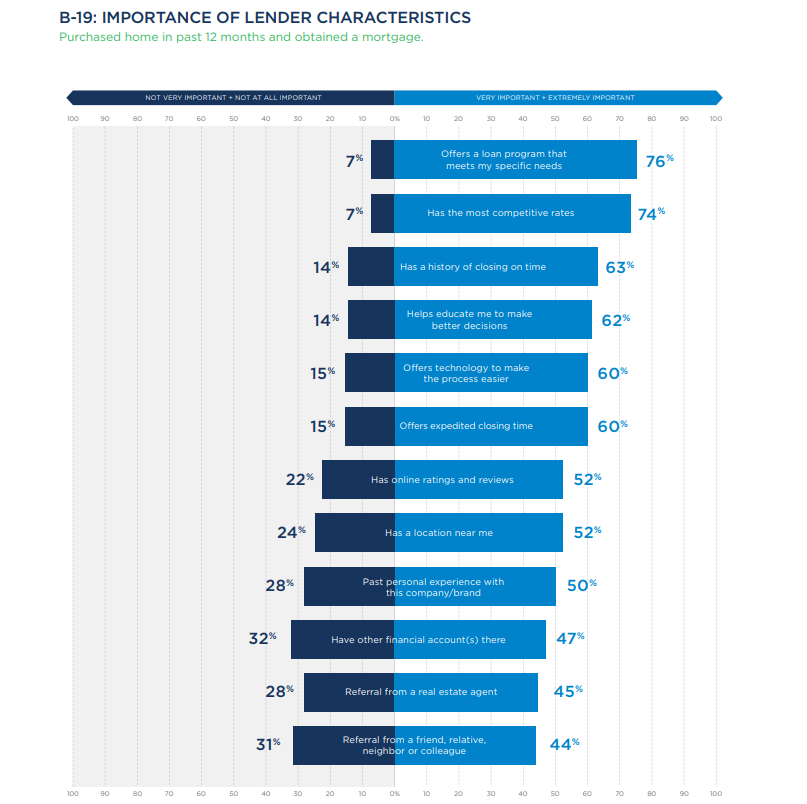
Zillow crunched the numbers and looked at the typical homebuyer in 2017. The typical buyer is 40 years old, making 87k. Millennials make up 42% of the cohort. They typically spend about 4.3 months finding a home. Interestingly, despite the size of the investment, most homebuyers only contacted 1 lender. Here is what is important to homebuyers when thinking about a lender:


The median home was sold in 81 days, and that includes the closing process. This means the typical home was on the market for only 1 month. This is 8 days faster than 2016. 

The National Low Income Housing Coalition has a new report showing how acute the housing shortage is at the low end. Only 35 affordable and available rental homes exist for every 100 extremely low income renter households. Rising home prices and mortgage rates are reducing affordability, however interest rates are still extremely low historically. In the early 80s, a the first year's mortgage payment consisted of 99% interest, 1% principal. 

The IMF forecasts that global growth will hit 3.9% this year, the fastest since 2011, driven by emerging Europe, and the US. 

Friday, February 16, 2018

Morning Report: Robust housing starts

Vital Statistics:

Last Change
S&P Futures  2736.0 2.0
Eurostoxx Index 379.5 3.0
Oil (WTI) 61.4 0.1
US dollar index 82.9 0.2
10 Year Govt Bond Yield 2.88%
Current Coupon Fannie Mae TBA 103.591
Current Coupon Ginnie Mae TBA 103.688
30 Year Fixed Rate Mortgage 4.44

Stocks are higher on no real news. Bonds and MBS are up.

Housing starts came in at 1.326MM annualized, better than expectations. Building permits hit 1.4 million - a 10 year high. Both numbers beat estimates by about 100k, a sizeable amount. The jump was largely in the volatile multi-family segment however. Single family starts were up about 4% YOY. That said, we are still well under the historical averages for starts, which was about 1.5 million units a year during from the 60s through the 90s and early 00s. 

NAR welcomed the housing starts number: "Terrific news on housing starts in January with a solid 10% gain. This rise in single-family housing construction will help tame home price growth, and the increase in multifamily units should continue to help slow rent growth. The large gain in housing starts in the West (10.7%) is especially welcomed, as that region has been facing acute housing shortages. Ultimately, there is still large room for improvement given the fact overall housing inventory is currently near historic lows." This is from Lawrence Yun, Chief Economist.

Import prices rose 1% MOM and are up 3.6% YOY. Energy prices were a big driver of the increase, however if you pull out energy, import prices were up just under 2% YOY. The dollar has been selling off for about a year now, and that is adding pressure to import prices which will flow through to inflation. 

Consumer sentiment improved in early February despite the stock market sell-off. Sentiment came in at about December levels and is at post-recession highs. 

Changes may be coming to TRID disclosure. The House passed a measure requiring more detail in how insurance fees are disclosed. The bill would amend language in the Real Estate Settlement Procedures Act (RESPA) to require the itemization of “all actual charges” and not just the itemization of “all charges.” The bill also would amend RESPA to require that ‘‘Charges for any title insurance premium disclosed on [the TRID rule] forms shall be equal to the amount charged for each individual title insurance policy, subject to any discounts as required by State regulation or the title company rate filings.’’. Thus, the bill would not permit the current approach to the disclosure of title insurance premiums under the TRID rule, and would require that the amounts disclosed for title insurance reflect the actual premium charges, including any discounts.

Thinking of relocating? Here is how much you need to make to be able to qualify for a mortgage on the median house in that MSA. The highest? San Jose, where the median home price is 1.3 million and you need to make just under a quarter of a million. 

Thursday, January 18, 2018

Morning Report: Housing starts disappoint

Vital Statistics:

Last Change
S&P Futures  2802.5 -1.3
Eurostoxx Index 398.1 0.1
Oil (WTI) 64.0 0.1
US dollar index 84.5 -0.2
10 Year Govt Bond Yield 2.62%
Current Coupon Fannie Mae TBA 102.375
Current Coupon Ginnie Mae TBA 103.25
30 Year Fixed Rate Mortgage 4.03

Stocks are lower this morning on no real news. Bonds and MBS are down.

The House looks ready to pass a one-month stopgap measure to keep the lights on. Senate Democrats are considering blocking it in order to push immigration reform, but nothing is set in stone. Bottom line, the odds of a government shutdown tomorrow are falling. 

Initial Jobless Claims came in at 220,000 last week. This is a 45 year low. When you take into account population growth and the fact that we had a military draft back then that number is astounding. 

The Beige Book was released yesterday, and contained no major surprises. Growth is "modest to moderate" in most districts and the labor market is tight, to the point of constraining growth. They mentioned that we are seeing wage inflation more broadly in some districts, while inflation is generally under control. Separately, the Philly Fed report showed that growth eased somewhat, however it is still very strong. 

Housing starts came in at 1.19 million units (annualized), which was a big disappointment. Hurricane effects probably played a part, as many construction workers are being diverted to repair work. We did see a substantial (14%) drop in starts in the South. Building Permits came in at 1.3 million. All told, 1.2 million housing units were started in 2017, which was more or less flat with 2016. This is about 80% of the pre-bubble average of 1.5 million units a year. 

Mel Watt discussed housing reform in a letter to the Senate Banking Committee. He urged lawmakers to establish a guarantor framework where shareholder-owned entities guarantee mortgages with a government backstop and a utility model. The utility model means that pricing will be set by the government in order to set an allowable rate of return for the company and nothing more, similar to how gas and electric companies are run. If one of the guarantors runs into trouble, they will be allowed to fail, however the mortgages they guarantee will be backstopped by the government, thus protecting MBS investors. The document also recommended that these guarantors offset their credit risk in the private market when economically feasible and that they hold enough capital to withstand another 2007. 

Tuesday, December 19, 2017

Morning Report: Housing starts solid

Vital Statistics:

Last Change
S&P Futures  2697.3 2.8
Eurostoxx Index 392.4 -0.3
Oil (WTI) 57.4 0.2
US dollar index 86.9 0.3
10 Year Govt Bond Yield 2.43%
Current Coupon Fannie Mae TBA 102.531
Current Coupon Ginnie Mae TBA 103.375
30 Year Fixed Rate Mortgage 3.88

Stocks are higher as Congress begins the voting for tax reform. Bonds and MBS are down. 

The House is expected to vote on tax reform this afternoon around 1:30. Depending on the procedural machinations, the Senate will vote either tonight or tomorrow. Bob Corker and Susan Collins are supposedly on board, so this should be done. 

Housing starts increased to 1.3 million in November, according to Census. This is up 3.3% MOM and 13% YOY. Building Permits came in at 1.3 million as well. The increase in starts was driven by single-family, not multi, and hit a 10 year high. Note that tax reform's pass-through treatment will be good news for landlords and could encourage more multi-fam construction. We didn't see any jump in multi-fam permits last month, so maybe the change is too recent to influence behavior yet. 


Minneapolis Fed Head Neel Kashkari argues that we should not be raising interest rates yet. Neel was one of 2 dissenters at the last FOMC meeting, preferring to maintain the current level of rates.  His argument is that inflation remains below the Fed's target rate of 2% and there is still slack in the labor market. He also is worried about what the flattening yield curve is saying. IMO he has a point - we want the labor market to keep bringing back the long-term unemployed, however we are hardly going to a tightening posture. On a scale of 1 - 10, where 1 is easy and 10 is tight, we are going from a 1 to a 2. Real interest rates are still negative, and the Fed is still buying Treasuries and MBS albeit at a reduced pace. What would a 10 on that scale look like? The early 1980s, when Paul Volcker tightened to quell inflation and took the Fed Funds rate from 9% to 19%. We are in a different economic scenario than the late 70s, but some historical perspective is helpful. 


New mortgage loan credit risk increased in the third quarter, according to CoreLogic's Housing Credit Index. The increase in risk was driven by an increase in the share of condo / multi-fam loans. Credit scores improved, while DTIs fell. We are back in the pre-bubble range of credit risk. 


Friday, November 17, 2017

Morning Report: Housing starts improve

Vital Statistics:

Last Change
S&P Futures  2584.5 -0.5
Eurostoxx Index 384.3 -0.6
Oil (WTI) 56.0 0.9
US dollar index 87.3 -0.1
10 Year Govt Bond Yield 2.37%
Current Coupon Fannie Mae TBA 102.651
Current Coupon Ginnie Mae TBA 103.494
30 Year Fixed Rate Mortgage 3.9

Stocks are flat this morning on no real news. Bonds and MBS are down small. 

Housing starts came in just shy of 1.3 million, the highest print in a year. This is up 14% from last month, but down 3% from a year ago. Building Permits came in at 1.3 million as well. Both numbers were driven by a big jump in multi-family, while single-fam continues to gradually move higher. We are still below historical numbers: From the late 50s through 2002, starts averaged 1.5 million a year. When you factor in population growth, that average is way too low for today. We probably should be pushing 2MM a year in order to keep up with population growth and to fix the inventory problem. 

The House passed tax reform yesterday, and now all eyes turn to the Senate, where the latest bill made it out of Committee and is scheduled for a vote after the Thanksgiving holiday. Then begins the hard work of reconciling the House and Senate versions. The Senate bill has some high profile opposition, which makes passage difficult. This is still a very fluid situation. 

Donald Trump will nominate OMB Chairman Mick Mulvaney to be the interim head of the CFPB. Mulvaney is a reliable conservative, who has a healthy skepticism of government regulation. He is expected to name another Chairman or Committee to run it, while he maintains his focus on OMB. Names mooted for the role include George Mason University professor Todd Zwyicki and ex-Congressman Neugebauer. 

A study concludes that homeownership doesn't increase wealth as much as renting and investing the savings in the stock market. The critical part of the argument is investing the savings in the stock market. I haven't read the study, but I wonder if they are using absolute house prices instead of what you actually put up. If the house appreciates 5% a year, and you only put down 20%, what is the best number for determining your return? The it amount of the house or the amount you actually put up? Is the proper return 5% / 100% or is it 5% / 20% (or 25%)? 

Wednesday, October 18, 2017

Morning Report: Housing starts fall

Vital Statistics:

Last Change
S&P Futures  2561.0 4.0
Eurostoxx Index 392.0 1.5
Oil (WTI) 52.1 0.2
US dollar index 86.8 0.2
10 Year Govt Bond Yield 2.33%
Current Coupon Fannie Mae TBA 102.96
Current Coupon Ginnie Mae TBA 104.188
30 Year Fixed Rate Mortgage 3.86

Stocks are lower on no major news. Bonds and MBS are down small. 

Housing starts fell in September, as hurricane effects probably had an effect. Starts fell 4.7% from August, but are up 6.1% on an annual basis. Weather probably doesn't explain all of it, however as building permits were also down on month-over-month basis. Permits were also down on year-over-year basis. Housing starts fell in the North, South, and Midwest, but rose in the West. Permits rose in the Northeast and Midwest and fell in the South and West. We should probably see some improvement in these numbers as the flood waters recede and people rebuild. 

Mortgage applications rose 3.6% on an adjusted basis for the holiday-shortened week. Purchases rose 4% while refis rose 3%. The MBA said that mortgage rates decreased by 2 basis points overall last week. This was the first increase in the applications index in over a month. 

Treasury Secretary Steve Mnuchin predicts the stock market will slump if tax reform isn't passed this year. Since Democrats are uniformly against tax reform, it will have to be modest in order to pass it under a straight majority in the Senate. "There is no question that the rally in the stock market has baked into it reasonably high expectations of us getting tax cuts and tax reform done," Mnuchin said in the "Politico Money" podcast interview. "To the extent we get the tax deal done, the stock market will go up higher. But there's no question in my mind that if we don't get it done you're going to see a reversal of a significant amount of these gains." Note that there are some procedural hurdles to get this done. It all comes down to earnings. If there are no changes in taxes at the corporate level, then the forward earnings estimates are too high, which means the multiple is higher than people think. 

The Senate has a tentative deal to save Obamacare and the cost reduction subsidies, however the White House is lukewarm on it, and many in the House are outright hostile to anything that props up Obamacare. 

Trump is expected to name his nominee to be the next Fed Chairman by early November. The expected nominees are John Taylor, Kevin Warsh, Gary Cohn, Jerome Powell, or Janet Yellen. Trump meets with Yellen this week. Note a Reuters poll of economists think Powell will get the nod. 

One puzzling aspect of the current economy is the labor market and the lack of wage growth. Theory says that if the unemployment rate is as low as it is now, we should be seeing bidding wars for workers and general wage hikes across the board. The leading indicator for wage growth - the JOLTS quit rate - has been flat for 2 years. What is going on? The first (and biggest) is that the unemployment rate is sending a false signal about how tight the labor market is. While there is some tightness in the labor force, particularly in skilled labor, most people are not in the hot sector, and are reluctant to leave. Second, many could still be trapped in homes with negative equity, unable to move to where the jobs are. And finally, many are just not willing to move, for whatever reason. I think the answer is the first one: Our unemployment rate stops counting the unemployed at 6 months, which may have been a reasonable thing to do 30 years ago, but not today. The employment to population ratio is probably a better indicator. And according to that, we still have a ways to go. Note that demographic trends will play a part here as well. The low ratios in the 50s and 60s are explained by a lack of women in the labor force. And some of the drop in recent years is due to the retirement of the baby boomers, however their kids (the Millennials) should be replacing them. 


Tuesday, September 19, 2017

Morning Report: Housing starts depressed by hurricanes

Vital Statistics:

Last Change
S&P Futures  2504.5 1.8
Eurostoxx Index 382.0 0.0
Oil (WTI) 50.3 0.4
US dollar index 85.3 -0.1
10 Year Govt Bond Yield 2.22%
Current Coupon Fannie Mae TBA 103.33
Current Coupon Ginnie Mae TBA 104.21
30 Year Fixed Rate Mortgage 3.83

Stocks are flat this morning as the Fed begins its meeting. Bonds and MBS are flat as well. 

Housing starts for August came in at 1.18 million, a touch above the 1.17 million estimate. Building Permits rose 1.3 million, much better than the 1.23 million the Street was forecasting. The hurricanes did depress starts a bit, as the FEMA disaster areas accounted for about 13% of US building permits. Multi-family starts have been more or less flatlining over the past couple years, while single family has steadily increased. Note that starts will probably be depressed over the near term as construction workers in these already tight markets get drawn into rebuilding projects versus new home construction. 

Import prices rose 0.6% MOM and 2.1% YOY as the hurricanes boosted energy prices last month. The Fed will almost certainly consider that effect to be transitory and it won't affect their inflation out look all that much. 

Mortgage fraud risk is up 17% YOY, according to CoreLogic. In the second quarter, over 13,400 mortgage applications (or 0.82%) showed symptoms of fraud, compared to 12,700 (0.7%) a year earlier. “This past year we saw a relatively large increase in the CoreLogic National Mortgage Application Fraud Index,” said Bridget Berg, principal, Fraud Solutions for CoreLogic. “If the factors that influenced the increase continue, including a shift to purchase transactions and growing wholesale channel origination activity, it is likely that mortgage application fraud risk will continue to rise as well. Fraud on cash-out refinance transactions and home equity loans may become more of a factor in the coming years as home values and equity rise.”

30 day + Delinquencies fell to 4.5% in June from 5.3% a year ago. The foreclosure rate of 0.7% was the lowest in 10 years. The range went from 0.1% in the Denver MSA to 2.2% in the Newark MSA. Decent home price appreciation and job growth are pushing delinquencies back down to pre-crisis levels. 

The Fed is expected to announce that it will begin to unwind its balance sheet at the September meeting. There seems to be a lot of handwringing in the press over the implications of the Fed ending its "easy money" policy. An important thing to remember is that easy money / tight money isn't a binary choice. It is a continuum. In all reality, if you were to put Fed policy on a scale of 1 to 10, with 1 being easy money, we are basically moving from 1.0 to 1.1. Real short term interest rates (i.e the Fed funds rate less the inflation rate) are still negative. Long term real rates are barely positive. The Fed will still continue to purchase assets in the open markets, however they will let something like 10% - 20% of maturing assets simply go away. These are truly baby steps intended to cause as little negative impact as possible. The Fed is going very slow and cautiously, and the persistent low inflation numbers give them that cushion. 

Wednesday, August 16, 2017

Morning Report: Housing starts disappoint

Vital Statistics:

Last Change
S&P Futures  2468.0 4.3
Eurostoxx Index 379.3 2.8
Oil (WTI) 47.7 0.2
US dollar index 86.7 0.1
10 Year Govt Bond Yield 2.28%
Current Coupon Fannie Mae TBA 103.09
Current Coupon Ginnie Mae TBA 103.97
30 Year Fixed Rate Mortgage 3.88

Stocks are higher this morning on no real news. Bonds and MBS are down. 

The big event of the day will be the release of the FOMC minutes at 2:00 pm EST. The Street will be looking for more info on how the Fed plans to wind down its QE portfolio. Investors will also be parsing the statement for clues regarding the Fed's stance on the current status of low inflation. While inflation remains low if measured against the Fed's inflation target, we are starting to see wage inflation. The hawks on the Committee will push to get ahead of that, while the doves (like Yellen) will prefer to let the labor market "run hot" for a while. The minutes will probably not be market-moving, but just be aware if you are locking around that time. 

The minutes will be interesting given the recent GDP forecasts out of the Atlanta Fed, which have Q3 growth coming in at 3.7%, and are predicting a much stronger second half to the year. You could really start to see a battle between the hawks and the doves. The Fed Funds futures contracts are still predicting no move in September and a 50-50 chance of a hike in December. 

Mortgage Applications fell 0.1% last week as purchases fell 2% and refis increased 2%. Mortgage rates continue to tick lower, with the 30 year fixed rate mortgage down to 4.14%, the lowest since November. 

Housing starts disappointed last month, coming in at 1.15 million, down 4.8% MOM and 5.8% YOY. The notoriously volatile multi-family segment drove the decrease, as single family starts were more or less unchanged. The Street was looking for 1.22 million units. Building permits came in at 1.22 million, lower than estimates as well. They were down 4% on a MOM  basis but were up 4% on a YOY basis. 

Where is the growth in housing construction? Texas. Of course Texas didn't really experience the bubble type behavior the way states like California, Arizona, and Florida did. This may be because Texas has more restrictions on cash-out refinances than other states. Here is a chart of where the action is (and is not)


Wednesday, July 19, 2017

Morning Report: Housing starts rebound

Vital Statistics:

Last Change
S&P Futures  2459.5 1.8
Eurostoxx Index 384.1 1.5
Oil (WTI) 46.5 0.0
US dollar index 86.9 -0.4
10 Year Govt Bond Yield 2.27%
Current Coupon Fannie Mae TBA 103.31
Current Coupon Ginnie Mae TBA 104.375
30 Year Fixed Rate Mortgage 3.96

Stocks are higher this morning as the ECB starts its two day meeting. Bonds and MBS are flat.

Bonds staged a strong rally yesterday after the Senate was unable to repeal and replace Obamacare. Obamacare repeal was to be the source of funds for infrastructure spend and tax reform, and this failure largely means the rest of the Trump reflation trade is pretty much dead.

Mortgage applications rose by 6.3% last week as purchases rose 1% and refis rose 13%. Treasury yields fell last week on dovish comments by Janet Yellen. 

Housing starts rose to 1.22MM and building permits rose to 1.25 million. Starts were up 8.3% MOM and 2.1% YOY. Activity rebounded in the Northeast and the Midwest while falling in the South. The West was unchanged. This is a strong rebound after a terrible May. Tariffs on framing lumber are increasing home construction costs, just as the first time buyer re-enters the housing market. Historically starts have averaged around 1.5 million a year, which largely explains the current housing shortage. In reality, we should be closer to 2 million a year, which is typical for a post-recession rebound. 

CNBC discusses the pros and cons of a 30 year mortgage versus a 15 year mortgage. Yes, the payments on a 30 year will be lower, but the interest paid over the life of the loan will be much higher. One thing worth remembering: you tend to get a decent drop in rate for moving from a conforming 30 year to a 15 year. That pickup is much, much smaller on a FHA or VA loan, due to the illiquidity of 15 year TBA. The one thing the article doesn't really touch on is inflation. US Treasuries are priced as if inflation is never, ever coming back - if you are buying Treasuries at 2.27%, you are really betting that "this time is different," which are the 4 most dangerous words in investing. If you can borrow money for 30 years at under 4%, you will almost assuredly see inflation running hotter than that at some point during the mortgage's life. The world's central bankers are on a mission to create inflation. Eventually they will succeed. 


Friday, June 16, 2017

Morning Report: Housing starts fall

Vital Statistics:

Last Change
S&P Futures  2433.8 1.8
Eurostoxx Index 388.2 2.2
Oil (WTI) 44.9 0.4
US dollar index 88.5 -0.1
10 Year Govt Bond Yield 2.17%
Current Coupon Fannie Mae TBA 103.31
Current Coupon Ginnie Mae TBA 104.375
30 Year Fixed Rate Mortgage 3.89

Stocks are higher this morning on no real news. Bonds and MBS are flat.

Slow news day.

Housing starts fell in May to an annualized rate of 1.09MM. This is a 5.5% drop from April and a 2.4% drop YOY. Building Permits fell as well. Both single-fam and multi-fam segments fell. Builders claim that a lack of skilled labor and available land are causing the problem. 

The lack of building is pushing rents higher, and the number of people who spend 50% or more on of their income on housing is at a record level. The issue is a big problem in many metro areas, however outside of those areas affordability is better. There is also a huge difference between MSAs, with places like the Bay Area completely unaffordable compared to the Rust Belt, where prices have yet to recover their bubble peaks. 

Amazon is buying Whole Foods..  I guess you'll soon be able to get your artisanal tortilla chips delivered by drone to your house.

Tuesday, May 16, 2017

Morning Report: Housing starts disappoint again

Vital Statistics:

Last Change
S&P Futures  2399.0 0.5
Eurostoxx Index 395.5 -0.5
Oil (WTI) 49.0 0.1
US dollar index 89.9 -0.1
10 Year Govt Bond Yield 2.34%
Current Coupon Fannie Mae TBA 102.625
Current Coupon Ginnie Mae TBA 103.938
30 Year Fixed Rate Mortgage 4.09

Stocks are flat this morning on no real news. Bonds and MBS are flat as well.

Housing starts for April disappointed, rising 0.7% YOY to an annualized rate of 1.17 million. The Street was looking for 1.26 million. This was the lowest reading in a year. Building Permits rose to 1.26 million on an annualized basis, up 5.7% YOY. It is strange to see disappointing starts alongside the strong builder sentiment number reported yesterday, but builders seem content to build fewer homes and to grow the business by raising prices. 

Industrial and manufacturing production came in stronger than expected however, growing 1% in April. Capacity Utilization rose to 76.7%. Auto assembly drove the increase, pardon the pun. 

The Washington Post broke a story that Donald Trump shared classified info with Russia. There seems to be a shift in the political winds. You are starting to see mainstream Republicans distance themselves from the Administration. Don't know if this becomes a stampede, but the crowd is looking for their coats and nervously eyeing the exits. I don't think this is impeachment material (what he did was legal) however, you can probably stick a fork in the Trump legislative agenda. 

The machinations in Washington so far are not affecting the stock market, but the dollar is beginning to take notice. Bonds are not yet reacting however don't forget the 10 year was trading around 1.8% before Trump's surprise victory. The Trump reflation trade is running on fumes at this point. 

The National Association of Realtors estimates that if the mortgage interest deduction and the state & property tax deduction is eliminated, you would see a 10% drop in real estate values. The Trump plan would double the size of the standard deduction, which will go from roughly 12k to 24k. The increase in the standard deduction will make the mortgage interest deduction meaningless for anyone with a sub $600k mortgage because they will be better off taking the standard deduction. This will eliminate one of the advantages of buying versus renting for first time homebuyers, which in theory should create more renters and less buyers. Given all the other advantages of buying, this will probably be a second-order effect. I have a hard time seeing a 10% drop in prices - the FHFA House Price Index only had a 22% drop peak to trough - and inventories are tight. 

Absent any changes to the tax code, NAR is looking for prices to rise 7% - 8% this year.

Ex Fed Head Narayan Kocklerakota recommends that the Fed maintain its balance sheet and not let its QE assets run off as they mature. 

Tuesday, April 18, 2017

Morning Report: Housing starts miss

Vital Statistics:

Last Change
S&P Futures  2339.5 -5.5
Eurostoxx Index 377.0 -3.6
Oil (WTI) 52.3 0.4
US dollar index 89.8
10 Year Govt Bond Yield 2.22%
Current Coupon Fannie Mae TBA 103.09
Current Coupon Ginnie Mae TBA 104.31
30 Year Fixed Rate Mortgage 3.97

Stocks are lower this morning after housing starts disappoint. Bonds and MBS are higher.

Housing starts fell 9% MOM to 1.215 million in March. This was below the 1.26 million estimate. Building Permits rose 1.26 million, which exceeded the 1.25 million estimate. A big drop in single family starts in the Midwest drove the decrease, which may have been weather-related. Multi-fam continues to be volatile, while SFR is slowly creeping upward. 

Industrial Production rose 0.1% in March, however manufacturing production fell 0.4%, which was a big miss from the 0.3% increase that was expected. Capacity Utilization bumped up to 76%. This is another example of the disconnect between the soft data (sentiment surveys) and hard data (actual spending patterns etc) that has been a hallmark of the post-election landscape. 

We had a nice rally in the 10 year bond last week, with the yield falling about 15 basis points to 2.23%. The mortgage rate has lagged the move, falling about 10 basis points. Generally speaking this is typical, as the mortgage rate is less volatile than the 10 year. If the 10 year stabilizes here, we could see a move lower in mortgage rates. 

Part of the post-election rally was due to the Trump reflation trade, which assumed tax cuts and infrastructure spending. Tax cuts really mean tax reform, as the plan is to increase the size of the standard deduction and reduce itemized deductions. While the mortgage interest deduction is too popular to eliminate, the state and local tax deduction is being targeted. This will hit taxpayers in high tax areas like CA and the Northeast the hardest. Democrats are opposing this however, even though the people most likely to be affected are the very rich (90% of the increase will fall on the wealthy), and will raise something like $1.3 trillion over 10 years. 

The Trump Administration has said that health care reform will take precedence over tax reform this year. Note that we are coming up on the period where health insurers will announce whether they are staying on the Obamacare exchanges or not for 2018. That will most likely color the debate. As hard as it is to get anything through Congress right now, it will only get harder in 2018 as midterms loom on the horizon. 

The punch line is that bonds and stocks are telling you different things, and when that happens the bond market is usually correct. If the Trump reflation trade is indeed dead, and we don't see a big increase in growth, we should start thinking about the possibility of the 10 year trading below 2%. The pre-election yield on the 10 year was 1.78%. 

Note that the IMF may be catching on as well. They are taking up their global GDP growth numbers, probably on the bet that protectionist policies in the US aren't going to happen. 

Both the Atlanta Fed and the NY Fed took down their Q1 GDP estimates after the lousy retail sales numbers last week. A CNBC survey of economists is pegging Q1 GDP at about 90 basis points. The Fed Funds futures are now pricing in an under-50% probability of a rate hike in June. You can see that the Fed Funds futures have been cheating down their estimates for hikes over the past month or so:


Treasury Secretary Steve Mnuchin said that the Administration prefers a strong dollar "over time." There had been some confusion in the markets over the Administration's exact policy on the dollar, since Trump had said early on it was too strong, in reference to China. Note that there is some horsetrading going on between the US and China over currencies, trade, and North Korea. Trump is willing to tone down his comments on Chinese currency manipulation in exchange for action from China in reining in NK. A strong dollar policy out of the Admin will generally make for lower interest rates. 

The CFPB is soliciting input for possible changes the Home Mortgage Disclosure Act.