A place where economics, financial markets, and real estate intersect.
Showing posts with label Jerome Powell. Show all posts

Friday, August 24, 2018

Morning Report: Jerome Powell speaks in Jackson Hole

Vital Statistic:

Last Change
S&P futures 2865 6.75
Eurostoxx index 383.72 0.32
Oil (WTI) 68.91 1.08
10 Year Government Bond Yield 2.85%
30 Year fixed rate mortgage 4.58%

Stocks are higher this morning on no real news. Bonds and MBS are down.

Another slow news day. Low level talks between China and the US over trade didn't really go anywhere. 

Durable Goods orders fell 1.7% in July on weak aircraft orders, but the core capital goods rate jumped 1.4%, which shows another month of strong business investment, particularly business equipment. Many economists had been skeptical that cutting corporate taxes would increase capital expenditures, but it looks like it has. Theory certainly predicted it would. 

Jerome Powell is speaking in Jackson Hole this morning. There probably won't be anything market moving, but just be aware. The conference will focus on a academic papers for the most part. The agenda is here. One of the papers argues that the Fed should continue to hike rates, even in the absence of current indications of inflation, if the unemployment rate is below the long-term sustainable rate. Since monetary policy acts with a lag, a low unemployment rate can increase inflationary pressures before monetary policy takes effect. 

The Fed faces two major risks of “moving too fast and needlessly shortening the expansion, versus moving too slowly and risking a destabilizing overheating,” said Mr. Powell. “I see the current path of gradually raising interest rates as the [Federal Open Market Committee’s] approach to taking seriously both of these risks. In other words, expect maybe 2 more hikes this year, and maybe one or two more next year.

The Fed funds futures increased their handicapping of a Dec hike slightly, to 68% (Sep is a given). Longer term, the September 2019 futures predictions look like this:


The central tendency seems to be 2 more hikes this year, one more next year, and then the Fed takes a break. Slightly more people think the Fed stops after 2 hikes than those who think the Fed does 4 or more.

St. Louis Fed President James Bullard would vote to maintain the current Fed Funds rate through the end of the year. “If it was just me, I’d stand pat where we are and I’d try to react to data as it comes in,” he said Friday in an interview with CNBC’s Steve Liesman. “I just don’t see much inflation pressure. ... I’m an inflation hawk, but I just don’t see that developing. ... I just don’t think this is a situation where we have to be pre-emptive.” He also sees the economy slowing next year, and in 2020. 

The Senate Banking Committee voted 13-12 along party lines to advance the nomination of Kathy Kraninger to run the CFPB. Remember if Kraninger is rejected, Mick Mulvaney continues to run the agency, which was probably the plan all along. 

Tuesday, August 21, 2018

Morning Report: Housing inventory is still falling, albeit at a slower rate

Vital Statistics:

Last Change
S&P futures 2862 4
Eurostoxx index 384.93 1.7
Oil (WTI) 67.47 1.04
10 Year Government Bond Yield 2.83%
30 Year fixed rate mortgage 4.58%

Stocks are higher this morning as earnings season winds down. Bonds and MBS are down. 

Same store sales rose 4.7% last week, which is indicative of a strong back-to-school shopping season. BTS is a good predictor of the holiday shopping season, which would support strong GDP growth for the rest of the year. Consumption is about 70% of US GDP. Current projections are looking at north of 3% growth for the year.

The Fed Funds futures are now handicapping a 96% chance of a Sep hike and a 63% chance of a Sep and Dec hike. Meanwhile, the yield curve continues to flatten. 

Trump made some comments about Fed Chairman Jerome Powell at a fundraiser, saying that he expected him to be a "cheap money guy" and didn't expect him to raise interest rates. He also tweeted that he is "getting no help" from the Fed. While publicly discussing monetary policy is not a normal thing for the President to do, wishing rates were lower is. The only politicians who want higher rates are the ones not in power. He also called the Europeans and the Chinese currency manipulators. Under any other President this would be big, but the dollar and the bond market largely ignored it. It  shows that markets are largely dismissing "Donald being Donald" communiques from the WH.  

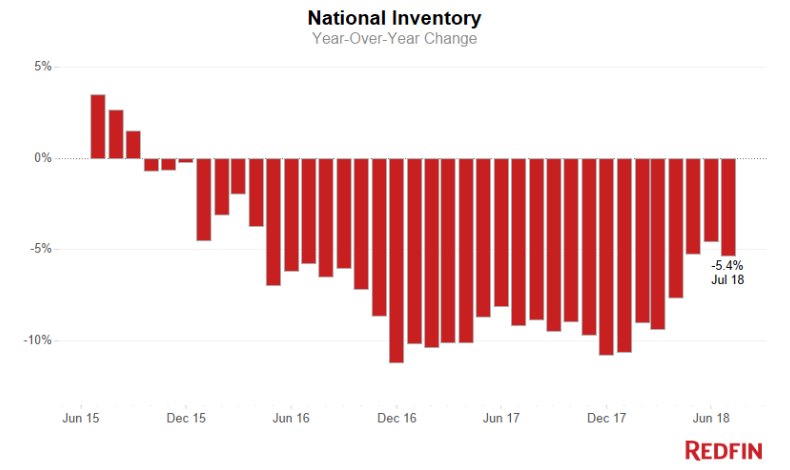
The YOY declines in inventory that have bedeviled the industry are beginning to moderate, at least according to Redfin. Inventory was down 5.8% in July, which is lower than the double-digit decreases we had been seeing. The median sales price rose 5.3%. Homes went under contract in 35 days, which is 3 days faster than a year ago. Activity is slowing in some of the hotter markets however, especially Washington DC. The inventory issue won't be fixed until we get housing starts back to some semblance of normalcy, which means a few years of 2MM units before returning to historical averages of around 1.5MM. 


Toll Brothers reported strong numbers this morning, which has sent the stock up 11%. Revenues were up 27% and deliveries were up 18%. Backlog rose 22% in dollars and 13% in units. They also bought back about $137 million worth of stock, which accounts for about 70% of earnings. Robert I. Toll, executive chairman, stated: “We believe there is room for continued growth in the new home market in the coming years. Household formations have been increasing and in many regions the aging housing stock may not satisfy the lifestyles of today’s buyers. Yet new home production has not kept pace with the growth in population and households. On the single-family side, housing starts, other than during the anemic years of this recovery, are at their lowest level since 1970. In addition, existing home values have increased, providing potential move-up and empty nester customers with more equity that they can put toward a new home purchase. We believe these two groups, along with the growing number of millennials starting to buy homes, are all sources of potential new demand in the coming years.”  

I find it interesting that he talks about the low level of housing starts, while at the same time spending 70% of Toll's net income on buybacks. Certainly the actions don't seem to match the words. 

Wednesday, July 18, 2018

Morning Report: Big difference between average and median earnings

Vital Statistics:

Last Change
S&P futures 2808 -2.5
Eurostoxx index 386.74 1.76
Oil (WTI) 67.62 -0.46
10 Year Government Bond Yield 2.85%
30 Year fixed rate mortgage 4.51%

Stocks are lower this morning on no real news. Bonds and MBS are flat. 

Mortgage Applications fell 2.5% last week as purchases fell 5% and refis rose 2%. The refi share rose to 36.5%. 

Housing starts hit their lowest level since September last year, falling to 1.17 million annualized. This is a huge drop from the strong May print of 1.33 million. The Midwest and the South explain the declines, which was both in single family and multi. June weather was generally good, so that isn't the explanation. Building Permits fell as well, although not as dramatically. They came in at 1.27 million. The Midwest accounted for most of the decline in permits. Housing starts tend to be volatile, but the moving average is turning down, which is worrisome. 

Despite the drop in starts, builder confidence remains strong, at least according to the NAHB. The index was flat at 68, which is an elevated number. Pricing remains strong, but the supply is not there. Rising material costs are becoming an issue as lumber tariffs raise costs. So far builders are able to pass these costs on, but there is a limit, especially if wage inflation remains below house price inflation. The median house price to median income ratio is getting back to extreme levels, and interest rates are not going to come to the rescue this time around. 

Jerome Powell begins his second day of testimony on Capitol Hill. There was nothing market-moving yesterday, so expect more of the same. Yesterday, his message was that the US economy has clear sailing ahead with strong growth and moderate inflation. With regard to the potential trade war, Powell downplayed the risks to the economy and said there will be a benefit if it turns out that Trump's actions lower tariffs overall in the global economy. The US generally has much lower tariffs than its trading partners, and Trump has already made the offer to eliminate all US tariffs if our trading partners eliminate theirs. Separately, Powell said that it would ultimately be better for the US if the GSEs were off the government balance sheet. That is pretty much a universal opinion in DC these days, as the US taxpayer bears the credit risk of the majority of the mortgage market. 

Median weekly earnings have not kept pace with the CPI lately, which means workers are losing ground, at least according to the latest survey out of the BLS. It shows that the median weekly wage rose 2% in the second quarter versus an increase in the CPI of 2.7%. Interestingly, the average hourly earnings increase during Q2 was 2.64% in April, 2.74% in May and 2.74% in June. It seems strange that the difference between average wage inflation and median wage inflation would be so stark, which would imply that wages are mainly rising at the high end, not the lower end. Note the other BLS measure of wage inflation, the employment cost index, shows comp growth of 2.9%, which takes into account benefits. For the most part, average hourly earnings have been rising faster than the core PCE index:


New York, Connecticut, New Jersey, and Maryland sued the government yesterday over the state and local tax deduction cap. The lawsuit if probably more for show than anything and doesn't seem to have much chance of success. Some of the states are looking at workarounds, allowing people to "donate" to charitable funds which go to funding state and local services. Charitable deductions are still deductible. At the end of the day, the biggest issue to states like NY and NJ are the property taxes. NY and NJ have some of the highest property taxes in the country, where people routinely pay $20 - $30k or more. That explains at least partially why you can't find buyers for luxury properties in the Northeast. 

The ECB concludes that QE may have helped the rich, but it helped the poor more. While QE did boost asset prices (housing, bonds, stocks etc) it also boosted growth, which more than offset the increase in asset prices.  “Low short rates do hurt savers via a direct effect, that is a reduction in income on their assets . . . however [low rates] also benefit savers, like all other households, via an indirect effect — that is, the reduction in their unemployment rate and the increase in the labour income,” the paper, called “Monetary policy and household inequality”, said. “The indirect effect dominates . . . The paper also finds that [QE] reduced inequality, mainly through a reduction of the unemployment rate of poorer households.”

Note that this contradicts the observation between median and average earnings. If QE was actually decreasing inequality, you should see median earnings growth close to average earning growth or even slightly higher. Not way below. 

Tuesday, July 17, 2018

Morning Report: Northeast real estate market struggles

Vital Statistics:

Last Change
S&P futures 2794 -2.5
Eurostoxx index 383.01 -1.04
Oil (WTI) 68.12 0.06
10 Year Government Bond Yield 2.85%
30 Year fixed rate mortgage 4.51%

Stocks are lower after Netflix (one of the FAANG leaders of the market) missed earnings. Bonds and MBS are flat. 

Industrial Production rebounded in June by 0.6% and manufacturing production increased 0.8%. Capacity utilization is 78%. 

Jerome Powell heads to Capitol Hill today to begin his semiannual testimony in front of Congress. Expect a lot of questions regarding wage growth, trade wars, and regulation. Overall, he is expected to say that the economy is in good shape overall with above-trend growth and a strong labor market. He will face some questions from Democrats on regulation, especially since the Fed approved Goldman and Morgan Stanley's capital plans despite the fact they were technically failed their stress tests. The Fed Funds futures continue to move in a hawkish direction, with the Sep futures pricing in a 88% chance of a hike and the Dec futures pricing in a 63% chance of 2 hikes. 

Despite trade tensions, the IMF still expects the global economy to grow 3.9% this year and next. Trade remains a threat, however the impact is relatively small: a decrease of 0.5% in global growth by 2020. They forecast the US economy will grow 2.9% this year. Note many strategists took up their Q2 numbers on the strong retail sales print yesterday.

The Fifth Court of Appeals ruled yesterday that the structure of the FHFA is unconstitutional. Not sure how that is going to play out. Separately it also ruled that the FHFA was within its authority to sweep the profit from the GSEs, which is bad news for shareholders. FNMA stock was hit to the tune of 6% after the ruling. 

The difference in sentiment between Northeastern real estate markets and the West is night and day. Growth in single family permits was actually negative for the first 5 months of this year. Compare that to the West, where they are up almost 18%. 


The Northeast still has yet to really recover from the Great Recession, although some of that has more to do with secular trends in banking and the securities industry than it does with the real estate bubble. The securities industry has been hit by secular trends (falling commissions, ETFs) that have been great for investors but not great for employment in the industry. 5 cent commissions and 2%/20% hedge fund fees supported a lot of jobs which supported a lot of $1MM + homes. Towns like New Canaan have banned For Sale signs and the only part of the real estate market that is moving is in the sub-$750k segment. Million dollar plus listings languish. It is amazing - we have a housing shortage in the US overall, but you would never know that if you looked at the NYC suburbs. 


Friday, July 13, 2018

Morning Report: Bank earnings pour in

Vital Statistics:

Last Change
S&P futures 2797 -1
Eurostoxx index 385.18 0.81
Oil (WTI) 70.6 0.27
10 Year Government Bond Yield 2.84%
30 Year fixed rate mortgage 4.53%

Markets are flat as bank earnings come in. Bonds and MBS are up small. Slow news day.

The US government held a reasonably strong auction yesterday, where primary dealers took down their smallest positions ever. Meanwhile, speculative shorts in Treasuries (one of the biggest trades on the Street) are struggling as rates stay stubbornly low. Some continue to warn that the flattening yield curve is really telling us that a recession is around the corner. 

The prepared remarks for Jerome Powell's semiannual report to Congress should be out today. Probably won't be market-moving, but you never know. 

Import prices fell 0.4% in June as petroleum and food prices fell. For the year, they are up 4.3% however. 

Consumer sentiment fell according to the University of Michigan / Reuters survey. The current conditions index drove the fall, which is usually a function of gas prices. Trade fears also weighed on sentiment. 

Wells Fargo reported earnings this morning. Earnings were down due to a tax charge. Stripping out the tax charge, they were flat. They had a tough quarter for mortgages like everyone else. Origination for the quarter was $50 billion, which is up seasonally from Q1, but down 11% YOY. The current pipeline of $24 billion is down 26% YOY. Margins were 77 basis points, which is down 17 from the prior quarter and down 47 bps from a year ago. The stock is down 3% pre-open. 

JP Morgan had a similar story to Wells. They originated $23.7 billion in mortgages during Q2, which was higher seasonally and down about 10% from a year ago. Mortgage banking revenue (which includes servicing) was down 6% YOY. Margin compression again was the story, especially in correspondent lending. They marked up the MSR book. JPM is flat pre-open. 

A bunch of other banks reported this morning and the whole sector is getting hit, with the XLF down about a percent and a half. 

Federal Reserve Chairman Jerome Powell made positive comments about the economy, although he is concerned about trade and the effects of a long trade war with China. He is concerned about rising trade tensions, although he notes that Trump's goal is to get others to lower their tariffs. If he succeeds in that, then the trade tension would be a good thing, not a bad thing. It is important to remember that China's biggest weapon against the US is not imposing tariffs on US goods - it is ignoring US intellectual property laws. Those sorts of things will not really show up in the balance of trade numbers, but will have huge effects on IP firms, particularly media and software. 


Thursday, March 1, 2018

Morning Report: ISM survey points to higher inflation going forward

Vital Statistics:

Last Change
S&P Futures  2708.3 -6.3
Eurostoxx Index 375.7 -4.0
Oil (WTI) 61.2 -0.5
US dollar index 84.3 0.1
10 Year Govt Bond Yield 2.84%
Current Coupon Fannie Mae TBA 102.313
Current Coupon Ginnie Mae TBA 102.531
30 Year Fixed Rate Mortgage 4.4

Stocks are lower this morning on no real news. Bonds and MBS are up.

Jerome Powell is set to testify in front of the Senate this morning. On Tuesday, he made some hawkish statements about inflation that sent bond yields higher. I doubt we will see a repeat today, but just be aware. 

Initial Jobless Claims fell to 210,000 last week, the lowest number since the 1960s. Last week included the President's Day holiday, which means we could have some sort of funky adjustment going on,  but regardless it speaks to a labor market where employers are hanging onto their employees. 

Personal Incomes rose 0.4% last month, while consumer spending rose 0.2%. The incomes number was a little better than expected. The inflation numbers show a modest pickup, but the core annual growth came in at 1.5% YOY, which is below the Fed's 2% target. 

Construction spending came in flat for January, and is up 3.2% YOY. Residential Construction was up 0.2% MOM and rose 4.3% YOY. 

The ISM Manufacturing Index improved to 60.8 in January. New Orders drove the improvement and employment improved markedly as well. The report often includes some snippets from respondents, and many of them are touching on the same thing:
  • “Availability of electronic components, long lead times, allocations and constraints continue to wreak havoc in the purchasing cycle, with no end in sight at this time.” (Computer & Electronic Products
  • “Steel market is doing rather well. Everybody is out of what I need.” (Fabricated Metal Products)
  • “Employment is one of our biggest challenges. No labor available.” (Food, Beverage & Tobacco Products)
  • “Business is very strong, and our lines are running at full capacity.” (Plastics & Rubber Products)
All of these statements relate to demand-driven bottlenecks and point towards inflation going forward. In fact, an ISM reading of this level would normally correspond with GDP growth over 5%. Note that the Fed pays close attention to the ISM numbers. 

CoreLogic has a good retrospective on the state of the housing markets in the US. 

Interesting development in the capital markets: Streaming music site Spotify is going public, without doing an IPO. Instead of selling a chunk of the company to an investment bank, who then sells it to the public, Spotify will skip the whole process and do a direct IPO, where it sells stock directly to the public on the NYSE. Without the certainty of a set number of shares, a set price for the shares and any sort of lock up period, SPOT could be a volatile stock out of the gate. 

The Senate looks poised to tackle banking reform, which essentially eases some of the Dodd-Frank restrictions on smaller banks. The asset threshold will be moved from $50 billion in assets to $250 billion in assets, which will prevent banks like M&T or Zions from having to conduct the detailed, 20,000 page stress tests that the bigger banks have to do. Aside from a few on the far left, there is general bipartisan support for easing the regulatory burden on smaller banks. 


Wednesday, February 28, 2018

Morning Report: Jerome Powell spooks the bond market

Vital Statistics:

S&P Futures  2751.5 4.0
Eurostoxx Index 381.0 -1.3
Oil (WTI) 63.0 0.0
US dollar index 84.1 0.1
10 Year Govt Bond Yield 2.89%
Current Coupon Fannie Mae TBA 102.313
Current Coupon Ginnie Mae TBA 102.531
30 Year Fixed Rate Mortgage 4.4

Stocks are marginally higher this morning after the second revision to fourth quarter GDP came in as expected. Bonds and MBS are flat.

Fourth quarter GDP increased at 2.5%, which matched Street expectations. The price index was revised downward a touch and consumer spending was revised upward. For the year, GDP increased at 2.3% versus 1.6% for 2016. Inflation is picking up, as the price index rose 2.5% versus 1.7% in the third quarter. Excluding food and energy, the index was up 1.9%, compared to 1.3% in the third quarter. 

The Chicago PMI decelerated last month, but still came in at a strong 61.9. The number was below estimates however. 

Pending Home Sales fell 4.7% in January, according to NAR. This is down 3.8% YOY and the lowest since October 2014 after the Taper Tantrum. Despite higher rates and smaller inventory, traffic was up YOY in January, except for the Northeast, which could have been weather-driven. 

Jerome Powell spooked the bond markets yesterday during his testimony in front of the House. He acknowledged that inflation is accelerating and that the economy has improved since the meeting in December, and that statement pushed bond yields higher. He said he didn't want to "prejudge a new set of projections," referring to the dot plot at the March meeting. Powell will testify in front of the Senate tomorrow. 

The Fed Funds futures didn't really do much in response: The March futures are now handicapping an 87% chance of a hike and the consensus is still for 3 hikes this year. 

Mortgage applications increased 2.7% during the holiday-shortened week, with the refi index falling 1% and the purchase index increasing 6%. The average contract rate was 4.64%, unchanged from the prior week. 

The NAR and ATTOM weigh in on the real estate outlook for 2018. Unsurprisingly, they expect the inventory issue to continue, and homebuilders to modestly ramp up production while constrained by labor shortages. They point out also that the churn of move-up buyers has largely collapsed post-crisis. The average tenure (or amount of time that someone has lived in their home) has doubled since the crisis, from just over 4 years to 8 years. This lack of churn depresses the number of homes available on the market. I wonder if the churn was simply an issue related to underwater homeowners - short sales are tough to do. Second, as the foreclosure inventory is largely worked through, with the exception of the Northeast and a few other states, distressed homes are drying up. I suspect the professional investors who bought these homes will want to ring the register at some point, but that will be a function of interest rates and home price appreciation. 

Lowe's missed Street estimates and is down 8% pre-open. It looks like this is a company-specific problem and doesn't reflect on the home improvement market. The Despot beat earnings recently. 

Tuesday, February 27, 2018

Morning Report: Jerome Powell Addresses Congress

Vital Statistics:

Last Change
S&P Futures  2782.0 -2.5
Eurostoxx Index 381.8 -1.3
Oil (WTI) 63.6 -0.3
US dollar index 83.7 0.2
10 Year Govt Bond Yield 2.88%
Current Coupon Fannie Mae TBA 102.313
Current Coupon Ginnie Mae TBA 102.531
30 Year Fixed Rate Mortgage 4.4

Stocks are down small on no real news. Bonds and MBS are down as well.

Durable Goods Orders fell 3.7% in January MOM, but rose 6.8% YOY. Ex-transportation, they fell 0.3% MOM and rose 6.9% YOY. Core Capital Goods (a proxy for business capital expenditures and expansion) fell 0.2% MOM and is up 6.3% YOY. 

In other economic news, the trade deficit widened to 74 billion, while retail inventories rose 0.8%. Wholesale Inventories rose 0.7%.

Home prices rose 6.3% YOY in December to close out 2017 up 6.3% overall. House price inflation will be subject to a bit of a push-pull effect: Strong demand and limited supply will provide support for home prices, while increasing interest rates will reduce affordability and should have a dampening effect on home price inflation. That said, by historical standards, these mortgage rates are still extremely low, and affordability is still extremely high, at least on a long-term basis when you use monthly payment as a percentage of income. 

The FHFA House Price Index rose 0.3% and it is up 6.5% for the year. 

Fed Chairman Jerome Powell testifies in front of Congress this morning at 10:00 am. Here are his prepared remarks. Nothing in the remarks jumps out at me as anything all that new, although Powell argues that the stability of the labor force participation rate over the past few years is a sign of strength, not weakness. Yes, baby boomers are retiring but their kids are entering the workforce so it should balance out. Below is a chart of the labor force participation rate going back to WWII. Note the steady rise beginning in the 1960s. That is the baby boom entering the workforce, and the secular change of more women entering the workforce. About half of those gains have been given back in the Great Recession. I think he is saying that the labor force participation rate should be trending even lower due to demographic factors, and that the stability of the past few years is evidence that the labor market is strong. Perhaps. 


The Fed has always had a simple model of unemployment and inflation called the Phillips Curve. It basically says that unemployment will start driving inflation if it gets low enough. Historically economists have thought that unemployment levels in the low 4s would trigger it. So far we have seen some wage inflation in some skilled areas, but nothing widespread. Most of the inflation we have been seeing has been commodity push inflation driven by food and energy prices. These things often reverse, as higher prices invite new supply. Or in other words, the cure for high prices is high prices. 

You are beginning to see a new theory in academia - that the slow growth in wages is not due to a supply / demand issue, but is evidence of an antitrust problem, or at least a market failure. Hard to see how heavyweights like Wal Mart and McDonalds are colluding for low wage labor, but that;s what they believe, and they think the cure is a higher minimum wage, more unions, and exerting more oversight over the bigger employers. Occam's Razor says that labor-replacing technology is probably the driver, but that's no fun. 

Toll Brothers reported better-than expected earnings this morning, showing that there is still plenty of strength in the luxury sector of the market. Orders rose 19% in units, and ASPs rose 6.8% to $826k.  Margins are falling however, as increasing input and labor costs push against price hikes. 

Surprising stat: 35% of homebuyers bid on a home before seeing it in person. The young buyer is more likely to do this: almost half of Millennial buyers bid before seeing. 

Monday, February 26, 2018

Morning Report: New Home Sales fall

Vital Statistics:

Last Change
S&P Futures  2757.3 8.5
Eurostoxx Index 383.2 2.1
Oil (WTI) 63.3 -0.2
US dollar index 83.5 -0.1
10 Year Govt Bond Yield 2.85%
Current Coupon Fannie Mae TBA 103.591
Current Coupon Ginnie Mae TBA 103.688
30 Year Fixed Rate Mortgage 4.4

Stocks are higher this morning on the back of global strength overnight. Bonds and MBS are up. 

The highlight of the week will probably be new Fed Chairman Jerome Powell's testimony in front of Congress. There probably won't be anything market-moving (the questions will probably focus on financial regulation and wage inflation), but just be aware. He testifies on Tuesday and Thursday. The jobs report will be released next Friday, not this one. 

Economic activity moderated slightly in January, according to the Chicago Fed National Activity Index. The 3 month moving average fell as an unusually strong October reading fell off. 

New Home Sales fell in January to 593,000. December was revised upward. The median price rose to 323,000. Inventory stood at just over 300k, which amounts to about 6 month's worth of inventory at the current sales pace. 

Goldman is forecasting a 3.25% 10 year yield by the end of the year, adding that if bond yields hit 4.5% you could see a big sell-off in the stock market (no kidding). Surprisingly, they don't think that sort of yield would trigger a recession. 

Quantitative hedge funds are having their worst month in 17 years, especially the trend-following ones. Some of these funds are down 10% plus this month. If this continues, expect to see redemption notices being filed, which means they will be unwinding positions. One of the biggest positions on the street, aside from being long stocks is being short bonds. This will actually provide some support for bond prices, which means that we could be looking at stable / rising rates in the near term. 

Very surprising stat: Since the bubble peak, the median home price is up about 4.5% and the Case-Shiller Index is up 6.5%. The new home median price is up 27.5%. This demonstrates just how much the homebuilders focused on the luxury market after the bust. I think it also reflects a push towards urban construction as well. 

As the Spring Selling Season begins, inventory is sparse. Most homebuyers have been searching for 3 months or more. The biggest issue? Finding a house they can afford. 

Fannie Mae has almost delivered the 10% return on the preferred stock it sold the government during the financial crisis. Freddie has further to go. Once the GSEs pay their 10%, the preferred stock could be retired, perhaps in exchange for housing reform. 

Wednesday, February 14, 2018

Morning Report: Bonds sell off on a higher than expected CPI

Vital Statistics:

Last Change
S&P Futures  2672.8 11.0
Eurostoxx Index 373.4 2.9
Oil (WTI) 58.6 -0.6
US dollar index 83.6 -0.1
10 Year Govt Bond Yield 2.87%
Current Coupon Fannie Mae TBA 103.591
Current Coupon Ginnie Mae TBA 103.688
30 Year Fixed Rate Mortgage 4.39

Stocks are up this morning on no real news. Bonds and MBS are down. 

Consumer prices rose 0.5% MOM and are up 2.1% YOY, according to the Consumer Price Index. Apparel drove the increase. Ex-food and energy the index was up 0.3% and 1.8%. These numbers are a little higher than what the Street was looking for, and bonds sold off about 5 basis points on the report. Between the CPI and the higher-than-expected wage inflation in the jobs report, Treasury investors are getting nervous about inflation. 

The Fed Funds futures are predicting a 78% chance of a 25 basis point hike next month. For the year, there is about a 1/3 chance of two hikes and a 1/3 chance of 3 hikes. with the final 1/3 split between 1 and 4. 

Goldman's inflation forecast is for a 1.8% increase in the core PCE. Despite upward creeping inflation, this is still below the Fed's target rate. 

Mortgage Applications fell 4% last week as purchases declined 6% and refis declined 2%. On the back of the jobs report, Treasury yields rose and mortgage rates hit the highest level in 4 years. The typical 30 year mortgage rate rose to 4.57% from 4.5%. 

Retail Sales were down 0.3% in January and were flat YOY. Weak auto sales were behind the change. The control group was flat. 

Fannie Mae reported earnings of $2.5 billion for 2017, after taking a $9.9 billion hit on deferred taxes based on the tax law. Adding back the $9.9 billion noncash charge gives the company net income of about $12.4 billion, about the same as 2016. The stock has a market cap of $10.7 billion, meaning it is trading at a P/E below 1. Arguably, the stock shouldn't exist in the first place, and it only trades due to the vagaries of government accounting. 

About 130 mortgage bankers sent an open letter to Congress stressing the need for GSE reform. The letter laid out their preference for a guarantor-based system over an issuer-based system. Essentially the difference would be that the guarantor-based system would be most similar to the current one, where someone like Fannie and Freddie do not originate mortgages, but guarantee than and issue securities. The issuer-based system would rely on a few large aggregators to secure the government guarantee and issue securities. The smaller bankers would probably be at some sort of competitive disadvantage under an issuer-based system and would be better off under a guarantor-based system. 

Federal Reserve Chairman Jerome Powell's prepared remarks at his swearing-in ceremony. "While the challenges we face are always evolving, the Fed's approach will remain the same. Today, the global economy is recovering strongly for the first time in a decade. We are in the process of gradually normalizing both interest rate policy and our balance sheet with a view to extending the recovery and sustaining the pursuit of our objectives. We will also preserve the essential gains in financial regulation while seeking to ensure that our policies are as efficient as possible. We will remain alert to any developing risks to financial stability."

Tuesday, February 6, 2018

Morning Report: Sell-off is "technical fear" not "real fear"

Vital Statistics:

Last Change
S&P Futures  2593.8 -14.0
Eurostoxx Index 373.2 -8.8
Oil (WTI) 63.4 -0.8
US dollar index 84.0 0.0
10 Year Govt Bond Yield 2.74%
Current Coupon Fannie Mae TBA 103.591
Current Coupon Ginnie Mae TBA 103.688
30 Year Fixed Rate Mortgage 4.33

Stocks are lower after yesterday's bloodbath. Bonds and MBS are down.

There was no real catalyst for yesterday's sell-off. The economic data has been great, earnings have been good, and nothing has really changed fundamentally. The canary in the coal mine economically is credit spread behavior, and we have not seen any major movement there. To put things in perspective: We are 8.5% off the record highs set last week. That doesn't even meet the threshold for a correction, which is defined as a 10% drop. Don't forget that a lot of money has been hiding in the stock market because bonds have paid nothing for so long. As the Fed hikes rates, short-term money instruments begin to come back on the radar screen for many investors. Investors have been spoiled over the past few years. Low volatility made people a lot of money in some trades, and it also made investors complacent. 

In fact, THE trade of 2017 was short volatility, and it blew up yesterday. Retail investors can trade volatility via VIX futures, and there are exchange traded funds that mimic movements in the volatility indices. VIX is a "fear index" and it is generally associated with major downward moves in stocks. The "short vol" trade made something like 100% last year, and the mechanics of exiting it can cause all sorts of technical trading issues that can affect stocks. If all the speculators are short volatility, then their exit from the market can add to the destabilization. It is tough to explain, but think of a marble in a bowl. That is "normalcy." If the marble is off-center, it is attracted to the center. That is what typical buy low / sell-high stock market behavior is like. Too many sellers come in, and the buyers emerge which stabilizes things. But, when the crowd is generally short volatility, it is like the bowl is flipped over and the marble is on top. So when the marble is off-center, it is more likely to move away from equilibrium, and the further away it gets, the more the momentum builds. That is what a short squeeze in volatility feels like, and that is what happened yesterday. I am hearing that the mechanical covering in the exchange traded notes is largely done. However, the real money resides in the over-the-counter market and there is simply no visibility there. 

You can see the correlation between high VIX and market-moving events below. There is an old market saw: "VIX is high, time to buy. VIX is low, time to go." You can see the volatility spikes which generally correspond with major events, like the end of the dot-com bubble or the financial crisis. There is no catalyst to speak of here, so I have to imagine this will be short. Yesterday was technically-driven "fear" not "real fear."


By the way, whenever you hear the term "convexity-related buying or selling" that describes sort of the same phenomenon in bonds, although the magnitude is much less than it is with stocks and VIX. Convexity buying and selling generally refers to the behavior of mortgage backed securities and interest rate hedging. We did not see much activity in credit spreads yesterday, and that is a good sign. If credit spreads are increasing, that means investors are becoming worried about the economy going forward. While spreads moved a little, it wasn't much. 

Bonds rallied hard on the flight-to-quality trade, which gives LOs a chance to retrieve some loans that may have gotten away from them last week. Take advantage of the drop in rates to review your pipelines and see if any borrowers might want to lock and / or consider a refi. Given the massive home price appreciation we have seen lately, the switch out of a FHA into a conforming loan with no MI still makes a lot of sense. You might only have a short window here. 

As an aside, Jerome Powell took over as Fed Chairman yesterday as Janet Yellen heads to Brookings. Welcome to the party, Jerome!

Interestingly, the move in markets yesterday caused the Fed Funds futures to take down their estimate of a March hike from 78% to 69%. While it is a low-probability event, the Fed could ease up on rate hikes if the sell-off continues, provided that inflation remains below target. If inflation passes the target and hits the upper 2% range, then they will probably stick to script regardless of what happens in the markets, barring a crash of some sort. 

Home prices rose 0.5% MOM and 6.6% YOY in December, according to CoreLogic

Monday, February 5, 2018

Morning Report: Friday's jobs report and the FOMC

Vital Statistics:

Last Change
S&P Futures  2848.0 -9.0
Eurostoxx Index 382.4 -5.7
Oil (WTI) 65.0 -0.4
US dollar index 83.6 0.0
10 Year Govt Bond Yield 2.83%
Current Coupon Fannie Mae TBA 103.591
Current Coupon Ginnie Mae TBA 103.688
30 Year Fixed Rate Mortgage 4.26

Markets are lower this morning as last week's weakness continues. Bonds and MBS are flat.

Not a lot of data this week (typical in the week after the jobs report), but we will have plenty of Fed-Speak all week. 

The services economy continues to hum, as the ISM non-manufacturing PMI hit 59.9. 

Bonds rolled over Friday on the jobs report, which showed stronger-than-expected wage growth. The 10 year bond yield has increased dramatically since last fall, and it certainly looks like bond yields want to test that 3% level. 


Despite the big sell off in the bond market on the jobs report, the Fed Funds futures didn't really do much - they are predicting a 78% chance of a 25 basis point hike in March, which is where it was mid week. Janet Yellen has previously said she wanted to "let the labor market run hot" and Jerome Powell is considered to be more or less the same philosophically as Yellen was on the issue of monetary policy. I suspect the Fed is comfortable to maintain the current pace of rate hikes, to get off the zero bound and allow the economy to digest the new levels. They don't need to be aggressive quite yet, and IMO they are looking at the employment - population ratio as much as the increase in average hourly earnings. If you look at it from their standpoint, they have a duty to maximize employment as well as control inflation. Even though the unemployment rate says "full employment" the employment to population ratio and the labor force participation rate do not. Some of the drop is demographic, but not all of it. Here is a way to put the drop in the labor force participation rate into perspective: The big increase in the labor force participation rate started in the 1960s and was driven by women entering the workforce. Half those gains were given back during the recession. Until that number moves up, the Fed is going to stay dovish unless we get a massive upward surprise on inflation. 

Won't all of these raises were are seeing force the Fed's hand? More and more companies are increasing compensation and capital expenditures. Keep this in mind: one-time bonuses are probably not going to do much for inflation, especially if they are saved / used to pay down debt. That said, the increase in paychecks from tax reform starts this month. 

The Atlanta Fed raised its Q1 GDP estimate to 5.4% on Friday. They have been a bit of an outlier in terms of growth predictions, but still - 5% plus is an eye-popping number.

Forbes has a list of the best housing markets for 2018... Lots of Midwestern and Southern cities, and none of the usual suspects like SF, Seattle, etc. 

Acting CFPB Director Mick Mulvaney has taken the office of Fair Lending and Equal Opportunity and moved it under his direct control. Consumer advocates are unhappy, but this looks mainly like a shuffling of the organizational chart. The big change - Mulvaney will be in charge of enforcement, which is in keeping with the philosophy he outlined in his memo to the CFPB

Tuesday, November 28, 2017

Morning Report: Jerome Powell testifies in front of the Senate

Vital Statistics:

Last Change
S&P Futures  2604.8 3.0
Eurostoxx Index 386.4 1.5
Oil (WTI) 57.6 -0.5
US dollar index 86.5 0.0
10 Year Govt Bond Yield 2.32%
Current Coupon Fannie Mae TBA 102.938
Current Coupon Ginnie Mae TBA 103.75
30 Year Fixed Rate Mortgage 3.89

Stocks are up this morning on no real news. Bonds and MBS are up small. 

Jerome Powell will testify in front of the Senate today. Here are his prepared remarks. With respect to monetary policy, he had this to say: "If confirmed, I would strive, along with my colleagues, to support the economy's continued progress toward full recovery. Our aim is to sustain a strong jobs market with inflation moving gradually up toward our target. We expect interest rates to rise somewhat further and the size of our balance sheet to gradually shrink." He discusses the dual mandate, and his interpretation of that: "maximum employment, meaning people who want to work either have a job or are likely to find one fairly quickly; and price stability, meaning inflation is low and stable enough that it need not figure into households' and businesses' economic decisions."

In other words, he is pretty much going to vote to continue the same path of Janet Yellen and Ben Bernanke. He thinks inflation is too low, and we are not yet at full employment. However, we are closer to our goals and therefore it is time to remove some of the emergency measures we took during the crisis. Monetary policy is not going to become more hawkish in any meaningful way. 

On the regulatory front, he had this to say: "As a regulator and supervisor of banking institutions, in collaboration with other federal and state agencies, we must help ensure that our financial system remains both stable and efficient. Our financial system is without doubt far stronger and more resilient than it was a decade ago. Our banks have much higher levels of capital and liquid assets, are more aware of the risks they run, and are better able to manage those risks. Even as we have worked to implement improvements, we also have sought to tailor regulation and supervision to the size and risk profile of banks, particularly community institutions. We will continue to consider appropriate ways to ease regulatory burdens while preserving core reforms--strong levels of capital and liquidity, stress testing, and resolution planning--so that banks can provide the credit to families and businesses necessary to sustain a prosperous economy. In doing so, we must be clear and transparent about the principles that are driving our decisions and about the expectations we have for the institutions we regulate."

On this issue, he is probably very close to Yellen, however he is presenting a more business-friendly face. He wants to ease regulatory burdens where appropriate, and to give (hopefully) brighter lines about what the regulators want than previously. 

The issue of regulatory transparency falls along two schools of thought. First, the attitude of the Obama administration (and many regulators on the left) is that regulators should disseminate general principles and not specific guidance (bright lines). Their logic is that the financial sector will figure out a way to game the system, so the easiest way to prevent that is to make the lines so blurry that bankers will not approach them. It definitely makes the system safer, however the downside is that compliance officers end up running the banking system. Most bankers refer to compliance as "the business discouragement unit" because the incentives for compliance offers are to focus solely on the downside. It makes banks risk averse and therefore restricts credit. 

The attitude of those on the right is that there are diminishing returns to that framework in terms of safety at the expense of credit expansion (and overall economic growth). So their view is to give the banks brighter lines so that the lawyers (who are risk averse) are no longer making the capital allocation decisions. The plus side is higher growth, however the downside is that banks game the system and take too much risk. 

I suspect both Yellen and Powell are pretty similar in their regulatory approach, but Powell will probably be a touch more banker-friendly. Of course for the banking sector, the Fed is just one regulator, and they have all the state regulators, plus the CFPB to consider so any change will probably be minor if recognizable at all. So punch line: don't expect to even notice the difference between Powell and Yellen. 

In other news, home prices continued to rise in September, with the FHFA house price index up 0.3% MOM / 6.3% YOY and the Case-Shiller index up 0.5% MOM and 6.2% YOY. While the Pacific and Mountain states continue to experience strong growth, we are seeing a pickup in New England and the Middle Atlantic states. These are the judicial states which still have been still working through their foreclosure inventory. 

Inventories fell at both the retail and wholesale level in October, which means Q4 GDP will start off with an inventory drag. Note we will get the second revision to Q3 GDP tomorrow morning. 

The Senate continues to work with tax reform. Here are the 8 Senators who can make or break tax reform and what they are looking for. In one group are the deficit hawks. The CBO estimate is that this will add $1.4 trillion to the national debt, before taking into account any improvement in growth. Some are looking for some sort of trigger that will bump tax rates back up if the revenue is not there. Others worry about the effect tax rate uncertainty will have on corporate behavior. Another group worries that tax reform will benefit large multinational corporations at the expense of small business. And finally, there are the ones that don't support eliminating the individual mandate in Obamacare to fund tax cuts (Collins and McCain). The inability to repeal and replace Obamacare is making tax reform so much more difficult. We'll see what happens, but I suspect we can't thread the needle here. 

Morgan Stanley is advising clients to bet on a yield curve flattening via the 2 year and 10 year spread. Right now the 10 year is trading at 2.32% and the 2 year is at 1.74%. They are forecasting that the difference in yields (currently 58 basis points) will go to 0 next year. Continued demand from global central banks will support demand for government debt to begin with, and if growth comes in stronger than expected, short rates will increase faster. If growth comes in lower than expected, then demand for duration will keep the 10 year yield low. Note this strategist at Morgan Stanley is a huge bond bull, and was calling for a 1% 10 year bond in 2016 before the surprise election of Donald Trump destroyed that forecast. 

Thursday, November 2, 2017

Morning Report: Tax and Fed Head day

Vital Statistics:

Last Change
S&P Futures  2573.8 -1.0
Eurostoxx Index 395.3 -1.4
Oil (WTI) 54.3 0.0
US dollar index 87.7 0.0
10 Year Govt Bond Yield 2.37%
Current Coupon Fannie Mae TBA 102.875
Current Coupon Ginnie Mae TBA 103.938
30 Year Fixed Rate Mortgage 3.95

Stocks are flat after the Fed maintained rates and the Bank of England hiked them. Bonds and MBS are flat as well. 

As expected, the Fed maintained the current level of the Fed Funds rate and said its plan of tapering QE remained on track. Since there was no press conference or updated projections, there really wasn't much for the bond market to work with. The part that caught my eye was that the Fed saw risks to the economy as evenly balanced. Given the growth and the low unemployment rate the risks to the economy are probably to the high side. What is more likely? An uptick in inflation to 2 - 3% or a recession? 

Separately, the Atlanta Fed bumped up their estimate for Q4 GDP to 4.5%. That would work out to 3.1% growth for 2017. That said, hurricane effects didn't drag down Q3 all that much so we may not see that big of a rebound in Q4. This estimate is going to hinge on the holiday shopping season. 

Job cuts fell to 29,831 in October, the lowest in 20 years, according to outplacement firm Challenger, Gray, and Christmas. The health care sector had the biggest number of cuts. Separately, initial jobless claims fell to 229,000 last week. 

Perhaps an explanation of why we are starting to see wage growth: productivity rose to 3% in the third quarter. Lousy start / stop productivity growth has bedeviled the economy since 2008. Increases in productivity drive increases in real (non-inflationary) wages. Unit labor costs rose 0.5%. 

Donald Trump is expected to nominate Jerome Powell to run the Fed today. There are many that are disappointed that Yellen didn't get a second term, however Trump wants someone with private sector experience to run the Fed, after a string of academics. We probably won't see much difference between Powell and Yellen in terms of monetary policy (any differences would be so minor no one will notice) but there will be differences in regulatory approach. Janet Yellen was very much in the Obama mold of aggressive regulation. Powell is expected to be more balanced in his approach to the banks. 

The GOP is slated to release their tax reform bill today. There have been trial balloons galore floated, so nobody really knows what it will entail. The most likely change is a drop in the corporate tax rate (which may or may not be phased in and / or temporary), an increase in the standard deduction, and limitations on deductions for those that itemize. Some sacred cows are going to take a hit in this bill, and with zero expected Democratic votes, it will have a narrow path to approval. Here is what the latest handicapping has..

Donald Trump signed the Congressional Review Act override to the CFPB's arbitration rule. Eliminating the mandatory arbitration rule was always more about benefiting lawyers than consumers, and even the CFPB's own research showed that consumers get better compensation from arbitration than they do from class action suits (ever get an unexpected check in the mail for $1.37 after a class action suit you never heard of? The rest went to the legal fees). Small and medium sized financial firms will be the biggest beneficiaries of this rule.