A place where economics, financial markets, and real estate intersect.
Showing posts with label IMF. Show all posts

Tuesday, July 17, 2018

Morning Report: Northeast real estate market struggles

Vital Statistics:

Last Change
S&P futures 2794 -2.5
Eurostoxx index 383.01 -1.04
Oil (WTI) 68.12 0.06
10 Year Government Bond Yield 2.85%
30 Year fixed rate mortgage 4.51%

Stocks are lower after Netflix (one of the FAANG leaders of the market) missed earnings. Bonds and MBS are flat. 

Industrial Production rebounded in June by 0.6% and manufacturing production increased 0.8%. Capacity utilization is 78%. 

Jerome Powell heads to Capitol Hill today to begin his semiannual testimony in front of Congress. Expect a lot of questions regarding wage growth, trade wars, and regulation. Overall, he is expected to say that the economy is in good shape overall with above-trend growth and a strong labor market. He will face some questions from Democrats on regulation, especially since the Fed approved Goldman and Morgan Stanley's capital plans despite the fact they were technically failed their stress tests. The Fed Funds futures continue to move in a hawkish direction, with the Sep futures pricing in a 88% chance of a hike and the Dec futures pricing in a 63% chance of 2 hikes. 

Despite trade tensions, the IMF still expects the global economy to grow 3.9% this year and next. Trade remains a threat, however the impact is relatively small: a decrease of 0.5% in global growth by 2020. They forecast the US economy will grow 2.9% this year. Note many strategists took up their Q2 numbers on the strong retail sales print yesterday.

The Fifth Court of Appeals ruled yesterday that the structure of the FHFA is unconstitutional. Not sure how that is going to play out. Separately it also ruled that the FHFA was within its authority to sweep the profit from the GSEs, which is bad news for shareholders. FNMA stock was hit to the tune of 6% after the ruling. 

The difference in sentiment between Northeastern real estate markets and the West is night and day. Growth in single family permits was actually negative for the first 5 months of this year. Compare that to the West, where they are up almost 18%. 


The Northeast still has yet to really recover from the Great Recession, although some of that has more to do with secular trends in banking and the securities industry than it does with the real estate bubble. The securities industry has been hit by secular trends (falling commissions, ETFs) that have been great for investors but not great for employment in the industry. 5 cent commissions and 2%/20% hedge fund fees supported a lot of jobs which supported a lot of $1MM + homes. Towns like New Canaan have banned For Sale signs and the only part of the real estate market that is moving is in the sub-$750k segment. Million dollar plus listings languish. It is amazing - we have a housing shortage in the US overall, but you would never know that if you looked at the NYC suburbs. 


Wednesday, April 18, 2018

Morning Report: Controversial CA housing bill dies in committee

Vital Statistics:

Last Change
S&P futures 2716.75 10
Eurostoxx index 380.83 0.06
Oil (WTI) 67.63 1.11
10 Year Government Bond Yield 2.84%
30 Year fixed rate mortgage 4.44%

Stocks are higher this morning as earnings from the financials continue to pile in. Bonds and MBS are flat. 

Mortgage Applications increased 5% last week as purchases rose 6% and refis rose 4%. The refi share was 37.8%, the lowest in a decade. Purchase activity was up on a YOY basis however. Mortgage rates were generally flat as international tensions and the FOMC minutes dominated the news. 

2017 was a tough year for the mortgage industry, as profits per loan were more or less cut in half, from $1,346 to $711. Revenues per loan were up, as higher loan balances driven by home price appreciation were offset by lower margins due to competitive pressures. Volumes were down 20% overall, and down 9% on a comparable basis. While revenues per loan increased, costs were up more, and productivity fell. 

The IRS's computer system crashed yesterday due to all the last minute e-filers. If you were unable to file yesterday, you are in luck - the IRS gave you an extra day to get it in without penalty.

Most consumers don't rate shop when getting a mortgage. This is a surprise since the savings is actually pretty big: between $1,000 and $2,000 over the life of the loan when getting a single competing quote. It increases to $2,000 - $4,000 when the borrower gets 5 competing quotes. Why more don't do that is a mystery. 

An unprecedented bill (SB 827) allowing the state to overturn local zoning ordinances died in committee yesterday. California has an acute housing shortage, and affordable housing advocates had been pushing hard for a bill that would force cities to accept dense multi-family housing complexes within a half mile of rail stops. The bill's early demise was a blow to affordable housing advocates and environmentalists, who want to reduce the need for driving. 

The IMF is warning that years of 0% nominal interest rates have created risks in the financial system, with valuations of risky assets stretched and some late-stage credit cycle behavior. The subprime auto sector in the US is one case in point, and we have multiple residential real estate bubbles globally, especially in China and Canada. That said, the banking system is much more safe and capitalized now than it was 10 years ago. They warn that investors aren't positioned for a sharp increase in inflation and interest rates over the next several years. Which is probably the right bet - if the Chinese credit and real estate bubble implodes, it will be deflationary, not inflationary. 

Tuesday, April 17, 2018

Morning Report: Housing starts still below demand

Vital Statistics:

Last Change
S&P futures 2698 16.25
Eurostoxx index 379.67 1.95
Oil (WTI) 66.26 0.05
10 Year Government Bond Yield 2.83%
30 Year fixed rate mortgage 4.44%

Stocks are higher this morning as China relaxes ownership restrictions on domestic manufacturers. Bonds and MBS are flat. 

We have a lot of Fed-speak today, especially in the morning. Separately, Trump announced two Fed nominees: Richard Clarida of Columbia, to be the Vice Chairman of the Fed and Michelle Bowman, previously a bank executive from Kansas. For all of his criticism of the Fed while on the campaign trail, Trump has nominated pretty much middle-of-the-fairway people to the Board. 

Housing starts came in at 1.32 million, better than expectations but still well below what is needed to meet demand. Building Permits came in at 1.35 million. Single family starts fell, while multi rose. Most of the increase was in the Midwest. 

Industrial Production rose 0.5% last month, while manufacturing production rose 0.1%. Capacity Utilization increased to 78%. So far we aren't seeing any tariff effects in the numbers.

Bank of America announced earnings yesterday, and lumped mortgage banking income into the miscellaneous "all other income" category. What an ignominious end to Countrywide. Bank earnings season continues.

Independent mortgage bankers saw profit per loan get cut in half last year as refis dried up and the business got more competitive. Refis fell from 36% of all origination volume to 25%. 

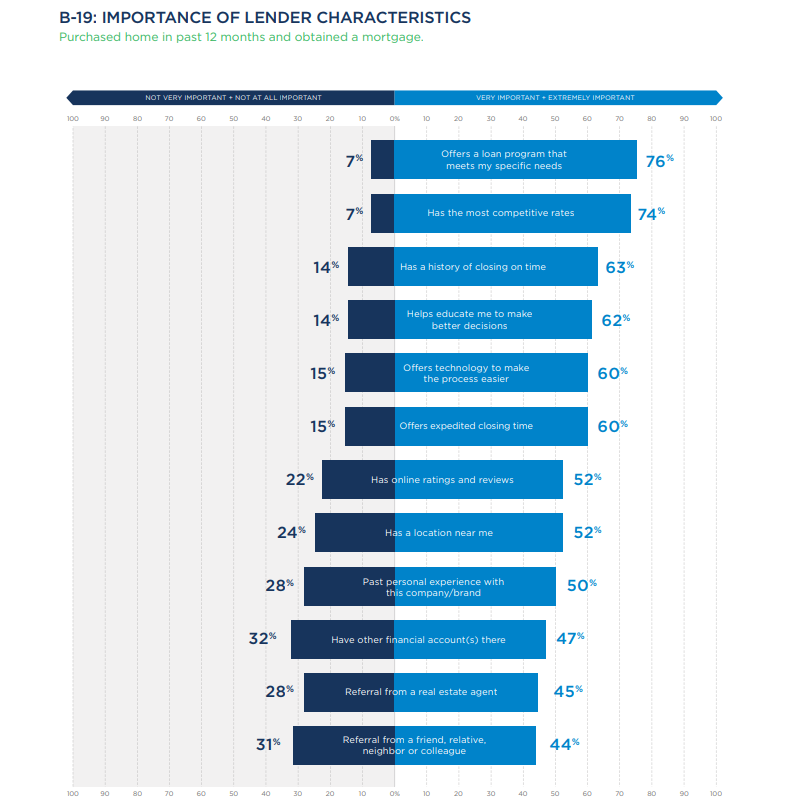
Zillow crunched the numbers and looked at the typical homebuyer in 2017. The typical buyer is 40 years old, making 87k. Millennials make up 42% of the cohort. They typically spend about 4.3 months finding a home. Interestingly, despite the size of the investment, most homebuyers only contacted 1 lender. Here is what is important to homebuyers when thinking about a lender:


The median home was sold in 81 days, and that includes the closing process. This means the typical home was on the market for only 1 month. This is 8 days faster than 2016. 

The National Low Income Housing Coalition has a new report showing how acute the housing shortage is at the low end. Only 35 affordable and available rental homes exist for every 100 extremely low income renter households. Rising home prices and mortgage rates are reducing affordability, however interest rates are still extremely low historically. In the early 80s, a the first year's mortgage payment consisted of 99% interest, 1% principal. 

The IMF forecasts that global growth will hit 3.9% this year, the fastest since 2011, driven by emerging Europe, and the US. 

Thursday, June 4, 2015

Morning Report - Bond Market Volatility

Vital Statistics:

Last Change Percent
S&P Futures  2107.4 -8.6 -0.41%
Eurostoxx Index 3552.8 -31.0 -0.87%
Oil (WTI) 58.92 -0.7 -1.21%
LIBOR 0.279 -0.004 -1.35%
US Dollar Index (DXY) 95.23 -0.237 -0.25%
10 Year Govt Bond Yield 2.34% -0.02%
Current Coupon Ginnie Mae TBA 101.1 0.1
Current Coupon Fannie Mae TBA 99.78 0.2
BankRate 30 Year Fixed Rate Mortgage 4.03

Stocks are lower this morning as talks in Greece stall. They have a big payment due to the IMF tomorrow.

Some labor market numbers this morning. Initial Jobless Claims fell to 276,000, a great number. That said, the final revision to productivity for the first quarter is in, and it fell to -3.1%. Unit Labor Costs rose 6.7%.

The IMF is urging the Fed to hold off raising rates until the first half of 2016. They also cut their forecast for US GDP growth from 3.1% to 2.5%, more or less matching what the Fed was forecasting at its March meeting. Given the weak Q1, that forecast is probably coming down in the June FOMC meeting. 

If you have been caught by surprise with the big moves in the bond market, you aren't alone. The volatility in the bond market has been stunning over the past several months. The mood of the markets seems to go from fear of deflation in Europe to fears of inflation in the US. Jim Bianco characterized the bond market like this: “You want to shove rates down to zero, people are going to make big bets because they don’t think it can last,” Bianco said. “Every move becomes a massive short squeeze or an epic collapse -- which is what we seem to be in the middle of right now.” IMO, the action in the markets is also a function of the fact that the major players in the markets right now are central banks, and they are taking positions based on social policy considerations, not economic ones. In other words, the ECB isn't buying bonds because it thinks they are cheap - it is buying them in an attempt to create inflation. When you have non-economic players (players that are not concerned about their p/l) dominating the market, the ones that do care about their p/l (everyone else) are bound to get whipsawed. 

Another issue is the fact that new regulations against proprietary trading has diminished the historical market stabilization role of trading desks. In the old days, when a big buyer or seller (say someone like a PIMCO) had an big order, they would find an investment bank to take the other side of the trade. The bank would bid (or offer) a little bit above or below the market and gradually work out of the trade over the course of the day or days. This had the effect of dampening volatility as it kept the market from getting whipsawed by big orders. Ironically, the regulatory push to "make banking boring again" has had the effect of making the government bond market anything but boring.

For mortgage bankers, the thing to keep in mind is that mortgage rates have been "fading" this volatility. In other words, they have been reluctant to follow big outsized moves. You can see it in the graph below, where the upper line is the Bankrate 30 year mortgage rate and the lower line is the US 10 year bond yield. Note how mortgage rates ignored the big dip in yields at the end of Janurary and have lagged the moves upward lately. Think about this when you are locking. If rates stop going up, mortgage rates will still probably keep rising to "catch up" with Treasuries. Even if rates fall, mortgage rates will probably stay up here for a while.  In a volatile market like this it doesn't make a lot of sense to be floating. Rates are still at historical lows, and can move up in a hurry. It would be shame to end up paying an extra 30 basis points on your mortgage because you were waiting to catch a rally that never came. 


Thursday, January 24, 2013

Morning Report - Orders increase 54% at KB Homes

Vital Statistics:

Last Change Percent
S&P Futures  1488.5 -1.8 -0.12%
Eurostoxx Index 2706.9 -1.4 -0.05%
Oil (WTI) 95.96 0.7 0.77%
LIBOR 0.301 -0.001 -0.17%
US Dollar Index (DXY) 80 0.083 0.10%
10 Year Govt Bond Yield 1.83% 0.01%
RPX Composite Real Estate Index 192.1 -0.1

Markets are lower after Apple stunk up the joint.  Initial Jobless Claims came in at 330k.  The Markit PMI came in at 56.1.  Bristol Myers and 3M beat expectations. Bonds and MBS are down small.

The IMF forecast world economic growth of 3.5% for 2013.  The US is forecast to grow 2%, with growth accelerating in 2H. The Euro area is expected to contract by .2%.

KB Homes reported that preliminary quarter-to-date net orders increased 54%.  Separately, they announced they are forming a home-loan company for its buyers with Nationstar. Concurrently, they are doing a $100MM secondary and a $200MM convertible bond issue priced at 1.375s up 50.

Obama is expected to name Mary Jo White as the new head of the SEC. A former prosecutor, she is expected to signal the importance of holding Wall Street accountable.

Bob Schiller is still cautious on housing.

The renovation boom continues.  As inventory remains small, many homeowners are choosing to upgrade current homes as opposed to buying new ones.  Are 203ks the next big thing?