A place where economics, financial markets, and real estate intersect.
Showing posts with label Zillow. Show all posts

Tuesday, April 17, 2018

Morning Report: Housing starts still below demand

Vital Statistics:

Last Change
S&P futures 2698 16.25
Eurostoxx index 379.67 1.95
Oil (WTI) 66.26 0.05
10 Year Government Bond Yield 2.83%
30 Year fixed rate mortgage 4.44%

Stocks are higher this morning as China relaxes ownership restrictions on domestic manufacturers. Bonds and MBS are flat. 

We have a lot of Fed-speak today, especially in the morning. Separately, Trump announced two Fed nominees: Richard Clarida of Columbia, to be the Vice Chairman of the Fed and Michelle Bowman, previously a bank executive from Kansas. For all of his criticism of the Fed while on the campaign trail, Trump has nominated pretty much middle-of-the-fairway people to the Board. 

Housing starts came in at 1.32 million, better than expectations but still well below what is needed to meet demand. Building Permits came in at 1.35 million. Single family starts fell, while multi rose. Most of the increase was in the Midwest. 

Industrial Production rose 0.5% last month, while manufacturing production rose 0.1%. Capacity Utilization increased to 78%. So far we aren't seeing any tariff effects in the numbers.

Bank of America announced earnings yesterday, and lumped mortgage banking income into the miscellaneous "all other income" category. What an ignominious end to Countrywide. Bank earnings season continues.

Independent mortgage bankers saw profit per loan get cut in half last year as refis dried up and the business got more competitive. Refis fell from 36% of all origination volume to 25%. 

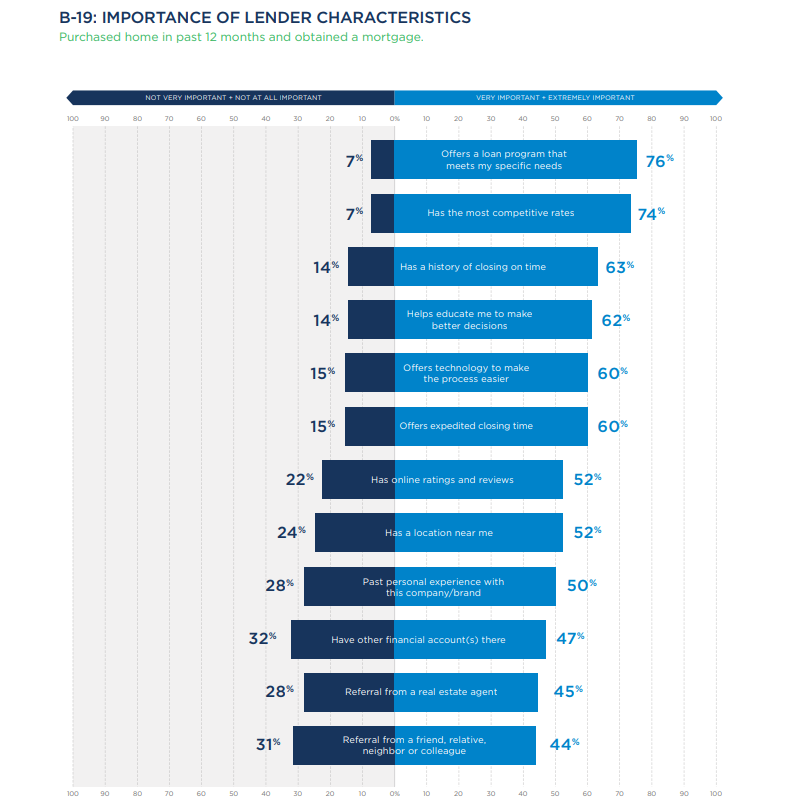
Zillow crunched the numbers and looked at the typical homebuyer in 2017. The typical buyer is 40 years old, making 87k. Millennials make up 42% of the cohort. They typically spend about 4.3 months finding a home. Interestingly, despite the size of the investment, most homebuyers only contacted 1 lender. Here is what is important to homebuyers when thinking about a lender:

The median home was sold in 81 days, and that includes the closing process. This means the typical home was on the market for only 1 month. This is 8 days faster than 2016. 

The National Low Income Housing Coalition has a new report showing how acute the housing shortage is at the low end. Only 35 affordable and available rental homes exist for every 100 extremely low income renter households. Rising home prices and mortgage rates are reducing affordability, however interest rates are still extremely low historically. In the early 80s, a the first year's mortgage payment consisted of 99% interest, 1% principal. 

The IMF forecasts that global growth will hit 3.9% this year, the fastest since 2011, driven by emerging Europe, and the US. 

Monday, April 16, 2018

Morning Report: Zillow gets slammed after changing its business model

Vital Statistics:

Last Change
S&P futures 2672 14
Eurostoxx index 378.3 -0.91
Oil (WTI) 66.56 -0.84
10 Year Government Bond Yield 2.87%
30 Year fixed rate mortgage 4.44%

Stocks are higher despite coordinated strike in Syria over the weekend. Bonds and MBS are down. 

Watch the oil markets. North Sea Brent crude is rising on tensions in the Middle East, but West Texas Intermediate (which is the main oil used in the US) is shrugging off the news. Bullish bets on Brent oil have hit record highs

The 2 year hit 2.4%, the highest level since 2008. The flattening of the US yield curve continues. 

There isn't much in the way of market-moving data this week, although we will get a lot of Fed-speak. Probably the biggest one will be housing starts tomorrow. 

Retail sales rose 0.6% in March, which was better than the Street 0.4% consensus. The control group increased by 0.4%, a touch below the 0.5% consensus estimate. Gasoline sales were up on higher prices. Revisions were lower, however. 

Business activity in New York State decelerated last month according to the Empire State Manufacturing Survey. New Orders and Production slowed down somewhat, but employment remained firm and the workweek increased. Future sentiment declined to the lowest level in 2 years.

The NAHB / Wells Fargo Housing Market Index slipped last month, but builder sentiment remains strong. 

Wells Fargo faces $1 billion in fines due to force-placed auto insurance and improper charges for lock extensions. The big banks have all reported strong earnings, and the tax law changes are certainly helping. 

Zillow shares fell 9% on news they plan to get into the house flipping business. "We're entering that market and think we have huge advantages because we have access to the huge audience of sellers and buyers," Zillow CEO Spencer Rascoff said on CNBC's "Squawk Alley." "After testing for a year in a marketplace model, we're ready to be an investor in our own marketplace." Investors are understandably skeptical, as the multiple for a fintech company is much higher than one for a property company, and it puts Zillow in direct competition with the realtors who utilize the site. Investors are not wild about changing focus from an ad model with high margins and low balance sheet usage to one that is low margin and uses a lot of balance sheet. Another issue: will people trust Z-scores if the company has a financial interest in the value of real estate in a particular area?

Want to know how acute the housing shortage is in California? From 2000 - 2015, the state built 3.4 million too few homes to keep up with job, population, and income growth. That is over 2 year's worth of current housing starts for the whole US population. Pretty astounding when you consider those years start before the housing bubble really got going. CA has always had NIMBY issues, and now there is a push to allow dense multi-family building near public transit, even if local zoning codes prohibit it. Separately, it looks like Dodd-Frank regulations did have an adverse affect on smaller banks. I wonder how much that plays into the housing shortage. 

Speaking of CA housing, here is what you can get for $800,000 in San Jose. Handyman special. 

Tuesday, July 11, 2017

Morning Report: Hiring and quits are rising

Vital Statistics:

Last Change
S&P Futures  2422.0 -2.0
Eurostoxx Index 380.1 -1.6
Oil (WTI) 44.1 -0.3
US dollar index 88.4 0.1
10 Year Govt Bond Yield 2.39%
Current Coupon Fannie Mae TBA 102.88
Current Coupon Ginnie Mae TBA 103.75
30 Year Fixed Rate Mortgage 4.05

Stocks are lower this morning on no real news. Bonds and MBS are flat.

Job openings fell slightly in May to 5.7 million, according to the BLS. The number of hires increased by 430k to 5.5 million. The quits rate increased to 2.2 million. The quits rate is a key indicator that carries a lot of weight with the Fed. An increase in the quits rate usually is an indicator of future wage inflation. The quits rate is back to pre-crisis levels.


Small business optimism declined in June, according to the NFIB. We are still higher than we were pre-election, but some of the optimism is fading as it looks like tax reform and healthcare reform are not going to happen. Employment-related indicators ticked down, but are still very strong. 85% of all respondents that tried to hire reported that there were few or no candidates with the required experience. Rising compensation will draw more people into the workforce, however that will be a slow process. Note that much of the drop in the labor force participation rate has been due to people aging out. The first big question is whether these people want back into the workforce or are content to stay retired. The second big question is whether ageism will keep these people out. 

Consumers are becoming more optimistic according to the New York Fed. Nearly 35% of all respondents said they are better off now than they were a year ago, and they are less worried about losing their jobs. Consumers also said they expect to spend about 3.3% more in the coming year than they did last year.

Are appraisers going to be replaced by artificial intelligence and / or algorithms like Zillow's Z-estimates? Some people think so. Zillow has been tweaking its model to take into account more than just the comps - now it will include things like interior amenities. This may happen out of necessity: the regulators raised the barriers to entry so high that the pipeline of new people entering the profession is almost nothing (In 2005, 1,200 people entered the profession. Now it is 100). The average age of an appraiser is 58 and there simply isn't a stream of replacements. Freddie Mac is now willing to accept model-generated appraisals for some refis and is asking FHFA for permission to use more. It kind of begs the question of why the government then thinks appraisers need to have so much education and apprenticeship time if it is willing to accept modeled values to begin with. 

Mortgage performance improved last month according to CoreLogic. 4.8% of all mortgages were 30 days down in April compared to 5.3% the year prior. That said, early stage delinquencies (30 - 60 days down) ticked up to 2.2% from 2% the year before. 60-90 day DQs were roughly flat YOY. Some of the drop in performance is coming from the energy-intensive states like Alaska and North Dakota. Now that oil cannot seem to get out of its own way, we may start seeing more trouble in the oil patch. 

The CFPB has released a new rule making it easier for class-action suits against lenders. Financial firms will be restricted in their ability to use mandatory arbitration clauses to protect themselves against lawsuits. Under the Congressional Review Act, Congress has 60 days to overturn the new rule. The OCC has asked the CFPB for their data, and Republican Jeb Hensarling has already come out against it. 

Wednesday, October 19, 2016

Morning Report: Housing starts disappoint

Vital Statistics:

Last Change
S&P Futures  2137.5 4.0
Eurostoxx Index 343.1 0.6
Oil (WTI) 51.1 0.8
US dollar index 88.0 0.0
10 Year Govt Bond Yield 1.76%
Current Coupon Fannie Mae TBA 103.3
Current Coupon Ginnie Mae TBA 104.2
30 Year Fixed Rate Mortgage 3.57

Stocks are up this morning as earnings reports continue to pile in. Bonds and MBS are flat.

Mortgage Applications rose 0.6% last week as purchases rose 3% and refis fell 1%. 

Housing starts fell to a 1.05 million pace in September, driven by a big drop in multi-fam. Single fam was up around 8%. Building Permits rose to 1.23 million. Housing continues to be the biggest underperformer in the economy, but the subject hasn't really come up in this election, for either side. 

We have some Fed-speak today, with John Williams speaking at 8:45, Rob Kaplan at 1:30 and William Dudley tonight. 

The final debate is tonight, and it looks like Hillary is pulling away from Trump at this point. The black swan event for the markets is a Democratic Party sweep, which will probably cause the stock market to spit up a hairball. 

Lending standards in the jumbo space are loosening, even as the luxury end of the housing market underperforms. Loan Depot is now offering 40 year jumbo products that are interest-only for the first 10 years. Redwood is now offering a 90 LTV product that goes down to a 660 FICO. 

The NAR is releasing its latest Profile of Home Buyers and Sellers. Here are the big changes over the past 35 years.
  • The first time homebuyer is a smaller percentage than it has been in the past. 
  • The internet is not replacing the real estate agent
  • Houses have been getting bigger of the past 30 years, but have leveled out in recent years
  • Down payments have been going down
  • The home search process is taking longer than ever due to tight inventory
Zillow has their own report on trends in housing. Here is the executive summary (the report is very long and detailed): 

"The home buying experience is both an intimidating financial transaction and an emotional milestone. Half of home buyers in the U.S. are under 36, meaning a new generation— Millennials—is shaping the future of real estate. Despite demographic reports about young adults’ urban lifestyles, Millennials share their parents’ aspirations for a single-family home, often in the suburbs. 

The process of finding or selling a home is much more collaborative for Millennials than for older generations. They bring all available tools to the process, including their smartphones, social media and online networks. While older generations rely on real estate agents for information and expertise, Millennials expect real estate agents to become trusted advisers and strategic partners. 

Millennial home buyers are also diverse. While only 9 percent of all homeowners are Hispanic, nearly 15 percent of the Millennials buying homes are Hispanic—reflecting the changing demographics of the American middle class. 

Homeownership remains a vehicle for wealth in the U.S., but it can also be a financial burden, as families stretch their finances to afford the space they need, and large, dated homes owned by Baby Boomers and the Silent Generation demand maintenance and improvements."

Thursday, December 10, 2015

Morning Report: Competition for Zillow's Z-estimate

Vital Statistics:

Last Change Percent
S&P Futures  2046.7 4.6 0.23%
Eurostoxx Index 3272.4 -4.8 -0.15%
Oil (WTI) 36.83 -0.3 -0.89%
LIBOR 0.487 0.010 1.99%
US Dollar Index (DXY) 97.7 0.358 0.37%
10 Year Govt Bond Yield 2.22% 0.00%
Current Coupon Ginnie Mae TBA 104.5
Current Coupon Fannie Mae TBA 103.3
BankRate 30 Year Fixed Rate Mortgage 3.92

Markets are rebounding this morning after several days of losses. Bonds and MBS are flat. 

Initial Jobless Claims rose 13k to 282,000 last week. The story remains the same: companies are reluctant to let go of employees. 

Import prices fell 0.4% in November and are down 9.4% year over year. Blame low commodity prices. Note that some strategists are starting to say the downside in oil is limited at these prices.

The Bloomberg Consumer Comfort Index rose to 40.1 from 39.6 the prior week. 

Everyone knows to treat Zillow's Z-estimates with a grain of salt. Pre-crisis, they generally overstated property values and post-crisis, they have generally been low. Their median error rate is something like 8% (which is calculated by measuring the difference between the modeled value of a house and what it actually sells for). Now Redfin is rolling out their own model, which they claim has an error rate closer to 2%. 

Rental prices in Manhattan have risen so much that potential renters are balking at the asking prices. Rental vacancies are at the highest level since 2006. In November, the median monthly rent in Manhattan rose to $3661, up 4% YOY.