A place where economics, financial markets, and real estate intersect.
Showing posts with label CFPB. Show all posts

Thursday, August 23, 2018

Morning Report: No surprises in the FOMC minutes

Vital Statistics:

Last Change
S&P futures 2858 -2.75
Eurostoxx index 384.09 0.07
Oil (WTI) 67.46 -0.4
10 Year Government Bond Yield 2.81%
30 Year fixed rate mortgage 4.58%

Stocks are flattish this morning on no real news. Bonds and MBS are flat.

The FOMC minutes didn't offer anything too surprising. Most participants said it would be appropriate to raise rates soon, which wasn't a surprise - the Fed Funds futures have a Sep hike as pretty much a sure thing. They worried about how trade could be a downside risk to the economy, especially if it affects business sentiment, investment and employment. They mentioned that in the "not too distant future" monetary policy will no longer be viewed as accomodative. This statement seems to hint that rate hikes should wind up next year, provided inflation remains around these levels. Note that the head of the Dallas Fed suggested that the tightening cycle might be done once we get 75 - 100 basis points higher on the Fed Funds rate.  Bonds didn't react to the minutes at all, and the Fed Funds futures didn't budge either. 

There wasn't much talk about reducing the size of the balance sheet, which is more or less on autopilot right now. As the yield curve flattens, you would think the Fed would consider getting more aggressive on the balance sheet unwind. Maybe not on the mortgage backed securities side, but on the Treasury side. If credit is still widely available and the demand is there, why not? If the ducks are quacking, feed 'em. 

Central Bankers are meeting in Jackson Hole today. There usually isn't much in the way of market-moving statements out of these things, but just be aware. 

Initial Jobless Claims fell to 210,000 last week. We are bumping around levels not seen since 1969. When you consider the fact that the US population was only 200 MM back then (compared to 325 MM today), it is even more impressive. It certainly has economists scratching their heads. 

Home prices rose 0.2% in June and 1.1% for the second quarter, according to the FHFA House Price Index. The second quarter's pace was the slowest increase in 4 years, which shows that higher interest rates are beginning to have an effect on prices. Prices did rise in all 50 states and 99 out of 100 MSAs. 5 states (NV, ID, DC, UT, and WA) had double digit increases. The Las Vegas MSA had the biggest increase - almost 19%. The laggards were CT, AK, ND, LA, and WV. 


Heidi Heitkamp, a moderate Democrat from North Dakota says she will not support Kathy Kraninger to run the CFPB. She said she was inclined to vote yes, however she is concerned about Kraninger's experience in consumer protection and also felt she "lacked empathy" for consumers and didn't believe in the Bureau's mission. Heitkamp has been supportive of regulatory relief, which means she was a gettable vote. Kraninger's nomination looks largely to fall along partisan lines now. 

New Home Sales fell 1.7% MOM to 627,000, which was below the Street estimate of 649,000. It is up 12.8% on a YOY basis however. The new home inventory situation is getting more balanced, with 5.9 month's worth of supply. As always, the question is whether that inventory represents the oversupplied luxury market or the undersupplied starter market. 

Thursday, July 19, 2018

Morning Report: Leading Indicators show strong growth ahead

Vital Statistics:

Last Change
S&P futures 2808 -8.25
Eurostoxx index 386.86 -18
Oil (WTI) 68.23 -0.53
10 Year Government Bond Yield 2.87%
30 Year fixed rate mortgage 4.51%

Stocks are lower as earnings continue to come in. Bonds and MBS are down.

Initial Jobless Claims fell to 207,000 last week, which is the lowest level since 1969. Despite the tightness of the labor market, wage growth is tough to come by.

I have discussed at length the disconnect between the Northeast and the rest of the country when it comes to the real estate market. It turns out that not only does the real estate market lag, so does mortgage banking. Last year was a rough year for mortgage banking, and the typical profit per loan was about 31 basis points. That varied by region, with the Midwest in the lead at 39 basis points while the Northeast lagged at 8. 


The Fed's Beige Book characterized the economy as strong, and said that labor shortages are beginning to impede growth. Engineers, skilled construction workers, truck drivers, and IT professionals are in short supply. So far increasing input prices are not translating into higher inflation - corporate margins are taking the hit. Residential housing continues to improve ever so slowly, and commercial real estate is flat. Overall, the picture points to a strong economy, with room to run. The lack of pricing pressures gives the Fed the leeway to go slow as they get off the zero bound. 

The Conference Board echoed this assessment, with the Index of Leading Economic Indicators increasing 0.5% in June. The LEI is still rising faster than the CEI (basically the future indicators are showing that growth should accelerate) which means we have no sign of a slowdown.


Kathy Kraninger, the Administration's nominee to run the CFPB, will appear before the Senate Banking Committee today. Little is known about her views on financial regulation. Congressional aides have said that she will have enough support to pass the Committee on a party-line vote. In her prepared remarks, she said she will continue Mick Mulvaney's work of balancing the need for consumer protection with the need to treat the financial sector fairly. Suffice it to say, having come from OBM, she doesn't really fit the type of bureaucrat who would normally be tapped to run the CFPB, and that may be the point. If her nomination bogs down, Mick Mulvaney can continue to run the agency.

Interesting stat: 70% of the Millennials who own a home have buyer's remorse. Many used their retirement savings to fund the down payment, which is generally a bad move. Many first time home buyers completely underestimate closing costs as well. Others underestimated the costs of upkeep, which is around $16,000 a year. I suspect many of these lessons are learned by every generation who buys their first home. 

The CoreLogic Mortgage Fraud Risk Index rose 12% in the second quarter compared to a year ago. An increase in borrowers taking on loans for multiple properties (i.e more professional investors) appeared to drive the increase. 

Wednesday, July 11, 2018

Morning Report: Quits rate jumps in May

Vital Statistics:

Last Change
S&P futures 2781 -11
Eurostoxx index 382.05 -4.2
Oil (WTI) 73.29 -0.82
10 Year Government Bond Yield 2.85%
30 Year fixed rate mortgage 4.53%

Stocks are lower this morning after Trump threatened tariffs on $200 billion worth of Chinese goods. Bonds and MBS are flat. 

China has vowed to retaliate if the Trump Administration follows through on its threat to impose 10% tariffs on about $200 billion worth of Chinese goods. Since China imports far less than $200 billion from the US, they may have to come up with other measures to retaliate - anything from denying visas to limiting tourism and increasing regulatory measures. Strategists are beginning to warn that the trade war could derail the recovery. 

Inflation at the wholesale level increased in June, according to the PPI. The headline number rose 0.3% MOM / 3.4% YOY. Ex food and energy, it was up 0.3% / 2.8% and ex food energy and trade services 0.3% / 2.7%. Services and motor vehicles drove the increase. 

Donald Trump nominated Brett Kavanaugh to the Supreme Court yesterday. He is generally a regulatory skeptic, and has ruled against overreach in the past. He has already weighed in on the CFPB, which he believes is unconstitutional. From CFPB vs PHH, writing for the majority: "The CFPB’s concentration of enormous executive power in a single, unaccountable, unchecked Director not only departs from settled historical practice, but also poses a far greater risk of arbitrary decision-making and abuse of power, and a far greater threat to individual liberty, than does a multi-member independent agency. The overarching constitutional concern with independent agencies is that the agencies are unchecked by the president, the official who is accountable to the people and who is responsible under Article II for the exercise of executive power." That said, Kennedy was already considered a vote against the CFPB, so the nomination won't move the needle there. 

Kavanaugh has also ruled against the EPA, which generally ignored the "cost" side of the "cost / benefit" analysis of regulations during the Obama Administration. Overall the regulatory environment for the financial industry could get a little easier with Kavanaugh on the Court. 

Speaking of the CFPB, Brian Johnson has been tapped to be the #2 of the agency. He replaces Leandra English, who resigned last week. 

Small business optimism remains elevated despite trade concerns, according to the NFIB Small Business Optimism Survey.  Employment continues to grow, with 1 in 5 firms adding employees in June on net. Sales are up overall, but margins appear to be facing pressure from higher labor and input prices. Credit needs are being fully met. 

Job openings fell to 6.6 million in May, which was just off the record high of 6.8 million set in April. Hires were strong at 5.8 million, led by health care and social assistance. The big number was the quits rate, which is one of the best leading indicators of wage inflation. It rose to 2.4%. 


The big question remains: how much slack is there really in the labor market? Most of the official numbers imply there is none. Yet, there is only modest wage inflation. I suspect the employment-population ratio tells the real story, and that number has yet to really recover from the Great Recession. Demographics are part of the story, but as people work longer, the assumption of 65 = retirement might have to change. I suspect many of those who are retired would gladly take a job if offered. 

For the construction sector, the number of unfilled jobs hit a record high. That sector has been facing labor constraints for quite some time, and this partially explains why housing starts have been so far below what is needed to meet demand. 


Mortgage Applications increased 2.5% last week as purchases rose 7% and refis fell 4%. Last week included the 4th of July, so there are all sorts of adjustments baked into that number. Refis fell under 35%, the lowest number since August 2008. ARMS decreased to 6.3%. Overall rates fell about 3-4 basis points last week. 

Meanwhile, the MBA's mortgage credit availability index improved last month as increases in conventional and jumbo availability offset a contraction in government. 

Friday, June 22, 2018

Morning Report: Administration proposes to privatize the GSEs

Vital Statistics:

Last Change
S&P futures 2767 14
Eurostoxx index 384.04 3.19
Oil (WTI) 67.44 1.9
10 Year Government Bond Yield 2.92%
30 Year fixed rate mortgage 4.57%

Stocks are higher on no real news. Bonds and MBS are flat.

The Trump administration released a set of principles around privatizing the GSEs. It is more or less the same thing as before - the goal is to lessen the government's footprint in the mortgage market. The idea would be to have Fannie and Fred issue MBS with a catstrophic government guarantee - in other words, some private mortgage insurer would bear the initial losses and the government would only step in if the losses exceeded that number. That is all well and good, however there are all sorts of issues that remain before private label MBS can do the heavy lifting of the mortgage market. 

First and foremost, there is a huge gulf between what the MBS investor market requires as a rate of return and current mortgage rates. In a perfect world, PL MBS would trade at similar levels to Fannie / Freddie MBS, but they won't. There are huge governance issues that need to be resolved. For just one example, will the servicer (who is probably the issuer, who may also have a second lien) service the loan to benefit the MBS holder or themselves? What about reps and warranties? I went into more depth about this whole issue here. These uncertainties need to be priced in, which means that the bid / ask spread between private label and FNMA MBS is so large that nobody would take out a mortgage at the rate the private label investors require. That is a necessary but not sufficient requirement to bring back private money into the US mortgage market. 

Taking the GSEs out of conservatorship is going to require legislation, and to be honest it isn't a priority for either party. As far as DC is concerned, yes it would be nice if the government could lessen its footprint in the mortgage market, but people are getting loans, and the market is functioning normally. It just isn't a priority. 

The US borrower believes that the 30 year fixed rate mortgage is nothing unusual. In fact, it is a distinctly American phenomenon, where the borrower bears no risk. In the rest of the world, mortgages are adjustable rate, and not guaranteed by the government. In other words, the borrower bears the interest rate risk and the bank bears the credit risk. In the US, the bank bears the interest rate risk and the taxpayer bears the credit risk. Upsetting that apple cart is going to be a tough slog politically. 

Finally, the news did nothing for the stocks of Fannie and Fred, which continue to languish. When the government took over Fannie and Fred, they left 20% of the common outstanding. This was an accounting gimmick to prevent the government from having to consolidate Fan and Fred debt on its balance sheet (incidentally, this was the reason why LBJ privatized the GSEs in the first place). The government could not take the GSEs through a bankruptcy without creating chaos in the mortgage market. So they left 20% outstanding and decided to deal with the bankruptcy part later. The stock should be worthless, but it is a litigation lottery ticket.


A Federal Judge ruled yesterday that the CFPB's structure is unconstitutional. The PHH case never made it to SCOTUS, but it will be interesting if this one does. At some point, the CFPBs structure will make it to SCOTUS, and the only one with the standing to defend the agency is the government. 

Tuesday, June 19, 2018

Morning Report: Housing starts jump despite higher lumber prices

Vital Statistics:

Last Change
S&P futures 2752 -28
Eurostoxx index 382.86 -3.1
Oil (WTI) 64.89 -0.96
10 Year Government Bond Yield 2.88%
30 Year fixed rate mortgage 4.57%

Stocks are lower this morning on increasing trade tensions with China. Bonds and MBS are up. 

Trump threatened $200 billion in sanctions on Chinese goods, which sent global markets down and bonds up. This is in addition to the $50 billion in tariffs he threatened on Friday. Stock market investors are swapping out of S&Ps and Nasdaqs into smaller cap stocks, as they are more insulated from international trade tensions. 

Housing starts improved to 1.35 million in May, which is up 5% MOM and 20% YOY. Building permits came in at 1.3 million, down 5% MOM, but up 8% YOY. Most of the activity was in the Midwest, where they increased by 100k. The Northeast was down, while everywhere else was flattish. Tariffs on Canadian lumber certainly aren't helping. Lumber prices peaked in May and are starting to decline, but they have had quite the run. The NAHB report yesterday discussed lumber prices are hurting builder confidence. 


Trump formally nominated Kathleen Kraninger to replace Mick Mulvaney as the head of the CFPB. This promised to be a contentious confirmation fight, and the usual suspects are already complaining. That may actually work out in the Administration's favor however. The tougher the confirmation fight, the longer Mick Mulvaney can remain in place and fix some of the excesses of the Bureau. Under the Vacancies Act, Mulvaney's term as Acting Director expires on June 22. He can remain in place while her nomination is pending. If she is defeated, he would get another 210 days. If that nominee is defeated, he gets another 210. So basically, this gambit would keep Mick Mulvaney in place until 2020.

Where are Millennials moving? Where the jobs are

Monday, June 18, 2018

Morning Report: Will the US have a Wile E Coyote moment in 2019?

Vital Statistics:

Last Change
S&P futures 2765.5 -19
Eurostoxx index 385 -3.9
Oil (WTI) 65.16 0.1
10 Year Government Bond Yield 2.91%
30 Year fixed rate mortgage 4.57%

Stocks are lower this morning on trade fears. Bonds and MBS are up. 

We will get a lot of housing-related data this week, but nothing should be market-moving. We will get housing starts and building permits tomorrow, existing home sales on Wednesday, and house prices on Thursday. Otherwise, should be a relatively quiet week. 

The NAHB Housing Market Index (a sentiment indicator for the homebuilders) fell to 68 last month from 70. Rental markets are softening in some of the more pricy MSAs.

OMB official Kathy Kraninger is supposedly the front-runner to replace Mick Mulvaney as the permanent director of the CFPB. The confirmation process will probably take at least through the end of the year. She is not viewed as any sort of financial regulatory expert, so expect to see a lot of objections from Democrats over the nomination.

Ben Bernanke thinks the US economy will have a Wile E Coyote moment in 2019 or 2020 when the tax cut stimulus wears off. His point is that we are enacting fiscal stimulus at "exactly the wrong time" when the economy is already at full employment. Of course the statement about full employment is debatable. The unemployment numbers indicate we are, but the employment-population ratio does not. The employment-population ratio currently stands at 60.4%, and pre-crisis, we were around 63%. That 2.6% difference works out to be about 8.5 million people. We are getting some modest real wage growth (average hourly earnings are up 2.7% YOY and the core PCE index is growing at 2%) however broad-based wage growth probably isn't going to happen until the EP ratio gets back up around 63%. Yes, there is a demographic element to this with the baby boomers retiring, but that is overplayed. Many people who are retiring in their 60s would rather work. You can see just how bad the Great Recession was. Most of the gains that started in the 60s with women entering the workforce were given back. The "retiring boomers" narrative has a kernel of truth in it, but it isn't driving it. 


The FAANG stocks are now worth more than the entire UK stock market. While people talk about short Treasuries as being the most crowded trade on the Street, it doesn't hold a candle to the FAANGs


Goldman's model now suggests the US economy grew at 4% in the second quarter. Friday's Empire State Manufacturing Survey was the catalyst for the upgrade. 

The government is trying to clarify the Volcker Rule, which prohibits banks from proprietary trading. So far, it seems to be clouding the issue as opposed to clarifying it. Ultimately trades held for less than 60 days are considered proprietary trades although there is a carve-out for hedging and market-making. Given the drop in commissions over the past 20 years, and sub-penny bid ask spreads, the economics of market-making are terrible to begin with, but the regulatory uncertainty probably seals the deal. The next crash is not going to be pretty. 

Monday, June 11, 2018

Morning Report: Big week ahead

Vital Statistics:

Last Change
S&P futures 2782 -0.5
Eurostoxx index 386.55 1.43
Oil (WTI) 65.12 -0.61
10 Year Government Bond Yield 2.96%
30 Year fixed rate mortgage 4.59%

Stocks are flattish this morning ahead of a busy week. Bonds and MBS are down small. 

This is a big week with the FOMC meeting on Tuesday and Wednesday, the ECB, and also a slew of economic data, particularly inflation data. The FOMC meeting will dominate, and we will also get a fresh new set of projections. The Street will focus on the inflation projections, especially as we continue to get anecdotal evidence of wage inflation. 

The G7 met over the weekend, and it largely consisted of Donald Trump playing Al Czervik to the Bushwood global elite. There is talk about us doing permanent damage to our allies, but these events are largely messaging affairs and nothing much concrete ever comes out of them. There were a bunch of threats and counter-threats over trade barriers, and the message from the Administration was that the US has historically accepted the short end of the stick on these trade deals in the name of free trade in general, but those days are over. Will anything actually come from this? Probably not, which is why the markets don't care. 

Trump left the G7 meeting early to head to the Singapore Summit to meet with Kim Jong Un. 

CFPB Director Mick Mulvaney said on Friday that he fired the 3 advisory boards because they were simply too big. He said that many participants were uncomfortable being candid at these meetings, and that "There is actually some good information that can pass when you sort of turn the cameras off." Mulvaney has also been frustrated by leaks coming out of the agency, and he hopes this will help. Mulvaney also intends for the CFPB to go out "in the field" and have more town hall discussion meetings. 

The interest rate on excess reserves is a real "inside baseball" statistic that could hold some clues on how the Fed intends to proceed going forward. The Fed is worried that conditions are tightening in the money markets and there are less excess reserves (excess reserves in another name for "dry powder" in the banking system). If there is less dry powder (or lending capacity) in the system then borrowers will have to accept higher rates in order to access these funds. The Fed funds rate is already close to the high end of the target range, which is worrying the some on the FOMC. The Fed started unwinding its QE balance sheet, letting about $100 billion of its $4.5 trillion sheet run off. We are already seeing a swoon in emerging markets. Bottom line: tightening financial conditions could cause the Fed to take a breather sooner than anticipated. 


Rising interest rates and home prices are not deterring potential home purchasers, as the Fannie Mae Home Purchase Sentiment Index hit a new high in May. “The HPSI edged up to another survey high in May, bolstered in part by a fresh record high in the net share of consumers who say it’s a good time to sell a home. However, the perception of high home prices that underlies this optimism cuts both ways, boosting not only the good-time-to-sell sentiment but also the view that it’s a bad time to buy, and presenting a potential dilemma for repeat buyers,” said Doug Duncan, senior vice president and chief economist at Fannie Mae.


Thursday, June 7, 2018

Morning Report: Changes afoot at the CFPB

Vital Statistics:

Last Change
S&P futures 2774 1.75
Eurostoxx index 386.72 -0.16
Oil (WTI) 65.25 0.52
10 Year Government Bond Yield 2.98%
30 Year fixed rate mortgage 4.58%

Stocks are higher this morning as trade tensions with China ease. Bonds and MBS are lower.

Initial Jobless Claims fell to 222k last week. We are still bouncing around lows that we haven't seen since the Vietnam War. 

Changes are afoot at the CFPB. First, Mick Mulvaney dismissed all 25 members of the Consumer Advisory Board in order to cut costs and increase the diversity of voices. The Community Bank Advisory Board and the Credit Union Advisory Board were also terminated. Apparently, these committees were traveling to DC on taxpayer expense. Many of these people are simply professional political activists in the business of raising money for liberal candidates, and were often given funds from settlements - in other words, it was a bit of a political money-laundering operation. So, there is no reason for an agency under a Republican Administration to fund the Democratic political machine. Also, the Obama / Cordray CFPB was one-sided - they listened only to consumer advocates and had zero interest in input from the industry. For better or worse, you make better policy when you have input from the people who will be affected by your rules and regulations. 

Separately, the CFPB is prepared to dismiss its case against PHH. The PHH case is a tricky one, where the CFPB unilaterally increased a judge's $6 million penalty to $106 million. PHH won a big victory last January when an appeals court threw out the judgement. There structure of the Agency was also brought into question during this case, which helps explain why the CFPB is anxious to make this case go away. 

Independent mortgage bankers lost money on average in the first quarter, according to the MBA. Net production losses were $118 per loan (or about 8 basis points). The last time we saw something similar was the first quarter in 2014. The first quarter is always a seasonally weak period.  Declining volumes, increasing costs, and thinner margins are driving the losses. Net secondary marketing income was more or less flat, and purchases accounted for 71% of the volume. Pull-through rates fell to 70% from 74% in the fourth quarter. Production expenses and personnel expenses increased quite a bit, to almost $9,000 a loan. That number has been closer to $6,200 since 2008. Productivity also fell to 1.9 loans per employee from 2 loans in the fourth quarter. 

Chinese money has been pushing up real estate prices in many cities, from Vancouver to Seattle, to Sydney. Local governments are finding more and more of their citizens are being priced out of the market and are trying to do something about it. In Vancouver, prices were appreciating at an annual rate of 30% before the government imposed a foreign investments tax. The money then left and moved to Toronto. Ultimately probably nothing will change until the Chinese real estate bubble bursts, and no one has any idea when that will happen. One thing is for sure, however. When the bubble does burst, these cities will get hit first. In a financial crisis, you sell what you can, not what you want to. 


Apparently the market cap of the FAANG stocks (Facebook, Amazon, Apple, Netflix, and Google) is now higher than the GDP of Germany. Most crowded trade since the Nifty 50 in the 1970s. 

Tuesday, June 5, 2018

Morning Report: Job openings equals number of unemployed

Vital Statistics:

Last Change
S&P futures 2747 1.75
Eurostoxx index 388.56 0.45
Oil (WTI) 64.56 -0.19
10 Year Government Bond Yield 2.91%
30 Year fixed rate mortgage 4.54%

Stocks are higher this morning on no real news. Bonds and MBS are flat. 

Job openings continue to creep upward, hitting 6.7 million in April, which is just about the number of unemployed people in the country. Job openings increased in manufacturing, but fell in finance. The quits rate was flat MOM at 2.3% and is up about 20 bps since last year. The quits rate is a strong predictor of wage inflation, as it measures people leaving jobs to take new, higher paying ones. Below is a chart of the quits rate versus wage growth. Wage inflation is a bit more volatile, but the correlation is pretty tight. 


The ISM non-manufacturing index rose in May to 58.6. The current level historically corresponds to a GDP growth rate of around 3.5%. Tariffs are weighing on many sectors however. 

The House Financial Services Committee will hold a hearing tomorrow to discuss transparency and accountability at the CFPB. This hearing is the result of a memo from Mick Mulvaney, which recommended that the CFPB be subject to Congressional appropriation, that major rules be passed by legislation, that there be an independent Inspector General, and recommended that the agency report to the President. 

Home prices rose 1.2% in April, according to CoreLogic. On a YOY basis, they are up 6.9%. They expect home price appreciation to moderate over the next year and increase about 5%. Much of the country's real estate is becoming overvalued, according to CoreLogic's model - in fact, over half. The valuation metric is based on incomes, which is why an expensive market like San Francisco may appear fairly valued, while areas on the Gulf Coast may seem overvalued. 


The first time homebuyer accounted for almost half the Freddie Mac purchase market, the highest since 2012, when Freddie first started tracking this statistic. The Bloomberg headline is terrible - the first time homebuyer does not account for almost half of mortgages. 40% are refis and the first time homebuyer is about 32% of existing home sales. 

Over the past 2 years, about 4.4 million jobs have been added in the US. How many houses have been built? 2.4 million. Great illustration of just how acute the housing shortage is. 

Thursday, May 17, 2018

Morning Report: The REO-to-Rental trade earned 9% a year

Vital Statistics:

Last Change
S&P futures 2718.5 -4.5
Eurostoxx index 394.21 1
Oil (WTI) 72.15 0.66
10 Year Government Bond Yield 3.10%
30 Year fixed rate mortgage 4.65%

Stocks are lower this morning on bad earnings from Cisco. Bonds and MBS are down small. 

The US and China will enter trade talks over the next couple of days. Both sides have signaled willing to make some compromises, so this could potentially be good for interest rates.

Initial Jobless Claims came in at 222k last week, while the Philly Fed improved to 34.4 which is a strong reading. The Index of Leading Economic Indicators rose a respectable 0.4%. 

One of the reasons why starter homes have been so tough to find has been the REO-to-rental trade, where professional investors scooped up REO properties early in the crisis and rented them out. CoreLogic crunched the numbers and it turns out the trade made about 9% per year for the past 5 years. Impressive return in an environment of financial repression. Most of the return came from home price appreciation however, so if prices begin to level out, some of these professional investors will turn sellers. This is especially true if they had these properties in funds with a life. As short term interest rates rise, the low single-digit rental return will have more competition. 


While longer-term bonds can be used as a proxy to estimate future inflation, Treasury Inflation Protected Securities represent a direct measure of inflationary expectations. The Fed invariably mentions TIPS in their meeting minutes. The breakeven rate of inflation has hit a 4 year high in this market at 2.2%. This means that an investor would need 2.2% in the consumer price index to be indifferent between buying Treasuries and TIPS, which pay a return equal to the interest imputed in the bond plus the consumer price index. 

2/3 of the mortgage originated in April were purchase loans, according to Ellie Mae's Origination Insight Report. Fewer loans in the pipeline is speeding up processing times, as the average time to close fell to 41 days. The average FICO score ticked up to 723.

CSFB thinks 3.5% on the 10 year will be the level to trigger a stock market exodus, although rates could stall out somewhere south of that for a while.

The hits just keep coming for Wells. The WSJ reports they added or changed information for some business customers during an anti-money laundering audit. Wells states that it was an internal matter only: “This matter involves documents used for internal purposes. No customers were negatively impacted, no data left the company, and no products or services were sold as a result.” This is only going to increase the voices in DC calling for the bank to be broken up. It already is not allowed to increase its balance sheet. At some point, it might make sense for Wells to spin off Wachovia and its securities unit. 

GoBankingRates calculated what you can get for $300k in every state. The best value? West Virginia, where $300k will get you 3,347 square feet. Worst? Washington DC, which gets you 581 square feet.


CFPB Interim Chairman Mick Mulvaney reiterated his commitment to tame the CFPB by ending regulation by enforcement at NAR's Legislative Trade Meeting and Expo. Student loan debt was also discussed, and while the CFPB doesn't have a magic wand to make the debt go away they will continue to ensure that students understand the risks they are taking and also will go after predatory student loan collection practices. 

Wednesday, May 9, 2018

Morning Report: Job Openings equal the number of unemployed

Vital Statistics:

Last Change
S&P futures 2680 9.75
Eurostoxx index 390.81 0.81
Oil (WTI) 70.9 1.84
10 Year Government Bond Yield 3.00%
30 Year fixed rate mortgage 4.63%

Stocks are higher this morning after the US pulled out of the Iran deal. Bonds and MBS are down, with the 10 year trading over 3% again. 

The Iran deal was never ratified by the Senate, so it never reached the level of "treaty." It was basically a deal with the Obama Admin and Iran. 

Oil had a volatile day yesterday and is rallying again. China is the biggest customer of Iranian oil, so in theory it shouldn't affect the US all that much, but WTI will follow Brent on the relative value trade. Note that a sustained oil price over $70 is estimated to be about a 0.7% drag on GDP growth. 

Inflation at the wholesale level moderated last month, with the producer price index rising 0.1% MOM and 2.6% YOY. Ex-food and energy, the index rose 0.1% / 2.3% and the core rate rose 0.1% / 2.5%. 

Job openings hit 6.6 million last month, which is a new record for the index, which goes back to early 2000. The quits rate increased to 2.3%. The quits rate has been stuck in a 2.2% - 2.3% range for what seems like forever. Fun fact: The number of job openings has hit the number of unemployed for the first time. 


The labor shortage is particularly acute in construction, which is part of the reason why housing starts have been short of demand. This shortage has extended to home remodeling as well

While everyone seems to focus on the CPI / PPI / PCE inflation measures and imagines that a single point estimate accurately reflects the cost of living, it doesn't. First the relative weights of different goods and services differ. For example, PCE and CPI will weight healthcare differently, as well as owner-equivalent rent. The St. Louis Fed notes that the differences in inflation between regions of the US can be substantial as well. 

Mortgage Applications fell 0.4% last week as purchases fell 0.2% and refis fell 1%. Tough times for the smaller originators. 

Despite the slim pickings out there, mortgage credit has contracted a bit this year. Overall, it was a mixed bag, as government credit contracted on less streamlines while conventional increased as jumbos rose. Government credit has been tightening since early 2017, when the government began to crack down on serial VA IRRRL shops. 

How have things changed at the CFPB or the (BCFP) under Mick Mulvaney? Despite the ululating in the press, not that much. One of the panelists warned industry lawyers not to advise their clients that the CFPB is relaxing its enforcement activities. So far, the biggest change we have seen is that the name has been changed back to the Bureau of Consumer Financial Protection, which was the way it was written into Dodd-Frank. 

Fair Housing groups are suing HUD over Ben Carson's delay of the Obama-era re-interpretation of AFFH - affirmatively furthering fair housing. Their complaint is that HUD didn't provide advance notice before suspending the rule,. which would have required communities to "examine and address barriers to racial integration and to draft plans to desegregate their communities." HUD delayed the compliance deadline until 2024. In practice, this means that HUD wants communities to change or eliminate their zoning ordinances to include more multi-family housing in wealthier neighborhoods. 

Wednesday, May 2, 2018

Morning Report: Awaiting the FOMC

Vital Statistics:

Last Change
S&P futures 2652 0.25
Eurostoxx index 387.17 2.14
Oil (WTI) 67.45 0.19
10 Year Government Bond Yield 2.99%
30 Year fixed rate mortgage 4.55%

Stocks are flat as we await the FOMC decision. Bonds and MBS are down small. 

Mortgage Applications fell 2.5% last week as purchases fell 2% and refis fell 4%. 

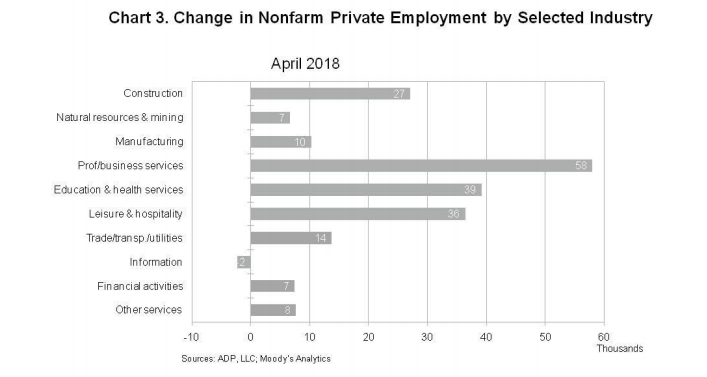
The economy added 204,000 jobs last month according to the ADP Employment Report. This was higher than expectations and is above the Street estimate for Friday's jobs report. Medium sized firms (50-500 employees) added the most jobs, and Professional and Business Services sector had the most growth. Construction added a lot of jobs as well. 


The FOMC announcement is scheduled for 2:00 pm EST today. No changes in rates are expected, but investors will be looking to see if the Fed changes its language about inflation running below target. The latest PCE index came in at 2%, which is the Fed's target. The second-order question will be to see whether the Fed changes their 2% rate from a symmetric target to a ceiling. The most likely outcome will be a "steady as she goes" statement and any changes will be communicated at the June meeting with a fresh set of economic forecasts. Today's announcement should be a nonevent. 

The Fed Funds futures are predicting a 6% chance of a hike at the May meeting and a 94% chance of a 25 basis point hike at the June meeting. 

The labor shortage is so acute in the Rust Belt that some towns are paying people to move there. Most of these small towns have a major demographic problem - younger workers moved to the cities in response to the Great Recession, leaving only the older workers who are now retiring. The fear is that labor shortages will prompt employers to leave, which will create a downward spiral.

Consumer advocates worry that Mick Mulvaney is not going to blow up the CFPB, but will neuter it with a thousand cuts. That said, the rhetoric from the left is a bit overblown. Mick Mulvaney said: “When I took over, we had roughly 26 lawsuits ongoing,” he told the House Appropriations Committee on April 18. “I dismissed one, because the other 25 I thought were pretty good lawsuits.”

Tuesday, May 1, 2018

Morning Report: Where is the private label MBS market?

Vital Statistics:

Last Change
S&P futures 2645 -1.75
Eurostoxx index 385.49 0.17
Oil (WTI) 67.92 -0.65
10 Year Government Bond Yield 2.96%
30 Year fixed rate mortgage 4.56%

Stocks are lower as we begin the FOMC meeting. Bonds and MBS are flat.

Construction spending fell 1.7% MOM but is still up 3.6% YOY. Bad weather in the Northeast and Midwest probably drove the decrease. Residential construction was down 3.5% MOM and up 5.3% YOY.

Manufacturing downshifted in April, but is still reasonably strong according to the ISM Manufacturing Report. Steel tariffs were mentioned several times as an issue. A few comments from the piece:

  • "[The] 232 and 301 tariffs are very concerning. Business planning is at a standstill until they are resolved. Significant amount of manpower [on planning and the like] being expended on these issues.” (Miscellaneous Manufacturing)
  • “Business is off the charts. This is causing many collateral issues: a tightening supply chain market and longer lead times. Subcontractors are trading capacity up, leading to a bidding war for the marginal capacity. Labor remains tight and getting tighter.” (Transportation Equipment)

The US economic expansion is now the second-longest on record. Low inflation and low interest rates have made that possible. Despite the increase in interest rates, Fed policy is still highly expansionary, so as long as inflation behaves this could go on for a while longer. 


House prices rose 1.4% MOM and 7% YOY, according to CoreLogic. About half of the MSAs are now overvalued according to their model.


Acting CFPB Director Mick Mulvaney is looking for ways to save money. Sharing desks and moving to the basement are possibilities. As an aside, this article belongs on the opinion page. 

The private label MBS market used to be a $1 trillion market - last year it was only about $70 billion. What is going on? Regulation may appear to be the culprit, but it really isn't. There are still all sorts of unresolved issues between MBS investors and securitizers. The biggest surround servicing - how do investors get comfort that the loan will be serviced conflict-free, especially if the issuer has a second lien on the property. How do investors get comfort that the issuer won't solicit their borrower for a refinance? A lack of prepay history is also a problem - it makes these bonds hard to model and price. Many investors also remember the crisis years, when liquidity vanished and investors were unable to sell, sometimes at any price. 

Issuers were content for a lot of years to simply feast on easy refi business - rate and term streamlines which were uncomplicated and simple to crank out. Warehouse banks were reticent to fund anything that didn't fit in the agency / government box, so why not concentrate on the low-hanging fruit? Investors were able to pick and choose from all sorts of distressed seasoned non-agency paper trading in the 60s and 70s. Most of that paper ended up being money good. But in that environment, why would anyone be interested in buying new issues over par? If you are a mortgage REIT, why not buy and lever new agency debt with interest rates at nothing and a central bank that is actively supporting the market? 

Now that the easy refi business is gone, will we see a return of this market? Perhaps, but there probably still is a big gulf between what borrowers and investors are willing to accept and the governance issues remain unsolved. 

Wednesday, April 25, 2018

Morning Report: Markets sell off as 10 year breaches 3% level

Vital Statistics:

Last Change
S&P futures 2626.5 -9
Eurostoxx index 379.58 -3.53
Oil (WTI) 67.53 -0.22
10 Year Government Bond Yield 3.02%
30 Year fixed rate mortgage 4.59%

Stocks are lower this morning after yesterday's interest rate-driven sell-off. Bonds and MBS are down.

The 10 year breached the 3% mark yesterday, which served as a catalyst for a substantial stock market sell-off. Of course 3% is just a round number, but it is the highest rate since 2014. Some pros are looking for a global slowdown in the economy, which could make some corporate borrowers vulnerable. We certainly appear to be in the late stages of a credit cycle. Junk-rated bond issuance has been on a tear over the past few years, reaching $3 trillion as yield-starved investors have had to reach into the lower credits to make their return bogeys. That said, corporate bond spreads are still at historical lows, (investment grade spreads are still half of what they were as recently as early 2016. Let's also not forget that much of the bond issuance over the past 8 years went to refinance old debt at higher interest rates - in other words it was a net positive for these companies. 

We are now going to see just how much of the huge rally in financial assets over the last decade was due to the inordinate amount of stimulus coming out of the Fed. As stocks now have to compete with Treasuries, some changes in asset allocations are to be expected and the riskier assets are going to bear the brunt of the selling. Keep things in perspective, however. Interest rate cycles are measured in generations. 


One of the benefits of QE has been to goose asset prices (which was kind of the whole point). Increasing people's net worth would increase spending and therefore increase GDP. It probably worked, however that hasn't been costless. One of the problems with increasing real estate prices is that it shuts people out from places where there is opportunity (California in particular). If you already own property in CA and have been experiencing torrid home price appreciation, you can move since your increased home equity can be used to purchase another expensive property. But if you live in the Midwest were home price appreciation has been less, you might not be able to take that job in San Francisco since you can't afford to live there. That said, negative equity was probably a bigger problem and home price appreciation did mitigate that issue. 

Mortgage Applications fell 0.2% last week as purchases were flat and refis were down 0.3%. Conforming rates increased 6 basis points, while government rates increased 1. ARMs decreased to 6% of total applications. A flattening yield curve makes ARMs less and less attractive relative to 30 year fixed mortgages.  

Acting CFPB Director Mick Mulvaney has made some changes at the Bureau. First, he is ending the pursuit of auto lenders, which Dodd-Frank prohibited. The Cordray CFPB did an end-around by going after the big banks behind some of the auto financing, and that will end. Second, Mulvaney will no longer make public the complaint database against financial services companies, saying that “I don’t see anything in here that I have to run a Yelp for financial services sponsored by the federal government.” Finally, he plans to change the name from the CFPB to the BCFP. All of this is in keeping with Mulvaney's commitment to follow the law and go no further. 


Tuesday, April 24, 2018

Vital Statistics:

Last Change
S&P futures 2682 10.5
Eurostoxx index 383.28 0.1
Oil (WTI) 68.68 0.01
10 Year Government Bond Yield 2.99%
30 Year fixed rate mortgage 4.56%

Stocks are up this morning on strong earnings by Caterpillar. Bonds and MBS are down. 

New Home Sales rose 4% MOM and 8.8% YOY to an annualized pace of 694,000 in March. The median sales price was$337,200 and the inventory of 301,000 represented about 5 month's worth. The number was well above Street estimates, however the confidence interval for this estimate is invariably wide. 

Consumer Confidence improved to 128.8 in April as tax cuts have pushed sentiment to post-recession highs. 

Home price appreciation is accelerating, with the Case-Shiller Home Price index up 6.8% YOY. We saw double-digit annual increases in San Francisco, Seattle, and Las Vegas. 

The FHFA House Price Index reported a bigger increase - 7.2% YOY. The FHFA index only covers conventional loans, so it is a narrower index than Case - Shiller. The increases ranged from 4.8% in the Middle Atlantic to 10.3% in the Pacific.


What is the issue with the lack of home construction? Lack of labor. The construction industry has about 250,000 unfilled jobs right now, according to the NAHB. At the peak of the bubble, there were about 5 million people in construction; today that number is closer to 3.8 million. Many of these workers found employment in other industries (especially energy extraction) and aren't about to go back. Immigration restrictions are another headache, as the government estimates that 13% of the construction workforce is working illegally. Finally, the opiod epidemic is particularly problematic in an industry where people are likely to be injured on the job and in pain generally. Ultimately, wages will have to increase to the point to lure a new generation of construction workers out of their climate controlled offices. 

Round numbers always bring out the strategists, and as the 10 year sits close to the 3% level, we are seeing pieces discussing the asset allocation implications. Since the financial crisis, the earnings yield on the S&P 500 has been higher than the 10 year, although the premium is at the lowest level since 2010. One strategist thinks the 1950s are a good analogy for investors, where interest rates gradually rose as the memories of the Great Depression faded and the economy was strong. As an aside, Jim Grant discusses how the big retail investor trade in the 1950s was the leveraged curve flattener, where people would borrow short term money to invest in long-term Treasuries. That trade worked until the bond market crashed in the late 50s and a lot of people got carried out. 

Is demand falling for houses? According to Redfin's Housing Demand Index it is. “Abnormally late winter weather and an early Easter likely delayed homeowners planning to list their homes for sale in March,” said Redfin chief economist Nela Richardson. “While inventory levels are still not nearly high enough to meet strong buyer demand, we do expect new listings to pick up in April and May.”

The House has introduced legislation to end regulation by enforcement by the CFPB. HR 5534 would require the CFPB to provide guidance on its regulations and to establish a framework for monetary penalties.