A place where economics, financial markets, and real estate intersect.
Showing posts with label Freddie Mac. Show all posts

Thursday, August 9, 2018

Morning Report: Despite good labor news, more people worried about their jobs

Vital Statistics:

Last Change
S&P futures 2859 3.5
Eurostoxx index 389.41 -0.28
Oil (WTI) 67.29 0.35
10 Year Government Bond Yield 2.94%
30 Year fixed rate mortgage 4.58%
Stocks are higher this morning on decent earnings. Bonds and MBS are up.

Very slow news day. 

Initial Jobless Claims fell to 213,000 last week, an exceptionally low level. The 4 week average is sitting at 45 year lows. 

Inflation at the wholesale level was surprisingly weak in the first of two inflation readings this week. The Producer Price Index was flat MOM and rose 3.3% YOY. Ex-food and energy, it rose 0.1% MOM / 2.7% YOY. Tariffs explain some of it, but freight and packaging costs pushing prices higher too. 

Freddie Mac has extended mortgage forbearance measures due to the wildfires in California. Borrowers in FEMA-declared disaster areas may be allowed to suspend mortgage payments without penalty for up to a year. Fannie Mae is expected to do something similar. 

Fannie Mae's Home Purchase Sentiment Index fell in July for the second consecutive month as inventory and affordability issues weighed on homebuyer moods. The net number of respondents who think it is a good time to buy fell by 4 percentage points and the number who think it is a good time to sell fell by 6. Most respondents think mortgage rates and home prices will rise over the next year. One interesting data point: a big jump in the number of people who are worried about their job. The net number of people (% who are concerned less the % who are not concerned) fell by 11 percentage points. This certainly flies in the face of the data out there, and sentiment surveys are usually not very predictive, but it is a surprise. 


Tuesday, August 7, 2018

Morning Report: Home prices rise 6.8% in June

Vital Statistics:

Last Change
S&P futures 2856 6
Eurostoxx index 391.01 2.35
Oil (WTI) 69.62 0.61
10 Year Government Bond Yield 2.96%
30 Year fixed rate mortgage 4.58%

Stocks are higher this morning on no real news. Bonds and MBS are flat.

There were 6.7 million open jobs in June, according to BLS. The all-important quits rate was unchanged at 2.3%. The quits rate is a leading indicator for wage growth and is a stat the Fed follows closely. The quits rate was highest in the South and Midwest, and lowest in the Northeast. If you look at industry groups, one group stands out with a quits rate that is going nowhere. Financial Services.


Home Prices rose 0.7% MOM in June, according to CoreLogic. They are up 6.8% YOY and forecast to rise another 5% over the coming year. Rising mortgage rates and home prices are affecting sales in the high cost markets. They also surveyed renters and found that affordability is the biggest reason why they aren't interested in buying a home. For older renters, affordability isn't the biggest issue - probably convenience is - although a jump in bankruptcy filings in the senior citizen demo is on the rise. We are seeing large pockets of overvaluation on the coasts, but the interior of the country is undervalued.


Freddie Mac is trying a new program to enhance rental affordability: providing low-interest loans to developers who promise to cap rental inflation. This is certainly a less intrusive way to deal with the affordable housing problem. The West Coast is finding that affordable housing mandates are pushing developers to scrap projects entirely and local governments are being pushed to override zoning restrictions. Freddie's program is a way to incentivize the private sector into doing something: “Maybe there’s a way we can help change incentives,” said David Brickman, an executive vice president at Freddie Mac and head of its multifamily division. “We can provide an economic basis for private, profit-oriented developers to pursue a strategy where they didn’t raise rents by quite as much. You’re taking some of the opportunity to hit a home run off the table but arguably making it more likely you can hit a single or a double.”

Washington is hoping to address the affordable housing crisis by allowing tax credits for low-income renters who spend more than 30% of their income on rent. Cory Booker's plan also looks to ease some of the regulatory burden in building new housing as well as introduce a new savings plan for renters.

What is it with tech companies who have a competitive edge wanting to diversify into hyper-competitive low-margin businesses? The latest is Zillow, which has decided it is time to get into the mortgage business. Wall Street panned the move, sending the stock down 20%. Part of the decline was due to lousy earnings, but still....

Friday, July 27, 2018

Morning Report: Blockbuster GDP print

Vital Statistics:

Last Change
S&P futures 2842 2
Eurostoxx index 391.88 1.35
Oil (WTI) 69.55 -0.1
10 Year Government Bond Yield 2.95%
30 Year fixed rate mortgage 4.62%

Stocks are up this morning after blowout earnings from Amazon and a strong GDP report. Bonds and MBS are up.

Second quarter GDP came in at 4.1%, a big jump from the first quarter, and the highest print in 4 years. Q1 was revised upward to 2.2% from 2.0%. The inflation numbers were good as well. Q2 inflation came in at 1.8% which was a decrease from the 2.5% pace in Q1. Ex-food and energy, prices increased 2%. Consumption increased 4%, while investment increased 2.1%. Capital Expenditures increased strongly, while residential construction fell. Inventories fell, which dismisses the talking point that Q2 was artificially boosted by inventory build ahead of a trade war. 


Note that international trade was a big boost to GDP numbers. While economists talk about trade wars negatively affecting growth, remember that GDP includes the net trade balance. So if imports fall in response to tariffs, that will actually increase GDP. Does that mean you can goose growth via trade spats? No, but trade wars that reduce the trade deficit will bump up the GDP numbers, which is largely an accounting question. 

In the wake of the GDP report, the Fed funds futures are predicting a 90% chance of a Sep hike and a 68% chance of a Sep and Dec hike. 

Freddie Mac reported that delinquencies fell in June and they are back to pre-hurricane levels. 

Foreign demand for US residential property fell in 21% Q1, according to NAR. Foreign buyers accounted for 8% of existing home sales, a drop from 10% in the previous period. While a drop in foreign buying will help alleviate the supply / demand imbalance in the US resi market, new construction is really needed to square the circle, and judging by the GDP numbers, that still isn't happening. 


Friday, June 22, 2018

Morning Report: Administration proposes to privatize the GSEs

Vital Statistics:

Last Change
S&P futures 2767 14
Eurostoxx index 384.04 3.19
Oil (WTI) 67.44 1.9
10 Year Government Bond Yield 2.92%
30 Year fixed rate mortgage 4.57%

Stocks are higher on no real news. Bonds and MBS are flat.

The Trump administration released a set of principles around privatizing the GSEs. It is more or less the same thing as before - the goal is to lessen the government's footprint in the mortgage market. The idea would be to have Fannie and Fred issue MBS with a catstrophic government guarantee - in other words, some private mortgage insurer would bear the initial losses and the government would only step in if the losses exceeded that number. That is all well and good, however there are all sorts of issues that remain before private label MBS can do the heavy lifting of the mortgage market. 

First and foremost, there is a huge gulf between what the MBS investor market requires as a rate of return and current mortgage rates. In a perfect world, PL MBS would trade at similar levels to Fannie / Freddie MBS, but they won't. There are huge governance issues that need to be resolved. For just one example, will the servicer (who is probably the issuer, who may also have a second lien) service the loan to benefit the MBS holder or themselves? What about reps and warranties? I went into more depth about this whole issue here. These uncertainties need to be priced in, which means that the bid / ask spread between private label and FNMA MBS is so large that nobody would take out a mortgage at the rate the private label investors require. That is a necessary but not sufficient requirement to bring back private money into the US mortgage market. 

Taking the GSEs out of conservatorship is going to require legislation, and to be honest it isn't a priority for either party. As far as DC is concerned, yes it would be nice if the government could lessen its footprint in the mortgage market, but people are getting loans, and the market is functioning normally. It just isn't a priority. 

The US borrower believes that the 30 year fixed rate mortgage is nothing unusual. In fact, it is a distinctly American phenomenon, where the borrower bears no risk. In the rest of the world, mortgages are adjustable rate, and not guaranteed by the government. In other words, the borrower bears the interest rate risk and the bank bears the credit risk. In the US, the bank bears the interest rate risk and the taxpayer bears the credit risk. Upsetting that apple cart is going to be a tough slog politically. 

Finally, the news did nothing for the stocks of Fannie and Fred, which continue to languish. When the government took over Fannie and Fred, they left 20% of the common outstanding. This was an accounting gimmick to prevent the government from having to consolidate Fan and Fred debt on its balance sheet (incidentally, this was the reason why LBJ privatized the GSEs in the first place). The government could not take the GSEs through a bankruptcy without creating chaos in the mortgage market. So they left 20% outstanding and decided to deal with the bankruptcy part later. The stock should be worthless, but it is a litigation lottery ticket.


A Federal Judge ruled yesterday that the CFPB's structure is unconstitutional. The PHH case never made it to SCOTUS, but it will be interesting if this one does. At some point, the CFPBs structure will make it to SCOTUS, and the only one with the standing to defend the agency is the government. 

Tuesday, May 8, 2018

Morning Report: Jerome Powell agrees with markets on interest rates

Vital Statistic:

Last Change
S&P futures 2667 -3
Eurostoxx index 388.93 -0.56
Oil (WTI) 70.09 -0.62
10 Year Government Bond Yield 2.96%
30 Year fixed rate mortgage 4.55%

Stocks are lower as we await the Trump Administration's decision on the Iran deal. Bonds and MBS are down small. 

The Administration is set to announce later today whether they intend to stay in the Iranian deal or abandon it. Oil has been rallying on expectations Trump will leave. 

Jerome Powell said that market expectations (i.e. the Fed Funds futures) are more or less in alignment with the Fed's expectations for the future path of interest rates. The December Fed funds futures are predicting about a 10% chance of one more hike this year, a 44% chance of 2 more and a 39% chance of 3 more. Over the past month, the central tendency has become more hawkish. 


Small Business Optimism remains strong, according to the NFIB. More businesses are planning on increasing capital expenditures, while hiring remains strong and we are seeing evidence of increased compensation. Profitability increased as well, which indicates that productivity is increasing, and that some of this CAPEX is going towards labor-saving technology. Finding qualified workers continues to be the biggest issue surrounding small business. “There is no question that small business is booming,” said NFIB Chief Economist Bill Dunkelberg. “Consumer spending, the new tax law, and lower regulatory barriers are all supporting the surge in optimism across all small business industry sectors.”

Despite the hurricane-related spike in delinquences, overall DQ rates have been falling, according to CoreLogic. Home price appreciation, in addition to more stringent underwriting standards are the driving force behind it. The foreclosure rate is down from 0.8% to 0.5%, and the 30 day DQ rate is down to 4.8% from 5.0%. As you would expect, TX and FL are experiencing rising DQ rates, but the rest of the nation is down. 

Tesla stock has more or less recovered from its conference call induces swoon from last week. The bonds are at the lows however, trading at 88. Note there is a divergence also in NFLX, which has bonds in the low 90s, while the stock is a highflyer. 

NYS AG Eric Schneiderman resigned from office after reports came out that he abused 4 women. Schneiderman was an AG cut in the same cloth as Eliot Spitzer, and hated the financial industry about as much as he did (FWIW the feeling was mutual). When Spitzer announced his resignation, cheers went up on the floor of the NYSE. 

Freddie Mac is getting into the business of providing lines of credit against MSR portfolios. Nonbank servicers face liquidity issues when loans they are servicing go delinquent. They are required to make the mortgage payment to the ultimate investor of the mortgage until the loan is brought current or foreclosed. Banks generally have no problems with this, but nonbank issuers generally don't have the balance sheet to withstand heavy advances activity. Fannie Mae only requires 6 months of advances, but Ginnie Mae has no similar relief. Policymakers are concerned about the ability of nonbank servicers to withstand a period of prolonged stress if delinquencies spike. 

Homebuyer sentiment hit an all-time high according to the Fannie Mae Home Purchase Sentiment Index. "The latest HPSI reading edged up to a new survey high, showing that consumer attitudes remain resilient going into the spring/summer home buying season," said Doug Duncan, senior vice president and chief economist at Fannie Mae. "High home prices and good economic conditions helped push the share of Americans who think it’s a good time to sell to a fresh record high. However, the upward trend in the good-time-to-sell share seen since last spring has done little to release more for-sale inventory. The tightest supply in decades, combined with rising mortgage rates from historically low levels, will likely remain a hurdle for mobility and a persistent headwind for home sales."

Friday, April 27, 2018

Morning Report: GDP comes in better than expected

Vital Statistics:

Last Change
S&P futures 2673 -1.5
Eurostoxx index 384.63 0.87
Oil (WTI) 67.92 -0.27
10 Year Government Bond Yield 2.97%
30 Year fixed rate mortgage 4.62%

Stocks are flat this morning after GDP came in higher than expected. Bonds and MBS are up small. 

The advance estimate of first quarter GDP came in at 2.3%, higher than the Street 2.0% estimate. Consumption rose 1.1%, in line with estimates, and inflation was lower than expected at 2%. In many ways, this was a Goldilocks type report, with decent growth and controlled inflation. The savings rate increased to 3.1%, compared to 2.6% in the fourth quarter. One note of caution: the first quarter has had some quirky measurement issues over the past several years, which has subjected it to subsequent upward revisions. The tax cuts will probably have a similar effect this time around. 


Wage inflation is picking up, according to the Employment Cost Index which rose 0.8% for the quarter and is up 2.7% for the year. Wages and salaries increased 0.9% compared to 0.5% in the previous quarter. For the Fed, these two reports this morning are great news. Real wage growth (2.7% increase in wages and salaries less a 2% increase in inflation) with moderate growth and inflation. 

Consumer sentiment slipped from March's 14 year high in April to a still strong 98.8.

The Fed Funds futures are predicting a 93% chance of another 25 basis point hike at the June meeting. 

North and South Korea pledged to de-nuclearize the peninsula and declare an official end to the 50 year old Korean War. 

Freddie Mac is introducing its 3% down product for first-time homebuyers - HomeOne. With an Affordable Second, the LTV can go as high as 105%. Income and geographic limits are intended to reach a broad audience. 

Tuesday, March 20, 2018

Morning Report: FOMC meeting begins today

Vital Statistics:

Last Change
S&P futures 2725.25 3
Eurostoxx index 375.23 1.54
Oil (WTI) 62.97 0.91
10 Year Government Bond Yield 2.88%
30 Year fixed rate mortgage 4.43%

Stocks are higher this morning after yesterday's bloodbath in tech. Bonds and MBS are down small. 

Current funding for the government is set to expire on Friday, and Congress is still working on a plan to keep the lights on. Sticking points include funding for the military, the border wall, and the NY-NJ Hudson River Tunnel. Votes are looking likely for Thursday and Friday, so there isn't a lot of margin for error. Making matters worse is a major snowstorm which is set to hit the East Coast tomorrow. Washington is set to get 4-8 inches which could shut down government for the day. New York is set to get a foot. 

We could see some movements in interest rates over the next couple of days with the FOMC decision tomorrow and the Bank of England decision on Thursday. A 25 basis point hike is more or less assured, but the markets will be focused on the projection materials, particularly the dot plot. This will be Jerome Powell's first rate hike, so every word in the statement and everything he says in the press conference will be parsed even more closely that usual. 

The government is mulling a change in the bankruptcy laws that would allow more students to reduce or eliminate student loan debt in bankruptcy. High levels of student loan debt are one reason why the first time homebuyer has been missing in action in this housing recovery. As of now, tax debt and student loan debt are more or less permanent - bankruptcy doesn't eliminate them. Student loan servicers are required by Department of Education regulations to oppose bankruptcies, even if they know there is little chance of recovery. The servicers realize this is often throwing good money after bad. 

Freddie Mac crunched the numbers on how rising interest rates affect the housing market and the mortgage industry. Since 1990, increases in interest rates have dropped home sales by 5%, cut housing starts by 11% and cut mortgage origination by 30%. Of course the rate hikes since 1990 were in the context of a secular bull market in bonds that started around 1981 and ended around 2016 or so. In other words, these rate hikes were short-lived. This time around, that probably isn't happening. That said, starts are so depressed relative to demand to begin with that we probably won't see an 11% drop. Unless inflation picks up massively, the Fed will continue to go slow and will be loath to knock the economy back into a recession. 

As I mentioned yesterday, I have left iServe and am seeking a new opportunity. I will be contacting many of you over the next few days / weeks. 

Monday, December 18, 2017

Morning Report: Don't fear the flattening curve

Vital Statistics:

Last Change
S&P Futures  2692.5 10.5
Eurostoxx Index 392.1 3.9
Oil (WTI) 57.5 0.2
US dollar index 86.9 -0.2
10 Year Govt Bond Yield 2.37%
Current Coupon Fannie Mae TBA 102.531
Current Coupon Ginnie Mae TBA 103.591
30 Year Fixed Rate Mortgage 3.88

Stocks are up this morning on optimism over tax reform. Bonds and MBS are down small. 

This should be a quiet week as people prepare for the holidays, however we will get a lot of economic data. The biggest one will be personal incomes and outlays on Friday. 

Homebuilders are more optimistic now than they were during the bubble years, according to the NAHB Homebuilder Sentiment Index. 

Congress worked on making smallish changes to the tax bill over the weekend. Marco Rubio held out for an increased child tax credit. The state and local tax deduction was supposedly widened to $10k. Another change involves tax breaks for real estate pass-throughs, which caught one wavering Republican Senator - Bob Corker - by surprise. Since it looks like John McCain will not be voting on the plan this week, Republicans need Corker's vote. It is a fluid situation, to say the least. 

The New York Fed took up its estimate for Q4 GDP to 4%. We will get the final revision to third quarter GDP on Thursday. 

One of the biggest trades on the Street right now is the yield curve flattening trade, where investors bet the difference between long-term rates and short-term rates will decrease. There are many reasons to put on the trade, but the most common one is that the yield curve tends to do this during tightening cycles, and people are making the bet that history will repeat itself. The side effect of this trade is a whole lot of articles claiming that the changes in the yield curve are predicting a recession going forward. Given that the NY Fed just took up its Q4 GDP estimate up to 4%, a recession doesn't seem to be on the horizon. But here is the bigger issue: What information is the yield curve transmitting when it is being influenced by global central banks? Yes, before the Fed was buying (and holding) 4.5 trillion worth of bonds, the yield curve was probably providing useful information. But now? I would argue that all of this central bank buying is distorting the signals the curve might be sending. And therefore I would caution against reading too much into it. 

Freddie Mac weighs in on the housing market and makes its predictions for 2018. Big picture: the economy is getting better, Millennials are beginning to buy, and increased homebuilding should alleviate the big inventory problem. That said, cuts in the mortgage interest deduction and increasing supply should dampen home price appreciation. Basically the current housing market is great and that should continue, albeit at a somewhat slower level. FWIW, I suspect the demand for housing is only going to get bigger, and will dwarf whatever homebuilding is being done. 

Friday, September 22, 2017

Morning Report: Freddie Mac anticipates a 6% drop in originations in 2018

Vital Statistics:

Last Change
S&P Futures  2499.5 -5.8
Eurostoxx Index 382.9 0.1
Oil (WTI) 50.4 -0.1
US dollar index 85.7 0.1
10 Year Govt Bond Yield 2.25%
Current Coupon Fannie Mae TBA 103.24
Current Coupon Ginnie Mae TBA 104.21
30 Year Fixed Rate Mortgage 3.85

Stocks are lower this morning on no real news. Bonds and MBS are flat. 

We will have some Fed-speak today, however nothing should be market-moving given how recent the FOMC decision was. 

The Markit PMI flash index came in at 54, showing manufacturing remains strong. Separately, businesses expect to see about 1.9% inflation in the coming year, according to the Atlanta Fed. 

San Francisco Fed President John Williams sees the Fed gradually raising rates and considers 2.5% on the Fed Funds rate the "new normal." “Although I do expect us to need to raise rates gradually over the next couple of years, it’s not like we need to raise rates a lot over the next couple of years,” Williams said, adding that the pace “will depend on how the economy progresses.”

US household wealth hit a record in the second quarter as asset price appreciation continued. Household wealth increased to 96.2 trillion. Total debt grew at 3.8% as households and businesses borrowed more than governments. State and local government borrowing actually fell. 

Freddie Mac is out with its 2018 forecast, which basically predicts more of the same. Economic growth is expected to hang out in the 2% range, while mortgage rates are expected to rise. The increase in purchase activity will not offset the drop in refis, however and they are forecasting a 6% drop in originations versus 2017. They see home price appreciation of 5%. They expect the limited inventory problem to remain as the aging of the population and limited mobility keep a lid on home sales. They see the 30 year fixed rate mortgage increasing by 40 basis points to 4.4% and only a modest increase in housing starts to 1.33 million. 

Ray Dalio of Bridgewater on why the US economy resembles 1937. His point was that the Fed began to remove accomodation from the markets in 1937, which caused (in his opinion) the "recession within the Depression in 1937. While it is possible that monetary policy caused that recession, it is also possible policy had an effect too, especially FDR's undistributed profits tax, which basically told companies to "use it or lose it" with respect to their retained earnings. It was a political disaster from the start and only lasted two years, but it certainly was an ominous sign for business, which didn't help release the animal spirits. The Fed is going so cautiously at the moment, I don't see how they will send us into a recession by overshooting. 

Jamie Dimon doubled down on his criticism of Bitcoin, saying cryptocurrencies are a "novelty" and "worth nothing." 

Friday, August 18, 2017

Morning Report: Freddie Mac introduces automated appraisals for purchases

Vital Statistics:

Last Change
S&P Futures  2432.0 2.5
Eurostoxx Index 374.0 -2.8
Oil (WTI) 47.2 0.1
US dollar index 86.1 -0.3
10 Year Govt Bond Yield 2.16%
Current Coupon Fannie Mae TBA 103.09
Current Coupon Ginnie Mae TBA 103.97
30 Year Fixed Rate Mortgage 3.88

Stocks are higher this morning after yesterday's sell-off. Bonds and MBS are flat. 

There is a risk-off feel to the market as the current situation in Washington DC plus the terror attacks in Spain are causing investors to sell stocks and buy bonds. The post-election low on the 10 year was 2.14%, and we are getting close. Loan officers, maybe take a look at some old refi candidates that might have missed the boat and see if there is interest again. 

Freddie Mac is introducing an automated appraisal alternative for some purchases and refis. "Freddie Mac's automated collateral evaluation (ACE) assesses the need for a traditional appraisal by leveraging proprietary models and using data from multiple listing services and public records as well as a wealth of historical home values to determine collateral risks." ACE has been available for some refis since June, but will also be available for some purchases starting in September. This is one way to alleviate the problem of appraiser shortages. 

Freddie Mac has issued their outlook for the rest of 2017. Highlights include
  • Housing starts will remain low, and should come in below 1.24MM (which is the long-term average). 
  • Home sales will hit 6.2 million and mortgage rates will stay below 4%.
  • House price appreciation will come in at 6.3% for the year.
  • Cash sales as a percentage of sales will remain elevated in the high teens. This is lower than the peak of 35%, but higher than the historical average of about 10%. This difference translates into about $172 billion in fewer originations. 
Freddie Mac explains what is going on with the cash sales: "Usually, not many people like to invest a lot of cash into real estate, which is illiquid and has high transaction costs. However, in the current, highly-competitive housing market, a cash offer is an effective way to gain an advantage over other bidders. In a cash sale, the seller doesn't have to worry about the buyer's ability to obtain a mortgage or the chances that an appraisal will come in below the agreed sales price. And each cash sale means one less mortgage origination."

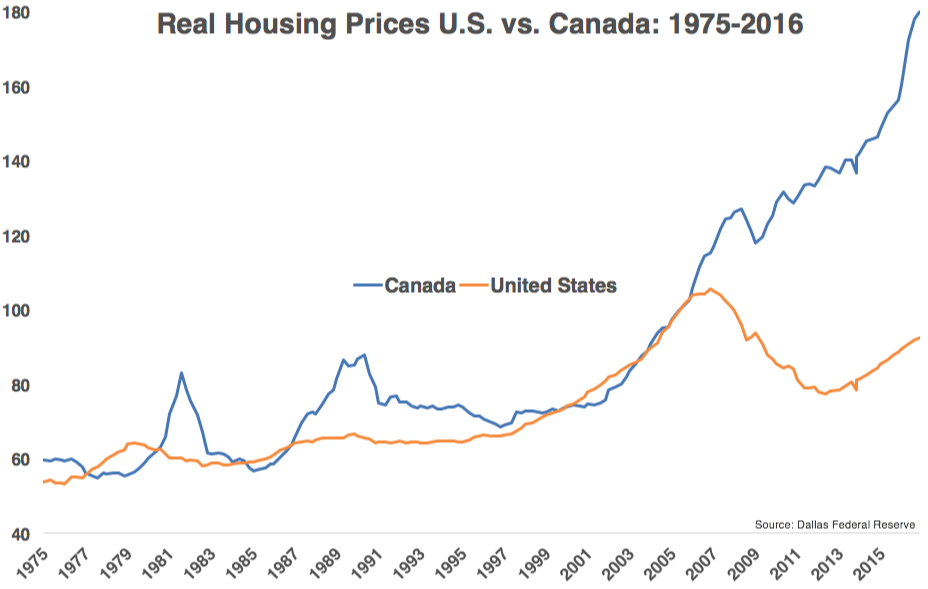
The Canadian real estate bubble will probably not affect the US all that much, however it could have an impact on higher priced properties, especially on the West Coast. Here is a chart comparing the US bubble to the Canadian one:


Note that the Canadian real estate market doesn't have CDO squareds, NINJA loans, pick-a-pay mortgages, or anything like that. Perhaps bubbles are caused by something else - like too much money chasing too few assets... 

Home sales fell 3.5% in July, according to Redfin as tight inventory continues to be a problem. Inventory fell 11%, and many buyers are pulling back from the market, waiting for new inventory. You can see just how much inventory has been falling on a YOY basis below.


Monday, July 31, 2017

Morning Report: Freddie Mac explores what is driving low inventory

Vital Statistics:

Last Change
S&P Futures  2473.3 3.0
Eurostoxx Index 379.6 1.3
Oil (WTI) 49.7 0.0
US dollar index 86.2 -0.3
10 Year Govt Bond Yield 2.29%
Current Coupon Fannie Mae TBA 102.93
Current Coupon Ginnie Mae TBA 103.81
30 Year Fixed Rate Mortgage 3.95

Stocks are flat this morning on no real news. Bonds and MBS are unchanged.

Pending Home Sales rose 1.5% in June, according to NAR. On a YOY basis, the index is up half a percent. Housing inventory is down 7% YOY. 

Freddie Mac explores the issue of tight inventory and asks why builders aren't adding much supply. The issue largely concerns labor, especially skilled labor. The bust laid off about 1.5 million construction employees, who ended up finding new jobs in different sectors of the economy (especially the energy sector). These people are probably not coming back to the construction sector without some sort of catalyst. Second, young people don't seem all that interested in working construction, and the ones that are cannot pass a drug test. Tighter immigration enforcement and the economy in general have led to a drop in immigrants, who have historically been about 25% of the construction industry. Land costs as a percent of new home costs have been rising as well, which is creating pressure on margins. Land use regulations are also stretching out the time it takes to work through the permitting process. 

Speaking of drug tests, a factory owner in Ohio says they have plenty of jobs, but can't find people who can pass the drug test. 40% of their applicants cannot pass a drug test. 

The Fed plans to unveil soon its recommendation to replace LIBOR. LIBOR had been the benchmark interest rate for all sorts of variable rate products for decades, but had one fatal flaw: it was set based on self-reports from a consortium of investment banks. The problem is that the bank could say it was pricing LIBOR at a rate that it wasn't prepared to actually honor. Since banks have all sorts of products that are pegged to LIBOR, they have an incentive to manipulate the measure in order to get the most favorable mark for their own positions. The group is recommending a broad treasury financing rate based on Treasury repos. This rate will be based on what people are actually paying for financing in the markets, not a survey. There are something lie, $330 trillion of derivatives and loans (everything from mortgages to student loans) that are pegged to LIBOR. 

New documents bolster the case for Fannie Mae shareholders that the government lied when began to sweep all of Fannie's profits. The cover story was that Fannie was in a "death spiral" and this was necessary to hasten the wind-down of their business. The documents show Tim Geithner saying that Fannie will be earning strong revenues and can support the 10% dividend for years into the future. Does that mean shareholders will get anything? They probably shouldn't, as the government maintained a 20% public minority stake only so it didn't have to consolidate Fannie's debt on its own balance sheet. Under any sort of bankruptcy scenario shareholders would have been wiped out. The stock is a litigation lottery ticket. 

Friday, February 3, 2017

Morning Report: Decent Jobs Report

Vital Statistics:

Last Change
S&P Futures  2281.3 4.5
Eurostoxx Index 364.1 2.2
Oil (WTI) 53.8 0.2
US dollar index 90.6 0.1
10 Year Govt Bond Yield 2.47%
Current Coupon Fannie Mae TBA 102.1
Current Coupon Ginnie Mae TBA 103.2
30 Year Fixed Rate Mortgage 4.19

Stocks are up after a decent jobs report. Bonds and MBS are up as well.

Jobs report data dump:
  • Nonfarm payrolls up 227,000
  • 2 month prior revision down 39,000
  • Unemployment rate 4.8%
  • Underemployment rate 9.4%
  • Labor force participation rate 62.9%
  • Average hourly earnings up 0.2% MOM / up 2.5% YOY
Overall, a pretty decent report. Payrolls were much better than expectations, although the downward revision of 40,000 to November offset that somewhat. The employment to population ratio ticked up from 59.7 to 59.9, which is something the Fed pays close attention to. The year-over-year increase in wages took a step back, but part of that is due to very strong January 2016 number which fell off the YOY comparison. In terms of industries, we saw big increases in construction and retail. The oil patch is hiring again as well. In some ways this was a Goldilocks type report: strong enough to make the stock market happy, and weak enough in wage growth to keep bonds from selling off. 

The ISM non-manufacturing index took a step back in January from December's strong pace. Factory orders increased 1.3%. 

President Trump has ordered a comprehensive review of Dodd-Frank and suspended Obama's fiduciary rule executive order which was to take effect in April. The goal of the review is to remove regulatory burdens to the financial industry and to increase investor options, according to an administration official. Areas of focus include reforming the CFPB, the Volcker rule, and the fiduciary order. Critics claim that the CFPB is restricting credit, the Volcker rule is restricting liquidity in the markets, and the fiduciary rule amounts to a gag order for retirement advisors. 

US CEOs are meeting with Donald Trump today, as the relationship between the two becomes more tenuous. The problems are twofold. First, the left is organizing boycotts on any company associated with the Trump administration, while culminated in Uber's CEO resigning from Trump's business panel after the #deleteUber campaign. Second, fears of immigration limits are worrying many, particularly in the tech space. Finally Trump's naming and shaming of companies via Twitter is causing uncertainty as well. 

Interesting article in the Wall Street Journal about the future of the labor market and the business world's continued move towards outsourcing, even within the US. Companies like Pratt and Whitney are now using UPS to handle parts of the logistics chain that used to be done by Pratt and Whitney employees. This obviously gives the company more flexibility and they don't have to deal with the HR issues of hiring and firing. Temporary worker agencies continue to grow and allows companies to have "just in time" employee management. Accenture sees a future where the only full time employees at some companies are C-level: the rest will be temps. I wonder if it will work out the way these companies imagine however. Once these agencies control vast parts of the company's operations, the agency will be able to hold up a company for higher rates the way unions used to hold up companies for higher wages. 

Freddie Mac has a somewhat gloomy outlook for origination next year, forecasting a drop of 25% from 2016's level of $2 trillion in origination. They see the 30 year mortgage rate averaging 4.4% and total home sales falling from 6 million to 5.75 million. House price growth is expected to moderate to 4.7% from 6%. Freddie Mac is baking in some possibility of expansionary fiscal policy coming out of Washington, especially with respect to tax reform, where an increase in the standard deduction will reduce the incentive to itemize and reduce the subsidy from the mortgage interest deduction. They do point out that increases in interest rates have been generally short-lived over the past 8 years as slow global growth and excess savings find their way into the bond market. Freddie Mac caveats this outlook with the fact that the new administration provides a lot of uncertainty. FWIW, it is looking like it will take 60 votes to get anything done in the Senate, which means a fiscal status quo. That will likely mean only 2 hikes in 2017, not 3. Rates may not be going up as much as people think.

You can see the refinanceable population has decreased significantly as rates have risen:


Friday, January 20, 2017

Morning Report: Steve Mnuchin testifies and sinks the GSEs

Vital Statistics:

Last Change
S&P Futures  2267.0 5.0
Eurostoxx Index 362.7 -0.7
Oil (WTI) 52.2 0.8
US dollar index 91.9 0.1
10 Year Govt Bond Yield 2.48%
Current Coupon Fannie Mae TBA 101.2
Current Coupon Ginnie Mae TBA 103.1
30 Year Fixed Rate Mortgage 4.19

Stocks are up as we prepare for the inauguration. Bonds and MBS are down.

Should be a quiet day for bonds as there are no economic data. 

Janet Yellen spoke yesterday at Stamford and stressed the Fed was not behind the curve, and we still have some slack in the labor market. However, she said it was prudent to undo some of the accomodation so that we don't have to move too quickly later. She also said the economic outlook was clouded due to uncertainty out of Washington. While Trump can sand down the edges of the regulatory state, he has a problem legislatively with Democrats in complete opposition, and a tenuous relationship with Republicans. 

A partial explanation for the weakness in the high end of the real estate market can be explained by new Chinese capital controls. The Chinese government has instituted capital control to prevent an outflow of yuan. Foreign real estate was a big beneficiary of that capital, so expect to see more weakness in the high-priced markets like San Francisco, NYC, Seattle, and Denver. 

Trump Treasury Secretary nominee Steve Mnuchin testified in front of Congress yesterday, and largely escaped unscathed. He called for a reform of Fannie Mae and Freddie Mac, however he said he did not support "recap and release." He also said that any sort of "border tax" would be targeted at companies that offshore manufacturing and then sell back into the US. The hearing got testy at times, with Sen Pat Roberts (R-KS) suggesting that Sen Ron Wyden (D-OR) take a valium. Democrats zeroed in on his role with IndyMac and purported foreclosure abuses. 

Fannie Mae and Freddie Mac tumbled during the testimony, however they also lost a lawsuit that could have have explained the fall as well. Both were down 5% after being up for the day. Both stocks have more than doubled since the election on optimism that Donald Trump would support some sort of change in how the government treats these stocks. Currently, the government owns 79.9% and all profits from the company go directly to Treasury. 

In terms of other takeaways from Mnuchin's testimony, he supports bringing the CFPB into the appropriations process, would like to tweak the Volcker rule (which prohibits proprietary trading) to eliminate the negative effects it is having on market liquidity, to ease the regulatory burden on small banks, and to bring back a "21st century" Glass-Steagall law, whatever that means. 

Glass Steagall was implemented during the Great Depression because investment banks were putting busted underwritings (i.e. underwritten bonds they couldn't sell to the public) on the balance sheets of their captive commercial banks and insurance companies at par in order to hide the losses. Glass Steagall ended this practice by requiring all of these transactions to be arm's length. Fast forward to 2007, the crisis wasn't caused by JP Morgan the investment bank stuffing bad paper on Chase the commercial bank's balance sheet. For what its worth, the US is the only country on the planet that separates investment banking and commercial banking, or even draws a distinction between the two. Everywhere else, it is just called "banking." Indeed, the reason Glass-Steagall was repealed in the first place was that reason: Wall Street investment banks like Morgan Stanley and Goldman couldn't compete with foreign banks because they had to fund their balance sheets at LIBOR while the foreign banks could borrow at much lower deposit rates. As the derivatives business expanded in the 1990s, "Wall Street" was becoming Credit Suisse, Deutsche Bank, Nomura, and Barclay's. 

The Mortgage Bankers Association was out with a statement yesterday, speculating that the change in FHA MIP could be reversed by Ben Carson's HUD. ""Based on recent testimony and political pushback, we believe there is a strong chance the most recent MIP reduction... may be one of the rollback actions taken soon after President Trump takes office." Carson has said he would study how the change would affect the insurance fund, but hasn't indicated whether he supports the change or not. 

Note that we did see a rally in the Ginnie II higher coupon MBS yesterday despite a rough day for bonds otherwise. You can see in the chart below how Ginnie 4.5s (black line) outperformed Fannie 4.5s (blue line). Expect to see higher volatility in the higher note rates for FHA and VA loans as this plays out. 


Negative equity is becoming less of a problem as home prices continue to rise. During 2016, 1 million homes regained positive equity, leaving only 2.2 million homes with negative equity. While we are still well above the bubble years in terms of negative equity, we have fallen markedly from the peak of 15.1 million homes in 2010. As houses regain positive equity, it will create refinance opportunities which will help offset the effect of higher rates. It will also increase mobility, which is one of the reasons why we have a low unemployment rate, but have so many workers still on the sidelines. They can't move to where the jobs are because they are trapped in a home with negative equity they can't sell. 


Tuesday, August 16, 2016

Morning Report: Freddie thinks 2016 could see $2 trillion in origination

Vital Statistics:

Last Change
S&P Futures  2182.0 -4.0
Eurostoxx Index 343.7 -2.0
Oil (WTI) 45.9 0.2
US dollar index 85.6 -0.6
10 Year Govt Bond Yield 1.54%
Current Coupon Fannie Mae TBA 103.3
Current Coupon Ginnie Mae TBA 104.2
30 Year Fixed Rate Mortgage 3.45

Stocks are lower this morning on no real news. Bonds and MBS are mixed

Inflation at the consumer level continues to be well-contained. The consumer price index was flat month-over-month and is up 0.8% year-over year. Ex-food and energy it was up 0.1% MOM and 2.2% YOY. The biggest contributors to inflation were health care costs (up 4% YOY) and housing (up 2.4% YOY).

Housing starts were 1.211 million annualized in July, coming in higher than expected. The driver was multi-fam, which can be extremely volatile. Single fam continues to plug along. Building permits were more subdued, coming in at 1.15 million. Same situation in permits: multi-fam permits rose while single fam declined. 

Industrial production increased 0.7% in July versus expectations of a 0.3% increase. Manufacturing production increased 0.5%. Capacity utilization increased to 75.9%. So some signs of life in the manufacturing sector after a dismal Spring and early summer.

An idea that is percolating at the Federal Reserve is the idea that this low productivity / low growth economy is a new normal, which implies a lower neutral interest rate. This in part explains why the Fed has been so reluctant to raise rates despite unemployment being at levels historically associated with full employment. One idea is that the Fed should either raise its inflation target or begin targeting nominal GDP. The big question is whether the PhD standard, which has pushed interest rates to the floor, is part of the reason why productivity and growth are so low. By creating a bubble in sovereign debt, you have a misallocation of resources (by definition - that is what bubbles are) and that could account for our disappointing growth and productivity. Certainly business capital expenditures remain low and focused on saving labor costs. 

Meanwhile, William Dudley thinks the market may be too complacent about a September rate hike. The market has been calling the Fed's bluff for over a year now.

Freddie Mac thinks 2016 could be the best year for mortgage origination since 2012, with total origination topping $2 trillion. The unexpected gift of lower rates is the reason why. For 2017, they are forecasting a drop back to $1.7 trillion as home price appreciation falters and interest rates rise, although rising rates shouldn't be too bad given they are forecasting 2017 GDP growth to be below 2%. They anticipate the mortgage rate to increase 10 basis points to 3.7%. 

Monday, March 14, 2016

Morning Report: FOMC week

Vital Statistics:

Last Change Percent
S&P Futures  2019.9 31.1 1.56%
Eurostoxx Index 3097.4 23.6 0.77%
Oil (WTI) 37.46 -1.0 -2.70%
LIBOR 0.634 0.002 0.24%
US Dollar Index (DXY) 96.4 0.228 0.24%
10 Year Govt Bond Yield 1.96% -0.03%
Current Coupon Ginnie Mae TBA 105
Current Coupon Fannie Mae TBA 104.1
BankRate 30 Year Fixed Rate Mortgage 3.68

Stocks are lower this morning as oil gets roughed up. Bonds and MBS are up.

There is no economic data this morning, however the rest of the week looks pretty active, with retail sales, inflation data, housing starts, and industrial production. Of course we have the FOMC meeting Tuesday and Wednesday as well. 

Mohammed El-Arian lays out his prediction for the FOMC meeting this week. Bottom line: No move in rates, and an emphasis on data-dependency. They will mention overseas weakness, but won't make the statement that it will affect the US economy all that much. They will be sanguine on overall US data without becoming too hawkish on wages and inflation. So, generally a dovish take on things. 

It is hard to come up with a good reason to take away the punch bowl when investor sentiment is hitting 2 year lows. Of course the ultimate poll is the market, and not some survey. Where are investors doing well these days? Rental properties

Note that the recent increase in US rates was driven at least partially by increases in Euro rates. That move seems to be unwinding (in other words, Euro rates are heading back down). This will probably help guide US rates lower as well, especially if we get a dovish statement on Wednesday. 

Morgan Stanley is out with a call saying yields are going lower. Their forecast: 1.45% 10 year by the end of September. While the US economy is doing ok, the rest of the world is not. They think the next rate hike will be in December. 

Why is the first time homebuyer sitting out? Freddie Mac attributes at least some of the reason to misconceptions about buying, specifically credit scores and down payments. Many young borrowers still believe you need 20% down and perfect credit to qualify for a mortgage. Freddie has launched their Real Estate Professionals Resource Center to give pros the lowdown on products that can get a young borrower into a home. 

Wednesday, July 22, 2015

Morning Report - Median home prices hit a record

Vital Statistics:

Last Change Percent
S&P Futures  2104.6 -9.8 -0.46%
Eurostoxx Index 3631.4 -16.6 -0.45%
Oil (WTI) 50.32 -0.5 -1.06%
LIBOR 0.295 0.003 1.11%
US Dollar Index (DXY) 97.49 0.160 0.16%
10 Year Govt Bond Yield 2.31% -0.01%
Current Coupon Ginnie Mae TBA 104 0.4
Current Coupon Fannie Mae TBA 103.2 0.3
BankRate 30 Year Fixed Rate Mortgage 4.26

Stocks are lower as earnings have been generally disappointing. Bonds and MBS are up small.

Earnings season is off to a lousy start, highlighted by a miss from Apple. The stock is down 8% pre-open. IBM and United Technologies (which is selling its Sikorsky unit to Lockheed) reported disappointing earnings as well. The NASDAQ has been hitting records lately (it finally eclipsed its early 2000 high), but earnings are looking like a headwind. 

Existing home sales rose 3.2% to a seasonally adjusted annual rate of 5.49 million units, the highest number in 8 years. Lawrence Yun, NAR chief economist, says backed by June's solid gain in closings, this year's spring buying season has been the strongest since the downturn. "Buyers have come back in force, leading to the strongest past two months in sales since early 2007," he said. "This wave of demand is being fueled by a year-plus of steady job growth and an improving economy that's giving more households the financial wherewithal and incentive to buy."

Inventory remains tight as a drum, with 5.0 month's worth of inventory, well below the 6.5 months that historically represents a balanced market. Time on market hit a record low of 34 days, down from 40 in May. The first time homebuyer represented 30% of sales, down from 32% in May and below its historical run rate of about 40%. All-cash sales fell to 22%, the lowest since December 2009. 

The median house price rose to $236,400 a new record. Yes, we have surpassed the heights of the bubble years. That puts the median house price to median income ratio at a sporty 4.4x, well outside its traditional range of 3.15x - 3.6x and not far off its record of 4.8x. Either wage growth gets on its horse or further home price appreciation is going to be hard to come by.

Mortgage Applications rose 0.1% last week as purchases rose 1% and refis fell .5%. The 30 year fixed rate mortgage has been stuck at 4.23% for the last 3 weeks. 

House prices rose 0.4% in May, according to the FHFA. On a year-over-year basis, prices are up 5.4%. Home prices are now about 1.8% from the peak in 2006. Note that this index only considers homes with conforming / government mortgages, so it excludes the jumbos and cash sales. While home price appreciation is accelerating nationwide, it is actually decelerating in the markets that have lagged the most - the Northeast and the Mid-Atlantic states. It has truly been a tale of two markets, with the red-hot West Coast and the ice-cold East Coast. That may be a result of increasing foreclosure activity in the Northeast / Mid-Atlantic judicial states


Washington is looking for a way to fund infrastructure spending without raising the gasoline tax. It looks like at least one possibility would be to extend the 10bp Fannie Mae G-fee to 2025 from 2021. Banks may also see less dividend income on the shares of regional Fed bank stock they must hold. 

Freddie Mac's latest Housing Market Insight and Outlook is out, along with their forecasts for 2015 and 2016. 2015 GDP is forecast to be 2.2%, while 2016 is forecast to be 2.7%. The 30 year fixed rate mortgage is expected to be 4.0% for 2015 and 4.9% for 2016. Originations are expected to fall from 1.35T to 1.27T. They discuss why low downpayment loans are less risky now than they were in the bubble days.