A place where economics, financial markets, and real estate intersect.
Showing posts with label employment cost index. Show all posts

Friday, April 27, 2018

Morning Report: GDP comes in better than expected

Vital Statistics:

Last Change
S&P futures 2673 -1.5
Eurostoxx index 384.63 0.87
Oil (WTI) 67.92 -0.27
10 Year Government Bond Yield 2.97%
30 Year fixed rate mortgage 4.62%

Stocks are flat this morning after GDP came in higher than expected. Bonds and MBS are up small. 

The advance estimate of first quarter GDP came in at 2.3%, higher than the Street 2.0% estimate. Consumption rose 1.1%, in line with estimates, and inflation was lower than expected at 2%. In many ways, this was a Goldilocks type report, with decent growth and controlled inflation. The savings rate increased to 3.1%, compared to 2.6% in the fourth quarter. One note of caution: the first quarter has had some quirky measurement issues over the past several years, which has subjected it to subsequent upward revisions. The tax cuts will probably have a similar effect this time around. 


Wage inflation is picking up, according to the Employment Cost Index which rose 0.8% for the quarter and is up 2.7% for the year. Wages and salaries increased 0.9% compared to 0.5% in the previous quarter. For the Fed, these two reports this morning are great news. Real wage growth (2.7% increase in wages and salaries less a 2% increase in inflation) with moderate growth and inflation. 

Consumer sentiment slipped from March's 14 year high in April to a still strong 98.8.

The Fed Funds futures are predicting a 93% chance of another 25 basis point hike at the June meeting. 

North and South Korea pledged to de-nuclearize the peninsula and declare an official end to the 50 year old Korean War. 

Freddie Mac is introducing its 3% down product for first-time homebuyers - HomeOne. With an Affordable Second, the LTV can go as high as 105%. Income and geographic limits are intended to reach a broad audience. 

Wednesday, January 31, 2018

Morning Report: Wages and salaries accelerating

Vital Statistics:

Last Change
S&P Futures  2835.5 11.0
Eurostoxx Index 396.6 0.4
Oil (WTI) 64.2 -0.3
US dollar index 83.0 0.0
10 Year Govt Bond Yield 2.71%
Current Coupon Fannie Mae TBA 103.591
Current Coupon Ginnie Mae TBA 103.688
30 Year Fixed Rate Mortgage 4.19

Stocks are higher this morning after global markets recovered overnight. Bonds and MBS are flat.

We should get the FOMC decision today around 2:00 pm EST. Be careful locking around then. The consensus seems to be that this will be a no change / hawkish tone type of statement. 

This will be Janet Yellen's last FOMC meeting. Jerome Powell seems to be cut more or less from the same cloth as Yellen, so the Fed's go-slow approach to hiking interest rates will probably continue. 

Treasury increased the size of its debt issues for the first time since 2009 this morning on the back of increased deficit spending and lower purchases from the Fed. They are offering $66 billion of 3, 10, and 30 year notes this time around, an increase from $62 billion in November. Less purchasing by the Fed plus increased issuance = higher interest rates, at least at the margin.  

Mortgage Applications fell 2.6% last week as both purchases and refis fell by the same amount. The average 30 year conforming rate increased 6 basis points to 4.41%

The ADP jobs number came in at 235,000 last month, which was higher than expectations. The Street is looking for 175,000 jobs in this Friday's jobs report. 

Compensation is accelerating, according to the Bureau of Labor Statistics. The Employment Cost Index rose 0.6% in the fourth quarter, and is up 2.6% YOY. Private Industry compensation rose faster than government, with wages and salaries up 2.8% YOY. A year ago, that annual increase was 2.3%. The industry with the biggest increase? Truck drivers. 

The "typical" mortgage payment rose 12% last year, according to CoreLogic. This measure takes the median home price and calculates the principal and interest payment using the prevailing Freddie Mac mortgage rate and assumes a 20% down payment. They are looking for this payment to increase another 13% next year as home prices and interest rates continue to rise. 

Pending home sales rose 0.5% in December, according to NAR. Home sales are being depressed by tight inventory despite strong growth in wages and jobs. 

Tuesday, October 31, 2017

Morning Report: Wages and confidence are rising

Vital Statistics:

Last Change
S&P Futures  2573.0 4.8
Eurostoxx Index 394.7 0.8
Oil (WTI) 54.1 -0.1
US dollar index 87.6 0.1
10 Year Govt Bond Yield 2.37%
Current Coupon Fannie Mae TBA 102.875
Current Coupon Ginnie Mae TBA 103.938
30 Year Fixed Rate Mortgage 3.99

Stocks are up this morning as we start the November FOMC meeting. Bonds and MBS are down small. 

No changes to FOMC policy are expected at this week's meeting, however the Fed Funds market is predicting a 96% chance they raise rates in December. 

Aside from the FOMC meeting, Congress is expected to unveil tax reform tomorrow, and Trump is slated to nominate the new Federal Reserve Chairman on Thursday. And on Friday, we get the all-important jobs report, so a lot going on this week. 

Despite what the business press is saying, the markets are treating the Mueller / Manafort thing as a sideshow. As of now, nothing going on there is going to affect Washington enough to rile up markets. Earnings are the focus at the moment for stocks, and economic data (along with foreign central bank policy) is driving the bond market.  

The Washington DC goat rodeo isn't affecting consumer confidence either, which just hit a 17 year high. Most notably, the job market got positive marks for strength for the first time since 2001. 

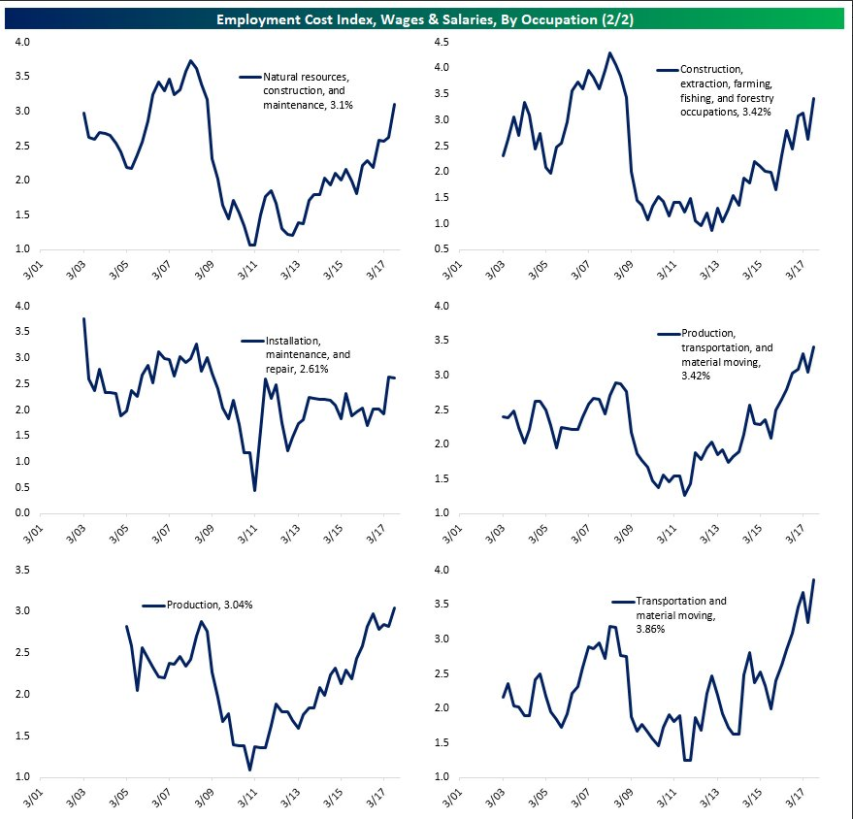
Are we starting to see stirrings of wage inflation? Perhaps. The Employment Cost Index rose 0.7% in the third quarter, faster than the 0.5% rate we saw in the second. Wages and salaries (which account for 70% of the ECI) rose 0.7%, while benefits rose 0.8%. On a year-over-year basis, they rose 2.5%. So far, bonds aren't reacting to the number. An increase in wage inflation will force the Fed to move more aggressively. For those who worry about income inequality, the biggest growth was in blue collar jobs, where wages rose 0.8% and benefits rose 1.7%. 


Home prices rose 0.5% in August and are up 5.9% for the year, according to Case-Shiller. Seattle has been on a tear, rising over 13% for the past year, followed by Las Vegas and San Diego. A strong economy along with low inventory and rates have been a support for home prices. The interest rate environment will be changing, however inventory doesn't appear to be a temporary phenomenon, and the US economy seems to be accelerating, not declining. While the usual affordability questions are mentioned, the median mortgage payment for the median house as a percent of income is still very low by historical standards. 

Note that the lack of building is simply creating pent-up demand for housing which will get satisfied eventually. That will push up growth for the next few years when it finally happens. 

Manufacturing continues to hum along, with the Chicago PMI coming in well above expectations. 

Bitcoin futures are coming... The contracts will be cash settled, not by delivery of the underlying. 

Friday, April 28, 2017

Morning Report: Q1 GDP weakest in 3 years

Vital Statistics:

Last Change
S&P Futures  2387.0 1.0
Eurostoxx Index 386.8 -1.0
Oil (WTI) 49.5 0.6
US dollar index 89.7
10 Year Govt Bond Yield 2.32%
Current Coupon Fannie Mae TBA 102.63
Current Coupon Ginnie Mae TBA 103.68
30 Year Fixed Rate Mortgage 3.98

Stocks are flattish after first quarter GDP misses expectations. Bonds and MBS are down.

First quarter GDP came in at 0.7%, which was lower than the 1.1% consensus forecast. A decline in spending on motor vehicles was a drag on Q1, which has been weak the past several years for some reason. The personal consumption expenditure (the inflation measure most preferred by the Fed rose 2.4%, which is higher than their target rate. This was the highest reading in several years, which means the Fed might be forced to move even though growth is weak. The savings rate jumped from 5.5% to 5.7%, which means consumers are still using increases in income to pay down debt. Inventory depletion and a drop in government spending, along with weak consumption were the main drivers. Note that this is just the advance estimate, and will be revised twice in the next month. 


Employment costs rose 2.8% annualized in the first quarter, according the BLS. Wages and salaries rose 2.5% while benefit costs increased 2.2%. We have been seeing a gradual tick up in this index, however wages are still well off their pre-crisis historical trend. 


Trump's tax plan was short on specifics, but it certainly looks like wealthier residents in high tax states will feel it the most. Killing the state and local tax deduction has been fraught with risk, but given that it will largely affect the blue states it might have a chance. Eliminating the mortgage interest deduction will be a poison pill, IMO. Will tax reform hit the residential real estate market? Probably not, as tight inventories are the dominant factor driving pricing right now. 

The homeownership rate ticked down slightly in the first quarter to 63.6% from 63.7% in the fourth quarter. It looks like it is on the rebound, however the first time homebuyer really needs incomes to rise in order to catch an asset that is increasing 7% a year. More starter home construction would help too, but multi-fam seems to be the interest of builders. Vacancy rates are largely flat MOM and YOY. 


The Chicago Purchasing Manager Index rose last month, while consumer sentiment slipped. 

Housing Wire's home price forecast for the rest of the year. Overall, looking at 3.5% growth, with a range of anywhere from 1% to 10%. 

Tuesday, January 31, 2017

Morning Report: Wages and salaries up 2.3% YOY

Vital Statistics:

Last Change
S&P Futures  2270.3 -5.8
Eurostoxx Index 362.9 0.3
Oil (WTI) 53.0 0.3
US dollar index 90.8 -0.3
10 Year Govt Bond Yield 2.48%
Current Coupon Fannie Mae TBA 102.1
Current Coupon Ginnie Mae TBA 103.2
30 Year Fixed Rate Mortgage 4.16

Stocks are lower as earnings come in (and some are bad). Bonds and MBS are up small.

Employment costs increased 0.5% in the fourth quarter as wages and salaries increased 0.5% and benefit costs increased 0.4%. On a year-over-year basis, wages and salaries are up 2.3%, an uptick from the 2.1% pace a year ago. This report is more or less in line with expectations and shouldn't have much of an effect on the FOMC's rate decision. The meeting starts today, with an announcement scheduled for 2:00 pm EST tomorrow.  FWIW, the Fed Funds futures are pricing in a 13% chance of a rate hike tomorrow, and a 50% chance of a hike by June. 

Home prices increased 5.6% YOY in November, according to the Case-Shiller Home Price Index. This index has recouped all of its losses from the bubble years. The Pacific Northwest led the charge, with prices increasing double digits in Portland and Seattle. Washington DC and NYC were the laggards. 

Here is the income required to buy the median home in various locations. It varies from almost $150k in San Francisco to $34k in Cincinnati. As they say, all real estate is local. 

Donald Trump promised to "do a big number" on Dodd-Frank yesterday. While the President is limited in what he can do unilaterally, he can ease the burden somewhat without legislation. 

One economic historian thinks the current bond market most closely resembles the late 1960s, as we exited a multi-decade period of low inflation. From 1965-1970, inflation rose from 1.6% to 5.9%, and long term Treasuries lost 36% in real terms. The lesson from the 1960s is that inflation can sneak up on you very quickly. Of course there are fundamental structural differences in the economy that make it harder to see inflation creep up the way it did in the 1960s and 1970s, so it is probably unlikely that we will see any sort of 1970s conflagration. First, the US was insulated from globalization in the late 60s and early 70s as postwar Asia and Europe were still rebuilding. Second, union contracts had automatic cost of living increases which caused wage-push inflation. Today, we don't have that. In fact, technology is replacing labor, which is pushing costs down, not up. Capacity Utilization rates were in the high 80s back then versus mid 70s now. Inflation is a case of too much money chasing too few goods. We might have too much money at the moment, but we don't have too few goods. If anything, we have too much money chasing too few assets, which is why we have experienced asset bubbles over the past 30 years, not inflation. 

Speaking of asset price inflation, the best investment in inflationary times can be real estate, especially when you use a 30 year fixed rate mortgage. 

Single women buy houses as twice the rate of single men. Most likely explanation: kids.

Last week, I participated in a webinar for HousingWire where we discussed interest rates, regulation, and MI. The playback is here.

Tuesday, December 6, 2016

Morning Report: Productivity rises

Vital Statistics:

Last Change
S&P Futures  2207.5 3.0
Eurostoxx Index 343.2 2.0
Oil (WTI) 50.7 -1.1
US dollar index 91.0 0.0
10 Year Govt Bond Yield 2.39%
Current Coupon Fannie Mae TBA 103
Current Coupon Ginnie Mae TBA 104
30 Year Fixed Rate Mortgage 4.11

Stocks are lower this morning on no real news. Bonds and MBS are up. 

Non-farm productivity improved to 3.1% in the third quarter, breaking out of a long slump. Unit labor costs increased 0.7%. Note that productivity and costs have been kind of oscillating around the zero point for the past several years. This is why wage growth has been going nowhere. New policies in terms of regulatory relief and tax reform could help improve productivity according to St. Louis Fed Head James Bullard. 


Donald Trump has been discussing a potential 35% tariff on good imported from companies that offshore jobs. Not sure if this is even going to be legal, let alone legislatively possible. Tariffs are generally good for no one, except perhaps union workers. The last time we had a cocktail of tariffs and Fed tightening (1930), the economic result was nothing to write home about. While Reagan did impose tariffs against Japan, the results were mixed at best. 

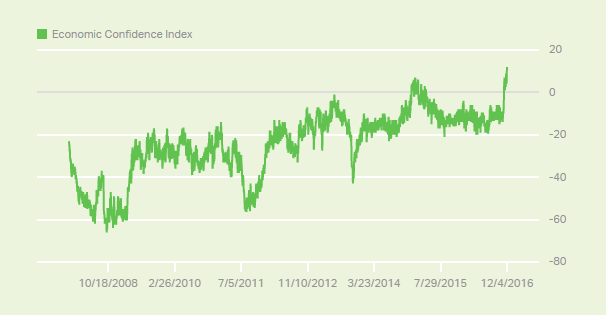
Economic confidence improved markedly in November, according to Gallup and is now at post-crisis highs. It will be interesting to see whether this translates into higher holiday spending. Separately, it could bode well for the Spring selling season, which is just around the corner (basically starts around Super Bowl Sunday).


Luxury homebuilder Toll Brothers announced better than expected numbers this morning. Deliveries were up 29% in dollars and 22% in units, however we are seeing a moderation in inflation. Average selling prices rose 5.5% to $834k, which is well below the double-digit ASP inflation we have been seeing, especially at the high end. They discussed the Millennials and how they are targeting them: “With the millennial generation now entering their thirties and forming families, we are starting to benefit from the desire for home ownership from the affluent leading edge of this huge demographic wave. In FY 2016, approximately 22% of our settlements included one primary buyer thirty-five years of age or under. (emphasis mine). We are currently courting these customers with our core suburban homes, urban condos and rental apartment properties. We are also introducing a new product line, T|Select by Toll Brothers, which incorporates the elegance and style of a higher-end Toll Brothers home but with fewer structural options, a quicker delivery time and a slightly lower price."

Home prices rose 1.1% MOM and are up 6.7% YOY, according to CoreLogic. The coasts remain largely overvalued, while the interior is mainly undervalued. 


While rising rates are creating worries in the mortgage banking sector of the economy, banks have been on a tear since the election, outperforming the S&P 500 by 11 percentage points. This means the Street is forecasting a big increase in credit and profitability which should offset some of the doom and gloom amongst mortgage bankers. The "tell" will be the return of the private label securitization market, and the follow-on return of the first time homebuyer. Shops that focus on purchase activity should be optimistic about the future. 


Friday, July 31, 2015

Morning Report: Employment Cost inflation lowest since 1982

Vital Statistics:

Last Change Percent
S&P Futures  2106.2 2.5 0.12%
Eurostoxx Index 3580.9 -2.9 -0.08%
Oil (WTI) 47.92 -0.6 -1.24%
LIBOR 0.297 0.000 0.00%
US Dollar Index (DXY) 96.63 -0.928 -0.95%
10 Year Govt Bond Yield 2.20% -0.06%
Current Coupon Ginnie Mae TBA 104.1 0.2
Current Coupon Fannie Mae TBA 103.4 0.1
BankRate 30 Year Fixed Rate Mortgage 3.93

Stocks are flattish after the Employment Cost Index comes in lower than expected. Bonds and MBS are flat

The Employment Cost Index rose 0.2% in the second quarter, the lowest increase since BLS started keeping track, which began in 1982. On a 12-month basis, employment costs are up 2%. This number includes salaries and benefits, so we still have wage inflation barely keeping up with inflation in general. Given the low ECI and falling commodity prices in general, the Fed has an excuse not to move in September. Bonds rallied hard on the announcement. 

Note that in 1982, the US was in the worst recession since the Great Depression. This was the recession caused by Paul Volcker's tightening to conquer 1970s inflation. It also corresponded to the first wave of globalization, where US industry had to deal with international competition for the first time since WWII. Given that we are 5 years into an expansion, that number sticks out like a sore thumb. 

The ECI is just another demonstration of the strange state of affairs in the US labor market. People who have jobs are keeping them, as demonstrated by the multi-decade lows in initial jobless claims and the low unemployment rate. Job openings are at the highest since BLS started keeping track in 2001. The labor force participation rate is the lowest since the late 1970s and wage inflation is the lowest since 1982. Definitely a perplexing environment for the Fed to navigate. 

Lost in the GDP data from yesterday, GDP growth was revised downward from 2.3% to 2% for the years 2011-2014. Apparently the government overestimated what government spending was during those years. Kind of funny, actually.

The Chicago Purchasing Manager's index rose to 54.7 in July from 49.4. 

Consumer Confidence slipped slightly in July, according to the University of Michigan Consumer Sentiment Survey. The current conditions index rose while the expectations index fell. The number of people who say their household financial situation is worse than a year ago ticked up to 29%. Interesting to say the least, given that these consumer confidence indices often are influence by gasoline prices and those have been falling as oil has been taken to the woodshed. 

Speaking of oil prices, both Exxon-Mobil and Chevron reported weaker than expected numbers this morning, and both stocks are getting whacked. Surprisingly, D.R. Horton (who has a lot of TX exposure) has not seen any evidence of this hitting homebuyer demand. 

Chart: West Texas Intermediate:


Ocwen missed earnings estimates and the stock is down about 16% on the open. The UPB of its servicing portfolio fell 26% to $322 billion. They unveiled a new plan to cut costs as their assets fall. 

The House Financial Services Committee passed a "hold harmless" period for TRID, which basically says the CFPB won't be able to enforce TRID and impose penalties until Feb 1 2016, provided the issuer is making a good-faith effort to comply with the regulation. There is a competing bill in the Senate which would have a shorter period, ending on Jan 1. The CFPB has already delayed the implementation once. 


Thursday, April 30, 2015

Morning Report - Economic data dump and the FOMC

Vital Statistics:

Last Change Percent
S&P Futures  2090.8 -8.2 -0.39%
Eurostoxx Index 3632.6 15.5 0.43%
Oil (WTI) 59.16 0.6 0.99%
LIBOR 0.278 -0.001 -0.30%
US Dollar Index (DXY) 95.09 -0.124 -0.13%
10 Year Govt Bond Yield 2.10% 0.06%  
Current Coupon Ginnie Mae TBA 102.7 0.0
Current Coupon Fannie Mae TBA 101.5 -0.3
BankRate 30 Year Fixed Rate Mortgage 3.86

Stocks are lower this morning on no real news. Bonds and MBS are down as European bonds continue to sell off.

European bonds have been selling off as fast money gets caught on the wrong side of the boat. This is pushing up Treasury yields, which should be moving down based on some of the economic data lately. 

There is a lot of economic data this morning. Initial Jobless Claims fell to 262,000, the lowest reading in 15 years. The ISM Milwaukee index fell to 48.08. The Bloomberg Consumer Comfort Index fell to 44.7 and the Chicago Purchasing Manager Index rose to 52.3.

The Employment Cost Index rose .7% in Q1. Wages and Salaries increased .7%, while benefits increased .6%. On an annualized basis, wages and salaries were up 2.6%, while benefits were up 2.7%. This is a big jump from the fourth quarter reading of 2.1%, and the average over the past few years of around 2%. One data point does not make a trend, but economically this is encouraging - wage growth has been a long time coming. 

Personal Income was flat in March, however compensation was up .2%. Personal spending rose to 0.4%, and the savings rate dipped slightly to 5.3%. The savings rate has been trending upward however, as people use some of the added income to pay off debt. The increase in spending is an encouraging data point. 

Inflation remains low, using the Fed's preferred inflation measure, personal consumption expenditures. On a year-over-year basis, the core number is up 1.3%, well below their 2% target. Given the weak Q1 GDP number and the weak inflation numbers, I find it hard to imagine the Fed moving in June. 

The FOMC statement was pretty bland, and we didn't see much of a reaction. The slowdown was attributed largely to "transitory factors." On rate hikes: "The Committee anticipates that it will be appropriate to raise the target range for the federal funds rate when it has seen further improvement in the labor market and is reasonably confident that inflation will move back to its 2 percent objective over the medium term." Given unemployment is back at normal levels, they are probably looking at wage growth as their key metric. 

The Bernank is now an advisor to PIMCO, as well as Citadel. Bond managers will be like: "Hey Ben, can you take Janet's temperature on a June rate hike?"

Household formation increased at an annual rate of 1.5 million in Q1, even as the homeownership rate dipped. This is good news for landlords, however it isn't spilling over to residential construction yet, with housing starts still mired about 70% of normalcy.