A place where economics, financial markets, and real estate intersect.
Showing posts with label corelogic. Show all posts

Tuesday, August 7, 2018

Morning Report: Home prices rise 6.8% in June

Vital Statistics:

Last Change
S&P futures 2856 6
Eurostoxx index 391.01 2.35
Oil (WTI) 69.62 0.61
10 Year Government Bond Yield 2.96%
30 Year fixed rate mortgage 4.58%

Stocks are higher this morning on no real news. Bonds and MBS are flat.

There were 6.7 million open jobs in June, according to BLS. The all-important quits rate was unchanged at 2.3%. The quits rate is a leading indicator for wage growth and is a stat the Fed follows closely. The quits rate was highest in the South and Midwest, and lowest in the Northeast. If you look at industry groups, one group stands out with a quits rate that is going nowhere. Financial Services.


Home Prices rose 0.7% MOM in June, according to CoreLogic. They are up 6.8% YOY and forecast to rise another 5% over the coming year. Rising mortgage rates and home prices are affecting sales in the high cost markets. They also surveyed renters and found that affordability is the biggest reason why they aren't interested in buying a home. For older renters, affordability isn't the biggest issue - probably convenience is - although a jump in bankruptcy filings in the senior citizen demo is on the rise. We are seeing large pockets of overvaluation on the coasts, but the interior of the country is undervalued.


Freddie Mac is trying a new program to enhance rental affordability: providing low-interest loans to developers who promise to cap rental inflation. This is certainly a less intrusive way to deal with the affordable housing problem. The West Coast is finding that affordable housing mandates are pushing developers to scrap projects entirely and local governments are being pushed to override zoning restrictions. Freddie's program is a way to incentivize the private sector into doing something: “Maybe there’s a way we can help change incentives,” said David Brickman, an executive vice president at Freddie Mac and head of its multifamily division. “We can provide an economic basis for private, profit-oriented developers to pursue a strategy where they didn’t raise rents by quite as much. You’re taking some of the opportunity to hit a home run off the table but arguably making it more likely you can hit a single or a double.”

Washington is hoping to address the affordable housing crisis by allowing tax credits for low-income renters who spend more than 30% of their income on rent. Cory Booker's plan also looks to ease some of the regulatory burden in building new housing as well as introduce a new savings plan for renters.

What is it with tech companies who have a competitive edge wanting to diversify into hyper-competitive low-margin businesses? The latest is Zillow, which has decided it is time to get into the mortgage business. Wall Street panned the move, sending the stock down 20%. Part of the decline was due to lousy earnings, but still....

Wednesday, July 25, 2018

Morning Report: New Home Sales fall

Vital Statistics:

Last Change
S&P futures 2816 -4
Eurostoxx index 387.12 -1.06
Oil (WTI) 68.52 0
10 Year Government Bond Yield 2.94%
30 Year fixed rate mortgage 4.61%

Stocks are lower this morning after lousy earnings out of the automakers. Bonds and MBS are flat. 

Donald Trump tweeted contradictory statements about trade yesterday, both extolling the virtues of tariffs and also telling Europe that he is ready to end all tariffs if they are. He is also planning to use taxpayer money to help offset the negative effects of Chinese retaliatory tariffs on American farmers. This is New Deal type stuff and I have to imagine that Congress is contemplating legislation to take control of tariffs back from the Executive Branch. When tariffs were going down overall worldwide, it may have made sense to allow the President to lower them without involving the legislative branch, but the unintended consequence was that it allows the President to conduct a trade war unilaterally. 

New Home Sales fell 5% on a MOM basis, but were up 2% on a YOY basis to a seasonally-adjusted annual level of 631,000. The Street was looking for something around 680,000. New Home Sales is a notoriously volatile estimate so that number could be revised upward next month. For sale inventory came in at 301,000 which represents a 5.7 month supply. 

Mortgage Applications fell 0.2% last week as purchases fell 1% and refis rose 1%. 

Flagstar reported earnings yesterday. EPS and revenues rose, however there are some acquisition-related effects happening (not Stearns though). Mortgage origination volume fell by 1.5% and gain on sale fell by 6 basis points. Flagstar appears to be taking share, at least judging by those numbers. Most other banks are reporting sizeable volume drops. 

With home prices back above peak bubble levels, the question of affordability invariably comes up. CoreLogic crunched the numbers and it turns out that if you adjust for inflation, the median mortgage payment (P&I) on the median house is much lower than the peak years. This is being driven by the drop in rates. Of the top 10 MSAs, only San Francisco and Denver were higher than the peak. Compared to pre-bubble years (2002), they are higher. 


Redfin notes that some of the least affordable MSAs are starting to see an increase in inventory. Homes for sale rose 35% in Portland, 12% in San Jose, and 24% in Seattle. Whether that inventory buildup remains enough to slow the double-digit home price appreciation in those markets remains to be seen. We are heading into the seasonally slow period, and as a general rule home prices decline in Fall and Winter. Overall, home prices rose 5.7% which is the smallest increase since late 2016. Inventory levels still declined on a YOY basis. 

Chinese investors were net sellers of US commercial property in the second quarter for the first time in a decade. Pressure from Beijing is the catalyst, although China has a real estate bubble of their own to deal with. Chinese money was also behind some of the activity in the big West Coast MSAs, and it will be interesting to see if that dumps some supply on the market to balance it out. 

Tuesday, May 8, 2018

Morning Report: Jerome Powell agrees with markets on interest rates

Vital Statistic:

Last Change
S&P futures 2667 -3
Eurostoxx index 388.93 -0.56
Oil (WTI) 70.09 -0.62
10 Year Government Bond Yield 2.96%
30 Year fixed rate mortgage 4.55%

Stocks are lower as we await the Trump Administration's decision on the Iran deal. Bonds and MBS are down small. 

The Administration is set to announce later today whether they intend to stay in the Iranian deal or abandon it. Oil has been rallying on expectations Trump will leave. 

Jerome Powell said that market expectations (i.e. the Fed Funds futures) are more or less in alignment with the Fed's expectations for the future path of interest rates. The December Fed funds futures are predicting about a 10% chance of one more hike this year, a 44% chance of 2 more and a 39% chance of 3 more. Over the past month, the central tendency has become more hawkish. 


Small Business Optimism remains strong, according to the NFIB. More businesses are planning on increasing capital expenditures, while hiring remains strong and we are seeing evidence of increased compensation. Profitability increased as well, which indicates that productivity is increasing, and that some of this CAPEX is going towards labor-saving technology. Finding qualified workers continues to be the biggest issue surrounding small business. “There is no question that small business is booming,” said NFIB Chief Economist Bill Dunkelberg. “Consumer spending, the new tax law, and lower regulatory barriers are all supporting the surge in optimism across all small business industry sectors.”

Despite the hurricane-related spike in delinquences, overall DQ rates have been falling, according to CoreLogic. Home price appreciation, in addition to more stringent underwriting standards are the driving force behind it. The foreclosure rate is down from 0.8% to 0.5%, and the 30 day DQ rate is down to 4.8% from 5.0%. As you would expect, TX and FL are experiencing rising DQ rates, but the rest of the nation is down. 

Tesla stock has more or less recovered from its conference call induces swoon from last week. The bonds are at the lows however, trading at 88. Note there is a divergence also in NFLX, which has bonds in the low 90s, while the stock is a highflyer. 

NYS AG Eric Schneiderman resigned from office after reports came out that he abused 4 women. Schneiderman was an AG cut in the same cloth as Eliot Spitzer, and hated the financial industry about as much as he did (FWIW the feeling was mutual). When Spitzer announced his resignation, cheers went up on the floor of the NYSE. 

Freddie Mac is getting into the business of providing lines of credit against MSR portfolios. Nonbank servicers face liquidity issues when loans they are servicing go delinquent. They are required to make the mortgage payment to the ultimate investor of the mortgage until the loan is brought current or foreclosed. Banks generally have no problems with this, but nonbank issuers generally don't have the balance sheet to withstand heavy advances activity. Fannie Mae only requires 6 months of advances, but Ginnie Mae has no similar relief. Policymakers are concerned about the ability of nonbank servicers to withstand a period of prolonged stress if delinquencies spike. 

Homebuyer sentiment hit an all-time high according to the Fannie Mae Home Purchase Sentiment Index. "The latest HPSI reading edged up to a new survey high, showing that consumer attitudes remain resilient going into the spring/summer home buying season," said Doug Duncan, senior vice president and chief economist at Fannie Mae. "High home prices and good economic conditions helped push the share of Americans who think it’s a good time to sell to a fresh record high. However, the upward trend in the good-time-to-sell share seen since last spring has done little to release more for-sale inventory. The tightest supply in decades, combined with rising mortgage rates from historically low levels, will likely remain a hurdle for mobility and a persistent headwind for home sales."

Tuesday, September 12, 2017

Morning Report: Small Business Optimism at 12 year highs

Vital Statistics:

Last Change
S&P Futures  2490.0 4.3
Eurostoxx Index 381.8 2.4
Oil (WTI) 48.3 0.2
US dollar index 85.2 0.1
10 Year Govt Bond Yield 2.15%
Current Coupon Fannie Mae TBA 103.33
Current Coupon Ginnie Mae TBA 104.21
30 Year Fixed Rate Mortgage 3.73

Stocks are higher this morning on overseas strength. Bonds and MBS are down. 

Small Business optimism remained strong in August, according to the NFIB Small Business Optimism Index. Increases in capital spending and higher sales expectations drove the increase. The index now matches the 12 year high set earlier this year. Interestingly, small business cited "quality of labor" as their second biggest problem, behind higher taxes. 59% reported trying to hire, and of those 88% reported few or no qualified applicants. In fact, both manufacturing and construction reported low labor quality as their biggest problem. Compensation is on the rise, as a net 28% of small businesses reported increasing comp. So, even though we aren't getting much in the way of legislation out of DC, the drop in new regulations are helping sentiment. A net 9% of firms reported an increase in average selling prices, which is good news to the Fed. 

Job openings totaled 6.17 million in July, according the JOLTs report. The quits rate, which is a leading indicator of increasing wages, was steady at 2.2%, and has been in a tight 2.1% to 2.2% range. The Fed watches this indicator closely. 

Delinquencies continue to fall, driven by job growth and home price appreciation, according to CoreLogic. 30 day + DQs were 4.5% in June, down from 5.3% a year ago. The foreclosure rate was 0.7%, the lowest level in 10 years. The foreclosure rate varied between 0.1% in Denver and 2.2% in New York - Newark - Jersey City MSA. 

Trump is planning on hitting the road to pitch tax reform. He was criticized for not doing more to sell the repeal of Obamacare, so he is trying not to repeat that mistake. Congress has yet to determine the particulars over what individual and corporate rates will be, but the purpose of these rallies is to make the case that we need tax reform to improve our competitiveness. Business friendly groups are also going to spend money on ads pushing for reform. 

Banks with exposure to Florida are breathing easier after the damage from Irma turned out to be lower than expected. CoreLogic estimated that uninsured flood losses from Harvey could turn out to be $18-$27 billion. 


Wednesday, July 5, 2017

Morning Report: FOMC minutes today

Vital Statistics:

Last Change
S&P Futures  2421.5 1.5
Eurostoxx Index 379.4 -1.3
Oil (WTI) 46.3 1.4
US dollar index 87.7 0.1
10 Year Govt Bond Yield 2.30%
Current Coupon Fannie Mae TBA 102.88
Current Coupon Ginnie Mae TBA 103.75
30 Year Fixed Rate Mortgage 4

Stocks are up small after the long weekend. Bonds and MBS are down.

At 2:00 pm we will get the minutes from the June FOMC meeting. There is the always the possibility of market movement from these things, so just be aware. Here are the things the markets will be looking for

Construction spending was flat MOM in May and up 4.5% YOY. Private residential construction was up 11% YOY. 

Manufacturing continues to accelerate, according the ISM PMI report, which hit a 3 year high. The index level would historically correspond with a 4.6% increase in GDP. The average for the first half of the year would correspond to a 4.1% increase in GDP. Of course manufacturing doesn't have the share of GDP it used to, but it is a good indication that things are getting better. 

Bond yields have been backing up, largely on overseas events. Bonds in Europe are selling off and dragging US yields higher on the relative value trade. The current projections for the upcoming FOMC meetings have become slightly more in favor of rate hikes, but we are still looking at no change at the July meeting, and only a 18% chance of a hike in September. The markets are also looking to the September meeting for more clarity regarding balance sheet reduction. 

Home Price appreciation continues to accelerate, as the CoreLogic home price index rose 1.2% MOM and is up 6.6% YOY. Rental inflation rose 3.1%, so the increase in home prices is a bit of a double-edged sword. Those who already own homes are getting the benefit of home price appreciation while the first time homebuyer is squeezed. 

Upcoming changes that will affect mortgage credit. Tax liens and civil judgements will be expunged from credit reports, which could amount to a 20 point increase in FICOs for some people. Second, Fannie Mae is increasing the DTI ratio from 45 to 50 in order to take into account high levels of student loan debt. 

HUD is recommending that Fannie Mae tweak upward its affordable housing goals for 2018-2020. Most goals are unchanged, but a couple were pushed up slightly. 

Tuesday, June 20, 2017

Morning Report: Good numbers out of Lennar

Vital Statistics:

Last Change
S&P Futures  2446.3 -1.3
Eurostoxx Index 391.2 -0.8
Oil (WTI) 43.1 -1.1
US dollar index 88.9 0.1
10 Year Govt Bond Yield 2.18%
Current Coupon Fannie Mae TBA 103.31
Current Coupon Ginnie Mae TBA 104.375
30 Year Fixed Rate Mortgage 3.92

Stocks are lower as oil continues to fall. Bonds and MBS are flat.

No economic data today, however we do have some Fed-speak. Overnight Stanley Fischer observed that some countries have real estate bubbles and low interest rates might have played a role. (Gee, ya think?) The planet's central bankers are on a mission to create inflation, however the inflation they want (wages) is not happening - it is going into inflation they don't necessarily want (asset prices). Fischer noted that the US government basically IS the mortgage market in the US and that government support for MBS should be made explicit. 

Lennar reported better than expected earnings this morning, with revenues up 19%. Deliveries increased 15% and backlog was up 20% in dollar terms. While revenues rose, margins are falling, with gross margins down 160 basis points. Lennar CEO Stuart Miller said: "We are now seeing, contrary to recent reports on housing starts and building permits, more of a reversion to normal in the housing market than the slow and steady recovery pace of the last several years." The stock is up a couple of percent pre-open. 

Meanwhile, the lousy housing starts number prompted a number of houses to take down their Q2 GDP estimates. Merrill took their estimate down to 2.2%, while the Atlanta Fed took their estimate down to 2.9%. The NY Fed's estimate is coming in at 1.9%. 

Credit risk for new mortgages edged up according to CoreLogic. The index is at similar levels to 2001-2003, which CoreLogic considers a baseline for credit risk. Part of this is due to the effect higher interest rates have on credit scores. As CoreLogic observes: “Since 2009, for every one-half percentage point increase in mortgage rates, the average credit score on refinance borrowers has dipped by 9 points, and this pattern will likely continue if mortgage rates move higher. That is because when rates rise, applications drop off and loan officers spend more time with the applicants that have less-than-perfect credit scores, require more documentation or have unique property issues.”

Tuesday, April 4, 2017

Morning report: Hard vs soft data

Vital Statistics:

Last Change
S&P Futures  2345.5 -10.5
Eurostoxx Index 378.7 -0.6
Oil (WTI) 50.5 0.3
US dollar index 90.5
10 Year Govt Bond Yield 2.32%
Current Coupon Fannie Mae TBA 103.41
Current Coupon Ginnie Mae TBA 103.7
30 Year Fixed Rate Mortgage 4.09

Stocks are lower this morning after auto sales disappointed. Bonds and MBS are up. 

Factory orders rose 1% last month, in line with expectations.

US economic confidence decreased last week, according to Gallup, however confidence is still strong. Meanwhile, consumer spending was flat


These data points (economic confidence, consumer spending, and auto sales) illustrate the conundrum we have been seeing for the past few months: soft data like confidence and ISM reports show a strong economy, while the hard data like sales have been showing a mediocre economy. Much of this is Washington-driven as investors realize that Trump will have a difficult time pushing through his agenda in the face of unified Democratic opposition and a Freedom Caucus that wants less government, period. Unrealistic expectations are being brought back to Earth. Despite gridlock, much is being done on the regulatory front and with executive orders which don't require Congressional approval. That will help. But there seems to be a shift in the psychology of investors: the markets seem to be worrying less about the Fed and worrying more about tepid growth. Bonds have noticed as well, with the 10 bond yield down about 30 basis points over the past 3 weeks. 

Home prices rose 7% YOY in February, according to CoreLogic. We are seeing the highest price appreciation at the lower price points. The first time homebuyer is getting hit with a double-whammy of higher prices and borrowing costs. 

Housing's share of GDP came in 15.6% in the fourth quarter. Historically, that number has been around 18%. Housing continues to punch below its weight, as evidenced by tight inventory. It is hard to know exactly why homebuilding continues to be weak - credit is an issue, as is the general post-bubble caution, along with local land use regulations. 

Tuesday, March 21, 2017

Morning Report: Credit risk at post-crisis lows

Vital Statistics:

Last Change
S&P Futures  2373.8 3.5
Eurostoxx Index 378.3 0.6
Oil (WTI) 48.4 0.2
US dollar index 90.2  
10 Year Govt Bond Yield 2.49%
Current Coupon Fannie Mae TBA 101.703
Current Coupon Ginnie Mae TBA 102.98
30 Year Fixed Rate Mortgage 4.22

Stocks are up small this morning while bonds and MBS are flat.

We have no economic data this morning, but will have a lot of Fed-speak during the day. 

CoreLogic took a look at credit risk of mortgages going back to 2001 and came up with an index to describe the credit risk of a typical mortgage, using things like credit scores, LTVs, and DTI ratios. Credit risk is now re-approaching the lows of 2011-2012. This is somewhat interesting as you would expect lenders to loosen standards as rates rise - basically using a larger credit box to offset some of the volume lost from refis. So far (this data is through December) we don't have evidence of lenders doing that. Even the Ellie Mae data had a de minimus change in FICOs. 


Speaking of increasing the credit box, we are seeing signs of life from the private label securitization market, which has largely been dormant since 2006. Angel Oak did a $148MM deal securitized by non-QM mortgages that got a AAA rating from Fitch. The new deals are much different than the past deals in that they documented, have large downpayments, and are much more overcollateralized than they were in the past. Part of the problem in bringing them back has simply been interest rates. Banks have been unable to structure anything that provides a high enough rate of return to interest the traditional MBS investor. As rates rise, that problem should go away. We are a long way from the no-no loans of 2005 - the typical loan is either a high quality jumbos or non-QM loans for the self-employed. 


Thursday, March 9, 2017

Morning Report: Home equity rises

Vital Statistics:

Last Change
S&P Futures  2363.0 -1.0
Eurostoxx Index 372.1 -0.5
Oil (WTI) 49.6 -0.7
US dollar index 92.0
10 Year Govt Bond Yield 2.58%
Current Coupon Fannie Mae TBA 101.438
Current Coupon Ginnie Mae TBA 102.784
30 Year Fixed Rate Mortgage 4.19

Stocks are lower this morning as oil continues to fall. Bonds and MBS are down small. 

Initial Jobless Claims ticked up to 243k last week. The 4 week moving average is 237k. Consumer Comfort improved. 

There were 37,000 announced job cuts in February, according to outplacement firm Challenger, Gray and Christmas. This is a decline of 19% from January and a decrease of 40% from February last year. The job cuts are dominated by the retail sector as department stores had a lousy holiday season. In fact, the job cuts in retail are almost 6x the next biggest sector (energy). Of course some of this is seasonal, but there continue to be problems with the shopping mall sector or retail. The financial sector also reported about 3,300 job cuts as higher interest rates hurt some in the mortgage space and automation / falling fees reduce headcount in banking and asset management. On the other side of the coin, companies announced they were hiring over 162k - and 100k of them were by Amazon.com. It seems strange to think that for every job lost in bricks and mortar retail, 3 were created for online shopping, but there you go. 

Import prices rose 0.2% in February and are up 4.6% YOY, however when you strip out petroleum, they fell 0.1% and are up 0.5% YOY. While the Fed is concerned about potential inflation, we have yet to see any hard evidence of it yet. 

Rising home prices helped reduce negative equity by over $2 billion in the fourth quarter, according to CoreLogic. About 3.2 million homes (or 6.2%) have negative equity. A total of 7.7 million have under 20% equity. These loans become refi candidates as home price rise. Cashout refis driven by increasing home prices will undoubtedly become a larger component of the refi universe as rates continue to rise. 

Under Donald Trump's proposed budget HUD will get about 14% less than last year. It looks like most of the cuts will fall on community devlopment block grants and public housing maintenance. It doesn't appear (at least initially) that the mortgage side of things is affected at all. 


Tuesday, March 7, 2017

Morning Report: Home purchase sentiment rises again

Vital Statistics:

Last Change
S&P Futures  2372.0 -3.5
Eurostoxx Index 372.8 -0.5
Oil (WTI) 53.6 0.4
US dollar index 91.7
10 Year Govt Bond Yield 2.50%
Current Coupon Fannie Mae TBA 101.86
Current Coupon Ginnie Mae TBA 103.19
30 Year Fixed Rate Mortgage 4.19

Stocks are lower this morning on no real news. Bonds and MBS are flattish.

Home prices rose 0.7% MOM and are up 6.9% YOY, according to CoreLogic. Including distressed sales, home prices are about 4% below their April 2006 peak. Other indices like the FHFA House Price Index have already surpassed their old bubble peaks. Of course they haven't really surpassed the bubble peaks on an inflation-adjusted basis - over the past 11 years, inflation has increased prices 20%. Currently, we have pockets of overvaluation in Florida, the Pacific NW, Texas, and parts of the Northeast.


Rising prices are helping homebuyer sentiment. The latest Fannie Mae Home Purchase sentiment index rose 5.6 percentage points to 88.3, a new record. Note that the index only started in 2010, so it has a limited history. The employment-related questions showed big improvements. People are not worried about losing their jobs, and a net 19% of respondents reported increased income over the past year. 

Redfin has some advice for Ben Carson regarding affordable housing policy. Punch line: increase subsidies, and try and coax local governments to change their zoning laws using carrots of infrastructure investment. 

Meanwhile, construction executives are the most optimistic they have been in years. Of course some of that optimism is predicated on a big infrastructure plan out of DC, which may or may not happen. 

The Republican replacement for Obamacare is out. The major changes include an elimination of the individual mandate, and block-granting Medicaid to the states. The Cadillac tax gets deferred until 2025 as well. The popular parts of Obamacare (allowing kids to stay on their parents' plan until their mid twenties and the the pre-existing condition coverage mandate) remain in place. 

Wednesday, January 4, 2017

Morning Report: Corporate America senses a shift in the winds

Vital Statistics:

Last Change
S&P Futures  2257.0 4.5
Eurostoxx Index 365.7 0.0
Oil (WTI) 52.5 0.1
US dollar index 93.2 -0.3
10 Year Govt Bond Yield 2.47%
Current Coupon Fannie Mae TBA 103
Current Coupon Ginnie Mae TBA 104
30 Year Fixed Rate Mortgage 4.17

Stocks are higher this morning on some good economic news out of Europe. Bonds and MBS are up small.

The FOMC minutes are scheduled to be released at 2:00 pm EST today. The focus will be on the dot plot, which showed the Committee members predicting 3 Fed Funds rate hikes this year. At her press conference, Janet Yellen downplayed the change, so investors will be looking closely at the discussion to get some more color on what the Fed is thinking. There is a chance that rates could get volatile around 2:00 pm, so just be aware if you are looking to lock around then. 


Mortgage Applications fell 12% last week as purchases fell 2% and refis fell 22%. It was a holiday week, so the numbers aren't as bad as they look. 

The Gallup Job Creation Index was unchanged last week and is at post-crisis highs. 

China recently imposed new capital controls in order to prevent outflows of their currency, which restricts Chinese companies from buying foreign real estate. You are starting to see the effect of that in the high end real estate markets. Apartment prices fell 6.3% in Manhattan and you are seeing the same thing in Central London (which has been in bubble territory for years). Though we have yet to see it, you should expect to see some of the froth come off other high flying real estate markets, particularly on the West Coast. 

CoreLogic looks at the change in Administrations (and ideologies) regarding housing going forward. Think tanks like the Urban Institute will take a backseat to think tanks like Cato. Expect to see a de-emphasis on fair housing issues like zoning and more of a focus on free-market solutions. Steve Mnuchin has been out calling for a re-privatization of Fannie Mae. 

"Buy the election, sell the inauguration" is Morgan Stanley's advice to equity owners. Their call is that uncertainty about Trump's policies and the Fed will overshadow the optimism over regulatory relief and lower taxes going forward. 

Wall Street lawyer Jay Clayton is the leading candidate to run the SEC. Along with Treasury Secretary Steve Mnuchin, they will hopefully get the private label securitization market back on track. 

A fascinating read on the CFPB and how it operates. 

It is interesting to see Corporate America begin to tout bringing jobs back to the US post-election. You have seen Ford, GM, Sprint, etc all out with headlines about planned job creation and shifting production back to the US. This could be the beginning of a trend. IMO, Corporate America has read the tea leaves from the election and realizes that they too are in the spotlight and want to get ahead of it. Ironically, Obama would have been crucified if he took on companies directly via Twitter the way Trump has. I guess only Nixon could go to China. 

Tuesday, December 20, 2016

Morning Report: Mortgage credit remains tight

Vital Statistics:

Last Change
S&P Futures  2265.5 5.5
Eurostoxx Index 360.9 1.3
Oil (WTI) 52.6 0.5
US dollar index 93.6 0.4
10 Year Govt Bond Yield 2.57%
Current Coupon Fannie Mae TBA 103
Current Coupon Ginnie Mae TBA 104
30 Year Fixed Rate Mortgage 4.29

Stocks are higher this morning on no real news. Bonds and MBS are down small.

No economic data today. The financial networks are giddy over #Dow20000. 

Housing credit remained tight in the third quarter, according to CoreLogic. New loan risk fell as credit scores improved and the average LTV fell to 85.8 from 86.8 a year ago. Average DTIs fell as well, to 35.4 from 35.7. I guess this index could be taken one of two ways: either credit is getting tighter, or the average borrower is getting into better financial shape as time goes on. I suspect it is a little of both. Regardless, you can see that we are a long way away from the glory days of the housing bubble, and even nowhere near the depths of the post 9/11 economy. 


Ray Dalio of Bridgewater has a good piece on the incoming administration and compares it to Reagan and Thatcher in the late 70s / early 80s. Bottom line is that the reins of government will be handed from academics and activists to businesspeople, which should unleash some of the animal spirits that have been dormant for the past decade. 

Quote from the article: "This particular shift by the Trump administration could have a much bigger impact on the US economy than one would calculate on the basis of changes in tax and spending policies alone because it could ignite animal spirits and attract productive capital. Regarding igniting animal spirits, if this administration can spark a virtuous cycle in which people can make money, the move out of cash (that pays them virtually nothing) to risk-on investments could be huge. Regarding attracting capital, Trump’s policies can also have a big impact because businessmen and investors move very quickly away from inhospitable environments to hospitable environments. Remember how quickly money left and came back to places like Spain and Argentina? A pro-business US with its rule of law, political stability, property rights protections, and (soon to be) favorable corporate taxes offers a uniquely attractive environment for those who make money and/or have money."

What does that mean for the financial sector? First, it probably means a return of the private label securitization market, which will open up capital to borrowers who are currently shut out of the market. Certainly it will encourage homebuilders to begin to address the shortage of housing we currently have, with the concomitant job creation that entails. And finally, it may be the catalyst to get the Millennial first time homebuyer in a position to own a home. Granted, there are a lot of "ifs" in Dalio's statement, but those sentiments are certainly being echoed in the stock and bond markets.  

Monday, December 19, 2016

Morning Report: Lennar beats

Vital Statistics:

Last Change
S&P Futures  2256.8 1.5
Eurostoxx Index 359.6 -0.4
Oil (WTI) 51.7 -0.2
US dollar index 93.2 0.1
10 Year Govt Bond Yield 2.55%
Current Coupon Fannie Mae TBA 103
Current Coupon Ginnie Mae TBA 104
30 Year Fixed Rate Mortgage 4.29

Stocks are up this morning on no real news. Bonds and MBS are up as well.

Not much in the way of economic data this morning, however Janet Yellen speaks at 1:30pm EST. 

The flash services PMI fell slightly to 43.5. 

Today the Electoral College votes for President. The vote will then go to Congress to be certified in early January. 

Homebuilder Lennar reported earnings this morning, with revenues up 15%, new orders up 12%, and backlog up 17%. Average selling prices rose only 2.9% to $357k, which indicates that home price appreciation is slowing. The press release didn't address the cancellation rate, which will probably begin to grow for the builders as higher rates kick in. Lennar has a November 30 fiscal year, so it is probably a little early to see how higher rates are affecting them. 

Lenders foresee a drop in margins and demand going forward as rates rise, according to the Fannie Mae Quarterly Lender Survey.  Fully 2/3 of lenders view rates as "not favorable" at the moment. Lenders expect margin compression as well as refi shops cut prices to stay competitive. Lenders do expect to continue to ease lending standards. Lenders also intend to execute more through the GSEs and the government and plan to reduce the number of loans they hold on their balance sheet. 

CoreLogic put out its forecasts for 2017. Home price appreciation will slow into 2017 as higher mortgage rates and home prices take a bite out of demand. Credit quality will remain good, however and we will start to see more HELOC activity, while refis will decrease. Vacancy rates will remain low, and rental inflation will be around 3%. 

Tuesday, December 13, 2016

Morning Report: The FOMC meeting begins

Vital Statistics:

Last Change
S&P Futures  2258.6 8.0
Eurostoxx Index 356.3 2.6
Oil (WTI) 53.1 0.3
US dollar index 91.3 0.0
10 Year Govt Bond Yield 2.44%
Current Coupon Fannie Mae TBA 103
Current Coupon Ginnie Mae TBA 104
30 Year Fixed Rate Mortgage 4.13

Markets are higher this morning as Italian bank Unicredito launches a restructuring plan. Bonds and MBS are up.

The FOMC meeting begins today, with the announcement scheduled for 2:00 pm tomorrow. 

Despite the expectation that the Fed will hike rates tomorrow, inflation remains pretty much nowhere to be found. Import prices fell 0.3% last month and are down 0.1% on an annualized basis. Export prices were down 0.1% MOM and down 0.3% YOY. 

Holiday shopping is starting out subdued, according to Redbook. Same Store Sales were up 1% for the week ending Dec 10. 

Here is a comparison of the past 3 tightening cycles: 1994-1995, 2004-2006 and the current one. The biggest differences: This tightening is happening much later in the cycle (this second hike is almost 7.5 years since the expansion began), unemployment is much lower (4.9% versus 5.5% and 6.5%) and growth is much lower. Of course the biggest difference is that the prior cycles were implemented in the context of a traditional business cycle, where a buildup in inventory caused a recession. This time around, it is the context of an asset bubble, where a buildup in bad debt caused the recession. These are fundamentally different animals, and explains why the Fed is taking baby steps this time around. 


One thing to watch after the FOMC announcement: Donald Trump's twitter feed. Any sort of jawboning of the Fed by Trump will almost certainly affect bonds. In the past, Trump has been hawkish, however now that he is a politician, he might adopt a more dovish tilt, as most politicians do (at least the ones in office). 

Fed watcher Tim Duy believes the markets are probably too sanguine about rate hikes in 2017. The markets are looking for two 25 basis point hikes, and he believes the risk is to the upside (i.e. a more aggressive Fed). 

Small business optimism picked up in November, according to the NFIB. Expectations for an improvement in the economy and top line growth drove the improvement. We also saw a big uptick in hiring plans, although capital expenditures are still depressed. Business is looking for a cut in corporate taxes and a relaxation of regulations. Remember however, these are expectations, not a description of how business is at the moment. 

  • Cities will focus on denser development of smaller homes close to public transit and urban centers.
  • The drop in the homeownership rate will reverse as more Millennials become homeowners.
  • Rental affordability will improve as incomes rise and growth in rents slows.
  • New home price inflation will continue, and could be exacerbated by any sort of slowdown in immigration.
  • The suburban population will increase as city-dwellers seek more affordable housing outside of the cities. 
  • Home values will grow 3.6 percent in 2017 versus 4.8% in 2016.
There were 30,000 completed foreclosures in October, according to CoreLogic. Foreclosure inventory is down 32% from a year ago. 1 million mortgages were down 90 days + which is a decrease of 25% YOY and is the lowest level since August 2007. Normalcy for foreclosures is around 22,000 a month, so we still have some wood to chop. 

Donald Trump has nominated Exxon-Mobil CEO Rex Tillerson to be Secretary of State. Getting this nominee past the Senate will not be a slam-dunk, given his ties with Vladimir Putin and Russia in general. This is even more sensitive given that the CIA thinks Russia might have had something to do with the Wikileaks emails surrounding the DNC

Separately, Donald Trump cancelled a press conference scheduled for today regarding how he will handle his business interests once he takes office. 

Tuesday, November 1, 2016

Morning Report: Credit explains tight housing inventory

Vital Statistics:

Last Change
S&P Futures  2124.8 5.0
Eurostoxx Index 338.3 -0.7
Oil (WTI) 47.1 0.2
US dollar index 88.3 -0.2
10 Year Govt Bond Yield 1.87%
Current Coupon Fannie Mae TBA 103
Current Coupon Ginnie Mae TBA 104
30 Year Fixed Rate Mortgage 3.62

Stocks are higher as the FOMC begins its November meeting. Bonds and MBS are down.

The PMI Manufacturing Index improved in October to 53.4 from 51.1. We are starting to see increases in input prices be passed through to customers. 

The ISM Manufacturing Index ticked up to 51.9 from 51.6. 

Bonds had their worst October in 2 years as European bonds slid on bets that there will be no further stimulus out of the ECB. US bond yields are going to be naturally pulled in the direction of overseas bonds absent any info coming out of the US. If the global economy is truly out of the woods, then the path of least resistance for bonds is down, which means gradually increasing interest rates going forward. However, if the Chinese economy blows up as asset prices fall, then all bets are off. 

The FOMC meeting begins today and we will get the announcement tomorrow. The markets are assuming that we will have no change in monetary policy at this meeting. The Fed Funds futures are assigning a 71% probability of a 25 basis point hike in the Fed Funds rate at the FOMC meeting in December. That said, we could see some volatility around the statement tomorrow afternoon if they deviate from the script (which probably isn't going to happen 1 week before the election). 

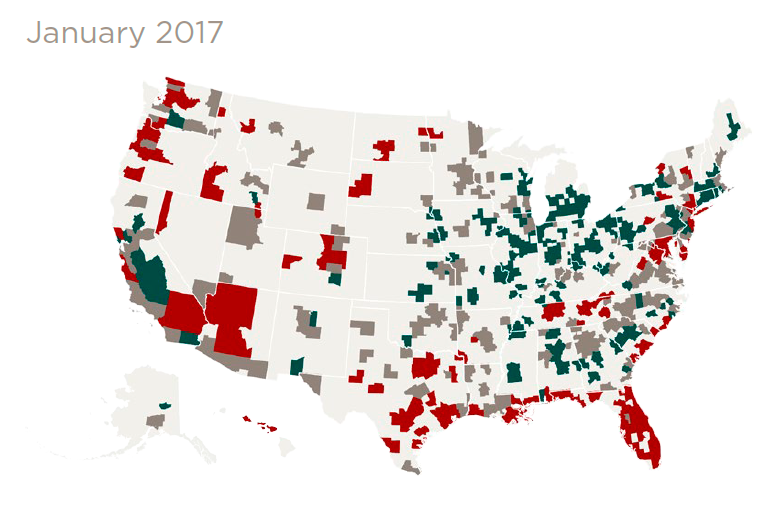
Home prices rose 1.1% MOM and 6.3% YOY according to CoreLogic. Home equity wealth has doubled over the past 5 years to $13 trillion. This works out to be about $11,000 per homeowner, however the geographic split is pretty wide. In September, CoreLogic reported that 112 markets are overvalued, with 19 of them in Texas. The heat map is shown below, where red = overvalued and green = undervalued. 


Part of what is driving home prices into overvalued territory is supply, and as we know, builders are adding to inventory only grudgingly. What is going on? Ultimately credit is a big driver, but not at the residential mortgage level, it is at the bank level. There has been a huge bifurcation in credit over the past several years, where big builders like D.R. Horton or Lennar can access the bond market at very favorable rates, while the smaller builders are having trouble getting loans from their local bank. In addition, most of the lending has gone to multi-fam, not single fam. Second, lack of skilled labor and land are playing a part. The skilled labor part will fix itself on its own as high wages attract more people to the business. Land is a more difficult issue, however the price differential between the exurbs eventually will win out. 

If Halloween candy were bonds:


Thursday, March 24, 2016

Morning Report: Lenders are getting more cautious easing credit

Vital Statistics:

LastChangePercent
S&P Futures 2040.1-9.2-0.51%
Eurostoxx Index3016.5-45.5-1.49%
Oil (WTI)39.010.51.43%
LIBOR0.6420.0020.38%
US Dollar Index (DXY)95.03-0.860-0.90%
10 Year Govt Bond Yield1.89%-0.02%
Current Coupon Ginnie Mae TBA105.4
Current Coupon Fannie Mae TBA104.5
BankRate 30 Year Fixed Rate Mortgage3.70

Stocks are under pressure this morning as commodities drop. Bonds and MBS are up small.

Initial Jobless Claims rose to 265k last week while the Bloomberg Consumer Comfort Index ticked up to 44.6

Durable Goods Orders fell 1.8% last month, slightly better than expectations, but when you strip out transportation, the number was a huge miss. Capital Goods orders (a proxy for business capital expenditures) fell 1.8% missing by a country mile. 

In other economic data, the Markit PMI numbers were barely expansionary and the Kansas City Fed improved slightly, but is still negative. 

Mel Watt is going to have a decision on principal mods for conforming loans held by the government within the next 30 days. The left has been pushing FHFA to do this for years. Why the (expected) change? Probably the FHFA House Price index, which has now recouped all of its losses from the bubble years. HARP may go away as well - FHFA is toying with the idea of a high-LTV refi. 


Cash sales are at their lowest level in 7 years, according to CoreLogic. In 2015, they accounted for 34% of all sales. The peak was January 2011 when they hit 47%. Pre-crisis, that number was in the high 20s. Unsurprisingly, the states with the highest foreclosure pipeline and the lousiest real estate markets have the highest cash sales percentages.


Mortgage lenders are on net still easing credit standards, however they are doing it at a slower pace, according to the latest Fannie Mae Mortgage Lender Sentiment Survey.Government loans actually were tightened.