A place where economics, financial markets, and real estate intersect.
Showing posts with label tariffs. Show all posts

Wednesday, August 1, 2018

Morning Report: Strong jobs number

Vital Statistics:

Last Change
S&P futures 2818 1.75
Eurostoxx index 389.71 -1.9
Oil (WTI) 67.7 -1.06
10 Year Government Bond Yield 2.99%
30 Year fixed rate mortgage 4.62%

Stocks are higher this morning after good earnings from Apple. Bonds and MBS are down. 

Japanese government bonds got shellacked overnight, with yields rising 8 basis points, which is causing reverberations throughout global bond markets. 8 basis points is a lot in one day regardless, but when rates were only 5 bps to begin with, it is quite the move. 

Donald Trump threatened more tariffs with China. We seem to be going back and forth between detente and escalation. 

The FOMC announcement is scheduled to be released at 2:00 pm EST. No changes in rates are expected, however the action will be in the statement and the interpretations for a December hike. While Trump's criticism of the Fed's rate hikes was unfortunate, things have been testier between the Central Bank and the Executive branch in the past. LBJ shoved William (take away the punch bowl just as the party is getting going) McChesney up against the wall in the Oval Office. 

Mortgage Applications fell 2.6% last week as purchases fell 3% and refis fell 2%. We saw a 7 basis point increase in conforming rates to 4.84%. The government share of mortgages increased. 

The private sector added 219,000 jobs in July, according to the latest ADP report. The Street is looking for 190,000 in Friday's report, but as always, the bond market will be looking more at average hourly earnings than the headline payroll number. Construction added 17,000 jobs, while business services added 47,000 and healthcare added 49,000. 


Manufacturing decelerated slightly in July, but continued to its torrid pace. As expected, much of the talk is about steel tariffs and when those costs will get passed on to consumers. Labor is becoming a bottleneck as well - it is causing capacity constraints. 

Construction spending fell 1.1% in June (which missed estimates) and is up 6.5% on a YOY basis. Resi construction was down on a MOM basis, but increased 8.7% on an annual basis. 

Thursday, July 26, 2018

Morning Report: Durable Goods orders increase

Vital Statistics;

Last Change
S&P futures 2836.5 -4.75
Eurostoxx index 388.69 1.55
Oil (WTI) 69.2 -0.1
10 Year Government Bond Yield 2.96%
30 Year fixed rate mortgage 4.62%

Stocks are lower after fAANG leader Facebook reported a slowdown in revenues. The stock is under severe pressure this morning, having traded down 24% last night. Bonds and MBS are flat.

As expected, the ECB kept rates unchanged and reiterated their plan to end QE this year. German Bunds are down in Europe, which is pulling US rates higher as well.

Durable goods orders rose 1%, which was lower than expected. Capital Goods orders rose 0.6%, which is better than expected. May numbers were revised upward as well. Capital Goods Orders are a proxy for business capital expenditures and it looks like we are breaching the $68 billion level where we have historically stalled out.


Initial Jobless Claims rose from a 48 year low to 217,000.

The US and the EU have come to an agreement on trade, where the Europeans will import more soybeans and LNG in exchange for an easing in auto tariffs. Euro automakers are up big this morning. They still have to come to an agreement on steel and aluminum tariffs however. Still it is good news for the markets and takes some of the pressure off.

PulteGroup reported strong earnings that beat consensus estimates. Revenues increased 25% and we saw margin expansion. New orders were only up 3%, however. Despite their strong growth, Pulte sold some land and bought back a lot of stock. Given the deceleration in new orders, it raises the question if they are sensing that the market is slowing down a little. With affordable land hard to come by, selling inventory and buying back stock in lieu of investing more in the business is a cautionary sign.

Maxine Waters (who will lead the House Financial Services Committee if Democrats take the House) said that reforming the GSEs will be a priority  Both liberals and conservatives would like to see the government less involved in residential real estate finance, and there is broad agreement on the model they would like to see. The problem is that there doesn't appear to be the demand from private capital to pick up the slack, at least not yet. The private label securitization market is still a shadow of its former self and there are many governance issues that need to be solved before we see the buy side increase their appetite.

The FHFA announced that it will not make a decision about updating the credit scoring model and instead will continue to come up with new rules. Consumer advocates have complained that FICO scores are preventing some credit-worthy borrowers from accessing mortgages. Separately, Jeb Hensarling sounded like he is being considered to replace Mel Watt.

New rules intended to prevent the serial refinancing of VA IRRRLs are creating problems for some VA loans that were originated prior to the law change. These loans are not eligible for Ginnie Mae multi-issuer pools, which effectively "orphans" them. As a result, these loans are going to be illiquid and will probably trade at scratch and dent levels, exposing some originators to big losses.

Wednesday, July 25, 2018

Morning Report: New Home Sales fall

Vital Statistics:

Last Change
S&P futures 2816 -4
Eurostoxx index 387.12 -1.06
Oil (WTI) 68.52 0
10 Year Government Bond Yield 2.94%
30 Year fixed rate mortgage 4.61%

Stocks are lower this morning after lousy earnings out of the automakers. Bonds and MBS are flat. 

Donald Trump tweeted contradictory statements about trade yesterday, both extolling the virtues of tariffs and also telling Europe that he is ready to end all tariffs if they are. He is also planning to use taxpayer money to help offset the negative effects of Chinese retaliatory tariffs on American farmers. This is New Deal type stuff and I have to imagine that Congress is contemplating legislation to take control of tariffs back from the Executive Branch. When tariffs were going down overall worldwide, it may have made sense to allow the President to lower them without involving the legislative branch, but the unintended consequence was that it allows the President to conduct a trade war unilaterally. 

New Home Sales fell 5% on a MOM basis, but were up 2% on a YOY basis to a seasonally-adjusted annual level of 631,000. The Street was looking for something around 680,000. New Home Sales is a notoriously volatile estimate so that number could be revised upward next month. For sale inventory came in at 301,000 which represents a 5.7 month supply. 

Mortgage Applications fell 0.2% last week as purchases fell 1% and refis rose 1%. 

Flagstar reported earnings yesterday. EPS and revenues rose, however there are some acquisition-related effects happening (not Stearns though). Mortgage origination volume fell by 1.5% and gain on sale fell by 6 basis points. Flagstar appears to be taking share, at least judging by those numbers. Most other banks are reporting sizeable volume drops. 

With home prices back above peak bubble levels, the question of affordability invariably comes up. CoreLogic crunched the numbers and it turns out that if you adjust for inflation, the median mortgage payment (P&I) on the median house is much lower than the peak years. This is being driven by the drop in rates. Of the top 10 MSAs, only San Francisco and Denver were higher than the peak. Compared to pre-bubble years (2002), they are higher. 


Redfin notes that some of the least affordable MSAs are starting to see an increase in inventory. Homes for sale rose 35% in Portland, 12% in San Jose, and 24% in Seattle. Whether that inventory buildup remains enough to slow the double-digit home price appreciation in those markets remains to be seen. We are heading into the seasonally slow period, and as a general rule home prices decline in Fall and Winter. Overall, home prices rose 5.7% which is the smallest increase since late 2016. Inventory levels still declined on a YOY basis. 

Chinese investors were net sellers of US commercial property in the second quarter for the first time in a decade. Pressure from Beijing is the catalyst, although China has a real estate bubble of their own to deal with. Chinese money was also behind some of the activity in the big West Coast MSAs, and it will be interesting to see if that dumps some supply on the market to balance it out. 

Thursday, July 5, 2018

Morning Report: Gen X hit hardest by the Great Recession

Vital Statistics:

Last Change
S&P futures 2733 19.7
Eurostoxx index 382.97 2.89
Oil (WTI) 74.32 0.2
10 Year Government Bond Yield 2.85%
30 Year fixed rate mortgage 4.54%

Stocks are higher this morning on rumors that the Trump Administration is dialing back its plans for tariffs on European autos. Bonds and MBS are flat.

The minutes from the June FOMC meeting are coming out at 2:00 pm today. Be careful locking around then since they could be market-moving. 

The service economy continues to plow ahead, according to the ISM Non-Manufacturing Survey. Higher input prices, tariffs, and labor shortages are the biggest worries. Trucking shortgages are increasing prices, and that has the potential to push up inflation since it touches just about every business, at least indirectly. 

The economy added 177,000 jobs last month according to the ADP Survey. This was a touch below street estimates. Note that ADP numbers have generally been higher than the government's for the past several months. The Street is looking for 191,000 jobs in tomorrow's payroll report. While the payroll number will be important, for the bond market, it will all come down to the average hourly earnings number. 

Initial Jobless Claims ticked up to 231,000 last week. Separately, outplacement firm Challenger, Gray and Christmas noted there were 37,000 announced job cuts in May. 

Tariffs on about $34 billion worth of Chinese exports are set to go into effect tomorrow. Beijing has announced it will retaliate with more tariffs the "instant it goes into effect." Trade fears have been weighing on the stock market, and we are seeing some effects in commodity prices. Today's minutes will probably discuss the issue at length. On one hand, this trade war is pushing up commodity prices, which is inflationary and should encourage the Fed to lean hawkish, at least at the margin. On the other hand, trade wars are an economic drag, which should encourage more dovishness. The Fed generally considers commodity inflation to be transitory, so on net trade wars should encourage dovishness, at least at the margin. 

Oil prices have been a problem for while now, as WTI crude now trades close to $75 a barrel. Oil prices have been rising due to Venezuela issues and pressure on Europe to not buy Iranian oil. Trump tweeted that OPEC should increase production, which caused Saudi Arabia to announce it would increase output and Iran to announce that his pressure on them have added about $10 to the price of oil in the first place.  At the end of the day however these issues affect North Sea Brent prices, which really only matter to East Coast refineries. The rest of the country uses US domestic oil. Higher gas prices do make consumers surly and the Administration wants to see them down ahead of midterms this fall. 

Here are the hottest real estate markets in June, according to Realtor.com. Note it isn't the names you would think. 

Interesting chart in today's Journal about which breaks down the labor force participation rate by age cohort. The press keeps harping on the job market for entry level workers (essentially the Millennial Generation) however if you look at the labor force participation rate for that cohort, it is lower than the year 2000, but not by much. Nor is the problem the 55+ cohort (baby boomers). They are close to all-time highs. It is Gen X that is the issue - their cohort peaked around 83% in 2000 and now is closer to 80%. It is this generation that was hit hardest by the Great Recession (nailed right during the peak earnings years) and has yet to recover. 


Friday, March 9, 2018

Morning Report: Goldilocks Jobs Report

Vital Statistics:

Last Change
S&P Futures  2762.3 17.0
Eurostoxx Index 376.8 0.2
Oil (WTI) 60.6 0.4
US dollar index 83.9 0.0
10 Year Govt Bond Yield 2.9%
Current Coupon Fannie Mae TBA 102.25
Current Coupon Ginnie Mae TBA 102.5
30 Year Fixed Rate Mortgage 4.4

Stocks are higher after the strong jobs report. Bonds and MBS are down. 

Jobs report data dump:
  • Nonfarm payrolls up 313,000 vs expectations of 205,000
  • Unemployment rate 4.1% vs expectations of 4.0%
  • Labor Force Participation rate 63% vs expectations of 62.7%
  • Average Hourly Earnings up .1% / 2.6% vs expectations of .2% / 2.9%
Overall a great report for the stock market. Strong growth in payrolls, without a massive increase in wage growth. The civilian employment to population ratio increased from 60.1% to 60.4%, which matched the post-crisis record set in September. The labor force increased by 800k, while the population increased by 150k. The civilian employment to population ratio peaked in 2000 at 64.7% and bottomed in 2009 at 58.3%, and we are much closer to the low than we are to the high. Some of that is demographics, however there is undoubtedly still slack in the labor market that number bears it out. Which is why we still have the wage inflation typically associated with 6% unemployment and not 4% unemployment. 


The Fed funds futures didn't do much on the report - as we approach the March meeting, the probabilities of a hike continue to increase and are sitting at 89%, and the December futures are still coalescing around a prediction of 3 hikes this year. Chicago Fed President Charles Evans says he would argue against a March hike. 

Home Depot is donating $50 million to train 20,000 construction workers over the next decade. "It's important that we support the trades," Home Depot CEO Craig Menear said in an interview. "Not only do we sell product to professionals like plumbers and electricians," but the company also partners with service providers that install kitchen flooring, hot water heaters and other equipment in consumers' homes. There are still 158,000 job openings in the construction sector that need to be filled. 

Donald Trump announced tariffs of 25% on steel and 10% on aluminum yesterday, with temporary relief for Canada and Mexico while we renegotiate NAFTA. Senator Jeff Flake introduced legislation to overturn these tariffs. I would bet there are enough votes in both chambers to pass the bill, and there might be enough to override a veto. 

File under "Only Nixon could go to China:" Donald Trump will meet North Korean President Kim Jong Un in May, to discuss the country abandoning its nuclear weapons program. 

Mortgage credit decreased in February, according to the MBA's Mortgage Credit Availability Index. Apparently the decrease was due to a single large investor in the conventional space. While we are close to post-crisis levels in the index, we are a long way from the go-go days of the bubble. 

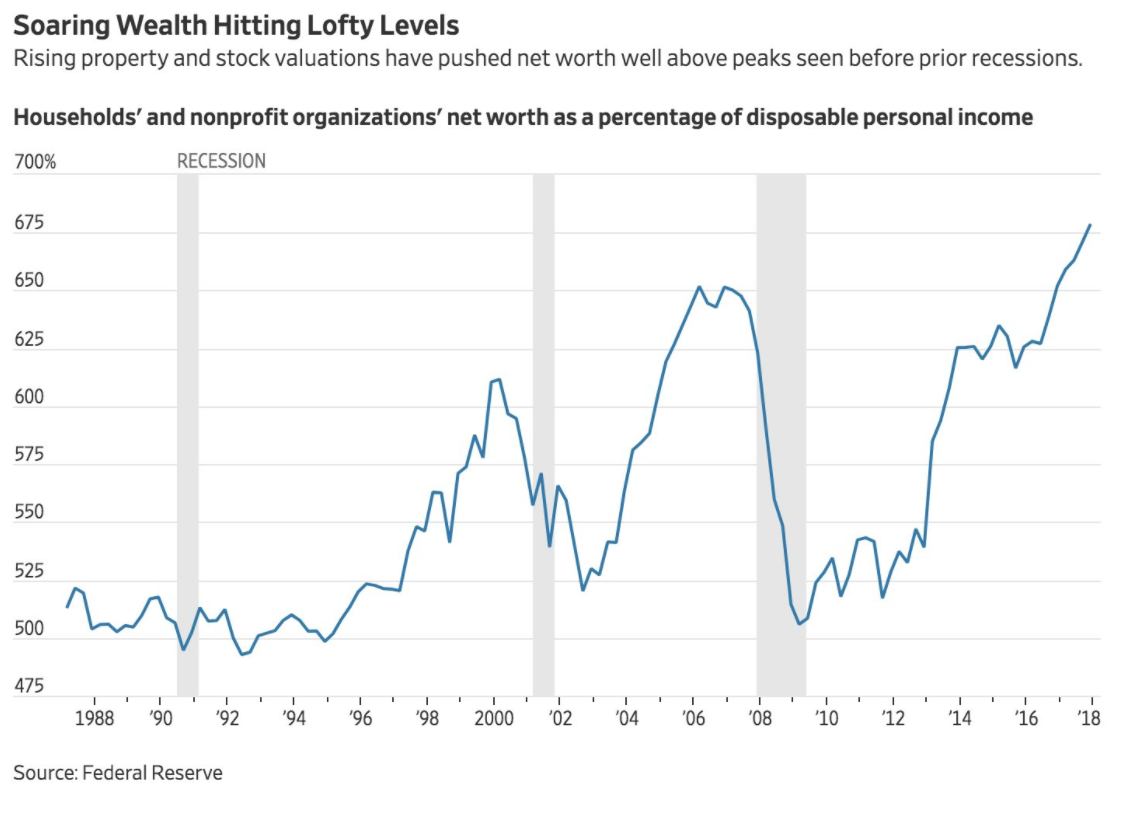
Soaring stock and real estate prices have sent net worth as a percent of disposable income to record levels.  I wouldn't be surprised to see this number fall as the Fed pulls back support for the asset markets and we finally start seeing wage inflation. 


Thursday, March 8, 2018

Morning Report: Fed Beige Book points to strong labor market

Vital Statistics:

Last Change
S&P Futures  2729.3 6.0
Eurostoxx Index 374.0 1.3
Oil (WTI) 61.2 0.0
US dollar index 83.6 0.1
10 Year Govt Bond Yield 2.87%
Current Coupon Fannie Mae TBA 102.25
Current Coupon Ginnie Mae TBA 102.5
30 Year Fixed Rate Mortgage 4.4

Stocks are higher this morning on no real news. Bonds and MBS are up small.

Donald Trump is set to impose tariffs on steel and aluminum, however there is talk of exempting Canada and Mexico from them (which is where we get most of our foreign steel to begin with). That exemption will be used as leverage to renegotiate NAFTA. So far, the trade war is largely symbolic - Trump tweeted that he wanted to see a $1 billion decrease in our trade deficit with China, which is about $375 billion. In other words, it is a drop in the bucket, and all for show. That might have been an error however, some reports are saying he meant $100 billion, which probably makes more sense. That said, stocks are taking the trade war in stride, and bonds seem to have found a level here. 

Initial Jobless Claims rose to 231k last week from 220k. Job outplacement firm Challenger, Gray and Christmas reported that companies announced 35,369 job cuts in February. 

The overall economy grew at a modest to a moderate pace in January and February, according to the Fed's Beige Book survey. With regard to employment, it said: "On balance, employment grew at a moderate pace since the previous report. Across the country, contacts observed persistent labor market tightness and brisk demand for qualified workers, as well as increased activity at staffing placement services. Several Districts reported continued worker shortages across most sectors, with contacts often mentioning shortages in the construction, information technology, and manufacturing sectors. In many Districts, wage growth picked up to a moderate pace. Most Districts saw employers raise wages and expand benefit packages in response to tight labor market conditions. Contacts in a few Districts conveyed reports of modest increases in compensation following passage of the Tax Cuts and Jobs Act." The increases in wage inflation are a good sign for the economy overall, but not so much for interest rates. The Street is looking for a strong reading in wage growth in tomorrow's Employment Situation Report: an increase of 2.9% YOY. 

Buyer sentiment fell last month, according to the Fannie Mae Home Purchase Sentiment Index. “Volatility in consumer housing sentiment continued into February, with the new tax law beginning to impact respondents’ take-home pay and the stock market creating negative headlines due to early-month turbulence,” said Doug Duncan, senior vice president and chief economist at Fannie Mae. “Additionally, consumers’ expectations for higher mortgage rates suggest that consumers expect the Fed to hike rates a few more times in 2018. We will continue to track how consumer housing attitudes trend in the coming months as these various market forces play out.”

Tuesday, March 6, 2018

Morning Report: Fears of a trade war easing

Vital Statistics:

Last Change
S&P Futures  2727.3 9.0
Eurostoxx Index 373.3 2.4
Oil (WTI) 63.1 0.5
US dollar index 83.5 -0.3
10 Year Govt Bond Yield 2.89%
Current Coupon Fannie Mae TBA 102.25
Current Coupon Ginnie Mae TBA 102.5
30 Year Fixed Rate Mortgage 4.4

Stocks are higher this morning on no real news. Bonds and MBS are down.

The EU proposed tariffs on some US goods if Trump follows through on his plan to institute higher tariffs on steel and aluminum imports. White House Gary Cohn is working with business leaders in an attempt to change the President's mind. Think about that. An economic advisor is reaching out to administration outsiders to try and get the President to change his mind. Imagine Austan Goolsbee soliciting the input of the financial industry in 2009 in an effort to derail Dodd-Frank. Supposedly Cohn plans to resign if Trump doesn't relent on a trade war. House Speaker Paul Ryan has also come out against tariffs. Despite Trump's warning that he "won't back down" on tariffs, the markets are starting to bet that a trade war isn't going to happen, which is probably why futures are up. 

Don't forget that we already have tariffs on Canadian softwood lumber. Prices are at record levels. This is yet one more reason why we have such an affordability problem - not enough (cheap) new construction. 


House prices rose 0.4% MOM from December to January, according to CoreLogic. Prices are up 6.6% YOY. They are forecasting prices to rise 5% this year. The fastest appreciation is at the lower price points, where prices are increasing 9% for homes at the 75% of the area's median home price, while appreciating only 5% for homes at 125% of the area's median home price. This demonstrates the struggle that the first time homebuyer is facing: rising rates and higher home price appreciation. Below is a chart of where home prices are overvalued and undervalued


Factory orders fell 1.4% in January reversing a string of gains. This is interesting simply because most of the regional Fed reports and the ISM data are showing strength in new orders, which was the weakness in this report. 

Friday, March 2, 2018

Morning Report: Tariff Threats cause bond market to rally

Vital Statistics:

Last Change
S&P Futures  2658.0 -20.0
Eurostoxx Index 368.8 -6.1
Oil (WTI) 60.8 -0.2
US dollar index 83.8 -0.2
10 Year Govt Bond Yield 2.84%
Current Coupon Fannie Mae TBA 102.313
Current Coupon Ginnie Mae TBA 102.531
30 Year Fixed Rate Mortgage 4.4

Stocks are lower this morning on news of a possible trade war. Bonds and MBS are flattish.

Donald Trump has announced plans to impose 25% tariffs on steel imports and 10% tariffs on aluminum imports. The dollar has weakened in response, and we have seen bond yields fall as well. He characterized trade wars as "good" and "easy to win." As a general rule, nobody wins trade wars - they depress economic growth - but the silver lining is that you are seeing a bit of a flight to quality, which means Treasuries have a bid for once. This is pushing rates down. Don't know how long it will last (he may be bluffing, or someone will probably talk him out of it), but take advantage of it. I could see him re-thinking and abandoning this idea over the weekend, and we could be looking at a 2.9% 10 year on Monday. 

Consumer sentiment was flat in February, according to the University of Michigan Consumer Sentiment Survey. 

Jerome Powell's testimony in front of the Senate wasn't all that dramatic. The main subjects were wage growth (or the lack of it), fair lending, and regulation. Elizabeth Warren spent her time harping on Wells Fargo. These events are mainly for political posturing and not much else. One Senator asked him about climate change, which Powell took in stride. I was hoping he would ask the Senator to lay out the connection between the Fed Funds rate and atmospheric CO2, but alas he played it straight. 

On the subject of the labor market and wage growth, he said that nobody really knows what full employment actually is. The unemployment rate suggests that we are, while wage growth and the labor force participation rate suggest we are not. His view is that if you take all of the data, we are probably at or very close to full employment. He did say that the Fed has been modeling something like a 25 basis point annual decline in the labor force participation rate due to demographics - i.e. the retiring Baby Boomers, and that it has now caught up with that demographic model. 

Acting Director of the CFPB Mick Mulvaney said yesterday that the Bureau will rely more on state AGs when deciding on enforcement actions. He reiterated the plan to spend resources on cases that are on "solid legal ground" and less on "creative claims." Regulation by enforcement is also on the way out, and the CFPB intends to be much more forthcoming in telling the industry what the rules of the road are.