A place where economics, financial markets, and real estate intersect.
Showing posts with label tax reform. Show all posts

Thursday, December 28, 2017

Morning Report: Chicago PMI strong

Vital Statistics:

Last Change
S&P Futures  2687.5 2.0
Eurostoxx Index 390.3 -0.2
Oil (WTI) 59.7 0.0
US dollar index 86.3 -0.3
10 Year Govt Bond Yield 2.43%
Current Coupon Fannie Mae TBA 102.375
Current Coupon Ginnie Mae TBA 103.25
30 Year Fixed Rate Mortgage 3.97

Stocks are modestly higher this morning on no real news. Bonds and MBS are flat.

Very slow news day. 

The Chicago PMI came in at a very strong 67.6 as production and new orders hit multi-year highs. Employment was disappointing however as businesses struggle to find qualified employees. 

Initial Jobless Claims came in at 245k last week ahead of the Christmas holiday. Surprised it is that high.

Some the biggest fixed income managers lay out their trades for 2018. Blackrock says to move up in credit quality. Note that they are neutral on everything. U.S. municipal bonds, U.S. credit, emerging markets and Asian fixed income, and an underweight position on Treasuries, European sovereign debt and European corporate bonds. They don't like anything, really. Fidelity says global growth is going to become inflationary, so buy TIPS (Treasury inflation protected securities) and emerging market debt. Goldman is betting against the crowd, favoring yield curve steepeners as opposed to the biggest trade on the Street, which is betting on a flatter yield curve. The theme seems to be inflation will return, and that means higher rates next year. The elephant in the room is the Fed, and the fear that increasing short term rates will torpedo the recovery. 

Easy come, easy go. Bitcoin continues to give back gains after it hit a record last week. It is down 28% from its highs on fears that South Korea might close one of its exchanges. Here is the fundamental issue with Bitcoin: governments despise it, and while they might not be able to kill it directly, they can attack everything that supports it. While there are a few retailers that accept Bitcoin, understand that they don't hold it. They immediately exchange it into dollars.  

Tax reform has some people in high tax jurisdictions rushing to pre-pay their property taxes ahead of the change in 2018. Note the IRS will only allow this if they are assessed and paid in 2017. So if your local government can't get the assessments out in time, it doesn't matter if you prepay. 

Tuesday, December 19, 2017

Morning Report: Housing starts solid

Vital Statistics:

Last Change
S&P Futures  2697.3 2.8
Eurostoxx Index 392.4 -0.3
Oil (WTI) 57.4 0.2
US dollar index 86.9 0.3
10 Year Govt Bond Yield 2.43%
Current Coupon Fannie Mae TBA 102.531
Current Coupon Ginnie Mae TBA 103.375
30 Year Fixed Rate Mortgage 3.88

Stocks are higher as Congress begins the voting for tax reform. Bonds and MBS are down. 

The House is expected to vote on tax reform this afternoon around 1:30. Depending on the procedural machinations, the Senate will vote either tonight or tomorrow. Bob Corker and Susan Collins are supposedly on board, so this should be done. 

Housing starts increased to 1.3 million in November, according to Census. This is up 3.3% MOM and 13% YOY. Building Permits came in at 1.3 million as well. The increase in starts was driven by single-family, not multi, and hit a 10 year high. Note that tax reform's pass-through treatment will be good news for landlords and could encourage more multi-fam construction. We didn't see any jump in multi-fam permits last month, so maybe the change is too recent to influence behavior yet. 


Minneapolis Fed Head Neel Kashkari argues that we should not be raising interest rates yet. Neel was one of 2 dissenters at the last FOMC meeting, preferring to maintain the current level of rates.  His argument is that inflation remains below the Fed's target rate of 2% and there is still slack in the labor market. He also is worried about what the flattening yield curve is saying. IMO he has a point - we want the labor market to keep bringing back the long-term unemployed, however we are hardly going to a tightening posture. On a scale of 1 - 10, where 1 is easy and 10 is tight, we are going from a 1 to a 2. Real interest rates are still negative, and the Fed is still buying Treasuries and MBS albeit at a reduced pace. What would a 10 on that scale look like? The early 1980s, when Paul Volcker tightened to quell inflation and took the Fed Funds rate from 9% to 19%. We are in a different economic scenario than the late 70s, but some historical perspective is helpful. 


New mortgage loan credit risk increased in the third quarter, according to CoreLogic's Housing Credit Index. The increase in risk was driven by an increase in the share of condo / multi-fam loans. Credit scores improved, while DTIs fell. We are back in the pre-bubble range of credit risk. 


Tuesday, December 5, 2017

Morning Report: Toll Brothers misses

Vital Statistics:

Last Change
S&P Futures  2642.0 3.8
Eurostoxx Index 386.6 -0.9
Oil (WTI) 57.3 -0.2
US dollar index 86.7 0.1
10 Year Govt Bond Yield 2.39%
Current Coupon Fannie Mae TBA 102.625
Current Coupon Ginnie Mae TBA 103.625
30 Year Fixed Rate Mortgage 3.88

Stocks are higher this morning on no real news. Bonds and MBS are flat.

Toll Brothers announced earnings this morning that missed analyst expectations. The sector has been on a tear this year, so weak earnings are expected to be punished by the markets. Revenues increased 9% and earnings increased 68%. The company used a lot of its cash to repurchase stock and bonds, which isn't a great sign for future growth. Generally when companies are seeing great opportunities, they re-invest in the business. When they don't, they buy back stock. The street didn't like the guidance, and the stock is down about 6% pre-market. 

Toll is in the luxury end of the housing market, covering McMansions in urban areas out West and luxury apartments in the East. The change in the mortgage interest deduction is probably going to impact demand. Note that the builders that focus on entry-level building are doing much better. For the past 10 years, the luxury end of the market was the only part that was working. Now the market is shifting to the first time homebuyer. 

Speaking of the luxury end of the market, the New York Times frets about the effect tax reform will have on New York City. It turns out that 40,000 residents in New York City account for half the city's revenue. If they leave, it will have a huge impact on the city's finances. The people most affected will be those making over $200,000, and in a high cost area like New York City and the suburbs, that is not rich by any stretch of the imagination. 

Factory orders fell 0.1% in October, ending a generally good month for manufacturing. Capital Goods orders were strong however, and that points to a stronger Q4 and 2018. Capital Goods orders are generally associated with business expansion, capacity increases, and modernization. 

The services economy decelerated in November from a record in October, according to the ISM Non-Manufacturing Survey. 

Tax reform heads to committee to resolve the differences between the House and Senate versions. Here are the biggest sticking points. The committee starts work on Monday, with an eye to have a final vote in Mid-December. 

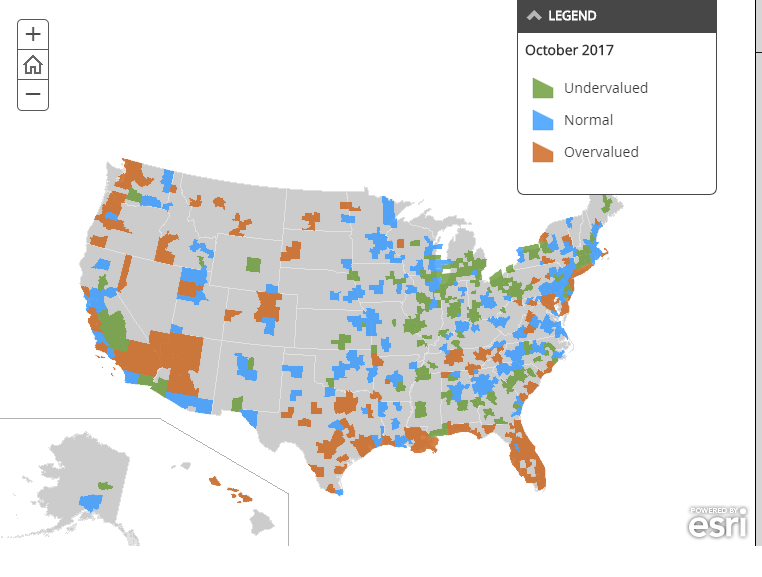
Home prices rose 0.9% MOM and are up 7% YOY, according to CoreLogic. The fastest growth continues to be in the West and Mountain states. Much of the Midwest remains undervalued while we are seeing overvaluation in places like Florida, Texas, and the West Coast. Note that fears about climate change are not evident in Florida real estate


First time homebuyers are still relatively uninformed about mortgages. According to a recent survey, 20% of Americans think it is impossible to get a mortgage with less than 5% down, despite the fact that FHA goes down to 3%, VA allows nothing, and the GSEs have 3% down products. Most people get their information on the Internet, and surprisingly almost nobody gets their mortgage information from the CFPB. 

How did HAMP and HARP help struggling homeowners? It turns out, not much. In fact, borrowers who had a principal reduction had pretty much the same default rates as borrowers without a principal reduction. These reductions were big: 32% or about $112,000 on average. These results pour cold water on the strategic default theory, which says that borrowers will choose to toss the keys to the bank once the home value is less than their outstanding mortgage. FWIW, I think the defaults in 2006 were strategic defaults, as the economy had yet to roll over and professionals were playing the greater fool game. Note that modifying a mortgage payment to a percentage of income didn't really help either. The punch line is that many defaults were caused by a short term blip in a borrower's financial situation - often an unexpected expense like a medical bill - and servicers should work on creating a solution to help the borrower over that hump and then re-evaluate. 

Monday, December 4, 2017

Morning Report: Tax reform passes

Vital Statistics:

Last Change
S&P Futures  2657.5 13.5
Eurostoxx Index 388.0 4.0
Oil (WTI) 57.8 -0.6
US dollar index 86.7 0.3
10 Year Govt Bond Yield 2.39%
Current Coupon Fannie Mae TBA 102.625
Current Coupon Ginnie Mae TBA 103.625
30 Year Fixed Rate Mortgage 3.88

Stocks are higher this morning after tax reform passes in the Senate. Bonds and MBS are flat. 

This week should be pretty quiet with the exception of the jobs report on Friday. We are in the quiet period ahead of the FOMC meeting next week, so we won't be getting any Fed-speak. 

Tax reform passed over the weekend in the Senate. Now comes the reconciliation between the House and Senate versions. The winners in this bill? Banks, as they generally have fewer deductions and end up paying the high statutory rate. The corporate AMT remains at 20%. The losers? Health insurance companies that will see the healthier and younger eschew health insurance because the mandate is gone. Note however that the penalty for not carrying insurance under Obamacare was pretty small to begin with - so it probably won't make that big of a difference when all is said and done. 

One potential wrinkle in the tax reform bill seems to have been fixed, and that is the treatment of mortgage servicing rights. The tax bill would have made mortgage servicing rights taxable upon creation, which would have been negative for smaller independent mortgage originators. It looks like there was an amendment to eliminate this. Like many things in the tax bill, it will take some time to digest what the provisions were.  

Note that while the stock market has cheered tax reform, bonds and currencies are largely ignoring it. Good news for originators who don't need higher rates. It is early days, however. 

Stocks on Friday had a swoon mid-day on an ABC report that Mike Flynn was directed to make contact with the Russians. This was supposedly the smoking gun in the Trump - Russia collusion story. It turns out that Flynn was told to make contact after the election, which is what you would expect to see from an incoming administration in transition. The reporter from ABC was suspended for the story, although it certainly gave stock investors heartburn for a day. 

One columnist is a bear on the builders after tax reform. FWIW, I think that the absolute dearth of inventory will dominate any secondary effects from the tax bill. He notes that household formation did lag for the Millennial generation, and that student loan debt is an issue. That said, the financial difference between renting and buying is still very favorable towards buying given that interest rates are low and rental inflation is high. Second, the economy is accelerating (the Atlanta Fed just took up its estimate for Q4 GDP to 3.5%) and wage inflation seems to be coming back. The article does make a good point: that the homebuilding business is highly cyclical - and during booms P/E ratios will compress. That said, we haven't had a homebuilding boom in 12 years, which is a long, long time. 

Monday, November 20, 2017

Morning Report: Goldman sees 3.7% unemployment in 2018

Vital Statistics:

Last Change
S&P Futures  2576.3 0.0
Eurostoxx Index 385.1 1.3
Oil (WTI) 56.3 -0.3
US dollar index 87.2 0.1
10 Year Govt Bond Yield 2.34%
Current Coupon Fannie Mae TBA 102.651
Current Coupon Ginnie Mae TBA 103.494
30 Year Fixed Rate Mortgage 3.9

Stocks are flat this morning on no real news. Bonds and MBS are flat as well. 

Slow news day. 

This week should be relatively quiet with the Thanksgiving holiday. There won't be any market-moving economic releases, and the only thing out of the Fed will be the minutes from the November meeting on Wednesday. 

The Index of Leading Economic Indicators came in at 1.2%, doubling the Street estimate of 0.6%. 

Goldman is extremely bullish on 2018, as they see the job market getting even tighter and wage growth accelerating. They see the unemployment rate falling to 3.7% in 2018, and to 3.5% in 2019. They are forecasting 4 rate hikes as well, which is well above what the Fed Funds futures are predicting. The Fed Funds futures are pricing in between 1 and 2 hikes in 2018 (assuming that December is a given). 

More than half the refis in October were FHA / VA loans. This is due as much to home price appreciation as interest rates. Borrowers can save money by refinancing into a conventional loan once they have 20% equity. Loan officers, take a look at the FHA loans you did a few years ago and look for opportunities. 

Tax reform is scheduled for an 11/30 vote in the Senate, as Congress takes this week off. The upper middle class is probably going to benefit the least from tax reform, and Republicans are going to test the theory that they are indeed the third rail in US politics. The upper middle class consists of what demographers call the HENRYs (high income, not rich yet), who may appear to be rich according to the numbers, but often live in high cost areas and have lifestyles more similar to the middle class than the rich. We could see home price appreciation begin to moderate in some of the suburbs around DC and NYC. It probably won't affect California as much, as the CA real estate market inhabits its own universe. 


Friday, November 17, 2017

Morning Report: Housing starts improve

Vital Statistics:

Last Change
S&P Futures  2584.5 -0.5
Eurostoxx Index 384.3 -0.6
Oil (WTI) 56.0 0.9
US dollar index 87.3 -0.1
10 Year Govt Bond Yield 2.37%
Current Coupon Fannie Mae TBA 102.651
Current Coupon Ginnie Mae TBA 103.494
30 Year Fixed Rate Mortgage 3.9

Stocks are flat this morning on no real news. Bonds and MBS are down small. 

Housing starts came in just shy of 1.3 million, the highest print in a year. This is up 14% from last month, but down 3% from a year ago. Building Permits came in at 1.3 million as well. Both numbers were driven by a big jump in multi-family, while single-fam continues to gradually move higher. We are still below historical numbers: From the late 50s through 2002, starts averaged 1.5 million a year. When you factor in population growth, that average is way too low for today. We probably should be pushing 2MM a year in order to keep up with population growth and to fix the inventory problem. 

The House passed tax reform yesterday, and now all eyes turn to the Senate, where the latest bill made it out of Committee and is scheduled for a vote after the Thanksgiving holiday. Then begins the hard work of reconciling the House and Senate versions. The Senate bill has some high profile opposition, which makes passage difficult. This is still a very fluid situation. 

Donald Trump will nominate OMB Chairman Mick Mulvaney to be the interim head of the CFPB. Mulvaney is a reliable conservative, who has a healthy skepticism of government regulation. He is expected to name another Chairman or Committee to run it, while he maintains his focus on OMB. Names mooted for the role include George Mason University professor Todd Zwyicki and ex-Congressman Neugebauer. 

A study concludes that homeownership doesn't increase wealth as much as renting and investing the savings in the stock market. The critical part of the argument is investing the savings in the stock market. I haven't read the study, but I wonder if they are using absolute house prices instead of what you actually put up. If the house appreciates 5% a year, and you only put down 20%, what is the best number for determining your return? The it amount of the house or the amount you actually put up? Is the proper return 5% / 100% or is it 5% / 20% (or 25%)? 

Thursday, November 16, 2017

Morning Report: Richard Cordray resigns

Vital Statistics:

Last Change
S&P Futures  2572.0 7.0
Eurostoxx Index 382.0 -1.9
Oil (WTI) 55.4 0.1
US dollar index 87.3 0.0
10 Year Govt Bond Yield 2.34%
Current Coupon Fannie Mae TBA 102.688
Current Coupon Ginnie Mae TBA 104
30 Year Fixed Rate Mortgage 3.87

Stocks are higher this morning on no real news. Bonds and MBS are down small. 

Some economic data this morning: Initial Jobless Claims rose to 249k last week, which is still a remarkably low number. We are starting to see wage inflation at the blue collar level. Manufacturing is still strong in the Northeast, with the Philly Fed index coming in at 22.7. Inflation remains on the low side, although import prices did increase by 0.2% MOM / 2.5% YOY on a weaker dollar. Finally, industrial and manufacturing production came in higher than estimates, while capacity utilization improved to 77% from 76.4%. All of these data point to less slack in the economy. 

Homebuilder sentiment bounced back in November, according to the NAHB. The index rose to 70  from 68 in October. The index hit a post-recession peak of 71 in early 2017, and the last time above that level was in late 2005. Builders are happy, bit supply remains low. In fact, inventory is so low in San Jose, days on market is less than two weeks, and prices rose almost 20% to hit a median value of over $1 million. 

CFPB Chairman Richard Cordray announced his resignation yesterday and said he will be stepping down at the end of the month. The speculation is that he will challenge John Kasich for governor of Ohio. No word on who might replace him. What's Angelo Mozillo up to these days?

The House is scheduled to vote on tax reform today, while the Senate continues to work on it. Public support for tax reform remains weak, probably because there hasn't been a plan yet to actually sell to the public - it remains in such a state of flux nobody knows what it will actually entail. The latest potential provisions include sunsetting the individual tax cuts, removing the Obamacare mandate, and cutting Medicare. While these may or may not be smart things to do, Congress and the WH need to be singing from the same sheet of music, which they aren't. Meanwhile, opponents have been able to run stories against it largely unopposed. Ironically, tax reform in the Senate will probably hinge on two Republicans who will not be facing re-election again in their lives: John McCain and Jeff Flake. I stand by my initial thoughts on this - that the only thing that has a chance of passing is something small and largely symbolic. Re-doing the corporate tax code should be a bipartisan endeavor with comment periods, a visible public debate, etc.. Not finalizing a plan hours before the vote. 

Home equity wealth hit a new high of $13.9 trillion, half a trillion over the 2006 high and double the low at the nadir of the Great Recession. It is important to remember that these are nominal numbers (in other words, not adjusted for inflation). Inflation-adjusted home prices still have yet to recoup their highs, in fact they are still 17% below their peak levels. This is why affordability remains decent in spite of the nominal home price indices hitting new highs. It is also why articles in the financial press warning of a new real estate bubble are complete and utter nonsense. 


Monday, November 13, 2017

Morning Report: What does the flattening yield curve mean?

Vital Statistics:

Last Change
S&P Futures  2572.5 -7.0
Eurostoxx Index 384.9 -3.8
Oil (WTI) 56.9 0.1
US dollar index 87.7 0.0
10 Year Govt Bond Yield 2.38%
Current Coupon Fannie Mae TBA 102.875
Current Coupon Ginnie Mae TBA 103.938
30 Year Fixed Rate Mortgage 3.95

Stocks are lower this morning after General Electric cut its dividend in half. Bonds and MBS are up.

We will have a lot of data this week, along with a plenty of Fed-Speak. None of the data should be all that market-moving, but watch the inflation numbers on Tuesday and Wednesday. We will also get housing starts and industrial production. 

Many market participants are watching the slope of the yield curve and warning that it could be indicating a recession ahead. The slope of the yield curve is most often measured by the difference between the 10 year bond and the 2 year bond (the 2s-10s spread). The 10 year rate is usually higher than the 2 year rate, but that relationship can move around a lot, especially when the Fed is active. Most are using comparisons from the beginning of the year, which is somewhat exaggerated by the initial post-election jump in rates. The Trump Reflation Trade turned out to be relatively short-lived, and it exaggerated the slope of the yield curve. That said, we have typically seen a curve flattening during tightening regimes. Some participants are predicting the curve could invert next year, if the Fed can't get inflation to rise. But supposedly the fast money is playing the yield curve flattening trade and this is one of the biggest trades on the Street. 

One effect of a flattening yield curve will be to make the early payment pickup in ARMS less dramatic than it otherwise would be. ARMS are based off of LIBOR, while the 30 year rate is based more on the 10-year. If LIBOR is rising relative to the 10 year (which you would expect to see in a flattening yield curve environment) then borrowers would be better off refinancing out of an ARM and into a 30 year fixed. In a tough environment, this can be a way to get some loans in the door, along with the FHA to conventional without MI refi. 

Tax reform will influence the shape of the curve as well. If tax reform doesn't get done this year, it probably is doomed for the immediate future, as midterm elections will dominate 2018. One strategist sees a 15% correction in the stock market if tax reform doesn't get done. Expectations for a corporate tax cut boosted the S&P 500 by 20% this year. Note that earnings have been increasing for the S&P 500 as well, so that provides support for valuations. Look at the chart below: The blue line is the absolute level of the S&P 500, while the orange line is earnings per share. Granted, the stock market theoretically looks at forward earnings and not contemporaneous or past earnings, but as long as earnings keep rising, the stock market 


Thursday, October 26, 2017

Morning Report: Pending Home Sales flat

Vital Statistics:

Last Change
S&P Futures  2561.8 3.3
Eurostoxx Index 389.7 2.5
Oil (WTI) 52.2 0.0
US dollar index 87.4 0.2
10 Year Govt Bond Yield 2.43%
Current Coupon Fannie Mae TBA 102.875
Current Coupon Ginnie Mae TBA 103.938
30 Year Fixed Rate Mortgage 3.93

Stocks are up this morning after yesterday's sell-off. Bonds and MBS are up on the ECB's decision to start tapering QE.

Initial Jobless Claims rose 10k to hit 233k last week. We are still at historically low levels.

Pending home sales were flat in September, according to NAR. The hurricanes in Florida and Texas did depress the number somewhat, but the same old story of low inventory is the real culprit. The Pending Home Sale Index is the lowest since early 2015. 

The House will vote on a budget for next year, which will set the stage for tax reform scheduled to be announced on November 1. As expected, the state and local tax deduction is the biggest bone of contention, with Northeast Republicans dead set against ending it. They are hoping to use the budget vote as leverage to keep the deduction in the tax plan, but they may end up having to wait to see what comes out of the Committee. 

Rising rents are becoming a burden for one in five renters, as the number of people looking to rent exceeds the supply of rentals out there. For people earning under 30,000, 28% were unable to make a full rental payment in the last 3 months. Affordable housing advocates will undoubtedly seize upon this number in order to push HUD to do more. 

The MBA is forecasting about a 5% drop in origination volume from 2017 to 2018 based on higher interest rates depressing refinancing opportunities. Refis will probably be driven by two effects going forward: home price appreciation and the flattening yield curve. As home prices appreciate, those that have FHA loans with MI may now have enough equity in their homes to refinance into a conventional loan with no MI, thus saving a lot of money. Second, 30 year fixed rate mortgages will become more attractive relative to ARMS as the yield curve flattens. These two effects will create refinance opportunities in a rising interest rate environment. That said, purchase activity will be driving things going forward.

The financial services industry had a small victory yesterday as the Senate overturned a rule from the CFPB allowing class-action suits for banks. The argument in favor of class action lawsuits say it is necessary to prevent bad behavior from the banks, while those against class action suits say that wronged customers make more in arbitration, since they save on legal fees. While the big banks are probably able to absorb the massive penalties from a class-action suit, the smaller ones probably cannot. This is a highly divisive issue, pitting two giant funding sources for both parties: the trial lawyer bar for Democrats, and the financial services industry for Republicans. The vote was 50-50 and Mike Pence had to cast the tiebreaking vote.

The BLS released its projection of the job market for the next 10 years. Suffice it to say, the trends we have been seeing over the past decades (decreased emphasis on manufacturing, increased emphasis on services, higher education requirements) will continue. Heath care employment is the growth area, while many manufacturing jobs are becoming obsolete. 

Monday, October 23, 2017

Morning Report: 401k plans won't be affected by tax reform

Vital Statistics:

Last Change
S&P Futures  2575.8 1.8
Eurostoxx Index 390.9 0.8
Oil (WTI) 52.0 0.2
US dollar index 87.2 0.2
10 Year Govt Bond Yield 2.38%
Current Coupon Fannie Mae TBA 102.875
Current Coupon Ginnie Mae TBA 103.938
30 Year Fixed Rate Mortgage 3.9

Stocks are up small on no real news. Bonds and MBS are flat.

Economic activity picked up in September, according to the Chicago Fed National Activity Index. Production, consumption, and employment indicators all improved. August and July were both weak, so the 3 month moving average is still negative, but within the range that shows the economy growing on trend. 

Congress continues to work on tax reform. Over the weekend, a trial balloon was floated that concerned limiting 401k contributions. This morning, Donald Trump tweeted that no changes in 401ks are being contemplated. Here is going to be the rub for tax reform. While the elderly were historically considered the "third rail" of American politics, in fact the real third rail is the upper middle class. Things like the mortgage interest deduction, 401k contributions, 529 college savings plans, etc are going to be almost impossible to eliminate. Obama tried to tinker with 529 plans and got nowhere. The state and local tax deduction is probably going to tough to eliminate as well, given that there is uniform Democratic opposition to any sort of tax reform, and there are enough blue state Republicans in the House who will see their constituents hit with higher tax bills. Donald Trump is so eager for a win, he will probably sign anything, and that "anything" will probably consist of a few marginal cosmetic things that won't amount to much of a change. It will allow everyone to claim victory and move on to the midterms. 

The prospect for tax reform is affecting interest rates. As we increase the probability of tax reform, rates are going to go up on the expected economic growth. If we end up getting some sort of symbolic tax reform, I wouldn't be surprised to see a "buy the rumor, sell the fact" effect. In other words, an increase in rates leading up to it, and then a drop as people digest the fact that it probably won't make much of a difference in growth. 

Trump said he will decide on the new Fed Head "very shortly." It is between Jerome Powell (the economists' choice), John Taylor (the conservative choice) and Janet Yellen (the liberal choice). This decision will be relatively apolitical, and will be nothing like when Obama was leaning towards Larry Summers and Elizabeth Warren led a vanguard from the left to nominate Janet Yellen. 

Ray Dalio of Bridgewater warns the Fed to not pay too close of attention to national statistics that are simply averages. As the economy bifurcates and the top 40% pull away from the bottom 60%, the effects of a recession will be borne more by those in the lower part. The punch line: the 4.2% unemployment rate probably overstates the strength of the labor market, and GDP growth overstates the growth of the economy. While he is correct on both points, the Fed doesn't seem to be in danger of overshooting and sending the economy into a recession. They are stepping very gingerly, and are de-emphasizing the unemployment rate in favor of wage inflation. Inflation is coming back in commodity prices (especially food), but that is almost invariably a temporary phenomenon. 

Friday, September 29, 2017

Morning Report: Incomes rise, but wages flat

Vital Statistics:

Last Change
S&P Futures  2506.8 -1.0
Eurostoxx Index 386.5 0.1
Oil (WTI) 51.6 0.1
US dollar index 86.3 0.0
10 Year Govt Bond Yield 2.31%
Current Coupon Fannie Mae TBA 103.05
Current Coupon Ginnie Mae TBA 103.98
30 Year Fixed Rate Mortgage 3.88

Stocks are flattish on no real news. Bonds and MBS are flat as well.

Personal Incomes rose 0.2%, right in line with estimates. The prior month was revised downward to 0.2%. The increase in personal incomes largely came from increased rental income, transfer payments, and interest income, not wages and salaries. Consumer spending rose 0.1%, while all of the inflation numbers came in a touch light. Weak auto sales drove the low consumer spending number. The personal savings rate was 3.6%. It probably won't affect any of the Fed's thinking with respect to a December hike, however the declining annual PCE inflation will concern some of the doves at the FOMC, as will the lack of wage growth. Note that these numbers will have some effects of the TX and FL hurricanes, and BEA is unable to separate them out. 

The Chicago Purchasing Manager Index bounced back in September, hitting 65.2, way above expectations. While several regions have been reporting strength, Chicago has been an outlier. 

Consumer sentiment slipped slightly in September, showing only a modest impact of the hurricanes, according to the University of Michigan survey. 

Donald Trump reportedly met with Kevin Warsh to discuss the Federal Reserve Chairman position. The choice will probably end up either Warsh or Yellen. 

Tax reform could be a big boost for the financial sector, especially banks. Since banks generally have fewer deductions than other businesses, a drop in the tax rate disproportionately benefits them. Note that lowering rates will create issues with pass-through small businesses, and could be subject to abuse. Note that the Admin is already softening its stance on state and local tax deductions, which has always been a tough one politically. Given the probability that no Democrats will support tax reform (at least at the individual level), a few blue state Republicans could sink it. 

Most renters would like to own a home someday, however the up-front costs are the biggest obstacle. Renters need to be educated more on FHA loans, which are designed specifically to get the first time homebuyer into a home with a minimum down payment. 

An improving economy means less payday loans. I wonder how much of this has been due to the CFPB too. 

Tuesday, August 22, 2017

Morning Report: Are we hitting price exhaustion at the high end of the market?

Vital Statistics:

Last Change
S&P Futures  2432.3 4.3
Eurostoxx Index 374.4 1.6
Oil (WTI) 47.4 0.0
US dollar index 86.2 0.3
10 Year Govt Bond Yield 2.21%
Current Coupon Fannie Mae TBA 103.09
Current Coupon Ginnie Mae TBA 103.97
30 Year Fixed Rate Mortgage 3.89

Stocks are higher this morning on no real news. Bonds and MBS are lower. 

House prices rose 1.6% in the second quarter and are up 6.6% YOY, according to the FHFA House Price Index. The fastest growth was out West, with Washington up 12.4%. The weakest areas were in the Northeast and Mid-Atlantic, particularly CT. 

Morgan Stanley is warning that stocks and corporate bonds could be vulnerable once the Fed begins to let its portfolio of Treasuries and MBS run off. A committee of investors and banks hypothesized that corporate credit spreads could widen as much as 135 basis points. Will that have the same effect on mortgage backed securities spreads? Quantitative easing itself didn't move in spreads all that much, so I cannot imagine something that will amount to a tiny fraction of that having much impact either. The Fed's balance sheet is now about $4.5 trillion. Pre-crisis it was under $1 trillion. Many market observers think the Fed may never be able to get its balance sheet back down to where it was pre-crisis. 


Tensions with North Korea and fears of a debt ceiling standoff have pushed down the market's assessment of future Fed Funds hikes. The December Fed Funds futures are now predicting a 62% chance of no hike versus a coin toss about a week ago. 

The government plans to try and get some sort of tax reform done this year, however it will be difficult. We are much more likely to see some sort of "tax reform light" which probably won't have a massive impact on the economy in the near term. The first order of business is to fund the government and to get an increase in the debt ceiling. Meanwhile, Bridgewater CEO Ray Dalio is taking off risk due to political polarization and buying gold. 

The DOJ ended the Obama Administration's Operation Choke Point, which was sold as an attempt to prevent banks from funding fraudulent actors, but in reality was just an attempt to prevent banks from doing business with payday lenders, which the Administration opposed on ideological grounds. The idea was to hopefully drive payday lenders out of business by making them unable to find banks to service them. 

Luxury homebuilder Toll Brothers reported earnings this morning, and the stock is down a touch pre-market. Average selling prices fell due to a change in product mix. ASPs for signed contracts were flat and contracts were up 25%. Could we be seeing exhaustion, pricing-wise- at the high end of the market? Perhaps, but Robert Toll, Chairman of the Board said: “We believe our industry has room to run. Single-family housing starts, at 811,000, are still well below the 50-year industry average of 1.02 million units. The home ownership rate is on the rise but also still below historic norms. Interest rates remain low, unemployment is low, and more and more buyers are entering the upscale market. Based on these trends, we believe Toll Brothers is well positioned for future growth.”

Despite the lousy housing starts numbers, homebuilder stocks have been on a tear, rising 31% this year. Part of this was due to corporate tax reform - since homebuilders generally have little to no international exposure, a drop in the statutory rate would boost their earnings the most, compared to someone like Apple who has international entities all over the world. Builders have been struggling with their own issues however, especially a shortage of skilled labor. Many of the skilled laborers who worked in homebuilding during the boom either retired or went to work in different industries. Second, construction materials (aka sticks and bricks) are rising as well, and any sort of trade war with Canada will affect framing lumber prices. One thing to remember about homebuilding is that it is a very cyclical business, and during booms, multiples compress. The average homebuilder P/E is about 11 right now, and during the go-go years, it got down to 8.5. In other words, you could be right on earnings increasing, but wrong on the stock price as it goes nowhere while earnings grow. The other side of that argument is that there is so much pent-up demand for housing right now that a slowdown is simply not on the horizon. 

A new lending firm claims it can cut the closing process down to 8 days, and the borrower never has to speak to a loan officer. The industry average is 43 days. 

Wednesday, March 29, 2017

Morning Report: Pending Home Sales back to bubble years

Vital Statistics:

Last Change
S&P Futures  2352.5 1.0
Eurostoxx Index 377.2 -0.1
Oil (WTI) 48.6 0.2
US dollar index 90.1
10 Year Govt Bond Yield 2.40%
Current Coupon Fannie Mae TBA 102.06
Current Coupon Ginnie Mae TBA 103.36
30 Year Fixed Rate Mortgage 4.11

Markets are flat this morning on no real news. Bonds and MBS are down small. 

Mortgage Applications fell 0.8% last week as purchases rose 1% and refis fell 3%. Rates collapsed at the end of the week due to the failure of health care reform, so it is probably premature to see if that has affected things. Note that mortgage rates invariably lag moves in the 10-year as lenders wait to see if the changes are for real. 

Pending Home Sales increased 5.5% in February, which is 2.6% higher than a year ago, and the second-highest reading since the bubble years (the first was last April). A slight uptick in listings drove the increase. Demand is there, supply is not.

Deep Subprime auto loans (loans to borrowers with sub 550 credit scores) have increased to 1/3 of all auto loan ABS. In 2010, they were just 5%. As you can expect, delinquencies are increasing on these. It is surprising that institutional investors are happy to buy bonds securitized by assets that depreciate like sushi, while securitizing an overcollateralized pool of high quality non-QM loans is like pulling teeth. 

If there is anything in Washington that should have bipartisan support, it is finding a solution for Fannie Mae and Freddie Mac. The current situation is untenable, as the government is sweeping all of their profits, which is making them more and more undercapitalized. The Trump Administration has indicated that dealing with the GSEs is a high priority, but they have yet to give any sort of indication of how they think the future housing market should look. The model the MBA supports is to turn them into regulated utilities, with a capped rate of return. The Obama Administration supported nationalizing them, while another plan would get them out of the securitization business and into the mortgage insurance business. There are many stakeholders in this discussion, including the affordable housing types who want to ensure underserved areas can get credit, hedge funds who own the common and preferred shares, as well as lenders and borrowers. 

Here is a good backgrounder on how hard tax reform is going to be. Every "loophole" will have a constituency which will defend it to the death. The failure to end Obamacare (at least for now) will have taken the biggest "pay for" off the table. That leaves Republicans with a couple choices: Either pass a 10 year tax cut the way George W Bush did, or do revenue-neutral tax reform like Reagan did. 

Institutional Investors are implementing artificial intelligence into the stock picking business. How much do you want to bet that everyone's algorithms will look pretty much the same and will pick the same stocks?