A place where economics, financial markets, and real estate intersect.
Showing posts with label HAMP. Show all posts

Tuesday, December 5, 2017

Morning Report: Toll Brothers misses

Vital Statistics:

Last Change
S&P Futures  2642.0 3.8
Eurostoxx Index 386.6 -0.9
Oil (WTI) 57.3 -0.2
US dollar index 86.7 0.1
10 Year Govt Bond Yield 2.39%
Current Coupon Fannie Mae TBA 102.625
Current Coupon Ginnie Mae TBA 103.625
30 Year Fixed Rate Mortgage 3.88

Stocks are higher this morning on no real news. Bonds and MBS are flat.

Toll Brothers announced earnings this morning that missed analyst expectations. The sector has been on a tear this year, so weak earnings are expected to be punished by the markets. Revenues increased 9% and earnings increased 68%. The company used a lot of its cash to repurchase stock and bonds, which isn't a great sign for future growth. Generally when companies are seeing great opportunities, they re-invest in the business. When they don't, they buy back stock. The street didn't like the guidance, and the stock is down about 6% pre-market. 

Toll is in the luxury end of the housing market, covering McMansions in urban areas out West and luxury apartments in the East. The change in the mortgage interest deduction is probably going to impact demand. Note that the builders that focus on entry-level building are doing much better. For the past 10 years, the luxury end of the market was the only part that was working. Now the market is shifting to the first time homebuyer. 

Speaking of the luxury end of the market, the New York Times frets about the effect tax reform will have on New York City. It turns out that 40,000 residents in New York City account for half the city's revenue. If they leave, it will have a huge impact on the city's finances. The people most affected will be those making over $200,000, and in a high cost area like New York City and the suburbs, that is not rich by any stretch of the imagination. 

Factory orders fell 0.1% in October, ending a generally good month for manufacturing. Capital Goods orders were strong however, and that points to a stronger Q4 and 2018. Capital Goods orders are generally associated with business expansion, capacity increases, and modernization. 

The services economy decelerated in November from a record in October, according to the ISM Non-Manufacturing Survey. 

Tax reform heads to committee to resolve the differences between the House and Senate versions. Here are the biggest sticking points. The committee starts work on Monday, with an eye to have a final vote in Mid-December. 

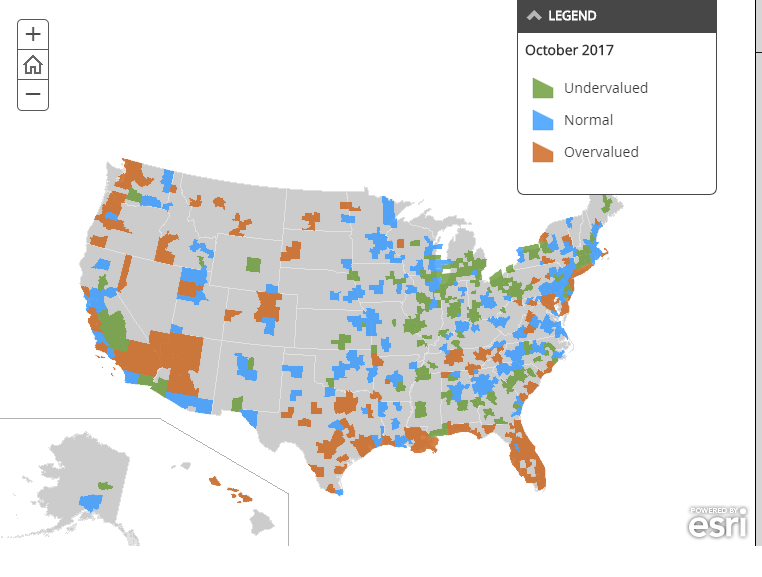
Home prices rose 0.9% MOM and are up 7% YOY, according to CoreLogic. The fastest growth continues to be in the West and Mountain states. Much of the Midwest remains undervalued while we are seeing overvaluation in places like Florida, Texas, and the West Coast. Note that fears about climate change are not evident in Florida real estate


First time homebuyers are still relatively uninformed about mortgages. According to a recent survey, 20% of Americans think it is impossible to get a mortgage with less than 5% down, despite the fact that FHA goes down to 3%, VA allows nothing, and the GSEs have 3% down products. Most people get their information on the Internet, and surprisingly almost nobody gets their mortgage information from the CFPB. 

How did HAMP and HARP help struggling homeowners? It turns out, not much. In fact, borrowers who had a principal reduction had pretty much the same default rates as borrowers without a principal reduction. These reductions were big: 32% or about $112,000 on average. These results pour cold water on the strategic default theory, which says that borrowers will choose to toss the keys to the bank once the home value is less than their outstanding mortgage. FWIW, I think the defaults in 2006 were strategic defaults, as the economy had yet to roll over and professionals were playing the greater fool game. Note that modifying a mortgage payment to a percentage of income didn't really help either. The punch line is that many defaults were caused by a short term blip in a borrower's financial situation - often an unexpected expense like a medical bill - and servicers should work on creating a solution to help the borrower over that hump and then re-evaluate. 

Monday, May 11, 2015

Morning Report - Greece may causes some volatility this week

Vital Statistics:

Last Change Percent
S&P Futures  2110.1 1.7 0.08%
Eurostoxx Index 3624.2 -25.3 -0.69%
Oil (WTI) 59.64 0.3 0.42%
LIBOR 0.28 0.001 0.36%
US Dollar Index (DXY) 95.07 0.275 0.29%
10 Year Govt Bond Yield 2.17% 0.03%  
Current Coupon Ginnie Mae TBA 102.4 -0.2
Current Coupon Fannie Mae TBA 101.3 -0.1
BankRate 30 Year Fixed Rate Mortgage 3.83

Stocks are flattish on no real news. Bonds and MBS are down.

The week after the jobs report is usually pretty data-light and this week is no exception. The highlights will be retail sales on Wednesday and industrial data on Friday. 

Bonds will be vulnerable to shifts in the wind due to a few big deadlines in Greece this week. To put the Greek situation in perspective, over the past 3 weeks, the German 10 year yield has gone from 7.5 basis points in yield to 77 basis points in yield intraday last week. This is what has been pushing down Treasuries. Last week the 10 year briefly traded over 2.3% in yield.

The Fed may not pursue a path of steady consecutive 25 basis point increases in the Fed Funds rate when they start hiking rates. Interestingly, the article posits that the Fed wants to learn the lesson of the last hike cycle - in which they tightened too predictably, and which some believe caused the real estate bubble. If the Fed truly believes that rate hikes caused the real estate bubble, and everything was fine in the markets before then, it shows we have learned absolutely nothing from 2008. 

Tuesday, May 14, 2013

Morning Report - Housing Scorecard

Vital Statistics:

Last Change Percent
S&P Futures  1631.8 1.0 0.06%
Eurostoxx Index 2778.9 1.5 0.05%
Oil (WTI) 94.59 -0.6 -0.61%
LIBOR 0.274 -0.001 -0.36%
US Dollar Index (DXY) 83.34 0.065 0.08%
10 Year Govt Bond Yield 1.91% -0.01%  
Current Coupon Ginnie Mae TBA 104.9 -0.2
Current Coupon Fannie Mae TBA 103 0.1
RPX Composite Real Estate Index 196.6 0.4
BankRate 30 Year Fixed Rate Mortgage 3.62

Markets are flattish this morning on no real news. Appalloosa manager David Tepper said on CNBC that he is still bullish and the economy is getting better. Bonds finally catch a bid after a pretty brutal two week sell-off. MBS are up small.

The National Federation of Independent Business released their Small Business Optimism Survey this morning, which showed the index creeping up slightly to 92.1 from 90.7. Owners are still pessimistic about the economy, with a net negative 15% expecting business conditions to improve over the next six months. Hiring and raises are being done only grudgingly, and capital expenditures are only at maintenance levels. Yet the stock market is at record highs. So what gives? Part of it is that the big S&P 500 stocks have a lot of international exposure, which means they can offset US weakness elsewhere. Also, I think quantitative easing is playing a part.

The Obama Administration released their monthly Housing Scorecard which showed home equity increased again last month. HAMP trial modifications jumped, while HAMP permanent mods fell. HARP refis were flat for the month. It is still looking like Mel Watt as the new FHFA Chairman is no sure thing, either. Even if he doesn't get nominated, HARP 3.0 might still happen, which would extend the eligibility dates for HARP refis to include late 2009 and 2010 vintages. That would undoubtedly kick off another refi wave.

Thursday, December 27, 2012

Morning Report - The Mod Squad

Vital Statistics:

Last Change Percent
S&P Futures  1416.2 2.7 0.19%
Eurostoxx Index 2665.1 16.6 0.62%
Oil (WTI) 91.18 0.2 0.22%
LIBOR 0.311 0.001 0.32%
US Dollar Index (DXY) 79.44 -0.182 -0.23%
10 Year Govt Bond Yield 1.77% 0.01%
RPX Composite Real Estate Index 192.3 0.5

Markets are quiet again as desks are understaffed both in Europe and the US. Initial Jobless Claims fell to 350k, back to the bottom end of our 350k - 390k range. Bonds and MBS are down small and continue to dismiss the possibility of a cliff-induced recession.

President Obama heads back to Washington to try and craft a deal to avert the fiscal cliff. The WH seems to have backed off its proposal to increase taxes at 400k and has moved back to 250k. It is looking more and more like we will go over the cliff on Jan 1 and then pass some sort of tax cut package soon thereafter.  Treasury informed Congress that we will hit the debt limit on Monday, but they can play some games to keep the government funded through Feb.

Of course, once we climb the fiscal cliff, we will go right into the battle of the debt ceiling. Moody's has already fired a shot across the bow, saying that they expect the government to raise the limit, but they may downgrade the U.S.'s credit rating unless we get a decrease in the debt / GDP ratio.

Yesterday's WSJ report on possible new initiatives to mitigate the effects of the housing bust have already been met with skepticism. The first plan involved allowing deeply underwater non-agency loans to refi into Fan and Fred loans.  James Pethokousis of the American Enterprise Institute points out that allowing the GSEs to refi underwater non-agency mortgages is a non-starter with virtually all Republicans and many Democrats as it shifts risk from the private sector to the public sector.  Plus, you have to get the originators on board, and they won't make 125%+ LTV loans without some sort of safe harbor against buyback risk.

A second plan would further expand HAMP, by changing the definition of "in danger of imminent default" to include anyone who is has a LTV over 125%, even if they are current on their mortgage. Such a move would not require Congressional approval. The American Securitization Forum is against the idea, given that these loans are worth their weight in gold.  They are current, have above-market coupons, and have virtually no chance of being prepaid for years. If enacted, investors would take an income hit (although Treasury would pay them the coupon difference for 5 years), and would see a capital loss as well. My sense is that ASF's argument will be met with very little sympathy in the Administration, although state and federal pension funds will be quietly making the same argument as well. Still another hurdle would be servicers, who would have to buy off on the idea that modding a current loan is somehow good for the investor.