A place where economics, financial markets, and real estate intersect.
Showing posts with label Greece. Show all posts

Monday, July 13, 2015

Morning Report - Greece capitulates

Vital Statistics:

Last Change Percent
S&P Futures  2082.4 13.4 0.65%
Eurostoxx Index 3580.9 52.1 1.48%
Oil (WTI) 52.2 -0.5 -1.02%
LIBOR 0.286 0.000 -0.07%
US Dollar Index (DXY) 96.48 0.454 0.47%
10 Year Govt Bond Yield 2.45% 0.05%
Current Coupon Ginnie Mae TBA 103.4 -0.3
Current Coupon Fannie Mae TBA 102.4 -0.3
BankRate 30 Year Fixed Rate Mortgage 4.19

Markets are higher as it looks like the Greek situation looks resolved for the time being and Chinese stocks staged another rally. Bonds and MBS are down.

Endgame continues in Greece, where Prime Minister Alexis Tsipras has agreed to bailout terms, but now must sell the agreement to his own country. The summit agreement avoided a worst-case scenario for Greece, but many of the terms of the bailout have strings attached. Dr. Cowbell is despondent over the whole episode, as the Germans are really pushing Greece hard. Memo to Tsipras: Don't bring up the Nazis when negotiating with the Germans. 

Earnings season kicks off in earnest this week, with the big banks reporting. Note the Mortgage Bankers Association Mortgage Applications index is off about 16% during the quarter, so mortgage origination numbers could be light. 

We have some big economic data this week, with retail sales tomorrow, industrial production on Wed, and housing starts on Friday. Bonds should still be at the mercy of international events however. 

Janet Yellen spoke on Friday and said she expects the Fed to hike rates this year, however she cited weakness in the labor market as a reason for caution. I think the Fed is determined to make at least a symbolic move to get off the zero bound, but will tighten much more gradually than it did in the past. The exit from the post stock market bubble days was pretty dramatic, about 2 percentage points a year, or 25 basis points every meeting. 


You can see from the dot graph from the June meeting that the FOMC is forecasting a slower liftoff, however we are still looking at a 350 basis point (roughly) tightening vs the 425 basis point tightening in 2004, which blew up the residential real estate bubble. Will this tightening campaign blow up the sovereign debt bubble? Or something else?


Tuesday, July 7, 2015

Morning Report - Chinese stocks collapsing

Markets are higher this morning as Europe and Greece still try and to seek a solution. Bonds and MBS are up.

Greece and their creditors are basically searching for a way to finance Greece's next payment (about 3.5 billion euros) to the ECB which is due on July 20. If they default, the die is more or less cast. The final result of this negotiation will not be a bailout, but just a liquidity injection to keep things going for another month. The Greek banks have deferred tax assets and Greek government debt as their capital. They are cut off from global credit markets and have been closed to prevent a bank run. The banking system will have to be nationalized and the Greek government will have to issue some sort of scrip to pay people.

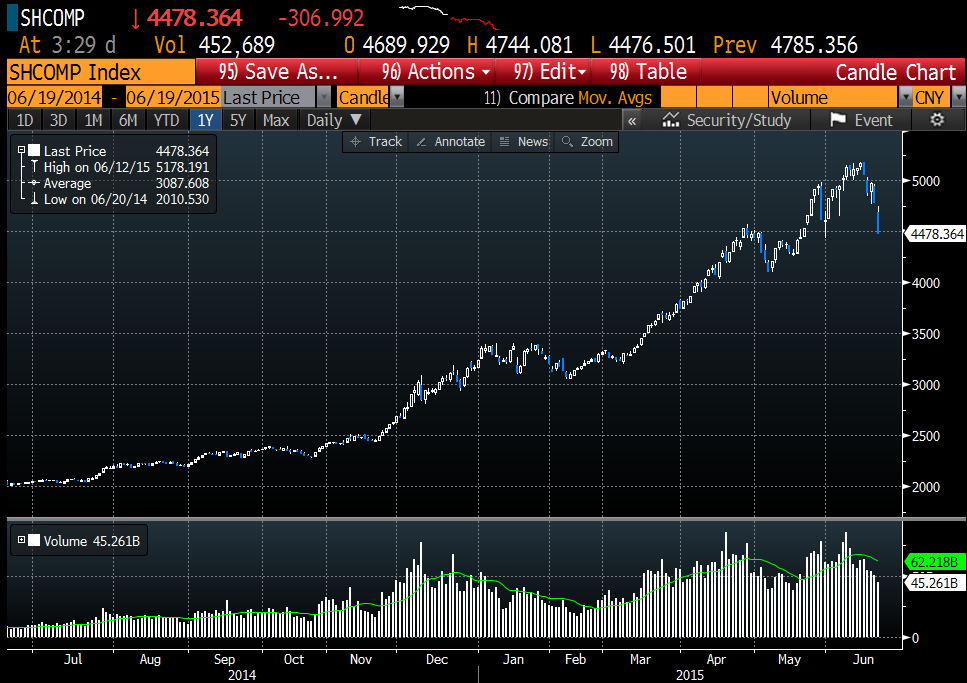
If it weren't for the Greek Crisis, everyone would be talking about what is going on in China. Their stock market is collapsing, with the Shanghai Composite B share index down 40% in a month.  The Chinese government has been pulling out all the stops to try and support the market - cutting interest rates, increasing liquidity, creating a stock fund to buy up stocks to support the market - and none of it has been working. The Shanghai Composite B-share index dropped another 9% last night as margin traders get liquidated. To stop the selling, the Chinese government has basically suspended trading in 26% of the stocks on the Chinese exchange. Of course this does nothing but delay the inevitable. Chart: Shanghai Composite (B-shares)


Between the Greek and Chinese situations, bonds should be heading higher. We are already seeing the German Bund rally, with the yield having dropped from just over 1% to 66 basis points over the past month. Relative value trades should work US Treasuries higher as well. US investors (and loan officers) should brace themselves for a bumpy ride as the situation in Greece is hardly settled, China is a falling knife, and the Fed is in rate hike mode. Global financial stress is bond bullish, while the Fed's posture is bond bearish. LOs, tell your borrowers they are playing with fire if they are floating. 

That said, I think the overall medium term effect of the stress will be to push rates lower on the flight to safety trade. A struggling China will try and use exports to stimulate their economy, which means the US will be importing deflation. The last thing the Fed will want to do in that situation is to raise rates. As an added bonus, you could see renewed buying in MBS as investors reach for government guaranteed yield. TBA spreads to Treasuries could narrow, which means that mortgage rates could fall as fast or faster than Treasury yields. IMO, the Treasury market has been fading the moves overseas and is behind the curve. 

Job openings hit 5.36 million in May, another record in the JOLTS Job Openings index. There definitely seems to be a mismatch between what employers want (someone with the wisdom of a 50 year old, the efficiency of a 40 year old, the drive of a 30 year old and the paycheck of a 20 year old) and what is actually available in the labor market. 


Monday, July 6, 2015

Greferendum No

Stocks are down after Greece voted down further austerity. Bonds and MBS are up.

The jobs report last Thursday was okay for the most part. The labor force participation rate hit a new low, however.

The ISM Non-Manufacturing Index came in a little light, but was generally strong. Business Activity accelerated, however that was offset by weakening employment growth. Employment activity in the services sector has been decelerating for months.

The week after the jobs report is usually pretty data-light and this week is no exception. The highlight will be the FOMC minutes on Wednesday.

The immediate fallout of the crisis should be bond (and MBS) bullish. US stocks are down in sympathy with global markets, but there should be almost no exposure here. The ECB will probably take additional measures to boost markets via QE, so that should be stock and bond bullish here.

On to the next crisis, which is the bursting of the Chinese stock and real estate bubbles. China's government is pulling out all the stops trying to support stock prices (the invisible hand meets the iron fist). In many ways it it reminiscent of the Japanese government in the 1990s, where they tried to artificially support markets through "price keeping operations." Of course these measures inevitably prevent necessary adjustments from occurring, which is why Japan has stayed in economic stagnation for over a generation.

The Chinese situation has more potential to affect US markets than Greece. Chinese money is behind a lot of the price appreciation in the cities, especially at the high end. Whether it stays or goes will be dependent on what the Chinese government wants.

Wednesday, July 1, 2015

Morning Report - Greece defaults

Stocks are up smartly this morning on stronger economic data and the prospect of a solution in Greece. Bonds and MBS are down.

Mortgage Applications fell 4.7% last week as interest rates spiked on the strong personal spending data. Purchase applications fell 4.1% while refis dropped 5.2%. The average 30 year fixed rate mortgage rose to 4.26%.

The ADP employment survey reported that 237k jobs were created in June, higher than the 218k forecast. The Street is forecasting a rise of 230k for the jobs report tomorrow. Challenger job cuts rose to 44k.

Fed St. Louis President James Bullard spoke last night and said the Fed should consider raising rates at the Sep meeting given the strength of the latest economic data.

Vehicle sales will be coming in all day. Early returns are disappointing.

Construction spending rose .8% in May, beating the .5% estimate. Residential construction rose .3%.

The ISM Manufacturing Index rose in June from 52.8 to 53.5. A reading over 50 indicates expansion. This is good news as the decline in oil prices had depressed activity in the oil patch. New orders and employment drove the increase. The 53.5 reading would typically correspond to a GDP growth rate of 3.3%.

Last night, Greece became the first advanced economy to officially default on an IMF loan. Most Greek banks are out of money, and pensioners who are used to getting 600 euros for the month are being given less than a quarter of that - about 120 euros. ATM deposits are being limited to 60 euros a day. The first snap poll of Greek citizens has pretty convincingly rejected the EU's offer - 53% "no", 33% yes.

Greece has told Europe that the latest offer comprises the basis of a compromise. The Europeans are going to wait until the results of the referendum are out on July 5. If the voters say "no" to the European demands, Greece will have no other option than to print its own currency to pay workers and pensioners. IMO, a Greek exit will be bond bullish, as it will probably force a policy response out of the ECB and that means more QE.

While home prices still remain affordable compared to the bubble years, low inventory has pushed up the price / rent ratio. We are back to late 2003 levels. On a nominal (in other words, non-inflation adjusted basis), prices are approaching peak levels, but on an inflation adjusted basis, they still have a ways to go. Of course wage inflation remains muted, so that will act as a drag on home price appreciation, or at least affordability.


The latest CoreLogic Market Pulse is out, and it has some good stuff on the state of the housing economy. They discuss the most overvalued housing markets, and find 4 are in Texas. Not sure how their index works, but there you go. The other ones are Washington DC (duh), Miami FL (huh?) and Charleston SC (huh?). Overall, prices nationwide appear reasonable and sustainable, with many localities still recovering from the collapse. 

Monday, June 29, 2015

Morning Report: Grexit imminent?

Stocks are down worldwide as Greece imposed capital controls and China enters a bear market. Bonds and MBS are up.

We have a short week coming up, with markets closed on Friday for the 4th of July. The jobs report has been moved up to Thursday. Liquidity could be lighter than normal this week as traders head to the Hamptons for a long weekend.

Greece and their creditors are at an impasse, with the Greek government scheduled a vote to determine whether to accept the creditor demands. The European Central Bank froze their Emergency Liquidity program at the same level as last week, making the Greek banks more or less insolvent. ATMs are out of money and the banks will be closed for the next six days. If they cannot get a deal with creditors, Greece will have to start printing money in order to keep the banks solvent, which would pave the way for their exit from the Euro.

While the Greek economy is only about 2% of the Eurozone (in reality, about the size of Milan or Dusseldorf) their exit will probably be bond bullish. Why? In order to support European banks which hold Greek sovereign debt, the ECB will probably announce further measures to support the banking system, and that means more QE. This will cause the Bund to rally, and relative value trading will pull the US 10 year along for the ride.

ICYMI: Puerto Rico can't pay their debts, either.

TBAs got clobbered last week, with the Fannie TBA and the Ginnie TBA losing well over a point. This sent mortgage rates up. It may have been an overreaction to the strong personal spending data we got on Thursday, or fears of volatility over the Greek situation, but it is something to keep an eye on.

Pending Home Sales rose .9% in May, which is the highest level in over 9 years. Home Price Appreciation continues to rise about 4 times wage growth, which is an issue.

The Supreme Court ruled that the CFPB could use the "disparate impact" theory in housing discrimination cases. This was unexpected. It no longer matters whether a lender intended to discriminate, all that matters is the numbers. While the Court tried to explain that this doesn't mean lenders just got quotas, for all intents and purposes, they just did.


Wednesday, June 24, 2015

Morning Report - A generation of renters?

Vital Statistics:

Last Change Percent
S&P Futures  2111.6 -4.8 -0.23%
Eurostoxx Index 3595.1 -30.9 -0.85%
Oil (WTI) 60.99 0.0 -0.03%
LIBOR 0.282 0.001 0.34%
US Dollar Index (DXY) 95.24 -0.189 -0.20%
10 Year Govt Bond Yield 2.39% -0.02%
Current Coupon Ginnie Mae TBA 100.7 0.1
Current Coupon Fannie Mae TBA 99.28 0.1
BankRate 30 Year Fixed Rate Mortgage 4.18

Markets are lower after Greek Prime Minister Tsipras expressed shock that his proposals still do not go far enough to get a deal. Bonds and MBS are up.

Mortgage Applications rose 1.6% last week as purchases rose 1.2% and refis rose 1.8%. 

The third revision to first quarter GDP came in at -0.2%. This is an upward revision from the previous -0.7% estimate. A combination of harsh weather, a West Coast port strike, and a slowdown in the oil patch depressed growth. Lower gas prices still are not translating into higher spending at the malls, however. Consumers continue to save / repay debt.

Greece was handed new terms for a bailout. The proposals Tspiras provided do not go far enough, and he took to Twitter to harangue the IMF and the EU. Brave new world: negotiating and posturing via Twitter. “There is still a lot of work to do,” Dutch Finance Minister Jeroen Dijsselbloem, who chairs meetings of his euro-area counterparts, told reporters in Brussels. “We are not there yet.”

Homeownership levels have fallen back to the levels of the early 90s. Millennials are renting in droves. Is this the new face of homownership, or simply the pendulum overcorrecting on the other side? While house prices are back in bubblicious territory (primarily due to a lack of inventory), rates are so low that mortgage payments are still comparable to rents. 

Speaking of lack of inventory, homebuilding giant Lennar reported earnings this morning, beating the Street. Revenues increased 30% as deliveries increased 21% and ASPs increased to $348,000. New orders increased 18% in units as well. The stock is up about 5% pre-open. Could housing be the new engine for the economy? Hopefully, as manufacturing seems to be going through a soft patch. 

Washington is alleging discrimination in REO, saying that homes in low-income neighborhoods are not being properly maintained. The problem in many of these place, especially in the rust belt, is that the opportunities are so sparse that people are moving out, and no one is moving in. When you have a net outflow of people and an endless supply of vacant houses, these properties become basically worthless. And what bank wants to throw good money after bad maintaining a house that probably will never sell in the first place?

Tuesday, June 23, 2015

Morning Report - New Home Sales highest in 7 years

Vital Statistics:

Last Change Percent
S&P Futures  2115.6 2.8 0.13%
Eurostoxx Index 3637.5 41.5 1.15%
Oil (WTI) 59.92 -0.5 -0.76%
LIBOR 0.281 0.001 0.18%
US Dollar Index (DXY) 95.44 1.106 1.17%
10 Year Govt Bond Yield 2.41% 0.04%  
Current Coupon Ginnie Mae TBA 100.8 -0.7
Current Coupon Fannie Mae TBA 99.13 -0.2
BankRate 30 Year Fixed Rate Mortgage 4.11

Stocks are higher this morning on optimism for a Greek deal. Bonds and MBS are down.

New home sales rose 546k in May, higher than the 523k expectation and the upward-revised 534k April number. We will hear from homebuilding giant Lennar tomorrow. This is the highest number in 7 years, which will hopefully alleviate the problem of low inventory.

Durable Goods Orders fell 1.8% in May. April was revised downward from -0.5% to -1.5%. Capital Goods Orders ex defense and air (which is a proxy for business capital expenditures) rose 0.4% in May after falling a revised 0.3% in April. The low CAPEX numbers were largely driven by the decline in oil prices, which appear to have stabilized. 

Home Prices rose 0.3% in April, according to the FHFA. The index is now roughly 2.3% below its March 2007 peak and corresponds to Feb 2006 prices. Note the FHFA index is narrower than the other indices like Case-Shiller in that it only looks at homes with a conforming mortgage. As usual, the West coast did the best, while the Northeast lagged.


Tspiras surrenders. That is the headline in Bloomberg regarding the Greek situation. Greece has more or less offered to meet the demands of their creditors. The glass of ouzo is close to being full.


Monday, June 22, 2015

Morning Report - Existing Home Sales increase

Vital Statistics:

Last Change Percent
S&P Futures  2115.8 18.1 0.86%
Eurostoxx Index 3545.9 90.1 2.61%
Oil (WTI) 59.32 -0.3 -0.49%
LIBOR 0.281 0.001 0.18%
US Dollar Index (DXY) 94.11 0.023 0.02%
10 Year Govt Bond Yield 2.33% 0.07%
Current Coupon Ginnie Mae TBA 101.2 -0.4
Current Coupon Fannie Mae TBA 99.7 -0.4
BankRate 30 Year Fixed Rate Mortgage 3.99

Markets are higher this morning after the Greek government offered a new proposal to end the standoff. Bonds and MBS are down

The Chicago Fed National Activity Index improved slightly in May to -.17. The 3 month moving average was also negative, which means the economy is growing a little below trend. Production and Consumption were negative, while employment was positive. 

Merger mania in the health insurance space: Cigna rejected an offer from Anthem, and Aetna supposedly approached Humana. Insurers are looking to cut costs.

Existing Home Sales improved 5.1% to 5.35 million in May, according to the NAR. This is the highest since May 2009.  The first time homebuyer accounted for 32% of sales, up from 30% in April, but still below its historical average of about 40%. All cash transactions were flat at 24%, while days on market ticked up slightly to 40 days. The median price of a home rose 7.9% to $228,700. This puts the median home price to median income ratio at 4.3x, which is again stretched and well outside the historical norm of 3.2x - 3.6x. 

In political news, the Supreme Court is supposed to rule on King vs Burwell, the case which decides whether states that did not set up exchanges are eligible for federal subsidies. This will dominate the news headlines in Washington if the Court decides the language in the law needs to be changed. 

Friday, June 19, 2015

Morning Report - Endgame for Greece

Vital Statistics:

Last Change Percent
S&P Futures  2112.5 -2.2 -0.10%
Eurostoxx Index 3469.3 18.9 0.55%
Oil (WTI) 59.35 -1.1 -1.82%
LIBOR 0.286 -0.001 -0.19%
US Dollar Index (DXY) 94.34 0.312 0.33%
10 Year Govt Bond Yield 2.29% -0.05%  
Current Coupon Ginnie Mae TBA 101.2 0.1
Current Coupon Fannie Mae TBA 100.1 0.2
BankRate 30 Year Fixed Rate Mortgage 4.04

Markets are lower after the ECB increased the size of its emergency liquidity program to Greece. Bonds and MBS are up.

No economic data today

We are getting to crunch time with Greece. Euro-area leaders are meeting Monday to try and hammer out some sort of gameplan. The ECB's emergency liquidity package expires on June 30, which is also the day a big payment is due to the IMF. It is looking more and more likely that Greece is going to exit the Euro. While most Greek debt is owned by the Greek banking system, some is owned by the big European banks as well. Some could see a hit to their capital. This will probably be dollar (and Treasury) bullish. 

Chinese stocks have been selling off, and have entered correction territory (defined as down 10%). The Chinese stock market has been in bubble territory for a while, and it looks like it is finally bursting. This market is being fueled by a toxic cocktail of margin debt and dumb money. Current margin debt is $368 billion. The market increased over 150% in one year (or about $6 trillion). While the index was higher in 2009, the Shanghai Composite P/E is currently about 95x earnings, versus 68x at the height of the 2009 market.


The bursting of the Chinese stock and real estate bubbles is going to complicate the Fed's job of trying to normalize interest rates by causing a flight to quality in US Treasuries. The biggest headache for the Fed will be when China begins to export deflation. Inflation is still too low as far as the Fed is concerned. The biggest fear? Interest rates are already at the zero bound throughout the world, and central banks are largely out of ammunition.


Wednesday, June 17, 2015

Morning Report: FOMC day

Vital Statistics:

Last Change Percent
S&P Futures  2092.0 3.0 0.14%
Eurostoxx Index 3437.7 -16.4 -0.47%
Oil (WTI) 61.14 1.2 1.95%
LIBOR 0.283 -0.003 -0.98%
US Dollar Index (DXY) 94.84 -0.161 -0.17%
10 Year Govt Bond Yield 2.33% 0.02%  
Current Coupon Ginnie Mae TBA 100.9 -0.2
Current Coupon Fannie Mae TBA 99.56 -0.2
BankRate 30 Year Fixed Rate Mortgage 4.07

Stocks are flattish this morning ahead of the FOMC decision. Bonds and MBS are down small. 

The FOMC rate decision is scheduled for 2:00 pm EST today, so beware of volatility around that time. We will be getting a new set of economic projections and a new dot graph. Yellen will also hold a press conference afterward. What will investors focus on? the dot graph.

Mortgage Applications fell 5.5% last week. Purchases fell 4.2% while refis fell 6.9%. 

It is looking like there might not be a deal with Greece, as Tsipras said Greece was willing to live with the consequences of saying "no" to their creditors. Bloomberg provides this helpful graph of where we are in the tug-of-war between creditors and Greece: The ouzo is definitely running out of the glass at this point


"Sell in May and Go Away" meets "Don't fight the Fed." A record number of investors have told BOA / Merrill Lynch that they have bought downside protection in stocks ahead of rate hikes. FWIW, I am not sure that a 50 basis point or 75 basis point Fed Funds rate is going to do that much to pull back the economy, and I think the Fed is going to take it very, very slow. This is not a typical tightening, where the Fed is trying to cool off the economy. The last thing they want to do is choke off the recovery. Second, if (when) China's stock market bubble bursts, we could see a massive flight to quality (in other words, investors buying Treasuries) that would probably offset at least some of the effect of higher short term rates. 

Barclay's is exiting the US MBS market, following Royal Bank of Scotland's lead. They will still trade risk sharing bonds and might still trade agency paper, but they are out of the market making business in pre-crisis paper. 

Monday, June 15, 2015

Morning Report: All eyes on the FOMC this week

Vital Statistics:

Last Change Percent
S&P Futures  2093.1 -16.1 -0.76%
Eurostoxx Index 3434.5 -68.3 -1.95%
Oil (WTI) 59.08 -0.9 -1.47%
LIBOR 0.286 0.000 0.07%
US Dollar Index (DXY) 95.21 0.240 0.25%
10 Year Govt Bond Yield 2.33% -0.07%  
Current Coupon Ginnie Mae TBA 101.1 0.5
Current Coupon Fannie Mae TBA 99.57 0.4
BankRate 30 Year Fixed Rate Mortgage 4.09

Stocks are lower after talks between Greece and its creditors broke down over the weekend. Bonds and MBS are up.

This is supposedly "deal week" for Greece. They owe the IMF $1.7 billion. If they don't pay (and they have already missed one payment), then it makes it hard for the ECB to continue providing emergency liquidity. The current program with the ECB expires at the end of the month. Rhetoric is getting more and more heated between Germany and Greece at this point. At issue are the pensions. Greece is steadfastly resisting restructuring the country's pension system. And the Germans are getting sick of it: ‘We will not let the German workers and their families pay for the overblown election promises of a partially communist government,’’ Vice-Chancellor Sigmar Gabriel wrote in a Bild opinion column on Monday. If they can't get a deal, then the ECB will probably stop supporting the Greek banks and the county will have to impose capital controls to keep hard assets from fleeing the country. It sounds like the Europe will consider allowing Tsipras some sort of face-saving change to the deal, but nothing really meaningful. The bond markets are getting nervous, as the Greek 10 year bond yield is up almost one full percentage point this morning at 12.723%. For us in the the US markets, any sort of Greek exit will probably cause a flight to quality, which means it would be bullish for US bonds. 

Chart: Greek 10 year bond yield:


In other "bullish for US bonds" news, the manufacturing sector had a rough go of it in May. Industrial Production fell 0.2%, manufacturing production fell 0.2% and capacity utilization fell to 78.1%. Separately the New York State Empire Manufacturing Index fell to -1.98. While manufacturing is no longer the economic driver it used to be, these are still lousy numbers, and reinforces the idea that the Fed will stand pat this week. 

The NAHB Homebuilder index rebounded to 59 in June, topping its post-crisis highs. Builder confidence is more or less back at "normalcy." While homebuilder sentiment is back to normalcy, housing starts most certainly are not. The Street is forecasting housing starts to come in at 1.09 million tomorrow, which is still 27% below the normal, pre-bubble level of 1.5 million starts a year. Starts are only now approaching the recessionary lows of the past. So while builders may have positive sentiment, they aren't putting their money where their mouth is, at least not yet. 

Chart: housing starts, long term:


The FOMC meets on Tuesday and Wednesday this week. This will be the first FOMC meeting where a rate hike is in play. Given some of the weak economic data and persistent low inflation, it is unlikely the Fed will hike rates this week, however the language of the statement will certainly be important. Expect to see some volatility this week in bonds, between the FOMC and the Greek situation. LOs, be sure to tell your borrowers about the risks of floating. 

If the Fed does in fact hike rates, it doesn't necessarily follow that the 10 year bond yield (and by extension mortgage rates) will spike. When you look at the tightenings in the past, the yield curve flattened, which means the short end of the curve (overnight rates etc) moved higher, but the longer end of the curve largely ignored the increase. The 2004 tightening cycle is probably the most relevant, as we were still in the aftermath of the collapse of the stock market bubble. The Fed increased the Fed Funds target rate from 1% to 5.25% over the course of 2 years. The US 10 year basically went nowhere.

Chart: aftermath of 2004 rate hikes:


For a contrarian view on the Fed and long-term interest rates, listen to Bill Gross, who thinks the world's central banks want higher long-term rates because they are worried about insurance companies and pension funds. These entities are not able to earn the returns they need in this low interest rate environment (the actuarial tables couldn't care less that rates are zero), and they have been forced to take a lot of credit risk. The most painless way to avoid a crisis is to let long-term rates slowly creep up. It just goes to show how small the eye is in the needle the world's central banks need to thread.

Elizabeth Warren and the left are not fans of share buybacks And there are legitimate questions about companies levering up to fund buybacks. And yes, buybacks are more tax efficient than dividend hikes because investors can defer taxes on capital gains by not selling. . However they are trying to conflate stock buybacks with "market manipulation," which is fraud and illegal. I think the gameplan is twofold here: The first is to weaken the presumption that management's first priority is to maximize shareholder value. The second is to shame companies into raising wages for workers. 

Monday, June 8, 2015

Morning Report - Jobs report data dump

Vital Statistics:

Last Change Percent
S&P Futures  2088.7 -3.5 -0.17%
Eurostoxx Index 3491.1 -18.9 -0.54%
Oil (WTI) 58.74 -0.4 -0.66%
LIBOR 0.281 0.002 0.82%
US Dollar Index (DXY) 95.91 -0.398 -0.41%
10 Year Govt Bond Yield 2.38% -0.03%  
Current Coupon Ginnie Mae TBA 100.6 -0.1
Current Coupon Fannie Mae TBA 99.45 0.2
BankRate 30 Year Fixed Rate Mortgage 4.08

Stocks are lower after Greece officially missed its payment to the IMF. Bonds and MBS are up small.

The week after the jobs report is usually data-light and this week is no exception. The only data that should matter is retail sales on Thursday. While the labor market seems to be improving, consumer spending is still lagging. Part of that is demographic, where you have a bunch of old rich people who probably bought their last TVs, toasters, etc and a bunch of young broke people. 

Bonds got rocked on Friday after the stronger than expected jobs report. 280,000 jobs were created in May, and the two prior months were revised upward from "dismal" to "not hideous." Average hourly earnings rose to $24.96, up 2.3% from last year. The unemployment rate ticked up to 5.5% as the labor force participation rate improved to 62.9%. It is looking like the first quarter weakness was indeed transitory, and weather-driven. It probably doesn't mean the Fed is moving in June, but September is definitely in play. 

The big question the Fed is grappling with is the ceiling on the labor force participation rate. If it is high, say 66% - 67%, then returning workers will keep a lid on wages, and the Fed will be able to let the economy run a bit longer. It also means the overall growth potential for the economy is higher. If the ceiling is low, say 64% - 65%, it means wage inflation will force the Fed's hand earlier, which means the "speed limit" of the economy is lower. Of course demographics explain some of the long term changes in the labor force participation rate, however many of the long-term unemployed want to (and need to) have a full-time job. Whether they can get meaningful jobs after being on the sidelines for multiple years is an open question. 

In spite of the huge sell-off in bonds over the past two months, the street is forecasting  a 2.5% 10 year yield for 2015. The Fed has been consistently over-optimistic on the economy in general, and the simple fact that the Fed funds rate is increasing does not necessarily mean long term rates are going to go up big. Take a look at the chart below: it is the 10 year bond yield minus the Fed Funds target rate. In the last tightening cycle (early 2004 to early 2006), the Fed Funds rate increased from 1% to 5.25% over the course of two years. During that same period, the 10 year bond yield increased from about 4.8% to 5.2%. The yield curve actually inverted towards the end of the cycle (which more or less broke the real estate bubble). In other words, the Fed could start hiking rates this year and we could see the 10 year go basically nowhere. 


Tuesday, June 2, 2015

Morning Report - The dearth of starter home construction

Vital Statistics:

Last Change Percent
S&P Futures  2102.6 -6.6 -0.31%
Eurostoxx Index 3573.8 -1.2 -0.03%
Oil (WTI) 60.93 0.7 1.21%
LIBOR 0.284 0.001 0.35%
US Dollar Index (DXY) 96.2 -1.189 -1.22%
10 Year Govt Bond Yield 2.23% 0.05%  
Current Coupon Ginnie Mae TBA 101.7 -0.3
Current Coupon Fannie Mae TBA 100.7 -0.3
BankRate 30 Year Fixed Rate Mortgage 3.88

Stocks are lower this morning as European stocks and bond fall on some strong inflationary numbers. US Treasuries and MBS are lower as well.

Looks like we have dueling proposals to address the Greek situation. The parties are still a ways away from agreeing to anything. 

The ISM New York fell to 54 from 58 last month. Factory orders fell 0.4% in April. 

Economic Optimism fell to 48.1 from 49.7, according to IBD / TIPP. A reading of 50 is considered neutral, so consumers still feel slightly depressed about the state of the economy. If you dig into the data, the mood about the economy in general is somewhat negative, people's personal financial situation are slightly positive, and their view of government economic policy is highly negative.

May auto sales are coming better than expected. Ford is still negative, while Chrysler Fiat is up small. GM was up 3%. Surprisingly, this is the best May in 8 years. That said, with the average age of a US car at 11.4 years, I guess the comps are pretty easy.

An interesting stat demonstrates the lack of starter homes on the market. 10 years ago, about a quarter of new homes had 3 or more bathrooms. Today, that number is 36%. The average size of a new home has increased by something like 140 square feet since the crisis. If you look at the homebuilders, Toll Brothers has been seeing all the action, while the more diversified builders like D.R. Horton and Pulte are only recently beginning to focus on the first time homebuyer. Here are all sorts of fun facts about new construction, courtesy of the Census Bureau. This speaks to both sides of the income inequality debate that has been raging in Washington. If you are an aging baby boomer with assets, QE has been very good to you. If you are a Millennial, the results are mixed at best. You had a very narrow window to pick up a bargain in the real estate market and it closed very quickly. Now house prices are again over their skis relative to incomes. In fact, Bank of America is expecting slightly negative house price growth in 2017-2019 as income growth fails to materialize. What is a Millennial with a bunch of student loan debt to do? Go to Atlanta, Dallas, or Houston.


Thursday, May 28, 2015

Morning Report - Pending Home Sales hits a 9 year high.

Vital Statistics:

Last Change Percent
S&P Futures  2117.1 -3.8 -0.18%
Eurostoxx Index 3658.5 -24.3 -0.66%
Oil (WTI) 57.02 -0.5 -0.85%
LIBOR 0.286 0.001 0.47%
US Dollar Index (DXY) 97.43 0.062 0.06%
10 Year Govt Bond Yield 2.14% 0.01%  
Current Coupon Ginnie Mae TBA 102.2 0.1
Current Coupon Fannie Mae TBA 101.1 0.0
BankRate 30 Year Fixed Rate Mortgage 3.94

Stocks are lower this morning on overseas weakness. Bonds and MBS are flat.

Pending Home Sales rose 3.4% in April, and reached their highest level in 9 years, according to the NAR. Good news for originators focused on the purchase business. After a weak start to the year, sales in the Northeast and the Midwest picked up smartly. Sales in the West were almost flat. NAR expects to see existing home sales come in at 5.24 million in 2015, and the median house price to rise 6.7%. This is ALL inventory-driven, and these increases are vulnerable if wage inflation doesn't pick up soon. The ratio of the median house price to median income has topped 4x and is already well above its historical norm of 3.15x - 3.55x. At the height of the bubble, the ratio hit 4.8x. 


Initial Jobless Claims came in at 282k, the 12th straight week below 300k. A 300k level in initial jobless claims is usually associated with strong economies. People who have jobs are definitely not losing them, however the long-term unemployed and the involuntarily employed part-time are still trying to return. I still think you won't see meaningful moves out of the Fed until we start seeing wage inflation, and that has been slow to materialize.

The Bloomberg Consumer Comfort Index fell to 40.9 from 42.4 in the prior week. This is a 5 month low. The view of the state of the economy has fallen markedly over the past 5 weeks, however people's personal financial situation has not changed. Consumers are still more reluctant to spend money, which is a result of their perception of the economy. Note that we will get the second revision to GDP tomorrow, and the Street is forecasting that Q1 GDP contracted by 0.8%. 

Debt talks with Greece appear to be going nowhere still. The ECB is worried about contagion if a deal is not reached quickly. “In the absence of a quick agreement on structural implementation needs, the risk of an upward adjustment of the risk premia demanded on vulnerable euro-area sovereigns could materialize,” the ECB said in its twice-yearly Financial Stability Review published Thursday in Frankfurt. What this means is that you could see the yields on the PIIGS (Portugal, Ireland, Italy, Greece, and Spain) go one direction, while yields on Northern European debt move the other way. That said, you have to put this in perspective. The US 10-year yields 2.14% and the dollar is strengthening. The Italian 10 year yields 1.85%. Spain yields 1.82%. Ireland 1.2%, Portugal 2.52%. All in the context of Euro weakness. The yields on PIIGS debt is being artificially held down by central bank activity, and the fear is that they could begin to reflect economic reality. 


Tuesday, May 26, 2015

Morning Report - Home Prices continue to rise, FAQ on Greece

Vital Statistics:

Last Change Percent
S&P Futures  2117.9 -6.7 -0.32%
Eurostoxx Index 3649.2 -6.3 -0.17%
Oil (WTI) 58.59 -1.1 -1.89%
LIBOR 0.285 0.003 0.89%
US Dollar Index (DXY) 97.09 1.073 1.12%
10 Year Govt Bond Yield 2.20% -0.01%
Current Coupon Ginnie Mae TBA 101.8 0.1
Current Coupon Fannie Mae TBA 100.8 0.0
BankRate 30 Year Fixed Rate Mortgage 3.9

Stocks are down after Spanish elections over the weekend showed a move to the left. Euro bond yields are again going different directions, with the Greek, Spanish, and Portuguese bond yields increasing, and the Northern European yields falling. US Treasuries are getting pushed lower as well.

We have a ton of economic data this morning. Durable Goods fell 0.5% in April, however when you strip out defense and transportation, they were up 0.8% and March's -0.4% reading was revised upward to 1.0%. Capital Goods ex defense and transportation is considered to be a proxy for business capital expenditures, which has been more or less in maintenance mode since the financial crisis. We would need to see numbers around +1.5% - +2.0% to say that business is beginning to build out for expansion. 

New Home Sales rose to 517k from 484k in April. Given the strong housing starts numbers last week (highest since November 2007), we might be seeing a decent 2015 after all for the homebuilders and the real estate sector in general. Given the persistent shortage of available real estate (NAR has it at 5.4 months), I find it surprising it has taken this long. 

Home Prices continue to rise, according to Case-Shiller and the FHFA House Price Index. The FHFA index is up .3% in March and up 1.3% for the first quarter. This index is now within a couple percentage points of the January 2006 peak. The Case-Shiller index is up 0.95% for March and up 5% annually. The big gainers were San Francisco (up double digits again) and Denver. I suspect there is a lot of foreign money looking for a home in the big cities and that is affecting the Case-Shiller indices. The FHFA Index is narrower than Case-Shiller - it only looks at houses with a conforming mortgage, so it excludes a lot of the high end and the low end of the real estate market. 

Consumer confidence rose to 95.4 in May, up slightly from April, but still below the Jan peak of 103.8. The Richmond Fed Index rose slightly, and Markit is forecasting a slight downturn in the PMI indices.

It is looking more and more like Greece is going to miss its payment to the IMF next week, unless they get more bailout funds. Here is a good FAQ of what can happen. I suspect the IMF and the ECB will come up with a way to kick the can down the road. Greek Banks are a hot mess (much of their capital consists of deferred tax assets and Greek sovereign debt) and they are completely dependent on emergency loan agreements from the ECB. If the government defaults on IMF payments, the ECB could declare the collateral backing these loans as ineligible (which makes sense since they are more or less defaulted securities), which would make the Greek banks insolvent and set the stage for a bank run. The big European banks all have at least some exposure to Greece and that will certainly be a consideration for the ECB. Public opinion supports keeping Greece in the EU so I suspect they will find a way. However if they do miss their payment and things take a turn for the worse, it is probably dollar (and bond) bullish. 

Interesting article about how the Fed has consistently overshot its economic forecasts for the US economy. The market however continues to disagree with the Fed, and it has been right. Take a look at the chart below. The Fed makes new economic forecasts quarterly, and I have tracked the Fed's forecast for 2015 GDP since the March 2013 FOMC meeting. As you can see, two years ago, they thought 2015 GDP would come in around 3.3%. They are now forecasting 2%. Given that the Street is forecasting that the second revision to Q1 GDP is going to come in at -0.9% (we'll get that number Friday), they will probably end up taking down their forecast at the June meeting. People are starting to think the next rate hike will be a 2016 event. 

Thursday, May 21, 2015

Morning Report - Home Prices continue to rise

Vital Statistics:

Last Change Percent
S&P Futures  2121.4 -1.1 -0.05%
Eurostoxx Index 3670.2 -13.3 -0.36%
Oil (WTI) 60 1.0 1.73%
LIBOR 0.281 0.005 1.81%
US Dollar Index (DXY) 95.4 -0.047 -0.05%
10 Year Govt Bond Yield 2.24% -0.01%  
Current Coupon Ginnie Mae TBA 101.7 0.2
Current Coupon Fannie Mae TBA 100.7 0.0
BankRate 30 Year Fixed Rate Mortgage 3.91

Stocks are mixed as economic data continues to come in. Bonds and MBS are up small. Lots of economic data today. 

Existing Home Sales fell to 5.04 million in April from 5.21 in March, according to the NAR. Inventory is still low, however the situation is improving, with the unsold inventory increasing to 5.3 months' worth from 4.6 months in March. The median home price rose to 219,400, which is up 8.9% year-over-year. Real estate prices are getting frothy, as the median home price to median income ratio is now 4x, which is higher than its historical range of 3.2x - 3.6x. Low interest rates are playing a part here. That said, home price appreciation will be tough to come by going forward until we get some more wage growth. At some point, the builders will begin pumping out supply.


Initial Jobless Claims came in at 274k, which is a very good number. The labor numbers continue to look okay, however it is a bifurcated market, where people with jobs are keeping them and the long term unemployed have given up

Consumer Comfort fell to 53.8 from 54.1, however the big number was the steep drop in economic expectations: from 50 to 44. 

The Chicago Fed National Activity Index improved in April from -.36 to -.15. The Markit US Manufacturing PMI fell to 53.8 from 54.1, the Philly Fed index fell to 6.7 from 7.5, and the Index of Leading Economic Indicators jumped from 0.4% to 0.7%. 

The ECB threw a nickel to Greece yesterday, giving them the smallest aid rise ever. Greece is warning that it will default in June, unless it gets more aid. Whatever money they have is going to go to public sector workers and pensioners. While both sides want Greece to stay in the Euro, their left wing government is complicating things. Which means the bond market will be susceptible to violent swings as we sort this out. 

The markets generally took the FOMC minutes to be dovish, and focused on the fact that only "a few" members of the Committee believed it would be appropriate to raise rates at the June meeting. They still believe that the first quarter weakness was "transitory" due to bad weather and the West Coast port strike. That said, the economy seems to not be exhibiting the same sort of rebound we saw last year, where we had a weak Q1 followed by a strong Q2 and Q3. We are definitely not seeing the same sort of rebound in economic activity this year. The Fed noted the additional volatility in the bond market (as has pretty much everyone in the mortgage business) and attributed it to the increasing presence of high frequency traders, lower dealer inventory, and the elevated holdings of bond funds. The minutes more or less confirmed the direction of market forecasts - a September hike is becoming more likely and a June hike less so. 

Monday, May 11, 2015

Morning Report - Greece may causes some volatility this week

Vital Statistics:

Last Change Percent
S&P Futures  2110.1 1.7 0.08%
Eurostoxx Index 3624.2 -25.3 -0.69%
Oil (WTI) 59.64 0.3 0.42%
LIBOR 0.28 0.001 0.36%
US Dollar Index (DXY) 95.07 0.275 0.29%
10 Year Govt Bond Yield 2.17% 0.03%  
Current Coupon Ginnie Mae TBA 102.4 -0.2
Current Coupon Fannie Mae TBA 101.3 -0.1
BankRate 30 Year Fixed Rate Mortgage 3.83

Stocks are flattish on no real news. Bonds and MBS are down.

The week after the jobs report is usually pretty data-light and this week is no exception. The highlights will be retail sales on Wednesday and industrial data on Friday. 

Bonds will be vulnerable to shifts in the wind due to a few big deadlines in Greece this week. To put the Greek situation in perspective, over the past 3 weeks, the German 10 year yield has gone from 7.5 basis points in yield to 77 basis points in yield intraday last week. This is what has been pushing down Treasuries. Last week the 10 year briefly traded over 2.3% in yield.

The Fed may not pursue a path of steady consecutive 25 basis point increases in the Fed Funds rate when they start hiking rates. Interestingly, the article posits that the Fed wants to learn the lesson of the last hike cycle - in which they tightened too predictably, and which some believe caused the real estate bubble. If the Fed truly believes that rate hikes caused the real estate bubble, and everything was fine in the markets before then, it shows we have learned absolutely nothing from 2008.