A place where economics, financial markets, and real estate intersect.
Showing posts with label fed funds. Show all posts

Friday, December 22, 2017

Morning Report: Incomes and spending rise

Vital Statistics:

Last Change
S&P Futures  2689.8 2.0
Eurostoxx Index 390.0 -0.7
Oil (WTI) 58.0 -0.4
US dollar index 86.8 0.0
10 Year Govt Bond Yield 2.49%
Current Coupon Fannie Mae TBA 102.531
Current Coupon Ginnie Mae TBA 103.375
30 Year Fixed Rate Mortgage 3.88

Stocks are up this morning on no real news. Bonds and MBS are flat. 

This should be a relatively quiet day as bonds close early heading into the long holiday weekend. 

Durable Goods orders increase 1.3% MOM / 8.2% YOY in November, coming in below analyst estimates. A surge in aircraft orders drove the increase. Core capital goods orders (a good proxy for business capital expenditures) rose 8.1% YOY. 

Personal incomes rose 0.3% in October, slightly below the Street estimate of 0.4%. Consumer spending was better than expected, rising smartly at 0.6%. Inflation remains nowhere to be found, with the core PCE up 0.1% MOM and 1.5% YOY. The low inflation numbers certainly give the Fed some breathing room, although tax reform will probably push them to be more aggressive. Especially since 9 companies so far have announced wage increases based on tax reform. 

The Fed Funds futures are currently handicapping a 5% probability of no hikes in 2018, a 21% probability of a single 25 basis point hike, a 35% chance of 50, a 27% chance of 75, and a 10% chance of 100. 


Bitcoin is crashing right now, down 25% from yesterday. I was asked how Bitcoin would affect the real estate market.  My view was that Bitcoin is simply so volatile that I cannot imagine both a buyer and seller being comfortable quoting a house in bitcoin. I just don't see someone trying to sell their house for 25 bitcoin. Second, the financing has to be in dollars as no banks lend in bitcoin yet, and I cannot imagine what the interest rate for a bitcoin loan would be. So no, it may be accepted by your local store, however it is more of a novelty at this point. Will that change? Who knows? Will Bitcoin be dominant cryptocurrency or will it be like Classmates.com or MySpace - early adopters that got crushed later on by Facebook? 

Bloomberg takes a look at the state of housing entering 2018. Tight inventory, builder confidence, and a growing economy point to a strong housing market next year. On the other side of the coin, the drop in the mortgage interest deduction could hurt homes at the top end, while the larger standard deduction may lower the incentive to buy versus rent for many at the lower end of the income scale. IMO, the negatives are marginal compared to the positives. 

Don't forget, housing's contribution to GDP is way, way below historical levels. If 2018 is the year homebuilding finally breaks out, it will have an ousized effect on GDP growth. Labor shortages might be the bottleneck, but as wages rise, they attract new workers so that state of affairs doesn't last long. Swinging a hammer pays a lot more than slinging burgers.


90 day delinquencies spiked in November, according to Black Knight Financial Services. 85% of the spike is attributed to the hurricanes, so it doesn't really tell us anything about the state of the economy.

Finally, happy holidays to all!

Monday, March 13, 2017

Morning Report: Fed will almost assuredly hike this week

Vital Statistics:

Last Change
S&P Futures  2372.0 1.0
Eurostoxx Index 374.3 1.1
Oil (WTI) 48.3 -0.2
US dollar index 91.7
10 Year Govt Bond Yield 2.59%
Current Coupon Fannie Mae TBA 101.03
Current Coupon Ginnie Mae TBA 102.5
30 Year Fixed Rate Mortgage 4.21

Stocks are flat this morning on no real news. Bonds and MBS are up.

We will be getting a lot of important economic data this week, with housing starts, inflation, and retail sales. That said, the biggest event this week will be the FOMC meeting on Tuesday and Wednesday. A major snowstorm is expected to hit the East Coast on Tuesday, so that could affect things, especially if the government tells all non-essential government employees to stay home on Tuesday. DC is expected to get 6 - 10 inches, while the Northeast could get up to 2 feet. 

The era of easy money is supposedly over at the Fed, although even if the Fed hikes 3x this year, monetary policy will still be extraordinarily accommodative. With its giant balance sheet and still negative short term rates, it will take a long time to get to neutrality. Not only that, the Fed is going much slower than it has in the past. You can compare the different cycles in the chart below. Another big break from the past was communication: Over the past month, Fed governors have been singing from the same sheet of music and preparing the markets for hikes. This time around, the markets believe the Fed will actually hike rates; in 2016 the markets called the Fed's bluff. 

FWIW, Goldman is saying it will be a close call between 4 hikes this year and 3 hikes plus a balance sheet adjustment. The Fed Funds futures are now 90% on a hike this week. The big question is how much of this is the Fed getting ahead of expected expansionary fiscal policies which may or may not happen. 

Here is a good cheat sheet of how various asset classes have performed during Fed tightening cycles. Cash outperforms bonds, but stocks outperform both. Who says you can't fight the Fed?


Tuesday, December 29, 2015

Morning Report: Don't fear the Fed Funds hike

Vital Statistics:

Last Change Percent
S&P Futures  2062.5 13.7 0.67%
Eurostoxx Index 3309.6 53.1 1.63%
Oil (WTI) 37.54 0.7 1.98%
LIBOR 0.603 0.000 0.00%
US Dollar Index (DXY) 98.28 0.356 0.36%
10 Year Govt Bond Yield 2.25% 0.02%
Current Coupon Ginnie Mae TBA 104
Current Coupon Fannie Mae TBA 103.1
BankRate 30 Year Fixed Rate Mortgage 3.9

Markets are higher this morning as commodities gain. Bonds and MBS are down. 

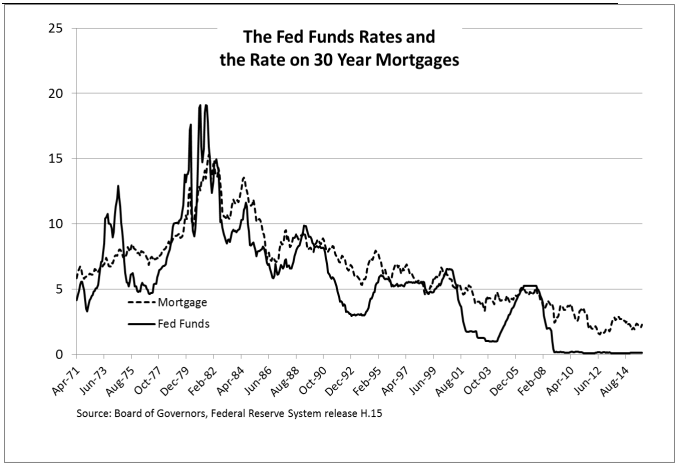
Home Prices rose 0.84% in October and are up 5.5% YOY, according to the Case-Shiller Home Price Index. Portland, San Francisco, and Denver led the charge. For those worrying about how the increase in the Fed Funds rate will affect mortgage rates, don't worry about a 1-for-1 increase in mortgage rates as the Fed hikes rates. Note that in the 2004-2005 tightening cycle, the Fed Funds rate went from 1% to 5.25% while the average 30 year fixed rate mortgage went from 6% to 6.75%. 


One thing to keep in mind, however: ARMS that are pegged to shorter-term rates like LIBOR, Fed Funds or Prime will increase as the Fed hikes short term rates. Might be a good time to pitch a switch from an ARM to a 30 year fixed. 

Ever since the bubble burst, homebuilders have largely focused on the luxury end of the market and the move-up buyer. Fun fact: the average size of a new home has increased by 150 square feet since 2008. Entry-level homebuyers had been priced out of the market. Now that is beginning to change, as builders are focusing on starter homes. High land prices remain an issue.

Consumer Confidence rose from 92.6 to 96.5 in December. 

Retailers had a decent holiday shopping season, with sales between Black Friday and Christmas up almost 8%. 

Average days to close a loan increased by 3 in November, according to Ellie Mae. Blame TRID. Average FICO slipped a point to 721.

Monday, July 13, 2015

Morning Report - Greece capitulates

Vital Statistics:

Last Change Percent
S&P Futures  2082.4 13.4 0.65%
Eurostoxx Index 3580.9 52.1 1.48%
Oil (WTI) 52.2 -0.5 -1.02%
LIBOR 0.286 0.000 -0.07%
US Dollar Index (DXY) 96.48 0.454 0.47%
10 Year Govt Bond Yield 2.45% 0.05%
Current Coupon Ginnie Mae TBA 103.4 -0.3
Current Coupon Fannie Mae TBA 102.4 -0.3
BankRate 30 Year Fixed Rate Mortgage 4.19

Markets are higher as it looks like the Greek situation looks resolved for the time being and Chinese stocks staged another rally. Bonds and MBS are down.

Endgame continues in Greece, where Prime Minister Alexis Tsipras has agreed to bailout terms, but now must sell the agreement to his own country. The summit agreement avoided a worst-case scenario for Greece, but many of the terms of the bailout have strings attached. Dr. Cowbell is despondent over the whole episode, as the Germans are really pushing Greece hard. Memo to Tsipras: Don't bring up the Nazis when negotiating with the Germans. 

Earnings season kicks off in earnest this week, with the big banks reporting. Note the Mortgage Bankers Association Mortgage Applications index is off about 16% during the quarter, so mortgage origination numbers could be light. 

We have some big economic data this week, with retail sales tomorrow, industrial production on Wed, and housing starts on Friday. Bonds should still be at the mercy of international events however. 

Janet Yellen spoke on Friday and said she expects the Fed to hike rates this year, however she cited weakness in the labor market as a reason for caution. I think the Fed is determined to make at least a symbolic move to get off the zero bound, but will tighten much more gradually than it did in the past. The exit from the post stock market bubble days was pretty dramatic, about 2 percentage points a year, or 25 basis points every meeting. 


You can see from the dot graph from the June meeting that the FOMC is forecasting a slower liftoff, however we are still looking at a 350 basis point (roughly) tightening vs the 425 basis point tightening in 2004, which blew up the residential real estate bubble. Will this tightening campaign blow up the sovereign debt bubble? Or something else?