A place where economics, financial markets, and real estate intersect.
Showing posts with label china. Show all posts

Thursday, January 14, 2016

Morning Report: Mortgage banking earnings fall at JP Morgan

Vital Statistics:


LastChangePercent
S&P Futures 18834.70.27%
Eurostoxx Index3101.416.70.54%
Oil (WTI)31.360.62.07%
LIBOR0.620.0030.49%
US Dollar Index (DXY)98.930.7090.72%
10 Year Govt Bond Yield2.06%-0.03%
Current Coupon Ginnie Mae TBA104.4
Current Coupon Fannie Mae TBA103.7
BankRate 30 Year Fixed Rate Mortgage3.83


Markets are up this morning after yesterday's bloodbath. Bonds and MBS are up.

Initial Jobless Claims ticked up to 284k last week. Import prices fell 1.2% as the dollar rallied, and consumer comfort ticked up a tiny bit last week. 

JP Morgan reported good numbers this morning. Mortgage Banking net income fell 21% as revenues fell 10%. 

The bursting of the China bubble is going to dominate the markets for the foreseeable future. This will be an epic battle of Mr. Market versus Big Communist Government. With debt at 282% of GDP, China's economy is more fragile than it appears. This is another reason why long term interest rates are probably not headed much higher for the foreseeable future. 

Note that the Chinese stock market is dominated by retail investors, not institutions. This makes their market more volatile. They are pouring money into Chinese government debt (probably a good call), the dollar (another good call) and gold. 

Note that in the President's State of the Union address, housing was basically ignored. The country has an acute shortage of affordable housing, and housing starts are still mired well below historical averages. Getting housing back on track is the difference between 2% GDP and 3% GDP. Unfortunately, the only mention political candidates have regarding housing is that Wall Street is evil, the banks are too big, and there needs to be more government control. Which is most definitely not the way to increase credit or confidence.

Tuesday, January 12, 2016

Morning Report: Foreclosures continue to fall

Vital Statistics:


LastChangePercent
S&P Futures 19182.70.07%
Eurostoxx Index3101.416.70.54%
Oil (WTI)30.16-1.2-2.57%
LIBOR0.620.0030.49%
US Dollar Index (DXY)98.930.7090.72%
10 Year Govt Bond Yield2.12%-0.05%
Current Coupon Ginnie Mae TBA104.4
Current Coupon Fannie Mae TBA103.7
BankRate 30 Year Fixed Rate Mortgage3.81

Markets are flat this morning on no real news. Bonds and MBS are up.

The NFIB Small Business Optimism Index rose from 94.8 to 95.2 last month. We see big positive numbers on plans to increase employment and capital expenditures. Earnings trends are down, however. Note that confidence is still depressed however. 

Job openings continue remain at 16 year highs, according to the JOLTs jobs report. 

The IBD / TIPP economic optimism index inched up as well last month

Junk bond spreads are widening as troubles continue in the energy patch. According to one prognosticator, the current risk premium for high yield debt is implying a 44% chance of a recession next year. Note the Fed seemed to be pretty sanguine about HY in the FOMC minutes. 

China's economic slowdown is having repercussions all over the global economy. The US is probably the most insulated, but it is wreaking havoc in South America and Asia.

There were 33,000 completed foreclosures in November, down from 41,000 last year, according to CoreLogic. The foreclosure rate of 1.2% is back to late 2007 levels. 

Thursday, January 7, 2016

Morning Report: FOMC minutes turn out to be a nonevent

Vital Statistics:

Last Change Percent
S&P Futures  1946.5 -39.4 -1.98%
Eurostoxx Index 3052.5 -86.8 -2.76%
Oil (WTI) 32.86 -1.1 -3.27%
LIBOR 0.617 0.005 0.88%
US Dollar Index (DXY) 98.75 -0.432 -0.44%
10 Year Govt Bond Yield 2.16% -0.01%
Current Coupon Ginnie Mae TBA 104.4
Current Coupon Fannie Mae TBA 103.7
BankRate 30 Year Fixed Rate Mortgage 3.87

Markets are lower again after Chinese markets got slammed down 7% overnight. Bonds and MBS are up small.

Chinese shares fell 7% in the first 30 minutes of trading and the authorities suspended trading for the rest of the day. FWIW, George Soros is comparing what is going on in China with 2008. That probably isn't far off, given they have a real estate bubble which seems to be bursting as well. 

North Korea claimed to have detonated a hydrogen bomb, but the US has so far found no evidence they actually did. 

In spite of all the volatility in the markets, we aren't really seeing much of a bid under Treasuries, or the dollar for that matter. No big flight to safety trade. The market seems to be taking the view that any problems in China will remain contained and won't affect the Fed's policy of normalization. Remember, the Fed was going to hike rates in September and chose not to after the late summer sell-off, so overseas markets do matter to them. 

The FOMC minutes were generally upbeat yesterday, with the Fed noting the continued improvement in the labor markets, nascent wage inflation, and strong consumer spending, especially autos. Worries included the stress in the high yield markets and weakness in overseas markets. The members are still divided over how much slack remains in the labor markets, and for some the decision to raise rates was a "close call."  Bonds didn't react to the release, although they were strong on the day to begin with. 

Initial Jobless Claims fell to 277k from 287k the week before. Announced job cuts fell 28% according to outplacement firm Challenger, Gray and Christmas. 


Tuesday, January 5, 2016

Morning Report: Dragon tail risk for 2016?

Vital Statistics:

Last Change Percent
S&P Futures  2005.7 -3.4 -0.17%
Eurostoxx Index 3178.2 13.4 0.42%
Oil (WTI) 36.83 0.1 0.19%
LIBOR 0.613 0.001 0.08%
US Dollar Index (DXY) 99.35 0.479 0.48%
10 Year Govt Bond Yield 2.24% -0.01%
Current Coupon Ginnie Mae TBA 104.2
Current Coupon Fannie Mae TBA 103.3
BankRate 30 Year Fixed Rate Mortgage 3.88

Stocks are lower this morning on no real news. Bonds and MBS are flat

The ISM New York ticked up to 62 from 60.7 in December. 

House prices rose 0.5% month-over-month and are up 6.3% year-over-year, according to CoreLogic. Home prices remain 7.3% below their April 2006 peak. Note the FHFA House Price Index has recouped its post-bubble losses.

"Dragon tail risk" is the new moniker for China risk. Overnight, the government signaled that restrictions on selling in their stock market will remain in place after they expire this week. Even if the Chinese economy "only" grows 4%, it will have effects on the global economy, particularly Asia. It would probably lop a half of a point worth of GDP from the US as well. UBS gamed out the scenario and they predict it would slow the Fed's pace of tightening, but not stop it. 

The bigger question for China is what happens when their real estate bubble bursts. If that happens, 4% GDP growth may be optimistic. The reverberations will almost certainly be felt in the US real estate market, especially at the high end in the big pricey urban markets like NYC, SF, and Seattle. 

After the weak ISM numbers yesterday, the Atlanta Fed took down their estimate for Q4 GDP growth from 1.3% to 0.7%. 

Byron Wein's predictions on 2016: Another down year for the S&P, the 10 year holds below 2.5% and Hillary defeats Ted Cruz. Oil stays in the 30s, and the Fed only hikes once, in March. 

Friday, October 23, 2015

Morning Report: China cuts rates

Vital Statistics:

Last Change Percent
S&P Futures  2069.3 16.2 0.79%
Eurostoxx Index 3439.4 86.3 2.57%
Oil (WTI) 45.22 -0.2 -0.35%
LIBOR 0.316 -0.004 -1.25%
US Dollar Index (DXY) 96.71 0.335 0.35%
10 Year Govt Bond Yield 2.09% 0.06%
Current Coupon Ginnie Mae TBA 105
Current Coupon Fannie Mae TBA 104.5
BankRate 30 Year Fixed Rate Mortgage 3.78

Stocks are higher this morning after China cut interest rates. Bonds and MBS are down. 

Definitely a risk-on feel to the markets after yesterday's torrid rally. China's easing and yesterday's comments from the ECB regarding further QE are putting green on the screen. All of this stimulus is going to make it harder for the Fed to raise rates.  Economists are beginning to warn of a global recession.

China's official growth rate is just shy of the government's 7% goal. Nobody actually believes that number however - estimates by foreign economists are closer to 3%.

The Markit US Manufacturing PMI rose in October.

The House Financial Services Committee spent some time yesterday looking at the future of HUD. The hearing looked at how HUD could help people escape poverty instead of simply pushing people to build more affordable housing. HUD has been very aggressive in suing local communities to change their zoning laws. 


Thursday, September 10, 2015

Morning Report: Brazil downgraded to junk

Vital Statistics:

Last Change Percent
S&P Futures  1936.2 -6.5 -0.33%
Eurostoxx Index 3216.4 -53.6 -1.64%
Oil (WTI) 44.41 0.3 0.59%
LIBOR 0.332 -0.001 -0.30%
US Dollar Index (DXY) 95.94 -0.072 -0.07%
10 Year Govt Bond Yield 2.20% 0.00%
Current Coupon Ginnie Mae TBA 104.1 -0.1
Current Coupon Fannie Mae TBA 103.9 -0.1
BankRate 30 Year Fixed Rate Mortgage 3.85

Stocks are lower this morning as emerging markets fall. Bonds and MBS are flat. Overnight, China intervened in the f/x markets to support the yuan. China's surprise devaluation in August was the catalyst for this whole sell-off. 

Remember, when you read the words "Chinese supporting the yuan" think one thing: Treasury sales and increasing interest rate. The Chinese support the yuan by selling dollars, and the way they sell dollars is by selling Treasuries. 

Brazil was downgraded to junk by S&P yesterday. This is part of the reason why emerging markets are heavy this morning. This move was expected eventually, however the speed in which it happened was surprising. Does this put a bid under Treasuries? Nope. 

Import prices fell 1.8% in August and are down 11.4% year over year. A strong dollar is depressing commodity prices and making imports more cost competitive. 

Initial Jobless Claims came in at 275k, a drop from 281k the week before. People who have jobs are generally keeping them. 

The Bloomberg Consumer Comfort Index was flat at 41.4 last week. 2/3 have a negative view of the economy. while 55% have a positive view of their own personal financial situation. 

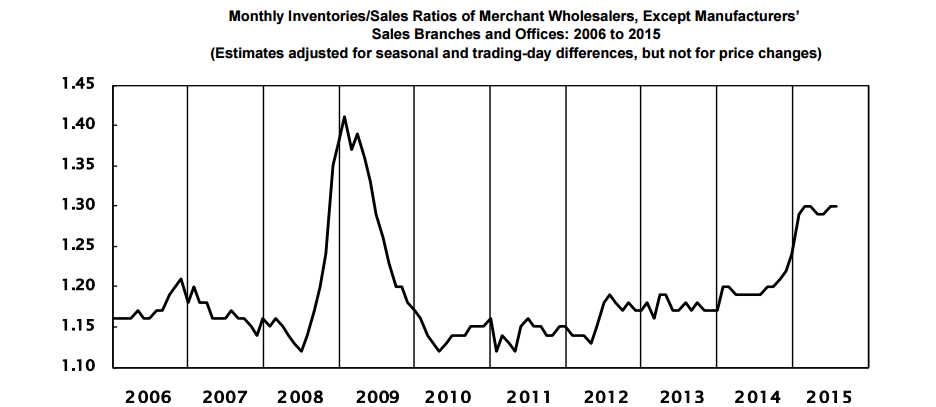
Wholesale inventories fell 0.1% in July, while wholesale sales fell 0.3%. The inventory to sales ratio, which can be considered a leading indicator for a recession is at 1.3x, an elevated reading. This would signal a recession is a possibility. 


The current continuing resolution to keep the government open expires at the end of the month. Government shutdown talk will undoubtedly escalate as the two sides posture over funding Planned Parenthood. 

To its proponents, Keynsianism cannot fail, it can only be failed. Dr. Cowbell is worried that Abenomics will fail in Japan. Of course Japan has followed the Keynsian playbook to the letter for 25 years and has had no growth and a debt to gdp ratio of 2.2x to show for it. Whenever you hear people saying: we need to spend big on infrastructure to put people to work and get the economy going again, remember they are basically putting the old New Deal / Japanese wine in a new bottle

Tuesday, September 1, 2015

Morning Report: Chinese selling of Treasuries

Vital Statistics:

Last Change Percent
S&P Futures  1922.9 -46.3 -2.35%
Eurostoxx Index 3170.6 -99.0 -3.03%
Oil (WTI) 47.13 -2.1 -4.21%
LIBOR 0.329 0.005 1.42%
US Dollar Index (DXY) 95.59 -0.234 -0.24%
10 Year Govt Bond Yield 2.17% -0.05%
Current Coupon Ginnie Mae TBA 104.2 0.2
Current Coupon Fannie Mae TBA 103.8 0.3
BankRate 30 Year Fixed Rate Mortgage 3.9

Stocks are lower this morning on global growth fears. Bonds and MBS are up.

IMF Managing Director Christine Lagarde said that global growth will likely remain weaker than the IMF was projecting two months ago. Chinese manufacturing fell to a 3 year low

China continues to sell US Treasuries in order to support its currency. There has been a fear that China could take down the US by dumping Treasuries and pushing up interest rates here. In reality, the US has more leverage here. China's economy is beginning to soften, and the last thing they would want to do is injure their biggest customer. Second, Japan would gladly take China's supply of Treasuries. Third, the article mentions that China has no better alternatives than US Treasuries to stash a trillion dollars. Actually I think that is wrong. The proceeds will go to pay off domestic debt pledged against falling asset prices within China. 

The ISM Manufacturing Survey fell to 51.5 in August, missing the Street expectation of 52.5. Prices paid fell from 44 to 39. 

Economic Optimism took a big hit in August as well, as the index fell from 46.9 to 42, missing the Street expectation of 47.1 by a country mile. 

Constructions spending rose 0.7% in July and June was revised upward from 0.1% to 0.7%.

Obama threw a bone to organized labor as his National Labor Relations Board ruled that companies that use contractors are considered joint employers. This makes parent companies liable for how their subcontractors treat their employees and also is intended to make it easier for unions to get a foothold in the big fast food chains. Who else has to worry about this? The homebuilding industry, which uses a lot of contract labor and has since the 1980s. "Are we concerned that this ruling might have some impact? I think we are alert to the ruling. We are aware that the Labor Department feels its mandate is broad, but we think that our business is highly differentiated from what's being discussed in the current case or even extensions," said Stuart Miller, CEO of Miami-based Lennar. Given how much homebuilding means to the overall economy, depressing the sector even further is not really what the economy needs at the moment. And the lack of housing supply leads to...

Higher prices and low affordability. The CoreLogic Home Price Index rose 1.7% in July, which is up 6.9% year over year. Prices remain 6.6% below their August 2006 peak. 


Wednesday, August 12, 2015

Morning Report: How will China affect bond yields?

Vital Statistics:

Last Change Percent
S&P Futures  2064.5 -15.2 -0.73%
Eurostoxx Index 3518.2 -87.0 -2.41%
Oil (WTI) 43.63 0.6 1.28%
LIBOR 0.314 0.003 0.83%
US Dollar Index (DXY) 96.33 -0.961 -0.99%
10 Year Govt Bond Yield 2.11% -0.03%
Current Coupon Ginnie Mae TBA 104.5 0.3
Current Coupon Fannie Mae TBA 103.7 0.1
BankRate 30 Year Fixed Rate Mortgage 3.83

Stocks are lower in the US on overseas weakness. Bonds and MBS are up

Mortgage Applications rose 0.1% last week as purchases fell 3.5% and refis rose 3.1%. 

Job openings fell in June, according to the JOLTS job openings report. The quits rate was steady at 1.9% and hires was steady as well. The quits rate is an important labor market indicator to the Fed. 

Chinese weakness has been driving the sell-off in stocks and the rally in bonds. Does it have staying power? Can it affect the Fed's thinking with interest rates? IMO, the answers are yes and no. The Chinese real estate bubble is deflating - the only question is whether it will be a disorderly mess or whether the government can let the air out slowly. Given the amount of state control over the economy they may be able to engineer a soft landing, but no one else has been able to do it  - Japan came close, however they took their debt to GDP ratio to 2.2x and have had to endure 25 years of no growth (and counting) to do it. 

The punch line however is that China's economy will slow, and that will depress commodity prices and increase deflationary pressure worldwide. This probably is Treasury bullish at the margin, but it isn't going to be the driver of Treasury prices - the US recovery and the Fed are. If anything, turmoil in China is going to be a secondary effect. I still think the Fed hikes rates 25 basis points in September and then waits to see what happens. If the economy accelerates, maybe they hike another 25 in December. If the economy flatlines, maybe they wait. Note the Fed has historically been reticent to make big changes in an election year, for fear of being accused of being political. 

Everyone knows that Dodd-Frank's limits on market-making has affected liquidity in asset markets. Stocks are already susceptible to air pockets as tight spreads and low commissions have made the market-making business unprofitable. However we are seeing it in other markets as well - gold, currencies, etc.. Citi makes an interesting observation: performance-chasing by professional investors is also exaggerating market moves. They call this a "fundamental change" in the markets. I wonder how much of it is due to ZIRP. If professional investors cannot make a return in buy and hold strategies because interest rates are too low, they have to chase performance. I suspect as rates go up, this dynamic will reverse as professional investors return to classic buy and hold strategies that work. That said, the market-making aspect is a new normal that we need to get used to. 

For all the sturm and drang about volatility, the VIX (a measure of fear in the market) is remarkably sanguine at 16. 


Hillary Clinton gave her server and a thumb drive to the FBI last night under subpoena. Supposedly the IG found top secret messages on her server, so this could (or at least should) potentially be serious, if Obama decides to make it serious. Supposedly the admin was the one who initially leaked the story to the press, so they may treat it seriously. As a former Naval Officer who handled classified material, I know if I had taken home top secret material, I would have been thrown in jail. Also, regardless of what the Obama Administration decides to do, someone has everything that is on that server. If it is someone's interest to not have Hillary as president, it will get leaked to the press. 

Tuesday, July 21, 2015

Morning Report - Liquidity squeezes ahead

Vital Statistics:

Last Change Percent
S&P Futures  2120.7 -1.2 -0.06%
Eurostoxx Index 3675.4 -11.2 -0.30%
Oil (WTI) 50.25 0.1 0.20%
LIBOR 0.292 0.005 1.66%
US Dollar Index (DXY) 97.88 -0.151 -0.15%
10 Year Govt Bond Yield 2.39% 0.02%
Current Coupon Ginnie Mae TBA 103.6 -0.2
Current Coupon Fannie Mae TBA 102.9 -0.2
BankRate 30 Year Fixed Rate Mortgage 4.16

Markets are lower this morning as earning pile in. Bonds and MBS are down small.

Dodd-Frank has severely neutered the market-making function of the banking system. When the Fed starts tightening and bonds sell off, the natural buyers of bonds (primary dealer banks) will no longer be able to dampen the moves by standing on the other side of the trade. The Fed is unconcerned about this, but we shall see what happens when rates start going up and the bond market starts falling faster than they are comfortable with. 

Incidentally, Hillary will probably be forced to support a financial transactions tax, which is a tax on market-making as well. Basically it would slap a  tax on every stock trade, currency trade, and bond trade. Narrowing bid / ask spreads and a 90% drop in commission rates has basically eliminated the market-making functions (NASDAQ market makers, the specialists on the NYSE floor, block trading at banks) in the stock market. Machines are all that is left, and even they are not in the market-stabilization business. The next crash, they are going to suspend trading until things stabilize and there will be nothing but GTC (good till cancelled) buy orders for people to sell to. Washington should be careful what it wishes for. 

As China's economy cools off, and the US dollar rallies, we have seen commodities get absolutely slammed. Oil has been cut in half over the past year. Gold is in free-fall. Natural Gas is down big. This will keep a lid on inflation, and allow the Fed to keep rates lower longer. 

Everyone knows that Chinese money has been behind the building boom in many large cities. This is actually driven by policy. Chinese investors who invest $500,000 and can prove that their investment created at least 10 jobs (not hard to do on a construction project) get permanent green cards. These are typically wealthy Chinese investors who are trying to get green cards for their kids and are not all that concerned about return on investment, which means dirt cheap financing for developers. Now, the government is thinking of making some changes. Obama would like these investors to put money in low-income housing, not luxury condos. Also, abuses in the program have led other to question it altogether. The program has bipartisan support so it probably isn't going anywhere, but when you use policy as an economic lever you invariably create dislocations and marginal projects that don't make economic sense. Something to watch. 

Wednesday, July 8, 2015

Morning Report: Don't believe the Chinese stock market indices

Stocks are lower this morning as the sell-off continues in Asia. Bonds and MBS are up small.

Mortgage Applications increased 4.6% last week as purchases increased 6.6% and refis rose 2.7%. Good numbers considering last week was only 4 days.

We will get the FOMC minutes later this afternoon. The items of interest will be the big downward revision in GDP forecasts, and of course any references to Greece. The China situation really was not ripe at that point, so I don't expect any mention there.

The EU put Greece on the clock, giving them until Saturday to come up with an agreement to stay in the EU. Europe has “a Grexit scenario prepared in detail,” European Commission President Jean-Claude Juncker said last night. Risk arbitrageurs have a term for this: showing them the downside. That is exactly what the EU is doing. The Greek ATMs are limiting withdrawals, however the Greeks have been taking out money for over 6 months, so most of them have an adequate cushion of cash at least for the time being. It won't last forever, and the EU is pushing the Greeks to make the necessary reforms to stay in the EU. While we haven't hit Venezuelan type shortages of goods, they are probably a month away.

Fun Chinese stock market fact: Last night the Shanghai composite fell 6%. Between the 1,331 stocks that are suspended, and the 747 shares that fell their daily 10% limit, approximately 72% of the index is non-tradeable. The A share index (which only Chinese can invest in) is down 33% since mid-June. The B share index (which foreigners can trade) is down around 43%. So when you hear someone point out that we are really only back to March levels, point out the index level is meaningless right now because 72% of the stocks aren't trading. Oh, and the Chinese government ordered anyone with a 5% position in any company to not sell for 6 months. This is going to be a titanic battle of wills between Mr. Market and Communist Government.

Don't forget, any economic pain in China due to the sell-off is going to be felt in commodity prices, which are already reflecting the sell-off. That will be deflationary, which the Fed fears more than inflation. IMO, unless something changes dramatically, the Fed isn't moving in September. If they truly mean it when they say they are being data-driven, the data is screaming: wait to see what happens first. Even if they do raise the Fed Funds rate a symbolic 25 basis points, just to get off the zero bound, I don't see how the long end of the curve moves all that much, if at all. Which means mortgage rates are probably not going to be affected.

The Obama administration has ordered HUD to re-integrate neighborhoods, using Federal funding as a carrot. LOs start thinking about FHA opportunities in areas that haven't historically been jumbo territory. That said, I don't know how many affluent areas get HUD grants in the first place so not sure how effective that will be. But, it might be an opportunity.


Tuesday, July 7, 2015

Morning Report - Chinese stocks collapsing

Markets are higher this morning as Europe and Greece still try and to seek a solution. Bonds and MBS are up.

Greece and their creditors are basically searching for a way to finance Greece's next payment (about 3.5 billion euros) to the ECB which is due on July 20. If they default, the die is more or less cast. The final result of this negotiation will not be a bailout, but just a liquidity injection to keep things going for another month. The Greek banks have deferred tax assets and Greek government debt as their capital. They are cut off from global credit markets and have been closed to prevent a bank run. The banking system will have to be nationalized and the Greek government will have to issue some sort of scrip to pay people.

If it weren't for the Greek Crisis, everyone would be talking about what is going on in China. Their stock market is collapsing, with the Shanghai Composite B share index down 40% in a month.  The Chinese government has been pulling out all the stops to try and support the market - cutting interest rates, increasing liquidity, creating a stock fund to buy up stocks to support the market - and none of it has been working. The Shanghai Composite B-share index dropped another 9% last night as margin traders get liquidated. To stop the selling, the Chinese government has basically suspended trading in 26% of the stocks on the Chinese exchange. Of course this does nothing but delay the inevitable. Chart: Shanghai Composite (B-shares)


Between the Greek and Chinese situations, bonds should be heading higher. We are already seeing the German Bund rally, with the yield having dropped from just over 1% to 66 basis points over the past month. Relative value trades should work US Treasuries higher as well. US investors (and loan officers) should brace themselves for a bumpy ride as the situation in Greece is hardly settled, China is a falling knife, and the Fed is in rate hike mode. Global financial stress is bond bullish, while the Fed's posture is bond bearish. LOs, tell your borrowers they are playing with fire if they are floating. 

That said, I think the overall medium term effect of the stress will be to push rates lower on the flight to safety trade. A struggling China will try and use exports to stimulate their economy, which means the US will be importing deflation. The last thing the Fed will want to do in that situation is to raise rates. As an added bonus, you could see renewed buying in MBS as investors reach for government guaranteed yield. TBA spreads to Treasuries could narrow, which means that mortgage rates could fall as fast or faster than Treasury yields. IMO, the Treasury market has been fading the moves overseas and is behind the curve. 

Job openings hit 5.36 million in May, another record in the JOLTS Job Openings index. There definitely seems to be a mismatch between what employers want (someone with the wisdom of a 50 year old, the efficiency of a 40 year old, the drive of a 30 year old and the paycheck of a 20 year old) and what is actually available in the labor market.