A place where economics, financial markets, and real estate intersect.
Showing posts with label ISM. Show all posts

Wednesday, May 3, 2017

Morning Report: Fed Day

Vital Statistics:

Last Change
S&P Futures  2382.3 -3.5
Eurostoxx Index 389.0 -0.4
Oil (WTI) 47.8 0.2
US dollar index 89.8
10 Year Govt Bond Yield 2.29%
Current Coupon Fannie Mae TBA 102.84
Current Coupon Ginnie Mae TBA 103.92
30 Year Fixed Rate Mortgage 4.04

Markets are quiet ahead of the Fed decision this afternoon. Bonds and MBS are flat.

Back from the MBA Secondary Conference. Q1 was dismal for pretty much everyone, but people are thinking interest rates are heading lower not higher. 

The FOMC decision will be out at 2:00 pm EST. Nobody expects the Fed to make any policy changes, but the wording in the statement could move markets. Just be prepared for some volatility around that time and be careful with locks. 

The ADP jobs report came in at 177k, a little bit better than the 170k forecast. The Street is looking for 185k jobs in this Friday's employment situation report. 

Mortgage Applications fell 0.1% last week as purchases rose 4% and refis fell 5%. 

Personal incomes rose 0.2% last month and consumer spending was flat. The core PCE index (the inflation measure preferred by the Fed) came in at 1.8%, below the Fed's 2% target rate.

The ISM manufacturing Index slipped to 54.8 from 56, while the ISM non-manufacturing index improved to 57.5 from 55.8.

Home prices rose 1.6% MOM and are up 7.1% YOY according to the CoreLogic Home Price Index. The index is within 2.8% of its April 2006 peak. The FHFA House Price Index has already recouped its losses from the bubble years. They forecast a 5% increase this year and see the index recouping the bubble losses in late summer. Here is a map of the overvalued (red) and the undervalued (green) MSAs. 


Given that the house price indices are approaching or have already surpassed their past peaks, you would figure that most houses in the US would be at those levels as well. Unfortunately, they are not. In fact, Trulia estimates that only 1/3 of houses have recouped the losses from the bubble. There is a huge dispersion as well - only 3% of homes in Fresno or Las Vegas or the NYC suburbs have surpassed their prior peak levels, while 94% of homes in Denver or San Francisco have. The problem with these home price indices is that they use a repeat sales methodology, which tends to over-emphasize hot markets. Real estate prices in states exposed to the tech sector and the energy sector are performing the best. Surprisingly, flyover America is doing better than Coastal America. On the link, you can do a county-by-county analysis to see where you stack up. 


Housing continues to punch below its weight in terms of contribution to GDP. Residential construction has historically been around 2% of GDP, and based on the first quarter estimate it was closer to 1.3%. We have incredibly tight demand for homes, so why aren't we seeing building? It depends on who you ask. If you ask a builder in a hot market, the problem is lack of skilled labor. In other areas, regulation and credit are the culprits. The housing market continues to be a conundrum for policy makers and analysts.


Thursday, March 31, 2016

Morning Report: Short squeeze in Treasuries

Vital Statistics:

Last Change Percent
S&P Futures  2055.3 0.1 0.00%
Eurostoxx Index 3013.3 -30.8 -1.01%
Oil (WTI) 38.38 0.1 0.16%
LIBOR 0.631 0.002 0.36%
US Dollar Index (DXY) 94.45 -0.389 -0.41%
10 Year Govt Bond Yield 1.82% 0.00%
Current Coupon Ginnie Mae TBA 105.4
Current Coupon Fannie Mae TBA 104.7
BankRate 30 Year Fixed Rate Mortgage 3.81

Markets are flattish on no real news. Bonds and MBS are flat as well. 

Initial Jobless Claims rose to 276k from 265k last week. 

In other economic data, the ISM Milwaukee rose to 57.8 while the Chicago purchasing Manager Index jumped. Consumer comfort fell however to 42.8.

Job cuts fell 13,4k to 48.2k in March, according to outplacement firm Challenger Gray, and Christmas. 

Note that Boeing announced 4500 job cuts yesterday, and the financial industry is going through another round of lay-offs. 

Not everything is grim in the labor markets, however. Some parts of the country are seeing outsized wage growth

Mohammed El-Arian on what to look for in tomorrow's jobs report. The numbers to watch: wage growth and the labor force participation rate.

TRID issues have shut the jumbo securitization market down for the moment. Non-bank jumbo originators are sitting on the sidelines at the moment because they can't move their inventory. Another unintended consequence of TRID. 

One unappreciated fact relating to the 10 year has been the massive short position that built up in them ahead of the Fed's hiking rates. Now that the Fed is becoming more dovish, it is creating a short squeeze in Treasuries, which is pushing down rates. The punch line is that the bid under Treasuries (and thus the forces pushing yields down) are somewhat temporary. 


Thursday, March 3, 2016

Morning Report: lots of economic data this morning

Vital Statistics:

Last Change Percent
S&P Futures  1980.6 -3.0 -0.15%
Eurostoxx Index 3008.4 -13.7 -0.45%
Oil (WTI) 34.41 -0.3 -0.72%
LIBOR 0.632 -0.002 -0.24%
US Dollar Index (DXY) 97.98 -0.232 -0.24%
10 Year Govt Bond Yield 1.85% 0.01%
Current Coupon Ginnie Mae TBA 105.4
Current Coupon Fannie Mae TBA 104.5
BankRate 30 Year Fixed Rate Mortgage 3.68

Stocks are slightly lower as a slew of economic data comes in this morning. Bonds and MBS are flattish. 

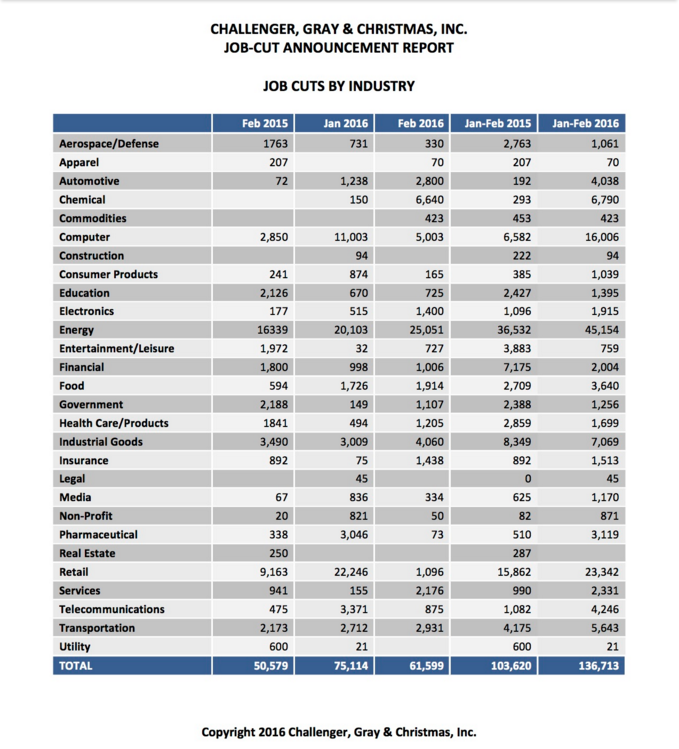
Outplacement firm Challenger, Gray and Christmas reported that announced job cuts rose 21.8% in February to 61.6k. The energy sector accounted for 25k of the losses, followed by chemicals, computer, and industrial goods. The West and the Midwest bore the brunt of the cuts. Remember these are announced job cuts and often never actually happen. Overall, the employment picture is looking decent, however we'll get a better look tomorrow. 

Here is a table of the industries hit. Note that aside from energy, job cuts are pretty low. Note that these are not net numbers either - they don't take into account any sort of hiring. 


Initial Jobless Claims rose to 278k last week. Anything below 300k is a good number.

The ISM Non-manufacturing composite fell slightly to 53.4 in February from 53.5 in January. Business continues to be decent in the services sector. 

Factory Orders fell 1.6% in January, while durable goods orders rose 4.7%. Capital Goods Orders rose 3.4%. 

Why is wage growth so difficult to find? Productivity growth has been weak since peaking around 1999 - 2000. This was the tail end of the big boost from the Internet and the decade-long transformation of the PC into a tool on everyone's desk. Last quarter it came in at -2.2%. Productivity has been negative for 3 out of the past 4 years, and that is not a recipe for wage inflation. 

Unit Labor costs rose 3.3% in the fourth quarter, which drove the drop in productivity as output only increased 1%. 

The Markit US Services PMI fell slightly in February to 49.7 while the composite PMI was flat at 50. 

The Bloomberg Consumer Comfort Index fell to 43.6 from 44.2 last week. Falling perceptions of the economy drove the decline. 

2012 Presidential Nominee Mitt Romney is going to try and push back the Trumpmentum with a speech tonight. 

Nothing too earth-shattering in the Fed's Beige Book which was released yesterday. Overall, manufacturing is flattish compared to last month, however labor markets improved overall, and "wage growth varied considerably, from flat to strong, across all districts." 

Wednesday, January 6, 2016

Morning Report: ADP predicts a strong jobs report on Friday

Vital Statistics:

Last Change Percent
S&P Futures  1974.3 -37.4 -1.86%
Eurostoxx Index 3118.5 -59.5 -1.87%
Oil (WTI) 34.65 -1.3 -3.67%
LIBOR 0.612 -0.001 -0.16%
US Dollar Index (DXY) 99.42 0.015 0.02%
10 Year Govt Bond Yield 2.18% -0.05%
Current Coupon Ginnie Mae TBA 104.3
Current Coupon Fannie Mae TBA 103.5
BankRate 30 Year Fixed Rate Mortgage 3.89

Markets are getting slammed as China revalued the yuan at a weaker level than expected. Bonds and MBS are up on the flight to safety trade.

Mortgage Applications fell 11.6% last week as purchases fell 11% and refis fell 12%. 

The ADP Employment Change came in at 257k, much better than the 198k Street expectation. Note Friday's jobs report is forecasting an increase of 200k. 

The ISM Non-Manufacturing Index fell to 55.3 from 55.9 last month. 

Factory Orders fell 0.2% in November, while durable goods orders were flat. Capital Goods orders (a proxy for business capital expenditures) fell 0.3%.

Fed Vice Chairman Stanley Fischer says that 4 rate hikes this year is "in the ballpark" of what to expect. Note the FOMC minutes are scheduled to be released at 2:00 pm EST today. 

Banks are taking down their estimates of Q3 GDP based on the lousy ISM data. Deutsche Bank took down Q4 to 0.5% from 1.5%. The Atlanta Fed took it down to 0.7% from 1.3%. 

While inventories and exports are pushing down the GDP data, consumption seems to be turning around. 2015 was the best year for vehicle sales in the US since 2000. While some of that undoubtedly has to do with easy financing (some calling autos the new subprime) most was due to a replacement cycle that was long overdue. 

Speaking of autos, GM is investing in Lyft, the competitor to Uber. This is to have a foothold in the future of summonable driverless cars. 

Monday, November 2, 2015

Morning Report: Big week ahead

Vital Statistics:

Last Change Percent
S&P Futures  2077.0 3.3 0.16%
Eurostoxx Index 3431.3 13.1 0.38%
Oil (WTI) 45.84 -0.8 -1.61%
LIBOR 0.334 0.005 1.58%
US Dollar Index (DXY) 96.72 -0.228 -0.24%
10 Year Govt Bond Yield 2.17% 0.03%  
Current Coupon Ginnie Mae TBA 104.8
Current Coupon Fannie Mae TBA 104.1
BankRate 30 Year Fixed Rate Mortgage 4.01

Stocks are higher this morning after some stronger economic data out of Europe. Bonds and MBS are down.

Construction spending rose 0.6% in September. Residential Construction increased 1.8% while nonresidential construction fell 0.1%. 

The ISM Manufacturing Index fell to 50.1 from 50.2. This is the weakest reading since 2013. The strong US dollar and weak overseas demand is acting like a wet blanket for the big US exporters. Even more worrisome, the employment reading decreased to 47.6 in October, which was the lowest reading since August 2009. 

We have a lot of important data this week, with construction spending today, vehicle sales tomorrow, productivity on Thursday, and the jobs report of Friday. The jobs report will carry the most weight with regards to December's FOMC meeting. The big question the Fed is grappling with is how solid the recovery is. We know that central bank efforts to prop up the economy have supported asset prices more than they have helped actual Main Street businesses. This is why (IMO) the Fed is going to take it slow raising rates. The Bloomberg article compares mortgage credit versus credit everywhere else. The reason why QE hasn't translated into easier mortgage credit (as compared to, well, everything else) is due to the regulatory environment. 

One result of QE and ZIRP has been a spate of merger activity. We have about $10 billion in new merger activity this morning alone. When companies have cash burning a hole in their pocket, but don't see much in the way of expansion opportunities, they buy their competitors and they buy back their stock. 

The latest Fed model has the US using up its resource capacity by the first quarter of 2016. The markets and the Fed have been predicting diametrically opposed outcomes. So far, the markets have been correct. Below, is a chart of the implied inflation rate using the prices of Treasury Inflation Protected Securities. The implied inflation rate has fallen by 100 basis points over the past 2 years.


Mohammed El-Arian sees a 25% - 30% chance of a recession by 2017. Even Larry Summers and Dr. Cowbell disagree on the state of the economy. We are in uncharted territory - not with the recession, since we have had asset bubbles before - it is with the recovery where the central bank has taken such an aggressive role in combating it. 

Thursday, October 1, 2015

Morning Report - Slew of economic data this morning

Vital Statistics:

Last Change Percent
S&P Futures  1912.8 4.1 0.21%
Eurostoxx Index 3097.1 -3.5 -0.11%
Oil (WTI) 46.64 1.6 3.44%
LIBOR 0.326 -0.001 -0.34%
US Dollar Index (DXY) 96.25 -0.102 -0.11%
10 Year Govt Bond Yield 2.03% -0.01%
Current Coupon Ginnie Mae TBA 104.7 0.0
Current Coupon Fannie Mae TBA 104.5 0.0
BankRate 30 Year Fixed Rate Mortgage 3.84

Stocks are higher after yesterday's rally. Given that yesterday was the end of a pretty lousy month (and quarter) it looked like people gunned the market a little to make their quarterly returns look a little better. Bond yields continue to grind lower.

The next two days are going to have a lot of economic data. 

The ISM Manufacturing Index fell to 50.2 in September from 51.1 in August. 7 industries reported expansion, while 11 reported contraction. The slowdown in China and the strong US dollar are weighing on business confidence. A 50.2 reading would correspond to about a 2.2% GDP growth rate. 

Construction spending rose 0.7% in August, which was better than the 0.5% Street estimate. Residential construction is up 1.3% for the month and 16% for the year. 

Initial Jobless Claims rose to 277k last week. We continue to bounce around the lows with this number. That said....

Jobless Claims may be increasing in the future, as Challenger and Gray announced job cuts increased 93%. This indicator combs the newswires for companies making announcements for job cuts. Something like 58,000 job cut announcements were made in September, with the 30,000 cuts at HP accounting for most of it. 

The Bloomberg Consumer Comfort index rose to 43 from 41.9 last week. 

Auto sales numbers are looking strong. Fiat Chrysler jeep sales are up 40%. Amazing what cheap gasoline can do. 


Monday, July 6, 2015

Greferendum No

Stocks are down after Greece voted down further austerity. Bonds and MBS are up.

The jobs report last Thursday was okay for the most part. The labor force participation rate hit a new low, however.

The ISM Non-Manufacturing Index came in a little light, but was generally strong. Business Activity accelerated, however that was offset by weakening employment growth. Employment activity in the services sector has been decelerating for months.

The week after the jobs report is usually pretty data-light and this week is no exception. The highlight will be the FOMC minutes on Wednesday.

The immediate fallout of the crisis should be bond (and MBS) bullish. US stocks are down in sympathy with global markets, but there should be almost no exposure here. The ECB will probably take additional measures to boost markets via QE, so that should be stock and bond bullish here.

On to the next crisis, which is the bursting of the Chinese stock and real estate bubbles. China's government is pulling out all the stops trying to support stock prices (the invisible hand meets the iron fist). In many ways it it reminiscent of the Japanese government in the 1990s, where they tried to artificially support markets through "price keeping operations." Of course these measures inevitably prevent necessary adjustments from occurring, which is why Japan has stayed in economic stagnation for over a generation.

The Chinese situation has more potential to affect US markets than Greece. Chinese money is behind a lot of the price appreciation in the cities, especially at the high end. Whether it stays or goes will be dependent on what the Chinese government wants.

Wednesday, July 1, 2015

Morning Report - Greece defaults

Stocks are up smartly this morning on stronger economic data and the prospect of a solution in Greece. Bonds and MBS are down.

Mortgage Applications fell 4.7% last week as interest rates spiked on the strong personal spending data. Purchase applications fell 4.1% while refis dropped 5.2%. The average 30 year fixed rate mortgage rose to 4.26%.

The ADP employment survey reported that 237k jobs were created in June, higher than the 218k forecast. The Street is forecasting a rise of 230k for the jobs report tomorrow. Challenger job cuts rose to 44k.

Fed St. Louis President James Bullard spoke last night and said the Fed should consider raising rates at the Sep meeting given the strength of the latest economic data.

Vehicle sales will be coming in all day. Early returns are disappointing.

Construction spending rose .8% in May, beating the .5% estimate. Residential construction rose .3%.

The ISM Manufacturing Index rose in June from 52.8 to 53.5. A reading over 50 indicates expansion. This is good news as the decline in oil prices had depressed activity in the oil patch. New orders and employment drove the increase. The 53.5 reading would typically correspond to a GDP growth rate of 3.3%.

Last night, Greece became the first advanced economy to officially default on an IMF loan. Most Greek banks are out of money, and pensioners who are used to getting 600 euros for the month are being given less than a quarter of that - about 120 euros. ATM deposits are being limited to 60 euros a day. The first snap poll of Greek citizens has pretty convincingly rejected the EU's offer - 53% "no", 33% yes.

Greece has told Europe that the latest offer comprises the basis of a compromise. The Europeans are going to wait until the results of the referendum are out on July 5. If the voters say "no" to the European demands, Greece will have no other option than to print its own currency to pay workers and pensioners. IMO, a Greek exit will be bond bullish, as it will probably force a policy response out of the ECB and that means more QE.

While home prices still remain affordable compared to the bubble years, low inventory has pushed up the price / rent ratio. We are back to late 2003 levels. On a nominal (in other words, non-inflation adjusted basis), prices are approaching peak levels, but on an inflation adjusted basis, they still have a ways to go. Of course wage inflation remains muted, so that will act as a drag on home price appreciation, or at least affordability.


The latest CoreLogic Market Pulse is out, and it has some good stuff on the state of the housing economy. They discuss the most overvalued housing markets, and find 4 are in Texas. Not sure how their index works, but there you go. The other ones are Washington DC (duh), Miami FL (huh?) and Charleston SC (huh?). Overall, prices nationwide appear reasonable and sustainable, with many localities still recovering from the collapse. 

Friday, May 1, 2015

Morning Report - construction spending falls

Vital Statistics:

Last Change Percent
S&P Futures  2085.5 6.6 0.32%
Eurostoxx Index 3615.6 -1.5 -0.04%
Oil (WTI) 58.99 -0.6 -1.07%
LIBOR 0.278 0.000 0.00%
US Dollar Index (DXY) 94.73 0.133 0.14%
10 Year Govt Bond Yield 2.07% 0.04%
Current Coupon Ginnie Mae TBA 102.7 -0.1
Current Coupon Fannie Mae TBA 101.7 0.0
BankRate 30 Year Fixed Rate Mortgage 3.86

Stocks are higher this morning on no real news. Bonds and MBS are down. Most of Europe is closed for May Day.

Construction Spending fell .6% in March - another bad economic number. Residential Construction fell 1.6%, although we already knew that from the lousy housing starts number of 926k. 

The ISM Manufacturing Survey was flat in April, coming in at 51.5. A reading of 51.5 would correspond to a GDP growth rate of about 2.6%. The comments suggest that conditions are good, and while the rise in the dollar is a headwind, it isn't choking off growth. The West Coast port strike didn't help either. 

Consumer sentiment fell slightly in April, according to Reuters and the University of Michigan. 

The European economy seems to be turning around. In fact, lending is expanding again. While it is very early days, it looks like the world economies are finally going in the right direction, and if so that will probably mark the end of the Great US Treasury Bull Market that began when Paul Volcker tightened to quell the inflation of the 1970s. Chart: US 10 year yield 1980 - present:


And of course, it probably means the end of the secular bear market in stocks that began in 2000. 


The open question is whether the Fed can raise rates without crashing the markets.