A place where economics, financial markets, and real estate intersect.
Showing posts with label NAHB. Show all posts

Thursday, August 16, 2018

Morning Report: Housing starts disappoint

Vital Statistics:

Last Change
S&P futures 2832 11
Eurostoxx index 380.51 0.81
Oil (WTI) 65.03 0.02
10 Year Government Bond Yield 2.87%
30 Year fixed rate mortgage 4.58%

Stocks are higher this morning on a potential that in trade tensions. Bonds and MBS are flat.

Initial Jobless Claims fell to 212k from 215k last week. 

Housing starts came in below forecasts for June - rising an anemic 0.9% to 1.17 million. They are down 1.4% on a YOY basis. Most areas showed modest increases, except for the West, which fell substantially. Permits were a little better, rising 1.5% MOM and 4.2% YOY. These numbers echo the drop in homebuilder sentiment, which is being driven by rising construction costs and labor shortages. "The solid economic expansion and firm job market should spur demand for new single-family homes in the months ahead," NAHB Chief Economist Robert Dietz said in a statement. "Meanwhile, builders continue to monitor how tariffs and the growing threat of a trade war are affecting key building material prices, including lumber. These cost increases, coupled with rising interest rates, are putting upward pressure on home prices and contributing to growing affordability challenges."

In the wake of the residential real estate bubble, the government has focused on regulatory solutions to fraud in the single family market. However, multifam was largely left alone, and it looks like the government is in the process of investigating an upstate NY developer which has about $1.5 billion in loans backed by the GSEs which may have been made under fraudulent circumstances. Apparently things like tenant income go unverified on these sorts of loans, and it is a systemic problem. 

Here are 3 misconceptions about credit scores: First, carrying a balance on revolving credit does not increase your score. Second incomes do not factor in a credit score (they aren't even tracked) and finally, your spouse's credit score and your own are completely independent. 

The Trump Administration is looking to tweak the Volcker rule in order to give banks a brighter line on what constitutes proprietary trading. The banks are not interested, surprisingly. Currently, the rule says banks need to hold a security for longer than 60 days in order to prove they aren't proprietary trading. The proposal would track the "available for sale" securities account and test it that way. From the bank's standpoint, brighter lines are better, but having spent a lot on internal controls to ensure compliance with the new rules, they don't seem anxious to re-do it. 

At the end of the day, market-making is largely dead, having been done in by declining bid-ask spreads, electronic trading, regulations, and declining brokerage fees. It simply is a money-losing business any more. The next crash is going to be an eye-opener when large swaths of the markets simply go no-bid. 

Thursday, February 15, 2018

Morning Report: Goldman forecasting 3.5% on the 10 year this summer

Vital Statistics:

Last Change
S&P Futures  2707.0 10.3
Eurostoxx Index 377.0 2.5
Oil (WTI) 60.4 -0.2
US dollar index 82.9 -0.2
10 Year Govt Bond Yield 2.90%
Current Coupon Fannie Mae TBA 103.591
Current Coupon Ginnie Mae TBA 103.688
30 Year Fixed Rate Mortgage 4.44

Stocks are higher this morning on no real news. Bonds and MBS are flat.

Inflation at the wholesale level came in higher than expected as the Producer Price Index rose 0.4% MOM and 2.7% YOY. Ex-food and energy, the index was up 0.4% / 2.2% and the core rate was up 0.4% / 2.5%. The US dollar is weaker on the data, which adds to inflationary pressures. I suspect at some point dollar weakness will feed higher rates, but we aren't there yet. Treasuries look like they want to test the 3% level we reached after the taper tantrum. The 10 year yield hit 2.94% overnight, so we aren't all that far away. Goldman is forecasting 3.5% on the 10 year within the next 6 months on monetary tightening. Other strategists are raising their forecast for Fed tightenings as well, based on the additional stimulus of the budget deal and tax cuts. 

FWIW, after the inflation data, the Fed Funds futures are now predicting a 83% chance of a hike at the March meeting, and sentiment is coalescing for a total of 3 hikes this year, to take the Fed Funds rate to 2.0% - 2.25%. 

In other economic data, Initial Jobless Claims rose to 230k last week, while the Philly Fed rebounded to 25.8. The Empire State Manufacturing survey slipped. Industrial Production fell a tenth of a percent while Manufacturing Production was flat. Capacity Utilization fell 20 basis points to 77.5%. So, between the higher than expected inflation data and weaker manufacturing data, bonds are pretty much flattish. 

Donald Trumps proposed 2019 budget contemplated an 18% cut in HUD's budget, with the cuts largely coming from the end of the Community Development Block Grant program. At the end of the day, this budget is a messaging document and has 0% chance of becoming law as-is. 

Builder Sentiment was flat in February according to the NAHB. 


Wednesday, January 10, 2018

Morning Report: Bonds testing support

Vital Statistics:

Last Change
S&P Futures  2741.5 -10.8
Eurostoxx Index 398.0 -216.0
Oil (WTI) 63.6 .06.6
US dollar index 85.6 -0.4
10 Year Govt Bond Yield 2.58%
Current Coupon Fannie Mae TBA 101.75
Current Coupon Ginnie Mae TBA 102.875
30 Year Fixed Rate Mortgage 4.01

Stocks and bonds are lower this morning on news that China may slow or halt its purchases of Treasuries. 

Bonds are currently trading at 2.58% after Chinese officials recommended slowing or halting purchases of US Treasuries. Driving this decision are the relative attractiveness of US Treasuries and the possibility of a trade war. Between the Fed tapering their purchases of Treasuries, and potential disinvestment of the Chinese, Treasuries are heavy. Ultimately, this is about the trade deficit, which is the difference in value between what we import from China and what we export to China. The deficit is simply filled in by Treasury purchases. While a trade war is probably just saber-rattling, a drop in trade will probably mean a drop in the trade deficit, which means less demand for Treasuries. Ultimately, the US would prefer the Chinese to buy less Treasuries since that would mean they are buying more goods and services. 

Note that the recent peak in the 10 year was 2.62% in March this year. We are close to breaking through support, which would probably trigger at least some technically-driven selling. We have a 10 year bond auction this afternoon at 1:00 pm EST. If we get a lousy bid / cover ratio that could be the catalyst to break through that level. 

We have a lot of Fed-speak today, with Charles Evans, Robert Kaplan and James Bullard speaking. 

Mortgage Applications rose 8.3% in a holiday-shortened week, as purchases rose 5% and refis rose 11%. The average contract rate for the 30 year conforming rate rose a basis point to 4.23%. 

Import prices rose 0.1% MOM and 0.3% YOY, while export prices fell 0.1% MOM and rose 2.6% YOY. 

Lennar reported fourth quarter earnings of $1.29 a share which missed analyst expectations. An undisclosed "one-time strategic transaction" was delayed until the first quarter, which apparently drove the miss. Revenues increased 12%, while deliveries were up 5% in units. Backlog was up 17% in units and 23% in dollars. Gross margins fell by 90 basis points to 22.4%. Lennar is also in the process of buying CalAtlantic, and that deal should close in February. 

The National Association of Homebuilders projects that 653,000 new homes will be sold in 2018, an increase of 5.4% from 2017. This won't be enough to meet demand. Lack of labor and land are the limiting factors, as well as government regulations. It seems that "urban villages" are the flavor du jour, with apartments and walkable developments that mix commercial and residential. 

Friday, October 6, 2017

Morning Report: Strong jobs report

Vital Statistics:

Last Change
S&P Futures  2547.5 -2.5
Eurostoxx Index 390.1 -0.9
Oil (WTI) 49.7 -1.1
US dollar index 87.2 0.2
10 Year Govt Bond Yield 2.38%
Current Coupon Fannie Mae TBA 102.875
Current Coupon Ginnie Mae TBA 103.938
30 Year Fixed Rate Mortgage 3.9

Stocks are lower after the jobs report. Bonds and MBS are down as well.

Jobs report data dump:
  • Nonfarm payrolls -33,000 (100k-150k expected)
  • Unemployment rate 4.2% (4.4% expected)
  • Labor force participation rate 63.1% (62.8% expected)
  • Average hourly earnings up .5% MOM / 2.9% YOY (expectation .3% / 2.6%)
Hurricanes Harvey and Irma are responsible for the weak payroll number, which is the only depressed number in an otherwise strong report. Much of the drop in payrolls was due to a drop in restaurant / bar jobs. If a restaurant was closed due to power outages or evacuation the employees are generally not paid, and therefore won't show up on the list of jobs. 

The critical numbers from the jobs report (which is causing rates to rise) is due to higher-than-expected wage growth and the increase in the labor force participation rate. These point to a tightening in the labor market and an increased likelihood of a rate hike in December. The Fed Funds futures are now predicting a 92% chance of a December hike, up from 80% yesterday. 

Take a look at the chart of average hourly earnings below. You can see the change in inflection (sharp slowdown in growth) starting in early 2009, however you can also see the change in inflection (that appears to be accelerating) that started in early 2015. We could finally be seeing some wage inflation at long last. Note that there is a possibility that the jump in wages could be driven by the drop in restaurant jobs, which are generally low-paying. That would bump up the average a tad. 


The NAHB and NAR are parting ways on the issue of the mortgage interest deduction. The MID is slated to become less important as tax reform takes shape. The standard deduction will be doubled, but many popular deductions will go away. For most people, taking the increased standard deduction will make more sense than itemizing. The NAHB is willing to allow the mortgage interest deduction to go away, as long as the low-income housing tax credit remains. The LIHTC is the big driver that makes building affordable housing make sense. NAR, on the other hand is suggesting that losing the MID would cause a 10% drop in house prices. Since Democrats will be uniformly opposed to any changes to the tax code, it will only take a few Republicans in blue states to put the kibosh on this. The MID has survived many attempts to kill it, and it is simply so popular that it may live to fight another day. Note that there are two things to make the MID less and less important: First, with interest rates so low, the actual interest paid is much less than it was, say, 30 years ago. Second, the MID cap is not indexed to inflation, so as house prices rise, the cap will kick in at progressively lower relative levels. 

The Fed weighed in on tax reform, saying that it could cause a short term bump in the economy, but will raise the deficit and inflation.  Of course how much it increases the deficit will depend on the economic forecast used. Republicans want to argue that cutting taxes will increase growth, which will increase the taxes received by Treasury (called dynamic scoring). Democrats want to exclude that growth, arguing that it is invariably too rosy. All sorts of think tanks will weigh in on it and you will have to know their political predilections before reading their take. Many think tanks sell themselves as "non-partisan" when they really are not. 

Monday, September 11, 2017

Morning Report: Hurricane Irma does less damage than expected

Vital Statistics:

Last Change
S&P Futures  2472.5 11.5
Eurostoxx Index 379.0 3.5
Oil (WTI) 47.7 0.2
US dollar index 84.8 0.3
10 Year Govt Bond Yield 2.10%
Current Coupon Fannie Mae TBA 103.33
Current Coupon Ginnie Mae TBA 104.21
30 Year Fixed Rate Mortgage 3.73

Stocks are higher this morning after Hurricane Irma does less damage than predicted. Bonds and MBS are down. 

The week should be relatively quiet for the bond market: there isn't much in the way of market-moving data, and there won't be any Fed-Speak as we have entered the quiet period before next week's FOMC meeting. 

Hurricane Irma did less damage than expected, and is weakening as it heads northward. Damage estimates have been cut by as much as $150 billion. 

Equifax's hacking has some people livid. The hack potentially affected 143 million people compromising social security numbers, addresses, drivers' licenses, birthdays and more. Equifax's initial site to check if you were affected had issues as well, which added insult to injury. If you have been affected by this hack, Equifax is offering a free year of credit monitoring (TrustedID), however if you accept the deal, you waive your right to sue. Equifax claims the arbitration waiver would only affect damages from TrustedID, not the cybersecurity incident. A class action lawsuit was filed on Thursday. Note several executives sold $1.8 million worth of stock after the hack (they supposedly didn't know yet). Here is what you need to know. 

The NAHB took a look at where the building activity was in 2016. Unsurprisingly, the activity was concentrated in the South and West, while the Northeast lagged. Between New York, New Jersey, and Pennsylvania there were less than 38,000 units started in 2016. This is less than a third of what Texas, Arkansas, Louisiana, and Oklahoma did. 


Rising rates have taken a bite out of refinancing volume, which hit a 16 year low in the second quarter. Overall, volumes were up 20% from Q1 to Q2, to $467 billion, but were down 16% on a YOY basis. Purchases have been driving the increase, however they remain 30% below pre-crisis levels (and this doesn't even take into account population growth and home price inflation). To give you an idea of how much credit standards have tightened, 720+ FICOs accounted for 3/4 of all loans in Q2. Pre-crisis, they were under half. Delinquencies did tick up 2.8% in the second quarter, to 3.9% of all mortgages. Hurricane Harvey could push up DQs by 300k.

Monday, May 15, 2017

Morning Report: Washington eyes contract for deed transactions

Vital Statistics:

Last Change
S&P Futures  2393.0 4.3
Eurostoxx Index 395.1 -0.5
Oil (WTI) 49.5 1.7
US dollar index 89.8 -0.3
10 Year Govt Bond Yield 2.33%
Current Coupon Fannie Mae TBA 102.625
Current Coupon Ginnie Mae TBA 103.938
30 Year Fixed Rate Mortgage 4.09

Stocks are up this morning with oil. Bonds and MBS are down.

Russia and Saudi Arabia made a joint statement saying they intend to keep production down through Q118. This is providing a boost. Separately, China said it intends to import more oil and natural gas from the US. 

The Empire State Manufacturing Survey contracted in May after a torrid start to the year. Expectations remain strong however. 

Several politicians are urging the FHFA to no longer sell foreclosed homes to firms that intend to follow "rent to own" or contract for deed transactions. The objection to these transactions is that the properties are sold as-is and the onus is on the renter to fix any issues like lead paint. This allows the landlord / lender to skirt property maintenance laws. Ultimately, this could be good for the market in that it brings some much-needed supply to the starter home space (and perhaps demand for 203k loans). 

Speaking of first time homebuyers, here are the best cities for them. Needless to say, the big coastal cities are generally not the best places as home prices are elevated there. There is more in the Midwest and the South. There is an interactive map that gives good info on the state of individual markets. Wonder how much size 300k gets you? Depends on the state - on one extreme is Indiana, which gets you almost 3500 square feet. The worst? DC, which gets you 600. Note that 300k is just a hair over the median price in the US. 

Homebuilder sentiment rose in April, according to the NAHB. The sentiment index rose to 70, higher than expectations. Note we will get housing starts tomorrow. 

Tuesday, February 21, 2017

Morning Report: Average home sizes falling again

Vital Statistics:

Last Change
S&P Futures  2352.8 4.8
Eurostoxx Index 372.3 1.3
Oil (WTI) 54.5 1.1
US dollar index 91.4 0.4
10 Year Govt Bond Yield 2.45%
Current Coupon Fannie Mae TBA 102.045
Current Coupon Ginnie Mae TBA 103.17
30 Year Fixed Rate Mortgage 4.14

Stocks are up as the markets have a risk-on feel to them. Bonds and MBS are down small. 

Not much in economic data, but we will have Fed-speak all day, with Kashkari, Harker, and Williams speaking. 

The highlight of the week should be the FOMC minutes coming out tomorrow. Other than that, we get existing home sales, new home sales and the FHFA House Price Index. 

The initial look at February manufacturing indicates a slight decline as the flash PMI falls from 55.5 to 54.3. Services came in at 53.9. 

Goldman is tempering their enthusiasm for the S&P 500, warning that investors are overly optimistic. They predict the stock market will go nowhere for the rest of the year. Their concerns are that the good earnings from Q4 won't continue, and any sort of fiscal stimulus out of Washington will take time to be felt. 

Despite TRID's best efforts, about 17% of consumers end up being surprised by the existence of closing costs when getting a mortgage. The surprises run the gamut of points, up front MI and taxes. 

Speaking of taxes, here are some tax tips from NAR. 

House Financial Services Committee Chairman Bill Huizenga (R-MI) has introduced a bill to clarify the definition of points and fees under the CFPB QM rule by excluding title charges and escrowed T&I. 

We are starting to see average new home sizes decline, which is a function of the emerging first time homebuyer and the market for starter homes. After the real estate bust, the only segment of the new home market that was working was the ultra-luxury end, which meant that average home sizes increased. From 2009 to 2015, it looks like average square footage increased by close to 400 square feet. Now, as more and more starter homes and townhouses are being built, we are seeing average size decline again. Strange to think that the luxury end is the only part that works in the aftermath of a bust, but there you go. 


One often overlooked advantage to buying versus renting: The fact that making your mortgage payment every month amounts to a savings plan as you pay down your principal on your loan. 

The Despot reported better than expected earnings this morning as more and more people do work on their homes. Comps were up 6.3%. 

Friday, February 17, 2017

Morning Report: Home affordability returns to pre-crisis levels

Vital Statistics:

Last Change
S&P Futures  2338.5 -7.0
Eurostoxx Index 368.5 -1.6
Oil (WTI) 53.1 -0.3
US dollar index 910.9 0.1
10 Year Govt Bond Yield 2.41%
Current Coupon Fannie Mae TBA 102.1
Current Coupon Ginnie Mae TBA 103.2
30 Year Fixed Rate Mortgage 4.11

Stocks are lower this morning on overseas weakness. Bonds and MBS are up.

The index of leading economic indicators rose 0.6%, stronger than expected. 

Household debt increased in the fourth quarter, as growth in non-mortgage debt outpaced growth in mortgage debt. The 4th quarter saw $617 billion in newly originated mortgages, the highest level since Q32007. Auto loans and student loans saw an uptick in 90 day delinquencies, while credit cards and mortgages saw an improvement. Remember, this is only the debt side of the equation - both incomes and asset prices (especially housing) are higher than they were in 2007. 


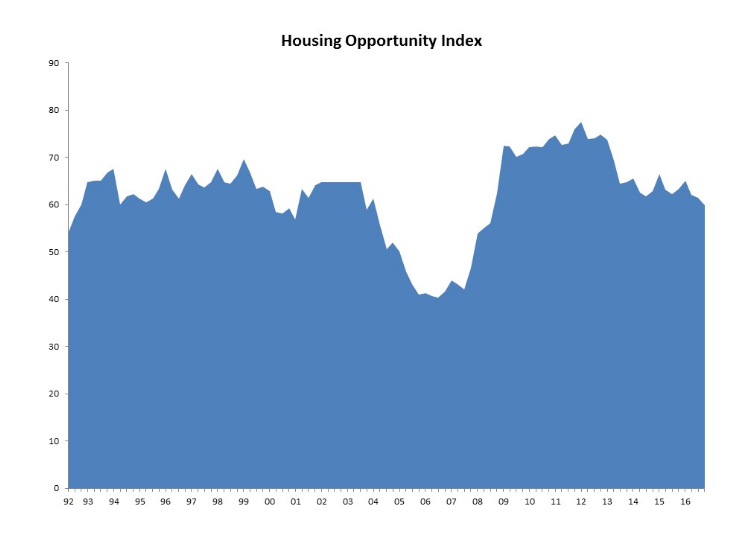
Housing affordability remains about in line with pre-crisis levels, according to the NAHB. As of the end of the year, approximately 59.9% of all homes were affordable to a borrower with the median income. You can see the big swing in affordability between the boom and bust years. Tight inventory is being offset by (still) low mortgage rates. California remains the biggest issue regarding affordability. In the San Francisco MSA, just 7.8% of the homes sold were affordable to people earning the median income of $104,700.  

The median home price increased 7% in January to $261,100, according to Redfin. Home sales were up 5.6% compared to January 2016, which shows that the uptick in rates hasn't affected the purchase market. Inventory is down 12% YOY, and listings have dropped 5.1%. 18% of homes sold above list price, and the average sales to list ratio was 93.7%. Days on market fell 7 days YOY to 59. 

Despite all the missteps of the initial days of the Trump administration, stocks are partying like it is 1999. This certainly has the political class (and the business press) scratching their heads. First, while the first 100 days of the Official U.S. Airing of The Grievances may seem dramatic, it doesn't mean much for business (except for some consumer product companies and retailers who suffer from ideologically-driven boycotts). Second, for all the talk in the business press of "uncertainty," investors are sensing (correctly, I think) that gridlock is going to rule the day in DC. Nothing is more "certain" than gridlock, and if regulations get eased a bit, that is good for business. Gridlock also means the Fed has some room to go slower. At the end of the day, earnings drive the stock market, not the histrionics in Washington and the media. 

Friday, November 18, 2016

Morning Report: Jeb Hensarling for Treasury?

Vital Statistics:

Last Change
S&P Futures  2184.0 -0.5
Eurostoxx Index 339.4 -1.2
Oil (WTI) 45.5 0.1
US dollar index 91.3 0.1
10 Year Govt Bond Yield 2.28%
Current Coupon Fannie Mae TBA 103
Current Coupon Ginnie Mae TBA 104
30 Year Fixed Rate Mortgage 4

Stocks are flat this morning on no real news. Bonds and MBS are down.

Bonds are ending their worst two week run in 25 years as the 10 year bond yield increased almost 50 basis points. Strategists are suggesting that the 10 year will be in the 2.5% - 2.75% range a year from now if Donald Trump manages to get his infrastructure spending plan and tax cut. The US dollar continues to strengthen as well. 

So far, it looks like Jeb Hensarling is in the mix to take over as Secretary of the Treasury for Donald Trump. Note he is a politician, not a Wall Streeter. In fact, the banks believe he is a bit of an obstacle for getting real reform. Hensarling is generally viewed as not a friend of the big banks, and he really isn't that interested in their input. Hensarling does have a plan to reform Dodd-Frank, which would include scrapping the Volcker Rule (which prohibits proprietary trading), reining in the CFPB, eliminating caps that banks can charge merchants for debit card transactions, and reforming the SIFI (systemically important financial institutions) rules. The big banks will need to raise a lot of capital in order to have more latitude however, as his bill requires a 10% capital cushion. Citi, for example, is at 7.4%, which means the banks would need to raise hundreds of billions in new equity capital.

The glory days of the CFPB are numbered. A court ruling that prevents the director from being fired and the potential for a business-friendly Trump Director has made it possible for a bipartisan consensus that the director be replaced with a 5 person committee, and that it be subject to Congressional appropriations. At least one expert believes that will slow down the agency and probably cut its enforcement actions in half. As of right now, if you are a graduate of a top law school and have an interest in financial regulation, the CFPB is the hot place to be. 

Bottom line: we could get some regulatory relief, however it will be at the margin and probably not a wholesale change from what we have now. Will it be enough to get the private label securitization market back? So far I have not seen anything with respect to required equity tranches etc, so it is hard to tell. The only name for HUD I have heard is Westchester County Executive Rob Astorino, who is fighting HUD on zoning issues and affordable housing mandates.

After rising for several years, average home sizes are falling, as construction moves away from focusing in the high end to starter homes. 


Thursday, May 16, 2013

Morning Report - Housing starts fall

Vital Statistics:

Last Change Percent
S&P Futures  1652.2 -2.1 -0.13%
Eurostoxx Index 2811.5 1.9 0.07%
Oil (WTI) 94.08 -0.2 -0.23%
LIBOR 0.274 0.000 0.00%
US Dollar Index (DXY) 83.81 -0.021 -0.03%
10 Year Govt Bond Yield 1.90% -0.03%  
Current Coupon Ginnie Mae TBA 104.3 -0.1
Current Coupon Fannie Mae TBA 102.9 0.1
RPX Composite Real Estate Index 197.6 0.5
BankRate 30 Year Fixed Rate Mortgage 3.65

Markets are slightly lower after a barrage of negative data. The day began with Wal-Mart reporting earnings in line with estimates, but giving 2nd quarter guidance below estimates. Then, we had higher-than-expected initial jobless claims and a very disappointing housing starts number. Stock index futures are down a couple of points while bonds and MBS are up about a quarter of a point.

Initial Jobless claims increased from a revised 328,000 to 360,000 last week. This is the highest level since mid-February. The Department of Labor has noted that that there has been some seasonal gremlins in the data lately, so maybe that is what is going on.

Census reported that building permits increased by 14.3%, while housing starts fell 16.5%. Single family starts fell from 623,000 to 610,000, while multi-fam fell from 376,000 to 234,000. Multi-fam had been driving the housing starts numbers lately as investors try and get in on the rental boom. Single family has been more slow and steady. On the permits side, single family increased from 599,000 to 617,000 and mult-fam increased from 266,000 to 374,000. So maybe the April multi-fam drop was a blip.

Chart:  Housing starts 1959- Present


You can see from the chart above that even though housing starts have rebounded smartly from the recession lows, we are still at very depressed levels historically. Consider that we are more or less at the lows of the previous major recessions (73-75, 81-82, 91-92). Then factor in population growth. Conclusion:  there is a lot of pent-up demand out there..

The National Association of Home Builders released their Housing Survey yesterday, which showed builder confidence improved in May after a brief drop in April. "Builders are noting an increased sense of urgency among potential buyers as a result of thinning inventories of homes for sale, continuing affordable mortgage rates and strengthening local economies" noted a North Carolina based builder. In fact, he notes challenges regarding the cost and availability of labor, lots, and building materials. The homebuilders reported recently and did note some of these concerns as well, but there is a geographic slant to it:  the West has the most issues, while the Northeast does not.

Wednesday, January 16, 2013

Morning Report - What a difference a year makes

Vital Statistics:

Last Change Percent
S&P Futures  1462.4 -2.8 -0.19%
Eurostoxx Index 2688.7 -12.9 -0.48%
Oil (WTI) 93.32 0.0 0.04%
LIBOR 0.303 0.000 0.00%
US Dollar Index (DXY) 79.86 0.085 0.11%
10 Year Govt Bond Yield 1.80% -0.03%
RPX Composite Real Estate Index 191.7 0.3

Markets are weaker this morning after the World Bank cut its global growth forecast.  Goldman and JP Morgan both reported better than expected earnings. Mortgage applications rose 15% last week and the CPI showed that inflation remains under control. Industrial production rose .3% and capacity utilization rose to 78.8%.  Bonds and MBS are up.

The National Association  Homebuilders Confidence index held at 47 in January, the highest level since April of 2006. A reading of 50 represents the point where builders view conditions as neutral. Conditions improved in all areas of the country, with the West performing the best, while the Midwest and Northeast performing the worst. This is the second sentiment report that has the "what a difference a year makes" theme.

The CoreLogic Home Price Index rose 7.4% YOY in Nov 2012. This is the largest gain since May of 2006.   Excluding distressed sales, home price increased nationally by 6.7%.  December's gain is forecast to be down .5% MOM (reflecting the typical seasonal pattern) and will be up 8.4% YOY. Mark Fleming, the Chief Economist made a point about QM - "that the recently released Qualified Mortgage rules issued by the CFPB are not expected to significantly restrict credit availability relative to today."  I am sure Cordray is breathing a sigh of relief on that one... the point of the QM rule was to expand credit.

Bank of America is intent on growing the mortgage business again after a hasty retreat in 2011. Of course this meant they missed the mother of all refinancing booms. They exited the wholesale business and basically ceded the market leader position to Wells Fargo. It also signals that they believe the worst is behind them with respect to Countrywide.

It is looking more and more like Republicans will not force a showdown on the debt ceiling (though "clean" debt ceiling increases have been rare in the past).  The polls aren't with them and the politics aren't there. Republicans will probably save spending cut demands for the sequester and the continuing resolution.

It looks like the case against Stevie Cohen has hit a wall.

Tuesday, January 8, 2013

Morning Report - NFIB Pessimism

Vital Statistics:

Last Change Percent
S&P Futures  1454.8 -1.0 -0.07%
Eurostoxx Index 2703.9 8.4 0.31%
Oil (WTI) 93.5 0.3 0.33%
LIBOR 0.305 0.000 0.00%
US Dollar Index (DXY) 80.37 0.113 0.14%
10 Year Govt Bond Yield 1.89% -0.01%  
RPX Composite Real Estate Index 192.2 -0.2  

Markets are lower this morning as we kick off 4Q earnings season. Alcoa officially begins the parade after the close. Bonds and MBS are up small.

The NFIB Small Business Survey for January ticked up slightly in December after falling off a cliff in November.  The current level of 88 is a recession-level reading.  Capital Spending is still in maintenance mode. Employment growth is flat. Housing, energy, and autos (the average age of a car is over 10 years) look to be the drivers of growth in 2013. But, overall, it was a glum report.

Chart:  NFIB Small Business Optimism:


The National Association of Home Builders Improving Market Index rose to 242 (out of 361 MSAs total) in January from 201 in December. This strength during a seasonally weak period bodes well for the summer selling season and confirms our view that housing bottomed about a year ago. Rentals are still booming as rents increased 3.8% YOY last quarter.  The vacancy rate dropped to 8%.

Could the East Coast get a break in gasoline prices?  Currently, the East Coast refineries use North Sea Brent crude oil, which trades at a premium to West Texas Intermediate, which is the source for West. Burlington Northern will boost crude oil shipments by 40% this year (primarily Bakken shale oil), and is looking to ship east to supply refineries on the Eastern Seaboard.  As coal shipments decline, oil is taking their place. Since railroads have more flexibility than pipelines, the continental US energy market will become more equalized.  Good news for the East Coast.

A new study shows that we may hit the debt ceiling sooner than expected, around Valentine's Day (how romantic). Obama has said that the debt ceiling is non-negotiable. My sense is that Republicans will cede the debt ceiling point and use the sequestration or the expiration of the government's operating budget to push through spending cuts.  As a plan B, the trillion dollar coin is still being bandied about, particularly by the Krug Man and Greg Sargent (who talks to NYPD hostage negotiators, instead of economists, apparently).

Wednesday, December 19, 2012

Morning Report - Fannie Mae's Economic and Housing forecast for 2013

Vital Statistics:

Last Change Percent
S&P Futures  1445.2 4.1 0.28%
Eurostoxx Index 2659.8 16.3 0.62%
Oil (WTI) 88.4 0.5 0.53%
LIBOR 0.31 0.001 0.32%
US Dollar Index (DXY) 79.04 -0.319 -0.40%
10 Year Govt Bond Yield 1.82% 0.00%
RPX Composite Real Estate Index 191.9 0.2

Markets are higher this morning on optimism over the fiscal cliff.  John Boehner introduced a Plan B yesterday in case bipartisan talks fail, but markets / observers still seem optimistic that a deal can get done. Bonds and MBS are flat

Housing starts came in at an annualized 861k pace in November, somewhat below expectations.  This is undoubtedly a Sandy-influenced number.  Building Permits came in at 899k, above expectations. This is the strongest 3 months in four years. The NAHB Builder Confidence Index rose in Dec. Overall, the housing sector has turned the corner and is now an engine for growth, not a drag.

Fannie Mae is out with their Economic and Housing Outlook for 2013.  Here is their forecast for 2013:

  • GDP +2.2%
  • Unemployment 7.5%
  • 10 year bond yield: 1.7%
  • Housing starts:  949k
  • House Price appreciation:  + 1.7%
  • 30 year fixed rate mortgage 3.4%
  • Purchase originations + 15%
  • Refinances: - 29%

I am surprised at their forecast for a drop in refis given that they think rates will stay low.

Peter Eavis of the NY Times discusses the state of play with the qualified mortgage.  Consumer advocates are pushing for a broad definition of a qualified mortgage in order to increase credit availability, but they are are reluctant to give banks any legal protection. The big banks are saying that they won't relax credit standards unless they are given some protection. Consumer advocates point out that that a shield will still presume the banks have met the standards, and merely allows the consumer to rebut that presumption, which means the lender has the upper hand to begin with.

Given the focus on the election and the fiscal cliff, fears of a European implosion seem to have fallen by the wayside.  The markets seem relatively sanguine about the prospect of a Euro debt crisis as sovereign yields have fallen since early Summer. Here is a chart of the Greek 10-year bond yield, post-re-org:


Actually, it isn't just Greece - all of the PIIGS are flying. All things considered this is a huge accomplishment.  Time should have named Mario Draghi Person of the Year instead of Barack Obama.


Tuesday, December 18, 2012

Morning Report - Reaching across the fiscal abyss

Vital Statistics:

Last Change Percent
S&P Futures  1431.2 4.2 0.29%
Eurostoxx Index 2637.4 9.4 0.36%
Oil (WTI) 87.76 0.6 0.64%
LIBOR 0.309 0.000 0.00%
US Dollar Index (DXY) 79.49 -0.077 -0.10%
10 Year Govt Bond Yield 1.78% 0.01%
RPX Composite Real Estate Index 191.7 0.1

Markets are higher this morning on optimism for a deal on the fiscal cliff. The President made some tax concessions to move closer to Speaker Boehner's position. The current account deficit increased more than expected to 107.5B.  Bonds continue to sell off, although it looks like the 10-year yield is bumping up against resistance. Certainly the announcement of QE4EVA was a case of "buy the rumor, sell the fact."  FWIW, that is my gut feeling about stocks and the fiscal cliff as well.

Both sides are coming closer on a deal to avoid the fiscal cliff.  Obama has lowered his revenue target to $1.2 trillion from $1.4 trillion and moved up the threshold for higher taxes to $400k from $250k.  $1.22 trillion will be cut in spending, from a variety of areas. The second biggest component of "savings" would be interest saved on debt that isn't going to be issued. Only in DC, would that count. It would also raise the debt ceiling enough to cover two years and the 2014 midterms.  On capital gains, the top tax rate would be 20%. Raising the medicare eligibility age from 65 to 67 seems to be off the table.  The sequester will be replaced by another sequester.  Extended unemployment benefits would continue.  One other surprising tidbit - the President wants to replace the expiring payroll tax cut with other stimulus measures such as infrastructure spending.  Which means everyone's taxes are going up, not just the rich.

The FHA plans to sell 40,000 non-performing loans over the next year to help improve its finances, which would make them the biggest seller of distressed paper, according to Louis Amaya of National Asset Direct.  One interesting wrinkle is that it is a back-door way to achieve principal mods.  Acting FHFA Chairman Ed DeMarco has steadfastly refused to allow FHA to reduce principal when modifying delinquent loans.  However, if they sell the loans, the investor is free to make whatever modification makes sense.  Under a U.S. Treasury program, investors can be reimbursed as much as 63 cents on the dollar for principal forgiveness.  Steve Schwartzman of Blackstone said they are "loading the boat." with delinquent loans, both for rentals and a macro bet on a housing recovery.

At 10:00 am, we will get the National Association of Homebulder's Housing Market Index.  This is a sentiment indicator of the homebuilders, which has been skyrocketing since housing bottomed earlier this year. According to Trulia, the Millenials are planning to ditch the rentals to buy a house in the next two years. As I have stated in other posts, household formation numbers have been highly depressed during the last 5 years, not because of demographics, but because of the economy. That represents a lot of pent-up demand that will be unleashed as the economy recovers.

Chris Whalen of Carrington discusses how the lending environment has changed and how the "regulatory arbitrage" favors the smaller independent lenders.  The downside is that mortgages will remain tough to get courtesy of the CFPB, especially in judicial states with high value properties.

Fun useless link of the day - put your own house in a snow globe.  h/t Rob Chrisman.

Friday, December 7, 2012

Morning Report - Jobs Day

Vital Statistics:

Last Change Percent
S&P Futures  1418.5 5.5 0.39%
Eurostoxx Index 2593.6 -9.8 -0.38%
Oil (WTI) 86.71 0.5 0.52%
LIBOR 0.31 -0.001 -0.32%
US Dollar Index (DXY) 80.48 0.225 0.28%
10 Year Govt Bond Yield 1.62% 0.03%
RPX Composite Real Estate Index 190.9 -0.1


Markets are higher after a better-than expected jobs report.  Nonfarm payrolls increased by 146k in November vs an expectation of 85k.  October was revised down from 171k to 138k.  The unemployment rate dropped from 7.9% to 7.7%, but this was driven by a drop in the labor force participation rate from 63.8% to 63.6%. Surprisingly, Sandy didn't appear to have much of an impact on the numbers. Still the headline numbers look good, and that is driving the index futures higher.  Feels like the Street was leaning short going into the numbers.  Bonds are down a point and MBS are down 7 ticks.


Small Business Hiring Plans hit post-recession low. Hiring plans are as low as they were in late 2008.  Resolution of the election "uncertainty" doesn't seem to be having an effect, at least not yet.  We'll see if resolving the fiscal cliff changes anything; my guess is that it won't.

The National Association of Homebuilders added 76 MSAs to their Improving Markets Index. The recent housing strength is spreading across the country. They note that "overly tight mortgage lending standards" are the one thing that is holding back progress.

HUD Secretary Shaun Donovan told the Senate Banking Committee that FHA is committed to selling at least 10,000 distressed loans per quarter over the next year, and it will raise the annual insurance premium paid by borrowers by 10 basis points.

If the Fed adds another Treasury-buying program to compensate for the end of Operation Twist, they will almost certainly have to re-write their exit plan.  The sheer size of the numbers (estimates are that the Fed will have to sell $2 - $3 trillion worth of assets over several years.  If the Fed attempts to dump mortgage backed securities en-masse, it will exacerbate the increase in borrowing rates that will already be taking place.

Tuesday, November 20, 2012

Morning Report - Housing Starts and NAHB Confidence

Vital Statistics:

Last Change Percent
S&P Futures  1381.7 -0.8 -0.06%
Eurostoxx Index 2487.6 -7.6 -0.30%
Oil (WTI) 88.79 -0.5 -0.55%
LIBOR 0.311 -0.001 -0.32%
US Dollar Index (DXY) 80.92 0.050 0.06%
10 Year Govt Bond Yield 1.62% 0.01%
RPX Composite Real Estate Index 191.4 0.0
Futures are lower this morning after Hewlett Packard announced accounting problems at its Autonomy unit. The company has taken an $8.8 billion charge on the Autonomy unit, which is shocking when you consider it only paid $7 billion for the company in the first place. Best Buy also missed. Bonds are down slightly, while MBS are flat.

Housing starts rose to an annualized pace of 894k, well ahead of the 840k estimate.  Sep through July numbers were revised downward. While the rest of the economy seems to be turning down, housing is turning into a bright spot. That said, 894k is still far away from "normalcy," which is 1.5 million units per year. Yesterday's builder confidence index from the NAHB posted another gain, although it is still reflects "unfavorable" conditions, but just barely.

Chart:  Housing Starts


Chart:  NAHB Sentiment Index:


The Bernank is speaking at the Economic Club of NY this afternoon. The market will be looking for clues regarding life after Operation Twist.  Expect Bernake to warn Washington that it won't be able to offset the damage to the economy if we go over the fiscal cliff. 

Hostess and the Baker's union have been asked to enter mediation.  This is a last-ditch attempt to see if the company can continue as a going concern.  One of the biggest issues is the defined benefit pension plan.  In an environment of zero percent interest rates, most, if not all, pension plans will be insolvent as there is no way to earn enough on the assets of the plan to cover healthcare inflation costs. Of course many companies choose to assume unrealistic rates of return on plan assets or unrealistic cost inflation assumptions to make the plans solvent.  By the way, this phenomenon affects insurance companies as well.  One of the (many) unintended consequences of ZIRP.

The recent downturn in the markets has brought out the perma-bears.  Marc Faber and Nouriel Roubini are warning about a tough 2013. Morgan Stanley is also warning of a recession in 2013 if we go over the fiscal cliff.  Even if we don't they are forecasting flat GDP growth next year. That said, after this sell-off, I would be aware of the potential for a face-melting rally if we get a deal on the fiscal cliff. For those who focus on technicals, the S&P 500 is right at the 200 day moving average.

One possible piece of a deal would be a cap on deductions - one current number being bandied about is $35,000.  Needless to say, this will have a negative effect on the high end of the housing market, especially in high cost areas like Coastal California and the NYC area. Moody's estimates that this could cut national home price growth from 4% to 3.5% from 2015 to 2019.  

Friday, May 18, 2012

Morning Report

Vital Statistics:


Last Change Percent
S&P Futures  1307.5 6.2 0.48%
Eurostoxx Index 2155.6 8.7 0.40%
Oil (WTI) 92.68 0.1 0.13%
LIBOR 0.467 0.000 0.00%
US Dollar Index (DXY) 81.38 -0.004 0.00%
10 Year Govt Bond Yield 1.72% 0.02%
RPX Composite Real Estate Index 175.6 0.1


Markets are firmer this morning after enduring a bloody week which sent the S&P down 3.6% and the 10 year government bond yield down to 1.69%. Today is also the expiration of May options, so there is always the potential for funny closing prints. There is no economic data being released this morning.  Bonds and MBS are down slightly.

It's Facebook Day! Facebook priced at the top end of the revised range last night and should begin trading around 11:00. There are a stocks that capture the attention of the populace and Facebook is one of them. Growth fund managers who have been starving for a good growth story besides Chipotle Mexican Grill and Lululemon just got a new one. With an IPO price at 28x revenue, the stock will have to almost collapse to get value and GARP guys interested. I'm sure if you are a good technical trader, you should be able to have a field day with this one. Treat it as a slip of paper with an alphanumeric code, not an investment, cause it isn't.

Bloomberg has a column on why principal reductions won't solve the housing crisis. The big problem is that something like 80% of all underwater homeowners with Fan and Fred mortgages are current on their mortgages. Any principal reduction program will encourage people to stop paying their mortgage. Second, of those seriously delinquent, most of them won't be able to afford the lower payment anyway.

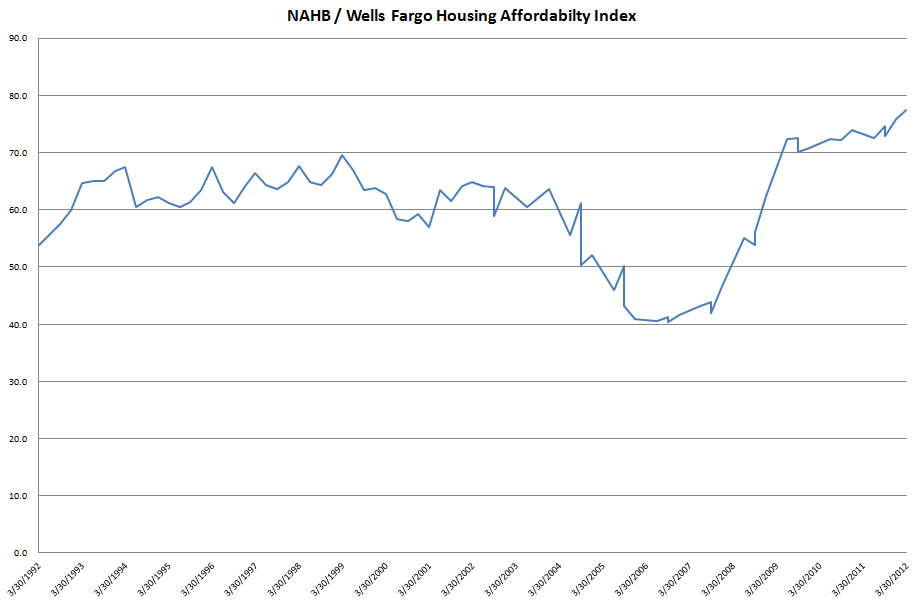
The National Association of Home Builders and Wells Fargo have constructed a housing affordability index, which is a measure of the percent of homes affordable by someone at the median income. The latest index is 77.5, which means 77.5 percent of all new and existing homes sold in Q1 were affordable for families earning the national median income. In a lot of ways, this chart is the inverse of my median house price to median income chart.

Chart: NAHB / Wells Fargo Housing Affordability Index: