A place where economics, financial markets, and real estate intersect.
Showing posts with label Federal Reserve. Show all posts

Tuesday, October 24, 2017

Morning Report: Dave Stevens talks at the MBA conference

Vital Statistics:

Last Change
S&P Futures  2567.3 3.8
Eurostoxx Index 390.5 -0.3
Oil (WTI) 52.2 0.3
US dollar index 87.2 0.1
10 Year Govt Bond Yield 2.41%
Current Coupon Fannie Mae TBA 102.875
Current Coupon Ginnie Mae TBA 103.938
30 Year Fixed Rate Mortgage 3.9

Stocks are up this morning on strong earnings, especially from CAT. Bonds and MBS are down small. 

Manufacturing continues to be strong, according to the Markit Flash PMI which came in stronger than expected. 

Whoever Trump nominates to replace Janet Yellen will have a more hawkish bent than she had, and the Street is making a bet on a flatter yield curve. This means that people are betting that short term rates will increase more than long term rates as the Fed hikes, which should translate into at least stable mortgage rates despite a rising Fed Funds rate. The yield curve flattened during the last 3 tightening cycles and even inverted in one of them. 

The Fed Funds futures are now pricing in a 97% chance for a December hike.

The Treasury Department has weighed in on the CFPB's proposed arbitration rule, and concluded that it “failed to meaningfully evaluate whether prohibiting mandatory arbitration clauses in consumer financial contracts would serve either consumer protection or the public interest — its two statutory mandates.” They conclude that the CFPB's rule will do more for trial lawyers than it ever will for consumers of businesses - it is basically a $300 million transfer of wealth to the Plaintiff's Bar, coming from consumers and business. 

The MBA National Conference is going on right now in Denver. Dave Stevens warned that the heads of the FHFA and CFPB will be replaced in the future, and that could mean big changes for the industry. Mortgage bankers have a false sense of security at the moment, with the current FHFA Chairman advocating for a strong role of government in housing finance. That could change. Making the current changes permanent will require legislation, however and housing finance reform always seems to be something down on the priority list. 

76% of people renting believe it is more affordable than home ownership, and that could help explain why the homeownership rate is so low, particularly among the young. Certainly the housing indices show prices back to the heady days of 2006, however remember these indices aren't indexed for inflation. If you make the inflation adjustment, we still have not recouped those losses. When you take into account the tax effects and interest rates, affordability hit a record in 2012 and buying is still extremely cheap compared to historical numbers. 

Monday, August 24, 2015

Morning Report: Shades of 1937?

Vital Statistics:

Last Change Percent
S&P Futures  1871 -100 -4.87%
Eurostoxx Index 3103.0 -144.3 -4.44%
Oil (WTI) 38.83 -1.6 -4.00%
LIBOR 0.329 0.000 0.00%
US Dollar Index (DXY) 93.92 -1.084 -1.14%
10 Year Govt Bond Yield 1.98% -0.05%
Current Coupon Ginnie Mae TBA 104.3 0.0
Current Coupon Fannie Mae TBA 104.1 0.1
BankRate 30 Year Fixed Rate Mortgage 3.86

The #1 trending topic on Twitter is #BlackMonday.

The global stock market sell-off continues this morning, with S&P futures down 64 handles. Bonds and MBS are up small.

Markets sold off hard overnight, with Japan down 4.6%, China down 8.5%, and Europe generally down 4.5%. Commodities are getting clocked, with oil down to $39 a barrel. Emerging markets are getting crushed.

The Chicago Fed National Activity Index rebounded from -0.07 in June to 0.34 in July.

The sell-off in risky assets over the past week has pushed out the market's forecast for the first rate hike out of the Fed. Futures are pricing in a first hike in the Dec - March timeframe. Over the weekend, Larry Summers penned an editorial in the Financial Times encouraging the Fed to stand pat for a while. He makes the point that the sell-off in assets has a tightening effect all by itself, and hiking rates in this disinflationary environment risks another 1937.

After stocks bottomed in 1932, the Dow Jones Industrial Average went on a tear, increasing almost fivefold in 5 years. In 1937, however they started a brutal 1 year bear market, where stocks got cut in half. The most common explanation for the sell-off was the Fed's tightening in late 1936 and early 1937. Now, there are a lot of reasons for the sell-off in the 1930s (markets sensing something afoot in Europe, FDR's undistributed profits tax, etc), but the Fed is very cognizant of their role in the "recession in the depression" and this will certainly guide their decision-making. 


With stocks hitting air pockets on the downside, you would expect to see Treasuries flying. Yes, they are up, but not by as much as you would expect. Supposedly there has been massive supply of Treasuries coming out of the Middle East, which is keeping a lid on prices. 

Wednesday, April 10, 2013

Morning Report - FOMC minutes

Vital Statistics:

Last Change Percent
S&P Futures  1567.7 4.5 0.29%
Eurostoxx Index 2630.1 35.0 1.35%
Oil (WTI) 93.64 -0.6 -0.59%
LIBOR 0.277 -0.001 -0.36%
US Dollar Index (DXY) 82.38 0.070 0.09%
10 Year Govt Bond Yield 1.77% 0.02%
Current Coupon Ginnie Mae TBA 107.1 1.2
Current Coupon Fannie Mae TBA 103.6 -0.1
RPX Composite Real Estate Index 190.1 0.0
BankRate 30 Year Fixed Rate Mortgage 3.57

Stock markets are higher this morning in anticipation of the Fed minutes which will be released this morning at 9:00 am (a change from their usual 2:00 pm time).  Market participants will focus on hints regarding the end of quantitative easing. Mortgage Applications rose 4.5% last week on the back of the BOJ-led rally in the bond market and MBS. Treasury will also be conducting a 10-year auction around 1:00 pm. It will be interesting to see if the bid / cover ratio is affected by events in Japan. Bonds and MBS are down small.

Earnings season kicked of on Tuesday with Alcoa reporting better than expected earnings, but weaker sales. Retailers Fastenal and Family Dollar are down this morning after missing. We will get JP Morgan and Wells Friday morning before the open.

The President plans to release a $3.77 trillion budget today. He is proposing $1.8 trillion in new spending (although to be fair, that is to replace the sequester). He is also instituting a AMT II on incomes over $1 million of 30%. He also proposes to cap IRAs at $3 million, end carried interest, and to raise taxes on tobacco. He will also propose changes to the way cost-of-living adjustments are calculated - aka Chained CPI - to Social Security. Given that taxes and spending both increase pretty dramatically, the plan is DOA in the house.

It turned out the Fed mistakenly released the minutes early. Still don't have the actual link, but here are some of the particulars: Economy re-accelerating after Q4 slowdown. Private nonfarm payroll increased at a modest rate in January, but expanded more briskly in Feb. (We now know that March was a disaster). The Fed asked primary dealers about their expectations for when the Fed will start tightening (are they running the Fed according to polls now?) and the view seems to be Q114 for the end of QE and Q315 for the first increase in the Fed Funds Rate. They noted that there did not seem to be much of a pullback in the economy in response to the tax hikes that kicked in Jan 1. Opinions about QE were all over the place, with some wanting to end it now and others wanting to increase the pace of purchases.

Monday, March 11, 2013

Morning Report - Construction worker shortage

Vital Statistics:

Last Change Percent
S&P Futures  1542.5 -2.0 -0.13%
Eurostoxx Index 2712.8 -16.0 -0.59%
Oil (WTI) 91.9 0.0 -0.05%
LIBOR 0.28 0.000 0.00%
US Dollar Index (DXY) 82.75 0.057 0.07%
10 Year Govt Bond Yield 2.05% 0.01%
RPX Composite Real Estate Index 194.2 -0.6

Markets are slightly weaker this morning after Fitch downgraded Italy's sovereign debt. This week is light data-wise.  We have retail sales on Wed, and industrial production / capacity utilization on Friday. Bonds and MBS are up small.

Legal and business experts have weighed in on the government's case against S&P and have found it, well, wanting. Turns out they don't have any witnesses who will support allegations that S&P intentionally defrauded banks and the credit unions that are the victims in this case. In reality, the victims are not widows and orphans, but sophisticated institutional investors. And it is hard to argue that S&P were the smartest guys in the room and knew that the financial system was about to collapse when everyone else (Moody's, the Fed, etc) did not.

Fed Governor Elizabeth Duke gave a speech to the Mortgage Bankers Association where she predicted that the housing recovery is real and is poised to accelerate. She does note that inventory is very low, and credit standards are very tight which is making it difficult for the first time homebuyer who is going to drive demand in the housing sector. Apparently the fraction of mortgages going to first-time homebuyers is half of what it was in the early 00s. The low housing formation numbers of the past few years represent a lot of pent-up demand and the Fed is forecasting that it should reach 1.5 million a year. Of course some of those people will rent, but still it will drive home prices higher, especially when you consider housing starts had been stuck around 600k - 800k since the bubble burst. Finally, the Fed is watching liquidity in the MBS market and is prepared to slow purchases if it thinks that it is dominating the market.

On the back of last Friday's jobs report, it turns out that there a shortage of construction workers. Builders in some areas are finding it difficult to find workers and are having to raise wages to attract them. It turns out a lot of them left the residential construction industry after the bust and took jobs in trucking and energy. Interestingly, housing starts are up 24% or so YOY, while construction employment is up only 3%. In some ways, the weak housing market probably exacerbates this problem as many workers are stuck in an underwater house and cannot move to where the jobs are.  As house prices rise, this effect should dissipate and could portend a rapid drop in unemployment. Which also means that margins are going to be under pressure for the home builders if they cannot pass the higher labor costs onto home buyers.  Food for thought as the XHB bounds to post-crisis highs.

Tuesday, March 5, 2013

Morning Report. Volcker: "There's a lot of liquor out there now"

Vital Statistics:

Last Change Percent
S&P Futures  1531.2 5.5 0.36%
Eurostoxx Index 2659.6 39.8 1.52%
Oil (WTI) 90.65 0.5 0.59%
LIBOR 0.281 -0.002 -0.71%
US Dollar Index (DXY) 82.08 -0.115 -0.14%
10 Year Govt Bond Yield 1.89% 0.02%
RPX Composite Real Estate Index 195 0.2

Stocks are higher this morning on no real news. China re-affirmed its growth target of 7.5% GDP. European ministers opened the way for looser budget policies after the Italian election results. In spite of that, Euro sovereigns are generally stronger this morning. Generally, the market has a "risk on" feel to it, and bonds / MBS are lower.

Acting FHFA Chairman Ed Demarco laid out the plan for dealing with the GSEs. Fannie and Fred would be merged, slowly dissolved and a new entity would take their place. The new entity would be owned and funded by Fan and Fred, but would have its own CEO and Chairman and be in a physically separate location. Left undecided is exactly what role the government will have in the mortgage market. The government seems to be leaning in the direction of focusing on low income / VA products, and acting as a re-insurer.  That said, it is up to Congress to figure out what the the exact role will be. The securitization arm could be nationalized, turned into a utility, or privatized.

The GSEs owe the government something like $120B and it is estimated that it would take another $200 - $250 billion to capitalize them enough so that they could stand on their own.  The government is in a pickle on this one. On one hand, if the government nationalizes Fan and Fred, all of their debt becomes sovereign debt, with the attendant effects on our debt / gdp ratios. On the other hand, there is no way to raise $350B in the private markets. And the chances of getting a $350B appropriation for the GSEs in this Congress is probably too much to ask as well.  Given that the government backs 90% of all new mortgages it is probably safe to say they won't make any major changes until private financing takes some of the load.

Ex Fed Chairman Paul Volcker is warning that removing the central bank stimulus will be difficult and the temptation will be to stay too long.  "You can make a mistake and go too quick, but the much more frequent mistake is you go too slow, because its never popular to take the so-called punch bowl away or to weaken the liquor." Of course after the equity bubble burst, the Fed kept the punch bowl out so long that the real estate market went on a 5 year bender and then wrapped the car around a tree. Almost on cue, Janet Yellen, as the good co-dependent / enabling wife, is out there saying that the "potential costs of asset purchases definitely need to be monitored over time and she did not see any that would cause me to advocate a curtailment." Meanwhile, the stock market is approaching all-time highs, the VIX is at 14, and S&P 500 earnings have been dropping every quarter since Q212...


Monday, February 25, 2013

Morning Report - Life after Fan and Fred.

Vital Statistics:

Last Change Percent
S&P Futures  1521.4 6.8 0.45%
Eurostoxx Index 2688.7 58.6 2.23%
Oil (WTI) 94.04 0.9 0.98%
LIBOR 0.287 -0.002 -0.52%
US Dollar Index (DXY) 81.11 -0.368 -0.45%
10 Year Govt Bond Yield 1.98% 0.02%
RPX Composite Real Estate Index 194.5 0.2

Markets have a risk on feel this morning on no real news.  Elections are being held in Italy, with Bersani on track to win. Italian sovereign yields have tightened 20 basis points in response. Bonds and MBS are down.

Sequester week. Bob Woodward had a column over the weekend that said, WH protestations aside, that the sequester was Obama and Lew's idea in the first place. The WH is releasing all sorts of gloom and doom scenarios about what will happen if sequestration happens. Republicans seem to be content to allow the cuts to happen. FWIW, I do not believe the markets care one way or the other about the impending sequester.

The Chicago Fed National Activity Index showed growth moderated in January, falling to -.32 from a revised +.25 the previous month. Production related indicators explain most of the weakness, although employment and consumption also were negative contributors. The 3 month moving average is still in positive territory, indicating that economic growth continues to be moderately above trend.

The Bernank will be testifying in front of Congress this week. These things tend to be partisan dog-and-pony shows where the questioners are more interested in getting the Fed Chairman to validate their worldview than they are in seeking actual answers.  Democrats will undoubtedly be pushing for Bernake to say that sequestration will be an economic nightmare, while Republicans will be pushing for him to say that spending and the debt pose a problem. Democrats will also be looking for support for raising the minimum wage. Republicans will probably want to drill down a bit on the end of QE.

The Bipartisan Policy Center has released a report on the future of housing and the GSEs. With the government guaranteeing 90% of all mortgages these days, there is a push in Washington to get the private sector more involved. They envision phasing out Fan and Fred and replacing them with a "public guarantor," who has a re-insurance role, stepping in only when private insurers are unable to make good on the loan. They also propose that the government get involved with providing affordable rental housing.

Monday, December 17, 2012

Morning Report

Vital Statistics:

Last Change Percent
S&P Futures  1414.9 5.7 0.40%
Eurostoxx Index 2622.9 -7.6 -0.29%
Oil (WTI) 86.67 -0.1 -0.07%
LIBOR 0.309 0.001 0.32%
US Dollar Index (DXY) 79.58 -0.001 0.00%
10 Year Govt Bond Yield 1.72% 0.02%
RPX Composite Real Estate Index 191.6 0.4

Markets are higher this morning after Japan elected Shinzo Abe, who has advocated further fiscal and monetary stimulus.  The Empire Manufacturing Survey showed manufacturing in NY state contracted more than expected. Bonds are down and MBS are down small.

The negotiations on the fiscal cliff continue. The President has tied any discussions on entitlement cuts to increasing taxes on the rich and an increase in the debt ceiling.  Boehner has proposed a millionaire's surtax and an increase in the debt ceiling. Of course, Boehner can strike a deal with the President, but that doesn't mean he can deliver the votes in the House.

Barry Ritholz has MBIA's presentation on Countrywide's fraud.

Samuelson discusses the Fed's targeting of both unemployment and inflation and lays out some of the unintended consequences.


Friday, December 14, 2012

Morning Report: Hotel California Monetary Policy

Vital Statistics:

Last Change Percent
S&P Futures  1412.1 0.1 0.01%
Eurostoxx Index 2628.7 1.1 0.04%
Oil (WTI) 86.4 0.5 0.59%
LIBOR 0.308 0.000 0.00%
US Dollar Index (DXY) 79.91 -0.023 -0.03%
10 Year Govt Bond Yield 1.71% -0.02%  
RPX Composite Real Estate Index 191.6 0.4  

Stock index futures are flat after a benign CPI report.  Of course the Fed explicitly told us that until unemployment drops below 6.5%, they do not care what inflation does. Industrial Production rebounded in November, and Capacity Utilization rose. Bonds and MBS are up small.

Markit's flash Purchasing Manager's Index is generally upbeat and shows US manufacturing rebounding in December after reaching post-crisis lows in Aug and Sep. There has been some concern that Q4's GDP numbers have been goosed by an inventory build, which means we are borrowing growth from next quarter.  FWIW, the report does not bear that out as it shows inventories are falling. The report notes employment is picking up in the manufacturing sector as well.

CoreLogic's December Market Pulse is reasonably optimistic on housing.  Punch Line:  Residential Real Estate is finally contributing to economic growth instead of being a drag. While residential real estate is not a massive driver of the economy, it usually is the first to recover after a recession and makes its largest contributions early in the economic cycle. It is the piece of the puzzle that allows us to shift from first to second gear.

The Man With A Tan - Angelo Mozilo has no regrets about how he ran Countrywide and only agreed to a $67.5 million settlement to protect his children.  (BTW, it looks like Bank of America paid the lion's share of that) You can read his entire deposition here.

Great perspective on the history of banking from my favorite financial author, Jim Grant. "You can have the fear of God or the socialization of risk, but you cannot have both."

Interview with Dallas Fed President Richard Fisher on the Fed's "Hotel California" monetary policy.  He lays out the argument that the problem with the economy is not monetary policy, it is regulatory uncertainty out of Washington. He also notes that we are reaching the point of diminishing returns.

Friday, December 7, 2012

Morning Report - Jobs Day

Vital Statistics:

Last Change Percent
S&P Futures  1418.5 5.5 0.39%
Eurostoxx Index 2593.6 -9.8 -0.38%
Oil (WTI) 86.71 0.5 0.52%
LIBOR 0.31 -0.001 -0.32%
US Dollar Index (DXY) 80.48 0.225 0.28%
10 Year Govt Bond Yield 1.62% 0.03%
RPX Composite Real Estate Index 190.9 -0.1


Markets are higher after a better-than expected jobs report.  Nonfarm payrolls increased by 146k in November vs an expectation of 85k.  October was revised down from 171k to 138k.  The unemployment rate dropped from 7.9% to 7.7%, but this was driven by a drop in the labor force participation rate from 63.8% to 63.6%. Surprisingly, Sandy didn't appear to have much of an impact on the numbers. Still the headline numbers look good, and that is driving the index futures higher.  Feels like the Street was leaning short going into the numbers.  Bonds are down a point and MBS are down 7 ticks.


Small Business Hiring Plans hit post-recession low. Hiring plans are as low as they were in late 2008.  Resolution of the election "uncertainty" doesn't seem to be having an effect, at least not yet.  We'll see if resolving the fiscal cliff changes anything; my guess is that it won't.

The National Association of Homebuilders added 76 MSAs to their Improving Markets Index. The recent housing strength is spreading across the country. They note that "overly tight mortgage lending standards" are the one thing that is holding back progress.

HUD Secretary Shaun Donovan told the Senate Banking Committee that FHA is committed to selling at least 10,000 distressed loans per quarter over the next year, and it will raise the annual insurance premium paid by borrowers by 10 basis points.

If the Fed adds another Treasury-buying program to compensate for the end of Operation Twist, they will almost certainly have to re-write their exit plan.  The sheer size of the numbers (estimates are that the Fed will have to sell $2 - $3 trillion worth of assets over several years.  If the Fed attempts to dump mortgage backed securities en-masse, it will exacerbate the increase in borrowing rates that will already be taking place.

Wednesday, December 5, 2012

Morning Report - ADP and NEWCO spelled backwards

Vital Statistics:

Last Change Percent
S&P Futures  1408.4 2.9 0.21%
Eurostoxx Index 2598.9 8.1 0.31%
Oil (WTI) 88.63 0.1 0.15%
LIBOR 0.311 0.000 0.00%
US Dollar Index (DXY) 79.79 0.142 0.18%
10 Year Govt Bond Yield 1.60% -0.01%
RPX Composite Real Estate Index 191.2 0.3

Markets are higher this morning after China eased investment restrictions on banks and announced measures to promote urban development. Chinese GDP has slowed from close to 9% to 7.5% over the last 9 months. While 7.5% GDP growth sounds impressive, it is back in late '08-early '09 levels. Productivity rose 2.9% in Q3, while unit labor costs fell 1.9%.  Bonds and MBS are flattish.

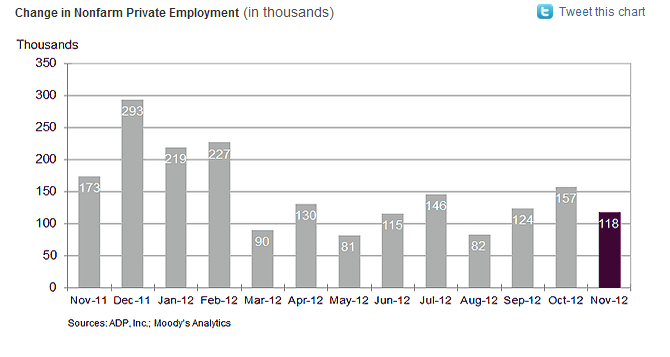
ADP reported a 118k increase in US nonfarm private sector employment for the month of November. This report was obviously driven by Hurricane Sandy. The biggest gains were in construction and utilities, while manufacturing fell. A blip upward in construction and temp workers for storm clean-up and a drop in manufacturing as plants with no power laid off employees.   October was revised downward.  Mark Zandi estimates that the hurricane depressed employment by 86k.

Edit:  Immediately after hitting "post"  Citi announces it will cut 11,000 jobs.

Chart:  ADP change in non-farm payrolls:


Obama has drawn a line in the sand:  No increase in top rates for incomes over 250k, no deal. He expressed openness to cutting top rates next year in the context of broad tax reform.

Servicers beware:  Not only do you have to fear the CFPB, the state regulators are getting involved.  New York State is refusing to approve Ocwen's purchase of Homeward and the servicing unit of ResCap unless the company agrees to bring in a monitor from NY State which would oversee operations for two years and recommend changes in business practices.  In all of my years of analyzing mergers and the regulatory process, I have never seen anything like this.  Ocwen goes on to point out that they have "not received from any regulator at the federal or state level or any level any findings or evidence we have wrongfully foreclosed on any borrower."  This is unprecedented.

The Fed is expected to announce a new round of Treasury buying after Operation Twist ends at the end of the year. US GDP is expected to slow as uncertainty over the fiscal cliff has weighed on capital expenditures and hiring.  ML / BOA is forecasting 1% GDP growth in Q4 and Q1.

Monday, December 3, 2012

Morning Report "Gs" and "Js" edition.

Vital Statistics:

Last Change Percent
S&P Futures  1420.8 6.4 0.45%
Eurostoxx Index 2603.5 28.2 1.10%
Oil (WTI) 89.54 0.6 0.71%
LIBOR 0.311 0.000 0.00%
US Dollar Index (DXY) 79.87 -0.288 -0.36%
10 Year Govt Bond Yield 1.64% 0.03%
RPX Composite Real Estate Index 191.1 0.0

Markets are higher this morning after a better than expected PMI report out of China and Europeans took steps to solve their crisis there.  We will get the November ISM report and Construction Spending at 10:00 am. Bonds are down a point, while MBS are down a few ticks.

Talks on the fiscal cliff seem to be at a stalemate.  Both sides are digging in their heels and making their respective cases on the Sunday morning talk shows. Given that we have seen this movie before in the debt ceiling and the last time we approached the cliff, the markets are taking a sanguine view.  Two economists sum up the left / right views pretty well this morning:  Sameulson vs Krugman.

Has the G-fee become the new Social Security Trust Fund - in other words, the piggybank government uses to fund items unrelated to housing?  It would appear so.  They were used in the debt ceiling deal a couple of years ago, and are now being used to pay for visas for highly skilled immigrants. Never mind that the G-fee is   more or less an insurance policy payment used to compensate the GSEs for credit risk. Maybe the "G" in G-fee should be changed from "guarantee" to "general"

The Fed is contemplating another round of asset purchases as Operation Twist ends this year. While Minneapolis President Kocherlakota believes "monetary policy if anything is too tight," Philly Fed President Charles Plosser warns that additional stimulus may not have the capability to affect employment rates and risks the possibility that the "US turns into a Japanese experience where we have extremely weak modest growth over a long period of time."  It is refreshing to hear someone invoke the "J" word - Japan - which should be the elephant in the room, both in Washington and at the Fed.

Check out our latest article in the Scotsman Guide:  Where are we going, Where have we been?

Thursday, November 15, 2012

Morning Report: Corzine gets a Pass

Vital Statistics:

Last Change Percent
S&P Futures  1352.6 -0.4 -0.03%
Eurostoxx Index 2456.5 -16.3 -0.66%
Oil (WTI) 86.54 0.2 0.25%
LIBOR 0.311 0.001 0.32%
US Dollar Index (DXY) 81.17 0.118 0.15%
10 Year Govt Bond Yield 1.61% 0.02%
RPX Composite Real Estate Index 192 -0.4

Markets are flat this morning after yesterday's bloodbath in the S&P and Wal Mart's miss, which is a negative sign for the economy. Inflation at the consumer level remained in the Fed's comfort range, while initial jobless claims jumped to 439k.  This is heavily influenced by Sandy, so don't read too much into it. The NY Fed's Empire Manufacturing Survey was negative, but better than expected and higher than the previous month.s  The Eurozone officially entered a recession.  Bonds are down small while MBS are flat.

The Bernank is speaking on Housing and Financial Markets at 1:20 est today.

Freddie Mac discusses housing starts in its November 2012 US Economic and Housing Market Outlook.

The FOMC minutes released yesterday showed the Fed is moving in the direction of providing explicit economic guideposts for monetary policy.  In other words, once unemployment drops to X%, we end QE. While they also expressed concern that the scheduled completion of Operation Twist may impact the economy, they did not announce a Treasury buying program.  The market does expect one, though.

A House report on MF Global basically characterizes Jon Corzine as the "de facto chief trader" and blames his trades for the firm's collapse.  The Democrats on the panel refused to endorse the report, basically proving (yet again) that the financial is political.

The Washington Post has a good backgrounder on the shale gas revolution.  This has the potential to be a real long-term elixir for the economy.

Tuesday, November 13, 2012

Morning Report: Jamie Dimon on Housing

Vital Statistics:

Last Change Percent
S&P Futures  1370.0 -8.2 -0.59%
Eurostoxx Index 2460.4 -13.1 -0.53%
Oil (WTI) 84.97 -0.6 -0.70%
LIBOR 0.31 0.000 0.00%
US Dollar Index (DXY) 81.2 0.166 0.20%
10 Year Govt Bond Yield 1.59% -0.01%
RPX Composite Real Estate Index 192.8 0.3

Markets are weaker this morning on Greek worries and a negative earnings report out of Weatherford. Bonds are up 1/2 a point and MBS are flat.

The NFIB Small Business Optimism index gained .3 points.  Uncertainty reached a record high, although this is understandable given it was an October before an election. CAPEX remains in maintenance mode, and hiring is absolutely flat. Generally it was a glum report.

Now that we have the election behind us, we can pretty much safely say that it is safer to be more constructive on Treasuries.  The Fed will continue to do what it does, and taxes are going up at the end of the year.  Combine that with the fact that Obama's re-election is a negative for energy and the financials, and we could be facing a weak Q113 as well.

But is there a bright spot?  Ah yes, housing.  Jamie Dimon has some optimistic comments regarding housing in the WSJ.  He basically cites the same things I have been talking about - household formation, affordability and inventory.  He makes the statement that housing isn't going to recover in the absence of a strong economy, which I am not so sure I agree with.  I think the low household formation numbers of the last 6 years are artificially depressed due to a lousy economy and have created pent-up demand.  Eventually, people get married, move out of Mom and Dad's place, and boot out the roommates.  In other words, housing can improve in spite of the economy.

Not only that, but think about this:  As part of obamacare, obama instituted a 3.8% surtax on investment income for people making over $250k.  In a tight rental market, landlords will undoubtedly attempt to pass that cost on to renters, making the rent vs buy decision even more of a no-brainer.  Credit availability remains a problem, though as Dimon notes.

Wapo notes that the REO discount is starting to disappear.

AIG is looking to expand its balance sheet in the mortgage business.

Wednesday, October 24, 2012

Morning Report: QE (Infinity)

Vital Statistics:

Last Change Percent
S&P Futures  1411.8 5.0 0.36%
Eurostoxx Index 2489.5 11.6 0.47%
Oil (WTI) 86.67 0.0 0.00%
LIBOR 0.314 -0.001 -0.32%
US Dollar Index (DXY) 80.02 0.041 0.05%
10 Year Govt Bond Yield 1.77% 0.01%
RPX Composite Real Estate Index 194.1 0.3

Stock index futures are stronger this morning after yesterday's rout. Dow Chemical reported better than expected earnings in spite of a leaked memo that said the company was considering laying off 5% of its workforce. Facebook surprised to the upside by cracking the code on monetizing mobile. Mortgage aps dropped 12% last week.  The Markit PMI (a predictor of the the ISM PMI) came in light, but still improved from Sep. Bonds and MBS are down small.

The FOMC rate decision is scheduled for 2:15 EST.  Historically the Fed has tried to stay out of the way this close to the election - in fact, the last announcement on QE (Infinity) was pushing it.  Which means the smart bet is going to be that this is a non-event.  That said, the Street is expecting some change - where the Fed adds Treasuries to its QE mix - so there is the possibility of market movement, especially MBS versus Treasuries. I wouldn't want to be floating going into that announcement.

The FHFA House Price Index rose .7% in August, and is up 4.7% YOY.  This index covers only conforming mortgages, so it is less noisy than Case-Schiller or Radar Logic.


Freddie Mac's latest US Economic and Housing Market Outlook expects QEIII to spark a further pick-up in housing activity, noting that housing has turned from a headwind to a tailwind for the economy. They are forecasting $2 trillion in originations this year, followed by a 15-20 percent contraction in 2013 as the refi boom plays out. They do worry about the fiscal cliff taking 2 percentage points out of GDP, although Obama is playing cat and mouse with the defense budget cuts, as he says one thing in the debates "cuts will not happen" and his advisers walk back the comments afterward. Elmer Fudd is quite concerned about the fiscal cliff as well.

Finally, Rob Chrisman gives you the data dump from the MBA Conference in Chicago.  Originators are adding capacity, the CFPB wants a flat fee for all mortgage originations, and the Street gets ticked when clients have the gall to check multiple dealers in order to get the best price on their TBA transactions.

Tuesday, May 15, 2012

Morning Report

Vital Statistics


Last Change Percent
S&P Futures  1336.0 1.9 0.14%
Eurostoxx Index 2179.7 -22.2 -1.01%
Oil (WTI) 94.71 -0.1 -0.07%
LIBOR 0.466 0.000 0.00%
US Dollar Index (DXY) 80.89 0.280 0.35%
10 Year Govt Bond Yield 1.78% 0.02%
RPX Composite Real Estate Index 175.5 0.4


Markets are up this morning on a lack of news out of Europe and some mixed economic data. The Consumer Price Index showed inflation remains benign, while retail sales data showed spending up slightly and below expectations. Bonds and MBS are down slightly. Greek bond yields are up 160 basis points. Portugal and Ireland are up as well.

The New York Fed released its Empire State Manufacturing Survey this morning, which came in better then expected on higher shipments. Six month optimism fell.

The National Association of Home Builders released its builder confidence survey this morning, which showed improving sentiment.

The Washington Post is starting to focus on the tax hikes that will take place in the beginning of 2013. They note the uncertainty that it is causing. So far, there seems to be no discussions in Washington about what to do about it. IMO this has been driving some of the recent deceleration in the economy.

Lots of institutional investors are clicking "Like" - Facebook raised the range of its IPO price from 28-35 to 34-38. At the top end of the range, FB would be valued at 26x sales - or about twice the valuation of the Google IPO.

Ally doesn't plan on re-organizing the mortgage business and getting back in to the housing market. They are going to stick with car loans. Money Quote from Ally CEO Michael Carpenter: "You can live in your car if you don't pay your mortgage.  I don't mean to be cute, but the fact is people make their car payment before they pay their mortgage."

Chart:  NAHB Index: