A place where economics, financial markets, and real estate intersect.
Showing posts with label principal reductions. Show all posts

Friday, May 3, 2013

Morning Report - CBO assumes a can opener

Vital Statistics:
Last Change Percent
S&P Futures  1603.4 11.1 0.70%
Eurostoxx Index 2736.0 17.1 0.63%
Oil (WTI) 95.21 1.2 1.30%
LIBOR 0.275 0.002 0.73%
US Dollar Index (DXY) 82.43 0.204 0.25%
10 Year Govt Bond Yield 1.70% 0.07%
Current Coupon Ginnie Mae TBA 106 -0.5
Current Coupon Fannie Mae TBA 104.2 -0.3
RPX Composite Real Estate Index 193.8 0.5
BankRate 30 Year Fixed Rate Mortgage 3.42

Markets are higher this morning after a better-than-expected jobs report. Bonds and MBS got whacked on the number.

Payrolls increased by 165,000 in April and the unemployment rate fell to 7.5%. March was revised upward from 88k to 138k. The labor force participation rate remained at 63.3%, the lowest since the 70s. Retail and business services added jobs, while construction was surprisingly flat. The average workweek fell, while average hourly earnings ticked up by 4 cents.

The CBO has come out with a study saying that principal mods on Fannie and Freddie mortgages could save the taxpayer money by reducing delinquency and foreclosure costs and increasing economic growth. As far as the moral hazard issue - they dismiss the costs of moral hazard as "relatively low," provided the government requires sufficient evidence of financial hardship. The study basically assumes that the government will thread the needle with drafting rules to prevent strategic defaults. The study reminds me of the old joke where an engineer and an economist are stranded on a desert island with an unopened can of soup. The engineer proposes to use a rock to open the can. The economist says "assume a can opener."

Lloyd Blankfein sees the current environment as a parallel of 1994. Borrowers had become so used to low interest rates that they weren't ready when the Fed started hiking rates. Old timers will remember that was when Orange County blew up as mortgage backed securities got clocked.


Thursday, April 25, 2013

Morning Report - Homebuilder Earnings

Vital Statistics:
Last Change Percent
S&P Futures  1581.3 7.2 0.46%
Eurostoxx Index 2708.5 6.4 0.24%
Oil (WTI) 91.74 0.3 0.34%
LIBOR 0.276 0.000 0.00%
US Dollar Index (DXY) 82.47 -0.583 -0.70%
10 Year Govt Bond Yield 1.72% 0.01%  
Current Coupon Ginnie Mae TBA 106 -0.1
Current Coupon Fannie Mae TBA 104.2 -0.1
RPX Composite Real Estate Index 191 0.5
BankRate 30 Year Fixed Rate Mortgage 3.47

Markets are higher after earnings continue to look decent. Initial Jobless Claims fell, although the data tends to be volatile this time of year. Bonds and MBS are down

Yesterday, the House Financial Services Committee held a hearing on the private label securitization market. Generally speaking the theme centered around regulatory certainty, and that until QRM issues get resolved, the private label market will still be a trickle. Everyone agreed that Fannie and Fred will remain doing what they do for quite some time. Interestingly, Ranking Member Maxine Waters expressed concern about the effects principal mods will have on investors - I wonder if CALPERs and PIMCO had a word with her. If Maxine Waters isn't onboard with principal mods, maybe the whole push is losing momentum. Fun fact that came out of the hearing:  The U.S. government currently bears 50% of the credit risk of the entire mortgage market.

We have had quite a few homebuilders report over the past week, and it is generally a tale of two geographies. The builders that are in the West Coast markets have done great (KBH, MTH, RYL), while the ones with more East Coast exposure (NVR, PHM) are doing better, but nowhere near the others. NVR actually missed estimates and the stock was clobbered for 6% at one point, but it has clawed back its losses with the general strength in the market. Pulte reported this morning and is looking down a quarter. Ryland, which focuses on the first time homebuyer and the second-time move up buyer reported great numbers. Perhaps the long-awaited return of the first-time homebuyer is finally here.

The connection between the first time homebuyer and household formation is something that I have been harping on for a while. CoreLogic talks about it in its latest Market Pulse. Household formation numbers have been depressed ever since 2006, and that has given the illusion that the homebuilders have been building enough starter homes. The problem is that the drop in household formation wasn't due to demographics - it was due to a lousy economy. If a normal run rate is 1 million new households per year, and we average around 600 for five years, that means we have roughly 2 million new households in pent-up demand, along with the normal demand. Of course as the economy improves, many of these households will become renters first, and not first-time homebuyers. But what sort of housing start number will we see in the future to accommodate this demand? Remember, 1.5 million starts is "normalcy." Certainly not the 1 million print we saw last week. Probably closer to 2 million. Think about the homebuilding stocks on double the activity...

Chart Household Formation:


Friday, May 18, 2012

Morning Report

Vital Statistics:


Last Change Percent
S&P Futures  1307.5 6.2 0.48%
Eurostoxx Index 2155.6 8.7 0.40%
Oil (WTI) 92.68 0.1 0.13%
LIBOR 0.467 0.000 0.00%
US Dollar Index (DXY) 81.38 -0.004 0.00%
10 Year Govt Bond Yield 1.72% 0.02%
RPX Composite Real Estate Index 175.6 0.1


Markets are firmer this morning after enduring a bloody week which sent the S&P down 3.6% and the 10 year government bond yield down to 1.69%. Today is also the expiration of May options, so there is always the potential for funny closing prints. There is no economic data being released this morning.  Bonds and MBS are down slightly.

It's Facebook Day! Facebook priced at the top end of the revised range last night and should begin trading around 11:00. There are a stocks that capture the attention of the populace and Facebook is one of them. Growth fund managers who have been starving for a good growth story besides Chipotle Mexican Grill and Lululemon just got a new one. With an IPO price at 28x revenue, the stock will have to almost collapse to get value and GARP guys interested. I'm sure if you are a good technical trader, you should be able to have a field day with this one. Treat it as a slip of paper with an alphanumeric code, not an investment, cause it isn't.

Bloomberg has a column on why principal reductions won't solve the housing crisis. The big problem is that something like 80% of all underwater homeowners with Fan and Fred mortgages are current on their mortgages. Any principal reduction program will encourage people to stop paying their mortgage. Second, of those seriously delinquent, most of them won't be able to afford the lower payment anyway.

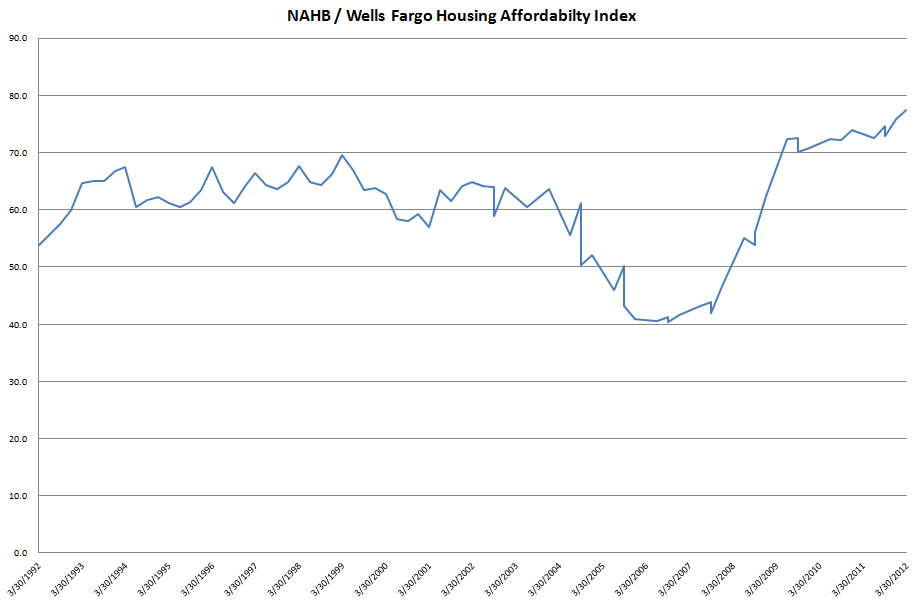
The National Association of Home Builders and Wells Fargo have constructed a housing affordability index, which is a measure of the percent of homes affordable by someone at the median income. The latest index is 77.5, which means 77.5 percent of all new and existing homes sold in Q1 were affordable for families earning the national median income. In a lot of ways, this chart is the inverse of my median house price to median income chart.

Chart: NAHB / Wells Fargo Housing Affordability Index: