A place where economics, financial markets, and real estate intersect.
Showing posts with label fed funds futures. Show all posts

Monday, August 13, 2018

Morning Report: Turkish situation continues to degenerate

Vital Statistics:

Last Change
S&P futures 2836 -0.55
Eurostoxx index 384.89 -0.96
Oil (WTI) 67.37 -0.26
10 Year Government Bond Yield 2.88%
30 Year fixed rate mortgage 4.58%

Stocks are lower as the Turkey situation snowballs to other emerging markets. Bonds and MBS are up on the flight to quality trade. 

Financial markets are being driven by the situation in Turkey, with the Turkish Lira continuing to depreciate. This has spread to other emerging markets currencies like the South African Rand. The Chinese currency has hit the lowest level in a year, which is bound to increase trade tensions with the US. There is the potential for this to affect the balance sheets of some European banks, however the US will be pretty much insulated from it. The most likely effect is that it will cause a flight to quality to the US dollar which will keep a lid on interest rates.


The Turkish crisis hasn't affected the Sep Fed Funds futures, which are handicapping a 94% of a hike, but they have tempered the probability of a follow-on hike in December. It isn't a dramatic move, but we have slipped from 66% to 61%. 


We won't have much in the way of market-moving data this week - retail sales on Wednesday will be the only one that matters. We will also get housing starts on Thursday. Other than that, it should be a dull week. 

Ben Carson is changing the way HUD encourages multifamily real estate development. The Obama HUD used the stick approach - suing local governments to force them to change their zoning rules, based on demographic analysis. The Carson HUD will use the carrot approach - tying grants to changes in zoning restrictions. 

Conventional financing accounted for 69% of all financing last year. Of the non-conventional types of financing, FHA loans led with 12%, followed by cash with 10% and VA with 4%. 

Elon Musk clarified his tweet regarding taking Tesla private. He decided to use Twitter in order to notify the public of his intention to take the company private. Most companies file an 8-K with the SEC and do a press release, but Elon decided to use Twitter. Second, his "funding secured" comment was based on a conversation with the Saudi Sovereign Wealth Fund who asked if Tesla was interested in selling to the fund. Musk then looked at the assets of the fund, concluded they had the money, and then tweeted that funding was secured. One thing is for sure, if this deal ever happens, the background section of the proxy statement is going to make for some entertaining reading. 

Tuesday, July 3, 2018

Morning Report: Strong manufacturing numbers, still a coin-toss for 2 hikes this year

Vital Statistics:

Last Change
S&P futures 2737 10
Eurostoxx index 380.51 3.77
Oil (WTI) 75 1.06
10 Year Government Bond Yield 2.87%
30 Year fixed rate mortgage 4.52%

Stocks are up this morning as emerging markets rally overnight. Bonds and MBS are flat.\

Today should be quiet as markets close early ahead of the 4th of July holiday. 

Manufacturing continued to plow ahead in June, according to the ISM PMI Index. The responses from the survey participants show that the trade war is having some impact. One food and beverage company mentioned that they were shifting some production to Canada in order to escape Chinese retaliatory tariffs on US products. Inflationary pressures are present in higher commodity prices, and we are seeing secondary pressure from transportation (higher oil prices and driver shortages are pushing up prices here). Pretty much every commodity is seeing price increases, and there are material shortages in aluminum, steel, and electronic components. Overall, this is a strong manufacturing reading, which is usually associated with 5.2% GDP growth. Of course, manufacturing isn't the driver of the economy it used to be, but it is still a strong reading. 

The Fed is going to pay close attention to this report, particularly the part about labor shortages. From their standpoint, inflationary pressures from commodity price inflation are generally considered transitory and therefore temporary. An old saw in the commodity markets is that the cure for high prices is high prices. The potential dampening effect from trade battles will also concern them. IMO, until you start seeing wage inflation pick up in a meaningful way the Fed will consider this a push. Note we will get some insight into this on Thursday when the minutes from the June meeting are released. 

The Fed funds futures are still handicapping a 76% chance of a 25 bp hike in September and a 45% chance of one in December as well. 


Construction spending rose 0.4% in May, and is up 4.5% on an annualized basis. Residential construction was up 0.8% MOM and 6.6% YOY, as an increase in private resi construction was offset by a drop in public housing spending. Manufacturing construction took a step back, which will be something to watch (could just be noise, but could be trade-related). Meanwhile retail (specifically mall-related construction) is in the doldrums as vacancy rates soar.

Home price appreciation accelerated in May, according to the CoreLogic Home Price index. Prices rose 1.1% MOM and are up 7.1% YOY. The housing shortage is well-documented, and the problem is most acute at the entry-level. Higher rates and low inventory is also preventing some people from moving. CoreLogic estimates that 50% of the mortgage market has a rate of 3.75% or lower. According to CoreLogic's model which compares home price appreciation to income appreciation, we are seeing large pockets of overvaluation, particularly in Florida, the West Coast, the sand states, and parts of the Eastern Seaboard. The Midwest remains cheap.


Trump is reportedly mulling whether to pick a new Chief of Staff. One of the potential candidates is current CFPB Chairman Mick Mulvaney. Mulvaney is currently doing double duty as OMB and CFPB head, so a change for him would be unlikely, but the possibility is still there. Here are the implications of a change and who might replace him

Labor shortages continue to be an issue in the Midwest. Companies are now less squeamish about hiring ex-cons. In Elkhart, (where the labor market is so tight it sports a 2% unemployment rate and even the KFC is offering sign-on bonuses), companies are hiring convicted felons (except sex offenders) and are waiving drug tests. It is a back-to-the future scenario, where the labor market is suddenly transported back to 1955. 

Thursday, June 28, 2018

Morning Report: First quarter GDP revised downward.

Vital Statistics:

Last Change
S&P futures 2695 -8.5
Eurostoxx index 376 -3.9
Oil (WTI) 72.39 -0.39
10 Year Government Bond Yield 2.83%
30 Year fixed rate mortgage 4.53%

Stocks are lower this morning on overseas weakness. Bonds and MBS are flat. 

The third estimate for first quarter GDP came in lower than expected, as an upward revision in the price index and a downward revision in consumer spending lowered the third and final estimate from 2.2% to 2%. The price index was revised upward from 1.9% to 2.2%, while consumer spending was revised downward from 1% to 0.9%. Housing was actually a negative in the first quarter. I may sound like a broken record, but from 1959 to 2002, housing starts averaged 1.5 million per year, with a much smaller population. Post-bubble, we have averaged around a million per year. Just to get supply and demand into balance probably requires 2 million starts, which would do wonders for GDP. Incidentally, yesterday's inventory figures prompted the Atlanta Fed to take up its tracking estimate for second quarter GDP to 4.5%. 


The drop in the 10 year yield has probably been influenced by the Fed Funds futures, which have been inching towards one more hike this year as opposed to 2. Current probability levels:
  • No more hikes: 11%
  • One more hike 44%
  • Two more hikes: 42%
  • Three hikes 2%
While the US economic data probably supports more hikes in interest rates, wage growth remains muted, and the sell-off in emerging markets is being viewed as a canary in the coal mine for global growth. Finally fears of a trade war are bearish for the economy, which would give the Fed another excuse to hold off in either September or December. 

Initial Jobless Claims increased to 227k last week, which is still an astoundingly low level. Meanwhile corporate profits were revised upward in the first quarter from 0.1% to 2.7%. 

Ben Carson testified in front of the House Financial Services Committee yesterday, where he laid out some of the changes he has implemented at HUD. He has made some changes with the Home Equity Conversion Mortgage program (aka reverse mortgages) to put the insurance fund on sounder footing. He is emphasizing the removal of lead paint and other hazards in HUD housing, and has suspended the Obama-era scheduled cut in the FHA mortgage insurance premium. HUD is concerned about the number of FHA cash-out refinances, which have increased from 45% of refis to 60% in the last year. (As an aside, since rate / term refi opportunities are largely gone, so you would expect to see an increase in the percentage of cash-outs). 

Why socially responsible investing sounds like a nice idea, but isn't a free lunch. You can "do good" but you should be prepared to underperform


Friday, June 8, 2018

Morning Report: Dec Fed funds futures still leaning towards 3 hikes this year

Vital Statistics:

Last Change
S&P futures 2767 -8.25
Eurostoxx index 385.56 -0.38
Oil (WTI) 65.78 -0.17
10 Year Government Bond Yield 2.93%
30 Year fixed rate mortgage 4.59%

Markets are lower this morning on negative news out of Apple. Bonds and MBS are down small. 

Something to watch: We are seeing bigger bets against emerging markets currencies and some European bonds. These trades will bump up against Treasury shorts, which were increased last week in the wake of the Italian election results. One of the biggest trades in the hedge fund community is short Treasuries - which means hedge funds are betting on rising rates. A sell-off in Euro bonds and emerging markets will add buying pressure to Treasuries on the flight to quality trade. So, expect some volatility in Treasuries as fast money enters and exits the market.

Rising interest rates are creating another phenomenon - increased flows into money market funds. Money market funds had been a moribund asset class after the crisis, with interest rates at 0% and the memories of breaking the buck still fresh in many investors minds. Money market funds are seeing the biggest inflows since 2013. Expect to see more of this as bond investors also look for ways to shorten duration. This is yet another reason why hedge funds are short Treasuries. 

After the Italian led drop in rates, the market adjusted its prediction for the Fed Funds rate. Still sitting at a 60-40 bet for 3 or less hikes this year / 4 or more. 


Warren Buffett and Jamie Dimon are exceedingly bullish on the US economy. "Right now, there's no question: It's feeling strong. I mean, if we're in the sixth inning, we have our sluggers coming to bat right now" is how Warren Buffet characterized it. Jamie Dimon's view: "The way I look at it, there is nothing that is a real pothole," he said. "Business sentiment is almost at the highest level it's ever been, consumer sentiment is at its highest levels, markets are wide open, housing's in short supply and my guess is mortgage credit will expand a little bit."

Buffett and Dimon are also arguing for companies to stop providing earnings guidance. They claim that focusing on short term quarterly earnings causes companies to de-emphasize long-term growth. Berkshire Hathaway does not provide any sort of guidance to the Street. It is an interesting idea, however companies provide guidance to the Street because investors as a general rule prefer predictable companies to unpredictable ones. 

How not to "teach your servicer a lesson." Yikes. If you think your lender is making a mistake, or you are unhappy with the service, don't stop paying as a means of retaliation. 

The OCC is taking a more constructive approach with the banks. At the top of the agenda: re-writing community reinvestment rules to be less onerous for the industry. Obama's head of the OCC was a career regulator who made a point of challenging the perception that the OCC was too close to the banks it regulated. The Obama administration pushed hard for banks to take less credit risk, and I wonder how much of the issue with a lack of housing construction is due to that. While this wouldn't affect the Lennars of the world, most construction is with smaller builders who would have to go to their local community bank for financing. 

Thursday, July 6, 2017

Morning Report: Fed minutes show balance sheet normalization this year

Vital Statistics:

Last Change
S&P Futures  2419.3 -8.8
Eurostoxx Index 379.0 -4.0
Oil (WTI) 45.9 0.7
US dollar index 88.3 0.1
10 Year Govt Bond Yield 2.37%
Current Coupon Fannie Mae TBA 102.88
Current Coupon Ginnie Mae TBA 103.75
30 Year Fixed Rate Mortgage 4.06

Stocks are down this morning along with overseas markets. Bonds and MBS are down as European bond markets sell off. 

The German Bund is getting whacked this morning after a lousy French auction and is up 10 basis points in yield to 55 bps. The Bund yield is at the highest level since early 2016, and this is pulling yields higher globally.

The FOMC minutes didn't reveal anything market-moving. The Fed still plans to raise interest rates gradually, and there is some disagreement between members over when and how to begin balance sheet normalization (which is their term for letting bonds mature and not re-investing the proceeds). It looks like they will gradually reduce reinvestment activity, not stop all at once. The proposed idea would be to reduce reinvestment of Treasuries by $6 billion a month and increase that in increments of $6 billion every 3 months until they hit $30 billion. For MBS, it will be $4 billion a month, increasing in $4 billion increments every 3 months until they hit $20 billion a month. The FOMC members were divided over timing, with some wanting to move in Q3, while others want to begin in Q4. 

The September Fed Funds futures didn't move in response to the minutes, but the December futures did move more towards a higher probability of a rate hike. December is pricing in a 42% chance of no changes, a 47% chance of a 25 bp hike and a 10% chance of a 50 bp hike. 

The overall economic outlook was positive, however residential investment "appeared to be slowing after increasing briskly in the first quarter." The Fed suspects that weather, along with homebuyers getting ahead of expected interest rate increases drove the bump in Q1. The staff also noted that the market seems to be handicapping a smaller chance of fiscal expansion. 

Mortgage Applications increased 1.4% last week as purchases 3% and refis fell 0.4%. The refi share continues to decline and the ARM share is ticking up slightly, however it is still in the single digits. 

The ADP payrolls number came in lower than expected, at 158,000 versus expectations of 180,000. The consensus for tomorrow's payroll number is 170,000. Note that lately the ADP number has been a lousy predictor of the BLS numbers. 

Employers are hanging on to their employees, according the Challenger and Gray Job Cuts report. While job cuts continue in retail, overall they remain low, at 31k. Note that these numbers come from press releases, where companies announce job cuts they expect to make. They aren't actual job cuts. Meanwhile, initial jobless claims ticked up slightly to 248k. 

Redfin has filed for an IPO. For those keeping score, Blue Apron has been an unmitigated disaster, trading at $8.31 a share after going public last week at $10. 

Tuesday, February 28, 2017

Morning Report: Futures now anticipate a 50% chance of a March hike

Vital Statistics:

Last Change
S&P Futures  2365.8 -2.5
Eurostoxx Index 369.7 0.2
Oil (WTI) 53.7 -0.4
US dollar index 90.9
10 Year Govt Bond Yield 2.36%
Current Coupon Fannie Mae TBA 102.59
Current Coupon Ginnie Mae TBA 104.063
30 Year Fixed Rate Mortgage 4.09

Stocks are flattish on no real news. Bonds and MBS are down small. 

There were no changes to the headline estimate for fourth quarter GDP in the second revision. It came in at 1.9%, while the price index was revised down to 1.9% from 2.2%. 


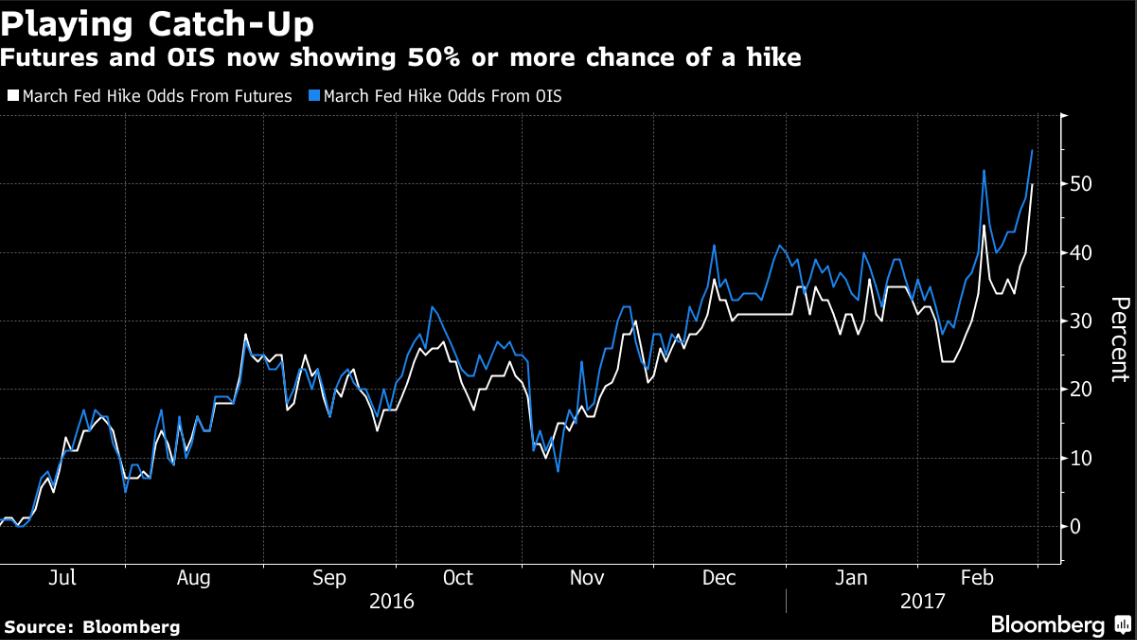
Despite the subdued growth and inflation, the Fed Funds futures are bumping up their probability of a March hike to about 50% now. There is the perception that Yellen's Fed is worried most about surprising the markets, so in some ways, this becomes a self-fulfilling prophecy. The more the Fed Funds futures price in a hike, the more likely the Fed is to vote for one. 


Home prices rose 5.8% in December, according to the Case-Shiller Home Price index. This is the fastest pace of acceleration in the past 2.5 years. Interestingly, we are starting to see correlations between the top tier and bottom tiers break down as the luxury market slows while the demand for starter homes increases. Much of that is inventory-driven, where starter homes are snapped up within a month of listing, while McMansions languish. Certainly in the Western MSAs, Chinese demand is a big factor, and that has been slowed by capital controls.

Housing demand increased 6.5% in January, according to Redfin. “Soaring stock markets, still low mortgage rates and a steady economy bolstered homebuyers at the start of 2017,” said Redfin chief economist Nela Richardson. “Homebuyers were not just window shopping, they were serious about making offers and getting to the closing table. However, this uptick in homebuyer enthusiasm won’t guarantee strong sales in the coming months. With pending home sales down across the country in January despite strong demand, the lack of supply is a formidable foe for buyers this year.”

The trade deficit widened to $69.2 billion in January from $64.4 billion in December. Exports fell 0.2% while imports rose 2.3%. The US dollar is playing a big part here, but I suspect this number will begin to take on more importance going forward, especially with respect to threats of protectionism, which will flow through to growth and ultimately interest rates. 

In other economic news, business activity strengthened in February, according to the Chicago PMI Index. Consumer confidence rose in February and stands at a 15 year high, according to the Conference Board. Finally, the Richmond Fed Manufacturing Index improved. 

Donald Trump will address Congress tonight, and lay out his vision for his administration going forward. Expect to see a call for increased defense spending, while cuts in discretionary spending to offset it, along with stepped up growth assumptions. Administration officials are signaling that the speech will be a Reaganesque "Morning in America" speech of optimism and economic growth. Those looking for details on his plans should probably not expect much in the way of clarity. The speech will probably not be market-moving unless it goes really badly, in which case you should expect a flight to safety, with lower stock prices and lower interest rates. Here are the sectors to watch: financials, retailers, healthcare.

Freddie Mac has put out its Outlook for the housing market and origination. They forecast a 27% drop in originations as the refi business goes away, with the 30 year fixed rate mortgage to average 4.4%. Their baseline prediction anticipates some fiscal stimulus out of DC, which should send inflationary expectations somewhat higher, but not cause a major increase. The second most likely scenario would be heavier fiscal stimulus, which would cause higher inflation, with higher interest rates, higher home price inflation, and lower origination numbers. The least likely scenario is a retrenchment of inflation (basically the Japan scenario).