A place where economics, financial markets, and real estate intersect.
Showing posts with label inflation. Show all posts

Monday, May 7, 2018

Morning Report: The US is at a Goldilocks moment with unemployment and inflation

Vital Statistics:

Last Change
S&P futures 2670 6.9
Eurostoxx index 388.46 1.44
Oil (WTI) 70.62 0.89
10 Year Government Bond Yield 2.94%
30 Year fixed rate mortgage 4.54%

Stocks are higher this morning as oil tops $70 a barrel. Bonds and MBS are flat.

Jobs report data dump:
  • Nonfarm payrolls 164,000 (lower than estimates)
  • Unemployment rate 3.9%
  • Average hourly earnings +.1% MOM / 2.6% YOY
  • Labor force participation rate 62.8%
This was the second month in a row where the labor force participation rate fell. The labor force fell by 236k, while the population increased by 175k. Wage inflation remains present, however it is still unlikely to drive higher inflation in the overall economy. The unemployment rate fell to the lowest since early 2000. This report takes some pressure off the bond market, and makes another run at 3% for the 10 year less likely. 


The drop in the unemployment rate along with moderate wage growth is somewhat of a Goldilocks moment for the Fed. The Philps Curve is an older economic model which suggests that inflation should rise as unemployment falls, which makes sense: Unemployment falls -> workers become scarce -> wages rise -> those costs get passed on to consumers. In reality, the relationship between unemployment and inflation has been weak (R^2 = .27). The low r-squared gives away the weakness of the model - it is too simplistic, plus the unemployment rate might not be the best measure of employment strength since it ignores the long term unemployed. However, if you look at the plot below, you can see we are at a very "Goldilocks" point, which is denoted by the yellow star.


The upcoming week will have the consumer price index and the producer price index, but that should be the only market-moving data. We will have some Fed-speak as well today and Wednesday. 

Donald Trump has until May 12 to renew the Iran deal. Israel calls the deal fatally flawed, while Iran says the US will regret not renewing it. West Texas Intermediate is trading over $70 on fears the deal will not be renewed. 

Doctors tend to have difficulties getting a mortgage early in their careers - they usually have a high level of student loan debt, no savings and the earnings early on can be low. Mortgages that carry a higher interest rate but don't require downpayments are becoming more popular for this market. These loans can carry an interest rate 25 -100 basis points over prevailing rates. although they usually don't require PMI. One catch - the prepay speeds on these mortgage will almost certainly be high. 

The CFPB dodged a bullet - PHH will not appeal the DC Circuit's ruling that rejected their claim that the single-director structure is unconstitutional. There are other cases in the process that also use that claim, so it is possible the question may come to SCOTUS. If one of these cases makes it to SCOTUS, the only one with standing to defend the agency is the Administration, who probably won't defend it.

Merger news: Mutual of Omaha is buying Synergy One. Synergy One will be a wholly-owned subsidiary and will continue to operate out of San Diego. 


Thursday, February 15, 2018

Morning Report: Goldman forecasting 3.5% on the 10 year this summer

Vital Statistics:

Last Change
S&P Futures  2707.0 10.3
Eurostoxx Index 377.0 2.5
Oil (WTI) 60.4 -0.2
US dollar index 82.9 -0.2
10 Year Govt Bond Yield 2.90%
Current Coupon Fannie Mae TBA 103.591
Current Coupon Ginnie Mae TBA 103.688
30 Year Fixed Rate Mortgage 4.44

Stocks are higher this morning on no real news. Bonds and MBS are flat.

Inflation at the wholesale level came in higher than expected as the Producer Price Index rose 0.4% MOM and 2.7% YOY. Ex-food and energy, the index was up 0.4% / 2.2% and the core rate was up 0.4% / 2.5%. The US dollar is weaker on the data, which adds to inflationary pressures. I suspect at some point dollar weakness will feed higher rates, but we aren't there yet. Treasuries look like they want to test the 3% level we reached after the taper tantrum. The 10 year yield hit 2.94% overnight, so we aren't all that far away. Goldman is forecasting 3.5% on the 10 year within the next 6 months on monetary tightening. Other strategists are raising their forecast for Fed tightenings as well, based on the additional stimulus of the budget deal and tax cuts. 

FWIW, after the inflation data, the Fed Funds futures are now predicting a 83% chance of a hike at the March meeting, and sentiment is coalescing for a total of 3 hikes this year, to take the Fed Funds rate to 2.0% - 2.25%. 

In other economic data, Initial Jobless Claims rose to 230k last week, while the Philly Fed rebounded to 25.8. The Empire State Manufacturing survey slipped. Industrial Production fell a tenth of a percent while Manufacturing Production was flat. Capacity Utilization fell 20 basis points to 77.5%. So, between the higher than expected inflation data and weaker manufacturing data, bonds are pretty much flattish. 

Donald Trumps proposed 2019 budget contemplated an 18% cut in HUD's budget, with the cuts largely coming from the end of the Community Development Block Grant program. At the end of the day, this budget is a messaging document and has 0% chance of becoming law as-is. 

Builder Sentiment was flat in February according to the NAHB. 


Tuesday, January 16, 2018

Morning Report: Possible government shutdown?

Vital Statistics:

Last Change
S&P Futures  2801.3 12.5
Eurostoxx Index 399.0 1.2
Oil (WTI) 63.9 -0.4
US dollar index 84.6 0.2
10 Year Govt Bond Yield 2.54%
Current Coupon Fannie Mae TBA 101.75
Current Coupon Ginnie Mae TBA 102.875
30 Year Fixed Rate Mortgage 4.03

Stocks are higher this morning as on overseas strength. Bonds and MBS are up small. 

Not a lot of market-moving data this week, however we do get housing starts and the FHFA House Price Index. Bank earnings will dominate the releases this week. 

The Empire State Manufacturing Survey came in a little weaker than expected, but was still pretty strong. Employment-related indicators (number of workers and average workweek) decelerated a touch, however the inflation indicators (both prices paid and prices received) increased. The bond market seems to be taking the inflation data in stride. 

The big thing this week will be a continuing resolution to keep the government open. The government will shut down if a budget deal isn't reached by Friday. Democrats are holding out over immigration. Republicans are weighing another short-term funding measure that will last until mid-February. 

So far, it looks like the meta-issue for 2018 will be inflation. Numerous companies have announced wage increases in response to the tax bill, and some states have raised the minimum wage. Commodity prices remain firm (especially food and energy). In order to really get inflation, we need wage inflation and so far we haven't really seen a lot in the BLS numbers. That said, with all the company announcements over raises this could be the year. 

Dallas Fed President Robert Kaplan believes we are going to "overshoot full employment" and he thinks we will need to see 3 rate hikes this year. His personal GDP forecast is 2.75% growth. "The history of overshooting full employment in this country has not been a happy one," he added. "Normally, what happens is you get an overheating, the Fed has to play catch up, and what happens then is you tend to often have a recession." Historically (post-Great Depression) that has been the case: the economy grows, inflation starts, and the Fed causes a recession to beat back inflation. That model probably works 90% of the time, but post-bubble economies are different, and have longer (and shallower) recoveries. The excesses of the bubble years may have been worked off, however the psychology of the bust instills a risk-aversion on the part of the business community that isn't necessarily conducive to inflation. Japan has been trying to create inflation since the early 90s and they still haven't been able to do it. The US isn't necessarily Japan, however the Japanese experience shows that the usual economic playbook goes out the window after asset bubbles. 

The black swan for US inflation? The bursting of the Chinese real estate bubble. This will be a drag on overall global growth and commodity demand. 

Friday, December 1, 2017

Morning Report: Corporate taxes and inflation

Vital Statistics:

Last Change
S&P Futures  2645.0 -3.0
Eurostoxx Index 386.0 -0.7
Oil (WTI) 57.8 0.4
US dollar index 86.8 0.1
10 Year Govt Bond Yield 2.39%
Current Coupon Fannie Mae TBA 102.625
Current Coupon Ginnie Mae TBA 103.625
30 Year Fixed Rate Mortgage 3.88

Stocks are falling victim to profit-taking (and possibly window-dressing) on the first day of the month. Bonds and MBS are up. 

Manufacturing slipped in November, according to the PMI Manufacturing Index. The ISM Manufacturing index moved slightly lower as well.

Construction spending rose 1.4% MOM and 2.9% YOY in October.

Negotiations continue on tax reform as Republican Senators made a lot of progress overnight. Issues about a financial trigger are separating fiscal hawks from conservatives. Probably the best summation of play:“We’re trying to get to a point where nobody is going to get exactly what they want but enough to get the bill passed,” Senator Thom Tillis of North Carolina said. Republicans need to have something to show in 2018, and this is something. At the end of the day, it will probably be more symbolic than substantial, at least on the individual income tax front. Cutting corporate taxes will almost certainly help the economy however.

Here is the thing to keep in mind about corporate taxes: Transfer pricing matters. Transfer pricing is how firms with international arms allocate revenues and expenses. For example, expenses like investor relations, legal, etc are used by the international arms as well and some of those costs should be allocated to them. If the company has operations in high tax and low-tax jurisdictions, they have the incentive to allocate all of their costs to the high tax jurisdiction and all of their revenues to the low tax jurisdiction. This minimizes US income and maximizes foreign income which results in companies making low payments to the IRS and high payments to foreign tax authorities. The US tax code effectively subsidizes foreign governments! It also locks up cash overseas, as companies have to pay US tax on that income once it is repatriated, which is even more of an incentive to shift earnings overseas. We have the highest corporate tax rate in the world, but the effective US tax rate is about what everyone else pays. If we equalize our corporate tax rate to the rest of the world, that incentive to play games with revenue and expense goes away. Which is why you could, at the margin, see revenues increase despite cutting corporate taxes. 

After tax reform, the focus in Washington turns to funding the government. Democrats are demanding action on immigration in exchange for yes votes on a continuing resolution. For all the posturing over these things, they invariably get resolved. 

Booms don't last forever, and neither do busts. After experiencing a generation of deflation, Japan is beginning to see the stirrings of inflation. Imported deflation from Asia has been a bit of a free lunch for the US as it allowed the Fed to be about as easy as it wanted without triggering inflation - at least inflation as measured by the Consumer Price Index. IMO, if Japan is recovering for real, and the Chinese economy maintains strength (i.e. their real estate bubble doesn't burst) then inflation is probably set to return. A Japanese recovery is a bit of a sea change for the Fed, and the return of the world's second biggest economy will gobble up the glut of capacity we currently have. This could force the Fed to act more quickly than it otherwise would. 

What does inflation mean for the US? First of all, more consumer comfort. An economy with low inflation and low wage growth is much more uncomfortable than an economy with moderate inflation and moderate wage growth. While this may seem counter-intuitive (if wages and prices are rising together, who cares what the rate is?) it matters because of debt. Rising wages and prices means that the relative size of a household's debt decreases over time. While this won't necessarily apply to floating rate debt like credit card debt, it will apply to things that are fixed, like car loans, student loans, and mortgages. Worries about 1970s style hyper-inflation in the US are also overblown. That phenomenon was largely due to the oil shocks and a host of other issues (capacity constraints) that are no longer applicable. 

Of course what is great for a borrower is necessarily bad for a lender (or people who own long-duration assets, like banks and insurance companies). I wouldn't rule out a hiccup in bank earnings or insurance company earnings, but I can't see anything systemic like we had in 2008. I do wonder how much this will affect the $4.5 trillion of assets owned by the Fed.

Overall, higher inflation will be good for the real estate market, as it means higher prices and higher employment. Higher inflation is most beneficial to the first time homebuyer. 

Thursday, July 13, 2017

Morning Report: More Yellen testimony today

Vital Statistics:

Last Change
S&P Futures  2443.0 3.0
Eurostoxx Index 386.4 1.5
Oil (WTI) 45.5 0.0
US dollar index 87.9 -0.1
10 Year Govt Bond Yield 2.33%
Current Coupon Fannie Mae TBA 102.625
Current Coupon Ginnie Mae TBA 103.59
30 Year Fixed Rate Mortgage 4.03

Stocks are flattish as Janet Yellen begins her second day of testimony in front of Congress. Bonds and MBS are flat.

Initial Jobless Claims fell to 247k last week, showing that employers are hanging on to employees.

Inflation still remains in check at the wholesale level, as the producer price index rose only 0.1% in June. Ex-food and energy it rose 1.9% YOY, which is below the Fed's target. Services increased 0.3%, which could indicate wage growth is beginning to happen.

The markets rallied yesterday on Janet Yellen's dovish comments. Fed-Watcher Tim Duy believes the markets have it wrong. His view is that Yellen has spent enough time at the Fed to understand that the longer the Fed waits to address inflation, the more aggressive they will need to be, which increases the risk of a recession. He basically lays out four scenarios:
  • Inflation rebounds while unemployment remains steady, which is the base case Fed scenario
  • Inflation remains low while unemployment holds steady. This is the market's bet. 
  • Inflation rebounds while unemployment goes lower: This would mean a more aggressive Fed in 2018
  • Inflation remains low while unemployment goes lower: Difficult for the Fed.
His view is that we see one of the latter two scenarios. FWIW, I think the unemployment rate is a bit of a red herring given that the employment to population ratio is still pretty low. Granted, some of that is demographic (older Boomers retiring) and some of it is discouraged workers, but a 4.5% unemployment rate today doesn't really mean the same thing it meant, say, 20 years ago. I think the mistake people make is that they fail to recognize that recoveries after burst residential real estate bubbles are fundamentally different animals, characterized by low inflation, weak demand, and risk aversion in business. Weak demand and risk aversion are not recipes for inflation. I suspect the second or the fourth scenario is the most likely. IMO, we won't see inflation until we see wage growth, and that has been slow to materialize. 

Angel Oak Advisors priced a $210 million deal of non-prime residential mortgages recently, and it looks like the second quarter may break $1 billion in non-prime RMBS. This is a record since the financial crisis, but is still a shadow of its former self. At one point during the boom, 1/3 of all mortgages were alt-A or subprime. Even if we hit a record for the rest of the year, we probably won't even sniff 5%. In fact, many of the loans being put in these securitizations wouldn't have even been considered non-prime during the bubble years. These loans are non-QM, and mainly consist of two types of  borrowers: self-employed who don't have enough W2 income and borrowers with a credit event in the past who have large down payments. The borrowers in Angel Oak's portfolio are paying between 5% and 9%. 

Why do appraisals sometimes come in low?  Typically, the problem is in apples-to-oranges comps (i.e. not in the neighborhood, or comps that had an issue like asbestos, mold, etc). The other big issue surrounds things that have value, but tend to get short shrift with appraisers: things like a nice finished basement, a good view, nice appliances, etc. Raised ranch homes are often problematic, as the lower level gets completely excluded from the square footage, basically cutting your square footage in half. 

Thursday, May 11, 2017

Morning Report: Starter homes are back

Vital Statistics:

Last Change
S&P Futures  2389.5 -5.8
Eurostoxx Index 394.6 -1.9
Oil (WTI) 48.0 0.6
US dollar index 90.6 0.1
10 Year Govt Bond Yield 2.41%
Current Coupon Fannie Mae TBA 102.06
Current Coupon Ginnie Mae TBA 103.53
30 Year Fixed Rate Mortgage 4.08

Stocks are lower this morning on lousy retailer earnings. Bonds and MBS are down small. 

Initial Jobless Claims fell to 236,000 last week which is a 28 year low. 

Inflation remains close to the Fed's 2% target, according to the Producer Price Index. The headline number rose 0.5% MOM and is up 2.5% on a YOY basis, but when you strip out food and energy, it is up 1.9% YOY. 

We had some hawkish statements from Boston Fed President Eric Rosengren yesterday, where he urged 3 more hikes this year as the economy is on an "unsustainable pace." His rationale is the unemployment rate at 4.4%, which is below his estimate for full employment at 4.7%. Of course sub 1% GDP growth is probably "sustainable" ad infinitum, and there is no evidence of much in the way of wage growth. He also doesn't think the tapering of MBS buying will affect mortgage rates too much, as long as it is gradual. 

Inflation isn't uniform, of course, and the index that measures it has to take this into account. Here is a chart of different goods and services and their inflation rates over the past 20 years:


The Canadians have a housing bubble on their hands, and the ratings agencies are getting worried. Canada is bedeviled with the same problem in the US of tight supply, although foreign demand is a big factor as well. Prices in Toronto rose 25% last year. Note that Canada's economy is highly dependent on strong commodity prices, and indirectly, Chinese demand. If / when the Canadian real estate bubble bursts, it will probably affect property prices in the Pacific Northwest. 


More evidence that builders are pivoting away from luxury building and towards more starter homes. In Q1, 854,000 new owner households were formed versus 365,000 new renter households. This is the first time new owners exceeded new renters in a decade. Fannie Mae's share of mortgages to first time homebuyers has been steadily increasing. We are seeing an increase in the number of new homes smaller than 2200 square feet. Even McMansion giant Toll Brothers is going smaller. 


FHFA Director Mel Watt is warning that the continuing sweep of Fannie Mae's profits to Treasury is risking confidence in the entity. His proposal is to let Fannie Mae retain their earnings in order to re-build its capital cushion. This is to prevent the GSEs from needing another bailout later on. Note that the Obama administration used Fannie's profits to paper over holes in Obamacare spending. 


Thursday, December 15, 2016

Morning Report: The Fed hiked, but the dot plot was the story

Vital Statistics:

Last Change
S&P Futures  2252.8 0.8
Eurostoxx Index 357.0 1.3
Oil (WTI) 50.1 -0.9
US dollar index 93.0 0.6
10 Year Govt Bond Yield 2.58%
Current Coupon Fannie Mae TBA 103
Current Coupon Ginnie Mae TBA 104
30 Year Fixed Rate Mortgage 4.14

Stocks are flat this morning after the FOMC meeting yesterday. Bonds and MBS are up small.

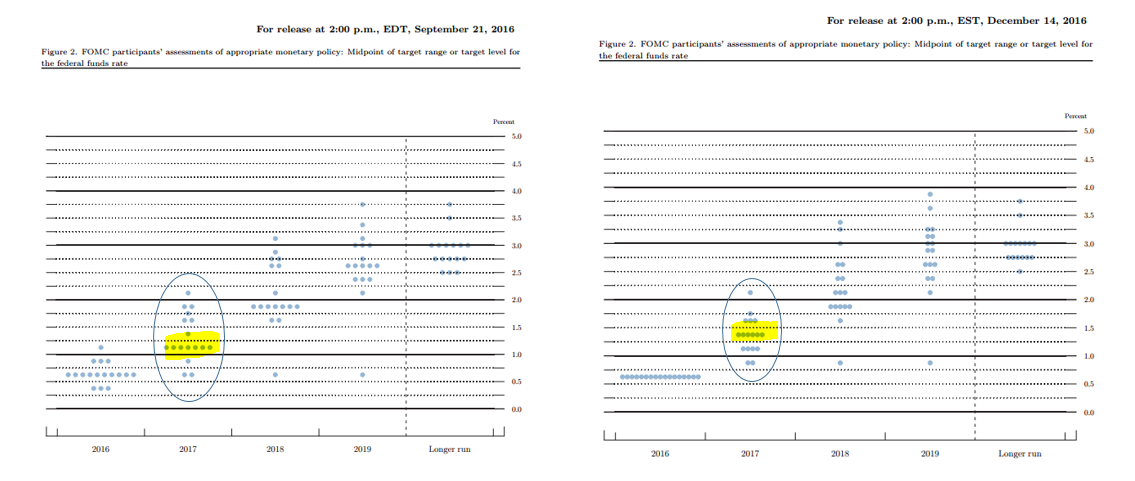
The Fed raised the Fed Funds rate a quarter of a point yesterday as expected, but the dot plot was what garnered all the attention. At the September meeting, the FOMC members were forecasting two more rate hikes in 2017, and now they are forecasting 3. That hit bonds, which sent the 2 year note yield up 12 basis points and the 10 year up 13 basis points. Overall, the language of the statement didn't change much, and neither did the economic forecasts. Aside from a small uptick in their forecast for 2017 GDP growth, most everything else was the same. You can see the change in the central tendency for 2017 in the comparison of the dot plots below. September's plot is on the right, and December is on the left. The yellow line represents the central tendency. 


Due to the volatility, most lenders shut down their lock desks, so mortgage rates didn't really move all that much, but expect to see at least some movement, although mortgage rates tend to lag the moves in the 10 year, sometimes quite substantially. The last few tightening cycles have seen a flattening of the yield curve, so an anticipated increase of 75 basis points in the Fed funds rate doesn't necessarily translate into a 75 basis point increase in the 10 year. Mortgage rates will almost undoubtedly increase by less than the increase in the 10 year. And if rates are going up for the right reasons (economic growth) that means the purchase business should offset some of the losses of the refi business. 

Janet Yellen's press conference was largely a non-event. She spent it dodging questions about how Donald Trump looks at the world and stressed the Fed will remain data-dependent. The issue of productivity kept coming up, and how Trump will use policies to improve on it (via regulatory reform and corporate tax cutting). Productivity growth should translate into non-inflationary wage growth, which is what everyone is hoping for. 

Bottom line: The Fed is going to fade into the background again, and Donald Trump will be driving the news cycle and bond yields. If Congress adds fiscal stimulus, the Fed will probably be more aggressive. Note the dot plot is only a forecast. In fact, many of those dots represent forecasts for people who are not voting members on the FOMC. The Fed might hike 3 times in 2017, but the 10 year yield probably won't go up as much, and mortgage rates will go up even less. 


Inflation at the consumer level increased 0.2% last month, and is up 1.7% YOY. The core rate (excluding food and energy) is up 0.2% MOM and 2.1% YOY. Healthcare and rent drove the increase

We have some manufacturing data as well: Industrial production fell 0.4% MOM and manufacturing production fell 0.1%. Capacity Utilization was flat at 75%. The Philly Fed manufacturing index jumped to 22 from 10 and the Empire State Manufacturing Index improved to 9 from 6. Finally business inventories fell 0.2%. 

Initial Jobless Claims fell 4k last week to 254,000. These are the lowest levels since the early 70s. 

The median house price rose almost 8% in November, according to RedFin. According to their numbers, the median house price is 274k and months of inventory is 3.4 (meaning they see the inventory situation much tighter than NAR does in their existing home sales report). 

Wednesday, June 15, 2016

Morning Report: Awaiting the Fed

Vital Statistics:

Last Change Percent
S&P Futures  2070.3 4.4 0.21%
Eurostoxx Index 2840.2 43.0 1.54%
Oil (WTI) 47.9 -0.6 -1.22%
LIBOR 0.653 -0.003 -0.47%
US Dollar Index (DXY) 94.77 -0.156 -0.16%
10 Year Govt Bond Yield 1.62% 0.01%
Current Coupon Ginnie Mae TBA 105.9
Current Coupon Fannie Mae TBA 105
BankRate 30 Year Fixed Rate Mortgage 3.66

Stocks are higher this morning as we await the FOMC decision at 2:00 pm today. Bonds and MBS are flat.

Bonds had a sensational rally yesterday, with the 10 year yield falling to 1.57% and the German Bund going negative before giving it all back. The Bund is basically at zero this morning. 

The FOMC decision is due out at 2:00 pm EST today. No one is expecting a rate increase, but we the press release and press conference might have some market-moving news. We will also get new a new Fed Funds dot graph and updated forecasts for inflation, unemployment, and GDP growth. Here is a primer on what to look for. 

Mortgage Applications fell 2.4% last week as purchases fell 4.9% and refis fell 0.7%. Refis accounted for 55% of the total number of loans.

Inflation remains in check at the wholesale level, as the producer price index rose 0.4% MOM and fell 0.1% YOY. Ex food and energy, the PPI was up 1.2%, much lower than the Fed's 2% target rate.

Paul Singer of Elliott discusses central banks and how all of their policies have been slowing growth and exacerbating inequality. He is bearish on stocks, bullish on gold. Separately, Jeffrrey Gundlach of DoubleLine says that central bankers are losing control

Completed foreclosures ticked up to 37,000 in April from 36,000 a month ago, however they are down 16% YOY. The foreclosure inventory is just over 400,000 homes, which works out to be 1.1% of all homes with a mortgage. This number is down 23.4% from a year ago. Foreclosure inventory remains concentrated in the Northeast, Florida, and the sand states. 

iServe got a nice mention in Rob Chrisman's blog this morning. If you want to learn more about VA loans, we conduct seminars all over the US with our VA expert. We serve those that served. 

In other economic news, the New York State Empire Manufacturing Index rebounded in June, while industrial production and manufacturing production fell in May. Motor vehicles (which can be volatile) accounted for a big part of the drop. Capacity Utilization fell to 74.9%. Interestingly, more CEOs intend to increase capital expenditures than they did in the first quarter. 

Friday, February 19, 2016

Morning Report: inflation returning to the Fed's target

Vital Statistics:

Last Change Percent
S&P Futures  1910.0 -6.6 -0.34%
Eurostoxx Index 2867.6 -27.6 -0.95%
Oil (WTI) 30.09 -0.7 -2.21%
LIBOR 0.619 0.001 0.19%
US Dollar Index (DXY) 96.93 -0.019 -0.02%
10 Year Govt Bond Yield 1.77% 0.03%
Current Coupon Ginnie Mae TBA 105.3
Current Coupon Fannie Mae TBA 104.8
BankRate 30 Year Fixed Rate Mortgage 3.68

Markets are lower this morning on no real news. Bonds and MBS are down.

Real Average weekly earnings increased 1.2% in January.

Inflation at the consumer level was flat month-over-month and up 0.3% YOY. Ex food and energy, it was up 2.2%, which is the highest level since June of 2012. This would indicate the Fed is actually getting there as far as its inflation target. That said, the Fed prefers to use the Personal Consumption Expenditure index, which is still below their target.

Chart: YOY inflation, ex-food and energy:


Good explanation of why the markets and the price of oil have become positively correlated. Old timers might remember back when an increasing oil price was a bad thing. Punch line: the banks have a lot of exposure to the energy patch and are lugging debt that made sense at $60 a barrel, but not at $30. That said, energy companies have issued $5 billion in equity secondary offerings this year, which is a surprise. The appetite is there, at least for some investors. 

The thinking behind negative interest rates, explained. European economists give their take on it. Basically they work well in smaller. open economies as a lever to manipulate foreign exchange rates, but they aren't all that effective for larger economies which are trying to boost inflation and growth. In other words, they might work for Denmark, but probably won't do much good here. Japan recently went negative, so that will be a good test of that theory.

Housing affordability is getting a little better as rates fall. Unsurprisingly, the Rust Belt and the Northeast are the most affordable, while California remains the worst. Note San Francisco is proposing transfer taxes for luxury properties in order to address affordability. Between rich tech workers and Chinese investors, property prices in San Francisco are sky-high. 

There is legislation afoot to eliminate the caps on VA loans, which will make them much more popular in high cost areas. Basically it will become a no money down jumbo. It has passed the House, and the prospects are good in the Senate and the WH. 


Friday, September 18, 2015

Morning Report: FOMC data dump

Vital Statistics:

Last Change Percent
S&P Futures  1949.8 -27.4 -1.39%
Eurostoxx Index 3155.6 -100.2 -3.08%
Oil (WTI) 45.32 -1.6 -3.37%
LIBOR 0.34 0.005 1.60%
US Dollar Index (DXY) 94.32 -0.311 -0.33%
10 Year Govt Bond Yield 2.15% -0.04%
Current Coupon Ginnie Mae TBA 104.4 0.1
Current Coupon Fannie Mae TBA 104.1 0.2
BankRate 30 Year Fixed Rate Mortgage 3.84

Stocks are getting crushed this morning after the FOMC decision to not raise rates. Bonds and MBS are rallying.

The index of leading economic indicators rose 0.1% in August.

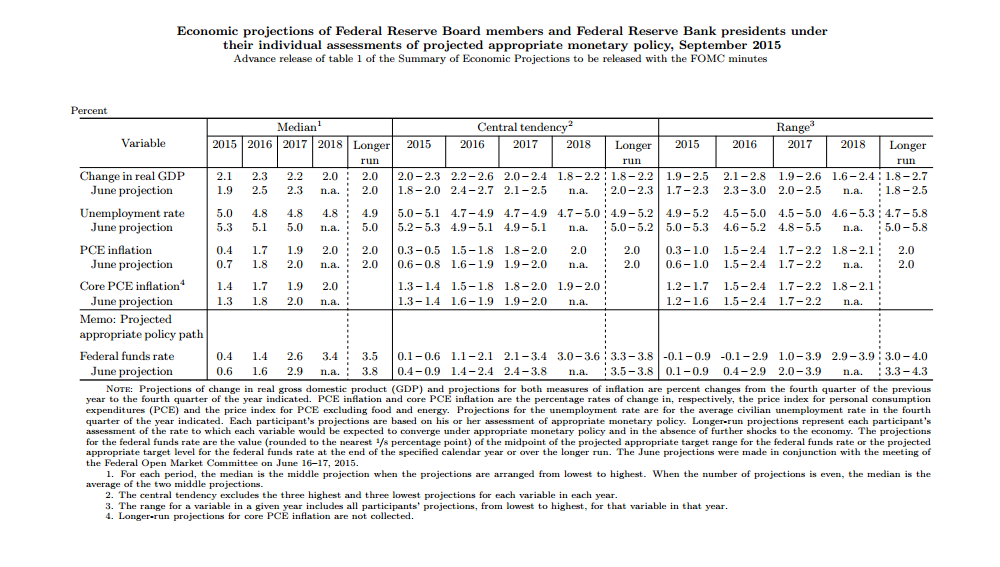
The Fed maintained rates yesterday, citing concerns over the global economy. Bonds rallied on the news while stocks rallied initially and then sold off. Even the statement was dovish. The new economic forecasts lowered GDP, unemployment, and inflation projections. The dot graph showed FOMC participants are forecasting lower interest rates through 2018 than they were in June. In fact, one participant thinks rates should be lower! Take a look at the dot graph below. Someone is predicting the Fed Funds rate should be negative this year and next. That is new. 


Here are the economic projections:


GDP is lowered, as is unemployment to below 5%. Note the Fed doesn't think it will hit its inflation target of 2% until 2018 (!). To me, this means the Fed is anticipating that the labor force participation rate is going to stay low - that is the only way to explain low unemployment and low GDP. They also seem to think that the overhang of these workers on the sidelines will be enough to keep wage inflation low. 

What does that mean for bonds and mortgage rates? If that forecast plays out, you could see short term rates increase and long term rates really not move all that much. To me it means a few more years of mortgage rates right around where they are now. This should be good for housing.


Thursday, July 30, 2015

Morning Report - Q2 GDP disappoints, but Q1 revised positive

Vital Statistics:

Last Change Percent
S&P Futures  2093.2 -8.3 -0.39%
Eurostoxx Index 3585.0 9.4 0.26%
Oil (WTI) 48.99 0.2 0.41%
LIBOR 0.297 0.003 0.92%
US Dollar Index (DXY) 97.47 0.494 0.51%
10 Year Govt Bond Yield 2.28% 0.00%
Current Coupon Ginnie Mae TBA 103.9 -0.2
Current Coupon Fannie Mae TBA 103.3 -0.1
BankRate 30 Year Fixed Rate Mortgage 3.97

Markets are lower this morning after 2Q GDP disappoints. Bonds and MBS are flat

The advance estimate for second quarter GDP came in at 2.3%, missing the 2.5% street estimate. However, that may have been due to the fact that the first quarter number was revised upward from -0.2% to 0.6%. In essence, people were expecting a big bounceback from the weak first quarter, however some of that bounceback was pulled back into Q1. The consumption number was better than expected at 2.9%, and the core PCE (personal consumption expenditure - the Fed's preferred measure of inflation) was 1.8%, just below the Fed's target. Government spending was flattish as was private investment. This pretty much says that consumption is getting better with the labor market, however business investment is still depressed, which is probably more due to overseas concerns than domestic ones. The next big economic "tell" will be the back-to-school shopping season, which is right around the corner. 

The FOMC statement was a non-event yesterday. They noted continued improvement in the labor market, although they want to see further improvement before they raise rates. Given the GDP report (especially the inflation data), it is looking more probable that the Fed moves in September. 

Initial Jobless Claims rose to 267k after hitting a multi-decade low last week. The big question for the Fed is when wage growth begins to happen. That will be a function of whether some of the people who have exited the labor force want to (and are able to) return to the labor market. If not, then we should start seeing wage inflation sooner. FWIW, hearing anecdotally that the job market for recent college grads is strong this year. 

Michael Feroli, Chief US Economist at J.P. Morgan draws parallels between the current economy and that of 1966, with regards to inflation. The Fed got behind the curve and ended up chasing inflation throughout the 1970s. IMO, there are big differences between 1966 and today, most notably the lack of international competition back then. Europe and Asia really didn't rebound from WWII until the 1970s, so the US had no competitive forces pushing prices down. That simply isn't the case today. If anything, the strength in the U.S. dollar is keeping commodity and import prices low, which is keeping a lid on inflation. Wage growth will be key. No wage growth, no wage-price spiral. 

Wednesday, July 15, 2015

Morning Report - Janet Yellen testifying today

Vital Statistics:

Last Change Percent
S&P Futures  2102.9 0.8 0.04%
Eurostoxx Index 3620.5 13.4 0.37%
Oil (WTI) 52.64 -0.4 -0.75%
LIBOR 0.289 0.003 1.05%
US Dollar Index (DXY) 96.9 0.256 0.26%
10 Year Govt Bond Yield 2.42% 0.02%
Current Coupon Ginnie Mae TBA 103.7 0.4
Current Coupon Fannie Mae TBA 102.7 0.4
BankRate 30 Year Fixed Rate Mortgage 4.21

Stocks are flattish this morning as economic data and earnings pile in. Bonds and MBS are down.

Janet Yellen will testify in front of the House Financial Services Committee this morning at 10:00. Her prepared remarks are here. She is basically saying the economy is expected to re-accelerate after the Q1 weakness, and if that plays out as expected, the Fed will probably make the move off the zero bound later this year. The rest of the testimony will generally consist of Republicans trying to get her to say that government spending and taxes are too high, and Democrats trying to get her to say that income inequality is the biggest threat to our planet today. 

Mortgage Applications fell 1.9% last week, as purchases fell 7.5% and refis rose 3.7%. 

Inflation at the wholesale level came in a little hotter than expected - 0.4% on the headline number, and 0.3% on the ex-food and energy number. 

Industrial Production rose 0.3% in June, a little better than the 0.2% expectation. Capacity Utilization rose to 78.4% from 78.2% last month. Manufacturing Production was flat. The Empire Manufacturing Index came in at 3.86. So manufacturing rebounded a little after a dismal start to the year. 

Bank of America reported better than expected earnings this morning. Mortgage origination increased 40%. 

Friday, May 22, 2015

Morning Report - inflation is running a touch hotter than expected.

Vital Statistics:

Last Change Percent
S&P Futures  2125.1 -2.9 -0.14%
Eurostoxx Index 3678.9 -9.8 -0.27%
Oil (WTI) 59.82 -0.9 -1.48%
LIBOR 0.284 0.003 0.89%
US Dollar Index (DXY) 95.72 0.469 0.49%
10 Year Govt Bond Yield 2.21% 0.02%  
Current Coupon Ginnie Mae TBA 102 0.0
Current Coupon Fannie Mae TBA 100.8 -0.2
BankRate 30 Year Fixed Rate Mortgage 3.89

Markets are lower after some hotter-than-expected inflation data. Bonds and MBS are down.

Bonds will close early today, at 2:00 pm EST. Stocks are open a full day. 

The Consumer Price Index increased .1% in April, bang in line with expectations. Prices ex-food and energy rose .3% vs. the .2% forecast. On an annual basis, the CPI ex food and energy is up 1.8%. 

Real Average Weekly Earnings rose 2.3% on an annualized basis in April. 

Janet Yellen will be speaking at 1:00 pm EST. I can't imagine she will say anything market moving an hour before the close on a 3-day weekend, but just be aware. Markets will become illiquid as the entire street will be on the L.I.E. by noon. 

Short missive today, as there really isn't much to talk about. Have a good Memorial Day Weekend.

Friday, April 17, 2015

Morning Report - sentiment and wages improving slowly

Vital Statistics:

Last Change Percent
S&P Futures  2086.8 -14.0 -0.67%
Eurostoxx Index 3685.8 -66.0 -1.76%
Oil (WTI) 56.23 -0.5 -0.85%
LIBOR 0.274 -0.001 -0.44%
US Dollar Index (DXY) 97.71 0.296 0.30%
10 Year Govt Bond Yield 1.90% 0.01%
Current Coupon Ginnie Mae TBA 103.7 0.1
Current Coupon Fannie Mae TBA 102.5 -0.2
BankRate 30 Year Fixed Rate Mortgage 3.73

Stocks are lower this morning after Chinese shares got roughed up overnight. Bonds and MBS are down small. 

Inflation remains well contained and below the Fed's target. Consumer Prices rose .2% in March. On a year over year basis, they were down .1%. Ex food and energy, they were up 1.8%. Real weekly earnings were up 2.2%. The wage inflation number is encouraging, as wage growth is the last piece of the puzzle. 

Consumer Sentiment rose, according to the University of Michigan Consumer Sentiment Survey. Current conditions and expectations both increased. 

The Index of Leading Economic Indicators improved slightly in in March, to 0.2% from a downward-revised 0.1% in February. 

The NAHB is pushing Congress to pass the Mortgage Choice Act, which makes some modifications to the definitions of points and fees in order for a mortgage to be considered a qualified mortgage. They believe credit is too tight, and the regulatory agencies are part of the reason why. Interesting given the lousy housing starts number this week.