A place where economics, financial markets, and real estate intersect.
Showing posts with label bank of america. Show all posts

Tuesday, April 17, 2018

Morning Report: Housing starts still below demand

Vital Statistics:

Last Change
S&P futures 2698 16.25
Eurostoxx index 379.67 1.95
Oil (WTI) 66.26 0.05
10 Year Government Bond Yield 2.83%
30 Year fixed rate mortgage 4.44%

Stocks are higher this morning as China relaxes ownership restrictions on domestic manufacturers. Bonds and MBS are flat. 

We have a lot of Fed-speak today, especially in the morning. Separately, Trump announced two Fed nominees: Richard Clarida of Columbia, to be the Vice Chairman of the Fed and Michelle Bowman, previously a bank executive from Kansas. For all of his criticism of the Fed while on the campaign trail, Trump has nominated pretty much middle-of-the-fairway people to the Board. 

Housing starts came in at 1.32 million, better than expectations but still well below what is needed to meet demand. Building Permits came in at 1.35 million. Single family starts fell, while multi rose. Most of the increase was in the Midwest. 

Industrial Production rose 0.5% last month, while manufacturing production rose 0.1%. Capacity Utilization increased to 78%. So far we aren't seeing any tariff effects in the numbers.

Bank of America announced earnings yesterday, and lumped mortgage banking income into the miscellaneous "all other income" category. What an ignominious end to Countrywide. Bank earnings season continues.

Independent mortgage bankers saw profit per loan get cut in half last year as refis dried up and the business got more competitive. Refis fell from 36% of all origination volume to 25%. 

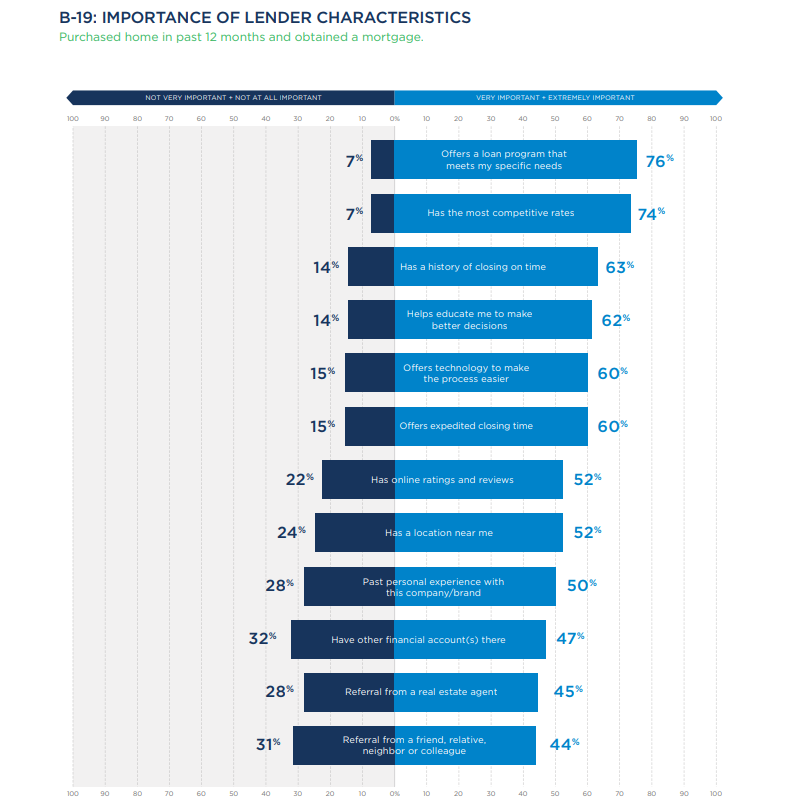
Zillow crunched the numbers and looked at the typical homebuyer in 2017. The typical buyer is 40 years old, making 87k. Millennials make up 42% of the cohort. They typically spend about 4.3 months finding a home. Interestingly, despite the size of the investment, most homebuyers only contacted 1 lender. Here is what is important to homebuyers when thinking about a lender:

The median home was sold in 81 days, and that includes the closing process. This means the typical home was on the market for only 1 month. This is 8 days faster than 2016. 

The National Low Income Housing Coalition has a new report showing how acute the housing shortage is at the low end. Only 35 affordable and available rental homes exist for every 100 extremely low income renter households. Rising home prices and mortgage rates are reducing affordability, however interest rates are still extremely low historically. In the early 80s, a the first year's mortgage payment consisted of 99% interest, 1% principal. 

The IMF forecasts that global growth will hit 3.9% this year, the fastest since 2011, driven by emerging Europe, and the US. 

Thursday, April 14, 2016

Morning Report: Originations and Margins fall for Wells

Vital Statistics:

Last Change Percent
S&P Futures  2079.4 3.5 0.17%
Eurostoxx Index 3053.6 14.4 0.47%
Oil (WTI) 42.03 0.3 0.65%
LIBOR 0.63 0.000 -0.04%
US Dollar Index (DXY) 94.78 0.033 0.03%
10 Year Govt Bond Yield 1.79% 0.03%
Current Coupon Ginnie Mae TBA 105.5
Current Coupon Fannie Mae TBA 104.7
BankRate 30 Year Fixed Rate Mortgage 3.62

Stocks are up this morning as commodities rally. Bonds and MBS are down.

Initial Jobless Claims fell to 253k from 266k the week before. This is the lowest reading since 1973. When you take into account population growth, the number is even more dramatic. Employers are hanging onto their workers, but they aren't necessarily paying them more. 

Inflation remains muted at the consumer level, with the Consumer Price Index rising 0.1% month over month. Ex-food and energy, it is up 0.9%. The core index, which excludes food and energy was up 0.1% MOM and 2.2% YOY. Real average weekly earnings were up 1.1%. 

Consumer comfort increased slightly last week to 43.6 from 42.6 the week before. 

Wells reported numbers this morning, with a decrease in profit on loan loss provisions. Mortgage loan origination volume and margins both fell on a QOQ and YOY basis. Originations fell 6% from Q4 and 10% YOY. Margins fell 15 bps QOQ and 25 bps YOY. Non-conforming mortgage growth was up 8% YOY. The stock is down a couple percent pre-open. Overall, lower net interest margins are hurting the banking business in general. Separately, the US government increased Well's "systemically important" rating, which means they could be subject to higher capital requirements. JP Morgan, Citi, Morgan Stanley and Goldman are also in that club. 

Bank of America also reported weaker-than expected earnings this morning. Losses in the energy patch are hurting them. The stock is down about a percent. The big legal fees and settlements should be in the rear view mirror now. 

Hillary Clinton and Bernie Sanders are debating in New York over whether the financial industry should be drowned in boiling oil or just put before a firing squad. 

Wednesday, January 20, 2016

Morning Report: Housing starts fall

Vital Statistics:

Last Change Percent
S&P Futures  1844.8 -28.1 -1.50%
Eurostoxx Index 2902.8 -77.7 -2.61%
Oil (WTI) 27.77 -0.7 -2.42%
LIBOR 0.624 0.004 0.68%
US Dollar Index (DXY) 99.01 0.019 0.02%
10 Year Govt Bond Yield 1.99% -0.06%
Current Coupon Ginnie Mae TBA 104.9
Current Coupon Fannie Mae TBA 104.2
BankRate 30 Year Fixed Rate Mortgage 3.74

Another down day in stocks as global indices hit bear market levels. Yes, Virginia that is a 1-handle on the 10 year...

Housing starts fell in December from 1.17 million to 1.15 million, missing the 1.2 million Street estimate. Building permits fell from 1.28 million to 1.23 million, topping the 1.2 million estimate. Single-fam permits hit the highest level in 8 years. I sound like a broken record, but the economy isn't going to hit the next level until housing construction returns to normalcy, about 1.5 million units per year. The plus side of this is that the housing deficit continues to grow, which means the rebound (when it happens) will be stronger and longer. Confidence and credit remain the issues at the moment.

Mortgage Applications rose 9% last week as refis rose 18.7% and purchases fell 1.6%. With the 10 year trading below 2% again, there should be refinance opportunities. With the 10 year yield falling and the Fed Fund rate increasing, the strategy to pitch is to swap out of an ARM (which is pegged to short term rates) and into a 30 year fixed. 

Inflation remains under control, as the consumer price index fell 0.1% in December. Ex-food and energy it increased 0.1%.  

The dramatic sell-off in the markets has taken down rate hike expectations out of the Fed. You can see this in the 2 year bond yield, which has fallen 25 basis points since late December. This forecast was borne out in the latest Bank of America survey on the economic outlook. A month ago, 40% of fund managers expected no more than 2 rate hikes in 2016. Now that number is closer to 50%. 


Earnings season is upon us, and the first companies to report are out of the banking sector. The main theme: a withdrawal from mortgage banking. The only big bank to report an increase in mortgage banking? Wells. Jamie Dimon said on JP Morgan's conference call that the banks remain under assault. And politicians in DC continue to scratch their heads and wonder why the economy remains tepid.  Refer to housing starts above. 

Wednesday, July 15, 2015

Morning Report - Janet Yellen testifying today

Vital Statistics:

Last Change Percent
S&P Futures  2102.9 0.8 0.04%
Eurostoxx Index 3620.5 13.4 0.37%
Oil (WTI) 52.64 -0.4 -0.75%
LIBOR 0.289 0.003 1.05%
US Dollar Index (DXY) 96.9 0.256 0.26%
10 Year Govt Bond Yield 2.42% 0.02%
Current Coupon Ginnie Mae TBA 103.7 0.4
Current Coupon Fannie Mae TBA 102.7 0.4
BankRate 30 Year Fixed Rate Mortgage 4.21

Stocks are flattish this morning as economic data and earnings pile in. Bonds and MBS are down.

Janet Yellen will testify in front of the House Financial Services Committee this morning at 10:00. Her prepared remarks are here. She is basically saying the economy is expected to re-accelerate after the Q1 weakness, and if that plays out as expected, the Fed will probably make the move off the zero bound later this year. The rest of the testimony will generally consist of Republicans trying to get her to say that government spending and taxes are too high, and Democrats trying to get her to say that income inequality is the biggest threat to our planet today. 

Mortgage Applications fell 1.9% last week, as purchases fell 7.5% and refis rose 3.7%. 

Inflation at the wholesale level came in a little hotter than expected - 0.4% on the headline number, and 0.3% on the ex-food and energy number. 

Industrial Production rose 0.3% in June, a little better than the 0.2% expectation. Capacity Utilization rose to 78.4% from 78.2% last month. Manufacturing Production was flat. The Empire Manufacturing Index came in at 3.86. So manufacturing rebounded a little after a dismal start to the year. 

Bank of America reported better than expected earnings this morning. Mortgage origination increased 40%. 

Wednesday, January 16, 2013

Morning Report - What a difference a year makes

Vital Statistics:

Last Change Percent
S&P Futures  1462.4 -2.8 -0.19%
Eurostoxx Index 2688.7 -12.9 -0.48%
Oil (WTI) 93.32 0.0 0.04%
LIBOR 0.303 0.000 0.00%
US Dollar Index (DXY) 79.86 0.085 0.11%
10 Year Govt Bond Yield 1.80% -0.03%
RPX Composite Real Estate Index 191.7 0.3

Markets are weaker this morning after the World Bank cut its global growth forecast.  Goldman and JP Morgan both reported better than expected earnings. Mortgage applications rose 15% last week and the CPI showed that inflation remains under control. Industrial production rose .3% and capacity utilization rose to 78.8%.  Bonds and MBS are up.

The National Association  Homebuilders Confidence index held at 47 in January, the highest level since April of 2006. A reading of 50 represents the point where builders view conditions as neutral. Conditions improved in all areas of the country, with the West performing the best, while the Midwest and Northeast performing the worst. This is the second sentiment report that has the "what a difference a year makes" theme.

The CoreLogic Home Price Index rose 7.4% YOY in Nov 2012. This is the largest gain since May of 2006.   Excluding distressed sales, home price increased nationally by 6.7%.  December's gain is forecast to be down .5% MOM (reflecting the typical seasonal pattern) and will be up 8.4% YOY. Mark Fleming, the Chief Economist made a point about QM - "that the recently released Qualified Mortgage rules issued by the CFPB are not expected to significantly restrict credit availability relative to today."  I am sure Cordray is breathing a sigh of relief on that one... the point of the QM rule was to expand credit.

Bank of America is intent on growing the mortgage business again after a hasty retreat in 2011. Of course this meant they missed the mother of all refinancing booms. They exited the wholesale business and basically ceded the market leader position to Wells Fargo. It also signals that they believe the worst is behind them with respect to Countrywide.

It is looking more and more like Republicans will not force a showdown on the debt ceiling (though "clean" debt ceiling increases have been rare in the past).  The polls aren't with them and the politics aren't there. Republicans will probably save spending cut demands for the sequester and the continuing resolution.

It looks like the case against Stevie Cohen has hit a wall.

Monday, January 7, 2013

Morning Report - Basel III

Vital Statistics:

Last Change Percent
S&P Futures  1455.6 -2.1 -0.14%
Eurostoxx Index 2697.9 -11.4 -0.42%
Oil (WTI) 92.64 -0.5 -0.48%
LIBOR 0.305 0.000 0.00%
US Dollar Index (DXY) 80.56 0.061 0.08%
10 Year Govt Bond Yield 1.90% 0.00%  
RPX Composite Real Estate Index 192.4 0.3  

Markets are slightly lower this morning after last week's big rally.  This week looks to be relatively light data-wise.  4Q earnings season kicks off tomorrow with Alcoa announcing after the close. Bonds are up small after last week's sell-off and MBS are flat.

Basel has relaxed some of the requirements for the liquidity coverage ratio, and delayed the implementation in response to requests from the ECB. The ECB feared that the new requirements would lead to a credit crunch and would require banks to be over-invested in sovereign debt. Now banks will be allowed to count corporate debt, residential MBS, and even equities as liquid assets.  While MBS and bond price behavior is dominated by the Fed and QE, the net effect will push banks to hold MBS and sell Treasuries, so you should be aware that the 10-year could sell off and MBS could rally.

On the other side of the coin, last week's sell off in bonds and MBS has fueled fears that the housing recovery may stall as rates rise. Much of the boom in prices last year was in areas hit hard by distressed sales, as professional investors snapped up properties in places like Phoenix, Las Vegas and Detroit.  The 20% price increases there have probably run their course.  Rising rates would certainly end the refi boom that banks have feasted on for the past year, meaning originators will have to go back to the ground game of building relationships with realtors and focusing on purchase activity.

The worst merger in history continues to plague BOA.  They agreed to pay Fannie Mae $3.6 billion to settle repurchase claims and to repurchase another $6.75 billion of bad mortgages. Worst merger since Steve Case sold Ted Turner a bill of goods just as the internet bubble was bursting. Separately, Nationstar purchased a $215 billion servicing portfolio from BOA as well. Half is GSE / Govvie and half is private label. They paid $1.3 billion.

Republicans have declared tax increases off the table for the upcoming negotiations on the debt ceiling and the sequestration. Obama has already said that cutting spending has to go "hand-in-hand with tax law changes so that the wealthiest corporations and individuals can't take advantage of loopholes and deductions that aren't available to most Americans." My guess is that he is talking about carried interest and oil "subsidies" and not about further increases in marginal tax rates or further limiting the mortgage interest deduction. Oh, and we need a clever name for the upcoming negotiations on the sequestration and debt ceiling.