A place where economics, financial markets, and real estate intersect.
Showing posts with label employment situation report. Show all posts

Friday, September 7, 2018

Morning Report: Average hourly earnings tick up again

Vital Statistics:


LastChange
S&P futures2870.5-9
Eurostoxx index372.33-1.26
Oil (WTI)67.74-0.02
10 year government bond yield2.92%
30 year fixed rate mortgage4.57%

Stocks are lower this morning on overseas weakness. Bonds and MBS are down. 

Jobs report data dump:
  • Payrolls up 205,000
  • Unemployment rate 3.9%
  • Average hourly earnings up 2.9%
  • Labor force participation rate 62.7%
The payroll number and the wages were higher than what the Street was looking for, which explains the reaction in the bond market. The labor force participation rate fell as 467,000 workers dropped out of the labor force. A big decrease was seen in the 16-19 year old category, which would mean summer jobs ending. With more and more schools starting in before Labor Day, perhaps it is time for BLS to make some re-adjustments in their seasonality calculations. In terms of sectors, professional and business services rose by the most, followed by health care. Surprisingly, construction increased going into what is a seasonally slow period and despite the jump in same store sales, retailers shed jobs. Overall, a decent report, which should keep stock investors happy and will also give bond investors something to fret about. Wage growth is getting close to a 3-handle and that will be a big number. 


In response to the jobs report, the December Fed Fund futures raised their 2 hike probability to 75%. 

The Trump administration continues to hammer out a trade deal with Canada and Mexico. Separately, the deadline passed for an additional 200MM in Chinese tariffs, which means he can implement them at any time. 

Rep. Jeb Hensarling penned an editorial in the Wall Street Journal yesterday, where he laid out a framework for dealing with the GSEs. His solution will be to run everything through Ginnie Mae, with private capital taking the first loss position, and the taxpayer taking a catastrophic loss position. It would create a common securitization platform and still maintain some sort of affordable housing fund. Originators would have to get a private credit enhancer to guarantee the loan. The private credit enhancer would have to be market-based and have a bank-like balance sheet. Note that this is the first bipartisan housing reform bill, which means we may be getting closer to having the political will to de-nationalize the US mortgage market. 

Skilled construction labor is hard to find. 83% of builders report some sort of shortage for rough carpenters. It is even worse for subcontractors. With those sorts of shortages, we should see wages accelerate. It is inevitable. The 9-occupation trade shortage is as big as it has ever been. 


Monday, June 4, 2018

Morning Report: Why we aren't seeing a lot of wage growth (yet), and what the left gets wrong about the labor markets

Vital Statistics:

Last Change
S&P futures 2743 9.7
Eurostoxx index 388.45 1.55
Oil (WTI) 65.49 -0.32
10 Year Government Bond Yield 2.91%
30 Year fixed rate mortgage 4.54%

Stocks are higher this morning on no real news. Bonds and MBS are flattish.

We should have a relatively quiet week coming up, with not much in the way of data and no Fed-speak.

Friday's jobs report was pretty much a Goldilocks report as far as the markets are concerned. Strong job growth, with respectable (but controlled) wage growth is exactly what the Fed wants to see. Tomorrow, we will get the JOLTS job openings report, which should show job openings of around 6.5 million.

Academics are scratching their heads trying to figure out why wage growth is so slow with unemployment below 4%. With the economy at "full employment" at least according to the unemployment numbers, how can so many jobs still be created? And if unemployment is below 4% and we are at a record number of job openings, where is the wage growth?

First of all, the jobs report had wage growth at 2.7%, and the core PCE inflation rate is 2%. So, we do have inflation-adjusted (i.e. real) wage growth. Second, productivity is a puzzle. It has been low for a decade, and part of the issue is that productivity is notoriously hard to measure, especially when valuable goods are "free" or hard to measure. Think of social media, which has all sorts of entertainment value and productivity enhancing value, yet is supposedly free. Yes, you are paying with your data, but what is your data worth? Productivity calculations need a dollar value. Productivity has been low, but there is a huge uncertainty range around that number.

I think a huge part of the issue is the fact that the unemployment rate excludes anyone who has been unemployed over 6 months, and there is a huge reservoir of workers on the sidelines who want to return to the labor force. Companies know this, and all they have to do is relax their standards (i.e. hire people who have been out of the labor force for a while) and they will fill their positions. At the end of the day, this is a numbers game. The employment-population ratio has been steadily increasing since 1970 as women have entered the workforce. It peaked in 2000, bottomed after the Great Recession, and has been steadily working its way upward. The demographic factor (retiring baby boomers) is probably getting overplayed here, as most people no longer can retire at 65 (and there really is no reason why most can't continue to work).

Leftist economics are arguing that employers are somehow colluding to keep wages low, and therefore are suggesting a panoply of policy levers designed to artificially force up wages and increase unionization. Aside from non-competes in the rarefied air of Silicon Valley engineers, generally this doesn't happen - cartels are almost impossible to make work (witness OPEC) and there are simply too many employers who don't compete with each other to coordinate it, even if they wanted to.

Instead of jumping to the "market failure" conclusion, the answer is that there is more slack in the labor market than the numbers suggest. There may be a mismatch of skills, where there is high demand in areas where there aren't a lot of available workers (skilled trades, data scientists) but overall the employment population ratio doesn't lie. The last time we saw decent wage growth was the 90s, where the employment-population ratio was around 63%. The latest number was 60.4%. That difference in a population of 326 million is about 8.5 million jobs. That is about 3 year's worth of job growth, without population growth which is still measurable at 0.7% a year. Even if you take into account the 6.5 million job openings, you still have probably 2 million extra workers on the sidelines. IMO, that is your answer about wage growth, not monopsony of collusion, which is just a specious argument for more government intervention in the labor markets.

Chart: Employment-population ratio.


House price appreciation continues apace, and between rising price and interest rates, the monthly house payment on the median house with 20% down has increased by $150 a month, according to Black Knight Financial Services. Income growth at 2.7% is not going to keep up with home price appreciation, which is running at around 6% a year. When rates were falling, we were able to paper over that issue with lower mortgage payments, but that game is over. Housing starts are still way too low, and that question is even more perplexing than wage growth. 

Note that private equity is now building homes for rent, which should alleviate some of the supply problem. It was only a matter of time until new entrants saw the opportunity that the big builders have been sitting on. Politicians are getting sick and tired of the lack of housing supply (especially at the lower price points).

Friday's jobs report reversed the Euro-driven drop in the June Fed Funds futures. At one point, they were predicting a 81% chance of a hike. Now it is back up to a near certainty. The December futures are predicting a 40% chance of 4 or more hikes this year and a 60% chance of 3 or less. 

Friday, June 1, 2018

Morning Report: No we are not in another housing bubble

Vital Statistics:

Last Change
S&P futures 2716 10
Eurostoxx index 387.8 4.74
Oil (WTI) 66.4 -0.63
10 Year Government Bond Yield 2.92%
30 Year fixed rate mortgage 4.48%

Stocks are higher after a Goldilocks employment report. Bonds and MBS are down.

Jobs report data dump:
  • Payrolls up 223,000 (expectation was 190,000)
  • Unemployment down to 3.8%
  • Labor force participation rate 62.7% (a drop)
  • Average hourly earnings up 0.3% / 2.7%
The Street was looking for wage growth of 0.2% MOM, but the annual number was in line with expectations. The wage growth print shouldn't move the needle as far as the Fed is concerned. The employment - population ratio increased a tad as the population increased by 183k and the number of employed increased by 293k. We saw another good jump in construction jobs. Bottom line, a good report for equity markets, and a push for the bond market. 

In merger news, Citizens Bank is acquiring Franklin American Mortgage. This deal should vault Citizens into a top-15 mortgage lender, bulk up its servicing portfolio and diversify its origination mix. 

Italy has found a solution to its political crisis with a new coalition government that will be installed on Friday. Treasury yields should probably be higher, however tough trade talk out of the Trump Administration is keeping them lower. Even the International Steelworkers is against new tariffs, and if you can't even get the unions on your side it says a lot...

Hard to believe it is here already, but the hurricane season is just beginning. CoreLogic estimates that 7 million homes are at risk in what NOAA expects to be a normal or above normal season. Note the National Flood Insurance program is set to expire right in the middle of the season. 

Construction spending increased in April, according to the Census Bureau. Residential construction rose 4.4% MOM and 9.7% YOY. 

Manufacturing accelerated in May, according to the ISM report. Employment expanded sharply. New order and production also grew. 

As usual, the ISM report showed employers having difficulty finding qualified labor. Labor shortages are a theme these days, but you aren't seeing the growth in wages you would expect. I wonder if part of the issue is application tracking systems, which seize on keywords and therefore have to be gamed somewhat. How many applicants are unaware of this or are simply bad at it? And if so, how many qualified workers are being screened out and never get presented before a set of eyes? I suspect ATS are good for companies in bad times, when there are a surfeit of applicants, but work against them when the labor pool is tighter. 

An interesting editorial in the Wall Street Journal today about the credit box and the possibility of another housing bubble. The authors point to the way home prices have outstripped income growth and posits that a widening credit box (i.e. new 3% down loans from Freddie) are contributing. The authors suggest that underwriters tighten standards, and the government tighten loan parameters to prevent another foreclosure crisis when the market turns. 

With regard to home price appreciation, is it due to widening credit standards, or is it due to restricted supply? In other words, is it a housing start problem or a MCAI (mortgage credit availability index) problem? The chart below is of the MBA's Mortgage Credit Availability Index, which shows a loosening of standards since the bottom, but also demonstrates we are nowhere near the standards that existed during the bubble (and pre-bubble days). 

FHA and the GSEs are stepping in on low downpayment loans because there is a complete and utter void in the private market. Prior to the crisis, FHA was a sleepy backwater of the mortgage market, targeted toward low income first time homebuyers. Afterward, its share grew because it was the only game in town. Let's not conflate FHA mortgages with neg-am pick a pay loans of the bubble years. IMO the issue is a lack of supply (heck the appreciation is the highest in places like San Francisco, where the median price is double the limit on a FHA loan). Housing starts around 2 million for the next several years is what will be needed to cool off home price appreciation (along with the REO-to-rental types ringing the register on their portfolios). 


Monday, May 7, 2018

Morning Report: The US is at a Goldilocks moment with unemployment and inflation

Vital Statistics:

Last Change
S&P futures 2670 6.9
Eurostoxx index 388.46 1.44
Oil (WTI) 70.62 0.89
10 Year Government Bond Yield 2.94%
30 Year fixed rate mortgage 4.54%

Stocks are higher this morning as oil tops $70 a barrel. Bonds and MBS are flat.

Jobs report data dump:
  • Nonfarm payrolls 164,000 (lower than estimates)
  • Unemployment rate 3.9%
  • Average hourly earnings +.1% MOM / 2.6% YOY
  • Labor force participation rate 62.8%
This was the second month in a row where the labor force participation rate fell. The labor force fell by 236k, while the population increased by 175k. Wage inflation remains present, however it is still unlikely to drive higher inflation in the overall economy. The unemployment rate fell to the lowest since early 2000. This report takes some pressure off the bond market, and makes another run at 3% for the 10 year less likely. 


The drop in the unemployment rate along with moderate wage growth is somewhat of a Goldilocks moment for the Fed. The Philps Curve is an older economic model which suggests that inflation should rise as unemployment falls, which makes sense: Unemployment falls -> workers become scarce -> wages rise -> those costs get passed on to consumers. In reality, the relationship between unemployment and inflation has been weak (R^2 = .27). The low r-squared gives away the weakness of the model - it is too simplistic, plus the unemployment rate might not be the best measure of employment strength since it ignores the long term unemployed. However, if you look at the plot below, you can see we are at a very "Goldilocks" point, which is denoted by the yellow star.


The upcoming week will have the consumer price index and the producer price index, but that should be the only market-moving data. We will have some Fed-speak as well today and Wednesday. 

Donald Trump has until May 12 to renew the Iran deal. Israel calls the deal fatally flawed, while Iran says the US will regret not renewing it. West Texas Intermediate is trading over $70 on fears the deal will not be renewed. 

Doctors tend to have difficulties getting a mortgage early in their careers - they usually have a high level of student loan debt, no savings and the earnings early on can be low. Mortgages that carry a higher interest rate but don't require downpayments are becoming more popular for this market. These loans can carry an interest rate 25 -100 basis points over prevailing rates. although they usually don't require PMI. One catch - the prepay speeds on these mortgage will almost certainly be high. 

The CFPB dodged a bullet - PHH will not appeal the DC Circuit's ruling that rejected their claim that the single-director structure is unconstitutional. There are other cases in the process that also use that claim, so it is possible the question may come to SCOTUS. If one of these cases makes it to SCOTUS, the only one with standing to defend the agency is the Administration, who probably won't defend it.

Merger news: Mutual of Omaha is buying Synergy One. Synergy One will be a wholly-owned subsidiary and will continue to operate out of San Diego. 


Friday, April 6, 2018

Morning Report: ADP and BLS differ by huge margin

Vital Statistics:

Last Change
S&P futures 2642 -19
Eurostoxx index 374.5 -1.62
Oil (WTI) 63.07 -0.44
10 Year Government Bond Yield 2.80%
30 Year fixed rate mortgage 4.43%
Stocks are lower after Trump announced more tariffs against China. Bonds and MBS are flat.

Jobs report data dump:
  • Payrolls up 103,000 (below expectations) 
  • Unemployment rate 4.1% (above expectations)
  • Labor Force Participation Rate 62.9% (increase of 0.1%)
  • Average Hourly Earnings up 0.3% / 2.7% (in line with expectations)
Another month where the ADP number (increase of 241k) and the BLS number (increase of 103k) were a mile apart. Weather may have played a part in the low payrolls number, as the Midwest and East Coast were hit by a number of snowstorms that knocked out power early in the month. Construction employment fell, which kind of supports that theory. Wage inflation remains in check for the most part. The employment-population ratio was flat at 60.4%. Overall, a disappointing report, but the weather makes me want to put an asterisk next to it. 

The NFIB reports that almost a third of small businesses raised wages to attract and / or retain employees last month, which was the highest percent since 2000.

Forget about the old picture of the Rust Belt - decaying small towns that peaked in the 1950s and crashed during the 1970s. Things have changed. When you think of Detroit, you now think of Quicken Loans, and places like Elkhart Indiana are unable to keep $90,000 SUVs in stock because the town is booming with factory workers making $68,000 on average. At full production, workers are making $90k, and foremen are making 6 figures. The unemployment rate is basically zero - a town of 50,000 people has 9.500 unfilled job openings. Despite what some economists think about employers having market power and exhibiting monopsonist behavior (hard to believe dozens of employers in a single locality could collude), the laws of supply and demand do in fact apply to the labor market.

CFPB Acting Director Mick Mulvaney responded to Elizabeth Warren's letter that posed about 100 questions about how the agency is being run. Suffice it to say, she believes the agency isn't being aggressive enough. Mulvaney's response was basically to say that he doesn't have to respond, and doesn't intend to. “When I served on the House Committee on Financial Services as a Member of Congress, I was frequently frustrated with what I perceived to be a lack of responsiveness, transparency and accountability at the Bureau,” Mulvaney wrote. “I encourage you to consider the possibility that the frustration you are experiencing now, and that which I had a few years back, are both inevitable consequences of the fact that [the Dodd-Frank Act] insulates the Bureau from virtually any accountability.” The saga continues..

Donald Trump announced plans for another $100 billion in tariffs against China last night, and China responded with plans to retaliate. As of now, this is still in the trash-talking phase. Larry Kudlow says negotiations haven't even begun yet.

Treasury has issued a set of recommendations for modernizing the Community Reinvestment Act. Probably the biggest change would be to move the focus from where bricks and mortar branches are to where the banks actually lend. This would bring the law up to date with the concept of less branches and more online banking. The other recommendation is to bring in more standardization and more certainty into what the government is looking for in examinations. In other words, make the law less arbitrary.

Friday, January 5, 2018

Morning Report: Payrolls disappoint

Vital Statistics:

Last Change
S&P Futures  2732.8 9.0
Eurostoxx Index 396.3 2.6
Oil (WTI) 61.3 -0.7
US dollar index 85.6 0.0
10 Year Govt Bond Yield 2.44%
Current Coupon Fannie Mae TBA 102.375
Current Coupon Ginnie Mae TBA 103.25
30 Year Fixed Rate Mortgage 3.91

Stocks are up despite surprisingly weak nonfarm payroll number. Bonds and MBS are up. 

Jobs report data dump:
  • Nonfarm payrolls up 148,000 vs 191,000 expected
  • Unemployment rate 4.1%, in line with expectations
  • Labor force participation rate 62.7% in line with expectations
  • Average hourly earnings up 0/3% MOM / 2.5% YOY in line with expectations
The NFP number was a surprise given that the ADP was over 100,000 higher. I suspect the NFP number will get revised upward in coming months given all of the other data we have been seeing. Wage growth remains slightly above inflation, and the labor force participation rate is still well below what would be considered a healthy job market. The employment-population ratio, which is one of the preferred metrics for the Fed was 60.1%, unchanged MOM, but up 0.3% YOY.  While some of the drop in the EP ratio is demographics-driven, it shows we still have a long way to go to recover from the Great Recession and return to the last great labor market, which was the 90s. 

Chart: Employment to population ratio:


Bill McBride of Calculated Risk summarizes the housing market forecasts for 2018:


In other words, not much of a change from last year. FWIW, I think either the total housing starts or the house price inflation numbers are too low. There is so much pent-up demand for housing that starts around 1.3 million are not going to come close to satisfying it, which would imply much faster home price appreciation (especially if inflation and wages rise). On the other hand, given the increases in input prices (labor, framing lumber, etc), if prices are only rising in the mid single digits, margins for builders are going to fall, which means they will have to compensate by increasing volume. This would make the housing starts estimates too low. Remember, historically (even ignoring the bubble / bust years) housing starts have averaged 1.5 million per year, and have typically hit 2 million per year coming out of recessions. 

NAR weighed in the jobs report: “The job market continues to improve, but at a decelerating pace. The year 2017 ended with 2.1 million net new job additions, a very solid rate. However, the gains had been 2.6 million, 2.9 million, and 2.5 million in the three preceding years. More jobs and more income for households definitely attest to the rising housing demand.

As to the supply of homes, construction workers are needed. In 2017, a net 190,000 new workers were employed in the construction industry, and that also marks a decelerating trend, as the prior three years averaged 284,000 annual additions. With the unemployment rate in the construction industry having fallen from over 20% in 2010 to 5.9% at the year-end of 2017, there could be a little growth to home construction despite the on-going housing shortage. There needs to be serious consideration in allowing temporary work visas until American trade schools can adequately crank out much needed, domestic skilled construction workers.”

As home prices get more expensive, people tend to turn to adjustable rate mortgages in order to lower their monthly payment, at least initially. For the past few years, the spread (or the yield pickup) has been shrinking. The current difference between the two is the lowest since 2009:


In fact, the Wall Street Journal's numbers show that the 30 year fixed rate mortgage is currently 3.92% and the 5/1 ARM is 4.07%. When ARMs are higher than a 30 year fixed rate mortgage, it makes no sense to go for an adjustable, unless you think long term rates are headed way lower. In this current economic environment, with an accelerating economy and a Fed raising rates, that is a long shot bet. 

Friday, December 8, 2017

Morning Report: Movement on housing reform

Vital Statistics:

Last Change
S&P Futures  2647.0 7.8
Eurostoxx Index 389.5 3.1
Oil (WTI) 57.6 0.9
US dollar index 87.3 0.0
10 Year Govt Bond Yield 2.38%
Current Coupon Fannie Mae TBA 102.625
Current Coupon Ginnie Mae TBA 103.625
30 Year Fixed Rate Mortgage 3.92

Stocks are higher after a strong jobs report. Bonds and MBS are down small. 

Jobs report data dump:
  • Payrolls up 228,000
  • Two month revision up 38,000
  • Unemployment rate 4.1%
  • Labor Force participation rate 62.7%
  • Average hourly earnings up 2.5% YOY
Overall a strong report, and probably good for the markets. The modest wage inflation will keep the Fed cautious, while slack continues to be taken up. That said, a rate hike is more or less a certainty next week. We probably won't see any big pickup in wage inflation until the labor force participation rate gets back up to the 65% - 66% level. 


In other labor news, job cuts increased slightly according to outplacement firm Challenger, Gray and Christmas, while initial jobless claims fell to 236,000. 

Consumer sentiment edged up slightly in November, according to the University of Michigan survey. 

Congress came up with a deal to keep the lights on for two weeks. The debt ceiling will have to be raised at some point, although the government can use cash on hand and other extraordinary measures to get through until Spring. Expect to see some conservative Republicans to balk at additional spending, which makes bringing aboard some Democrats a necessity. A deal with Democrats will involve an equal hike in defense and non-defense spending as well as some sort of immigration deal. A shutdown doesn't seem to be in the cards, at least not yet. 

With all the commotion going in Washington right now, it is easy to forget about housing reform, but Bob Corker and Mark Warner are beginning to come to a consensus over what the future of housing finance should look like. Fannie and Fred will remain, but the government will make it easier for new competitors to enter the market. Jeb Hensarling of Texas has moderated his stance on government guarantees of mortgages, which helped move things along. The goal is to keep the mortgage market more or less as-is for borrowers, while increasing competition in the secondary market and bolstering taxpayer protection. In one wrinkle, the Fannie Mae preferred shareholder might get some sort of recovery. The prefs were up 24% on the news, while the common fell slightly. 

The FHA will no longer insure mortgages for properties that include Property Assessed Clean Energy (PACE) assessments."FHA can no longer tolerate putting taxpayers at risk by allowing obligations like these to be placed ahead of the mortgage itself in the event of a default," said U.S. Department of Housing & Urban Development (HUD) Secretary Dr. Ben Carson. "Assessments such as these are potentially dangerous for our Mutual Mortgage Insurance Fund and may have serious consequences on a consumer's ability to repay, or when they attempt to refinance their mortgage or sell their home." Dave Stevens of the MBA also welcomed the decision.

Ginnie Mae is tightening requirements on securitizations in order to combat the high prepayment speeds that the securities have been experiencing. They targeted VA IRRRLs last year by making IRRRLs that refinanced a loan less than 6 months old ineligible for standard securitizations. Ginnie is now including cash-out refis and FHA streamlines as well. Some MBS strategists have predicted that this will weaken demand for the higher coupon Ginnie Mae securities, which would mean that borrowers get less and less of a pickup in points for going higher in rate.

Friday, November 3, 2017

Morning Report: Decent jobs report

Vital Statistics:

Last Change
S&P Futures  2579.0 2.3
Eurostoxx Index 395.2 0.3
Oil (WTI) 54.8 0.3
US dollar index 87.7 0.0
10 Year Govt Bond Yield 2.34%
Current Coupon Fannie Mae TBA 102.875
Current Coupon Ginnie Mae TBA 103.938
30 Year Fixed Rate Mortgage 3.95

Stocks are up small after the jobs report. Bonds and MBS are up small. 

  • Nonfarm payrolls up 261,000 versus 325,000 expected
  • 2 month payroll revision up 90,000
  • Unemployment rate 4.1% versus 4.2% expected
  • Labor force participation rate 62.7% vs 63% expected
  • Average hourly earnings flat / up 2.4% YOY.
Overall, a decent report. Payrolls disappointed, but the 2 month revision more than made up for the miss. The unemployment rate is now the lowest since 2000. The drop in the labor force participation rate and flat hourly earnings were disappointing, however. This report won't make any difference to the Fed's thinking for December, and the market is basically calling a 25 basis point hike a sure thing at this point. 

Note that the miss in average hourly earnings was driven in part by the hurricanes. Restaurant and bar jobs were hit the hardest in the areas affected, and they are lower paying jobs. The loss of these low-paying restaurant and bar jobs in September artificially increased average wages overall. That effect was reversed in October. 

The PMI for services was flat in October, while the ISM Services index increased to 60.1. Hurricane effects could be coming into play here as well. 

Factory orders increased 1.2% in September, as the manufacturing sector continues to expand. 

If you heard a snap yesterday, that was the sound of McMansions in places like Darien, CT and McLean, VA cracking on the proposed sharp reduction in the mortgage interest deduction. Luxury homebuilder Toll Brothers was down 6% yesterday on the proposal, which lowers the MID cap to $500,000 and ends the deduction for second homes. The homebuilder ETF was only down 2.5%. Automaker Tesla was also hit 7% on the proposed elimination of the $7,500 electric car tax credit. I also wonder how this will affect jumbo delinquencies and demand for jumbo MBS.  

The NAHB is warning that the change in the mortgage interest deduction could trigger a housing recession. Their point is that it will cause weakness in some high end markets and that weakness will spread to others. FWIW, I think the sheer lack of inventory is the most important characteristic of the current housing market and that will dominate. That said, it won't be good for home prices in the million dollar range at the margin, and some markets in California could see a moderation of home prices. 

Friday, October 6, 2017

Morning Report: Strong jobs report

Vital Statistics:

Last Change
S&P Futures  2547.5 -2.5
Eurostoxx Index 390.1 -0.9
Oil (WTI) 49.7 -1.1
US dollar index 87.2 0.2
10 Year Govt Bond Yield 2.38%
Current Coupon Fannie Mae TBA 102.875
Current Coupon Ginnie Mae TBA 103.938
30 Year Fixed Rate Mortgage 3.9

Stocks are lower after the jobs report. Bonds and MBS are down as well.

Jobs report data dump:
  • Nonfarm payrolls -33,000 (100k-150k expected)
  • Unemployment rate 4.2% (4.4% expected)
  • Labor force participation rate 63.1% (62.8% expected)
  • Average hourly earnings up .5% MOM / 2.9% YOY (expectation .3% / 2.6%)
Hurricanes Harvey and Irma are responsible for the weak payroll number, which is the only depressed number in an otherwise strong report. Much of the drop in payrolls was due to a drop in restaurant / bar jobs. If a restaurant was closed due to power outages or evacuation the employees are generally not paid, and therefore won't show up on the list of jobs. 

The critical numbers from the jobs report (which is causing rates to rise) is due to higher-than-expected wage growth and the increase in the labor force participation rate. These point to a tightening in the labor market and an increased likelihood of a rate hike in December. The Fed Funds futures are now predicting a 92% chance of a December hike, up from 80% yesterday. 

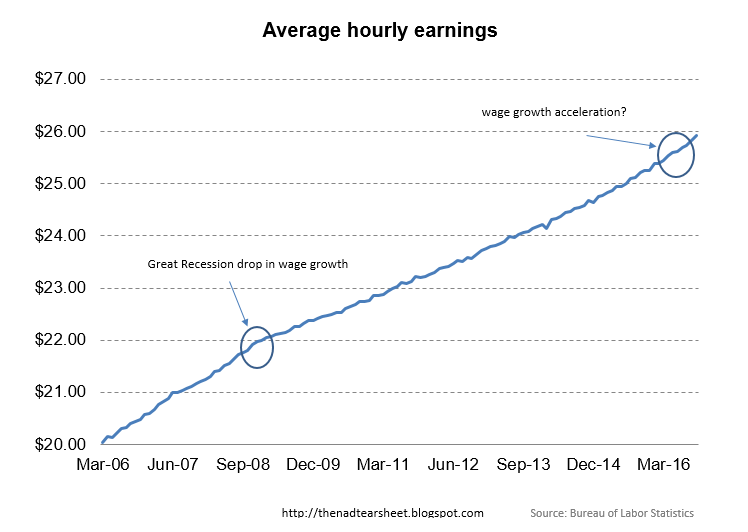
Take a look at the chart of average hourly earnings below. You can see the change in inflection (sharp slowdown in growth) starting in early 2009, however you can also see the change in inflection (that appears to be accelerating) that started in early 2015. We could finally be seeing some wage inflation at long last. Note that there is a possibility that the jump in wages could be driven by the drop in restaurant jobs, which are generally low-paying. That would bump up the average a tad. 


The NAHB and NAR are parting ways on the issue of the mortgage interest deduction. The MID is slated to become less important as tax reform takes shape. The standard deduction will be doubled, but many popular deductions will go away. For most people, taking the increased standard deduction will make more sense than itemizing. The NAHB is willing to allow the mortgage interest deduction to go away, as long as the low-income housing tax credit remains. The LIHTC is the big driver that makes building affordable housing make sense. NAR, on the other hand is suggesting that losing the MID would cause a 10% drop in house prices. Since Democrats will be uniformly opposed to any changes to the tax code, it will only take a few Republicans in blue states to put the kibosh on this. The MID has survived many attempts to kill it, and it is simply so popular that it may live to fight another day. Note that there are two things to make the MID less and less important: First, with interest rates so low, the actual interest paid is much less than it was, say, 30 years ago. Second, the MID cap is not indexed to inflation, so as house prices rise, the cap will kick in at progressively lower relative levels. 

The Fed weighed in on tax reform, saying that it could cause a short term bump in the economy, but will raise the deficit and inflation.  Of course how much it increases the deficit will depend on the economic forecast used. Republicans want to argue that cutting taxes will increase growth, which will increase the taxes received by Treasury (called dynamic scoring). Democrats want to exclude that growth, arguing that it is invariably too rosy. All sorts of think tanks will weigh in on it and you will have to know their political predilections before reading their take. Many think tanks sell themselves as "non-partisan" when they really are not. 

Friday, May 5, 2017

Morning Report: Strong jobs report

Vital Statistics:

Last Change
S&P Futures  2389.0 3.5
Eurostoxx Index 391.7 -0.3
Oil (WTI) 45.1 -0.4
US dollar index 89.9
10 Year Govt Bond Yield 2.34%
Current Coupon Fannie Mae TBA 102.625
Current Coupon Ginnie Mae TBA 103.625
30 Year Fixed Rate Mortgage 4.02

Stocks are up after the strong jobs report. Bonds and MBS are up as well.

Jobs report data dump:
  • Nonfarm payrolls + 211,000
  • Unemployment rate 4.4%
  • Labor force participation rate 62.9%
  • Average hourly earnings up 0.3% MOM / 2.5% YOY
Overall a strong jobs report. The unemployment rate is the lowest in a decade, reaching close to the cyclical low right before the real estate bubble blew up. Despite the low numbers we have yet to see much in the way of wage growth. The employment-to-population ratio, which is the Fed's preferred employment indicator, rose to 60.1%.  The U-6 unemployment indicator (which is more broad and includes the long-term unemployed) fell sharply during the month from 8.9% last month to 8.6%. U-6 is down 1.1% YOY. U-6 measures how much slack there is in the labor market, and as that slack is taken up wage inflation should return. This report shouldn't really move the needle for the June FOMC meeting and the Fed. 


Yesterday, the House passed narrowly its Obamacare replacement bill, and it will now head to the Senate where it will be ignored and slow-walked. The House bill was never scored by the CBO, and pushed through on short notice, which pretty much tips the GOP's hand that this was never intended to actually become law and has a 0% chance of surviving intact. FWIW, the bill is really the Republican Primary Prevention Act of 2017, which is to say merely a political gambit. The Senate may also be waiting to see what insurance rates look like for 2018 and also how many drop out of the exchanges. The only way to get Democrats and moderate Republicans on board is if they see the Obamacare exchanges failing.  

Now that Obamacare is out of the way in the House, their attention will turn to tax reform. Individual tax reform will get zero support from Democrats, however there might be some common ground on corporate taxes. 

Fannie Mae reported income of $2.8 billion for the first quarter, all of which will go to the government sometime in June. Total equity has fallen from $6.1 billion at the end of last year to $3.4 billion at the end of Q1. This is the problem the government has to address with the current regime: sending all profit to Treasury is eroding Fannie's capital. This is one motivation to get the government serious about GSE reform, although it isn't a high priority in Washington at the moment. 

Inflation continues to be tame, and part of that is being driven by oil, which has fallen 15% over the past few weeks. The rally in oil that began with OPEC's plan to cut production has been completely given back. While the Fed will undoubtedly characterize oil as a transitory phenomenon it does flow through to other products and can help drive inflation. 


Friday, April 7, 2017

Morning Report: Jobs report surprises to the downside

Vital Statistics:

Last Change
S&P Futures  2352.5 -1.3
Eurostoxx Index 379.9 -0.8
Oil (WTI) 52.1 0.4
US dollar index 90.7
10 Year Govt Bond Yield 2.31%
Current Coupon Fannie Mae TBA 102.78
Current Coupon Ginnie Mae TBA 104
30 Year Fixed Rate Mortgage 4.06

Stocks are lower this morning after a surprisingly weak jobs report. Bonds and MBS are up.

Jobs report data dump:
  • Nonfarm payrolls up 98,000. Expectations were for 175k so this is a huge miss
  • Unemployment rate down to 4.5%
  • Employment to population ratio increased to 60.1%
  • Average hourly earnings up 0.2% MOM and 2.7% YOY
  • Labor force participation rate flat at 63%
Part of the payroll miss could be explained by bad weather in the Northeast and the Midwest in March. We saw jobs increase in professional and business services while payrolls contracted in retail. The labor force increased by 145k, while the number of employed people increased by 472k and the number of unemployed fell by 326k. The number of involuntary part time employees (people who would like a full time job but can only get a part time one) fell, as did the number of long term unemployed and discouraged workers. While the payroll number will garner all the attention, the internals of the jobs report show the slack is being used up in the labor market, so it isn't as bad as it initially appears. 

The Fed Funds futures took down their probability of a June hike from 71% to 66% on the jobs report. 

Two things happened yesterday which could push bond yields lower. First the US attacked air bases in Syria in retaliation for using chemical weapons. International tension is almost invariably bond bullish as investors put on the flight to safety trade. The other is the Democratic filibuster of Neil Gorsuch. This probably forecloses any sort of possibility for bipartisan legislation, particularly stimulus plans or tax cuts. In fact, the debt ceiling battle could become an epic game of chicken as the government is rapidly running out of borrowing capacity. While the second scenario is not necessarily bond bullish the first one definitely is. 

Fannie Mae's Home Purchase Sentiment index fell last month as high prices and low inventories take their toll. The number of people who think it is a good time to buy fell by 10 percentage points while the number tho think it is a good time to sell rose by 9 percentage points. People are less bullish on their economic future as well. 

Neel Kashkari disputes Jamie Dimon's assessment of the regulatory environment for banks, citing the Fed statistic that there is a 70% chance of a bailout in the next century.  Jamie Dimon declared the era of too big to fail is over, while Kashkari disagrees. Forecasting banking scenarios over a 100 year time period is probably a fool's errand. I wonder what banking regulators thought in 1917 (The Fed had only been established a few years earlier). Kashkari is a bit of a regulatory hawk and thinks the capital standards should be doubled.

San Francisco Fed President John Williams says it should take about 5 years for the Fed's balance sheet to shrink to a normal level once they start reducing it. Of course the open question is "what constitutes normal?" Prior to the financial crisis, the Fed's balance sheet was under $1 trillion. It is now pegged at $4.5 trillion. 


Friday, November 4, 2016

Morning Report: Decent jobs report

Vital Statistics:

Last Change
S&P Futures  2085.7 2.0
Eurostoxx Index 328.9 -2.6
Oil (WTI) 44.1 -0.6
US dollar index 87.7 0.0
10 Year Govt Bond Yield 1.79%
Current Coupon Fannie Mae TBA 103
Current Coupon Ginnie Mae TBA 104
30 Year Fixed Rate Mortgage 3.61

Stocks are higher after a decent jobs report. Bonds and MBS are up as well.

Jobs report data dump:
  • Payrolls increased by 161,000
  • Unemployment rate 4.9% 
  • Labor Force Participation rate 62.8%
  • Average hourly earnings 0.4%
The payroll data was disappointing, as was the decrease in the labor force participation rate. The plus side was wage growth, where wages rose at a 2.8% annual rate, the biggest increase since 2009. The employment to population ratio slipped to 59.7%. Basically, it looks like the number of unemployed fell, however they didn't get jobs - they exited the labor force. Below is a chart of average hourly earnings. You can see the slope of the line decrease in 2008 as the Great Recession began and wage growth slipped from its bubble year growth rate of 3.3% to 2%, where it largely stayed during the recovery. It appears like the slope of the line is beginning to increase, which solves a lot of problems in our economy. Too early to tell if it is a trend, though. Bottom line: This gives the Fed all the ammo they need to raise the Fed Funds rate next month. FWIW, the Fed Funds futures are now assigning a 80% chance of a 25 basis point hike next month. 


Ordinarily, this report would be bond bearish, however global sovereigns are rallying and pulling the 10 year along for the ride. 

Ex Dallas Fed Head Richard Fisher blames the rise of Donald Trump partially on Fed policy. The Fed's policy of driving interest rates to the floor and flooding the system with money to support asset prices is great news for people who own real estate and stocks, however for those that save it has been terrible: 

"Global monetary policy has "skewered the middle-income groups, the 'middle class,' adding to the angst that has sprung from their sense of an overbearing, intrusive central government....Small wonder that we have ended up at a political crossroad, with a choice for the presidency between a candidate who advocates having government distribute still more to ease the pain and another arguing to provide relief by changing gears entirely, though we know not how, when or where...My more acerbic friends on both sides of the aisle consider it a Hobson's choice," he said, referring to a situation where it seems there's free choice but in reality there's no good alternative. On the one hand, Republicans believe the other party's candidate is channeling Eva Peron, planning policies that will ultimately lead us down the Argentine path to economic ruin while basking in personal profit and glory. On the other, Democrats liken the Republican candidate to Caligula."

On the subject of QE, he is spot-on. QE and unconventional monetary policy has certainly increased inequality, and made life tough if you are a renter. Rental inflation is increasing at a 4% annual clip, and as we saw above, wages are well below that. QE has been great for the landlord, but not the tenant. I find it amazing that the Fed gets a free pass in the media and from the political class on the subject of inequality. 

For all the sturm and drang regarding how markets will react to a Trump presidency, bond traders appear to be relatively sanguine. Just like stocks have the VIX index which measures fear indirectly by tracking the price of options, bonds have an index too. And it is close to yearly lows.