A place where economics, financial markets, and real estate intersect.
Showing posts with label ADP Employment Change. Show all posts

Wednesday, May 2, 2018

Morning Report: Awaiting the FOMC

Vital Statistics:

Last Change
S&P futures 2652 0.25
Eurostoxx index 387.17 2.14
Oil (WTI) 67.45 0.19
10 Year Government Bond Yield 2.99%
30 Year fixed rate mortgage 4.55%

Stocks are flat as we await the FOMC decision. Bonds and MBS are down small. 

Mortgage Applications fell 2.5% last week as purchases fell 2% and refis fell 4%. 

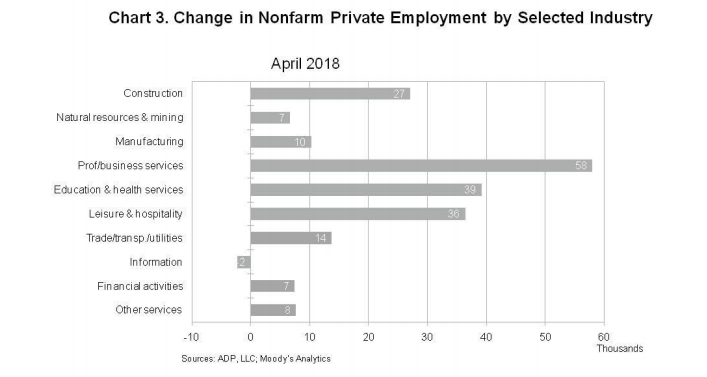
The economy added 204,000 jobs last month according to the ADP Employment Report. This was higher than expectations and is above the Street estimate for Friday's jobs report. Medium sized firms (50-500 employees) added the most jobs, and Professional and Business Services sector had the most growth. Construction added a lot of jobs as well. 

The FOMC announcement is scheduled for 2:00 pm EST today. No changes in rates are expected, but investors will be looking to see if the Fed changes its language about inflation running below target. The latest PCE index came in at 2%, which is the Fed's target. The second-order question will be to see whether the Fed changes their 2% rate from a symmetric target to a ceiling. The most likely outcome will be a "steady as she goes" statement and any changes will be communicated at the June meeting with a fresh set of economic forecasts. Today's announcement should be a nonevent. 

The Fed Funds futures are predicting a 6% chance of a hike at the May meeting and a 94% chance of a 25 basis point hike at the June meeting. 

The labor shortage is so acute in the Rust Belt that some towns are paying people to move there. Most of these small towns have a major demographic problem - younger workers moved to the cities in response to the Great Recession, leaving only the older workers who are now retiring. The fear is that labor shortages will prompt employers to leave, which will create a downward spiral.

Consumer advocates worry that Mick Mulvaney is not going to blow up the CFPB, but will neuter it with a thousand cuts. That said, the rhetoric from the left is a bit overblown. Mick Mulvaney said: “When I took over, we had roughly 26 lawsuits ongoing,” he told the House Appropriations Committee on April 18. “I dismissed one, because the other 25 I thought were pretty good lawsuits.”

Friday, April 6, 2018

Morning Report: ADP and BLS differ by huge margin

Vital Statistics:

Last Change
S&P futures 2642 -19
Eurostoxx index 374.5 -1.62
Oil (WTI) 63.07 -0.44
10 Year Government Bond Yield 2.80%
30 Year fixed rate mortgage 4.43%
Stocks are lower after Trump announced more tariffs against China. Bonds and MBS are flat.

Jobs report data dump:
  • Payrolls up 103,000 (below expectations) 
  • Unemployment rate 4.1% (above expectations)
  • Labor Force Participation Rate 62.9% (increase of 0.1%)
  • Average Hourly Earnings up 0.3% / 2.7% (in line with expectations)
Another month where the ADP number (increase of 241k) and the BLS number (increase of 103k) were a mile apart. Weather may have played a part in the low payrolls number, as the Midwest and East Coast were hit by a number of snowstorms that knocked out power early in the month. Construction employment fell, which kind of supports that theory. Wage inflation remains in check for the most part. The employment-population ratio was flat at 60.4%. Overall, a disappointing report, but the weather makes me want to put an asterisk next to it. 

The NFIB reports that almost a third of small businesses raised wages to attract and / or retain employees last month, which was the highest percent since 2000.

Forget about the old picture of the Rust Belt - decaying small towns that peaked in the 1950s and crashed during the 1970s. Things have changed. When you think of Detroit, you now think of Quicken Loans, and places like Elkhart Indiana are unable to keep $90,000 SUVs in stock because the town is booming with factory workers making $68,000 on average. At full production, workers are making $90k, and foremen are making 6 figures. The unemployment rate is basically zero - a town of 50,000 people has 9.500 unfilled job openings. Despite what some economists think about employers having market power and exhibiting monopsonist behavior (hard to believe dozens of employers in a single locality could collude), the laws of supply and demand do in fact apply to the labor market.

CFPB Acting Director Mick Mulvaney responded to Elizabeth Warren's letter that posed about 100 questions about how the agency is being run. Suffice it to say, she believes the agency isn't being aggressive enough. Mulvaney's response was basically to say that he doesn't have to respond, and doesn't intend to. “When I served on the House Committee on Financial Services as a Member of Congress, I was frequently frustrated with what I perceived to be a lack of responsiveness, transparency and accountability at the Bureau,” Mulvaney wrote. “I encourage you to consider the possibility that the frustration you are experiencing now, and that which I had a few years back, are both inevitable consequences of the fact that [the Dodd-Frank Act] insulates the Bureau from virtually any accountability.” The saga continues..

Donald Trump announced plans for another $100 billion in tariffs against China last night, and China responded with plans to retaliate. As of now, this is still in the trash-talking phase. Larry Kudlow says negotiations haven't even begun yet.

Treasury has issued a set of recommendations for modernizing the Community Reinvestment Act. Probably the biggest change would be to move the focus from where bricks and mortar branches are to where the banks actually lend. This would bring the law up to date with the concept of less branches and more online banking. The other recommendation is to bring in more standardization and more certainty into what the government is looking for in examinations. In other words, make the law less arbitrary.

Wednesday, March 7, 2018

Morning Report: Gary Cohn resigns

Vital Statistics:


LastChange
S&P Futures 2703.3-21.0
Eurostoxx Index371.3-2.4
Oil (WTI)62.10.5
US dollar index83.5-0.3
10 Year Govt Bond Yield2.86%
Current Coupon Fannie Mae TBA102.25
Current Coupon Ginnie Mae TBA102.5
30 Year Fixed Rate Mortgage4.4

Stocks are lower this morning on the prospect of a trade war. Bonds and MBS are up.

White House Economic Adviser Gary Cohn has resigned after losing the argument on tariffs. Cohn, a Democrat, was one of the more moderate voices in the Trump Administration, and his resignation cements the idea that the Administration is turning away from globalization, which has marked Washington establishment for decades.  

So far the potential trade war hasn't had much of an effect on the Fed Funds futures, which are handicapping a 86% chance of a hike in May and have centered on 3 hikes for the full year. The impact of a trade war will be an interesting question for the Fed. On one hand, they raise prices, which should translate into higher inflation. On the other, they depress economic activity which should translate into slower growth and higher unemployment. The first effect is more near term, while the second order effect is longer-term. 

Bolstering the Administration's case for tariffs is the fact that the trade deficit rose to a 9 year high last month. 

Atlanta Fed President Raphael Bostic says that the Fed should take a "wait and see" approach to a trade war. While the Trump Administration may be pushing back from globalization, Congress has not, and the courts provide another speed bump to tariffs. Note as well, that the US "ask" in trade negotiations usually centers on intellectual property protection, and that means Hollywood and Big Tech. Their partisanship will probably come back to haunt them. Think Trump is going to care about the Chinese pirating the latest Michael Moore flick? Or the latest left-wing Netflix "documentary?"

The economy added 235,000 jobs in February, according to the ADP Employment survey. The Street is looking for 205,000 jobs in Friday's jobs report. The ADP report has been coming in higher than the BLS reports lately, so this should have a muted effect. Secondly, the focus on the jobs report (at least from the Street's perspective) has shifted from payroll growth to wage inflation. 

Mortgage Applications rose 0.3% last week as purchases fell 1% and refis rose 2%. The average 30 year mortgage rate rose 1 basis point to 4.65%, the highest since early 2014. 

Nonfarm productivity for the fourth quarter was revised upward to flat, while unit labor costs were revised upward to 2.5% from 2.0%. Compensation costs drove the increase. So far, companies have been unable to pass on higher costs in the form of higher prices, which should mean profit margins will come in, making stocks vulnerable.  This should translate into lower interest rates at the margin.

A real estate startup called Knock is looking to disrupt the real estate industry by acting as a market maker for homes. They will buy a seller's home, move them into a new one, and then sell the old home. The benefit for the home seller is that they will now be able to compete in bidding wars without having any sort of home sale contingencies. That said, this is clearly a bull market phenomenon, and in this market the tough part is not selling your current house - it is getting (and winning) your new one. Still an interesting idea. 


Wednesday, December 6, 2017

Morning Report: Productivity increases in the third quarter

Vital Statistics:

Last Change
S&P Futures  2625.0 -3.3
Eurostoxx Index 384.5 -2.3
Oil (WTI) 56.9 -0.8
US dollar index 86.8 0.0
10 Year Govt Bond Yield 2.32%
Current Coupon Fannie Mae TBA 102.625
Current Coupon Ginnie Mae TBA 103.625
30 Year Fixed Rate Mortgage 3.88

There is a slight risk-off feel to the market today as stocks are lower and bonds rally.

Mortgage Applications rose 5% last week as purchases rose 2% and refis rose 9%. The average 30 year fixed rate mortgage dropped a basis point to 4.19%.

The economy added 190,000 jobs last month according to the ADP Employment Survey. The Street is looking for 204,000 jobs in this Friday's payroll report. This ADP number is more or less close to the average for the past year. Moody's Chief Economist Mark Zandi is warning that the job market could overheat next year, as he sees the unemployment rate going below 4%. Will that cause the Fed to start hiking rates more aggressively? Perhaps, but until we start seeing broad-based wage inflation and begin to see it flow through to prices the Fed will probably be content to gradually normalize policy and not push the economy into a recession.


Productivity rose 3% in the third quarter, according to BLS, as output increased 4.1% and hours worked increased 1.1%. Generally speaking productivity increases drive wage increases, although that relationship has broken down somewhat over the past 15 years or so. Unit labor costs declined 0.2% as the increase in productivity offset the 2.7% increase in wages. At a recent CEO roundtable, labor costs have taken over regulation as the top concern of Corporate America. Tax reform will probably encourage more capital investment to make workers more productive, and that should translate into wage inflation, although not necessarily into a larger number of workers.

As tax reform gets resolved, the next issue will be funding the government. It won't take many conservatives to balk at funding the government to make Democrats necessary to keep the lights on. Democrats want some sort of immigration deal to go along with voting for a continuing resolution, which will be a non-starter for many Republicans. Don't forget the last time we had a government shutdown, you couldn't get 4506-Ts from the IRS, loan officers, plan accordingly.

Ray Dalio of Bridgewater warns that tax reform will cause an exodus from high tax states like California, New York, New Jersey, and Connecticut. Many big names in the hedge fund business have already relocated to Florida, where there are no state income taxes. Connecticut will be especially vulnerable, as it gets most of its revenue from one county. Meanwhile, NAR and Trulia warn that tax reform will hit property values in these high tax states, and will exacerbate the inventory shortage as it will discourage sellers. As I have said before, it may affect the higher end of the market in these areas, but the sub $750,000 sector should be fine. If anything, it might encourage those that are thinking of buying a million dollar home to lower their price point, which would increase demand in that sector. As a general rule, the multi-million sector in the Northeast has been moribund to begin with, and the multi-million sector in the West has been driven by foreign money and stock market appreciation.

Affordable Housing Advocates are also staunchly opposed to the new tax bill. Many for simple ideological reasons, however tax reform will affect the value of the tax write-offs that act as the incentive to build affordable housing. It will make affordable housing construction less attractive (and may turn it into a money-losing enterprise). Some groups claim that the home price appreciation has been so fast (especially in California) that it is creating a homelessness problem. A lack of affordable housing has been an issue for a long time, and tax reform certainly won't make it less of one.

The hurricanes accounted for 10% of the country's mortgage delinquencies. This is going to be a huge headache for lenders with servicing portfolios in Texas and Florida.

The emergence of fraud and swindles usually signals the top of bubbles. Liar loans and CDO squareds were the bell ringing at the top of the US residential real estate market. It looks like we are getting to see some of this in China as well, which has a residential real estate market of epic proportions. When China's residential real estate bubble finally bursts, it will be a massive battle of wills between Mr. Market and Mr. Big Government. When Japan's bubble burst, the government used all sorts of ham-handed methods to prevent a crash, and I wouldn't be surprised to see China try some of the same things. Once China's bubble bursts, they will export deflation to the world, which will keep inflation in check in the US, however it will also sap global growth. Luckily Japan seems to be picking up at long last (almost 30 years).

Wednesday, November 1, 2017

Morning Report: ADP payrolls come in light

Vital Statistics:

Last Change
S&P Futures  2583.0 10.0
Eurostoxx Index 397.8 2.5
Oil (WTI) 55.0 0.6
US dollar index 87.8 0.1
10 Year Govt Bond Yield 2.39%
Current Coupon Fannie Mae TBA 102.68
Current Coupon Ginnie Mae TBA 103.75
30 Year Fixed Rate Mortgage 3.99

Green on the screen this morning as markets rally worldwide. Bonds and MBS are down. 

The Fed decision is due at 2:00 pm EST today. No changes in interest rates are expected, but there is always the risk that something in the statement could move rates. Be careful locking around then. Separately, Donald Trump is scheduled to announce Yellen's replacement tomorrow. 

Mortgage applications continue to fall (six times in the last seven weeks), according to the MBA. Applications decreased by 2.6% as purchases fell 1% and refis fell 5%. Mortgage rates hit a low for 2017 in September, but have risen about 20 basis points since then. The average contract interest rate was 4.22%, an increase of 4 basis points from last week. 

ADP saw an uptick in payrolls for October, increasing to 235k. September was revised downward to 110k due to the hurricanes. Many were expecting to see a bigger rebound for October, but it hasn't happened, at least according to ADP. The BLS is announcing payrolls on Friday, with the Street looking for 325k. 

Construction spending rose 0.3% in September, according to the Census Bureau. On a YOY basis, it is up 2%. Residential construction was flat on a month-over-month basis but is up 9.6% YOY. 

Manufacturing is still strong, according to the ISM index. It slipped slightly in October to 58.7 from 59.5. Hurricane effects are probably having some effect here. 

House Republicans moved back their tax reform reveal by a day, which shows there is some disagreement in whether this can pass. With uniform opposition from Democrats, it will only take a few Republicans to kill it. The state and local tax deduction will probably prove to be the deal killer, and while many Republicans have big philosophical objections to the estate tax, it probably isn't a hill worth dying on. While people have historically considered senior citizens to be the third rail of politics, in all reality, it is the upper middle class (especially the HENRY's, which stands for high earnings, not rich yet). They are the ones most affected by changes in 401k contributions, state and local tax deductions, and the mortgage interest deduction. The top 20% pays 95% of the income taxes in this country, according to OMB. 


Friday, June 2, 2017

Morning Report: Jobs report misses, and rates fall

Vital Statistics:

Last Change
S&P Futures  2434.3 4.8
Eurostoxx Index 394.3 2.6
Oil (WTI) 47.4 -1.0
US dollar index 88.5
10 Year Govt Bond Yield 2.16%
Current Coupon Fannie Mae TBA 103.33
Current Coupon Ginnie Mae TBA 104.25
30 Year Fixed Rate Mortgage 3.94

Stocks are up this morning despite a miss on the jobs report. Bonds and MBS are up.

Jobs report data dump:
  • Nonfarm payrolls up 138k
  • Unemployment rate 4.3%
  • Employment to population ratio 60%
  • Labor force participation rate 62.7%
  • Average hourly earnings up 2.5% YOY
  • Average workweek 34.4 hours
The payroll number was a big miss from the 185k expectation, and differs wildly from the ADP payroll number yesterday of 253k. Yet another instance where the ADP number and the official BLS number aren't even close to each other. Yes, the ADP number is meant to track the final revised BLS number, so it is possible that the BLS payroll number gets revised upward in the next two months. The labor force participation rate fell to 62.7% from 62.9% which was a disappointment as well. The unemployment rate fell to 4.3%, which is a 16 year low. The labor force shrunk by 430k people, while the number of people employed fell by 233k. The overall population increased by 180k. The two numbers the Fed pays the most attention to (employment / population ratio and hourly earnings) are certainly not pointing to any sort of inflation acceleration. 

Despite the payroll number, the Fed Funds futures increased their probability of a June hike to 93%. The 10 year continues to rally, and we are at the lowest yields since early November. The Trump reflation trade continues to deflate, at least as far as bonds are concerned. 

Construction spending continued its zigzag pattern, falling 1.4% MOM but increasing 6.7% YOY. Residential construction fell on a MOM basis but is up 16% YOY. Public residential construction fell. 

The ISM Manufacturing Index ticked up last month, led by increases in new orders, production, and employment. The prices index fell by a lot, however which again shows the lack of inflationary pressures in the supply chain. The current levels so far in the PMI index correlates with a historical GDP growth rate of around 4%. While manufacturing isn't the driver of the economy it used to be, it still matters. 

Announced job cuts at Ford pushed up the Challenger job cuts number, but otherwise job cuts are largely small. 

Donald Trump announced he will pull the US out of the Paris Accord yesterday. This will take years, so in the meantime expect no effects on oil prices or the economy. 

Investment bank Moelis, along with Blackstone and Paulson fund management have reportedly put out a detailed blueprint to bring the GSEs out from under government control. Treasury Secretary Mnuchin as well as the MBA are cool to the idea, because existing stockholders will benefit, when in reality they would have been wiped out back when the GSEs went under conservatorship. 

Home sizes are shrinking for the first time since 2009. This is mainly due to a change in the hombuilder mix. Post-crisis, the only segment of the homebuilding market that was working was the luxury end. Now, starter homes are becoming the focus, which is dragging average sizes lower. Home sizes are still larger than the bubble peaks were. 

Small business lending fell in April

Wednesday, February 1, 2017

Morning Report: Blowout ADP number

Vital Statistics:

Last Change
S&P Futures  2281.5 7.0
Eurostoxx Index 364.3 4.0
Oil (WTI) 53.3 0.5
US dollar index 90.7 0.2
10 Year Govt Bond Yield 2.49%
Current Coupon Fannie Mae TBA 102.1
Current Coupon Ginnie Mae TBA 103.2
30 Year Fixed Rate Mortgage 4.16

Stocks are higher this morning after a good ADP number. Bonds and MBS are down.

The private sector added 246,000 jobs in January, according to the ADP Employment Survey. This is the highest number since June 2016. We saw strong growth in construction jobs and manufacturing, while finance was flat and IT fell. The Street is looking for a 175k nonfarm payrolls in Friday's report. The ADP number hasn't been a great predictor of the BLS number for a while, so don't read too much into it. While strong, this number will probably not change anything with respect to this afternoon's Fed decision, which comes out at 2:00 pm EST. 

Mortgage Applications fell 3.2% last week as purchases fell 6% and refis fell 1%, according to the MBA. The average rate for a 30 year fixed rate mortgage rose 4 basis points. Refis fell below 50% for the first time since 2015. 

More evidence that the manufacturing sector is turning around: The ISM Manufacturing index hit a 2 year high in December. Input costs rose to a 5.5 year high, which is spooking the bond market a little this morning. 

Construction spending fell 0.2% in December, missing expectations. It is up 4.2% YOY. Residential construction rose 0.4% and is up 3,6% YOY. 

Donald Trump nominated Colorado federal appeals court judge Neil Gorsuch to the Supreme Court yesterday to replace Anonin Scalia who died last year. Democrats are vowing to filibuster in retaliation for the treatment of Obama's nominee Merrick Garland. 

Distressed sales fell in October, according to CoreLogic and are now at the lowest levels since 2007. Cash sales came in at 32%, which is still elevated compared to pre-crisis levels. Normalcy is around 25% or so. 

The REO-to-Rental trade worked out for Blackstone, culminating in the IPO of Invitation Homes, which raised $1.54 billion in an IPO yesterday. The deal was priced at $20 a share, within the $18-$21 range. The stock begins trading today under the symbol INVH.

Should homebuyers wait until spring to purchase a home? It turns out the best months to purchase are January and February. Less competition means bigger discounts to the asking price. 

Thursday, July 7, 2016

Morning Report: FOMC minutes show uncertainty

Vital Statistics:

Last Change Percent
S&P Futures  2092.0 -2.1 -0.10%
Eurostoxx Index 2778.1 16.7 0.60%
Oil (WTI) 47.85 0.4 0.89%
LIBOR 0.657 0.001 0.11%
US Dollar Index (DXY) 96.12 0.064 0.07%
10 Year Govt Bond Yield 1.40% 0.03%
Current Coupon Ginnie Mae TBA 106.3
Current Coupon Fannie Mae TBA 105.6
BankRate 30 Year Fixed Rate Mortgage 3.51

Stocks are higher this morning on no real news. Bonds and MBS are down after a stronger-than-expected ADP jobs report

We have a few economic data points this morning. Job Cuts fell 14.1% in June, according to Challenger and Grey. Job cuts fell in the East and Midwest, while rising in the South and the West. 

The ADP Employment number shows private companies added 172k jobs in June, above the 160k forecast. May was revised to 168k. Of course last month the ADP number came in at 173k while the official BLS nonfarm payroll number came in at 38k. So ADP has been pretty useless lately

Initial Jobless Claims fell to 254k last week.

The FOMC minutes didn't really shed much light on the state of thinking at the Fed, other than to say the Fed remains data-dependent. The June FOMC meeting predated Brexit, so in many ways it is a dated view. The participants noted that the labor market weakened while the overall economy was strengthening, and believe that the economy will continue to grow moderately. Given the added uncertainty of Brexit, the FOMC meeting in a few weeks will almost certainly be a non-event, and even tightening in September looks like a tall order


Thursday, June 2, 2016

Morning Report: ADP jobs report comes in line with expectations

Vital Statistics:

Last Change Percent
S&P Futures  2088.0 -6.9 -0.33%
Eurostoxx Index 3031.4 -32.1 -1.05%
Oil (WTI) 48.5 -0.6 -1.22%
LIBOR 0.673 -0.001 -0.15%
US Dollar Index (DXY) 95.38 -0.510 -0.53%
10 Year Govt Bond Yield 1.81% -0.03%
Current Coupon Ginnie Mae TBA 105.6
Current Coupon Fannie Mae TBA 104.7
BankRate 30 Year Fixed Rate Mortgage 3.65

Markets are lower this morning as ECB President Mario Draghi speaks. Bonds and MBS are flat.

The ECB will now start buying corporate bonds in an attempt to stimulate their economies. Truly an amazing time we live in. 

We get some labor market data this morning, before the big jobs report tomorrow. 

The ADP Employment Change report came bang in line with expectations at 173k jobs created. Tomorrow's non-farm payroll expectation is for an increase of 160k jobs created in May. Small business led the way, adding 76k employees. Professional and business services increased the most. Manufacturing jobs fell.

Note that tomorrow's payrolls number could be affected by the Verizon strike. Regardless. the number to focus on tomorrow is the change in average hourly earnings. 

Job cuts fell to a 5 month low, according to outplacement firm Challenger, Gray and Christmas. Announced job cuts came in at just over 30k, a drop of about 50% from April. The two biggest industries in job cuts - energy and finance - appear to be slowing down the pace of headcount reduction. 

Initial Jobless Claims came in at 267k last week, 

Homebuilder Hovnanian reported second quarter earnings this morning. Deliveries were up 31% and revenues were up 40%. Earnings were still below expectations. The stock is down this morning

US auto sales fell in May, which is usually one of the stronger months for auto sales. Auto sales had been increasing for 6 years, pushed by a stronger economy and ridiculously cheap financing. Yield pigs may find that doing 8 year auto loans at 3.5% is a dumb trade. 

Despite being disappointed by the current crop of presidential candidates, consumers still plan to buy cars and houses. Despite all the rhetoric, the economy is not doing all that badly, and there is tremendous pent-up demand for housing, especially from younger buyers. The issue for them is affordability, and tight inventory combined with a lack of building is making it hard. 

Here is a new one in the world of apartment leasing: Like our facebook page, or else.

The House included language in the 2017 budget to bring Congressional oversight to the CFPB and subject it to the appropriations process. Currently, it is funded by the Fed, who really has no choice but to give them what they want. Second, the provision would replace the single director with a five-member board appointed by the President. While this is going nowhere (we haven't had a budget since early in Obama's Presidency), it will be fodder for the fall elections. For the moment, it appears the CFPB is directing its attention to payday lenders

Wednesday, March 30, 2016

Morning Report: Janet soothes the markets again

Vital Statistics:

Last Change Percent
S&P Futures  2059.7 12.2 0.60%
Eurostoxx Index 3054.2 49.3 1.64%
Oil (WTI) 39.31 1.0 2.69%
LIBOR 0.629 -0.002 -0.24%
US Dollar Index (DXY) 94.98 -0.179 -0.19%
10 Year Govt Bond Yield 1.84% 0.04%
Current Coupon Ginnie Mae TBA 105.4
Current Coupon Fannie Mae TBA 104.7
BankRate 30 Year Fixed Rate Mortgage 3.69

Markets are higher following dovish comments from Janet Yellen yesterday. Bonds and MBS are down. 

Janet Yellen spoke yesterday in NY and reiterated the dovish statements from the last FOMC meeting. Stocks and bonds rallied on the announcement, with both going out on their highs, although bonds have given back their gains this morning. Fed Funds futures now assign a 0% probability of an April hike. It is very much a Goldilocks moment for stocks, not so much for the economy. For the time being, economic weakness is good news for stocks because it keeps the Fed on the sidelines. As if on cue, Boeing announces it is cutting 4.500 jobs

Overseas yields are still heading lower, with the German Bund trading at 16 basis points. As long as bond yields throughout the world trade at such low levels, the 10 year will have relative-value trading support. This means that as rates in Europe fall and go negative, investors will swap out of Bunds, which really have nowhere to go but down and buy Treasuries. The world is trading as if inflation is never, ever, ever coming back. There are a lot of "this time is different" stories going around about technology and inflation. It may turn out that the best possible trade is borrowing money for 30 years at 3.375%. 

Mortgage Applications fell 1% last week as purchases rose 2.1% and refis fell 3.3%. Refis fell to 52.4% of total loans, compared to 58.6% a month ago.

Payrolls increased by 200,000 according to outplacement firm ADP. The Street is looking for an increase of 210,000 on Friday. 

In the Webster's dictionary under real estate bubble, people should place China. Here is an example of the sort of stuff that is getting built these days. It reminds me of the height of the US property bubble when a thief supposedly broke into a McMansion with a boxcutter. Builders were cutting every corner just to make houses big. I have said this before: China is going to be an epic battle between Mr. Market and Big Communist Government. Compare property prices to stock prices. 


Wednesday, March 2, 2016

Morning Report: Global yields continue to fall

Vital Statistics:

Last Change Percent
S&P Futures  1971.8 -6.1 -0.31%
Eurostoxx Index 3002.6 6.2 0.21%
Oil (WTI) 33.81 -0.6 -1.72%
LIBOR 0.633 -0.002 -0.31%
US Dollar Index (DXY) 98.48 0.129 0.13%
10 Year Govt Bond Yield 1.86% 0.04%
Current Coupon Ginnie Mae TBA 105.3
Current Coupon Fannie Mae TBA 104.5
BankRate 30 Year Fixed Rate Mortgage 3.81

Stocks are lower this morning after yesterday's strong rally. Bonds and MBS are down.

Mortgage Applications fell 4.8% last week as purchases fell 0.6% and refis fell 7.2%. 

The ADP Employment change came in stronger than expected at 214k jobs. The Street is forecasting an increase of 195k payrolls for Friday's jobs report. All of the activity was in the services sector, as the manufacturing sector lost about 9,000 jobs and the financial sector added only 8,000. 

Chart: ADP jobs 


The ISM New York Index fell slightly to 53.6

Donald Trump and Hillary Clinton were the big winners on Super Tuesday. You can probably stick a fork in Sanders at this point. For the GOP, the question is whether Donald Trump is a plurality winner or a majority winner. The establishment is hoping that once they coalesce around a single candidate, the numbers will swing to that candidate. If they go the brokered convention route, Trump will almost certainly run as an independent, which guarantees a Clinton landslide. 

Yesterday was a bloodbath in Treasuries, with the 10 year yield increasing about 9 basis points to 1.82%. The 2 year yield increased 7 basis points. If we see strong wage growth on Friday's jobs report, we could see further weakness in Treasuries. 

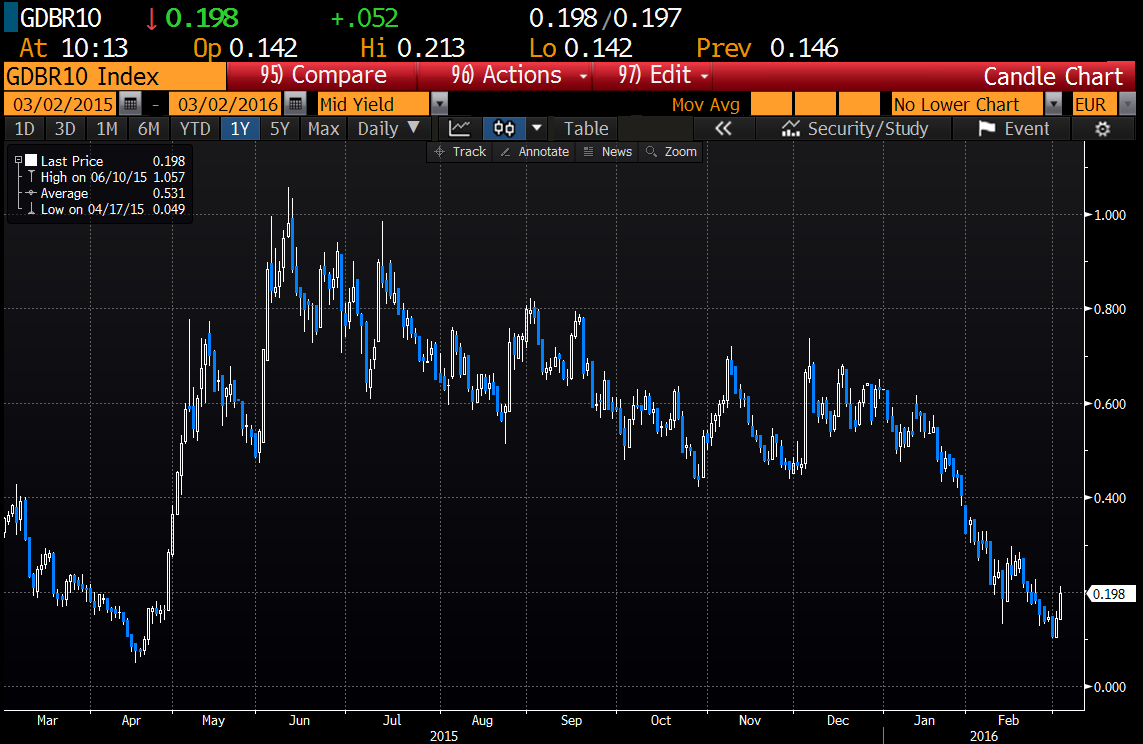
To put the current 1.85% 10 year yield in perspective: when the Fed hiked rates last December, the yield was 2.3%. That said, the fact that interest rates are falling globally will prevent Treasuries from falling too much. Note the German 10 year Bund is close to the sub 10 basis point lows of last spring, and currently yields 18 basis points. The Japanese Government 10 year bond yield is negative 5 basis points. Global investors look at Treasuries yielding more than Italian, Spanish, and Irish bonds and see relative attractiveness, especially since the US is about the only country not trying to devalue its currency. That should help keep a lid on rates. 

Chart: German Bund Yield


The collapse in global bond yields is sending a signal that the Fed isn't going to ignore - that deflation remains a threat. Janet Yellen has pledged to let the labor market "run hot" for a while and that means letting wage growth run. The big question is what happens to the labor force participation rate. If these workers come back, that will prevent too much wage inflation and will be ultimately better for the economy in the longer term. If they don't, then look for wage inflation to begin and the Fed to move earlier. 

Wednesday, February 3, 2016

Morning Report: How's that working for you?

Vital Statistics:

S&P Futures  1909.9 12.5 0.66%
Eurostoxx Index 2933.6 -18.2 -0.62%
Oil (WTI) 30.73 0.9 2.84%
LIBOR 0.619 0.006 0.98%
US Dollar Index (DXY) 98.32 -0.555 -0.56%
10 Year Govt Bond Yield 1.88% 0.04%
Current Coupon Ginnie Mae TBA 105.4
Current Coupon Fannie Mae TBA 104.7
BankRate 30 Year Fixed Rate Mortgage 3.71
Stocks are higher this morning after oil rebounds overnight. Bonds and MBS are down. 

Mortgage Applications fell 2.6% last week as purchases fell 7% and refis rose 0.3%. 

The ISM Non-Manufacturing Index fell to 53.5 from 55.8 in January

The ADP Employment Change report came in at 205k. The Street is forecasting 190k in Friday's jobs report. 

Bill Gross's latest Investment Outlook takes some shots at central bankers, and asks why we think negative interest rates are going to generate growth. As he says "How's that working for you?" While the consumer has deleveraged over the past 10 years, corporate america has not. That said, corporate america has taken advantage of record-low interest rates to refinance and extend high coupon debt with lower coupon debt. When people are willing to lend you money at 2% for 20 years, why not take it?

Speaking of negative interest rates, it seems the only nation anymore that isn't playing the beggar thy neighbor devaulation game is the US. Exports are falling, while imports are rising. This is the reason why we are seeing everyone - from Republicans to Democrats - willing to take potshots at free trade. Of course foreigners can accept one of two things in payment for their imports: goods and services from the US or IOUs (Treasuries). So far, they seem to want the IOUs. Which means interest rates are lower than they ultimately would be. Still manufacturing job losses are easy to point to versus interest rates and the benefits of cheaper imports. 

Another day, another settlement with the banks: Wells is paying FHA $1.2 billion over "failure to properly review early payment defaults in 2010-2012." And the government is scratching its head wondering why banks like JP Morgan are reducing / exiting FHA lending... At what point do these constant suits and settlements become simply a surtax on banking?

Wednesday, January 6, 2016

Morning Report: ADP predicts a strong jobs report on Friday

Vital Statistics:

Last Change Percent
S&P Futures  1974.3 -37.4 -1.86%
Eurostoxx Index 3118.5 -59.5 -1.87%
Oil (WTI) 34.65 -1.3 -3.67%
LIBOR 0.612 -0.001 -0.16%
US Dollar Index (DXY) 99.42 0.015 0.02%
10 Year Govt Bond Yield 2.18% -0.05%
Current Coupon Ginnie Mae TBA 104.3
Current Coupon Fannie Mae TBA 103.5
BankRate 30 Year Fixed Rate Mortgage 3.89

Markets are getting slammed as China revalued the yuan at a weaker level than expected. Bonds and MBS are up on the flight to safety trade.

Mortgage Applications fell 11.6% last week as purchases fell 11% and refis fell 12%. 

The ADP Employment Change came in at 257k, much better than the 198k Street expectation. Note Friday's jobs report is forecasting an increase of 200k. 

The ISM Non-Manufacturing Index fell to 55.3 from 55.9 last month. 

Factory Orders fell 0.2% in November, while durable goods orders were flat. Capital Goods orders (a proxy for business capital expenditures) fell 0.3%.

Fed Vice Chairman Stanley Fischer says that 4 rate hikes this year is "in the ballpark" of what to expect. Note the FOMC minutes are scheduled to be released at 2:00 pm EST today. 

Banks are taking down their estimates of Q3 GDP based on the lousy ISM data. Deutsche Bank took down Q4 to 0.5% from 1.5%. The Atlanta Fed took it down to 0.7% from 1.3%. 

While inventories and exports are pushing down the GDP data, consumption seems to be turning around. 2015 was the best year for vehicle sales in the US since 2000. While some of that undoubtedly has to do with easy financing (some calling autos the new subprime) most was due to a replacement cycle that was long overdue. 

Speaking of autos, GM is investing in Lyft, the competitor to Uber. This is to have a foothold in the future of summonable driverless cars. 

Wednesday, November 4, 2015

Morning Report: Earnings season has been a disappointment so far

Vital Statistics:

Last Change Percent
S&P Futures  2107.9 5.0 0.24%
Eurostoxx Index 3466.2 23.5 0.68%
Oil (WTI) 48.07 0.2 0.35%
LIBOR 0.334 0.000 0.00%
US Dollar Index (DXY) 97.57 0.411 0.42%
10 Year Govt Bond Yield 2.21% 0.00%
Current Coupon Ginnie Mae TBA 104.5
Current Coupon Fannie Mae TBA 103.9
BankRate 30 Year Fixed Rate Mortgage 3.78

Stocks are higher this morning after Tesla beat earnings estimates. Bonds and MBS are flat. 

Mortgage Applications fell 0.8% last week as purchases fell 0.6% and refis fell 0.9%. Mortgage rates spiked after the FOMC decision, so that could have been a factor. 

The ADP Employment Change report came in at 182,000 jobs, which is exactly the forecast for Friday's jobs report. 

The ISM services index rose to 59.6 from 56.9 in October, one of the bright spots economically. 

There will be lots of Fed-Speak today, with Janet Yellen, Stanley Fischer, and William Dudley all speaking at various points today. Yellen testifies about banking regulation at 10:00 am before the House Financial Services Committee. New York Fed president William Dudley speaks at 2:30. and Stanley Fischer will speak after the market closes. I don't expect Yellen's testimony to be market moving. 

What's old is new again: Amazon is opening a bookstore.

We had numerous elections last night - as a general overview Republicans are cheering this morning, while Democrats are talking about low turnout..

Earnings season is in full swing, and so far the box scores are pretty dismal. This is the worst quarter for earnings since 2009. Blame low commodity prices for the most part - the energy patch is getting killed with oil at these levels. This will make the stock market even more vulnerable once the Fed starts pulling away the punch bowl. 

Speaking of low energy prices, Transcanada has pulled its application for the Keystone XL pipeline, which inexplicably became a cause celebre for the environmental movement. Tar sands oil doesn't make sense at sub-$50 oil prices. 

Wednesday, September 2, 2015

Morning Report - productivity and quantitative tightening

Vital Statistics:

S&P Futures  1937.3 21.4 1.12%
Eurostoxx Index 3208.2 19.5 0.61%
Oil (WTI) 45.27 -0.1 -0.31%
LIBOR 0.329 0.005 1.42%
US Dollar Index (DXY) 95.83 0.381 0.40%
10 Year Govt Bond Yield 2.18% 0.03%
Current Coupon Ginnie Mae TBA 104.1 -0.1
Current Coupon Fannie Mae TBA 103.7 -0.1
BankRate 30 Year Fixed Rate Mortgage 3.85

Stocks are higher this morning after Chinese markets rallied to almost unchanged after an early swoon. Bonds and MBS are down.

Mortgage Applications rose 11.3% last week as purchases rose 4.1% and refis rose 16.8%. The 30 year fixed rate mortgage was steady at 4.08%. While the bond market has been pretty volatile, TBAs have been much more steady, tending to fade the moves of the bond market. This means you might see a big drop in the 10 year yield, hope to lock at a great rate, only to find that rates are lower, but not as much as the big move in Treasuries would suggest. 

The ADP jobs report showed payrolls increasing by 190,000 jobs, which is less than forecast. July was revised lower as well. The Street is forecasting an increase of 218,000 in the official report on Friday.

After a couple big quarters, unit labor costs fell in the second quarter by 1.4%. This number tends to be volatile, as does productivity. The Fed pays close attention to these numbers. 

The ISM New York Index fell pretty dramatically in August, from 68.8 to 51.1. The 68.8 reading was unusually good, while the 51.1 reading was unusually bad. 

Factory orders rose 0.4% in July, lower than the 0.9% forecast. Ex-transportation, factory orders fell 0.6%. 

Productivity rebounded in the second quarter to an annualized rate of 3.3%. Overall, productivity growth has been in a downtrend for the past dozen years or so. This is one reason why wage inflation has been so hard to come by - productivity growth has been declining. Take a look at the chart below. You can see productivity flatlining around 2% in the 1980s, then a big acceleration in the 1990s as the personal computer goes from a glorified typewriter to an indispensible tool on everyone's desk. That continues into the early 00s as the internet helps business become more productive. Finally, you see the decline as the PC and Internet phenomenons become played out. While the mainstream media mocked Jeb Bush for talking up the importance of productivity, he was right. 


Is "quantitative tightening" the new buzzword? Not yet, but as central banks worldwide begin to let go of some of their reserves, it may become more common. For the past two decades, central banks (especially China) have been accumulating reserves as they manage their trade balances and their currencies. The net effect has been a bid under Treasuries and a release of money into the system. As China slows, this is reversing as they sell Treasuries to support their currency. When they sell Treasuries, they put pressure on US interest rates and the withdrawal of liquidity acts like a tightening. Punch line: this is the second-order effect of the global slowdown - you might see upward pressure on interest rates, a rising dollar, and a withdrawal of liquidity. This would compound the effect of any Fed tightening. Which means a bumpier road ahead as the Fed pursues normalization. This might explain why the Fed has chosen to not sell (and even to keep re-investing) its portfolio of Treasuries and MBS that it bought during QE.

As world markets recover from last week's bloodbath, the probability of as Sep rate hike is increasing.


Wednesday, June 3, 2015

Morning Report: Bonds getting beat up on Mario Draghi's comments

Vital Statistics:

Last Change Percent
S&P Futures  2113.6 6.9 0.33%
Eurostoxx Index 3599.0 37.1 1.04%
Oil (WTI) 60.65 -0.6 -1.00%
LIBOR 0.283 -0.001 -0.44%
US Dollar Index (DXY) 95.99 0.150 0.16%
10 Year Govt Bond Yield 2.32% 0.06%
Current Coupon Ginnie Mae TBA 101.5 -0.6
Current Coupon Fannie Mae TBA 100 -0.3
BankRate 30 Year Fixed Rate Mortgage 3.92

There is a definite "risk on" feel to the market this morning after Mario Draghi committed to keep QE until at least September 2016. He also warned bond investors to expect more volatility, which is also depressing bonds worldwide. Peripheral European bonds (the nice term for the PIIGS) are rallying, while the Northern European bonds sell off. The German Bund yield is 80 basis points - hard to believe it was at 7 basis points a couple months ago. The sell-off in G7 debt is spilling over to US Treasuries which are trading at 2.32%, a six month high.

The trade deficit narrowed in May as the West Coast port strike ended. This could add a small boost to Q2 GDP, although no one expects a Q2 / Q3 rebound of 4%-5% like we had last year. 

The ISM Non-Manufacturing Index fell to 55.7 from 57.8 in May. This index level would typically be associated with GDP growth around 3%. 

Mortgage applications fell last week by 7.6% as purchases fell 3% and refis fell 11.5%. Last week was shortened by the Memorial Day holiday, so don't read too much into that number.

The ADP Employment Change index showed 201,000 jobs were created in May. We will get the official jobs report on Friday. The Street is forecasting 227,000 jobs were created in May. I can't see Friday's jobs report being market-moving unless it is unusually strong. That said, we have the first Greek deadline on Friday as well, so bonds could be in for a bumpy ride regardless. Manufacturing jobs contracted for the third month in a row, while construction jobs (a sort of proxy for housing) increased by 27,000. Construction employment levels haven't returned to pre-crisis levels yet, but they are slowly getting back. 


Home prices rose 6.8% year-over-year in April, according to CoreLogic. They remain 9% below their April 2006 peak. Some states are back to pre-crisis levels: Texas, Tennessee, New York (?!). Nevada, Florida, and Rhode Island are still around 30% below peak levels. The New York number doesn't make a lot of sense, unless Manhattan real estate is really influencing the numbers. CT and NJ are 25% and 22% below peak levels, respectively. California is down 10.6% from the peak levels.