A place where economics, financial markets, and real estate intersect.
Showing posts with label QE. Show all posts

Wednesday, April 25, 2018

Morning Report: Markets sell off as 10 year breaches 3% level

Vital Statistics:

Last Change
S&P futures 2626.5 -9
Eurostoxx index 379.58 -3.53
Oil (WTI) 67.53 -0.22
10 Year Government Bond Yield 3.02%
30 Year fixed rate mortgage 4.59%

Stocks are lower this morning after yesterday's interest rate-driven sell-off. Bonds and MBS are down.

The 10 year breached the 3% mark yesterday, which served as a catalyst for a substantial stock market sell-off. Of course 3% is just a round number, but it is the highest rate since 2014. Some pros are looking for a global slowdown in the economy, which could make some corporate borrowers vulnerable. We certainly appear to be in the late stages of a credit cycle. Junk-rated bond issuance has been on a tear over the past few years, reaching $3 trillion as yield-starved investors have had to reach into the lower credits to make their return bogeys. That said, corporate bond spreads are still at historical lows, (investment grade spreads are still half of what they were as recently as early 2016. Let's also not forget that much of the bond issuance over the past 8 years went to refinance old debt at higher interest rates - in other words it was a net positive for these companies. 

We are now going to see just how much of the huge rally in financial assets over the last decade was due to the inordinate amount of stimulus coming out of the Fed. As stocks now have to compete with Treasuries, some changes in asset allocations are to be expected and the riskier assets are going to bear the brunt of the selling. Keep things in perspective, however. Interest rate cycles are measured in generations. 


One of the benefits of QE has been to goose asset prices (which was kind of the whole point). Increasing people's net worth would increase spending and therefore increase GDP. It probably worked, however that hasn't been costless. One of the problems with increasing real estate prices is that it shuts people out from places where there is opportunity (California in particular). If you already own property in CA and have been experiencing torrid home price appreciation, you can move since your increased home equity can be used to purchase another expensive property. But if you live in the Midwest were home price appreciation has been less, you might not be able to take that job in San Francisco since you can't afford to live there. That said, negative equity was probably a bigger problem and home price appreciation did mitigate that issue. 

Mortgage Applications fell 0.2% last week as purchases were flat and refis were down 0.3%. Conforming rates increased 6 basis points, while government rates increased 1. ARMs decreased to 6% of total applications. A flattening yield curve makes ARMs less and less attractive relative to 30 year fixed mortgages.  

Acting CFPB Director Mick Mulvaney has made some changes at the Bureau. First, he is ending the pursuit of auto lenders, which Dodd-Frank prohibited. The Cordray CFPB did an end-around by going after the big banks behind some of the auto financing, and that will end. Second, Mulvaney will no longer make public the complaint database against financial services companies, saying that “I don’t see anything in here that I have to run a Yelp for financial services sponsored by the federal government.” Finally, he plans to change the name from the CFPB to the BCFP. All of this is in keeping with Mulvaney's commitment to follow the law and go no further. 


Tuesday, September 19, 2017

Morning Report: Housing starts depressed by hurricanes

Vital Statistics:

Last Change
S&P Futures  2504.5 1.8
Eurostoxx Index 382.0 0.0
Oil (WTI) 50.3 0.4
US dollar index 85.3 -0.1
10 Year Govt Bond Yield 2.22%
Current Coupon Fannie Mae TBA 103.33
Current Coupon Ginnie Mae TBA 104.21
30 Year Fixed Rate Mortgage 3.83

Stocks are flat this morning as the Fed begins its meeting. Bonds and MBS are flat as well. 

Housing starts for August came in at 1.18 million, a touch above the 1.17 million estimate. Building Permits rose 1.3 million, much better than the 1.23 million the Street was forecasting. The hurricanes did depress starts a bit, as the FEMA disaster areas accounted for about 13% of US building permits. Multi-family starts have been more or less flatlining over the past couple years, while single family has steadily increased. Note that starts will probably be depressed over the near term as construction workers in these already tight markets get drawn into rebuilding projects versus new home construction. 

Import prices rose 0.6% MOM and 2.1% YOY as the hurricanes boosted energy prices last month. The Fed will almost certainly consider that effect to be transitory and it won't affect their inflation out look all that much. 

Mortgage fraud risk is up 17% YOY, according to CoreLogic. In the second quarter, over 13,400 mortgage applications (or 0.82%) showed symptoms of fraud, compared to 12,700 (0.7%) a year earlier. “This past year we saw a relatively large increase in the CoreLogic National Mortgage Application Fraud Index,” said Bridget Berg, principal, Fraud Solutions for CoreLogic. “If the factors that influenced the increase continue, including a shift to purchase transactions and growing wholesale channel origination activity, it is likely that mortgage application fraud risk will continue to rise as well. Fraud on cash-out refinance transactions and home equity loans may become more of a factor in the coming years as home values and equity rise.”

30 day + Delinquencies fell to 4.5% in June from 5.3% a year ago. The foreclosure rate of 0.7% was the lowest in 10 years. The range went from 0.1% in the Denver MSA to 2.2% in the Newark MSA. Decent home price appreciation and job growth are pushing delinquencies back down to pre-crisis levels. 

The Fed is expected to announce that it will begin to unwind its balance sheet at the September meeting. There seems to be a lot of handwringing in the press over the implications of the Fed ending its "easy money" policy. An important thing to remember is that easy money / tight money isn't a binary choice. It is a continuum. In all reality, if you were to put Fed policy on a scale of 1 to 10, with 1 being easy money, we are basically moving from 1.0 to 1.1. Real short term interest rates (i.e the Fed funds rate less the inflation rate) are still negative. Long term real rates are barely positive. The Fed will still continue to purchase assets in the open markets, however they will let something like 10% - 20% of maturing assets simply go away. These are truly baby steps intended to cause as little negative impact as possible. The Fed is going very slow and cautiously, and the persistent low inflation numbers give them that cushion. 

Tuesday, May 16, 2017

Morning Report: Housing starts disappoint again

Vital Statistics:

Last Change
S&P Futures  2399.0 0.5
Eurostoxx Index 395.5 -0.5
Oil (WTI) 49.0 0.1
US dollar index 89.9 -0.1
10 Year Govt Bond Yield 2.34%
Current Coupon Fannie Mae TBA 102.625
Current Coupon Ginnie Mae TBA 103.938
30 Year Fixed Rate Mortgage 4.09

Stocks are flat this morning on no real news. Bonds and MBS are flat as well.

Housing starts for April disappointed, rising 0.7% YOY to an annualized rate of 1.17 million. The Street was looking for 1.26 million. This was the lowest reading in a year. Building Permits rose to 1.26 million on an annualized basis, up 5.7% YOY. It is strange to see disappointing starts alongside the strong builder sentiment number reported yesterday, but builders seem content to build fewer homes and to grow the business by raising prices. 

Industrial and manufacturing production came in stronger than expected however, growing 1% in April. Capacity Utilization rose to 76.7%. Auto assembly drove the increase, pardon the pun. 

The Washington Post broke a story that Donald Trump shared classified info with Russia. There seems to be a shift in the political winds. You are starting to see mainstream Republicans distance themselves from the Administration. Don't know if this becomes a stampede, but the crowd is looking for their coats and nervously eyeing the exits. I don't think this is impeachment material (what he did was legal) however, you can probably stick a fork in the Trump legislative agenda. 

The machinations in Washington so far are not affecting the stock market, but the dollar is beginning to take notice. Bonds are not yet reacting however don't forget the 10 year was trading around 1.8% before Trump's surprise victory. The Trump reflation trade is running on fumes at this point. 

The National Association of Realtors estimates that if the mortgage interest deduction and the state & property tax deduction is eliminated, you would see a 10% drop in real estate values. The Trump plan would double the size of the standard deduction, which will go from roughly 12k to 24k. The increase in the standard deduction will make the mortgage interest deduction meaningless for anyone with a sub $600k mortgage because they will be better off taking the standard deduction. This will eliminate one of the advantages of buying versus renting for first time homebuyers, which in theory should create more renters and less buyers. Given all the other advantages of buying, this will probably be a second-order effect. I have a hard time seeing a 10% drop in prices - the FHFA House Price Index only had a 22% drop peak to trough - and inventories are tight. 

Absent any changes to the tax code, NAR is looking for prices to rise 7% - 8% this year.

Ex Fed Head Narayan Kocklerakota recommends that the Fed maintain its balance sheet and not let its QE assets run off as they mature. 

Friday, March 31, 2017

Morning Report: Incomes and spending rise

Vital Statistics:

Last Change
S&P Futures  2362.3 -2.3
Eurostoxx Index 380.3 -0.2
Oil (WTI) 50.3 -0.1
US dollar index 90.5
10 Year Govt Bond Yield 2.42%
Current Coupon Fannie Mae TBA 102.06
Current Coupon Ginnie Mae TBA 103.36
30 Year Fixed Rate Mortgage 4.13

Stocks are lower this morning as investors take some profits after a good quarter. Bonds and MBS are flat.

Personal Incomes rose 0.4% MOM while consumer spending rose 0.2%. The savings rate increased 0.2% to 5.6%. The PCE Index (the Fed's preferred measure of inflation) rose 2.1% YOY, while the core index, which strips out some volatile commodity prices rose 1.8%. 

The Chicago PMI Index rose slightly in March as new orders rose and employment fell. 

Consumer sentiment retreated slightly in March, according to the University of Michigan Consumer Sentiment survey. Note that the spread between the "soft" economic data (like sentiment indices) and the "hard" economic data (like actual spending numbers) has never been higher. This is probably being driven by expectations of regulatory relief.

Dallas Fed President Robert Kaplan is worried about Washington and the effect policy will have on consumer spending. The fear is that any sort of protectionism via a cross-border tax or policies that could increase health care inflation would crimp spending, especially for older folks. Of course there is a demographic effect happening as well - older people tend to spend less. Their kids are still just starting out, but they will hit their peak spending years soon enough. And before everyone starts wringing their hands over the savings rate, it is still pretty low by historical standards:


Want a good statistic to demonstrate how tight the housing market is? 57% of all realtors have been involved in a sale with at least 10 offers on a single property in the past year. In fact, only 2% have not experienced a bidding war in the last year. We are starting to see home sales contingent on the seller finding a place to buy.  This is part of the problem for the first time homebuyer: The move-up buyer can't find (or afford) a better place so they are staying put. 

William Dudley of the NY Fed prefers the Fed go slowly in reducing the size of its balance sheet. So far, the consensus is that the Fed will just let maturing bonds roll off and not re-invest those proceeds back into the market. Dudley wants to be even more cautious than that, and taper the re-investment, which would mean they would start by reinvesting only half of maturing proceeds back into the market, and then stop altogether later. Regardless of how the Fed handles it, any sort of balance sheet change should have a minimal effect on MBS spreads. If QE had a de minimus effect on spreads then ending the reinvestment policy should have little to no effect. Note Dudley is also concerned about the effect this will have on long term rates, which could restrict credit. 


Monday, February 6, 2017

Morning Report: Donald Trump orders a review of Dodd-Frank

Vital Statistics:

Last Change
S&P Futures  2286.0 -5.0
Eurostoxx Index 362.3 -1.8
Oil (WTI) 53.7 -0.2
US dollar index 90.6 0.2
10 Year Govt Bond Yield 2.42%
Current Coupon Fannie Mae TBA 102.1
Current Coupon Ginnie Mae TBA 103.2
30 Year Fixed Rate Mortgage 4.19

Stocks are lower this morning as credit spreads widen in Europe. Bonds and MBS are up.

The week after the jobs report is usually data-light and this week is no exception. We have no data this morning, and about the only report of consequence is the JOLTs job opening report tomorrow. All eyes will be on the quits rate, which has been pretty steady. An increase would signal wage inflation ahead. 

Goldman strategists are beginning to re-think their initial bullishness on the Trump administration. Instead of tackling things like tax reform, he is spending his energy on immigration and trade. There is a realization that gridlock is going to be the norm for the next two years, and that means no big, sweeping changes. Regulatory relief is still possible, but bureaucrats seem to be preparing to push back against major changes in direction. So the "Trump effect" could end up being a lot smaller than investors (and the Fed) were thinking a month ago. Which means the Fed has more room to be cautious.

MBS investors are beginning to worry about what happens to MBS when the Fed stops re-investing maturing proceeds from its QE portfolio. After all, the Fed has been the biggest buyer of MBS paper. Will the lower demand for mortgage backed securities translate into higher mortgage rates, even if the 10 year goes nowhere? It is possible, however take a look at the chart below: I plotted the 10 year yield and the 30 year mortgage rate, with the difference between the two (the spread) below. The two blue shaded regions were QE1, 2 and 3. The green line didn't really move all that much during QE. MBS spreads are about where they were prior to QE. Since the Fed isn't entertaining selling bonds, just not buying them anymore, the pre-QE level of something like 167 basis points is about right. Right now, the spread is 177 basis points, which probably represents some of the lag you see in mortgage rates versus Treasuries. My point is that MBS spreads vary over time, but they have historically been around these levels. I can't see MBS spreads making or breaking a homebuying decision. They just aren't that significant. 


On Friday, Donald Trump signed an executive order which directed a review of Dodd-Frank. There were the expected breathless headlines in the business press (with a stroke of a pen, Donald Trump eliminates Dodd-Frank, he's "gutting" Dodd-Frank), however this is just a "review and report back to me" order. A full repeal of Dodd-Frank would be impossible, and probably would not be supported by the industry: after all, they have spent the past 6 years getting compliant with D-F and the last thing they want to do is have to adopt some new system. The unintended consequences will be addressed, but the structure will probably remain in place. These will turn out to be addressing the CFPB and small banking regulation in order to get credit flowing for smaller borrowers, addressing the Volcker rule to encourage market making, and the fiduciary rule, which many financial advisors interpret as a gag order and a limitation of the investment options menu. What does this mean for the mortgage business? Probably not much, although the biggest potential is in an easing of CFPB enforcement and an increase in mortgage products as the private label securitization market returns. 


Friday, January 27, 2017

Morning Report: GDP disappoints

Vital Statistics:

Last Change
S&P Futures  2294.3 0.3
Eurostoxx Index 366.1 -1.4
Oil (WTI) 53.5 -0.3
US dollar index 91.5 0.1
10 Year Govt Bond Yield 2.51%
Current Coupon Fannie Mae TBA 102.1
Current Coupon Ginnie Mae TBA 103.2
30 Year Fixed Rate Mortgage 4.16

Stocks are flattish after GDP comes in weaker than expected. Bonds and MBS are down small. 

Fourth quarter GDP growth came in at 1.9%, lower than the 2.2% Street estimate. For the year, GDP came in at 1.6%. Trade was the big drag, along with Federal government spending. This is the advance estimate and will be subject to two more revisions. Disposable personal income rose 3,7% and the PCE deflator (the Fed's preferred measure of inflation) increased 2%, right in line with the Fed's inflation target. Ex-food and energy it increased only 1.3%. The savings rate also fell. 

The Fed has been consistently high with its estimates for GDP growth. Check out the chart below. It shows the Fed's forecast for 2016 GDP starting with the June 2014 FOMC meeting. They started out forecasting 2.75% growth, and it actually came in at 1.6%. 

Durable Goods orders disappointed in December, falling 0.4% versus expectations of a 2.6% increase. Capital Goods orders (a proxy for business capital expenditures) increased .8%, which was below expectations again. 

Consumer sentiment improved in January, according to the University of Michigan survey. 

I crunched some numbers looking at the last few tightening cycles, and compared the move in the 10 year bond yield to the move in the Fed Funds rate. During the last 3 tightening cycles (1994, 1999, and 2004) the yield curve flattened, meaning that long term rates went up less than short term rates. In fact, for every percentage point increase in the Fed Funds rate, the 10 year increased by about 34 basis points. The 10 year was at 2.2% when the Fed began its latest hike. With the Fed expecting an increase of 50-75 basis points in the Fed Funds rate this year, we should see an end of 2017 Fed Funds rate of about 2.6% or so. With the 10 year already at 2.5% plus, the market is treating these increases as if they have already been made. The 10 year has gotten ahead of itself a little bit, which means we could see the yield stay at these levels during the year while the Fed Funds rate catches up. 


I talked about this and other stuff during the HousingWire 2017 Housing Outlook webinar: Trump's Mortgage Nation. There is a link in the article for a playback if you missed it. We discussed interest rates, regulation and mortgage interest. 

Mortgage backed securities got beat up a little yesterday after Brookings released an article by former Fed Chairman Ben Bernanke that discussed ending the practice of re-investing the cash from maturing bonds and MBS back into the market. The Fed's balance sheet has been stuck at $4.5 trillion since QE ended, and they purchased about 360 billion worth of MBS last year to maintain their exposure. Given that total originations were probably around $2 trillion, that number is not insignificant. Does that mean spreads will widen once the Fed ends this practice of re-investing maturing proceeds? The short answer is "probably not" The spread between the 10 year and the mortgage rate is about 165 basis points or so. Prior to QE, it was around 166, and you didn't really see any decrease in that spread when QE was active. The end of reinvestment should be a nonevent for the mortgage market. 

Friday, November 4, 2016

Morning Report: Decent jobs report

Vital Statistics:

Last Change
S&P Futures  2085.7 2.0
Eurostoxx Index 328.9 -2.6
Oil (WTI) 44.1 -0.6
US dollar index 87.7 0.0
10 Year Govt Bond Yield 1.79%
Current Coupon Fannie Mae TBA 103
Current Coupon Ginnie Mae TBA 104
30 Year Fixed Rate Mortgage 3.61

Stocks are higher after a decent jobs report. Bonds and MBS are up as well.

Jobs report data dump:
  • Payrolls increased by 161,000
  • Unemployment rate 4.9% 
  • Labor Force Participation rate 62.8%
  • Average hourly earnings 0.4%
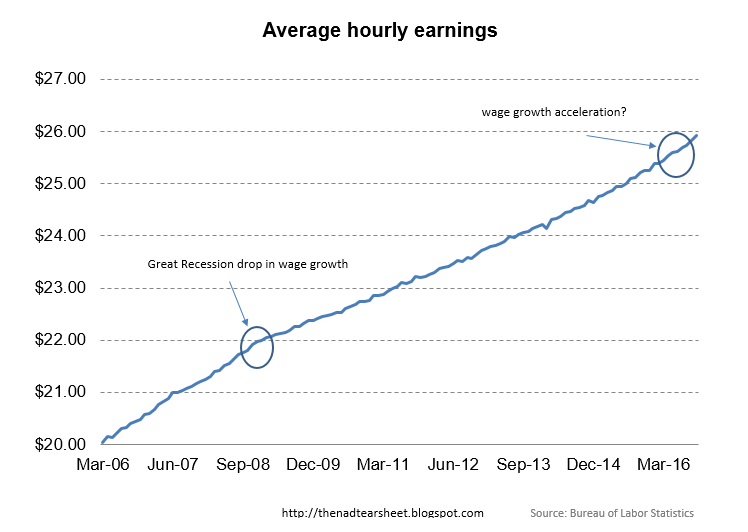
The payroll data was disappointing, as was the decrease in the labor force participation rate. The plus side was wage growth, where wages rose at a 2.8% annual rate, the biggest increase since 2009. The employment to population ratio slipped to 59.7%. Basically, it looks like the number of unemployed fell, however they didn't get jobs - they exited the labor force. Below is a chart of average hourly earnings. You can see the slope of the line decrease in 2008 as the Great Recession began and wage growth slipped from its bubble year growth rate of 3.3% to 2%, where it largely stayed during the recovery. It appears like the slope of the line is beginning to increase, which solves a lot of problems in our economy. Too early to tell if it is a trend, though. Bottom line: This gives the Fed all the ammo they need to raise the Fed Funds rate next month. FWIW, the Fed Funds futures are now assigning a 80% chance of a 25 basis point hike next month. 


Ordinarily, this report would be bond bearish, however global sovereigns are rallying and pulling the 10 year along for the ride. 

Ex Dallas Fed Head Richard Fisher blames the rise of Donald Trump partially on Fed policy. The Fed's policy of driving interest rates to the floor and flooding the system with money to support asset prices is great news for people who own real estate and stocks, however for those that save it has been terrible: 

"Global monetary policy has "skewered the middle-income groups, the 'middle class,' adding to the angst that has sprung from their sense of an overbearing, intrusive central government....Small wonder that we have ended up at a political crossroad, with a choice for the presidency between a candidate who advocates having government distribute still more to ease the pain and another arguing to provide relief by changing gears entirely, though we know not how, when or where...My more acerbic friends on both sides of the aisle consider it a Hobson's choice," he said, referring to a situation where it seems there's free choice but in reality there's no good alternative. On the one hand, Republicans believe the other party's candidate is channeling Eva Peron, planning policies that will ultimately lead us down the Argentine path to economic ruin while basking in personal profit and glory. On the other, Democrats liken the Republican candidate to Caligula."

On the subject of QE, he is spot-on. QE and unconventional monetary policy has certainly increased inequality, and made life tough if you are a renter. Rental inflation is increasing at a 4% annual clip, and as we saw above, wages are well below that. QE has been great for the landlord, but not the tenant. I find it amazing that the Fed gets a free pass in the media and from the political class on the subject of inequality. 

For all the sturm and drang regarding how markets will react to a Trump presidency, bond traders appear to be relatively sanguine. Just like stocks have the VIX index which measures fear indirectly by tracking the price of options, bonds have an index too. And it is close to yearly lows. 

Wednesday, September 2, 2015

Morning Report - productivity and quantitative tightening

Vital Statistics:

S&P Futures  1937.3 21.4 1.12%
Eurostoxx Index 3208.2 19.5 0.61%
Oil (WTI) 45.27 -0.1 -0.31%
LIBOR 0.329 0.005 1.42%
US Dollar Index (DXY) 95.83 0.381 0.40%
10 Year Govt Bond Yield 2.18% 0.03%
Current Coupon Ginnie Mae TBA 104.1 -0.1
Current Coupon Fannie Mae TBA 103.7 -0.1
BankRate 30 Year Fixed Rate Mortgage 3.85

Stocks are higher this morning after Chinese markets rallied to almost unchanged after an early swoon. Bonds and MBS are down.

Mortgage Applications rose 11.3% last week as purchases rose 4.1% and refis rose 16.8%. The 30 year fixed rate mortgage was steady at 4.08%. While the bond market has been pretty volatile, TBAs have been much more steady, tending to fade the moves of the bond market. This means you might see a big drop in the 10 year yield, hope to lock at a great rate, only to find that rates are lower, but not as much as the big move in Treasuries would suggest. 

The ADP jobs report showed payrolls increasing by 190,000 jobs, which is less than forecast. July was revised lower as well. The Street is forecasting an increase of 218,000 in the official report on Friday.

After a couple big quarters, unit labor costs fell in the second quarter by 1.4%. This number tends to be volatile, as does productivity. The Fed pays close attention to these numbers. 

The ISM New York Index fell pretty dramatically in August, from 68.8 to 51.1. The 68.8 reading was unusually good, while the 51.1 reading was unusually bad. 

Factory orders rose 0.4% in July, lower than the 0.9% forecast. Ex-transportation, factory orders fell 0.6%. 

Productivity rebounded in the second quarter to an annualized rate of 3.3%. Overall, productivity growth has been in a downtrend for the past dozen years or so. This is one reason why wage inflation has been so hard to come by - productivity growth has been declining. Take a look at the chart below. You can see productivity flatlining around 2% in the 1980s, then a big acceleration in the 1990s as the personal computer goes from a glorified typewriter to an indispensible tool on everyone's desk. That continues into the early 00s as the internet helps business become more productive. Finally, you see the decline as the PC and Internet phenomenons become played out. While the mainstream media mocked Jeb Bush for talking up the importance of productivity, he was right. 


Is "quantitative tightening" the new buzzword? Not yet, but as central banks worldwide begin to let go of some of their reserves, it may become more common. For the past two decades, central banks (especially China) have been accumulating reserves as they manage their trade balances and their currencies. The net effect has been a bid under Treasuries and a release of money into the system. As China slows, this is reversing as they sell Treasuries to support their currency. When they sell Treasuries, they put pressure on US interest rates and the withdrawal of liquidity acts like a tightening. Punch line: this is the second-order effect of the global slowdown - you might see upward pressure on interest rates, a rising dollar, and a withdrawal of liquidity. This would compound the effect of any Fed tightening. Which means a bumpier road ahead as the Fed pursues normalization. This might explain why the Fed has chosen to not sell (and even to keep re-investing) its portfolio of Treasuries and MBS that it bought during QE.

As world markets recover from last week's bloodbath, the probability of as Sep rate hike is increasing.


Monday, February 11, 2013

Morning Report - The disparate impact.

Vital Statistics:

Last Change Percent
S&P Futures  1511.8 -0.6 -0.04%
Eurostoxx Index 2626.5 -3.8 -0.14%
Oil (WTI) 95.4 -0.3 -0.33%
LIBOR 0.293 0.001 0.38%
US Dollar Index (DXY) 80.4 0.151 0.19%
10 Year Govt Bond Yield 1.95% 0.00%
RPX Composite Real Estate Index 193.2 -0.1

Markets are flattish on no real news. Most of Asia was closed overnight for the lunar new year.  The G7 is expected to make a statement against competitive devaluation.  There is no economic data this morning, but many will be looking at tomorrow's retail sales report to get a gauge on how much consumers have been affected by the increase in taxes.  Bonds and MBS are flat.

The internal debate at the Fed concerns how to start extricating itself from the market. As QE winds down, the Fed wants to prevent the market from getting ahead of it and prematurely slowing down the economy. The fear is that the market will interpret the end of QE as a signal that the end of ZIRP is imminent. Since the Fed has given numerical targets for the end of ZIRP, this fear is probably overblown, but targets can be changed. That said, if you look at the float numbers, the Fed has effectively cornered the market in 10 to 20 year bonds. And they have the buying power to maintain it.  The exit may involve simply holding the paper and letting it mature.

HUD just made it easier to prove discrimination cases.  Under the disparate impact rule, statistical proof that your lending mix is different that the population as a whole means you are guilty of discrimination, no matter what your policy or intention is.  Period. Obviously this is a huge victory for affordable housing advocates. The Mortgage Bankers Association is unhappy. IMO, this whole debate of FICO explaining everything misses the point that collateral valuation volatility in some neighborhoods is higher than in others.  Since the borrower is effectively long a put (if the house drops below the loan amount, they can toss the keys to the bank), and the value of a put is a function of volatility, then that has to be priced in the loan. And if house prices are more volatile in Detroit, or Harrisburg, or Newark then loans there should cost more to reflect that.  Which means FICO is not the whole story, contrary to what housing advocates insist.

45 Democrats sent a letter calling on President Obama to permanently replace Acting FHFA Director Ed DeMarco with someone more "willing to implement all of Congress' directives to meet the critical challenges still facing our nation's housing finance markets."  This statement means willing to forgive principal on Freddie and Fannie loans. The mandate to put taxpayers first is at loggerheads with the desire to ease the financial burden on consumers.

Separately, the White House is considering more mortgage relief for homeowners through executive order. The plan would allow underwater homeowners who are current on their mortgage to refinance at today's rates, even if their loans are private label.

Friday, January 4, 2013

Morning Report - Jobs Day

Vital Statistics:

Last Change Percent
S&P Futures  1453.4 -0.2 -0.01%
Eurostoxx Index 2696.4 -4.8 -0.18%
Oil (WTI) 92.08 -0.8 -0.90%
LIBOR 0.305 0.000 0.00%
US Dollar Index (DXY) 80.84 0.460 0.57%
10 Year Govt Bond Yield 1.92% 0.01%
RPX Composite Real Estate Index 192.1 0.1

Markets are slightly higher after the economy added 155k jobs in December.  The unemployment rate came in at 7.8%, flat vs the revised upward Nov number.  The labor force participation rate was flat at 63.6%. Bonds and commodities have been getting hit since the release of the FOMC minutes yesterday, which indicated QE's days are numbered.  The 10-year yield has broken out of its 6 month trading range, and MBS are down about 1/4 of a point.

The minutes of the FOMC meeting revealed that the Fed will probably end QE some time this year. This has put pressure on Treasuries, as well as commodities like gold.  The Fed is predicting 2.3% - 3% GDP growth this year, which is above most other forecasts.  They debated whether to purchase Treasuries or MBS, noting that they haven't been getting the "spill-over effect" in MBS that they had hoped for by buying Treasuries.  They also said that they do not want to give the impression that they are setting monetary policy solely on two variables - the unemployment rate and the inflation rate.

The minutes explain why Treasuries refused to rally on the debt ceiling brinkmanship last year - the market knew the Fed was planning to end QE some time this year.  And the differing reactions of the stock and bond market is explained because stocks were paying attention to the machinations in Washington, while bonds were watching the Fed. So this was not the typical "bonds are right, stocks are wrong" dynamic you usually see.

Tim Geithner plans to leave the Administration by the end of the month, and won't stick around for the debt ceiling debate.  White House Chief of Staff Lack Lew is the favorite to replace him. Lew worked for Citi from '06-'08, but other than that has spent his career in government.  This will be the first non Wall Street / Fed Treasury secretary in a while, since the disastrous reigns of industry guys like the Paul (The Tin Man) O'Neill and John Snow in the Bush Administration.

The Fed examines why lending rates have not fallen in lockstep with QE in a new paper which asks why isn't the 30 year fixed rate mortgage at 2.6%.  It does try and provide some reasonable explanations, for example, it does cite the increase in G-fees.  It also cites (a) increased put-back risk, (b) the declining value of MSR's, and (c) higher origination costs due to increased regulatory scrutiny. That said, the academics tested the hypothesis that each of these individual items were driving the increased margins for lenders, but nothing was significant by itself. So they reject that hypothesis.  Since the t-stat is below 2, it doesn't count, I guess, so price-gouging must be the explanation, and not these other reasons, which are 100% controlled by the government.  Sigh.


Thursday, January 3, 2013

Morning Report - Money for Nothing

Vital Statistics:

Last Change Percent
S&P Futures  1455.0 -2.1 -0.14%
Eurostoxx Index 2690.8 -20.4 -0.75%
Oil (WTI) 92.82 -0.3 -0.32%
LIBOR 0.305 0.000 0.00%
US Dollar Index (DXY) 80.16 0.317 0.40%
10 Year Govt Bond Yield 1.84% 0.01%  
RPX Composite Real Estate Index 192 0.2  

Stock markets are giving back a little after yesterday's relief rally on the fiscal cliff deal.  Mortgage Applications fell 10.4% last week.  2013 forecasts are starting to trickle in from strategists - suffice it to say 1H13 looks rough, with the economy basically at stall speed.

There is quite a bit of economic data this morning.  ADP forecast that 215k private sector jobs were created in December.  Challenger and Gray reported that announced job cuts fell in December to 32,556. Initial Jobless Claims came in at 215k. The NY ISM came in at 54.3, indicating the outlook is barely positive.  Later this afternoon, we will get the minutes from the Dec FOMC meeting.

Corelogic reported that shadow inventory - properties that are seriously delinquent, in foreclosure, or are REO that are not listed for sale - fell 12% in October to 2.3 million units, representing 7 month's supply.  Almost half of the properties are delinquent and not foreclosed.  The real question is how much this inventory will depress prices.  Given that many of these units are in judicial states, the supply will be dripped out slowly. Also, if a home has been vacant for several years, it develops problems that make the repairs more than the property is worth.  So, while it is in inventory, it is probably worth very little and isn't competing with the homes that most normal homebuyers are focused on.

So now that we have the fiscal cliff uncertainty out of the way, the markets should continue to rally, right?  We, according to business leaders, no.  And since the deal does not reduce debt, we are in danger of a downgrade, according to Moody's. The debt ceiling also was a taste of what is to come, with 3 gating items in the near future - the debt ceiling, the continuing resolution, and the sequestration.  Obama has already laid a marker down saying that it can't be "all spending cuts."  Given that Republicans have already made the tax hike concession, they are likely to take a tough negotiating stance on these items. So it could get ugly.

How did Obama get Boehner on board for tax increases?  A simple warning.  Stop opposing higher taxes for top earners or I will dedicate my second term to blaming Republicans for the global recession. And, blame is one of Obama's many talents.

Latest investment outlook from Bill Gross - Money for Nothin' Writing Checks for Free.  The basic idea is that right now, the government is financing its deficit more or less for free.  Why?  Because the Fed is buying the treasuries (or at least 80%) through QE, and by statute, it gives its profit or losses back to the government.  So the government is basically (in a roundabout way) paying interest to itself. Bill goes on to point out that this has been done before, and it has always ended badly. In the long run, inflation will rear its ugly head.  Of course Paul Krugman would echo Keynes and say "in the long run, we are all dead."  Bill also makes the good Austrian point - that Krugman has no answer for - that the unintended consequences of QE include mal-investments that will sow the seeds for the next bust.  You can view this debate here.


Friday, November 2, 2012

Morning Report: QE Targeting

Vital Statistics:

Last Change Percent
S&P Futures  1428.8 5.6 0.39%
Eurostoxx Index 2554.3 20.4 0.81%
Oil (WTI) 86.74 -0.4 -0.40%
LIBOR 0.313 0.000 0.00%
US Dollar Index (DXY) 80.44 0.393 0.49%
10 Year Govt Bond Yield 1.76% 0.04%
RPX Composite Real Estate Index 194.1 -0.3

Futures are higher on the back of a better-than-expected October jobs report.  Bonds are MBS are down

Nonfarm payrolls increased 171k in Oct and the Sep number was revised ipward from 114k to 148k.  The unemployment rate ticked up to 7.9% from 7.8% as the labor force participation rate increased to 63.8%. Weekly hours and pay fell. The report pretty much confirms the labor market is on the mend, albeit slowly.

The Northeast continues to pick up the storm damage, although gasoline shortages are becoming a problem as the lack of power in NJ means that gasoline can't be pumped out of the large tanks into trucks. This will be an additional drag on the 4Q economic numbers as people stay home instead of shopping.

We have another glimpse of how long the Fed thinks QE should last - until the unemployment rate falls below 7.25%. Boston Fed President Eric Rosengren cautioned that this was a threshold, not a specific target. Rosengren is one of the most dovish Fed members, but does not have a vote at the moment.  He went further to say that if the unemployment rate falls to 6.5%, it is time to start moving away from ZIRP.

Colony Capital won an auction for 970 Fannie Mae foreclosed homes in Arizona, California, and Nevada. It is a complicated partnership agreement and Colony plans to rent out the properties. It looks like they paid close to BPO $176MM for a portfolio that was appraised at $157MM in Feb.  Since Feb, prices have shot up in Arizona.  Colony will get 20% of the rents as a management fee, and will take 10% of the profits up to $136MM, and then their take grows to 50%.  It looks like they only have to put up something like $34 million.  Fannie was unable to sell the Atlanta portfolio.

The MR will be spotty next week as I am traveling to the Left Coast.