A place where economics, financial markets, and real estate intersect.
Showing posts with label Hillary Clinton. Show all posts

Monday, November 7, 2016

Morning Report: Mortgage credit eases in October

Vital Statistics:

Last Change
S&P Futures  25109.8 30.0
Eurostoxx Index 333.4 4.0
Oil (WTI) 44.5 0.5
US dollar index 88.0 0.4
10 Year Govt Bond Yield 1.82%
Current Coupon Fannie Mae TBA 103
Current Coupon Ginnie Mae TBA 104
30 Year Fixed Rate Mortgage 3.61

Stocks are higher this morning after the FBI absolved Hillary Clinton of her email woes. Bonds and MBS are down. 

Tomorrow we will go to the polls to vote in our fearless leader. Here is a cheat sheet for how markets should react based on the consensus of strategists. Punch line: Trump is negative for stocks, and positive for bonds. Hillary is the opposite. The effect will be only short-term as well. That said, IMO the black swan event is a D sweep. 


Consumer spending increased in October, according to Gallup. A poll of consumers indicated that they spent on average $93 a day in October from $91 in September. 

Credit eased somewhat in October, according to the MBA's Mortgage Credit Availability Index. The jumbo end of the market drove the increase. Since the depths of the real estate bust, mortgage credit has increased tremendously, however compared to the bubble days it is extremely tight. 


The labor market improved in October, according to the Labor Market Conditions Index. It rose to 0.7 from -0.2 in September. The LMCI is a composite index of various leading and lagging labor market indices, so it shouldn't have much of an effect on markets. 

55+ housing had a strong 3rd quarter, according to the NAHB

Realtors have a huge influence of a borrower's lender decision, according to a new survey out of Freddie Mac. The biggest factors are ease of doing business, reputation and the strength of their relationship with the realtor. From the article: "Eighty-four percent of real estate professionals have a select group of lenders to which they generally refer their clients. Of these, 73 percent have 1-3 lenders in their network and 24 percent work with 4-6 lenders. More than three-quarters (76 percent) say their clients always or often use their recommended lender referrals. This figure climbs to 87 percent among those who sell more than 20 properties per year."

Monday, October 31, 2016

Morning Report: inflation remains below the Fed's target

Vital Statistics:

Last Change
S&P Futures  2126.3 2.5
Eurostoxx Index 339.5 -1.3
Oil (WTI) 48.2 -0.6
US dollar index 88.8 0.1
10 Year Govt Bond Yield 1.84%
Current Coupon Fannie Mae TBA 103
Current Coupon Ginnie Mae TBA 104
30 Year Fixed Rate Mortgage 3.62

Markets are up on earnings and merger mania. Bonds and MBS are down.

Personal Incomes rose 0.3% in September, which was a little below expectations. Consumer spending rose 0.5%, which was in line with expectations. Core PCE inflation - the number the Fed uses to measure inflation - rose 1.7% YOY, so we are still below the 2% target. 

The Chicago PMI Index fell to 50.6 from 54.3. 

The FBI re-opened the email investigation on Hillary late Friday night. Democrats are attacking Comey (who just went from hero to goat). This will take until mid-week to be fully reflected in the polls, and the pundits will be watching polls in VA and NC closely. 

IMO, regardless of who wins, gridlock will be the result, unless Democrats sweep. So more of the same. I don't see much of an effect happening in either interest rates or stock prices. The Fed is much more influential than who occupies the WH. 

Home prices are up 0.3% MOM and 5.3% YOY, according to Black Knight Financial Services. The index now stands at $266k, which is 0.7% below the 2006 peak of $268. The report has good state-by-state info, so check it out. 

Banks continue to hoard Treasuries, and are tightening credit to business. Deposit growth is outstripping loan demand, which is the biggest reason. As the US savings rate increases, consumer spending is affected. Part of this is demographics: The baby boom is retiring and will inevitably cut spending, while the Millennials have yet to make any real money and start spending. 


Friday, October 7, 2016

Morning Report: Decent jobs report

Vital Statistics:

Last Change
S&P Futures  2156.0 -1.0
Eurostoxx Index 340.7 -2.0
Oil (WTI) 50.2 -0.3
US dollar index 87.7 0.0
10 Year Govt Bond Yield 1.76%
Current Coupon Fannie Mae TBA 103.3
Current Coupon Ginnie Mae TBA 104.2
30 Year Fixed Rate Mortgage 3.54

Stocks are flat this morning after an ok jobs report. Bonds and MBS are down.

Jobs report data dump:
  • Nonfarm payrolls increased by 156,000 (August revised upward)
  • Unemployment rate 5%
  • Labor Force Participation Rate 62.9%
  • Average weekly earnings up 0.2% (2.6% annually)
  • Average weekly hours 34.4
Overall, a decent report, but nothing to write home about. The best news in the report was the increase in the participation rate as the labor force increased by about 440k while the number of employed increased by about 350k. The labor force participation rate looks like it may have bottomed, at least for now.

Global sovereign debt continues its sell-off, with the German Bund venturing back into positive yield territory. Overnight we had a flash crash in the British pound, which fell 6%. For currency traders, a 6% move is gargantuan. 

We will have a lot of Fed-speak today, with Stanley Fischer at 10:30, Loretta Mester at 12:45, Esther George at 3:00 pm and Lael Brainard at 4:00. 

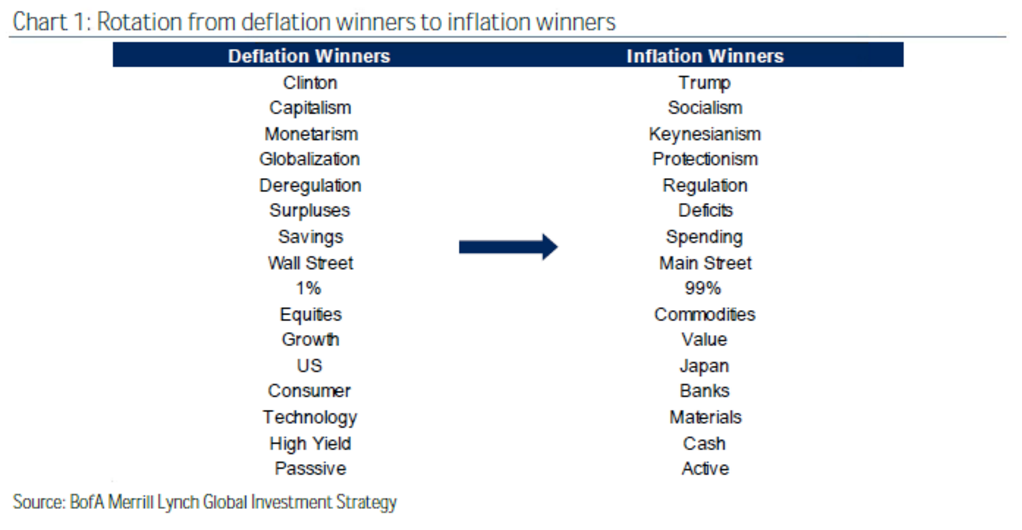
Bank of America is out with a report saying that the new populism and push-back against globalization represents a possible sea-change in asset pricing. The big picture is that we are moving from a "deflation" asset pricing environment to an inflation asset pricing environment. Corporate profitability will suffer as wages increase, regulation increases, and people push back against using globalization as a means of cost-cutting. Government attempts to goose the economy will transition from monetary stimulus to fiscal stimulus. Overall, bad for bonds, but probably good for real estate. 


Assuming Hillary wins, she may face the same nemesis her husband did early in his first term: bond market vigilantes. Every time Bill Clinton talked about stimulating the economy, bonds would sell off, which would offset any potential stimulative effect. Bob Woodward said that Bill Clinton's reaction to this dynamic as :"You mean to tell me that the success of my program and my reelection hinges on the Federal Reserve and a bunch of f*****g bond traders?" Clinton political adviser James Carville said at the time that “I used to think that if there was reincarnation, I wanted to come back as the president or the pope or as a .400 baseball hitter. But now I would like to come back as the bond market. You can intimidate everybody." 

Regardless of what this does to the refi market, it should positively affect the purchase market. Currently, the homeownership percentage for the Millennials is about 34%. That number should increase to above 40% as the Millennial age cohort hits homebuying age. The homeownership rate for the 35-45 age cohort has historically been 60%+. So there is a lot of pent-up demand for homes, which should keep the purchase business humming for many years to come. 


Tuesday, September 27, 2016

Morning Report: Home prices rise 5%

Vital Statistics:

Last Change
S&P Futures  2142.2 2.0
Eurostoxx Index 338.6 -1.0
Oil (WTI) 44.8 0.5
US dollar index 86.4 -0.2
10 Year Govt Bond Yield 1.56%
Current Coupon Fannie Mae TBA 103.3
Current Coupon Ginnie Mae TBA 104.2
30 Year Fixed Rate Mortgage 3.47

Markets are lower this morning on no real news. Bonds and MBS are up small.

Donald Trump and Hillary Clinton had their first debate last night. Early polls are showing Hillary won, however the debates went up against Monday Night Football, so the sample is going to skew female. Major media outlets are declaring the winner based on their ideological leanings: Bloomberg says Hillary won, and the WSJ says that Trump won. Did the debate change anyone's vote? We'll see, but my suspicion is that people's minds are more or less made up at this point. 

Global bonds have been rallying, but the US 10 year hasn't been following suit. The German Bund is now back at -15 basis points. Meanwhile, Blackrock is advising caution in Treasuries as the Fed starts hiking rates. Global central banks are selling Treasuries, which is putting pressure on yields. 

Tim Duy says December is a good bet for another tightening, but next year's voting members will skew more dovish than the current FOMC.

Home prices were flat month-over-month and are up 5% for the year, according to the Case-Shiller home price index. The real estate indices are beginning to show a slowdown in home price appreciation. Until we start seeing wage inflation, real estate prices will be stretched versus incomes. The labor market continues to send mixed signals


Tuesday, September 6, 2016

Morning Report: Jobs report disappointing

Vital Statistics:

Last Change
S&P Futures  2180.0 2.0
Eurostoxx Index 351.0 0.3
Oil (WTI) 44.2 -0.2
US dollar index 86.5 -0.2
10 Year Govt Bond Yield 1.59%
Current Coupon Fannie Mae TBA 103.3
Current Coupon Ginnie Mae TBA 104.2
30 Year Fixed Rate Mortgage 3.5

Markets are slightly higher this morning on no major news. Bonds and MBS are flat.

Jobs report data dump:

  • Nonfarm payrolls + 151k vs 175k expected
  • Unemployment rate 4.9% vs 4.8% expected
  • Labor force participation rate 62.8% flat
  • Average hourly earnings +0.1% vs. 0.2% expected
  • Average weekly hours 34.3 versus 34.5 expected
Overall, not a report that should move the needle for the Fed, especially with respect to the September meeting. Bonds initially rallied on the report, but sold off during the rest of the day. The key numbers (the disappointing hourly earnings and average weekly hours) point to the Fed standing pat in September.

The ISM Non-Manufacturing missed expectations by a country mile, falling to 51.4 versus expectations of 55. Growth is still positive (since the number is above 50), but growth took a big step back. 

The Labor Market Conditions Index slipped to -0.7 in August. 

Lack of construction workers are a drag on housing, according to Freddie Mac. About 30% of the construction workers from 10 years ago found jobs in other fields. There are about 200,000 unfilled construction jobs in the US at the moment, and the ratio of job openings to hiring is the highest since 2007. The number of open jobs has increased 81% over the past two years. 

Home prices rose 6% YOY in July, according to CoreLogic. Home price appreciation continues its torrid pace out West, while the Northeast and Midwest lag. We are beginning to see overvalued markets especially out west. Here is a map of the overvalued (red) and undervalued (green) markets:


Delinquencies ticked up in July, according to the Black Knight Financial Services Mortgage Monitor. Part of that was technical, with the month ending on a Sunday. Foreclosures and foreclosure inventory continue to work their way downwards.


What are the markets thinking about the Hillary versus Trump match up? While the US has some betting markets, the UK has a very liquid market in betting. You can track the markets here, at Sporting Index. The current markets are here:


The original bets pre-dated the conventions, so the payout is 25 if the person gets the party nomination and 50 if they win. Based on these markets the implied probability of the election is 72% Clinton, 28% Trump. FWIW, in the US-based PredictIt markets, Trump costs 37 cents and Hillary costs 64 cents... 

Wednesday, July 6, 2016

Morning Report: Bill Gross talks Monopoly

Vital Statistics:

Last Change Percent
S&P Futures  2069.8 -12.9 -0.62%
Eurostoxx Index 2756.5 -56.4 -2.00%
Oil (WTI) 46.06 -0.5 -1.16%
LIBOR 0.656 0.003 0.46%
US Dollar Index (DXY) 96.1 -0.066 -0.07%
10 Year Govt Bond Yield 1.36% -0.02%  
Current Coupon Ginnie Mae TBA 106.4
Current Coupon Fannie Mae TBA 105.8
BankRate 30 Year Fixed Rate Mortgage 3.39

Stocks are lower this morning as markets fret about the Italian banks and the Japanese 20 year bond went negative overnight. Bonds and MBS are up. The US 10-year hit 1.32% overnight and is trading at 1.36% at the moment. The German Bund now yields -18 basis points. 

The FOMC minutes from the June meeting will be released around 2:00 pm EST today. Brexit has pretty much made these pretty much irrelevant for July meeting which is in 3 weeks. Still, there is always the possibility that something surprising could come out of it, so just be aware. 

Mortgage applications rose 14.2% last week as purchases rose 4.3% and refis increased 20.8%. 

The June ISM services index jumped to 56.5 from 52.9 in May. 

Hillary Clinton will not face criminal charges over the email investigation. This should stick a fork in Bernie. 

Bill Gross compares the current state of the economy to the game of Monopoly. In the beginning of the game, you get $1,500 and begin buying properties (investing). You also get $200 for passing go. However, the game always ends in a credit crunch where your opponents go bankrupt. He then imagines the game where the amount you get for passing go increases as the game progresses. He likens the income from passing go as credit growth. If you look at credit growth over the past several years, it has been much less than the previous decades. His advice to Janet Yellen is to stop worrying about the Taylor rule and inflation and worry more about slow economic growth. While QE and negative interest rates should have helped create credit, they aren't really doing that, and the current economy is like the end of a monopoly game, where all the property has been bought, and conservation of cash becomes the name of the game. This is a recipe for stagnant growth. 


Bank of America is forecasting a 1.25% 10 year yield by the end of September as pension funds embrace the "lower for longer" thesis and build their holdings of Treasuries. Roughly 6% of pension fund assets are in Treasuries, about half the allocation they were in 1980. Of course Treasuries represented true value in 1980, and now they are simply a momentum trade. The 100 largest pension funds in the U.S. have a shortfall of $400 billion, which has doubled over the past year. Pension funds have been the biggest victims of ZIRP, as the actuarial tables couldn't care less that interest rates are zero. In fact, it makes their liabilities appear even worse because the rate used to discount them is lowered. 

Wednesday, June 1, 2016

Morning Report: Don't fear another real estate bubble

Vital Statistics:

Last Change Percent
S&P Futures  2088.0 -6.9 -0.33%
Eurostoxx Index 3031.4 -32.1 -1.05%
Oil (WTI) 48.5 -0.6 -1.22%
LIBOR 0.673 -0.001 -0.15%
US Dollar Index (DXY) 95.38 -0.510 -0.53%
10 Year Govt Bond Yield 1.81% -0.03%
Current Coupon Ginnie Mae TBA 105.6
Current Coupon Fannie Mae TBA 104.7
BankRate 30 Year Fixed Rate Mortgage 3.65

Markets are lower this morning on overseas weakness. Bonds and MBS are up.

Mortgage Applications fell 4.1% last week as purchases fell 4.7% and refis fell 3.9%. Refis ticked up to 54.3% of the total number of loans. 

The ISM Manufacturing report came in better than expected, indicating that the manufacturing economy is expanding, albeit modestly. The ISM services number is much more important, as manufacturing only represents 15% of the economy. It looks like the exporters are getting hit harder than those who mainly focus domestically. Employment was flat month-over-month, however it is in a contracting trend. 

Construction spending fell 1.8% month-over month, however the previous 0.3% print was revised upward to 1.5%. Residential construction fell 1.5% month-over-month, however it is up 8% YOY. 

As we saw from the FHFA House Price index, home prices have recouped their losses from the bubble years. Is it time to start worrying about a new housing bubble? Freddie Mac takes a look at real estate prices relative to incomes, credit scores, inventory, and leverage in the system and concludes that it is not yet time to worry. While house prices are indeed stretched relative to incomes, that figure ignores the effect of interest rates. The overall credit profile for new originations has been strong since the crisis, and while we are beginning to see some credit deterioration in the oil states, it is nothing like 2007-2008. Tight inventory remains a huge issue in terms of pricing, and notwithstanding last week's 617k print on new home sales, new construction is still well below historical levels. Consumers are increasing mortgage debt, however they seem to be using the cash-out refi to pay down credit card debt instead off funding consumption. The froth in the housing market still remains concentrated in the big coastal urban areas like San Francisco and Manhattan, which is driven by foreign demand. 

At the end of the day, bubbles are psychological phenomenons, where investors and lenders both believe an asset is "special" and cannot go down in price. We will probably never see another real estate bubble, but our grandkids might. If anything, the bubble is in sovereign debt, and people will wonder why investors chose to tie up their money for 10 years for negative returns. Purchasing a German Bund yielding 13 basis points over 10 years is in the same category as buying a new construction McMansion in Stockton CA circa 2006 or paying $76 a share for E Toys the day of its $20 IPO in 1999. 

Auto sales are coming in this morning, and it looks like they are coming in weaker than expected. 

Interesting editorial by Clintonite Doug Schoen who says Hillary might not be the Democratic Party nominee. There is talk in the Democratic party about a white knight candidate, like Joe Biden or John Kerry who could enter the race at the convention, and select someone like Elizabeth Warren to be VP. 

Monday, April 11, 2016

Morning Report: Home purchase sentiment the lowest in 18 months

Vital Statistics:

Last Change Percent
S&P Futures  2051.0 10.3 0.50%
Eurostoxx Index 2936.0 24.1 0.83%
Oil (WTI) 40.06 0.3 0.86%
LIBOR 0.631 0.002 0.32%
US Dollar Index (DXY) 93.99 -0.246 -0.26%
10 Year Govt Bond Yield 1.74% 0.03%
Current Coupon Ginnie Mae TBA 105.6
Current Coupon Fannie Mae TBA 105
BankRate 30 Year Fixed Rate Mortgage 3.63


Markets are higher this morning on no real news. Bonds and MBS are lower

No economic data today - in fact this week looks pretty data-light. We will get retail sales, inflation and industrial production data this week, but none of these should be market moving, unless inflation comes in way higher than expected. The Fed doesn't really pay too much attention to the CPI and PPI numbers.

Earnings season kicks off this week in the traditional way, with Alcoa reporting after the close. The first week is usually pretty slow, and dominated by the banks. JP Morgan and Citi report Wednesday and Friday, respectively. The banks are being squeezed by a flattening yield curve as the Fed is tightening while long-term rates are falling. This compresses net interest margins and cuts profits. The stock market has been hitting the financials lately, which you can see below with a relative performance graph of the S&P SPDRs versus the XLF financials ETF


Consumer home purchase sentiment is the lowest in 18 months, according to Fannie Mae. Pessimism over the economy is spilling over into the real estate market. They haven't been this pessimistic about the economy since March of 2014.


Want to hear something depressing? Check this out: Hillary's take on the banking industry...(feel free to ignore the commentator) She thinks lending discrimination is rampant in our industry, which is a preposterous assertion in the age of automated underwriting systems. The ironic thing is that if the government was on a mission to restrict credit to poor people, push mortgage origination to the biggest TBTF banks, and depress the economy, they would be doing exactly what they are doing. Worse, they don't even realize it.

Following on that theme, Wells just settled with the DOJ for $1.2 billion over errors in its FHA loans from 2001 to 2008. According to the settlement, Wells Fargo "admits, acknowledges, and accepts responsibility" for having from 2001 to 2008 falsely certified that many of its home loans qualified for Federal Housing Administration insurance. Wonder if Wells is going to follow JP Morgan in de-emphasizing FHA loans.

Friday, October 9, 2015

Morning Report: FOMC minutes confirm Fed is worried about the global economy

Vital Statistics:

Last Change Percent
S&P Futures  2010.8 4.2 0.21%
Eurostoxx Index 3265.5 40.6 1.26%
Oil (WTI) 50.18 0.8 1.52%
LIBOR 0.319 0.001 0.19%
US Dollar Index (DXY) 94.81 -0.509 -0.53%
10 Year Govt Bond Yield 2.12% 0.01%
Current Coupon Ginnie Mae TBA 104.8
Current Coupon Fannie Mae TBA 104.3
BankRate 30 Year Fixed Rate Mortgage 3.83

Markets are higher this morning as commodities continue to rebound. Bonds and MBS are down.

Import Prices fell 0.1% in September and are down almost 11% on a year-over-year basis. 

Wholesale inventories rose 0.1% in August, while wholesale sales fell 1%. Both numbers were worse than expectations. The increase in the inventory to sales ratio is a worrisome sign., You typically see the ratio build ahead of a cyclical recession. 


The FOMC minutes confirmed what everyone suspected - that international worries prompted the Fed to hold interest rates steady at the September FOMC meeting. Overall, the Committee seemed rather constructive on the US economy in general. The Fed Funds futures are currently handicapping a 10% probability of a hike at the October meeting and something like 40% in December. 

Note that while the Fed is sanguine on the US economy, economists are generally more cautious. A survey of strategists and economists puts the chance of a US recession at 15% over the next 12 months. It is important to note that the Fed's forecasts for economic growth have been consistently high since the Great Recession. 

Representative Kevin McCarthy withdrew his name from consideration for the next House speaker after allegations of an affair ended up on a Wikipedia page. This leaves current speaker John Boehner in charge for the time being. Interestingly, the Wikipedia edit emanated from the US government itself - someone in the Department of Homeland Security. After the Secret Service started distributing confidential information on Representative Chaffetz, it looks like the worker bees in the government are going directly after Republican politicians. It will be interesting to see if anyone in the Obama administration actually cares. 

Hillary's plan for the financial system. A surtax on banks with over $50 billion in assets, an increase in the statute of limitations for financial crimes, and toughening the Volcker rule regarding proprietary trading. 

Note that margin debt is falling on the stock exchanges. This could be a reaction to the turmoil in overseas markets. Generally speaking margin selling tends to exacerbate downward moves, so having less margin debt is actually a good thing. 

Monday, July 27, 2015

Morning Report: Fallout from low commodity prices

Vital Statistics:

Last Change Percent
S&P Futures  2065.1 -12.5 -0.60%
Eurostoxx Index 3541.3 -58.7 -1.63%
Oil (WTI) 47.34 -0.8 -1.66%
LIBOR 0.294 -0.002 -0.51%
US Dollar Index (DXY) 96.58 -0.668 -0.69%
10 Year Govt Bond Yield 2.22% -0.04%
Current Coupon Ginnie Mae TBA 104 0.0
Current Coupon Fannie Mae TBA 103.3 0.0
BankRate 30 Year Fixed Rate Mortgage 4.01

Markets are lower after Chinese stocks dropped 8% overnights. Bonds and MBS are up.

Durable goods orders came in at 3.4%, a good reading. Durable goods ex-transportation rose 0.8% versus the 0.5% estimate. Capital goods orders rose 0.9% while shipments fell. The Capital Goods number is used as a proxy for business capital investment - businesses look like they might be investing in capacity in the future, but so far they aren't. 

The biggest event this week will be the FOMC meeting on Tuesday and Wednesday. No one expects the Fed to raise rates at this meeting, since there is no press conference. The drop in commodity prices certainly gives the Fed room to hold off on raising rates. Some economists think the Fed might actually be closer to hitting its 2% inflation target than the consensus seems to be. The key is wage growth. And so far, it is nonexistent. 

Speaking of commodity prices, here are the states which have the most exposure to commodity prices. The top nine states on the map got at least 10 percent of their gross state product from energy, mining and agriculture last year: Wyoming, Alaska, North Dakota, West Virginia, Oklahoma, Texas, New Mexico, Louisiana and South Dakota. There is a massive spread between the states, with Wyoming getting 36% of its state domestic product from mining and agriculture, versus places like Connecticut, which gets 0.2% from mining and ag. We will get a read on Texas (almost 15%) tomorrow when homebuilder D.R. Horton reports tomorrow morning.

Overall, don't sweat the drop in commodity prices on the economy. While it does hurt earnings in the oil patch, most people are users of commodities and benefit from lower prices.

Hillary Clinton is going to push her plan to end "corporate short termism," by raising capital gains taxes. Not sure how that is going to help, but she has her story and she is sticking to it. She is going to review securities regulations in order to help companies defend against activist investors. Not sure what her corporate governance vision is (I am afraid to ask), but essentially her goal is to compel companies to shift the amount they plow into stock buybacks into "investment," whether that is capital expenditures or salaries. I hope this is just specious pablum for the Democratic party base - because it demonstrates a gross ignorance of how companies make decisions. Not only that, but government induced "investment" creates gluts which cause bad busts. Always has, always will. We are still digging out from the last glut (residential real estate). 

Friday, July 24, 2015

Morning Report: New Home Sales fall

Vital Statistics:

Last Change Percent
S&P Futures  2096.6 -1.9 -0.09%
Eurostoxx Index 3627.9 -6.8 -0.19%
Oil (WTI) 48.91 0.5 0.95%
LIBOR 0.293 -0.002 -0.54%
US Dollar Index (DXY) 97.52 0.403 0.41%
10 Year Govt Bond Yield 2.26% -0.01%
Current Coupon Ginnie Mae TBA 104 0.0
Current Coupon Fannie Mae TBA 103.3 0.1
BankRate 30 Year Fixed Rate Mortgage 4.14

Markets are flattish on no real news. Bonds and MBS are up.

Amazon.com reported good numbers last night and is now the biggest retailer in the US, by market cap, surpassing Wal Mart. Last year, Walmart made $16 billion on $485 billion in revenue. Amazon. com lost $130 million on $89 billion in revenue. 

New Home sales unexpectedly fell to 482k in June from a downward-revised 517k in May. Strange number given what we are seeing in housing starts / building permits, and numbers from the homebuilders. The median new home price fell 1.8% to $281,800. 

Hillary Clinton is bemoaning the "tyranny of short-termism" in Corporate America. She wants to hike capital gains taxes, play with the tax code regarding executive compensation, and rein in activist investors. I hope someone in her staff whispers in her ear to google the term "agency costs" and has her read up on Armand Hammer. I am guessing this is just red meat for the base. 

Sustainable Finance MBAs are having a rough go of it finding a job. Not surprising. Who wants a Social Justice Warrior managing their money? Maybe a union or a church. Not anyone who is concerned with, you know, actually making money. The business schools should be upfront about the job prospects for majors like these before students take on six figures worth of student loans. 

Tuesday, July 21, 2015

Morning Report - Liquidity squeezes ahead

Vital Statistics:

Last Change Percent
S&P Futures  2120.7 -1.2 -0.06%
Eurostoxx Index 3675.4 -11.2 -0.30%
Oil (WTI) 50.25 0.1 0.20%
LIBOR 0.292 0.005 1.66%
US Dollar Index (DXY) 97.88 -0.151 -0.15%
10 Year Govt Bond Yield 2.39% 0.02%
Current Coupon Ginnie Mae TBA 103.6 -0.2
Current Coupon Fannie Mae TBA 102.9 -0.2
BankRate 30 Year Fixed Rate Mortgage 4.16

Markets are lower this morning as earning pile in. Bonds and MBS are down small.

Dodd-Frank has severely neutered the market-making function of the banking system. When the Fed starts tightening and bonds sell off, the natural buyers of bonds (primary dealer banks) will no longer be able to dampen the moves by standing on the other side of the trade. The Fed is unconcerned about this, but we shall see what happens when rates start going up and the bond market starts falling faster than they are comfortable with. 

Incidentally, Hillary will probably be forced to support a financial transactions tax, which is a tax on market-making as well. Basically it would slap a  tax on every stock trade, currency trade, and bond trade. Narrowing bid / ask spreads and a 90% drop in commission rates has basically eliminated the market-making functions (NASDAQ market makers, the specialists on the NYSE floor, block trading at banks) in the stock market. Machines are all that is left, and even they are not in the market-stabilization business. The next crash, they are going to suspend trading until things stabilize and there will be nothing but GTC (good till cancelled) buy orders for people to sell to. Washington should be careful what it wishes for. 

As China's economy cools off, and the US dollar rallies, we have seen commodities get absolutely slammed. Oil has been cut in half over the past year. Gold is in free-fall. Natural Gas is down big. This will keep a lid on inflation, and allow the Fed to keep rates lower longer. 

Everyone knows that Chinese money has been behind the building boom in many large cities. This is actually driven by policy. Chinese investors who invest $500,000 and can prove that their investment created at least 10 jobs (not hard to do on a construction project) get permanent green cards. These are typically wealthy Chinese investors who are trying to get green cards for their kids and are not all that concerned about return on investment, which means dirt cheap financing for developers. Now, the government is thinking of making some changes. Obama would like these investors to put money in low-income housing, not luxury condos. Also, abuses in the program have led other to question it altogether. The program has bipartisan support so it probably isn't going anywhere, but when you use policy as an economic lever you invariably create dislocations and marginal projects that don't make economic sense. Something to watch. 

Thursday, April 23, 2015

Morning Report - Homebuilder earnings and new home sales disappoint

Vital Statistics:

Last Change Percent
S&P Futures  2095.2 -5.0 -0.24%
Eurostoxx Index 3682.6 -41.9 -1.13%
Oil (WTI) 56.64 0.5 0.85%
LIBOR 0.277 0.001 0.45%
US Dollar Index (DXY) 97.87 -0.060 -0.06%
10 Year Govt Bond Yield 1.96% -0.01%  
Current Coupon Ginnie Mae TBA 103.1 0.0
Current Coupon Fannie Mae TBA 102.2 0.1
BankRate 30 Year Fixed Rate Mortgage 3.77

Stocks are lower on overseas economic weakness. Bonds and MBS are flattish.

Initial Jobless Claims came in at 295, a little higher than expected. The Bloomberg Consumer Comfort index slipped to 45.4 from 46.6.

New Home Sales dropped to an annualized pace of 481k in March, from 543k in February. This was a big miss - the Street was at 515k. 

We heard from homebuilder D.R. Horton yesterday. They beat expectations, but the margin and revenue guidance was on the light side, so the stock was sold off. D.R. Horton is very exposed to Texas and has yet to see any evidence of an slowdown in that economy. Horton was encouraged by the demand and is seeing strong growth in its Express brand, which is targeted at the first time homebuyer. The downside is that the margins in Express are lower. 

Pulte reported this morning, and missed expectations. Revenues were light, however orders were up 6% and ASPs were up 2% to 323k. The company noted at strong start to the spring selling season, and characterized the housing recovery as "sustained but slow."

Interesting stuff on the state of part-time workers. US part-time employment is reaching historical norms and that indicates the slack in the labor market is going away. Interestingly they polled workers who put in 30 hours a week or less. Of those people, a third were happy with their hours or wanted to work less. Only 23% wanted a traditional 40 hour a week job. Of those working more than 30 hours, about a quarter wanted to work less. Punch line: as the slack is taken up, wages are going to have to go up. Which means the Fed is more likely to mover sooner rather than later. 

The Clinton Foundation is under the microscope right now, and the New York Times has a piece about how the State Department approved a Russian nuclear deal after a big donation to the Clinton Foundation. WaPo has a piece on the foundation and Bill Clinton's speaking fees. There is supposedly a tell-all book coming out on the Clinton Foundation as well. Whatever comes out of it, the Democratic Party is all-in on Hillary and will dismiss any revelations as partisan poo-flinging regardless of the merits. 


Wednesday, April 15, 2015

Morning Report - Hospital Thataway

Vital Statistics:

Last Change Percent
S&P Futures  2097.5 6.6 0.32%
Eurostoxx Index 3808.6 24.0 0.63%
Oil (WTI) 54.39 1.1 2.06%
LIBOR 0.275 -0.002 -0.61%
US Dollar Index (DXY) 99.16 0.429 0.43%
10 Year Govt Bond Yield 1.89% -0.01%
Current Coupon Ginnie Mae TBA 103.6 0.2
Current Coupon Fannie Mae TBA 102.5 0.2
BankRate 30 Year Fixed Rate Mortgage 3.79

Markets are higher this morning as ECB President Mario Draghi speaks and bank earnings continue to trickle in.

Mortgage Applications fell 2.3% last week. Purchases were down 3.1%, while refis were down 1.8%.

Some weaker economic data this morning: the Empire Manufacturing Index fell steeply in April, to -1.19 vs. 6.9 expected, while industrial production fell .6% and capacity utilization fell to 78.4%. Can't blame this on the weather - blame the dollar.  

Bank of America reported that mortgage originations increased 18% QOQ and 54% on a YOY basis. Between JPM, BAC, and WFC, it looks like the mortgage business is improving quite a bit. Maybe the long-awaited turn in the real estate sector is upon us. We will get more data tomorrow with housing starts and building permits. 


Hillary officially launched her campaign over the weekend, unveiling her new logo, which looks like "Hospital Thataway."  Suffice it to say, the H logo appears to be a bomb, and the interwebs are already making fun of it


Friday, April 10, 2015

Morning Report - GE exits financial services

Vital Statistics:

Last Change Percent
S&P Futures  2087.9 2.2 0.11%
Eurostoxx Index 3810.2 28.4 0.75%
Oil (WTI) 50.37 -0.4 -0.83%
LIBOR 0.271 -0.003 -0.93%
US Dollar Index (DXY) 99.58 0.422 0.43%
10 Year Govt Bond Yield 1.93% -0.03%
Current Coupon Ginnie Mae TBA 103 0.1
Current Coupon Fannie Mae TBA 102.5 0.2
BankRate 30 Year Fixed Rate Mortgage 3.75

Stocks are higher this mornings on no real news. Bonds and MBS are up.

Import prices fell .3% in March and are down 10.5% year over year. As we are seeing in the data elsewhere, the strong dollar is beginning to affect the economy. Q1 earnings will be interesting - how many multinationals will report weaker numbers due to weaker overseas demand. 

GE is ending its decades-long dalliance into financial services, by selling its lending business and real estate assets. GEFS basically has been a Old timers will remember when GE owned an investment bank - Kidder Peabody - which blew up in the 90s. Investors like the news - GE is up about 7% pre-open. 

Hillary Clinton announced she will announce her candidacy on Sunday, supposedly via Twitter. Are you ready?

Christine Lagarde of the IMF is warning that the financial markets could get bumpy when the Fed starts raising rates. Consider this: the Fed hiked rates in 94, 99, and 05. In the process, they blew up the MBS market (remember Orange County?), the stock market, and the real estate market. Asset prices are handicapping a 100% probability that the Fed can raise interest rates without any one blowing up. The Fed may in fact be able to stick the landing and exit ZIRP without a crisis, but that is not a foregone conclusion. The old market saw of "sell in May and go away" may turn out to be good advice this year.