A place where economics, financial markets, and real estate intersect.
Showing posts with label Tim Duy. Show all posts

Thursday, July 13, 2017

Morning Report: More Yellen testimony today

Vital Statistics:

Last Change
S&P Futures  2443.0 3.0
Eurostoxx Index 386.4 1.5
Oil (WTI) 45.5 0.0
US dollar index 87.9 -0.1
10 Year Govt Bond Yield 2.33%
Current Coupon Fannie Mae TBA 102.625
Current Coupon Ginnie Mae TBA 103.59
30 Year Fixed Rate Mortgage 4.03

Stocks are flattish as Janet Yellen begins her second day of testimony in front of Congress. Bonds and MBS are flat.

Initial Jobless Claims fell to 247k last week, showing that employers are hanging on to employees.

Inflation still remains in check at the wholesale level, as the producer price index rose only 0.1% in June. Ex-food and energy it rose 1.9% YOY, which is below the Fed's target. Services increased 0.3%, which could indicate wage growth is beginning to happen.

The markets rallied yesterday on Janet Yellen's dovish comments. Fed-Watcher Tim Duy believes the markets have it wrong. His view is that Yellen has spent enough time at the Fed to understand that the longer the Fed waits to address inflation, the more aggressive they will need to be, which increases the risk of a recession. He basically lays out four scenarios:
  • Inflation rebounds while unemployment remains steady, which is the base case Fed scenario
  • Inflation remains low while unemployment holds steady. This is the market's bet. 
  • Inflation rebounds while unemployment goes lower: This would mean a more aggressive Fed in 2018
  • Inflation remains low while unemployment goes lower: Difficult for the Fed.
His view is that we see one of the latter two scenarios. FWIW, I think the unemployment rate is a bit of a red herring given that the employment to population ratio is still pretty low. Granted, some of that is demographic (older Boomers retiring) and some of it is discouraged workers, but a 4.5% unemployment rate today doesn't really mean the same thing it meant, say, 20 years ago. I think the mistake people make is that they fail to recognize that recoveries after burst residential real estate bubbles are fundamentally different animals, characterized by low inflation, weak demand, and risk aversion in business. Weak demand and risk aversion are not recipes for inflation. I suspect the second or the fourth scenario is the most likely. IMO, we won't see inflation until we see wage growth, and that has been slow to materialize. 

Angel Oak Advisors priced a $210 million deal of non-prime residential mortgages recently, and it looks like the second quarter may break $1 billion in non-prime RMBS. This is a record since the financial crisis, but is still a shadow of its former self. At one point during the boom, 1/3 of all mortgages were alt-A or subprime. Even if we hit a record for the rest of the year, we probably won't even sniff 5%. In fact, many of the loans being put in these securitizations wouldn't have even been considered non-prime during the bubble years. These loans are non-QM, and mainly consist of two types of  borrowers: self-employed who don't have enough W2 income and borrowers with a credit event in the past who have large down payments. The borrowers in Angel Oak's portfolio are paying between 5% and 9%. 

Why do appraisals sometimes come in low?  Typically, the problem is in apples-to-oranges comps (i.e. not in the neighborhood, or comps that had an issue like asbestos, mold, etc). The other big issue surrounds things that have value, but tend to get short shrift with appraisers: things like a nice finished basement, a good view, nice appliances, etc. Raised ranch homes are often problematic, as the lower level gets completely excluded from the square footage, basically cutting your square footage in half. 

Thursday, March 2, 2017

Morning Report: Initial Jobless Claims lowest in 44 years

Vital Statistics:

Last Change
S&P Futures  2394.0 0.5
Eurostoxx Index 375.9 0.2
Oil (WTI) 53.0 -0.9
US dollar index 91.9
10 Year Govt Bond Yield 2.47%
Current Coupon Fannie Mae TBA 101.88
Current Coupon Ginnie Mae TBA 103.28
30 Year Fixed Rate Mortgage 4.09

Stocks are flat this morning on no real news. Bonds and MBS are down small after Fed dove Lael Brainard suggested rates should rise soon. 

The Fed funds futures are now assigning a 90% probability of a rate hike at the next FOMC meeting. It was only 30% or so just a few weeks ago. 

Fed watcher Tim Duy has a good piece on the Fed's balancing act and how it relates to November. He was in the "two hikes with an option for a third" camp and thinks the Fed will stand pat in March. He raises a good point on the December dot plot that freaked out bond investors: the most hawkish members that contributed to that plot are non-voters.  

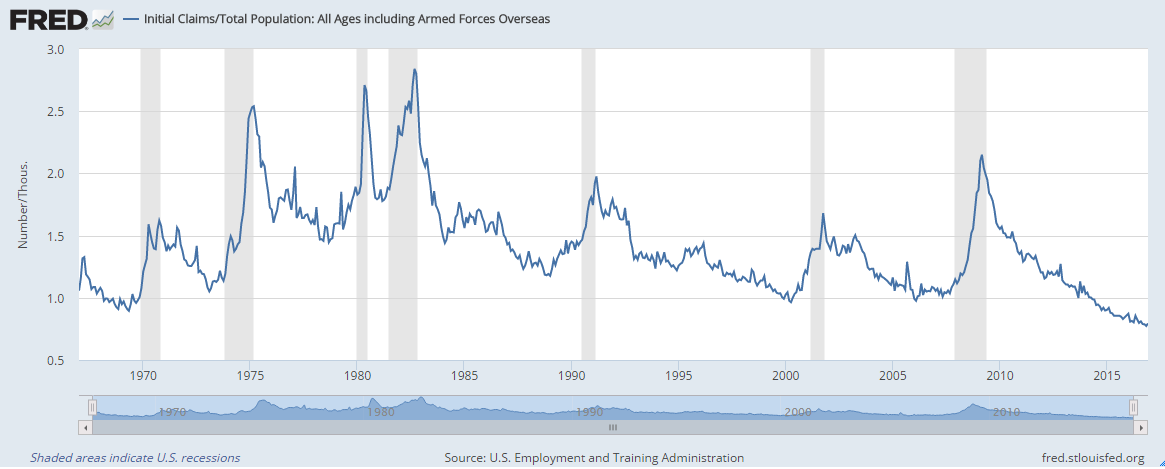
Initial Jobless Claims fell to 223k last week, which was the lowest level in 44 years. When you correct for population growth, we are in uncharted territory. 


Snapchat priced their IPO at $17 a share yesterday. The company sports a modest 21.4x sales multiple. 

Consumer Comfort improved last week, and is at the highest since early 2007.

Donald Trump seems to be settling in on picking Kevin Hassett from the American Enterprise Institute to lead his Council of Economic Advisors. Hassett is known for supporting a "New Deal" style program where the government provides jobs to the long term unemployed. His rationale is that the government gets some value in return, it makes the LT unemployed more attractive to private sector companies, and it probably reduces crime. 

While robotics have been displacing manual labor jobs for quite some time, artificial intelligence is replacing white collar jobs as well. In fact, the two professions that have been most insulated from the globalization wrecking ball (law and medicine) are ripe for machine learning and AI. Much of what I used to do as a trader 15 years ago is now completely done by algorithms. This is probably the single biggest reason why wage growth is so hard to find - the competitor to human labor only gets cheaper and better. 

As we approach tax season, it pays to look at some of the tax benefits of buying. In 2016, however several tax benefits expired, including the deduction for mortgage insurance, the tax free treatment for forgiven mortgage debt, and the tax break for "green" energy home improvements. The new administration and Congress are looking to simplify the tax code, which means ending some of the social engineering pieces like the green energy home improvements mentioned above. The gist is that tax rates will be lowered, however deductions will be eliminated, and the standard deduction will increase. The mortgage interest deduction, and the deduction for state and local taxes will have the biggest effects. 


Tuesday, September 15, 2015

Morning Report: The pro and con case for raising rates this week.

Vital Statistics:

Last Change Percent
S&P Futures  1945.1 1.1 0.06%
Eurostoxx Index 3183.9 8.3 0.26%
Oil (WTI) 44.46 0.5 1.05%
LIBOR 0.337 0.001 0.36%
US Dollar Index (DXY) 95.3 -0.010 -0.01%
10 Year Govt Bond Yield 2.19% 0.01%
Current Coupon Ginnie Mae TBA 104.2 -0.1
Current Coupon Fannie Mae TBA 103.6 -0.1
BankRate 30 Year Fixed Rate Mortgage 3.82

Stocks are up this morning as we await the big day Thursday. Bonds and MBS are down.

Retail Sales rose 0.2% in August, just missing the 0.3% Street estimate. The control group (which excludes volatile and price-sensitive goods like autos, gasoline and building supplies) rose 0.4%, which was better than the 0.3% Street estimate. August is the back-to-school month, so overall decent numbers, which bodes well for the holiday shopping season. Big retailers like Amazon.com and Wal Mart are up pre-open. 

Industrial Production fell in August by 0.4%, which was lower than the -0.2% estimate. Capacity Utilization fell to 77.6% from 77.8%. Separately, the Empire Manufacturing Survey (which measures manufacturing activity in New York State) was highly negative at -14.7. The strong dollar is taking a bite out of manufacturing activity. 

Business inventories and sales rose 0.1%. The inventory-to-sales ratio held steady at 1.36x. The inventory / sales ratio has been ticking up recently, which is a worrisome sign, at least for a cyclical recession. During recessions, it is not uncommon to see a big spike in this ratio. Historically, it has been much higher. You can see on the graph below the latest increase, and also the secular decline in the ratio that began in the mid-80s as manufacturing implemented just in time inventory management. 


Tim Duy, an influential Fed-watcher makes the case for not moving this week. His argument: With rates at the zero bound and market turmoil, the Fed has no margin for error since it is more or less out of ammo. Better to wait until the waters are calmer to make a move. FWIW, I tend to agree with those arguments, and I think the Fed is very wary of a 1937 scenario. Inflation is nowhere to be found and while there is a bubble in credit markets, widening credit spreads are acting as a tightening all by themselves (the Larry Summers argument). 

The argument for raising rates: - we have bubbles in the credit markets, and certainly in the pre-IPO market. Uber, which earns nothing, and has a market cap similar to Dow Chemical, is indicative of a craziness we haven't seen since the skyrocketing IPOs of eToys and Pets.com in the late 90s. Stocks are up 200% from the lows in 2009. His point is that we DO have inflation - but it is "too much money chasing too few assets," not "too much money chasing too few goods." Imagine if the Fed had raised rates in 2003 and the real estate bubble had popped in 2004. We still would have had a recession, but I seriously doubt the banking system would have collapsed the way it did in 2008. And the recession would have certainly been shorter and less severe than 2008 - 2009. His point: it is time to end the addiction to low interest rates. The economy is strong enough to take a Fed Funds rate of 50 basis points. This argument is highly, highly unpopular in policy circles, so it won't get any traction. The consensus in Washington (at least on the left, which runs things at the moment) was that policy had absolutely nothing to do with the bubble - it was 100% Wall Street Sharpies that did it, and "smart regulation" will prevent another one from happening.

Note that the one advocating for standing pat is a professor, and the one advocating moving is a trader. So they will look at the issue from two entirely different points of view. 

As credit spreads have widened, we have seen some jumbo securitizations pile up at the banks. This probably signals less aggressive jumbo pricing ahead. LOs - something to tell your borrowers, especially if they are thinking of floating right now. Even if the 10 year bond goes nowhere, jumbo rates could be heading up.