A place where economics, financial markets, and real estate intersect.
Showing posts with label Third Avenue. Show all posts

Wednesday, December 16, 2015

Morning Report: FOMC day

Vital Statistics:


LastChangePercent
S&P Futures 20559.20.48%
Eurostoxx Index327133.01.03%
Oil (WTI)36.77-0.58-1.76%
LIBOR0.4920.0061.13%
US Dollar Index (DXY)97.77-0.165-0.17%
10 Year Govt Bond Yield2.28%0.01%
Current Coupon Ginnie Mae TBA104.2
Current Coupon Fannie Mae TBA103.4
BankRate 30 Year Fixed Rate Mortgage3.93


Stocks are up this morning ahead of the FOMC meeting. The decision should be released around 2:00 EST. Given that this was the most telegraphed rate hike in history, I don't necessarily expect a lot of volatility around the decision, however the language in the statement could always spook the markets. The consensus seems to be a hike of 25 basis points and very dovish language.

Housing starts increased to 1,173 million last month and building permits increased to 1,29 million. The increase in housing starts was in both single-fam and multi-fam, while the increase in permits was mainly in multi-fam. We still continue to under-build which is just creating more pent-up demand. We are in the seasonally slow period for housing, so I wouldn't read too much into these numbers. 

Mortgage Applications fell 1.1% last week as purchases fell 2,8% and refis rose 1.4%.

The strong dollar is still wreaking havoc on the manufacturing sector. Industrial Production fell 0.6% last month and capacity utilization fell to 77% from 77.5%. Manufacturing Production was flat. 

As the Fed begins to remove support from the market, stock market strategists are wondering what will happen to the stock market. Are current market levels a function of the Fed's stimulus programs or are they supported by earnings and economic fundamentals? I can't see a gradual tightening cycle collapsing the market, but it will mean that further increases in the market will have to be driven by earnings and economics and you can't expect to see further multiple expansion. Dividends will become much more important. Here is a chart of the S&P 500 versus the Fed Funds rate over the past 45 years:  


Interest rate cycles are long. The bull market in Treasuries started in 1982 or so is probably over, unless the economy rolls over again. The previous bear market in Treasuries ran from the mid-50s through the early 80s. 

Note that the other central banks (especially Japan and Sweden) have tried to get off the zero bound, only to see rates fall back to 0% again. If that happens, then what? The Fed would have to raise its inflation target.

The story of Marty Whitman's Third Avenue downfall. A value investor who simply didn't fit with the current momentum-investor world. The current liquidity crunch in junk bonds is being attributed to Third Avenue's Focused Credit Fund, which just put up gates preventing investor withdrawals. Daily liquidity, they promised. 


Monday, December 14, 2015

Morning Report: Pain in the distressed credit market

Vital Statistics:


LastChangePercent
S&P Futures 1996-16.2-0.78%
Eurostoxx Index3141-63.0-1.73%
Oil (WTI)35.70.04-0.76%
LIBOR0.4920.0061.13%
US Dollar Index (DXY)97.77-0.165-0.17%
10 Year Govt Bond Yield2.17%0.04%
Current Coupon Ginnie Mae TBA104.4
Current Coupon Fannie Mae TBA103.4
BankRate 30 Year Fixed Rate Mortgage3.93

Markets are lower this morning as oil continues to fall and problems at a high yield mutual fund begin to spill over.

No economic data today. The markets will be focused on the Fed and the evolving situation in distressed debt markets.

Marty Whitman's Third Avenue Focused Credit Fund has suffered losses as the rout in high yield has reduced liquidity. Dodd-Frank has severely curtailed market-making operations at investment banks, and right now there are very few buyers of distressed credit as hedge funds face redemptions and investment banks cannot step in because of capital requirement. In fact, the regulators are considering additional steps to ensure a bank failure doesn't bring down the entire financial system, which means that investment banks will probably de-risk further, making them even less likely to act as market-makers. This will be an interesting first test of a financial crisis in the new Dodd-Frank world.

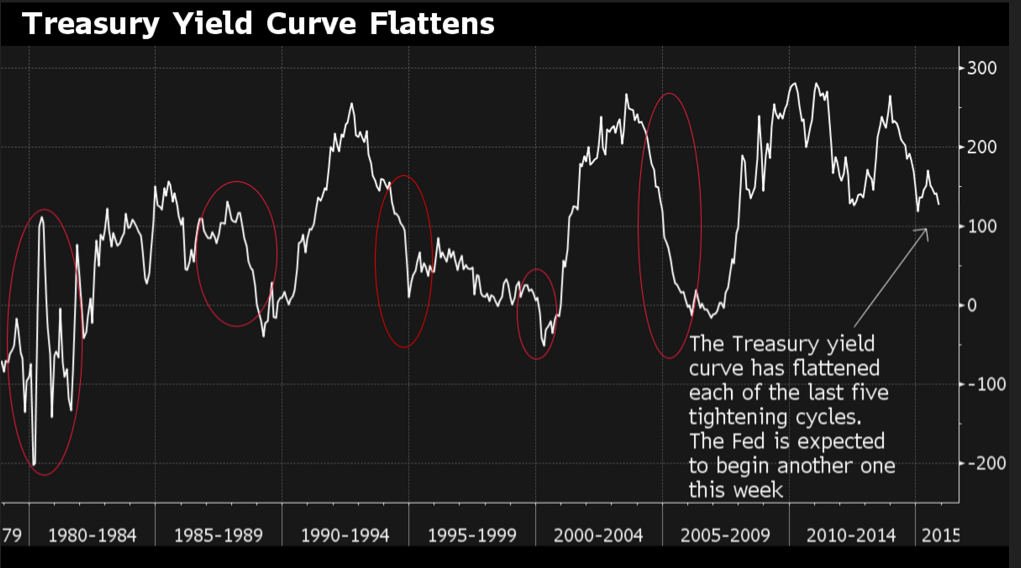
As a general rule, in credit crunches, the long bond rallies. You saw that on Friday, where the 10 year yield fell 10 basis points in spite of strong retail sales data. This week will be interesting between the evolving Third Avenue situation and the FOMC decision on Wednesday. LOs, expect bond market volatility this week.  As a general rule, tightenings have not had a dramatic effect on mortgage rates. In fact, the yield curve has flattened during all the tightening cycles since 1979. Granted, these tightenings have taken place in context of a secular bull market in bonds, so take this analysis with a grain of salt. That said, unless the economy really starts taking off (and you start seeing wage inflation), chances are that the 10 year yield increases less than the amount of the rate hike.  Note that CoreLogic is forecasting a 4.5% 30 year fixed rate mortgage by the end of 2016.


Mortgage loan performance has been improving, according to the OCC. Performing loans increased to 93.9% from 93% a year earlier. New foreclosures are down 22% YOY.

Ex GMAC Ally Financial is getting back in the mortgage business. Ally CEO said this about the move: “Don’t think of this as Ally going down the road of the old GMAC,” Brown said, referring to the home lending unit that brought Ally to the brink of collapse. The ironic thing is that the "new subprime" is auto loans, and that is Ally's bread and butter these days. They are offering 8 year loans for new cars at rates at rates substantially below the 30-year fixed rate mortgage (think 3.5% range). Given that new cars depreciate like sushi, this is a very, very mispriced loan. If you are wondering why the Fed wants to get off the zero bound even in the face of zero inflation, there you go. Those sort of rates are a function of ZIRP and the impossibility of earning a decent rate of return. It would be ironic if the ne-er do well of mortgages had simply morphed into the ne-er to well of auto lending and we see a collapse in asset backed security liquidity.