A place where economics, financial markets, and real estate intersect.

Tuesday, February 4, 2014

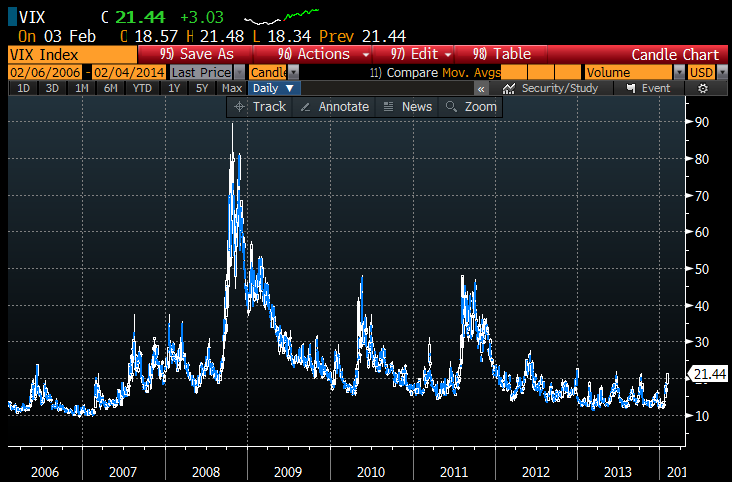
Morning Report - VIX is spiking again

Vital Statistics:

Last Change Percent
S&P Futures  1744.7 11.9 0.69%
Eurostoxx Index 2964.2 0.3 0.01%
Oil (WTI) 97.18 0.8 0.78%
LIBOR 0.236 0.001 0.36%
US Dollar Index (DXY) 81.11 0.103 0.13%
10 Year Govt Bond Yield 2.61% 0.04%  
Current Coupon Ginnie Mae TBA 106.1 -0.3
Current Coupon Fannie Mae TBA 105 -0.1
RPX Composite Real Estate Index 200.7 -0.2
BankRate 30 Year Fixed Rate Mortgage 4.25

They take 'em away, they give 'em back. Volatility is back. Markets are higher this morning after yesterday's bloodbath that sent the S&P 500 down 40 points. Overseas markets got slammed, particularly Japan, which is down 14.5% for the year already. Bonds and MBS are lower.

The VIX went out at 21.4. This is an indicator of financial pain and fear - as it rises, it should correlate positively with bonds - meaning if the VIX increases, rates will be falling. We are still nowhere near the spikes we saw in 2011 and 2010, let alone the late 2008 panic, but it is something to watch. The main thing to understand is that there are two forces acting on interest rates right now - 1) the Fed's ending of QE, which is pushing rates higher, and 2) the sell-off in worldwide markets, which is causing the flight to safety trade which pushes rates lower. I would stress to your borrowers that all bets are off right now with interest rates. You could float and you might get lucky if someone blows up, or this could all blow over and we could be looking at 4.75% mortgage rates before you know it. 

Speaking of interest rate bets, the largest mortgage REIT - American Capital Agency reported earnings yesterday. They had been deleveraging since last Spring, when they took their leverage ratio from 10x down to 7.2x. Last quarter they increased their exposure to the MBS market a tad, taking their leverage ratio up to 7.6x. The company had been seeing value in the MBS space. REITs are major players in the space and their activity influences mortgage rates, so their activity is something to watch. Given how much rates have fallen, this looks like a winning trade for them. That said, the sector is very much out of favor as the secular headwinds are going to be tough to manage. 

Part of the reason for yesterday's sell-off was an absolutely dismal ISM report. The ISM manufacturing report came in at 51.3, vs street expectations of 56. This shows a major deceleration in manufacturing in the month of January. Many reports - durable goods, for instance - showed a slowdown in December, which seems to have continued into the new year. Some of this could be weather-related, but investors are bracing for a lousy jobs report this Friday. Separately, construction spending rose .1% in January, which was better than expected. 

The fireworks should start tomorrow with the ADP employment report, which is all honesty has been a terrible predictor of the employment report lately. We have another potential winter storm affecting the area as well, so tomorrow could be sloppy in more ways than one.

Monday, February 3, 2014

Morning Report - spring selling season begins early

Vital Statistics:

Last Change Percent
S&P Futures  1776.5 -0.1 -0.01%
Eurostoxx Index 3003.0 -11.0 -0.36%
Oil (WTI) 97.79 0.3 0.31%
LIBOR 0.236 -0.001 -0.42%
US Dollar Index (DXY) 81.22 -0.088 -0.11%
10 Year Govt Bond Yield 2.67% 0.03%  
Current Coupon Ginnie Mae TBA 106 -0.1
Current Coupon Fannie Mae TBA 104.7 -0.1
RPX Composite Real Estate Index 200.7 -0.2
BankRate 30 Year Fixed Rate Mortgage 4.26

Markets are flat this morning on no real news. Bonds and MBS are down.

In spite of all the snow falling in the Northeast, the spring selling season more or less begins now. Last week, we heard from PulteGroup and D.R. Horton who both observed that traffic patterns were unusually strong in January, indicating the spring selling season has begun early. Regarding interest rates, both companies said the shock from higher rates appears to have worn off and buyers realize the low rates of a year ago aren't coming back. Both companies target the first time homebuyer who still remains absent from the market, although the move-up buyer appears to be doing well. 

Why is the first time homebuyer struggling? Student loan debt and a lousy job market are considerations. Also they are competing with professional investors for starter homes who are buying them to rent.

The Census Bureau reported that the homeownership rate fell to 65.2% at the end of the fourth quarter. The big excesses of the bubble years have been worked off.


Nonvoting San Francisco Fed Head John Williams said that the issues in the emerging markets aren't changing the Fed's forecast for the U.S. economy and that the FOMC doesn't "focus too much on the short-term developments in the markets." Take that to mean that emerging markets sell-offs aren't going to affect Fed tapering, at least as long as credit availability remains unaffected.

Friday, January 31, 2014

Morning Report - Fannie and Fred will continue the status quo for a while

Vital Statistics:

Last Change Percent
S&P Futures  1761.9 -19.3 -1.08%
Eurostoxx Index 2974.7 -52.6 -1.74%
Oil (WTI) 97.39 -0.8 -0.86%
LIBOR 0.237 -0.001 -0.42%
US Dollar Index (DXY) 81.23 0.140 0.17%
10 Year Govt Bond Yield 2.65% -0.04%
Current Coupon Ginnie Mae TBA 106 0.1
Current Coupon Fannie Mae TBA 104.7 0.2
RPX Composite Real Estate Index 200.7 -0.2
BankRate 30 Year Fixed Rate Mortgage 4.31

They're beating the tape with the ugly stick as emerging markets continue to get clobbered. Bonds and MBS are rallying, with the 10 year trading at 2.65%. 

We had some mixed earnings reports, with good news out of Google, a miss out of Mastercard, and a warning from Wal Mart.

Personal income came in flat in December (versus a .2% forecast), while personal spending rose .4%. The savings rate dipped to 3.9%. As I have said before - this is how recessions end. Spending increases and then wages increase. The PCE deflator came in in at 1.1%, showing inflation remains a non-problem. 

Squabbling among Senate Democrats probably means that nothing will get done about the GSEs this year. Left wing Democrats like Elizabeth Warren and Sherrod Brown will refuse to back any plan to re-organize the GSEs unless it guarantees affordable loans for most buyers. This means they want whatever entity that replaces Fannie and Fred to be more than simply a re-insurer of privately insured mortgages - they want to continue the social engineering role of the GSEs. Not all Democrats are onboard with this idea, let alone Republicans who rightly view government activism as a contributor to the housing bubble. The left would be more than happy to continue the status quo, with Mel Watt (a CRA guy) running the show, which is why Obama has shown little interest in changing anything. 


Thursday, January 30, 2014

Morning Report: Advance estimate for 4Q GDP is 3.2%

Vital Statistics:

Last Change Percent
S&P Futures  1780.7 9.5 0.54%
Eurostoxx Index 3010.3 -1.2 -0.04%
Oil (WTI) 97.75 0.4 0.40%
LIBOR 0.238 0.002 0.85%
US Dollar Index (DXY) 80.96 0.456 0.57%
10 Year Govt Bond Yield 2.71% 0.04%  
Current Coupon Ginnie Mae TBA 105.8 -0.1
Current Coupon Fannie Mae TBA 104.4 -0.2
RPX Composite Real Estate Index 200.7 -0.2
BankRate 30 Year Fixed Rate Mortgage 4.31

Markets are higher this morning after 4Q GDP came in at +3.2%, as forecast by the Street. Facebook is up big on good earnings. Bonds and MBS are still digesting the FOMC meeting and are lower

The advance estimate of fourth quarter GDP came in at +3.2%. Consumption rose 3.3%, which was below the 3.7% estimate. The Commerce Department estimates that the shutdown took .3% off of the number. Finally, the inventory build that drove the large (4.1%) third quarter number wasn't reversed in this reading.

The FOMC decided to reduce asset purchases by another $10 billion per month yesterday, which markets took in stride. The decision was unanimous, the first one the Bernank has had since 2011. Janet Yellen now takes the reins with more hawkish Committee. The Fed's balance sheet will continue to grow, just slower than it did last month. The Fed's balance sheet just passed 4 trillion (it was under 1 pre-crisis)


Pulte reported fourth quarter earnings, which beat expectations. Revenues were in line, but EPS beat by 12 cents. Gross margins expanded as the company raised prices - average selling prices jumped 13% to $325,000, while unit volume dropped by 4%. Orders are down 18%. The stock is up a buck (around 5%) pre-open.

December Pending Home Sales dropped dramatically (down 6.1% year-over-year and 8.7% month-over-month). The Street was forecasting a drop of .3%, so this was a big miss. November was revised down as well. This would comport with the big drop in mortgage applications we have seen.

Wednesday, January 29, 2014

Morning Report - What to watch for with the FOMC today

Vital Statistics:

S&P Futures  1775.5 -18.0 -1.02%
Eurostoxx Index 3010.7 -27.9 -0.92%
Oil (WTI) 96.97 -0.4 -0.45%
LIBOR 0.236 -0.001 -0.21%
US Dollar Index (DXY) 80.71 0.137 0.17%
10 Year Govt Bond Yield 2.72% -0.03%  
Current Coupon Ginnie Mae TBA 105.8 0.2
Current Coupon Fannie Mae TBA 104.5 0.3
RPX Composite Real Estate Index 200.7 -0.2
BankRate 30 Year Fixed Rate Mortgage 4.33

Markets are getting slammed this morning on weakness in Europe and emerging markets currencies. Bonds are rallying on the risk-off trade. We should hear from the Fed at 2:00.

The Street is predicting that the Fed will decrease asset purchases by 10 billion a month, equally split between MBS and Treasuries. I would be surprised if they mention the turmoil in emerging markets, and it probably won't affect their thinking regarding QE unless credit begins to tighten. I don't think anyone expected the Fed to stick the landing with regard to extricating themselves from the asset markets, so sell-offs like these should be expected. 

The WSJ has a good write-up on what to look for in the statement today. It also looks at the new voting members that will accompany Janet Yellen. If anything the Federal Reserve Board will become slightly more hawkish, especially with the addition of Philly Fed President (and my ex faculty adviser) Charles Plosser and Dallas Fed Head Richard Fisher.

I don't see emerging markets affecting the U.S economy all that much. That said, Canada's real estate bubble is bigger than ours and is ripe to burst. Most mortgages in Canada are guaranteed by the government or by the Ontario Teachers Fund, so it won't have the soft of fallout that 2008 had, but there could be still be some issues that could roil credit markets. Luckily for the Canadians, their government doesn't view housing as an vehicle for social engineering.

Mortgage Applications fell .2% last week, which was a holiday-shortened week. A short week + a 6 basis point drop in rates = a wash. Purchases increased while refis fell.

There were 41,000 completed foreclosures in December, according to CoreLogic. This is a decrease of 4% month-over-month and 14% year-over-year. Approximately 847,000 homes were in some stage of foreclosure as of the end of the year, versus 1.2 million a year ago. The foreclosure inventory remains the highest in the judicial states.


Tuesday, January 28, 2014

Morning Report - disappointing durable goods

Vital Statistics:

Last Change Percent
S&P Futures  1780.8 5.1 0.29%
Eurostoxx Index 3024.4 9.8 0.32%
Oil (WTI) 96.37 0.7 0.68%
LIBOR 0.236 0.000 0.00%
US Dollar Index (DXY) 80.52 -0.001 0.00%
10 Year Govt Bond Yield 2.75% 0.01%  
Current Coupon Ginnie Mae TBA 105.5 0.1
Current Coupon Fannie Mae TBA 104.3 0.0
RPX Composite Real Estate Index 200.7 -0.2
BankRate 30 Year Fixed Rate Mortgage 4.34

Stocks are higher this morning in spite of some weak economic data and disappointing sales out of Apple. Ford reported good numbers. Bonds and MBS are flat. Later on today we will get consumer confidence and Richmond Fed.

The FOMC starts its two day meeting today, which will be swan song for the Bernank.

Durable Goods orders came in at -4.3% vs. the Street expectation at +1.8%. This continues the trend we have seen of data suggesting a weak December. It is possibly weather-related, or tax related. Capital Goods orders were weaker than expected as well.

Continuing that trend, new home sales were weaker in December as well. New home sales fell to an annualized 414,000 pace in December from a downward-revised 445,000 pace in November. 

Case-Shiller rose 13.71% year-over-year although it reported its first month-over-month decline in prices. Most experts think the torrid pace of the last couple of years will not be repeated in 2014 as increasing prices and increasing rates take their toll.  Prices are back to mid 2004 levels.

Homebuilder D.R. Horton reported first quarter earnings that topped estimates. Orders increased 4% in Q1. Gross margins continue to expand as average sales prices jump 10%. It has been a tale of two markets as there is strong demand from the move-up buyer and the first time homebuyer struggles to get a foot on the first rung of the ladder. The stock is up a few percent pre-open. We will get a better read on the first time homebuyer later this week when PulteGroup reports.


Monday, January 27, 2014

Morning Report - Renting vs. Buying

Vital Statistics:

Last Change Percent
S&P Futures  1788.5 6.4 0.36%
Eurostoxx Index 3033.9 5.7 0.19%
Oil (WTI) 96.81 0.2 0.18%
LIBOR 0.236 0.001 0.32%
US Dollar Index (DXY) 80.53 0.076 0.09%
10 Year Govt Bond Yield 2.74% 0.03%  
Current Coupon Ginnie Mae TBA 105.6 -0.2
Current Coupon Fannie Mae TBA 104.4 -0.2
RPX Composite Real Estate Index 200.7 -0.2
BankRate 30 Year Fixed Rate Mortgage 4.33

Stocks are up following last week's late selloff. Emerging Markets have been getting beaten due to a potential default of a major Chinese Bank's bond issue. That accounts for some of the reason for the risk-off trade (stocks fall, bonds rise). Bonds and MBS are down.

This week promises to be eventful with the FOMC meeting on Tuesday and Wednesday as well as 4Q GDP on Friday. We will also get Pending Home Sales and Case-Shiller as well. The markets are handicapping another $10 billion / month reduction in asset purchases out of the Fed. Finally, we will hear from a couple of homebuilders - D.R. Horton and PulteGroup, which should give us hopefully a peek into how the spring selling season is shaping up, which unofficially kicks off next week.

What has been going on in emerging markets? Well, first there is a high yield bond issue from Industrial and Commercial Bank of China. This was intended to raise money for a coal miner that collapsed in 2012 and absconded with the money. ICBC will make good on investor's money. Second, we have had a couple currencies hit the wall - specifically the Argentina Peso and the Turkish Lira. These may not have the makings of a crisis, but you never know. IMO, this will not affect the Fed's thinking regarding tapering unless they see credit begin to become constrained in the U.S. However it is causing a small (and probably short-lived) rally in the bond market. LO's, any buyers on the fence that were balking at these high rates? Tell them the market just let them back in. Take advantage of it.

Speaking of talking to your potential buyers, here is a good chart to show them - a comparison of renting vs. buying. I charted the median monthly rent versus the expected monthly mortgage payment for the median house (assuming 20% down and the 30 year conforming rate that existed at the time). In spite of the increase in house prices and interest rates, the rent vs. buy decision is still heavily skewed towards buying. This should be shown to every first-time homebuyer. Check it out:


So far, the government has not changed the tax treatment for short sales and debt forgiveness. On January 1, the temporary tax reprieve for short sales and principal mods lapsed and now these events are treated as ordinary income. There doesn't seem to be much momentum to change it. Although with the FHFA home price index within 10% of its peak, it makes you wonder how many people are left who bought at the tippy top of the market.