A place where economics, financial markets, and real estate intersect.
Showing posts with label wage inflation. Show all posts

Monday, April 30, 2018

Morning Report: Personal Incomes and Spending increase

Vital Statistics:

Last Change
S&P futures 2679 7.6
Eurostoxx index 385.1 0.46
Oil (WTI) 67.48 -0.62
10 Year Government Bond Yield 2.96%
30 Year fixed rate mortgage 4.56%

Stocks are higher after a slew of new mergers were announced. Bonds and MBS are up small. 

We have a big week ahead with the FOMC meeting starting tomorrow and the jobs report on Friday. The Street isn't looking for any changes in interest rates at the May meeting, but will focus as usual on the language of the statement. For the jobs report, the expectation is 190k new payrolls and 2.7% annual wage inflation. 

Pending Home Sales were up marginally from February, but were still down on an annual basis, according to NAR's Pending Home Sales Index. Bad weather in the Northeast pushed down pending sales, however all parts of the country were down. Again, blame low inventory and falling affordability. 

Personal Incomes rose 0.3% in March, while personal spending rose 0.4%, in line with expectations. The PCE index was up 2% YOY and the core PCE index was up 1.9%. This is the Fed's preferred measure of inflation and it is right where they are targeting. Income growth was the weakest since last Fall, however. 

The big debate right now is whether there is any slack in the labor market. Anecdotal evidence abounds that companies are struggling to find qualified workers. However, Econ 101 says that we should be seeing higher wage inflation as a result and that isn't happening (at least not yet). Some theories are claiming this is a market failure and that employers are artificially holding down wages (which is then used as an argument for more government intervention in the labor market). I suspect the issue is that there are three big forces holding back wage growth. First, inflation is low - if companies cannot pass along price increases to their customers, they aren't going to be raising wages. Second, lower wage jobs are competing with technology which is only getting better and cheaper. And finally, the long-term unemployed represent a reservoir of slack that companies know they can tap if needed. FWIW, I think the first and third explanations explain it, and find the idea that employers are somehow colluding to keep wages low to be wholly unconvincing. Take a look at the chart below, which shows wage increases versus inflation. You are seeing actual wage growth.


For now it looks like the 3% level in the 10 year has held. What drove the sell-off - it wasn't like there was anything data-wise to support it. JP Morgan blames CTAs using momentum strategies to short the 10-year. Chinese selling has also been rumored to be a factor. We won't be able to confirm or deny that theory for a couple of months. CTA funds have been net short Treasuries since September, however a momentum signal in mid-April caused people to pile into the trade and that apparently drove the late month sell-off. 

Steve Mnuchin is "cautiously optimistic" on trade talks with China. The subject will include intellectual property and joint ventures. 

Defect risk decreased on a MOM basis but was up on a YOY basis, according to the First American Loan Defect Index. The biggest risk was in the sand states, while the lowest risk was in the Rust Belt. 


Friday, July 21, 2017

Morning Report: Wages increasing at the low end of the scale

Vital Statistics:

Last Change
S&P Futures  2470.8 -0.8
Eurostoxx Index 382.4 -1.6
Oil (WTI) 46.6 -0.4
US dollar index 86.7 0.2
10 Year Govt Bond Yield 2.25%
Current Coupon Fannie Mae TBA 103.31
Current Coupon Ginnie Mae TBA 104.375
30 Year Fixed Rate Mortgage 3.96

Stocks are flat this morning on another Summer Friday. Bonds and MBS are flat. 

Should be a dull day as much of the mortgage business is at the Western Secondary conference, there is no data or Fed-Speak, and the rest of the Street will be on the LIE by noon. 

What states still have the highest foreclosure issues? New Jersey is the worst, with 1% of all homes in some state of foreclosure. They are followed by DE. MD, IL, CT, NV, FL, SC, OH, and NM. Note there isn't a lot of overlap between these areas and the best places to start a business

Republicans in Congress plan to use the Congressional Review Act to overturn the Obama-era CFPB ruling that eliminates mandatory arbitration. The left wanted to overturn mandatory arbitration in order to make it easier to use class-action lawsuits to attack what it considers bad corporate behavior. The right worries that it will restrict credit, and amount to nothing more than a sop to the trial lawyers lobby. 

Are we beginning to see the stirrings of wage inflation" Certainly at the low end of the wage scale we are. We are also starting to see wage inflation at the high end, where there are shortages of skilled labor. The middle is still lumbering along at 2.5% wage growth or so - better than inflation, but not all that satisfying. Especially since rental costs are outpacing inflation due to tightness in the real estate market. I have said this before: getting housing starts up fixed two major problems: lack of middle class jobs and a tight real estate market. Both would go a long way towards making the economy feel better. 

Further to the above, Axios has a cool moving graph that demonstrates the malaise in the jobs market over the past decade. It plots the number of jobs on the vertical axis and wages on the horizontal axis. You can see in some professions where both the number and the wages have been falling. 

Monday, May 22, 2017

Morning Report: Why aren't we seeing wage growth?

Vital Statistics:

Last Change
S&P Futures  2382.3 0.8
Eurostoxx Index 391.4 -0.1
Oil (WTI) 51.0 0.6
US dollar index 88.6 -0.1
10 Year Govt Bond Yield 2.25%
Current Coupon Fannie Mae TBA 103.27
Current Coupon Ginnie Mae TBA 104.21
30 Year Fixed Rate Mortgage 3.94

Stocks are flat this morning on no real news. Bonds and MBS are down small. 

Economic activity picked up in April, according to the Chicago Fed National Activity Index. It rose to .49 (better than expectations) and the 3 month moving average rose to .23. Production and employment led the rise, while personal consumption and housing were negative. 

We have some Fed-speak at 10:00 EST today along with a bunch after the close. The biggest events this week should be the FOMC minutes on Wednesday and the second revision to Q1 GDP on Friday. We will also get a lot of housing data this week. 

One of the biggest issues for the Fed is wage inflation (or the lack thereof). The last time unemployment was this low, we were experiencing 4% wage growth. Why aren't we now? Here are a few explanations. They revolve around a few different theories. The first is that there has been a structural change in labor economics, and that the tradeoff between unemployment and inflation is over due to globalization, lack of union representation, etc. The second explanation is that wage negotiation dynamics have been colored by the economy since 2008: employers are training people internally instead of hiring outside at a higher price, employees don't feel comfortable asking for more, productivity is lousy, and the huge reservoir of the long-term unemployed means the market is not as tight as it may appear. The final one is a measurement problem: that the BLS numbers aren't accurately reflecting the reality of the marketplace. Take construction: Builders constantly complain that they can't find skilled labor, that they are offering signing bonuses, etc yet when you look at the actual BLS numbers, construction wages are only growing 2.1%. We are seeing in the mortgage business with ops folks as well. So maybe we are starting to see pockets of wage growth, however it isn't showing up quite yet in the rest of the economy or the numbers. 

The drop in construction spending hasn't only been in housing - it has also been in schools. State and local governments are spending about 1/3 less on school construction than they did before the crisis, yet enrollment is up 4%. This is just another problem for the first time homebuyer - finding affordable homes with good schools. 

NAR is predicting 5.6 million home sales in 2017, up 200k from last year, and new home sales of 620k, up from 560k last year. GDP will grow at 2.2% and inflation will remain tame. Sales would be higher if there was more inventory, and the group hopes that regulatory changes, especially with Dodd-Frank will ease up credit for smaller banks, who fund local homebuilders. 

Now that the REO-to-rental trade is largely played out, Wall Street is now building houses for rentals. Some are planned communities, where renters get the benefit of living in a single family detached homes, plus they get some of the advantages of apartment living, with gyms and common spaces. They also don't have to deal with maintenance.  Interestingly, many people intend to rent for only a short time period, but end up staying. For one landlord, 1/3 of the tenants have been on month-to-month arrangements for 7 years. The REITs behind this trade also get discounts from builders, lower maintenance costs, and about a 5% - 8% pickup in rental income for a new house. 

Friday, November 4, 2016

Morning Report: Decent jobs report

Vital Statistics:

Last Change
S&P Futures  2085.7 2.0
Eurostoxx Index 328.9 -2.6
Oil (WTI) 44.1 -0.6
US dollar index 87.7 0.0
10 Year Govt Bond Yield 1.79%
Current Coupon Fannie Mae TBA 103
Current Coupon Ginnie Mae TBA 104
30 Year Fixed Rate Mortgage 3.61

Stocks are higher after a decent jobs report. Bonds and MBS are up as well.

Jobs report data dump:
  • Payrolls increased by 161,000
  • Unemployment rate 4.9% 
  • Labor Force Participation rate 62.8%
  • Average hourly earnings 0.4%
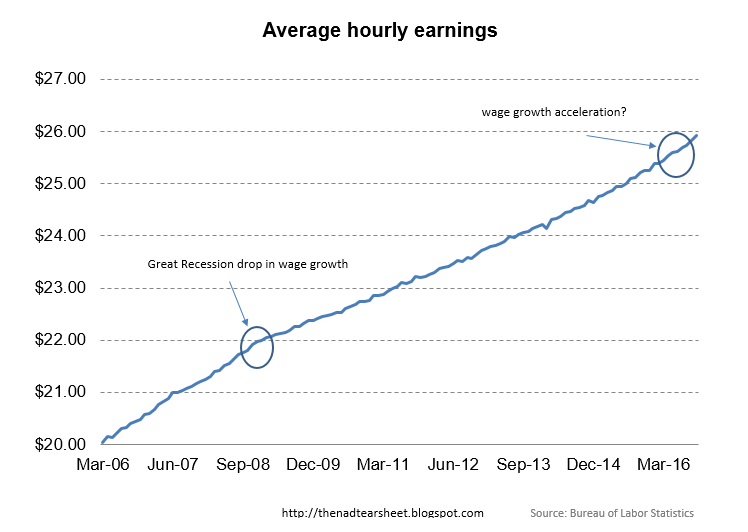
The payroll data was disappointing, as was the decrease in the labor force participation rate. The plus side was wage growth, where wages rose at a 2.8% annual rate, the biggest increase since 2009. The employment to population ratio slipped to 59.7%. Basically, it looks like the number of unemployed fell, however they didn't get jobs - they exited the labor force. Below is a chart of average hourly earnings. You can see the slope of the line decrease in 2008 as the Great Recession began and wage growth slipped from its bubble year growth rate of 3.3% to 2%, where it largely stayed during the recovery. It appears like the slope of the line is beginning to increase, which solves a lot of problems in our economy. Too early to tell if it is a trend, though. Bottom line: This gives the Fed all the ammo they need to raise the Fed Funds rate next month. FWIW, the Fed Funds futures are now assigning a 80% chance of a 25 basis point hike next month. 


Ordinarily, this report would be bond bearish, however global sovereigns are rallying and pulling the 10 year along for the ride. 

Ex Dallas Fed Head Richard Fisher blames the rise of Donald Trump partially on Fed policy. The Fed's policy of driving interest rates to the floor and flooding the system with money to support asset prices is great news for people who own real estate and stocks, however for those that save it has been terrible: 

"Global monetary policy has "skewered the middle-income groups, the 'middle class,' adding to the angst that has sprung from their sense of an overbearing, intrusive central government....Small wonder that we have ended up at a political crossroad, with a choice for the presidency between a candidate who advocates having government distribute still more to ease the pain and another arguing to provide relief by changing gears entirely, though we know not how, when or where...My more acerbic friends on both sides of the aisle consider it a Hobson's choice," he said, referring to a situation where it seems there's free choice but in reality there's no good alternative. On the one hand, Republicans believe the other party's candidate is channeling Eva Peron, planning policies that will ultimately lead us down the Argentine path to economic ruin while basking in personal profit and glory. On the other, Democrats liken the Republican candidate to Caligula."

On the subject of QE, he is spot-on. QE and unconventional monetary policy has certainly increased inequality, and made life tough if you are a renter. Rental inflation is increasing at a 4% annual clip, and as we saw above, wages are well below that. QE has been great for the landlord, but not the tenant. I find it amazing that the Fed gets a free pass in the media and from the political class on the subject of inequality. 

For all the sturm and drang regarding how markets will react to a Trump presidency, bond traders appear to be relatively sanguine. Just like stocks have the VIX index which measures fear indirectly by tracking the price of options, bonds have an index too. And it is close to yearly lows. 

Thursday, September 8, 2016

Morning Report: Consumers getting more constructive on the economy

Vital Statistics:

Last Change
S&P Futures  2186.5 2.0
Eurostoxx Index 350.5 1.0
Oil (WTI) 46.4 0.9
US dollar index 85.7 -0.1
10 Year Govt Bond Yield 1.54%
Current Coupon Fannie Mae TBA 103.3
Current Coupon Ginnie Mae TBA 104.2
30 Year Fixed Rate Mortgage 3.52

Stocks are higher after the ECB left rates unchanged. Bonds and MBS are flat.

Initial Jobless Claims came in at 259k, We have been below 300k (an important level) for 80 weeks now. 

Consumer comfort increased to 44 last week, according to Bloomberg.

Wage inflation is evident only in certain pockets of the labor economy - tech workers, engineers, construction, and remains flattish in the less skilled sectors. Elsewhere, hours are being cut and we are seeing full-timers being relegated to part-time. Until we start seeing broad-based wage inflation, the Fed is going to move slow. Note there is a disconnect between the Fed heads and what the markets are saying regarding near-term rate hikes. The markets aren't buying the hawkish language. 

Consumers are getting somewhat more constructive on the economy, according to Fannie Mae. The number of people who think the economy is on the right track improved to 38% and the number of people who think the economy is on the wrong track fell to 52%. Given the weak data recently that could be a temporary blip.